MASTER THESIS BY TOM DE LANGE
05 FEBRUARY 2015
UNIVERSITY OF TWENTE
GENERAL INFORMATION
STUDENT
Name Tom de Lange
SUPERVISORY COMMITTEE
Internal supervisor faculty MB: Dr. Ir. Ton A.M. Spil
MANAGEMENT SUMMARY
This research focused on the issue of IS/IT integration within M&As by taking a holistic perspective. Because IS/IT has such an important role within organizations nowadays, integration of IS/IT is considered to be crucial in M&As. The reason for initiating this research was the intended IS/IT integration of two manufacturing companies which are active in the same market.
After a first exploration of existing literature regarding the topic we found that this literature did not provide us with a method for a systematic approach towards an IS/IT integration strategy. Therefore, the main objective of this research became to combine and reuse existing knowledge about IS/IT integration in M&As such that the issue could be approached in a systematic manner. The research started with an exhaustive and systematic literature review. This literature review allowed us to identify important topics and concepts that play a role within IS/IT integration. Based on the results of this literature review we formed a framework which had the form of several steps in which each step considered one or more concepts.
Our framework starts with an analysis of the M&A context to identify the goals behind the M&A and the desired synergies. Furthermore, this analysis includes determining the M&A type, the desired organizational integration, and the level of desired IS/IT integration. In the next step the actual IS/IT contexts are the subject of analysis. This analysis should entail the IS/IT organizations and
corresponding cultures, the IT infrastructures and the IS landscapes. In the third step of our framework the possible integration methods and modes for the organizational structure, IT infrastructure, and IS landscape are investigated. The identified possibilities are then related to the objectives and expectation in liaison with top management to select the best option. Once this option is selected, the future IS/IT organization, IT infrastructure and IS landscape are designed in step 5 of our
framework. The final step of our framework is the design of a change plan, which outlines how to achieve the designed solution. Next to the theoretical concepts that were derived from existing literature, we also included the use of Enterprise Architecture modelling in our framework.
In the second part of this research the framework was applied to the two manufacturing companies. Using the framework we identified the similarities and differences between the two organizations. We found that the two companies were very similar in terms of IT infrastructure and business processes, but differed in terms of the application landscape and IS/IT organization structure. Based on our findings we proposed a take-over approach, which means that the application landscape of one of the companies will be transferred to the other company.
For this specific case we found the framework to be very useful and it helped us in systematically analysing the current situation and working towards a solution. Also the IS/IT managers and top management of the two organizations had the feeling that the used approach led to a well informed solution. The application of the framework led to a design of a solution and change plan which were both well received and will form the basis for the integration. Furthermore, the usage of Enterprise Architecture modelling proved to be very useful in the domain of M&As, because it allows an explicit representation of the solutions which is easy to understand by different stakeholders.
TABLE OF CONTENTS
General information ... i
Student ... i
Supervisory committee ... i
Management summary ... ii
Table of contents... iv
List of tables ... vi
List of figures ... vi
List of abbreviations ... vii
1. Introduction ... 1
1.1 Research topic ... 1
1.2 Problem context ... 2
1.3 Research problem and objectives ... 3
1.4 Research questions ... 3
1.5 Research methodology ... 4
1.6 Motivation for and application of the BPS methodology ... 5
1.7 Thesis structure ... 6
2. Problem definition ... 8
2.1 Intake ... 8
2.2 Orientation ... 8
2.3 Problem statement ... 9
2.4 Assignment ... 10
2.5 Project approach ... 10
2.5.1 Conceptual project design ... 10
2.5.2 Project outline ... 11
2.5.3 Data collecting ... 12
3. Analysis and diagnosis: literature review ... 13
3.1 Data collection methodology ... 13
3.1.1 Define ... 13
3.1.2 Search ... 14
3.1.3 Define ... 14
3.1.4 Analyze ... 15
3.2 IS versus IT ... 15
3.3 Mergers & acquisitions ... 16
3.3.1 Mergers vs acquisitions ... 16
3.3.2 Reasons for M&As ... 17
3.3.3 M&A types ... 18
3.3.4 M&As phases/lifecycle ... 20
3.3.5 Integration on different levels ... 20
3.4 IS/IT integration in M&As ... 21
3.4.1 IS/IT in the domain of M&As ... 21
3.4.2 Value of IS/IT integration in M&As ... 21
3.4.3 Role of IS/IT ... 21
3.4.4 Decision making and planning ... 22
3.4.5 Managing IS/IT integration ... 25
3.4.6 IS/IT integration objectives and modes ... 26
3.4.7 IS/IT integration levels and dimensions ... 27
3.4.8 IS integration levels and dimensions ... 29
3.4.9 IS/IT integration methods... 32
3.4.11 Important factors ... 35
4. Development of the framework ... 36
4.1 Step 0: Prepare for IS/IT integration ... 36
4.2 Step 1: Analyze M&A context ... 36
4.3 Step 2: Analyze IS/IT context ... 37
4.4 Step 3: Identify possible integration methods and modes ... 38
4.5 Step 4: Select best option by relating options to objectives and expectations ... 39
4.6 Step 5: Design future IS/IT ... 39
4.7 Step 6: Create change plan ... 40
4.8 Framework overview ... 40
4.9 Framework application ... 41
5. Analysis and diagnosis ... 42
5.1 Data collection techniques ... 42
5.2 Justification of the need ... 43
5.2.1 Strategic level perspective ... 43
5.2.2 IS/IT level perspective ... 44
5.2.3 Conclusion ... 44
5.3 M&A context ... 44
5.3.1 General background... 44
5.3.2 Preparations for the IS/IT integration ... 45
5.3.3 M&A type ... 45
5.3.4 Expected synergies and desired integration ... 45
5.3.5 IS/IT integration vision ... 46
5.4 Current IS/IT context of Company X ... 47
5.4.1 IS/IT organization ... 47
5.4.2 IT infrastructure ... 49
5.4.3 IS and data landscape ... 51
5.5 Current IS/IT context of Company Y ... 55
5.5.1 IS/IT organization ... 55
5.5.2 IT infrastructure ... 56
5.5.3 IS and data landscape ... 58
6. Plan of action ... 62
6.1 Solution design ... 62
6.1.1 Specifications ... 62
6.1.2 Possible solution directions ... 62
6.1.3 Choosing a solution direction ... 64
6.1.4 Solution design ... 64
6.2 Change plan design ... 71
6.2.1 Redesigned business system ... 71
6.2.2 Change process objectives ... 71
6.2.3 Delta analysis ... 71
6.2.4 Actions and change organization ... 72
6.2.5 Final stakeholder and resistance analysis ... 73
6.2.6 Intervention strategy ... 74
6.2.7 Communications plan ... 75
6.2.8 Summary ... 75
6.3 Solution justification ... 76
7. Evaluation ... 78
7.1 Project-oriented evalation ... 78
7.2 Learning for the future... 78
7.3 Scientific reflection ... 78
7.3.1 Contributions ... 78
7.3.3 Reliability ... 79
7.3.4 Validity ... 81
7.4 Personal and professional development ... 83
8. Conclusion ... 84
8.1 Research questions ... 84
8.2 Contributions ... 86
8.3 Limitations and future work ... 87
Appendices ... 88
Appendix A Literature overview ... 88
Appendix B Interview structure ... 91
Appendix C Process models ... 94
Appendix C1 Processes of Company X ... 94
Appendix C2 Processes of Company Y ... 94
Appendix D Focus group structure ... 95
References... 97
LIST OF TABLES
Table 1: M&A synergies (adapted from [2]) ... 18Table 2: Management fields linked to IS/IT integration dimension ... 25
Table 3: Ideal IS/IT configurations [4] ... 28
Table 4: Alaranta’s framework for post-merger integration of ERP systems [45] ... 30
Table 5: Alignment of M&A objective - IS/IT integration objective - IS/IT integration method [12] ... 34
Table 6: Merger strategies and corresponding models of change [4] ... 34
Table 7: Framework overview ... 41
Table 8: Framework steps related to thesis sections ... 41
Table 9: IS/IT configuration of Company X ... 48
Table 10: IS/IT configuration of Company Y ... 56
LIST OF FIGURES
Figure 1: Van Striens regulative cycle [24] ... 4Figure 2: Thesis chapters related to BPS methodology steps... 7
Figure 3: Cause and effect diagram of situation at Company X and Company Y ... 9
Figure 4: Conceptual project design (based on Van Aken et al. [22]) ... 11
Figure 5: Conceptual overview of methods and techniques for collecting data ... 12
Figure 6: Venn diagram of search results ... 14
Figure 7: Illustration of the computing environment [1] ... 16
Figure 8: Seven areas of practice within the computing environment [1] ... 16
Figure 9: FTC classification framework [31] ... 19
Figure 10: The four integration approaches of Haspeslagh and Jemison [28] ... 19
Figure 11: Strategic Alignment Model with alignment perspectives [35] ... 22
Figure 12: Effective IS/IT integration planning [38] ... 23
Figure 14: Possible IS/IT integration modes [5] ... 26
Figure 15: IS/IT culture conflicts [42]... 29
Figure 16: ERP integration model of Myers [15] ... 31
Figure 17: A process model of IS implementation [46] ... 31
Figure 18: Possible IS integration methods [2] ... 32
Figure 19: IT infrastructure of Company X ... 50
Figure 20: Overall process of Company X ... 52
Figure 21: IS landscape of Company X ... 54
Figure 22: IT infrastructure of Company Y ... 57
Figure 23: Overall process of Company Y ... 59
Figure 24: IS landscape of Company Y ... 61
Figure 25: Integrated IT infrastructure ... 66
Figure 26: Automation pyramid [59] ... 67
Figure 27: New IS landscape of Company Y ... 69
Figure 28: Sales overview (Company X) ... 94
LIST OF ABBREVIATIONS
BPMN – Business process modelling notation BPS – Business problem solving
CIO - Chief information officer EA – Enterprise architecture ERP – Enterprise resource planning IS – Information system(s)
IT – Information technology IS/IT – Combination of IS/IT M&A – Merger and acquisition MER – Main equipment room
MES - Manufacturing execution system PLC – Programmable logic unit
1.
INTRODUCTION
This first chapter discusses the problem context which forms the basis for this research project. Furthermore, this chapter contains a first exploration of the research topic and states the research questions and objectives of this research. Finally the overall research methodology which was used for this research will be discussed.
1.1
RESEARCH TOPIC
This study focuses on integration of information systems (IS) and information technology (IT) in mergers and acquisitions (M&As). The reason for this study is the intended integration of the IS/IT departments of two companies which are active in the same market. The two companies in question are both manufacturing companies and already part of the same holding for a few years, but are now about to study the options for integration. The integration of these IS/IT departments entails organizational integration as well as the more technical integration of IT and IS. The goal of this research is to derive a general (i.e. not specific to the Company X-Company Y merger case) framework that can be used as guideline when analysing and planning for such an integration. This framework will be structured using concepts and theories of previous research. Finally, the framework will be applied to the case of the two involved companies.
In this thesis the term IS/IT integration is used instead of IS integration or IT integration because both components are to be considered in the integration of the departments. Furthermore, there are several definitions of both IS and IT around and the terms are often used interchangeably [1]. According to Iyamu and Kekwaletswe [1] IS are the collection of systems through which business carry out their processes and logic. The IT component, which enables IS, is formed by technology artefacts such as hardware and software. The difference is that IT generally does not include business logic. For businesses the combination of IS and IT can help to achieve their goals and objectives [1]. We continue using the combined term IS/IT because we want to pay attention to both aspects: IT and IS. Furthermore, in the examined literature the terms are often used interchangeably, and it might lead to confusion if we keep switching between the two terms.
Integration of IS/IT of different organizational units has been the subject of several studies and can be viewed from different contexts such as inter-organizational or intra-organizational integration. The former refers to connecting to external parties such as customers, suppliers and collaborative
partners, whereas the latter refers to connecting internal business activities and functions together [2]. During the last years, the topic of IS/IT integration gained some attention in the context of mergers and acquisitions (M&As). However, the academic world has paid little attention to IS/IT integration compared to other corporate functions in M&As [3-5]. The overall success of M&As is often
determined by how successful the integration of the different companies is [6]. IT/IS integration is one of the tasks that must be conducted in the integration process and could generate several benefits in the context of M&As [3]. Several authors even argue that its role is critical for success [4, 6-8]. Or, conversely, many M&As fail to meet expectations because the companies stumble on IS integration [9].
In most of the recent literature on M&As, the concept of synergy is used to explain the reasons for M&As. Achieving synergy means that two organizational units can be run more efficiently and/or more effectively together than apart [10]. In the context of M&As possible synergies are mainly of organizational character [2, 10]. Therefore, when considering IS integration in M&As, an intra-organizational perspective seems useful [2].
proactive in two situations. The first is when IS/IT is a facilitator for operational and organizational integration. In this situation integration of IS/IT is required before integration of other operations is possible. The other situation is when acquiring the IS/IT of the other party is the underlying reason of the merger or acquisition. When IS/IT plays a proactive role the topic of IS/IT integration is introduced in earlier phases of the M&A [11].
For the actual IS/IT integration, different methods are mentioned in the literature. The naming of these methods differs within the literature, but four general approaches can be distinguished [12]. These four are (1) replacing all IS/IT with a completely new IS/IT landscape, (2) using the IS/IT of one of the parties of the merger for both of the parties, (3) combining the best of the IS/IT of both of the parties and (4) leaving IS/IT as is, but introducing some synchronization of redundant systems.
Compared to a few decades ago, IS/IT now plays a more pervasive and significant role in business processes [13] and thus occupies an important place in businesses, which makes integration of IS/IT more crucial in M&As [2, 14]. For example, in many large companies an ERP system is used to support and manage all operations. These systems are large and complex systems, and integration of
multiple of these systems is a complex and challenging project [15]. The increased importance of IS/IT within organizations emphasizes once more that IS/IT integration is an important topic.
1.2
PROBLEM CONTEXT
Company X is a manufacturing company which is located in the Netherlands since 1988. In 1994 Company X joined the Holding Z, the world market leader within the industry. Today, the Holding Z consists of more than 25 companies, all active in different parts of the production chain. Together, these companies cover the whole chain, which enables the Holding Z to come up with an integrated production chain. Besides Company X other manufacturing companies which produce similar products are part of the Holding Z. One of these companies is Company Y, which is closely located to Company X. Until 2011 Company Y was part of the Holding A. The takeover of the Holding A in 2011 made Company Y part of the Holding Z.
Company X and Company Y both existed a long time before joining the Holding Z and therefore have evolved separately. Because of this separate evolvement there are now many differences between the two companies. These differences exist in different aspects of the company such as company culture, workflows and information technology.
Company X and Company Y and want to explore the options for integrating their IS/IT departments. Currently, both Company X and Company Y have their own IS/IT department and IS/IT. Integration is expected to lead to cost reduction due to better deployment of resources and more and better information sharing. The idea of integration was already on the agenda of the companies, but is becoming a priority since the IT manager at Company Y is expected to retire in the coming years. The integration of IS/IT is expected to make a significant contribution to the integration of the two companies. The creation of synergy between the two IT departments does not solely involve changes
in technology, but also has a business focus.
From a technological perspective Company X and Company Y should look for a way to streamline their information technology. For example, at Company X the ERP software LOOP was developed to integrate all facets of Company X’s operations. LOOP is fully custom-built and is tailored to the processes of Company X. Company Y does not make use of LOOP at the moment, but uses different software products.
affects the personnel at the information technology departments, but possible changes in the application landscape and business processes might affect employees outside the information technology departments as well.
1.3
RESEARCH PROBLEM AND OBJECTIVES
Although there is a reasonable amount of literature available regarding IS/IT integration, there is almost no prescribing theory available for IS/IT integration [16]. Instead, previous studies have focused on exploring the phenomenon and analysing and describing historical IS/IT integrations in an M&A context. Toppenberg and Henningsson [16] found that none of the reviewed publications contained theory for design and action. A frequently mentioned reason for the lack of this type of theory - that says “how to do” something [17] - is that the actual integration strategy is highly contextual
dependent [18-20].
Although we agree with the argument that a large part of the strategy depends on the context, we also believe that developing a strategy can be done following a systematic approach. Theories and findings from previous studies can be used to identify the important areas on which the approach should focus. Thus, the approach should be based on existing theory. Such an approach should of course leave room for contextual influences.
We believe that taking more systematic approach can contribute to more deliberate decision making regarding the IS/IT integration strategy. There are many examples from practice in which the intended strategy is replaced with a new strategy because issues occur on a more tactical level [19, 21]. We believe that following a systematic approach - that pays attention to different levels of the IS/IT integration - should lower the risk of facing tactical issues at a later stage in the process.
The research problem however stems from a practical problem, which is the intended IS/IT integration of Company X and Company Y. The case of Company X and Company Y will be used to test the designed approach. The application of the approach is however not only meant for validation, but will serve as a means to provide a solution for the intended IS/IT integration of Company X and Company Y.
Up to this point we have used the term approach for the artefact that will be designed during this research. The term approach however might sound like a strict roadmap, which is not idea behind the artefact. Therefore, we prefer the term framework instead of approach, which is by definition more loose. With loose we do not mean less systematic, but leaving room for contextual
considerations. This way organizations can decide which parts or steps of the framework are relevant or not.
In summary, the objective is to develop a comprehensive framework that provides guidelines how organizations can analyse the current environment and design the IS/IT integration strategy. A second objective is to design a solution for the practical problem, which is the integration of the IS/IT of Company Y and Company X. This second objective allows us to demonstrate and test the
designed framework.
1.4
RESEARCH QUESTIONS
Based on the research problem and objectives we are able to form the research questions for this research.
The central research question is:
The sub questions are:
2. What is the nature of IS/IT integration problems caused by M&As?
3. What approaches exist for integration of IS/IT in M&As?
4. What are the critical success factors for IS/IT integration in M&As?
We can use the existing literature to derive a framework that can help in analysing and planning for IS/IT integration:
5. How can we use existing knowledge from literature to form a framework that contributes to designing a suitable IS/IT integration strategy?
1.5
RESEARCH METHODOLOGY
[image:13.595.192.407.583.733.2]This research uses the business problem solving (BPS) methodology of van Aken, Berends, & van der Bij [22]. This methodology was developed for university business programmes and focuses on solving real-life business problems and therefore differs from other research methodologies. The purpose of a general research project is to “solve a knowledge problem in the immaterial world of knowledge”
[22, p. 12]. In contrast, the BPS methodology is about solving an actual business performance problem in the material world. Performance improvement is central in BPS projects and knowledge is used to achieve this. Combining findings of several BPS projects can enable one to develop general knowledge. However, this is not the focus of the BPS methodology [22, p. 12].
The BPS methodology is design-focused and theory-based. It is design-focused because it focuses on the design of the solution for the business problem and the change processes needed to realize the solution [22, p. 4]. Furthermore, the methodology is theory-based, which means that state-of-the-art literature is used in problem-solving. Theory should be used in a comprehensive, critical and creative way [22, p. 5]. Comprehensive refers to a systematic review of literature. To achieve this we use the literature review methodology of Wolfswinkel, Furtmueller, & Wilderom [23], which was specifically developed to conduct such a systematic review. Furthermore, we try to be critical by looking at the source of and the context of the examined researches and whether this matches our business problem context. Finally, we try to be creative with literature by applying and contextualizing it to match the situation at Company X and Company Y.
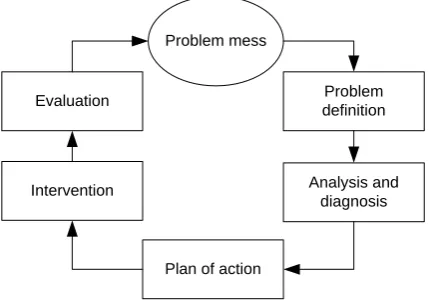
The BPS methodology builds on the regulative cycle of Van Strien [24], which consists of five steps. These five steps are (1) problem definition, (2) analysis and diagnosis, (3) plan of action, (4) intervention, and (5) evaluation. A visual representation of the regulative cycle can be found in Figure 1. The steps of the regulative cycle and their use in a BPS project are shortly discussed below.
Problem definition
Intervention Analysis and
diagnosis
Plan of action Problem mess
Evaluation
The problem definition step is key in the BPS project. Often, the initial problem definition is somehow given by the organization. Important is to find out whether this is a real problem, or a so called “perception problem”. Thus, step one is to come to a core problem, which may be the underlying problem of a perception problem. Furthermore, in a BPS project this step includes the creation of a project plan.
After the problem is defined the analysis and diagnosis step starts. The BPS methodology focuses on three approaches that together can (and should) be used to produce a diagnosis [22, p. 64]. These are empirical analysis, theoretical analysis, and process-oriented analysis. In general, in this step the business problem is validated and causes are explored and validated as well. Literature can be used to find support for causal relationships and analyse the situation using theoretical concepts.
Once the analysis and diagnosis step is completed, a solution for the business problem is designed in the plan of action step. Knowledge and solution concepts, which are derived from the systematic literature review, are used to design a solution. A plan of action is not only an object design but should be accompanied with a change plan that describes the process to realize the object design. The plan of action step is followed up by the intervention step, in which the actual change occurs in roles and work processes.
The last step is the evaluation step, in which learning to work with the new system and realizing the improvement in performance are central. The evaluation step however entails more than just the evaluation of the intervention. Besides evaluating the results of the BPS project, which focuses on determining whether the problem has indeed been solved, the evaluation step serves has three other purposes. The first is learning for the future, which is the process in which knowledge and capabilities are developed. The generated knowledge and capabilities can then be used for future projects. Furthermore, the evaluation step also serves as a means for scientific reflection. The last purpose of the evaluation step is the personal and professional development of professionals, which is achieved by reflecting on their own performance.
1.6
MOTIVATION FOR AND APPLICATION OF THE BPS METHODOLOGY
The BPS methodology was chosen because this research is driven by a real-world business problem. This is reflected by the second objective, which is about solving a real-world performance problem rather than a knowledge problem. In other words, the situation at Company X and Company Y asks for an actual solution rather than development of general knowledge. This perfectly aligns with the BPS methodology in which the focus remains on the actual performance improvement [22, p. 11] and thus is result-oriented. In other relevant (i.e. design science) research methodologies the main objective is generally not to solve a case specific real-world problem. Instead the focus is put on the development of an artefact, in our case the theory based framework. An example of such a methodology is that of Peffers et al. [25]. Such methodologies generally contain a demonstration step in which the artefact is applied to a practical scenario. The main objective of such a
demonstration step is to verify the usefulness of the artefact, and not to solve the practical problem. In contrast, the BPS methodology considers intermediate developed artefacts as a means to come to a solution for the practical problem. The primary objective of a BPS project remains the design of solution for a specific business performance problem.
“One can often generalize on the basis of a single case, and the case study may be central to scientific development via generalization as supplement or alternative to other methods. But formal generalization is overvalued as a source of scientific development, whereas ‘the force of example’ is underestimated. … A purely descriptive, phenomenological case study without any attempt to generalize can certainly be of value in this process [the process of knowledge accumulation in a given field or society] and has often helped cut a path toward scientific innovation”.
In short, Flyvbjerg argues that it is oftenpossible to generalize from single case studies and underpins this with examples. Furthermore, he argues that knowledge that cannot be formally generalized can be as valuable as formally generalized knowledge.
One way of generalizing from a case study is generalizing by similarity as proposed by Ghaisas et al. [27]. This similarity-based generalization of Ghaisas et al. is about identifying the architecture of the case and the mechanisms introduced by this architecture. The generalization is done by assessing whether a target case has the same mechanisms and a similar architecture to justify or block a generalization. This similarity-based generalization will be used in the evaluation step to make hypotheses about the generalizability of the applicability of the developed framework.
Although the BPS methodology generally does not focus on developing general knowledge, it leaves enough room for it. Therefore, we will start with an extensive literature review which allows us to develop a theory based framework. The framework should give us a good foundation in the process of designing a solution for the Company X-Company Y case, but we expect that this framework is also useful for other researchers and/or practitioners in the domain.
It might turn out during the BPS project that the developed framework does not satisfy all needs. In that case we will adapt the framework according to the needs. The evaluation step at the end of the BPS project then allows us to reflect on the framework and assess the usefulness and applicability of the framework by similarity-based generalization.
A note should be made regarding the intervention step. This step of the BPS methodology is not part of this research, because there is a limited time frame for this project. Thus, this research will follow the full regulative cycle. Omitting the intervention also implies that we will be unable to perform the full evaluation step. However, as we will see later, the evaluation step does not solely focus on the intervention itself but at the project as a whole. The evaluation will be done by focussing on the aspects that we are able to evaluate.
To summarize, this project is initiated by a real-world business problem that asks for a solution. The BPS methodology was chosen because this methodology keeps the focus on the actual performance improvement. To make our research more valuable for others, we will also develop a framework that should contribute in making well-informed decisions regarding the IS/IT integration strategy.
1.7
THESIS STRUCTURE
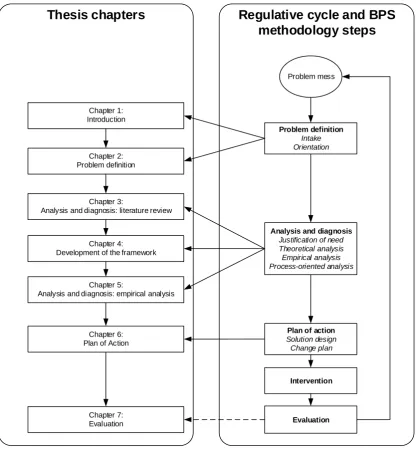
The structure of this thesis follows the steps of the BPS methodology and thus the steps of the
Figure 2 shows the thesis structure in relation to the adopted research methodology by linking steps of the BPS methodology and the regulative cycle to the thesis chapters. The figure shows that the intervention step is not part of this research. It might seem odd that while we do not perform the intervention step, we do include the evaluation step. But as already discussed in section 1.5, the evaluation step entails more than just an evaluation of the intervention. We use this evaluation step to look back on the specific case, but also to reflect on the developed framework. We drew a dotted line between the evaluation chapter of this thesis and the evaluation step of the regulative cycle to emphasize that our evaluation step does not fully correspond with the evaluation step of the regulative cycle.
Thesis chapters
Regulative cycle and BPS
methodology steps
Chapter 1: Introduction
Chapter 2: Problem definition
Chapter 3:
Analysis and diagnosis: literature review
Problem definition Intake Orientation
Intervention Analysis and diagnosis
Justification of need Theoretical analysis Empirical analysis Process-oriented analysis
Plan of action Solution design
Change plan
Problem mess
Evaluation
Chapter 5:
Analysis and diagnosis: empirical analysis
Chapter 6: Plan of Action
[image:16.595.85.502.215.673.2]Chapter 7: Evaluation Chapter 4: Development of the framework
2.
PROBLEM DEFINITION
According to Van Aken et al. [22], a BPS project starts with an intake and orientation process, which together form the problem definition step of the regulative cycle. The intake process is used to develop a written initial assignment. The intake process is succeeded by an orientation phase in which the technical content of the assignment is described in more detail. The orientation phase should result in a project proposal that typically contains six elements [22, p. 41]. These six elements are (1) the problem context, (2) the problem statement, (3) the assignment, (4) the project
approach, (5) the costs of the project, and (6) organization of the project. The problem context and the organization of the project (see the general information section) are already discussed.
Furthermore, the costs of the project are excluded from this thesis, because we believe these are not relevant for the reader of this thesis. The remaining elements will be discussed in the following
sections.
2.1
INTAKE
This BPS project started with an intake meeting with the IS/IT manager of Company X. During this meeting several possible assignments were discussed. One of these assignments was to explore the options and benefits of implementing Company X’s ERP system “LOOP” at Company Y. This ERP system is custom-built and is tailored to the processes of Company X. Since Company X and
Company Y have been operating isolated from each other for a long time, it is unlikely that LOOP fits the situation at Company Y without any changes being made to the software or workflows.
Although this was not an actual business problem, it was a good starting point for further questioning and forming an initial problem mess. It turned out that the implementation of LOOP at Company Y was seen as the solution to achieve IS/IT integration between the two companies. One of the reasons for starting with the IS/IT integration is the retirement of the current IS/IT manager at Company Y. The situation in which two completely distinct IS/ITs should be managed is considered to be an
unsatisfactory state of affairs and is expected to lead to performance problems. Rather, Company Y and Company X want to examine whether it is possible to standardize the application landscape and perform activities in a more centralized matter. Standardization and centralization should make it possible to deploy the IS/IT resources more efficiently, ease information sharing and make the IS/IT landscape maintainable.
Thus, instead of solely examining the possibility of implementing LOOP at Company Y, the focus was changed to examine how IS/IT integration could be achieved between Company X and Company Y. This initial assignment was discussed with the university supervisors and agreed upon.
2.2
ORIENTATION
After having formed the initial assignment, the orientation phase started in which we further elaborated on the problem. Several (informal) interviews were held with different stakeholders to discuss the business problem and find out whether other or root causes existed.
During this interviews we found out that a first step was already taken in the IS/IT integration.
Company X and Company Y were arranging a point-to-point glass fibre connection to create a high speed link between the two firm sites. This was of course only possible due the close geographic proximity. Furthermore, small steps were made to make the technical platforms more compatible. Company X is an avid user of virtualization and now Company Y made their first steps in creating a more virtualized environment. This compatibility should ease further integration.
In the orientation phase we also made the first step for the literature review. Initial examination of the literature allowed us to put the situation of Company X and Company Y into perspective and name and frame the problem.
2.3
PROBLEM STATEMENT
[image:18.595.85.531.296.600.2]According to Van Aken et al. [22, p. 48], cause and effect diagrams are useful for representing the problem mess. Out of this problem mess one or more problems can be chosen for the BPS project. Figure 3 shows the cause and effect diagram for the situation at Company X and Company Y. Most important is the autonomy of both the companies, which results in no or little overall integration. This is also reflected in the IS/IT departments. The departments operate in a more or less isolated fashion, which withholds the companies to achieve possible IS/IT related synergies and thus disables efficiently deploying the IS/IT resources. Furthermore, there is limited communication, which makes it hard to identify possible ways for integration.
No/low organizational integration No/low IS/IT integration Very limited information sharing
Existence of two separate, autonomous
IS/IT departments Two highly autonomous
companies without central steering Decision making lacks information Performance not optimal No IS/IT related
synergy benefits
IS/IT resources not efficiently deployed
Operations are not coordinated
IS/IT manager at ESA will retire IS/IT manager of Company X will be responsible for IS/IT of
Company X as well as Company Y
Unknown how to realize integration No/limited
communication
No insight in situation at Company Y
No/little non IS/IT related synergy
benefits
Will face situation of managing two isolated IS/IT
departments
Figure 3: Cause and effect diagram of situation at Company X and Company Y
This BPS project concentrates on the existence of two separate, autonomous IS/IT departments having their own IS/IT landscapes and the lack of IS/IT integration. Thus, the focus of this BPS project is not on achieving company wide organizational integration. Rather it focuses on exploring the options to integrate the two IS/IT departments, IS/IT related activities and IS/IT itself.
2.4
ASSIGNMENT
Based on the problem statement we are able to form an assignment. The overall assignment is to find a solution to integrate the two IS/IT departments. This assignment can be split up in several sub-assignments:
Analysis and diagnosis and justification of the incentive for the IS/IT integration
Analysis and diagnosis of the two IS/IT organizations, the current (IS/IT related) operations and IS/IT landscapes at Company X and Company Y to identify bottlenecks
Exploration of potential solutions to achieve integration
Elaboration of a particular solution into a solution design and a corresponding change plan The outputs of these sub-assignments form the deliverables of this BPS project. Van Aken et al. [22, p.50] argue that not only the solution itself, but all deliverables are of value for the client. The analysis and diagnosis and exploration of alternative solutions for example, can be of value in future decision making.
For the analysis and diagnosis, and exploration of potential solutions state-of-art literature will be used. Existing literature will be summarized into a framework which can be used to analyse the current situation and plan for IS/IT integration. This framework is thus another deliverable of this BPS project.
2.5
PROJECT APPROACH
2.5.1
CONCEPTUAL PROJECT DESIGN
Figure 4 shows the conceptual design of the research and design approach. This conceptual model is based on the general structure of Van Aken et al. [22, p. 52]. The conceptual design contains the subject of analysis, the theoretical perspectives that are applied in the analysis, a confrontation between theoretical perspectives and the subject of analysis, and the deliverables of the project. The subjects of analysis are the two companies Company X and Company Y. First, we want to identify the reasons for the M&A and the agreed IS/IT integration in order to understand the degree of integration. Furthermore, the operations and IS/IT of both companies will be analysed in order to identify where integration is possible and where bottlenecks are present.
The theoretical perspectives can be used to study the subject of analysis. In this case these theoretical perspectives cover IS/IT integration in M&As. This is a rather broad subject that entails many different aspects as we will see in the next chapter.
Theoretical perspectives IT/IS integration in M&A
Subjects of analysis
Project deliverables
Operations at Company X
IT/IS at Company Y
Operations at Company X
IT/IS at company Y
Analysis and diagnosis of current situation and bottlenecks
Recommendations for Company X-Company Y case (including change plan) Framework for (analyzing and)
planning IS/IT integration
M&A and integration incentive
[image:20.595.83.536.60.524.2]Possible solutions
Figure 4: Conceptual project design (based on Van Aken et al. [22])
2.5.2
PROJECT OUTLINE
The following list is a rough outline of the activities that will be undertaken during the research: 1. Perform a systematic review of state-of-art literature on IS/IT integration in M&As to answer the
research questions
2. Develop a framework that is built on existing literature that can be used to analyse the current situation and plan the IS/IT integration in M&As
3. Empirical, theory-based analysis of the Company X-Company Y case using the framework 4. Explore possible solutions for the IS/IT integration of Company X and Company Y
5. Elaborate on one possible solution in a solution design and a corresponding change plan 6. Collect feedback on proposed solution and change plan
7. Improve and deliver final solution and change plan
2.5.3
DATA COLLECTING
Problem (identification and)
definition
Theoretical analysis Plan of action Empirical
exploration and validation
Analysis and diagnosis
Observations Documents
Interviews Interviews Documents Focus group
Set up framework
Figure 5: Conceptual overview of methods and techniques for collecting data
Figure 5 shows the conceptual design of the methods and techniques that will be used for collecting, analysing, and processing the data. This overview quite general, because at this stage it is not clear which stakeholders should be interviewed or what exactly should be observed. During later stages of the project, more detailed plans for the interviews, observations and focus groups will be set up. The problem identification will be based on interviews with stakeholders. In the theoretical analysis existing papers and articles will be used to form a good theoretical background and a framework for analysis and planning. In the empirical phase the studied literature will be used, as well as
3.
ANALYSIS AND DIAGNOSIS: LITERATURE REVIEW
This chapter serves a preparation for the actual analysis which will be described in the next chapter. The goal of this chapter is to explore the research domain to find out what is already known about the research topic. Van Aken et al. describe four different ways in which theory can be used [22, p. 70], namely literature as support, conceptualization, suggesting causes and theory as a guiding framework. In the first way, literature as support, existing literature is used as evidence for casual relationships. Conceptualization is about using concepts from theoretical literature to interpret empirical phenomena. These concepts provide a way to abstract from the practical problem, which is useful for building on existing literature. Another way of using the existing literature is to identify alternative causes which are suggested by literature. Finally, existing theory can be used as a guiding framework which can have several forms.
Using the chosen methodology we aim at giving a comprehensive review of existing literature. The chosen methodology, which builds upon Grounded Theory, is focused on identifying concepts in literature. Based on the extensive review of literature and the identification of the different concepts we will design a theoretical framework that has the form of a solution creating process. Thus, we mainly focus on conceptualization and creating a framework. However, while discussing the existing literature we see evidence for identified causes such as the lack of possible synergies.
The chapter starts with discussing the methodology that was used to perform the literature review. Next, the existing literature will be discussed in detail. Finally the framework will be derived and discussed.
3.1
DATA COLLECTION METHODOLOGY
3.1.1
DEFINE
For the literature review we used the methodology of Wolfswinkel, Furtmueller, & Wilderom [23], which allows conducting a rigorous literature review using Grounded Theory. The five stages of the method are: (1) define, (2) search, (3) select, (4) analyse, and (5) present. The following sections discuss how the different stages were completed for this thesis.
The business problem shows that the focus is not on a single company; rather it is focused on combining (elements of) companies. In other words, the situation can be seen as a merger or acquisition. Furthermore, the problem is about IS/IT integration. Thus, we’re looking for literature on IS/IT integration within M&As.
The search for literature will be mainly focused on scientific publications such journal articles and conference papers. Furthermore, books, PhD theses, and master’s theses will be taken into
consideration. We do not put constraints on the time frame of publication, since were not specifically
books1. Web of Science indexes books, journals and proceedings2. Both index patents, but these are not considered in this thesis.
After some initial searches to identify key words and synonyms, the following search statement was formed:
("information systems" OR "IS" OR "information technology" OR "IT" OR "IS/IT") AND (“integrate” OR "integration" OR "integrating") AND
("merger" OR "mergers" OR "acquisition" OR "acquisitions" OR "M&As" OR "M&A")
3.1.2
SEARCH
Both the databases Scopus and Web of Science allow searching through different combinations of fields such as the article title, abstract and keywords. Initially we searched for the search terms in the combination of the article title, abstract and keywords. However, this led to more than 14,000 results in Scopus only and included (based on the article title) many irrelevant results. Therefore, we restricted the search by looking for the search terms in the article title only. It would have been also possible to restrict the number subject areas to be searched and consider the abstract and keywords as well. However, we think that restricting the search by focusing on the title gives us the most specific articles. Furthermore, when having this small set of articles with a very narrow focus, we can use the “snowball-method” to broaden our scope. The snowball-method refers to examining the references of the papers of the sample to identify more relevant literature [22].
Using the search statement of the previous section and limiting the fields being searched to the article title yielded 45 results in Scopus and 22 results in Web of Science.
3.1.3
DEFINE
The next step was to filter out doubles. It turned out that Scopus and Web of Science had nineteen publications in common. Thus, Scopus and Web of science yielded twenty-six and three unique results, respectively. Altogether, the search led to forty-eight unique publications. Figure 6 is a Venn diagram that shows the overlap and the number of unique results of the databases.
19 26
Web of Science Scopus
[image:23.595.214.393.492.616.2]3
Figure 6: Venn diagram of search results
After filtering out duplicates, it turned out that there were several publications that we could not retrieve due restricted access or unavailability. The papers that we were able to retrieve were judged on relevance by reading the titles and abstract, and sometimes parts of the full text as well.
Furthermore, it turned out that some articles were republished using a different title. We compared these publications and when we could only identify minor differences, one of these publications was removed from the sample. Otherwise, both papers were included.
The selection process resulted in a sample of thirty papers that were considered for analysis. An overview of the results of the search together with the reasons for exclusion can be found in Appendix A.
3.1.4
ANALYZE
The analysis phase started with reading the papers and highlighting interesting parts of the text, thus creating excerpts. After reading a small set of papers, we were able to identify recurring topics (open coding) such as “IS/IT integration methods”. We created a spreadsheet with the list of papers and identified concepts. Note that we did not specify a list of concepts beforehand. Rather, this list of concepts expanded over time because new concepts were identified after reading more papers. We did not explicitly defined properties for the concepts, but rather decided whether a new excerpt fitted an existing concept or not.
During this analysing phase we also performed the snowball method. That is, while reading the texts we looked for interesting references, which then were scanned and possibly added to our sample. Furthermore, we tried to focus on the contributions of the papers to identify new concepts.
The next step in the Grounded Theory method is axial coding, which is about identifying relationships between concepts and sub concepts. This is the first step in structuring the concepts and this was done by grouping related concepts in a ‘super’ concept. Finally, the main concepts and
relationships between these main concepts were identified (selective coding). It is clear that the overall main concept is IS/IT integration in M&As. This main concept is formed by concepts from the M&A domain as well as IS/IT integration concepts. In the next sections we will present the concepts.
3.2
IS VERSUS IT
When examining existing literature about IS/IT integration we noticed that the different terms IS and IT were used in different papers, but in general were meant to refer to the combination of IS/IT. In other words, much of the literature does not make a strict distinction between IS and IT. Although there is a general acceptance that difference exists between IS and IT, the two terms are often loosely and interchangeably used, even by computing practitioners [1]. Henningsson [2] classifies the relation between IS and IT as “intriguing and fuzzy” and shows that there is a lot of discussion about the terms. Iyamu and Kekwaletswe [1] use the concept of computing environment, which they define as “a structured environment that encompasses software, hardware, provides computer services, support
and maintenance”, to illustrate the interrelationship between IS and IT. Figure 7 shows an overview of
Computing
IS IT
Architecture
Figure 7: Illustration of the computing environment [1]
The computing environment consists of three elements: IS, IT and architecture [1]. The IS component consists of the systems that are directly used by the end user and through which the business carries out its processes and logic. The IT component consists of hardware (sometimes referred to as technology infrastructure) such as servers and disk, and the system software such as operating systems and utility software which are the tools that enable the IS software. Only the combination of IS and IT can help organizations achieve the goals and objectives. The architecture component is
“the strategic design and implementation of systems, technologies including processes and
governance” [1].
Based on their study, Iyamu and Kekwaletswe identified seven main areas of practice within the computing environment and related these areas to IS and IT [1]. An overview of these areas of practice can be found in Figure 8.
In the context of M&As, the scope is not limited to one of the components, but the computing environment as a whole. We prefer the term IS/IT instead of computing environment, because these terms are more common in other literature. With the term IS/IT in this thesis we implicitly mean architecture as well. In fact, architecture can be used to compare the different IS/IT between the two companies.
Hardware engineering
Software development
Business
systems Networking Architecture
System analysis and design Information systems
Information technology
Figure 8: Seven areas of practice within the computing environment [1]
3.3
MERGERS & ACQUISITIONS
3.3.1
MERGERS VS ACQUISITIONS
Just as there is confusion about the terms IS and IT, there is confusion about the terms merger and acquisition. Although many authors agree on the fact that there is a difference between a merger and an acquisition, the two concepts are used interchangeably and often studied as one
A review of existing literature reveals different classifications of the terms. Giacomazzi et al. [5] define an acquisition as the exchange of some assets of the target company, whereas a merger is seen as combining all the components of the two companies for the operation of one company. According to Giacomazzi et al., a merger can be achieved in two ways. The first is incorporation, which implies a power difference and results in the absorption of the target company. A merger of equals results in a totally new company, which is built from two companies. Henningsson [2] uses the distinction of organizational processes. A merger is then a combination of equally powered companies, whereas an acquisition involves a power difference.
Different authors have argued that the distinction is not always easy to make and is mainly a legal issue [2]. When the focus is on integration of IS/IT and not on the legal or property aspects, the legal or property aspects are not of importance [5]. An acquisition of an empty industrial building for example does not fulfil the condition that different IS/IT need to be integrated and thus is out of scope of this thesis.
In this thesis the term M&As is used to refer to both mergers and acquisitions. Thus, we follow the reasoning that the legal or property aspects are out of scope and agree with other authors to study the activities as one phenomenon.
3.3.2
REASONS FOR M&AS
In M&As the core task is to create value that becomes possible when the two organizations are combined [28]. This opportunity thus not exists if the firms remain separate. Many authors use the concept of “synergy” to explain the reasons for engaging in M&As. In the context of M&As, achieving synergy means that two operating units can be run more efficiently and/or more effectively together than apart [10].
Table 1: M&A synergies (adapted from [2])
Synergy group Synergy Description
Technical economies Marketing Scale economies in marketing and branding Production More efficient production of larger quantities Scheduling Occur in vertical mergers when two levels of
production are joined
Experience Reduction in cost that come with accumulated experience with a common technology Banking Reduction in outstanding cash balances as
consolidation reduces banking relationships Compensation Consolidation can lead to savings per
employee for offerings such as health and life insurance
Pecuniary economies Monopoly Ability to force buyers to accept higher prices Monopsony Ability to force suppliers to accept lower prices Diversification
economies
Portfolio management
Consistency of assets which markets’
development are negatively correlated with each other
Risk reduction Lower transaction costs to stakeholders
3.3.3
M&A TYPES
There are various frameworks that distinguish different types of M&As. Angwin [29] performed an extensive review of prominent typologies that exist in literature. He distinguishes pre-acquisition strategy typologies, a negotiation strategy, post-acquisition integration typologies, and an overarching integrative framework. Many of these typologies use different dimensions such as strategic fit, speed of integration or cultural integration. We will not discuss all the different typologies here, but only the most common ones.
As mentioned earlier, M&As can involve unequally powered companies or equally powered parties. The level of power difference is likely to affect decision making in M&As [30]. Next to the degree of difference in power, M&As can differ in the level of friendliness [2]. M&As can range from being very friendly (by rescuing a company) to a raid, which is very hostile. Friendly M&As are in general well perceived by the target, whereas a raid often leads to employee resistance which makes integration more challenging [2].
[image:27.595.74.521.90.308.2]Horizontal Market extension
Vertical
backward Vertical forward
[image:28.595.207.393.302.480.2]Product extension Conglomerate Same Different Same Market relation P ro d u c t r e la tio n Long-linked Unrelated
Figure 9: FTC classification framework [31]
Another commonly used and mentioned framework to categorize M&As is the framework by
Haspeslagh and Jemison [28] which can be found in Figure 10. This framework is a post-M&A typology [29] that includes strategic and organizational fit and is based on the idea that the companies are looking for a way to create value that is only possible after combining the companies.
Preservation Low High High N e e d f o r o rg a n iz a tio n a l a u to n o m y Low Need for strategic interdependence Symbiosis Holding Absorption
Figure 10: The four integration approaches of Haspeslagh and Jemison [28]
The dimensions of the framework are the need for strategic interdependence and the need for organizational autonomy. Strategic interdependence refers to the nature of interdependence, which is a requirement for capability transfers. Organizational autonomy refers to need for organization boundaries. The need for organizational autonomy should not be determined by the wishes of the companies but should be based on whether the organizational boundaries are crucial for retaining strategic capabilities. Based on these two dimensions, four different integration approaches are distinguished. These are preservation, symbiosis, absorption and holding.
Preservation refers to the situation in which there is a high need for organizational autonomy, because removing the organizational boundaries is expected to negatively influence the strategic capabilities of the company. Since the strategic capabilities are the reason for the M&A, in those situations organizational autonomy should be maintained. The preservation approach corresponds with a low need for strategic interdependence, which means that it’s not likely that resources will be shared or functional skills will be transferred. Rather, capability transfer is likely to be limited to general management capability transfer.
capability transfer often conflicts with the need for organizational autonomy. On one hand the boundaries between the companies should remain intact, while on the other hand there is a wish for strategic capability transfer, which implies crossing the boundaries.
Absorption implies full consolidation of the two companies. In this situation, a high degree of strategic interdependence is required to create value. Furthermore, organizational autonomy is not required and thus the objective is to remove boundaries.
The holding approach is actually not considered an integration approach. In this situation, there is no intention to integrate the companies. Value is only created by financial transfers, risk sharing or general management capability [28].
The different typologies show that it is possible to look at M&As from different perspectives. On one hand, the frameworks allow researchers to generalize the problem by grouping and focusing on certain characteristics. On the other hand, the frameworks allow researchers to see M&As not as one generic phenomenon, but as different specific versions of the phenomenon. The frameworks are not comprehensive, but rather complement each other by looking at other characteristics of the phenomenon.
3.3.4
M&AS PHASES/LIFECYCLE
M&As can be seen as a process that consists of several phases. At the highest level three different phases can be distinguished [19]. These phases are merger, merger and post merger. The pre-merger phase includes the search for a partner, strategic planning, due diligence, negotiations and making announcements to media and analysts. The merger phase, which is relatively short, occurs after the shareholders approve the plans and ends when the deal is actually closed. The post-merger phase starts after the deal is closed and focuses on achieving the integration.
Besides the three phased model, the research domain of M&As also contains more detailed models of the M&A process. These models split up the three phases in more specific phases (see Henningsson [2] for a comparison of some of theses models). The scope of this thesis and the business problem is mostly on the post-merger phase; however we will sometimes refer to the other phases of the M&A process.
3.3.5
INTEGRATION ON DIFFERENT LEVELS
Integration can take place on different levels within the organizations. From an IS/IT perspective, there are four general levels of integration in M&As [2]:
Strategic
Organizational
o Operational (primary process chain)
o Functional (administrative or support activities)
Information system
IT system
scope: it can help to standardize and couple business processes [2]. The IT system level is the underlying level of the IS level and integration on this level ignores application and business logic.
3.4
IS/IT INTEGRATION IN M&AS
3.4.1
IS/IT IN THE DOMAIN OF M&AS
For a long time the focus in M&As was on strategic and organizational factors. However, the growing importance of IS/IT led to the idea that IS/IT should also be considered when evaluating candidates for an M&A. Buck-Lew, Wardle, & Pliskin [32] introduced the concept of IS/IT fit in the domain of M&As, arguing that IS/IT is “so interrelated with many key aspects of the business” that attention should be paid to it beforehand. The concept of IS/IT fit helps companies to identify the contribution that both companies can bring to the combined company. Besides, assessing the IS/IT fit should play a role when negotiating about the price and in integrating the companies. For example,
incompatible IS/IT environments may lead to expensive integration effort. Buck-Lew et al. do not argue that IS/IT fit is crucial for success in every situation. Rather, the importance of a good fit depends on the desired level of integration.
3.4.2
VALUE OF IS/IT INTEGRATION IN M&AS
Many of the authors that do research on IS/IT integration in M&As stress its importance (for example [4] and [21]). The findings of an empirical study by Weber and Pliskin [33] indeed show that there is a positive relationship between IS/IT integration and overall M&A effectiveness. However, this positive relationship was only seen in cases when controlling for IS/IT intensity and organizational culture differences between the firms. This shows that IS/IT integration should not be seen as a purely
technological issue. Rather, IS/IT integration success depends on many different factors as we will see in the following sections.
There are several benefits of IS/IT integration. Tanriverdi and Uysal [3] for example mention that companies with a superior capability in integration IS/IT can expect four main benefits. These benefits are (1) IS/IT cost savings, (2) minimized disruption to business operations, (3) enabled realization of business synergies, and (4) contribution to regulatory compliance and reducing the costs of
achieving it. Robbins and Stylianou [34] list thirteen possible IS capability improvements. These include enhancing the organization’s competitive position, better information accessibility and quality and being more efficiently in developing and operating systems. Thus, literature shows that there are several benefits of IS/IT integration in M&As.
3.4.3
ROLE OF IS/IT
Organizations can have different views on the role of IS/IT within their organization. This does not only apply to M&A situations, rather it plays a role companies in general. In their famous paper about Business-IT alignment, Henderson and Venkatraman [35] identify four domains that play a role in alignment. These four domains are (1) business strategy, (2) IT strategy, (3) organizational infrastructure & processes, and (4) IS infrastructure and processes. The former two are external domains, whereas the latter two are internal focused.
The different perspectives show that the role of IS/IT can vary from being a subordinate of the business strategy to the other extreme being driving for the company.
[image:31.595.138.460.134.360.2]Business strategy Organizational infrastructure and proceses IS/IT strategy IS/IT infrastructure and proceses Strategic integration Operational integration Business IS/IT External Internal Functional integration S tr a te g ic f it Strategy execution Technology transformation Competetive potential Service level
Figure 11: Strategic Alignment Model with alignment perspectives [35]
McKiernan and Merali [6] argue that, in the context of M&As, the role of IS/IT can be proactive or reactive. IS/IT can have a proactive role by when it is used an opportunity for creating competitive advantage or as driver for organizational change. A reactive role means that IS/IT is expected to change to “accommodate other operational considerations”. Neglecting IS/IT at the strategic level withholds companies in creating a competitive advantage based on IS/IT.
The position that IS/IT has within a company will determine the role of IS/IT in an M&A [19]. If the role of IS/IT within a company is more or less supporting and is not considered at the strategic level, then it is unlikely that IS/IT will be involved in early phases of an M&A. On the other hand, when IS/IT is has an important position within a company, IS/IT is very likely to be considered in early phases of the M&A. Although many authors stress the importance of early involvement of IS/IT, there few companies that actually consider IS/IT in early stages of the M&A such as ex-ante due diligence [6]. An important reason for this is the secrecy characteristic of early phases of M&As [19, 32, 34]. Involving more people such as CIOs will increase the chance of leaks.
3.4.4
DECISION MAKING AND PLANNING
An important aspect of IS/IT integration is planning. Alaranta and Henningsson [37, 38] adapted six dimensions of strategic IS planning in the post-merger IS/IT context to relate them to planning effectiveness. The six dimensions of strategic IS planning are comprehensiveness, formalization, creativity focus, flow, participation and consistency. Planning effectiveness is summarized into alignment, analysis, cooperation and improvement. Figure 12 contains a conceptual overview of the relationship between strategic IS/IT planning and planning effectiveness.
Strategic IS planning
Comprehensiveness
Formalization
Creativity focus
Flow
Participation
Consistency
Planning effectiveness in M&A
Alignment
Analysis
Cooperation
Improvement Planning
[image:32.595.162.444.165.375.2]profile
Figure 12: Effective IS/IT integration planning [38]
Comprehensiveness can be high or low, and refers to the intensity of information gathering. The formalization of the strategic IS/IT planning can be high (more efficient) or low (more flexible). Furthermore, strategic IS/IT planning can have a creativity or control focus. A creativity focus implies an external focus, whereas a control focus looks at the internal organization. Flow can be top-down or bottom up. Participation can be broad, which involves many organizational groups, or narrow by having a small group of key actors. Consistency, referring to the rigidness of the planning, can be high or low.
Alignment means whether the IS/IT strategy is well aligned with the overall integration plan. Analysis refers to the understanding of the information needs and required changes in the organizational processes. Cooperation is about agreeing on boundaries, risks and trade-offs. Improvement refers to learning for future M&As.
The research of Alaranta and Henningsson has some important findings. Most important is that there is not one single best way to achieve effective planning. Rather, IS/IT integration planning should take the characteristics of the M&A in consideration to be effective [37]. However, Alaranta and
Henningsson argue that in M&As in which operational synergies are sought, a top-down approach and a control focus is desirable.

![Figure 4: Conceptual project design (based on Van Aken et al. [22])](https://thumb-us.123doks.com/thumbv2/123dok_us/9830410.484312/20.595.83.536.60.524/figure-conceptual-project-design-based-van-aken-et.webp)

![Table 1: M&A synergies (adapted from [2])](https://thumb-us.123doks.com/thumbv2/123dok_us/9830410.484312/27.595.74.521.90.308/table-m-a-synergies-adapted-from.webp)
![Figure 9: FTC classification framework [31]](https://thumb-us.123doks.com/thumbv2/123dok_us/9830410.484312/28.595.207.393.302.480/figure-ftc-classification-framework.webp)
![Figure 11: Strategic Alignment Model with alignment perspectives [35]](https://thumb-us.123doks.com/thumbv2/123dok_us/9830410.484312/31.595.138.460.134.360/figure-strategic-alignment-model-alignment-perspectives.webp)
![Figure 12: Effective IS/IT integration planning [38]](https://thumb-us.123doks.com/thumbv2/123dok_us/9830410.484312/32.595.162.444.165.375/figure-effective-is-it-integration-planning.webp)