Forecast Encompassing Tests and Probability Forecasts
.
Michael P. Clements and David I. Harvey
No 774
WARWICK ECONOMIC RESEARCH PAPERS
Forecast Encompassing Tests and Probability Forecasts
Michael P. Clements
∗Department of Economics,
University of Warwick
David I. Harvey
School of Economics
University of Nottingham
July 21, 2006
Abstract
We consider tests of forecast encompassing for probability forecasts, for both quadratic and logarithmic scoring rules. We propose test statistics for the null of forecast encompassing,
present the limiting distributions of the test statistics, and investigate the impact of estimating the forecasting models’ parameters on these distributions. The small-sample performance of the various statistics is investigated, both in terms of small numbers of forecasts and model
estimation sample sizes. Two empirical applications show the usefulness of the tests for the evaluation of recession probability forecasts from logit models with different leading indicators as explanatory variables, and for evaluating survey-based probability forecasts.
JEL classification: C12, C15, C53.
Keywords: Probability forecasts, encompassing tests, recession probabilities.
∗Corresponding author. Department of Economics, University of Warwick, Coventry, CV4 7AL, UK. Tel.: +44
1
Introduction
There is an extensive literature in economic and management science attesting to the usefulness
of forecast combination.1 That is, a linear combination of two or more forecasts may often yield
more accurate forecasts than using a single forecast. The forecast combination literature typically
assesses the out-of-sample accuracy of combinations whose weights have been determined in-sample.
Tests of forecast encompassing assess whether ex post a linear combination of forecasts results in a statistically significant reduction in the mean squared forecast error (MSFE) relative to using
a particular forecast, and can be viewed as an indicator of when combinations might be useful
ex ante, although Chong and Hendry (1986) originally presented such tests as model-specification tests for large-scale models where more conventional tests may be infeasible. Forecast encompassing
is formally equivalent to ‘conditional efficiency’ due to Nelson (1972) and Granger and Newbold
(1973), whereby a forecast is conditionally efficient if the variance of the forecast error from a
combination of that forecast and a rival forecast is not significantly less than that of the original forecast alone.
Tests of forecast encompassing and the closely-related tests of equal forecast accuracy of Diebold
and Mariano (1995) are routinely calculated in forecast comparison exercises in applied work. For
the most part they are applied to forecasts of variables that, in principle at least, can take any value
on the real line. Yet as noted by Diebold and Lopez (1996) in their review of forecast evaluation
and combination, forecasts of economic andfinancial variables often take the form of probabilities,
e.g., forecast probabilities of recession. These authors suggest that the significance of differences in accuracy between different probability forecasts can be tested using the Diebold-Mariano tests,
and Granger and Pesaran (2000) mention combining probability forecasts. Kamstra and Kennedy
(1998) propose a method of combining probability forecasts using logit regression. This is presented
as a computationally simple way of combining forecasts, and no optimality properties for the
derived combination are claimed. In other spheres, the combination of probability assessments is
commonplace, although the emphasis tends to be different from ours.2
In this paper we apply forecast encompassing to probability forecasts. Because of the nature of
the forecasts, our analysis will differ from the standard application of encompassing tests to point
forecasts in a number of ways. One is the nature of the loss function. Tests of encompassing applied
1Seeinter alia Diebold and Lopez (1996) and Newbold and Harvey (2002) for recent surveys, and Clemen (1989) for an annotated bibliography.
to point forecasts invariably use mean squared error (MSE). The same measure is commonly used to
evaluate probability forecasts, in the guise of the quadratic probability score (QPS), but at least as
commonplace is the logarithmic probability score (LPS). We consider forecast encompassing tests
based on both. Secondly, our analysis differs from the standard approach because of the nature of
the models that are used to generate forecasts. We will consider the effects of parameter estimation
uncertainty on tests of forecast encompassing when the forecasting models are logit models
esti-mated by nonlinear least squares, following West (1996), West and McCracken (1998), and West
(2001). Thirdly, we wish to evaluate forecasts which are not necessarily based on formal models,
or are based on well-defined information sets but do not make optimal use of that information.
A number of related tests of forecast encompassing appear in the literature for point forecasts.
Contrary to what is often assumed, we show that these tests can give different outcomes even
in the standard case (i.e., for point forecasts). With regard to the second and third points in
the previous paragraph, we show that the asymptotic distributions of the tests are differentially
affected by parameter estimation uncertainty, extending West and McCracken (1998), and West
(2001), and that in particular, the outcomes may depend on whether or not the forecasts are the
optimal predictors for a given information set.
Our analysis assumes linear combinations of forecasts, as in the literature for encompassing
tests for standard point forecasts. Linear combination of probability forecasts is commonly used in
the literature on combining experts’ subjective probability distributions (see e.g., Genest and Zidek
(1986) for a critique and annotated bibliography), where it is referred to as the ‘linear opinion pool’.
Linear combination (equal-weighted) of individuals’ probability forecasts is also used to construct
the Survey of Professional Forecasters’ anxious index described in section 5.2.
The plan of the paper is as follows. In section 2 we discuss the two most commonly used
loss functions for probability forecasts: QPS and LPS. One of the standard ways of evaluating (or
‘scoring’) probability forecasts (QPS) motivates the use of the standard forecast encompassing test
framework, and we show that within the standard framework the different approaches to testing
for forecast encompassing are not necessarily equivalent. In section 3 we consider a different way of
testing for forecast encompassing, based on the alternative scoring method LPS. We show that the
conditions for forecast encompassing are the same as under QPS, and moreover the different testing
approaches behave in a similar fashion, in population. Section 4 presents the test statistics and
cor-responding null limiting distributions, for both QPS- and LPS-based encompassing testing methods.
In addition, the impact on the tests of estimating the models’ parameters is considered, extending
some existing results on forecast encompassing tests and parameter estimation uncertainty, and
illustrating the implications for probability forecasts. Monte Carlo simulation is employed to assess
an evaluation of model-based forecasts, and an evaluation of survey-based forecasts. In keeping
with the majority of the literature on forecast combination and encompassing, we do not consider
the possibility of combining information at the modelling stage to produce a ‘super model’, as
an alternative strategy for generating forecasts. In some cases this may be possible, as when the
information sets on which the individual forecasts are based are observed, but is clearly impossible
for survey-based forecasts (as in our second application). Section 6 concludes.
2
Probability forecasts and forecast encompassing tests based on
QPS
In common with the literature on forecast combination, we consider linear combinations of forecasts.
Denoting the two rival forecasts byf1 andf2, then the combined forecasts isfc=α+β1f1+β2f2.
Standard approaches to testing forecast encompassing (when the forecasts are point forecasts) are
based on whether one forecast, say f1, contains all the useful information in f2, in the
mean-squared-error sense. Forecast encompassing is said to hold when the combination off1 and f2 does
not have a MSE which is significantly smaller than that of f1 alone. More generally then, given
a loss function, forecast encompassing holds when setting β2 = 0does not result in a statistically significant increase in the loss function.
The two main ways of scoring probability forecasts are the quadratic and logarithmic scores.
Given a probability forecastf, of the binary eventY = 0orY = 1, the Brier or quadratic probability score (QPS: Brier (1950)) is simply (f−Y)2, corresponding to the usual notion of squared-error loss.3 The logarithmic probability score (LPS: see Brier (1950) and Good (1952)) is defined as: −Y log (f)−(1−Y) log (1−f).4 For a sequence of probability forecasts and outcomes, {ft, yt},
t= 1, . . . , n, these scores are calculated as:
QP S= 1
n
n X
t=1
2 (ft−yt)2 (1)
3Note that in contrast to the evaluation of point forecasts, the actual values are not observed, so thatfis compared to a binary 0−1variable rather than the true probability. Probability forecasts can be evaluated by translating the forecasts into ‘categorical’ forecasts of the binary event, and then looking at the coincidence of predicted1’s and actual1’s, for example. In general this involves a loss of information, as a forecast of 0.99is treated identically to a forecast probability of0.51, if the usual0.5rule is used to translate forecast probabilities into event probabilities (see, e.g., Birchenhall, Jessen, Osborn and Simpson (1999)). Granger and Pesaran (2000) consider probability and categorical forecasts in a decison-based context, and show that only in specific circumstances will the two lead to the same actions.
4
and:
LP S=−1
n
n X
t=1
[ytlnft+ (1−yt) ln (1−ft)] (2)
AsQP S is proportional to squared-error loss, the adoption of this measure leads to tests of forecast
encompassing based on whether the combination of forecasts results in a statistically significant
reduction in the expected squared error, as in the point forecast case. These two well-known
measures of scoring probability forecasts have been used in economic applications by Diebold and
Rudebusch (1989) and Anderson and Vahid (2001),inter alia. In the remainder of this section, we consider forecast encompassing andQP S, and in the following section LP S.
We consider three tests of forecast encompassing that have been applied to point forecasts. If
we define the forecast errors as eit =yt−fit, i= 1,2, then these tests are based on the following three regressions:
FE(1)
yt=α+β1f1t+β2f2t+εt
FE(2)
yt=α0+¡1−β02¢f1t+β02f2t+εt
or, equivalently:
e1t=α0+β02(e1t−e2t) +εt
FE(3)
yt=α00+f1t+β002f2t+εt
or, equivalently:
e1t=α00+β002f2t+εt.
The null hypothesis that f1t forecast encompasses f2t isβ2= 0 in FE(1), and similarlyβ02 = 0
and β002 = 0for FE(2) and FE(3) respectively. The alternative hypothesis is typically 1-sided, i.e.,
β2 > 0 (or β02 > 0, β002 > 0), precluding the possibility of a negative weight on f2t. Regression FE(1) is the most general formulation, in that the coefficient onf1t is left unrestricted under both
the null and alternative. Fair and Shiller (1990) argue for the use of FE(1) over alternatives such
as FE(2), which restricts β1+β2 = 1 as part of the maintained hypothesis, so that only convex combinations are allowed. FE(3) tests β002 = 0 but with a maintained of β1 = 1. FE(3) is the form of the original Chong and Hendry (1986) forecast encompassing test. Each of the above
when α = (1−β1)E(f1t); this condition simplifies to α = 0 when β1 = 1, as assumed in FE(2)
and FE(3) under the null. Recently, West and McCracken (1998) and West (2001) have considered
FE(3) and FE(2) respectively, in the context of estimation uncertainty, and Harvey, Leybourne
and Newbold (1998) have considered the effects of conditionally heteroscedastic forecast errors in
FE(2).
Although there is little to suggest the use of one formulation over another in the literature
(except when there are unit roots: see Ericsson (1993, p. 650)), it is straightforward to show that
β2 = 0in FE(1) does not imply eitherβ02 = 0(in FE(2)) or β002 = 0(in FE(3)). Recall thatβ2 = 0
is the condition for forecast encompassing. Thus, f1 may forecast encompass f2 but tests based
on FE(2) and FE(3) will be invalid. Without making any specific assumptions about the process {yt, f1t, f2t}, from the population values of the least squares estimators of β2,β02 and β002 we have:
FE(1) : β2 = 0, ifV(f1t)C(yt, f2t)−C(f1t, f2t)C(yt, f1t) = 0 FE(2) : β02 = 0, ifV(f1t)−C(yt, f1t) +C(yt, f2t)−C(f1t, f2t) = 0
FE(3) : β002 = 0, ifC(yt, f2t)−C(f1t, f2t) = 0. (3)
It follows that providedf2t is uncorrelated with f1t and yt, then both β2 = 0 and β002 = 0, so that
f1 encompassesf2, and FE(3) will also indicate encompassing. But the same is not true of FE(2)
in general: for β02 = 0 the additional condition that V(f1t)−C(yt, f1t) = 0 has to be satisfied. When f2t is correlated with f1t and yt, it is possible that β2 = 0without either β02 = 0orβ002 = 0.
In which case tests based on both FE(2) and FE(3) are invalid as tests of encompassing. As we
define encompassing byβ2= 0, it would seem natural to base tests onβ2 = 0in FE(1). There are
two reasons to also consider FE(2) and FE(3). We might expect tests based on these regressions
to be more powerful when the population values of the parameters satisfyβ1+β2= 1and β1 = 1
respectively. Secondly, as these tests are commonplace in the literature, we wish to see whether
they are likely to be misleading in practice. In order to assess the practical usefulness of FE(2) and
FE(3) we check whetherβ02 andβ002 are zero for typical data generation processes for whichβ2 = 0.
2.1
Data generation process
Below we describe the probability-forecast data generation process used to investigate the three
forecast encompassing tests. We begin by deriving the population values of β2, β02 and β002 for a
range of cases: when the forecasts are correlated, biased, and when there is model mis-specification;
this allows us to ascertain circumstances under which forecast encompassing holds. The same DGP
including the effects of parameter estimation uncertainty. The forecasts can be viewed as the
forecasts from estimated logit models, but the formulation is general enough to support other
interpretations.
The DGP is given by:
yt = 1
µ
exp(δ0+δ1X1t+δ2X2t+δ3Zt)
1 + exp(δ0+δ1X1t+δ2X2t+δ3Zt)
> vt

(4)
f1t =
exp(θ01+θ11X1t)
1 + exp(θ01+θ11X1t)
f2t =
exp(θ02+θ12X2t)
1 + exp(θ02+θ12X2t)
where:
X1t
X2t
Zt
∼N
0 0 µZ ,
1 ρX1,X2 ρX1,Z ρX1,X2 1 ρX2,Z
ρX1,Z ρX2,Z 1
.
Here, yt is a binary variable that depends on three explanatory variables, X1t, X2t and Zt, when
δi 6= 0, for i = 1,2,3. yt = 1 when exp(δ0+δ1X1t+δ2X2t+δ3Zt)
1+exp(δ0+δ1X1t+δ2X2t+δ3Zt) exceeds vt, a uniform random
variable on the unit interval, that is independent of X1t, X2t and Zt, and otherwise yt = 0. The two rival forecasts depend on X1t and X2t, respectively. The form of the dependence restricts
fit ∈ (0,1), i = 1,2, so that f1t and f2t can be interpreted as probabilities. The explanatory variables follow a multivariate normal, with variances normalized to unity and non-zero correlations,
so that C(f1t, f2t)6= 0in general, allowing the rival forecasts to be correlated.5
A necessary condition for f1 to encompassf2 is thatδ2= 0(and δ16= 0) otherwiseyt depends on X2tdirectly. If in addition we setδ3 = 0, then the model underlying f1 is correctly-specified in
the sense that it contains all the variables that affect yt. Conversely, setting δ3 6= 0 allows us to
consider the effects of model mis-specification on the tests of encompassing.
2.2
Forecast encompassing based on QPS
Although conceptually straightforward, the form of the DGP does not allow us to obtain the
probability limits of β2, β02 and β002 analytically. However, expressions for the moments involving
{y,f1,f2} for this DGP can be obtained, and subsequently evaluated by numerical integration for
given values of the underlying parameters (δi,i= 1,2,3;µZ;ρX1,X2;ρX1,Z;ρX2,Z), with the resulting values substituted into (3) to obtainβ2,β02 and β002. In Appendix 1 we report expressions for these
5
moments for the caseδ0 = 0,δ1 = 1. Note that in order to evaluate the moments numerically, we
first need the population values ofθij–these cannot be obtained analytically from the underlying parameters. We assume the interpretation that the forecasts are obtained from estimated logit
models, with the θij parameters representing the population coefficients from logit regressions of
yt on a constant and X1t, and a constant and X2t, for f1t and f2t respectively. We therefore
simulate the population θij values by taking the average of logit parameter estimates from 10,000
replications of the DGP with n = 10,000. Note that when f2t is independent of f1t and yt, θ12
converges in probability to zero, and thereforef2t approaches a constant in the limit. This case is
of little interest in practice, and we focus exclusively on cases where ρX1,X2 >0.
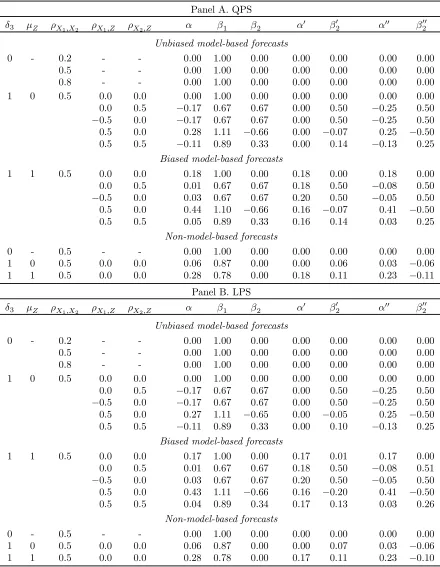
Table 1 (Panel A) gives the population values of the parameters in the forecast encompassing
regressions for a range of values of the underlying parameters. The table displays results for
δ3 = 0 and δ3 6= 0, allowing for both correctly specified and mis-specified forecasts, and results
are reported for both biased and unbiased forecasts. Unbiased forecasts result when µZ = 0, and the θij determining fit are the population parameters associated with logit regressions of yt on a
constant and Xit. We obtain biased forecasts when µZ = 1 (with δ3 6= 0) and the forecasts are
given by:
f1t =
exp(θ11X1t)
1 + exp(θ11X1t)
f2t =
exp(θ12X2t)
1 + exp(θ12X2t)
with theθij being the population parameters associated with logit regressions ofytonX1t andX2t
respectively, without a constant term. Results are reported for representative combinations of the
design parameter settings ρX1,X2 ={0.2,0.5,0.8},ρX1,Z ={0,±0.5},ρX2,Z ={0,0.5}.6
The results for the model-based forecasts using QPS can be summarised as follows (assuming
throughout thatδ16= 0,δ2 = 0andρX1,X2 >0):
(a) when the model giving rise to f1 is correctly specified (because δ3 = 0),f1 encompasses f2
regardless of the correlation between X1 and X2 (and therefore f1 and f2),
(b) when the model generatingf1 is mis-specified (e.g.,δ3 6= 0), encompassing fails when (i)X1
is correlated with the omitted variable Z, or (ii)X2 is correlated with the omitted variable Z,
(c) model mis-specification is not sufficient for forecast encompassing to fail: f1 encompassesf2
providedZ is uncorrelated with bothX1 and X2,
(d) the encompassing results for the three testing approaches FE(1), FE(2) and FE(3) coincide,
6
i.e., when β2= 0, it is also the case thatβ02 =β002 = 0.
Results (a)-(c) are intuitive except perhaps for (b) (i), i.e., the lack of encompassing when X1
is correlated withZ. For example, encompassing fails under (b) (ii) becauseX2 acts as a proxy for
the omitted variable, but under (b) (i), X2 is not correlated with Z, and it may seem surprising
that the omission ofZ from the model forf1causes a failure of encompassing in general (i.e., unless
X1 and X2 are uncorrelated). This finding is not specific to the probability forecasting case. In
Appendix 2 we illustrate the failure of encompassing in the analogous case for the standard point
forecast setup, for which analytical results can be derived.
In both the unbiased and biased model-based forecast cases, thefitare optimal predictors given
the forecasting model and the information set (an intercept andXit, or justXit). By construction,
the fit satisfy E[(yt−fit)Xit] =0 in the first case, where Xit = [1, Xit]0, and E[(yt−fit)Xit] = 0 in the second. The table also records the population values of the encompassing regression parameters when instead the forecasts are given by f1t = exp(X1t) (1 + exp(X1t))−1 and f2t =
exp(X2t) (1 + exp(X2t))−1, for whichE[(yt−fit)Xit]6=0. We refer to these as ‘non-model’-based forecasts. They allow for an inefficient use of information in the sense that the model’s forecast
errors and explanatory variables are correlated. The expressions for the moments involving{y,f1,f2}
for the non-modelled forecasts can be obtained from Appendix 1 by setting θ01 = θ02 = 0 and
θ11=θ12= 1in the general expressions given there. These moments are evaluated numerically for
particular paramater values, and substitution into the expressions for the FE(1) — FE(3) population
parameters gives the values reported in the table.
In contrast to the results for the model-based forecasts, the three testing approaches FE(1) —
FE(3) do not coincide for the non-model-based forecasts. While encompassing holds (i.e., β2 = 0) in the same circumstances as for the model-based forecasts, the FE(2) and FE(3) regressions imply
a failure of encompassing unless δ3 = 0, in which case the non-model-based forecasts are actually
correctly specified, coinciding with the optimal model-based forecasts. When mis-specification occurs, however, i.e., whenδ3 = 1,β02 and β002 are non-zero even thoughβ2 = 0. In these instances,
both β1 6= 1, and β1+β2 6= 1 (see table), that is, the restrictions underlying FE(2) and FE(3) (relative to FE(1)) are violated. The non-model-based case therefore highlights a potential weakness
in the application of tests based on FE(2) and FE(3), while FE(1) remains the more general
3
Forecast encompassing and the logarithmic scoring rule (LPS)
The LPS loss function (2) for the combined forecast is:
LP S =−1
n
X
[ytln(α+β1f1t+β2f2t) + (1−yt) ln(1−α−β1f1t−β2f2t)]
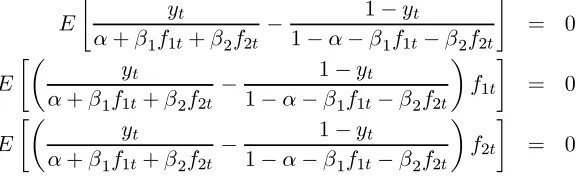
Unconstrained minimisation with respect to{α, β1, β2}gives the first order population conditions:
E
·
yt
α+β1f1t+β2f2t−
1−yt
1−α−β1f1t−β2f2t ¸
= 0
E
·µ
yt
α+β1f1t+β2f2t −
1−yt
1−α−β1f1t−β2f2t 
f1t ¸
= 0
E
·µ
yt
α+β1f1t+β2f2t −
1−yt
1−α−β1f1t−β2f2t 
f2t ¸
= 0
If f2t is independent of yt and f1t, and encompassing held (i.e., β2 = 0), some simplification is
possible. For example, the third condition reduces to the first, and becomes redundant, so for
forecast encompassing to hold, we require a unique solution to the following two equations, for
admissible values of αandβ1:
E
·
yt
α+β1f1t−
1−yt
1−α−β1f1t ¸
= 0 (5)
E
·µ
yt α+β1f1t −
1−yt
1−α−β1f1t 
f1t ¸
= 0 (6)
The simplest approach to investigating the tests of forecast encompassing for LPS is by
simula-tion. For given values of the underlying parameters (δi,i = 1,2,3;µZ;ρX1,X2;ρX1,Z;ρX2,Z), the population values of the θij are taken to be the values that we determined by simulation when
investigating the population QPS combination weights. These values are then used in the
simu-lations proper to construct f1t and f2t as model-based forecasts. Bias is introduced as discussed
in section 2, namely, by setting µZ 6= 0 and omitting the intercepts from the logit model fore-casts. For the non-model-based forecasts, the pre-simulations are unnecessary, as we simply set
f1t= exp(X1t) (1 + exp(X1t))−1 andf2t= exp(X2t) (1 + exp(X2t))−1, as for QPS.
Table 1 (Panel B) records the population values of the combination weights for LPS for the
same parameter settings as for QPS, so that the results for QPS and LPS are directly comparable.
As in the case of QPS, the FE(2) test imposesβ1 = (1−β2), and the FE(3) test sets β1= 1. It is apparent that the results match: when forecast encompassing holds for LPS it also holds for QPS,
and the three different LPS tests match in the case of the model-based forecasts, but not otherwise.
[image:11.612.163.451.209.297.2]pop-ulation is perhaps unsurprising as the two alternative loss functions can be viewed as two
dif-ferent estimators of the combination weights. Given that yt is binary, the combined probability
P(yt= 1) =α+β1f1t+β2f2t implies that
E(yt|f1t, f2t) =α+β1f1t+β2f2t
with associated regression model:
yt=α+β1f1t+β2f2t+εt.
OLS estimation is then the same as QPS. Alternatively, the likelihood route is based on maximizing
(the log of) L = Qy
t=1P(yt = 1)ytQyt=0P(yt = 0)1−yt, which corresponds to LPS. In the next section we consider tests based on LPS and QPS, as the different properties of the loss functions
(LPS penalises large errors relatively more heavily) means that a combined forecast may result in a
statistically significant reduction in loss for one loss function (forecast encompassing rejected) but
not for the other (forecast encompassing not rejected).
4
Forecast encompassing test statistics for QPS and LPS
In this section we present forecast encompassing test statistics for use with FE(1), FE(2) and FE(3)
for both QPS and LPS.
4.1
QPS tests
We follow Harveyet al.(1998) and West (2001) in considering tests of QPS forecast encompassing based on the Diebold and Mariano (1995) (DM)-type approach. Following these papers, we assume
that the forecasts are generated from a non-nested structure. When the forecasts are from models
which are nested, an analysis along the lines of Clark and McCracken (2001) is required (see also
the review article by West (2006)). Extending the Harvey et al. (1998) analysis of tests based on FE(2) to allow for biased forecasts, by working with deviations from means, it is straightforward
to define DM tests for both FE(2) and FE(3) as:
DM= qP nd
h−1
τ=−(h−1)
Pn
t=|τ|+1(dt−d)(dt−|τ|−d)
(7)
where
dt= (e1t−e1)[(e1t−e1)−(e2t−e2)] for FE(2)
dt= (e1t−e1)(f2t−f2) for FE(3)
andd=n−1Ptn=1dt. Harveyet al.(1998) provide the rationale for the modification to improve the small-sample performance of the DM test, that results in the MDM statistic. We also define DM
and MDM tests for FE(1) by making use of the Frisch-Waugh theorem. The population parameter
β2 in FE(1) is identical toβ2 in:
η1t=β2η2t+νt
where η1t and η2t are the errors from the regression of yt and f2t, respectively, on a constant and
f1t. The null of β2 = 0 therefore holds when E(η1tη2t) = 0, allowing use of the DM and MDM tests with:
dt= ˆη1tηˆ2t for FE(1).
Abstracting temporarily from the forecasts being based on models, whereby the estimation of
the models’ parameters imparts an additional source of uncertainty, then the asymptotic normality
of DM and MDM follows from standard results. In practice, we compare the MDM tests to a
Studenttdistribution withn−1degrees of freedom.Alternatively, one could consider a regression-based t-statistic of the null that β2 = 0 in FE(1) (and similarly for FE(2) and FE(3)), calculated using an appropriate heteroskedasticity and autocorrelation consistent variance estimator. Such a
test also has a limiting standard normal distribution under the null. Preliminaryfindings indicated
that tests based on the DM approach (especially MDM) generally outperformed regression-based
t-statistics. The DM approach can also be readily extended to consider the effects of parameter
estimation: see section 4.3.
A final point is that although it may appear that the form of the denominator in (7) is inap-propriate for FE(1) and FE(3) when {yt,f1t,f2t}is autocorrelated, allowing for dependence only
up to orderh−1 indt is in fact appropriate for all three approaches for ‘well-specified’ forecasts. In the case of FE(2), dt depends only on the forecast errors, with dependence structure that can
reasonably be assumed to be no more than an MA(h−1) for a horizon of h. Thus the form of the denominator in (7) is readily justified for FE(2). For FE(1) and FE(3) we arrive at the same
conclusion, although the argument is a little more involved. First consider FE(3) when h = 1. Regardless of any autocorrelation in f1t and yt, for well conceived forecasts we expect e1t to be
free of autocorrelation. As dt is the product of (e1t−e1) and a potentially autocorrelated process
dt will be free of autocorrelation regardless of the autocorrelation structure of ˆη2t. Turning now toh-step-ahead forecasts, the same arguments go through, except now we would expect(e1t−e1)
and ˆη1t to be autocorrelated to a maximum order of MA(h−1). Thus for both FE(1) and FE(3)
dtshould be autocorrelated no more than order (h−1).
The non-model-based forecasts do not give rise toh-step forecast errors which exhibit correlation
of no more thanh−1. For forecasts such as these additional covariance terms need to be included in the long-run variance estimator. Various kernel functions for weighting the covariance terms could
be used, although the simplest approach is to continue with the uniform, but with the
Newey-West lag truncation L = trun³4(n/100)29
´
replacing h−1 in the denominator. The advantage of maintaining uniform weighting is that the MDM small-sample modification is derived assuming the use of this variance estimator in the DM statistic. Because L < h−1 is possible for small estimation sample sizes, we suggest usingmax (L, h−1).
4.2
LPS tests
LPS-based tests of forecast encompassing are based on the MLE of the likelihood:
lnL=XlnLt=X[ytlnft+ (1−yt) ln(1−ft)] (8)
noting that this likelihood corresponds to −n−1 times LPS. For the test based on the FE(1) ap-proach,ft=α+β1f1t+β2f2t, with obvious modifications for tests based of FE(2) and FE(3). For the DGP given in section 2.1 it is straightforward to show that (8) is the true likelihood so that
the consistency of the MLEβˆ forβ follows under standard conditions. We use the OPG estimator of the covariance matrix of βˆ, denoted VˆG = (g0g)−1
¯ ¯
¯α,ˆˆβ1,βˆ2, where g is the n×3 gradient
ma-trix with typical row gt = ∂lnLt
∂α ,∂
lnLt
∂β1 ,
∂lnLt
∂β2 , and let gˆt (and gˆ) denote this quantity evaluated
at βˆ. For LPS, the ‘sandwich estimator’ is identical to the OPG estimator, because the hessian
H = ∂2lnL
∂β∂β0 is identical to −g0g. Therefore the sandwich estimator Vˆ
S = ˆVHˆg0gˆVˆH = ˆVG where
ˆ
VH = (−H)−1
¯ ¯ ¯α,ˆβˆ1,βˆ2.
When the {yt, f1t, f2t}are autocorrelated, we need to use an autocorrelation-consistent
estima-tor of the covariance ofβˆ. Unlike for the (M)DM test denominator for QPS-forecast encompassing, we need to allow for general autocorrelation in excess of orderh−1, as the arguments that permit us to restrict the dependence to h−1 in that context no longer hold. Put another way, we need an autocorrelation correction even forh= 1when the data and forecasts display serial correlation. The autocorrelation-consistent variance estimator we employ is given by:
ˆ
where:
ˆ
Γ=
n X
i=1
n X
j=1
|i−j|≤L
w(i−j) ˆg0iˆgj
with w(i−j) = 1− |i1+−Lj| and the Newey-West lag truncation L = trun³4(n/100)29
´
rather than
L = h−1 (provided L > h−1). Under the null, t = ˆβ2/r³VˆE´
3,3 has a standard normal
distribution in the limit. In practice, we compare the test statistic to a Studenttwithn−3degrees of freedom (n−2 for the FE(2) and FE(3) versions).
4.3
Parameter estimation uncertainty
When forecasts are derived from models with estimated parameters, as will typically be the case
in practice, it has recently been shown that the asymptotic distributions of tests of predictive
accuracy may be affected: see West (1996), West and McCracken (1998) and West (2001). West
(2001) establishes that forecast encompassing tests of the sort we describe as FE(2) will be affected
by the additional source of uncertainty from estimating the models’ parameters, and West and
McCracken (1998) show that the same is true for the FE(3) tests. West and McCracken (1998)
and West (2001) show by Monte Carlo the influence of estimation uncertainty and illustrate the
properties of tests which make an allowance for estimation uncertainty. Both studies consider linear
models estimated by OLS, and assume a squared-error loss function (corresponding to QPS). In
this section we extend their results to cover the FE(1) tests, and forecasts obtained from estimated
logit models, maintaining the assumption of a QPS loss function. We show that, in contrast to tests
based on FE(2) and FE(3), tests based on FE(1) are unaffected by estimating parameters in linear
models, and by simulation that the same is true of logit/probit models estimated by maximum
likelihood (ML).
Beginning with the linear model setup in West (2001), we suppose forecasts are obtained from
models with regressorsX1t and X2t, assumed here to be single variables for convenience:7
yt = X1tθ1+e1t
yt = X2tθ2+e2t (9)
When the parameters are known, and when the forecast errors are assumed to have zero mean, the
FE(2)DM test that thefirst model encompasses the second utilisesdt=e1t(e1t−e2t). Under the
7
null that E(dt) = 0, the sample average de=n−1PRt=+Rn+1dt scaled as
√
nd/e√S is asymptotically
N(0,1), where S = V (dt), and S is estimated by the sample variance of dt.8 When instead the forecasts are generated from models with estimated parameters, sod=n−1PRt=+Rn+1eˆ1t(ˆe1t−eˆ2t), witheˆit=Xit³θi−ˆθi´+eit, West and McCracken (1998) show that:
√
n£d−E(dt) ¤ a
∼N(0,Ω) (10)
where Ω=S +πDVθD0.9 Here, V
θ is the asymptotic covariance matrix of θ, where θ = (θ1, θ2)0,
D = E¡∂dt
∂θ0
¢
, and π = n/R, as n, R → ∞, π < ∞. We can show that estimation uncertainty affects tests of predictive accuracy of probability forecasts from logit (or probit) models estimated
by ML in the same general way that it affects OLS estimation of linear models: that is, (10) holds for estimated logit forecasts. This follows by checking that the assumptions in West (1996)
that give rise to (10) are also satisfied by ML estimation of logit models. That the assumptions
are satisfied follows immediately from West (1996, Assumption 2). In the nonlinear regression equation, yt = g(Xt, θ∗) +et, we need to be able to write ˆθ−θ∗ = B(t)H(t), where H(t) is a sample average of the population orthogonality conditions, andB(t)weights these conditions. We then require thatB(t)a.s→Band H(t) =t−1Pst=1hs(θ∗)withE[hs(θ∗)] = 0. For the logit model,
g(Xt, θ∗) = Λ(Xt, θ∗) = exp ¡
θ∗0Xt ¢ ¡
1 + exp¡θ∗0Xt ¢¢−1
is a smooth function of θ (as required).
The model is estimated by ML, so that, as noted by West, H(t) is the score and B(t) the inverse of the Hessian evaluated at a pointθ0, betweenθ∗ and ˆθ. For the logit model:
hs=hys−exp¡θ∗0Xs¢ ¡1 + exp¡θ∗0Xs¢¢−1iXs
and
B(t) =
"
−t−1
t X
s=1
³
exp¡θ00Xs¢ ¡1 + exp¡θ00Xs¢¢2´XsXs0
#−1
.
In general (that is, for linear models estimated by OLS, and logit/probit models estimated by
ML), for the three tests of forecast encompassing we have the following expressions fordt:
8We follow the convention in West (1996) and subsequent papers ofRdenoting the estimation sample, andR+1to R+nthe set of (1-step) forecasts. We consider the ‘fixed’ forecasting scheme, whereby model estimates are obtained once only on thefirstR observations and are subsequently heldfixed for all the forecasts.
9
FE(1)dt = ½
[yt−E(yt)]−
C(yt, f1t)
V(f1t)
[f1t−E(f1t)] ¾ ½
[f2t−E(f2t)]−
C(f1t, f2t)
V(f1t)
[f1t−E(f1t)] ¾
FE(2)dt = {[yt−E(yt)]−[f1t−E(f1t)]} {[f2t−E(f2t)]−[f1t−E(f1t)]} (11) FE(3)dt = {[yt−E(yt)]−[f1t−E(f1t)]}[f2t−E(f2t)]
The expressions for dt for FE(2) and FE(3) follow immediately, while FE(1) is discussed below.
Although our interest is in the logit models, the linear model set up (9) turns out to be informative.
The results for FE(2) and FE(3) are in the literature we have cited. For the DM test based on
the FE(2) regression, we haveD= [−2E(e1tX1t) +E(e2tX1t), E(e1tX2t)] = [E(e2tX1t), E(e1tX2t)], using E(e1tX1t) = 0. BecauseD6= (0,0),Ω6=S and parameter estimation affects the asymptotic distribution of the forecast encompassing test. Similarly for the DM test based on FE(3): in
population terms,dt= [e1t−E(e1t)][f2t−E(f2t)], so thatD= [−θ2C(X1t, X2t), C(e1t, X2t)]6= (0,0) in general.10
The effects of estimation uncertainty on tests based on FE(1) have not been considered to date.
Recall that our DM type test for FE(1) is based on testing E(dt) = 0, where dt=η1tη2t, with η1t
and η2t denoting the errors from the regressions
yt=γ1+γ2f1t+η1t
f2t=φ1+φ2f1t+η2t. (12)
Using the population values of the regression parameters we obtain:
η1t=yt−E(yt)−
C(yt, f1t)
V(f1t)
[f1t−E(f1t)]
η2t=f2t−E(f2t)−
C(f1t, f2t)
V(f1t)
[f1t−E(f1t)] (13)
For forecasts from linear models, e.g., fit = Xitθi, so that E(fit) = E(Xit)θi, the errors η1t and
η2t can be written as functions of moments of the data:
η1t= [yt−E(yt)]−
C(yt, X1t)
V(X1t)
[X1t−E(X1t)]
1 0
Whenf2t is independent of f1t andyt, then it follows immediately from (11) thatD=E
∂dt
∂θ0
= 0for FE(1) — FE(3), so that the limiting distributions of the tests are unaffected by estimation uncertainty. However, as noted earlier, this case is of little interest in practice, withf2t=X2tˆθ2approaching a constant as the estimation sampleR
η2t=θ2
½
[X2t−E(X2t)]−
C(X1t, X2t)
V(X1t)
[X1t−E(X1t)] ¾
so that we obtain dt as:
dt=θ2
½
[yt−E(yt)]−C(yt, X1t)
V(X1t)
[X1t−E(X1t)] ¾ ½
[X2t−E(X2t)]−
C(X1t, X2t)
V(X1t)
[X1t−E(X1t)] ¾
.
(14)
Clearly,∂dt/∂θ1= 0, and:
E
µ
∂dt ∂θ2

=C(yt, X2t)−
C(X1t, X2t)C(yt, X1t)
V(X1t)
(15)
The null hypothesis, β2 = 0, implies thatV(f1t)C(yt, f2t)−C(f1t, f2t)C(yt, f1t) = 0. Substituting for f1t and f2t in this expression, and dividing both sides by θ21θ2 (noting that θ1 6= 0, θ2 6= 0),
we find that the right-hand-side of (15) equals zero. SoD= (0,0)under the null, and estimation uncertainty is irrelevant asymptotically. This contrasts with the findings using the DM variants of the FE(2) and FE(3) tests.
Consider now logit model forecasts, fit = exp(θ0i+θ1iXit)
1+exp(θ0i+θ1iXit), where the parameter vector is now
θ = (θ01, θ11, θ02, θ12). In order to determine the effects of estimation uncertainty, we need D =
E¡∂dt ∂θ0 ¢
for each of the three cases FE(1), FE(2) and FE(3). For FE(1) we have:
∂dt
∂θj1
= [f2t−E(f2t)]
∂{[yt−E(yt)]−[f1t−E(f1t)]}
∂θj1
, j= 0,1
∂dt
∂θj2
={[yt−E(yt)]−[f1t−E(f1t)]}
∂[f2t−E(f2t)]
∂θj2
, j = 0,1.
and similar expressions can be obtained for FE(2) and FE(3). Unlike in the linear case (wherefit=
Xitθi), fit is a non-linear function of θi, and calculating D appears to be analytically intractable,
and so we proceed by Monte Carlo. It also appears that little progress can be made when instead
the loss function is given by LPS, so that the impact of parameter estimation on tests of forecast
encompassing for logit-model forecasts under LPS is also investigated by simulation.
4.4
A Monte Carlo of the small-sample test performance
As part of the overall assessment of the small-sample performance of the tests of forecast
encom-passing based on QPS and LPS, we design experiments that show up the effects of estimation
uncer-tainty, as well as the effects of the size of the sample of available forecasts. Data is generated from
and values of R such that for each n, n/R = {2,1,0.5,0.25,0.125,0.0625,0}, where the limiting value of zero corresponds to the case of no parameter estimation uncertainty (using the simulated
population θij values as described in section 2.2), andn/R= 2 indicates twice as many forecasts as in-sample observations. All simulations were computed using 10,000 Monte Carlo replications.
The parameter values used to simulate data in the Monte Carlo match those underlying the
estimates reported in Table 1. Note that the forecasting models match the logit models of the
first empirical application in section 5, and so the results of the Monte Carlo will serve as a guide
to the properties of the tests in that application, as well as showing up the effects of parameter
estimation uncertainty. The encompassing tests are implemented as described in sections 4.1 and
4.2. The LPS tests we report include an autocorrelation-correction. This is not necessary here as
we consider iid data andh= 1, but we do so as it is prudent in practical applications to apply such a correction.
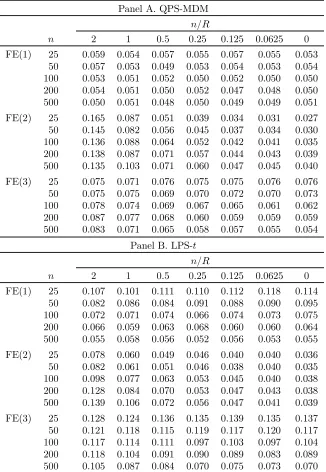
Table 2 presents the Monte Carlo estimates of size for 1-sided 5% level QPS-MDM and LPS-t
tests, for the three test approaches (FE(1), FE(2) and FE(3)), using the DGP given by (4) with
δ3 = 0andρX1,X2 = 0.5. The results for the probability forecast setup match the analyticalfindings
for the linear-model case, in that the QPS and LPS tests based on FE(1) are immune to parameter
estimation effects, while the tests based on FE(2) and FE(3) are not. For FE(1), the empirical
sizes depend on n, and the LPS-t test is clearly over-sized for the smaller values of n, but for a
given n are largely invariant to changes in n/R (that is, across columns). For FE(2) and FE(3)
the empirical sizes approach the nominal 5% as n gets largeand n/R→0, but are over-sized for larger n/R. The actual sizes are approximately 14% for FE(2) when n = 2R, for large n, and approximately 8%−10% for FE(3). The limiting case of no estimation uncertainty is recorded in the final column. For both the QPS and LPS tests, tests based on FE(2) display under-sizing in small samples, while those based on FE(3) exhibit over-sizing. Qualitatively similar results were
obtained for the mis-specified case (the DGP given by (4) withδ3= 1,µZ = 0,ρX1,Z =ρX2,Z = 0)
and for the biased foreast case (the DGP given by (4) with δ3= 1,µZ = 1,ρX1,Z =ρX2,Z = 0).
11
Table 3 reports empirical sizes for the same DGPs but using non-model-based forecasts. Here,
the additional autocorrelation correction is applied to the QPS-MDM tests, as described in section
4.1. The FE(1) tests are correctly sized in large samples for both QPS and LPS, and are somewhat
over-sized for small n. When the non-model-based forecasts are correctly specified, i.e., when
δ3 = 0, the FE(2) and FE(3) tests are also correctly sized for largen, as would be expected given
the population results of Table 1. However, for largenwhen δ3= 1, the FE(2) tests are over-sized
and the FE(3) tests are under-sized. This is again consistent with our earlier results, since, in
1 1
population, β02 > 0 and β002 < 0 for non-model-based forecasts when δ3 = 1, and the size results
reported pertain to 1-sided tests. Size distortions also persist for the FE(2) and FE(3) tests in
small samples.
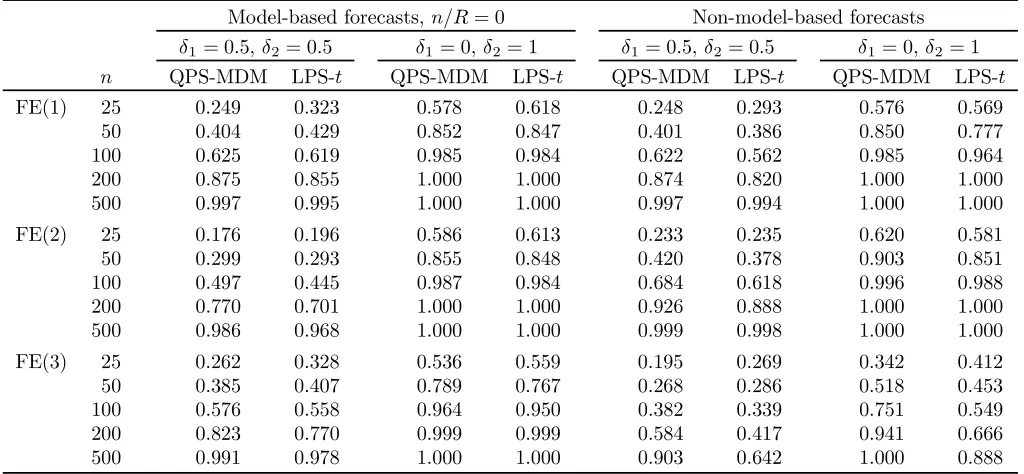
Finally, Table 4 presents estimated powers of the tests for the caseδ3 = 0,ρX1,X2 = 0.5, for two
alternative hypothesis DGPs, given byδ1 = 0.5,δ2 = 0.5, andδ1 = 0,δ2 = 1. We abstract from the
issue of parameter estimation uncertainty for the purposes of this power comparison. The power of
all the tests is increasing in n, and higher for the δ1 = 0, δ2 = 1DGP than the δ1 = 0.5, δ2 = 0.5
DGP, as would be expected. For the model-based forecasts, the FE(1) based tests have generally
the higher power compared to FE(2) and FE(3), under both QPS and LPS. The power advantages
of FE(1) over both FE(2) and FE(3) are often substantial, while on the relatively few occasions
where FE(1) is outperformed, the power losses are slight. For the non-model-based forecasts, FE(3)
is always considerably inferior in terms of power compared to the other two approaches. Neither
FE(1) nor FE(2) dominates the other, and although FE(2) has greater power than FE(1) in many
cases, the differences in power are not great.
Overall, tests based on FE(1) appear to have the most desirablefinite sample properties. They
are robust to the effects of parameter estimation uncertainty, have good finite sample size and power relative to approaches based on FE(2) and FE(3), and are more reliable when the forecasts
are non-model-based. We therefore recommend that the QPS-MDM and LPS-t tests based on the
FE(1) approach should be used in practical application.
5
Empirical illustrations
Our first empirical application of the QPS and LPS probability forecast encompassing tests is to the evaluation of rival model-based forecast probabilities of recession. The second assesses
the accuracy of individual survey respondents’ probability forecasts relative to the ‘consensus’ or
average probability forecasts of the phenomena of interest.
5.1
Evaluating model-based US recession forecast probabilities
The forecast encompassing tests are used to assess the relative information value of two leading
indicators for post War US recessions. Forecasts of the probabilities of recession are generated from
logit models that use, respectively, interest rate spreads, and some transformation of the oil price.
Recessionary periods are those defined by the NBER’s Business Cycle Dating Committee12. The
motivation for focusing on spreads and oil prices is as follows. The usefulness offinancial variables
1 2See
for predicting US recessions has been established by Estrella and Mishkin (1998), Anderson and
Vahid (2001) and Hamilton and Kim (2000), inter alia. The slope of the yield curve tends to dominate other financial variables as a predictor of recessions, in that the yield curve is often
the single best choice, and the incremental benefit of including other financial variables is often small. Chauvet and Potter (2002) allow for structural breaks in probit models that use the yield
curve to predict recessions, but we use simple constant-parameter models as our aim is simply
to illustrate the use of the forecast encompassing tests. Recent research also suggests a role for
oil prices as an indicator for output growth (e.g., Hamilton (1983), Mork (1989), Hooker (1996),
Hamilton (1996), Carruth, Hooker and Oswald (1998) and Hamilton (2000)), and by association,
for recessions, although there is some debate over the form of the relationship. We follow Lee, Ni
and Ratti (1995) and Hamilton (1996) and use thenet increasein oil prices over the previous year, and downweight increases in oil prices at times of relatively high volatility.
We use quarterly spread and oil price data for the period 1960:1—1999:4.13 We divide the
period into an in-sample estimation period (1960:1—1979:4) and a forecast period (1980:1—1999:4).
Preliminary work suggested that the logit models of the recession indicator on the spread (and an
intercept) appeared to work best if the spread is lagged three or four periods, and we chose a three
period lag. For the oil price model, the recession indicator was regressed on the net increase lagged
two periods. The in-samplefits of the two logit regression models are summarized in Table 5. The superior individual performance of the spread is apparent from the QPS and LPS, although from the
p-values of the pseudo-R2 statistics for both models it is evident that both leading indicators have
significant in-sample predictive power for recessions.14 It is therefore of interest to assess whether the oil price-logit model forecast probabilities contain useful information in terms of delivering a
statistically-significant reduction in QPS and/or LPS when used in combination with the yield curve predicted probabilities.
Table 6 reports results using the two recommended forecast encompassing tests–the FE(1)
based QPS-MDM test, and the FE(1) based autocorrelation-consistent LPS-ttest (given that the
1 3
The spread data is the 10-year treasury constant maturity rate less the 3-month treasury bill at secondary market rate. These are popular choices of long and short rates. Quarterly data is obtained from the monthly data by averaging. The data were taken from the FRED websitehttp://research.stlouisfed.org/fred2. The oil price data are available from James Hamilton’s web pagehttp://weber.ucsd.edu/~jhamilto.
1 4
Various R2 measures have been proposed in the literature for discrete choice models. We follow Estrella and Mishkin (1998) and report a measure defined as:
R2
= 1−
llu llr
−(2
nllr)
data is autocorrelated). The forecast probabilities underlying the results are 1-step ahead forecasts
for 1980:1—1999:4 (n= 80), generated using the coefficient estimates for 1960:1—1979:4. The tests are conducted using a 1-sided alternative, and the correspondingp-values are reported in the table.
The null that the oil price-model forecasts encompass the spread-model forecasts is clearly rejected.
This is consistent with the superior in-sample performance of the spread-model probability forecasts.
This holds regardless of whether accuracy is assessed by QPS or LPS; for LPS the null is rejected
at the 1% level. The more interesting hypothesis is whether the spread-model forecasts encompass
the oil-price model forecasts. The null of encompassing in this direction is not rejected at the 5%
level for either QPS or LPS. Thep-value for the LPS-ttest is0.060, but we have already established that it is likely to be over-sized in small samples. Consequently, we arrive at the conclusion that
encompassing holds in one direction only, with the spread-model forecasts encompassing the
oil-price-model forecasts.
5.2
Evaluation of survey-based expectations
The tests of forecast encompassing are also illustated using the probabilities of output decline
recorded by the respondents to the Survey of Professional Forecasters (SPF).15 Amongst other
things, respondents report the probabilities they attach to declines in real output in the current
quarter and in each of the following four quarters. We focus on the next quarter and the
four-quarter ahead forecasts, which correspond toh= 2andh= 5step-ahead forecasts. The individual forecasts will be compared to an average or ‘consensus’ forecast of the individual assessments. For
h= 2, this average forecast corresponds to the ‘anxious index’ reported by the SPF. The question we address is whether the average indices contain all the useful information in the individuals’
probability assessments: do the average indices encompass the individual forecasts? We calculate
tests in a pairwise fashion for the anxiety indices against each of the individuals’ forecasts in turn.
Comparing each individual to the average of those who respond has the advantage of allowing the
tests to employ all the occasions on which a particular individual responded.
The binary series of whether output declines in quarter t,{yt}, is calculated from the series of quarterly real-time data sets for real output maintained by the Federal Reserve Bank of Philadelphia
(see Croushore and Stark (2001)). Consider a respondent to the 1995first-quarter SPF survey who
reports forecast probabilities of a decline in 95:Q2 relative to 95:Q1 (ourh= 2 forecast), and of a decline in 96:Q1 relative to 95:Q4 (a h= 5 forecast). We determine whether there was a decline
1 5
in 95:Q2 relative to 95:Q1 based on the values of real output in these two quarters in the August
1995 real-time data set (which contains the advance releasefigures for 95:Q2), and we use the May 1996 real-time data set to evaluate whether there was a decline in 96:Q1. In this way, declines are
calculated based on the first-available figures. This seems preferable to using later vintage series which will typically contain revisions and definitional changes that were largely unpredictable at
the time (see, e.g., Koenig, Dolmas and Piger (2003), and Faust, Rogers and Wright (2005, 2003)).
Table 7 recordsp-values of the FE(1) forecast encompassing tests of the null that the individual
forecast encompasses the average, and of encompassing in the reverse direction. As we have no
knowledge of how the forecasts are formed, the test statistics for corrected for general
autocorre-lation, as described earlier. Results are presented for some individuals who made at least sixty2 -and5-step forecasts. Note that the historical time periods for which we have observations will vary from individual to individual, and that as the averages were constructed from all available forecasts
at each time point and horizon, the number of constituent forecasts differ over time period, horizon
and individual.
For h = 2, for all but the first individual, we reject the null that the individuals’ forecasts encompass the consensus for both QPS and LPS (at a 10% significance level). Tests that the average encompasses the individual forecasts reject in only one instance for both QPS and LPS
(the same individual). We conclude that for h= 2 the equal-weighted linear combinations of the individuals’ forecasts (such as the ‘anxiety index’) convey all the useful information in the individual
forecasts with one exception. Forh= 5the QPS and LPS tests indicate that encompassing holds in both directions: the respondents encompass the average and are encompassed by the average. This
is consistent with the individuals’ forecasts and the average forecast containing similar information.
The last rows of each panel of table 7 report the results of encompassing tests of the average
SPF forecasts against the logit-model forecasts using the spread as a leading indicator, as in the
previous section. To ensure a fair comparison with the survey predictions, the logit-model forecasts
are generated recursively using at each point in time the vintage of data that was available to the
respondents to the corresponding survey. For h= 2, both the QPS and LPS tests indicate that encompassing is rejected in both directions: both the survey and model-based forecasts contain
useful additional information not contained in the other. Forh= 5there is clear evidence that the model-based forecasts dominate: they encompass, but are not encompassed by, the survey-based
forecasts. This is consistent with Estrella and Mishkin (1998) who find that the yield curve has
6
Conclusions
We have investigated the use of tests of forecast encompassing for evaluating probability forecasts.
Probability forecasts are commonly evaluated using both quadratic and logarithmic scoring rules
(QPS and LPS), and we have considered tests of forecast encompassing based on both. The use of
QPS leads to encompassing tests based on OLS estimation of the encompassing regression, as in
the standard point forecast evaluation literature. For LPS we use maximum likelihood. We derive
tests which have limiting standard normal distributions under the null of encompassing for both
loss functions.
In the literature on forecast encompassing for standard (i.e., not probability) point forecasts,
tests are often based on one of a number of regression approaches which differ in terms of the
restrictions imposed in the maintained model. We show that the choice of which of these approaches
to use may matter for at least two reasons. Firstly, we are able to establish analytically that, in
the standard setup, the limiting distribution of the test based on the more general regression (that
advocated by Fair and Shiller (1990)) is unaffected by parameter estimation uncertainty, although
this is not the case for tests based on the two more restricted regressions which have been the focus of
the recent literature (see, e.g., West and McCracken (1998) and West (2001) on the more restricted
regressions FE(3) and FE(2)). Analytical results for the (non-linear) probability forecasting case
are difficult to obtain, and instead we rely on a Monte Carlo study to show that the same is true
for probability forecasts for tests based on both QPS and LPS.
Secondly, tests based on the more restricted forms of the encompassing regression (as frequently
used in the point forecast context) may reject encompassing when encompassing holds. This will
occur when the implicit assumptions underpinning the more restricted regressions do not hold.
This may occur for forecasts which do not make an efficient use of the information on which they
are based, as may be the case for some non-model-based forecasts.
The tests are illustrated with two empirical applications. The first is typical of the literature on assessing the usefulness of various leading indicators for predicting the probabilities of post War
US recessions. Logit models are used to derive predicted recession probabilities using two leading
indicators of recession–the yield curve and the oil price. We conclude that encompassing holds in
one direction only, with forecasts from the model with the yield curve encompassing predictions
from the oil price model. The second empirical illustration compared individual SPF respondents’
probability assessments of declines in output against the ‘consensus’, to see whether the implicit
equal-weighting of the consensus could be improved upon. Comparing the consensus and
yield-curve model forecasts, we also found that there was useful incremental information in the latter at
Appendix 1. Moments of forecasts for probability forecast DGP
In this Appendix we derive the moments of {yt, f1t, f2t} for the data generating process given by
equation (4) in section 2.1. The expressions for the moments can then be evaluated using numerical
methods to derive population values of the parameters in the QPS encompassing regressions.
Firstly, consider the unbiased forecast case where µZ = 0. Recall that the forecasts are given by:
f1t=
exp(θ01+θ11X1t)
1 + exp(θ01+θ11X1t)
, f2t=
exp(θ02+θ12X2t)
1 + exp(θ02+θ12X2t)
where θij can be interpreted as the population parameters associated with logit regressions of yt
on a constant andX1t, and a constant andX2t, respectively. Then, fori= 1,2:
E(fi) =
Z ∞
−∞
exp(θ0i+θ1iXi)
1 + exp(θ0i+θ1iXi)
f(Xi)dXi
=
Z ∞
−∞
exp(θ0i+θ1iXi)
1 + exp(θ0i+θ1iXi)
1
√
2π exp
µ −1 2X 2 i ¶ dXi
= √1
2π
Z ∞
−∞
exp(θ0i+θ1iXi−12Xi2)
1 + exp(θ0i+θ1iXi)
dXi
E(fi2) =
Z ∞
−∞
·
exp(θ0i+θ1iXi)
1 + exp(θ0i+θ1iXi)
¸2
f(Xi)dXi
= √1
2π
Z ∞
−∞
exp(2θ0i+ 2θ1iXi−12Xi2)
[1 + exp(θ0i+θ1iXi)]2
dXi
E(f1f2) =
Z ∞
−∞
Z ∞
−∞
exp(θ01+θ11X1)
1 + exp(θ01+θ11X1)
exp(θ02+θ12X2)
1 + exp(θ02+θ12X2)
f(X1, X2)∂X1∂X2
= 1
2πp|Ω2×2|
Z ∞
−∞
Z ∞
−∞
exp(θ01+θ02+θ11X1+θ12X2)
[1 + exp(θ01+θ11X1)][1 + exp(θ02+θ12X2)]
×exp
µ
−21x02×1Ω2−×12x2×1

∂X1∂X2
where:
x2×1=
"
X1
X2
#
, Ω2×2 =
"
1 ρX1,X2 ρX1,X2 1
so that, for example, whenρX1,X2 = 0.5:
E(f1f2) =
1 2π√0.75
∞ Z −∞ ∞ Z −∞
exp(θ01+θ02+θ11X1+θ12X2−23X12−23X 2
2 +23X1X2)
[1 + exp(θ01+θ11X1)] [1 + exp(θ02+θ12X2)]
∂X1∂X2
In the specification for yt, consider the potentially encompassing situation whereδ2 = 0. Also,
let δ0= 0and δ1 = 1. Then:
E(yt) =
∞ Z −∞ ∞ Z −∞ ∞ Z −∞ 1 Z 0 1 µ
exp(X1+δ3Z)
1 + exp(X1+δ3Z)
> v

f(X1, X2, Z)∂v∂X1∂X2∂Z
= ∞ Z −∞ ∞ Z −∞ ∞ Z −∞
Z exp(X1+δ3Z) 1+exp(X1+δ3Z)
0
1.∂vf(X1, X2, Z)∂X1∂X2∂Z
= ∞ Z −∞ ∞ Z −∞ ∞ Z −∞
exp(X1+δ3Z)
1 + exp(X1+δ3Z)
f(X1, X2, Z)∂X1∂X2∂Z
= 1
(2π)3/2p|Ω| ∞ Z −∞ ∞ Z −∞ ∞ Z −∞
exp(X1+δ3Z)
1 + exp(X1+δ3Z)
exp
µ
−12x0Ω−1x

∂X1∂X2∂Z
where: x= X1 X2 Z
, Ω=
1 ρX1,X2 ρX1,Z ρX1,X2 1 ρX2,Z
ρX1,Z ρX2,Z 1
In addition, we obtain for E(ytf1t):
∞ Z −∞ ∞ Z −∞ ∞ Z −∞ 1 Z 0 1 µ
exp(X1+δ3Z)
1 + exp(X1+δ3Z)
> v

exp(θ01+θ11X1)
1 + exp(θ01+θ11X1)
f(X1, X2, Z)∂v∂X1∂X2∂Z
= ∞ Z −∞ ∞ Z −∞ ∞ Z −∞
exp(X1+δ3Z)
1 + exp(X1+δ3Z)
exp(θ01+θ11X1)
1 + exp(θ01+θ11X1)
f(X1, X2, Z)∂X1∂X2∂Z
= 1
(2π)3/2p|Ω| ∞ Z −∞ ∞ Z −∞ ∞ Z −∞
exp(θ01+ (1 +θ11)X1+δ3Z)
[1 + exp(X1+δ3Z)][1 + exp(θ01+θ11X1)]
exp
µ
−12x0Ω−1x

and for E(ytf2t): ∞ Z −∞ ∞ Z −∞ ∞ Z −∞ 1 Z 0 1 µ
exp(X1+δ3Z)
1 + exp(X1+δ3Z)
> v

exp(θ02+θ12X2)
1 + exp(θ02+θ12X2)
f(X1, X2, Z)∂v∂X1∂X2∂Z
= 1
(2π)3/2p|Ω| ∞ Z −∞ ∞ Z −∞ ∞ Z −∞
exp(θ02+X1+θ12X2+δ3Z)
[1 + exp(X1+δ3Z)][1 + exp(θ02+θ12X2)]
exp
µ
−12x0Ω−1x

∂X1∂X2∂Z
A special case exists where δ3 = 0so thatZtdoes enter the DGP. In this case we have:
E(yt) =
Z ∞
−∞
Z ∞
−∞
exp(X1)
1 + exp(X1)
f(X1, X2)∂X1∂X2
= 1
2πp|Ω2×2|
Z ∞
−∞
Z ∞
−∞
exp(X1)
1 + exp(X1)
exp
µ
−21x02×1Ω2−×12x2×1

∂X1∂X2
E(ytf1t) =
1 2πp|Ω2×2|
∞ Z −∞ ∞ Z −∞
exp(θ01+ (1 +θ11)X1)
[1 + exp(X1)][1 + exp(θ01+θ11X1)]
exp
µ
−21x02×1Ω2−×12x2×1

∂X1∂X2
E(ytf2t) =
1 2πp|Ω2×2|
∞ Z −∞ ∞ Z −∞
exp(θ02+X1+θ12X2)
[1 + exp(X1)][1 + exp(θ02+θ12X2)]
exp
µ
−21x02×1Ω2−×12x2×1

∂X1∂X2
Consider now the biased forecast case where µZ = 1. The forecasts are given by:
f1t=
exp(θ11X1t)
1 + exp(θ11X1t)
, f2t=
exp(θ12X2t)
1 + exp(θ12X2t)
with theθij being the population parameters associated with logit regressions ofytonX1t andX2t
respectively, without a constant term. We have, for i= 1,2:
E(fi) =
Z ∞
−∞
exp(θ1iXi)
1 + exp(θ1iXi)
f(Xi)dXi
= √1 2π
Z ∞
−∞
exp(θ1iX1−12Xi2)
1 + exp(θ1iXi)
dXi
E(fi2) =
Z ∞
−∞
·
exp(θ1iXi)
1 + exp(θ1iXi)
¸2
f(Xi)dXi
= √1 2π
Z ∞
−∞
exp(2θ1iXi−12Xi2)
[1 + exp(θ1iXi)]2