Access to services with interpreters
User views
Claire Alexander, Rosalind Edwards and
Bogusia Temple with Usha Kanani, Liu Zhuang,
report are, however, those of the authors and not necessarily those of the Foundation. Joseph Rowntree Foundation
The Homestead 40 Water End York YO30 6WP
Website: www.jrf.org.uk
© London South Bank University 2004
First published 2004 by the Joseph Rowntree Foundation
All rights reserved. Reproduction of this report by photocopying or electronic means for non-commercial purposes is permitted. Otherwise, no part of this report may be reproduced, adapted, stored in a retrieval system or transmitted by any means, electronic, mechanical, photocopying, or otherwise without the prior written permission of the Joseph Rowntree Foundation.
ISBN 1 85935 228 6 (paperback)
ISBN 1 85935 229 4 (pdf: available at www.jrf.org.uk)
A CIP catalogue record for this report is available from the British Library. Cover design by BP Design, York
Prepared and printed by: York Publishing Services Ltd 64 Hallfield Road
Layerthorpe York YO31 7ZQ
Tel: 01904 430033; Fax: 01904 430868; Website: www.yps-publishing.co.uk
Contents
Acknowledgements vii
1 Introduction to the issues 1
Introduction 1
The political context of language use 1 Provision of interpreting services 3
Our study 5
Structure of the report 6
2 Researching lives in context 8
Introduction 8
Migration histories 8
The research process 12
The importance of researching lives in context:
barriers to learning to speak English 15
3 Ideals and process in using interpreters 17
Introduction 17
Who needs an interpreter? 17 Who makes a good interpreter? 19 Who is an interpreter? 23 Concluding summary: key issues in using interpreters 31
4 ‘Community’, family and friends 33
Introduction 33
Institutional ‘community’: the presence of formal services 33 Creating personal communities 35 ‘Community’ and marginalisation 42 Concluding summary: ‘community’ and access to services 43
5 Trust: personal and abstract qualities in interpreting 45
Introduction 45
Professional interpreting standards 60 Contrasts between user views and professional standards 61
Recommendations 63
Notes 66
We would like to thank members of our Advisory Group for their constructive advice and other help over the two years of the research project on which this report is based: Kusminder Chahal, Roland Chesters, Thomas Chan, Liz Eaton, William Gulam, Keri Roberts, Sarah Robson and Hamarash Salar. We are also grateful to the Joseph Rowntree Foundation for funding the research, and to Barbara Ballard and Chris Goulden for their support especially. Thanks to Jane Williams and Anosua Mitra for their administrative assistance, which helped the project run smoothly. Anosua also helped us by taking photographs for this report, as did Craig Strong of CAS Photography. We would also like to thank Min Liu, who assisted us with selecting our Chinese research assistants and Anne Gray for her help with the analysis of the Home Office 2001 Citizenship Survey data.
Our thanks also go to the research assistants who accessed, and conducted the interviews with, participants and translated the spoken interviews into written English. In addition, they read through drafts of this report and made valuable comments. Our acknowledgement of their vital role is signalled by our inclusion of their names as authors alongside our own (apart from our Kurdish researcher, who did not want his name published). Nevertheless, we take responsibility for the data and arguments presented here.
Finally, we want to thank the participants in this research, both those who helped us generally and in particular those who took part in the interviews. People often lived in difficult circumstances and had many other issues to deal with, yet gave their time to help us with our research. We have changed their names to protect their anonymity.
Introduction
This report explores the experiences of people who need interpreters in order to gain access to, and use of, health, welfare, legal and other services. There are no official figures collected on the number of people living in Britain who need interpreters. Modood and colleagues (1997), however, estimate that just under a third of the Asian ‘communities’1 taking part in their large-scale survey of minority ethnic diversity and
disadvantage spoke little or no English. Moreover, English-language competence was not distributed equally within these groups, reflecting variable socio-economic background and education, length of settlement in the UK, and also relating to gender and age. A further indication of the need for interpreters comes from the Home Office’s 2001 Citizenship Survey (Attwood et al., 2003), which included a broader range of minority ethnic groups comprising over a third of their total sample – 36 per cent of these often spoke languages other than English at home and just under 14 per cent needed someone to translate some or all of the questions for them during the survey interview (our calculations from their data).2 The differences
between these two figures suggests that, although a significant percentage use ‘mother tongue’ languages at home, this does not preclude a substantial degree of English-language capability within these groups overall.
What is not in doubt, though, is that the world of those who speak little or no English, in Britain, can be significantly constrained. There are links between English-language disadvantage and social exclusion and deprivation. Those who most need to register with, and draw on, the services of education, health, legal and social welfare
professionals and officials may be least able to do this because of language
difficulties (see, for example, Ahmed, 2002; Audit Commission, 1993; 2000; Baxter
et al., 1996; Gerrish, 2001; Kansu, 1997; Netto et al., 2001; Pettigrew, 2003;
Robinson, 2002; Stills et al., 1995; Yu, 2000). There is evidence to suggest they are also least integrated into the mainstream labour market (Performance and Innovation Unit, 2002).
Concerns about the exclusion of some minority ethnic groups from mainstream services and society, and the ability to speak English, however, have coalesced to become a political, rather than a merely pragmatic, issue. It is important to
acknowledge this broader political context, which places the topic of access to services with interpreters as a controversial and highly charged issue.
The political context of language use
Although promoting English-language skills has long formed a part of the rhetoric and policies of integration of minority ethnic communities, in recent years the issue
political debates around social inclusion and the future of multiculturalism. Where previously ‘mother tongue’ competency was seen as an integral part of the
maintenance of positive ethnic community identity, and was supported (alongside English-language classes) by government Section 11 funding,3 the past decade has
seen the erosion of financial and political goodwill. Indeed, ‘mother tongue’ language use now forms one of the primary targets in the Government’s rhetoric around
‘citizenship’ and ‘community cohesion’.
In the wake of the disturbances across the North of England in the spring and summer of 2001, lack of English-language facility was identified as an ‘important factor’ in the maintenance of ethnic segregation and cultural hostility between white and Asian communities (Denham Report, 2001, p. 12) and in underpinning high levels of unemployment and poverty among Muslim groups. In an essay on ‘Rethinking Britishness’, the Home Secretary wrote:
We must strive to connect people from different backgrounds, tackle segregation and overcome mutual hostility and ignorance. Of course, one factor in this is the ability of new migrants to speak English – otherwise they cannot get good jobs, or share in wider social debate … For those long settled in the UK … speaking English enables parents … to participate in wider modern culture.
(Quoted in The Guardian, 16 September 2002, our emphasis)
The new blueprint for citizenship education, laid out in the recent Crick Report (2003), has placed an explicit emphasis on ‘integration’, with language facility as a core measure of an individual’s merit for national inclusion. Aimed mainly at asylum seekers and the spouses of settled Asian communities,4 English-language education
has become the cornerstone of cultural and cross-generational integration strategies:
I … welcome the emphasis on English – acquiring English is a pre-requisite to social integration, to further education and employment and to the well being of succeeding generations.
(Home Secretary, quoted in The Guardian, 3 September 2003)
Introduction to the issues
Provision of interpreting services
Several statutes are accompanied by explanatory memoranda and codes of practice that explicitly or implicitly recommend the use of interpreters (Department of Health, 2004; Saunders, 1994), including the Race Relations, Mental Health, Children, and NHS and Community Care Acts. Consistently, though, studies show that there is an acute lack of permanent in-house interpreters across a whole range of social
provision, including primary health care, maternity care, housing, social services, counselling, mental health services, and criminal justice and immigration appeals (e.g. Baker et al., 1991; Baxter, 1997; Council on Tribunals, 1991; Edwards, 1993; Mental Health Act Commission, 1997; NACAB, 1994; Netto et al., 2001; Stills et al., 1995; Yu, 2000). This situation often results either in in-house bilingual employees being ‘called in’ to aid colleagues and act as interpreters, or users relying on friends or family. Racial stereotyping can exacerbate poor interpreting provision, for example with service providers assuming that any person who speaks an Asian language can communicate with all Asian service users, or assumptions about the capacity of older Chinese people to draw on their community’s resources. These are all established circumstances that find an echo in this report on users’ experiences of needing interpreters in order to access services.
Nonetheless, communication needs are increasingly being addressed by service providers, although these often seem to have ad hoc and uncertain funding. Interpreting services are located within local authorities, health services, the voluntary sector and the private sector, or partnerships of these, and are provided using a variety of delivery models and management arrangements (e.g. Department of Health, 2004; Schellekens, 2004). Depending on the source of provision,
interpreters are employed either on full- or part-time contracts, or by the session, and are either provided free to users or users are charged. In some areas, interpreting services are available only during normal office hours and, in others, there are various arrangements for out-of-hours cover. In most services, bookings for interpreters are made by the professional rather than the client, and it is their
judgement as to which minority language the interpreter needs to speak. In addition to face-to-face provision, telephone services have been set up (for example,
Collage of online first language publications
There are no clearly established national guidelines or standards for interpreting service provision, although many providers set their own (discussed further in Chapter 6). There is also a growing emphasis on professionalisation, with
recognised training and qualifications for interpreters. A National Register of Public Service Interpreters has been set up, and those registered are required to hold a qualification and follow a code of conduct. There is also advice provided to English-speaking professionals on how to work with interpreters. Phelan and Parkman’s (1995) advice to health professionals seeing patients with an interpreter, for
Introduction to the issues
the consultation and appearing attentive when the patient responds. In addition to best practice on the part of both interpreters and English-speaking professionals, there is discussion of the models of provision, for example differences between, and relative merits of, professional interpreters, bilingual providers, community
interpreters, interpreter-advocates (Department of Health, 2004; Schellekens, 2004; Thomson et al., 1999).
The vast majority of discussion, review and evaluation in the field of interpreting, however, is conducted from a service provider perspective. There has been little work that looks at users’ own experiences of interpreters, both professional and informal, from their point of view. There is even less research that looks at user preferences for who should interpret for them. In the few exceptions, the focus has been on a single service evaluation rather than on user views of their broad needs for interpreters (e.g. Gerrish, 2001; Healthy Communities Project, 1995; Kansu, 1997). In such work, the link between communication needs and the most
appropriate provider to fill these needs is often assumed rather than investigated. Communication issues, for example in relation to trust and the use of family
members, are seen as best solved by the provision of professional interpreters (e.g. Audit Commission, 2000; Rhodes and Nocon, 2003; Vydelingum, 2000). Generally, also, there are assumptions about the homogeneous nature of community for those with interpreting needs. Minority ethnic groups are often presented as internally homogeneous and equally placed in relation to service provision. These are issues that we will address later in this report.
An alternative approach, however, argues for a wider view of interpreting that is situated in an understanding and knowledge of people’s lives as a whole, rather than through a narrow focus on communication as technical competence, and missed or mistranslations, or a snapshot view of people’s lives (Gerrish, 2001; Robinson, 2002). Decisions about who is best to interpret need to be seen within the wider context of decision making in families, communities and cultures, and to be framed within the choices and constraints of people’s lives. Our research takes this
alternative approach, focusing on the people who need interpreting provision to access services rather than the perspective of service providers.
Our study
The starting point of our research is the experience of users, who are likely to require interpreters across a range of aspects of their lives. Our research aimed to:
• place services users’ experiences in the biographical and cultural context of their lives as a whole, in order to explore how needing interpreters to access and use services may be differentially understood
• point to guideline issues that policy makers, service providers and interpreters need to take into consideration when working with people with little or no English-language competence.
The study is thus concerned with drawing out general lessons for people working in a range of organisational settings, rather than concentrating on technical issues for best practice, or specific issues for users of one particular sort of service.
Structure of the report
This report is structured so as, initially, to introduce the context for the research and for the lives of the people we interviewed. It then examines and overviews the broad contours of our sample’s views and experiences of access to services with
interpreters. This is followed by a detailed exploration of these broad findings, explaining the issues and understandings that underlie them. Finally, we draw conclusions and make recommendations arising from our findings.
• Chapter 2 looks at the context for our research. It discusses the background to our selection of five particular minority ethnic groups, looking at their migration histories. We then describe the ways in which we accessed our sample and the social characteristics of that sample.
• Chapter 3 is concerned with ideals and process in accessing and using interpreters for our sample. We look at when they feel that they need an
interpreter, the qualities that they feel are important in a good interpreter and the role that they want them to play, and their experiences of accessing and using different interpreting resources. We note that, for the most part, people’s experiences of professional interpreters are not particularly good and that they express a preference for family and friends, considering them more ‘trustworthy’.
Introduction to the issues
• Chapter 5 provides an in-depth look at ‘trust’ as a crucial issue emerging from our research. We address the context for ‘trust’ for the people we interviewed, in terms of their views of the general trustworthiness of the society in which they live. We note how this draws attention to issues of personal and abstract trust. This is followed by an exploration of the issue of trust in relation to interpreters, focused around case studies. We draw out the attributes of personal trust in family and friends as interpreters, and those of abstract trust in professional interpreters. We also address the strategies that people have used where they do not trust their interpreter. Finally, we draw out the implications of our discussion, which point towards people’s valuing of a particular mix of personal and abstract trust in interpreters.
• Chapter 6 overviews the findings that have emerged from our research and uses these as a basis for policy and provision recommendations. We contrast our sample’s views of good interpreting practice with the main qualities
Introduction
In this chapter, we set the context for our research and its findings, moving from the broader background to the more specific situations for the people who we
interviewed from the ethnic groups that are the focus of this report. First, at the broad level, we discuss the background to our selection of five particular minority ethnic groups, looking at their migration histories. We then move on to describe our specific sample, addressing their social characteristics. We also look at the process of
accessing these people. Finally, we look at barriers to people learning English as part of the social context of their lives and their need to use interpreters to access services.
Migration histories
Britain has always been a country of migration (Parekh, 2000) and British migration patterns have a varied history. Since World War II, and until recently, immigration to the UK has been dominated by people from the former colonies, especially South Asia, the Caribbean and Africa. In the 1950s, immigration was primarily from the Caribbean and India, while immigration in the 1960s and 1970s was dominated by settlement from India, Pakistan and Asians from East Africa. Most of the Bangladeshi immigrant community arrived during the 1980s. Within recent years, however,
refugee and asylum claims from populations in Africa, the Middle East and Eastern Europe have been a feature (Dustmann et al., 2003).
The five minority ethnic groups that we have chosen to focus on in this research are a range of established and recent migrant groups within the UK: Polish, Chinese, Gujerati Indian, Bangladeshi and Kurdish. Each group has a different population profile, and various sections are more or less likely to be in need of interpreters in order to use services, often based on age and gender. Given their different migration histories, each of our chosen groups has access to varying infrastructures of formal and informal networks of people who can act as interpreters if required.
Polish
A major phase of Polish migration to the UK occurred during World War II and immediate resettlement period, against the background of wartime upheaval and an ideological refusal to return to communist rule. Polish people settled in organised groups (such as whole military units, schools and hospitals), predominantly
Researching lives in context
Polish-born people form 0.1 per cent of the UK population (Census, 2001). There is no specified category for people of Polish origin born in the UK in official statistics, and generally their situation tends to be hidden within the ‘White’ category. Most people of Polish origin live in Greater London, but Greater Manchester has a small concentration. The older, established population tends to live in owner-occupied housing in suburban areas, with more recent migrants in rented accommodation in more deprived areas. Both of these sections of the population can lack (or, for older people, have lost) English-language fluency and need interpreters in order to use mainstream services.
Chinese
The main post-war period of Chinese settlement in the UK occurred in the late 1950s and 1960s, with the largest group coming from Hong Kong under rights of
settlement. Young men left Hong Kong to escape deteriorating economic conditions in rural areas, attracted by the rise in demand for ethnic cuisine in the UK, and setting up a pattern of sponsored family migration (Song, 1999). There was also migration from Hong Kong just prior to the colony’s return to Chinese rule in 1997. From the 1980s on, there has also been migration from mainland China, in the form of both students coming to the UK to study and asylum seekers. Indeed, China was the fifth highest country by application for asylum in the UK in 2002 (BBC, 2003). People of Chinese origin form the smallest specified minority ethnic group at 0.4 per cent of the population of England and Wales, just under two-thirds of whom were born in China or Hong Kong (Census, 2001). Around half live in London, forming about 1 per cent of its population.
The Chinese population in the UK is said to be split into two halves – those who are well off and those who are not doing so well (Platt, 2002). Those doing well have high levels of qualifications, are self-employed and/or in managerial and professional occupations, and live in owner-occupied housing. Other Chinese, however, work in semi-skilled manual occupations, especially in the catering industry, and live in multiple-occupation rented accommodation. The age profile of the Chinese
population is dominated by younger adults. Older people and more recent migrants are those who are likely to need interpreters to access mainstream services
Gujerati Indian
Indian migration to the UK occurred largely between the mid-1950s and mid-1970s. This was enabled both by the need for labour in the UK and by a small pre-existing population of Indian settlers who could provide information and support (Robinson, 1996). Migrants were mainly young men from a business background who were later joined by wives and children. The removal of rights of residents from Kenyan Asians in 1967 and expulsion of Ugandan Asians in 1972 added to settlement of Indian families in the UK, again with business backgrounds. Indians now form 2 per cent of the population of England and Wales and the largest specified minority ethnic group, about two-fifths of who were born in India (Census, 2001). Gujerati Indians
(originating from Gujerat state in India, but including East African Asians) form the majority of the Indian population in the UK.
Those of Indian origin tend to have high rates of self-employment in both
manufacturing and retail trades, with just under half of this minority ethnic group concentrated in the top two social classes (Platt, 2002). The majority live in owner-occupied housing, which has led to the development of relatively affluent Indian
Researching lives in context
communities, especially in outer London (Dorsett, 1998). The main concentration is in the Midlands, but people of Indian origin form just over 1 per cent of the population of Greater Manchester. The age profile is becoming dominated by
second-generation younger adults, and it is usually the older second-generation, especially women, who are not fluent in English (Modood et al., 1997) and who need interpreters in order to use mainstream services.
Bangladeshi
Bangladeshi migration to the UK peaked during the 1980s with parents, wives and children coming to join the young men who had migrated during the 1960s and 1970s to work in manufacturing industries. Most originate from rural areas in the Sylhet region of Bangladesh. Bangladeshis form only 0.5 per cent of the population of England and Wales, the second smallest specified minority ethnic group, and just over half were born in Bangladesh (Census, 2001). They tend to be concentrated geographically in particular areas. Four-fifths live in London, with small but dense clusters in other areas such as the North West – people of Bangladeshi origin form just under 5 per cent of the population of Oldham, for example. Within these areas, they are largely housed in local authority accommodation in the less desirable properties in deprived wards (Dorsett, 1998).
A high proportion of the Bangladeshi population in the UK live below the established poverty line (Modood et al., 1997) and about a quarter of the working-age population are unemployed. Of those who are employed, over half work in the catering industry and in manual occupations. Poor education and qualifications, as well as a limited knowledge of English, are said to be factors in limiting Bangladeshi economic activity and achievement (Platt, 2002). The age profile is dominated by children and young people. It is older people generally, and especially women as both younger and older adults, who are less likely to be fluent in English (Modood et al., 1997) and so need interpreters in order to access mainstream services.
Kurdish
Kurdish community organisations estimate that there are between 80,000 and
100,000 Kurds living in the UK, forming under 0.2 per cent of the population. Most of them arrived from the early 1990s onwards (Wahlbeck, 1998). The majority live in the north London area (Griffiths, 2000), usually in rented accommodation in deprived boroughs. Those in employment often work in the textile and catering industries (Eren, 1999). It is thought that the majority of the Kurdish population in the UK is made up of young adults and young families, a good proportion of who are not fluent in English (community organisations estimate up to 80 per cent) and need
interpreters in order to use mainstream services.
The research process
As noted above, our research is based on semi-structured interviews with people needing interpreters from within these five different minority ethnic groups – Polish, Chinese, Gujerati Indian, Bangladeshi and Kurdish. We selected these groups because they represent a variety of experiences of migration to and settlement in Britain, in terms of length of presence, levels of integration or marginalisation, legal status (as citizens, as settlers, or as asylum seekers). They also vary between groups that have been highly visible in terms of academic research and policy
Researching lives in context
formulation (Bangladeshi and Gujerati) and those who are either overlooked (Chinese), subsumed into generic majority categories (Polish), or present new challenges (Kurdish).
One factor that was important in terms of the profile of the selected communities was their geographical location within the UK, or within and between local areas (see Chapter 4), with our research taking part in Greater Manchester and London. Thus the Polish community in Manchester has a long established presence, network and infrastructure (a similar situation is found among the Gujerati sample), while the Bangladeshi communities in Oldham and Rochdale have a highly localised concentration, which has been adversely affected by a long process of deindustrialisation and social marginalisation. The Kurdish community is
concentrated mainly in London, despite attempts at dispersal, but does not comprise a settled local community. The differences, even within settled minority ethnic
groups, were made apparent by our two Chinese sample groups – sited in East London and South East London, the former with an established sense of locally based community and services, and the latter comprising a loose network centred on a Chinese church.
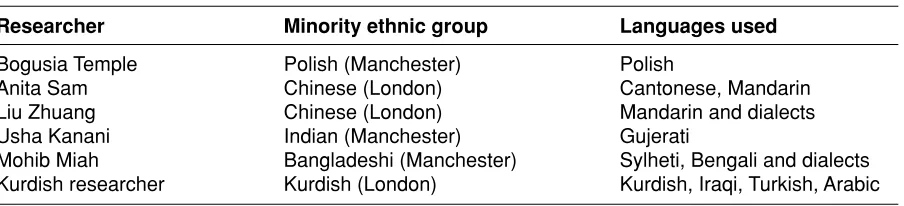
Ten semi-structured interviews were conducted from each community, by community researchers in the appropriate first language/dialect. Six researchers conducted the research interviews1 (two Chinese researchers and one for each of the other groups)
(see Table 1).
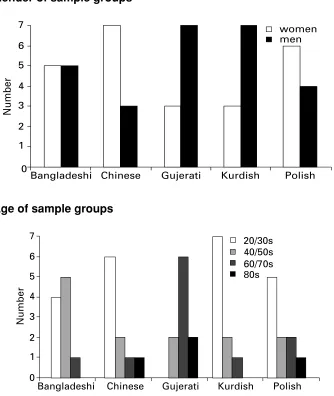
[image:21.595.74.526.619.722.2]The researchers were asked to access a range of people to interview who demonstrated the variety of experiences and needs within each community, for example, around gender (see Figure 1), age (see Figure 2), family background and migration history. In selecting people to interview, we did not aim to produce a demographically representative sample, but, rather, illustrative depth of the range and kinds of experiences of people who need and use interpreters. This revealed significant differences in the profile and interpreting needs of each group. For
Table 1 Researchers, groups and languages
Researcher Minority ethnic group Languages used
Bogusia Temple Polish (Manchester) Polish
Anita Sam Chinese (London) Cantonese, Mandarin Liu Zhuang Chinese (London) Mandarin and dialects Usha Kanani Indian (Manchester) Gujerati
example, with the Gujerati and Polish samples, the length of settlement in the UK meant that the need for English-language support was restricted largely to older people. On the other hand, the Kurdish and Polish Roma groups reflected the younger age and gender profile of the predominantly younger male and newly arrived asylum seekers.
Each researcher accessed their communities through a mix of channels – their own personal networks and a range of statutory, voluntary and community sector
services. Several of the researchers were members of local communities, or had work links with them; indeed, three of our researchers (Chinese, Gujerati and Kurdish) had worked as interpreters for local organisations and utilised these networks to access potential interviewees. However, we avoided recruiting our sample completely through such organisations and agencies. This was for two reasons: first, we did not want the research to be identified with a particular
Bangladeshi Chinese Gujerati Kurdish Polish 0
1 2 3 4 5 6 7
Number
[image:22.595.130.464.104.500.2]women men Figure 1 Gender of sample groups
Figure 2 Age of sample groups
Bangladeshi Chinese Gujerati Kurdish Polish 0
1 2 3 4 5 6 7
Number
Researching lives in context
organisation and their agenda. Secondly, and more importantly, we were keen to use informal networks to allow access to people who did not use such formal
organisations and who, therefore, fall through the gaps of formal provision. Every participant was given £10 at the end of their interview as a ‘thank you’.
The interviews themselves encompassed a brief life history, addressing people’s lives in their country of origin, as well as their experiences in the UK. This was to enable us to place their perspectives on interpreting provision in the broader
contexts of who they were as people and what they felt about themselves and their lives both prior to migration and afterwards. This was to prove very significant in terms of discussing issues around access to ‘community’ support (Chapter 4) and ‘trust’ in the interpreting process (Chapter 5). The interviews then concentrated on encouraging a ‘story-telling’ approach to instances when people required interpreters in order to gain access to various services, drawing out specific issues concerning the implications of a lack of English language competence, locating and accessing interpreters from both formal and informal sources, who and what type of interpreter and interpreting they felt best served their needs, and their self-positioning and perception of others within this relationship (Chapter 3). This part of the interview allowed us to focus down on priorities and issues for interpreting provision from service users’ perspectives.
The importance of researching lives in context: barriers to
learning to speak English
As we discussed in Chapter 1, the issue of English-language usage has become an important political and policy issue in recent debates about race relations, migration and asylum policies. The primary emphasis of these debates has been on the need for new migrants, and established settlers, to learn English as part of their attainment of full citizenship status. This has shifted attention away from ‘mother tongue’ support and interpreting provision, with a clear expectation that it is incumbent on migrants to learn English. However, as our research made apparent, this is in no way as clear-cut and straightforward a task as such rhetoric suggests.
There were also a number of informal reasons why some people had not learnt English, which rose out of personal experiences, life histories and cultural
expectations. Like several other women with families, Nisime, a 40-year-old Iraqi Kurdish woman, who is a mother of four children, one of whom has a learning
disability, said that her family responsibilities prevented her from attending language classes. Jie Chun, a 42-year-old Chinese woman, told us that she felt she was ‘too old’ to learn a new language and her family role made it difficult for her to find the time. Mr Lai, aged 86, similarly felt that his age, combined with his poor educational background in China, meant he would not be able to learn English. Mihe, a Kurdish man, said that both he and his wife had stopped attending English classes because of his poor health. Several of the asylum seekers we interviewed also told us that they were waiting for confirmation of their right to stay before learning English:
Just because of my situation, I cannot concentrate on learning English, because I worry about being expelled sometime. If I can settle, I must learn English carefully.
(Di Wu, a young, Chinese, male, asylum seeker)
Introduction
In Chapter 1, we pointed out that the research that exists on interpreting services is carried out from the service providers’ point of view. It is assumed that evidence for language-support needs is evidence of the need for professional interpreters. There is very little research on the views of people who use interpreters about what kind of resources they would like to meet their needs. Moreover, language services are provided for undifferentiated ‘communities’. For example, in relation to languages, Kurdish people may speak Kurdish, Iraqi, Turkish or Arabic, as well as other languages and dialects or combinations of these; Chinese people may speak Mandarin or Cantonese and/or a variety of dialects; while Bangladeshi people may speak Sylheti, Bengali and various dialects. Moreover, the length of time a
community has been established and their particular migration history will influence the resources available to people and their decisions about when and who to use as an interpreter.
In this chapter, we examine ideals and process when using interpreters for the people we interviewed. We start by showing that the question of who needs an interpreter is not necessarily a straightforward issue. We then move on to consider the questions of what qualities people felt were important in a good interpreter and what sort of role they wanted interpreters to play. Finally, we explore the question of who acted as an interpreter for the people we interviewed, looking in detail at their experiences of accessing and using interpreters from different sources. A key feature of the discussion throughout this chapter is that language proficiency – on the part of both those who need, and those who act as, interpreters – is not the only issue to be considered.
Who needs an interpreter?
There is no simple answer to the question of who needs an interpreter: the same person can both need an interpreter and be an interpreter, depending on the
circumstances. Although the people taking part in our research spoke only limited, if any, English, they made up their own minds about their level of English proficiency and whether or not the situation meant that they needed an interpreter. There is a continuum of interpreting that ranges from needing an interpreter, through being able to manage without one, to ability to act as an interpreter for others (see Figure 3).
There were people who were firmly situated at one end of the continuum. They felt that their English was very limited or non-existent and that they always needed help:
I’m unable to manage without a Bengali interpreter, I don’t know any English … If I go to the hospital or the doctor’s, I need interpreters. When I go to parents’ evenings, I need an interpreter to tell me how my children are doing at school. I need interpreters all the time.
(Shahida Chowdury, a Bangladeshi woman)
There were other people, however, who felt that they needed help on some occasions but that they could get by for some things. Furthermore, sometimes people acted as interpreters for others even though they felt that their English was limited, as some help was seen as better than no help at all. Their decisions about requiring an interpreter were influenced not merely by their level of English-language proficiency but also by the circumstances in which they were accessing services, as well as changes over the life course.
Thus people could move fluidly along the continuum rather than necessarily occupying a fixed place on it. Jan Lepak provides a good example of this fluid
movement according to circumstances. He was a Polish Roma asylum seeker in his late twenties and lived with his extended family. Jan felt that his limited English was good enough for him to get by on his own in everyday exchanges, but that he needed an interpreter to help him with his asylum case:
If I get an average Englishman I can cope … I can make myself understood. I wouldn’t say [my English] was good … It’s a good idea to take a professional when it’s important.
In addition, Jan’s mother spoke virtually no English and so he interpreted for her. He tried to help her communicate with the pharmacist and the GP:
If [the doctor] gives me something [for my mother] I don’t know what to do with it. I go back a second time without my mother so that she doesn’t tire herself. I have to make myself understood and if I don’t it’s hard luck.
The need for interpreters also changed over people’s life course. Some older people commented that they used to speak English well enough to manage themselves but
Need an interpreter Manage on own Act as an interpreter
Ideals and process in using interpreters
in old age they had forgotten the English that they had known and now needed someone to interpret for them:
Before I never used [Polish], only spoke in English … I didn’t have such a great need [for an interpreter].
(Mr Baranowski, a Polish man in his late seventies)
In turn, people could question language proficiency on the part of an interpreter as the sole consideration in their provision. We now turn to the issue of the qualities that the people we interviewed considered necessary in a good interpreter.
Who makes a good interpreter?
In talking about who made a good interpreter, people focused on the requisite qualities. In discussing these qualities, ascribed characteristics such as gender and religion, as well as the interpreter’s language proficiency, assumed less importance than the interpreter’s character and attitude. They also commented on the role that a good interpreter should play, often wanting them to be proactive.
Qualities
Although ‘matching’ interpreter and service user on ascribed characteristics has long been seen as important in interpreting provision (for example, Fuller and Toon, 1988; Karseras and Hopkins, 1987), very few of the people we interviewed felt that this was a key issue. Where they did, some women said that they preferred female interpreters for medical matters, others stated that they preferred interpreters who shared their religion (i.e. Islam), and a few felt that the interpreter’s age and maturity of experience was important. It was often Bangladeshi people who stressed such characteristics.
People were also concerned about language proficiency in terms of their own mother tongue. Bangladeshi and Gujerati people, for example, felt that service providers often were unaware of the range of different Asian languages and dialects within each language:
Our mother tongue is Gujerati so they should send someone who is Gujerati; it would be better and helpful. If they speak Hindi or Urdu then there would be difficulty with some of the words. Sometimes they send Punjabi people. If would be better if they sent a Gujerati person.
I think most people who do interpreting speak Dhaka dialect. This can cause problems for a Sylheti-speaking person. I think Sylheti-speaking interpreters should be provided for Sylheti people. Another example, say a person is from the Chittagong area. If you have a Sylheti-speaking interpreter then this person won’t understand the Sylheti dialect. For them, there should be someone from Chittagong doing the interpreting.
(Maroof Khan, a Bangladeshi man)
Furthermore, people often based their assessment of an interpreter’s English-language proficiency on the outcome of the situation in which they required them. If the outcome was what the person wanted, then the interpreter was competent; if the outcome was a disappointment, then, among other things, their proficiency could be in question:
I think that, when they don’t solve my claim, that maybe the interpreter didn’t explain the situation well enough, or said something bad, or he didn’t know how to interpret.
(Nisime, a Kurdish woman)
Language matching and proficiency are not always enough, however. Wider issues were highlighted by the Kurdish people we interviewed. Those who originated from Turkey often felt that an interpreter’s proficiency in Turkish did not mitigate the impact of political differences between them:
The Turkish Government didn’t allow us to be educated in Kurdish. If you were heard speaking Kurdish, they put you in prison … The school [my son now attends] said that, if we want, they can provide him with a Turkish teaching assistant, but we refused.
(Mihe, a Kurdish man)
The above example points towards the important issue of trust, or rather lack of it. Indeed, when asked about the qualities of a good interpreter, most people felt that the interpreter’s character and attitude was the primary issue. Generally, people felt that an interpreter should empathise with the people for whom they were interpreting:
It must be someone who is sympathetic to people generally. Some people are better than others at this. It doesn’t matter if their Polish is fantastic if they are cold to people.
Ideals and process in using interpreters
In many cases, people felt that interpreters whom they did not know were unlikely to be able to empathise with their situation and so would be unlikely to interpret
adequately. For them, interpretation was about not just conveying words but also arguing a case. In order to do this, both the user and the interpreter needed to know something about each other:
Some are suited [to be interpreters] but some you are better off without an interpreter … You learn what people smell of. [It’s important] what outlook on life you have, what character.
(Mr Baranowski, a Polish man)
I think that if I take someone [I know] then he or she would understand my feelings and if [the service] get someone, he or she will outline the questions and answers and will not understand everything.
(Dipon Ghosh, a Bangladeshi man)
It is interesting that the only two people who mentioned that they had used telephone interpreting services both found the process unsatisfactory because they were
unable to communicate in a personal manner:
[Social services] give you an interpreter over the phone, for a very short time. So that she can just interpret and then it’s finished. The conversation is over. But to sit down and discuss things, no. So it’s very hard.
(Mrs Zalewska, a Polish woman)
To summarise, for the people who took part in our research, good interpreting is about more than language proficiency and the literal exchange of words; it is about the interpreter putting forward the user’s view of their situation. This brings us to their perceptions of the role of interpreters.
Role
I think that a good interpreter should just make the interpretation accurately. I don’t have any other requirements. He shouldn’t make any decisions on behalf of his client without permission … If the interpreter works for his boss, it’s better that he doesn’t give any suggestions.
(Di Wu, a Chinese man)
One time the housing office didn’t pay my rent. I went to housing and they brought an interpreter. We asked them to pay my housing but they told me they didn’t pay my rent any more. So I came back and brought one of my friends. He explained my situation to them and they accepted it. This is the difference between good and bad [interpreting] as I said. I know that the interpreter didn’t interpret my words exactly. That’s why they refused me the first time … Actually I look on [an interpreter from a service provider] as a government agent. I don’t feel safe.
(Nedim, a Kurdish man)
The majority of the people interviewed, however, felt that they would like interpreters to be more proactive – a role akin to advocacy, pleading the user’s case and giving advice. They felt that interpreters should do more than pass on words, because people who needed interpreters often did not understand how health and social care,
Ideals and process in using interpreters
immigration, or the courts and other official systems worked. They appreciated interpreters who had knowledge of systems as well as technical language ability:
The Chinese generation who’ve been in the country for 20 or 30 years aren’t normally educated, they have language problems. Even if they’re eligible for some welfare, they don’t know how to get it and they may not even know such welfare exists … I prefer [interpreters who think from my standpoint], they can give me ideas.
(Jie Chun, a Chinese woman)
I was very lucky with my interpreter, she has helped me a lot. She has steered me through and told me where I can go and how I can arrange things … She advises me. If I say anything wrong she tells me herself that, ‘you can’t do that Mrs Zalewska because it’s not allowed’.
(Mrs Zalewska, a Polish Roma woman)
[An interpreter] should give good advice, that’s what I believe. Giving advice is helpful, whatever the case. Clients can benefit because they don’t have
knowledge of the laws and procedures. (Bijal Patel, a Gujerati man)
However, people did not see or understand differences between various types of interpreter, such as professional interpreters, bilingual employees, interpreter-advocates, link workers and so on. Indeed, they did not always know the status of the person who had been provided as an interpreter for them when they used services, whether they were professional or not. We now turn to this and other issues in looking at people’s experiences of accessing and using services with interpreters.
Who is an interpreter?
People used individual, family and community resources to find ways to get around their limited English proficiency. They developed a range of strategies and networks to access services, including health and social care professionals who spoke their language, family and friends, community organisations and professional interpreters. Whether and to whom they turned was not only a matter of choice, but also
depended on the context, who was available and the infrastructure arising from the history of establishment of the different communities. We begin, however, by looking at people’s access to and use of professional interpreters before going on to
Professional interpreters
Most people felt that they had used a professional interpreter at some time, although, as we noted above, they were not always sure about this status. There was also confusion about the procedures for obtaining a professional interpreter, but, even where people did know how to go about it, they experienced difficulties. Moreover, their experiences of using professional interpreters were not always satisfactory. We discuss each of these issues in turn.
Some people were unsure about whether or not the interpreters they had been provided with when they used services were professional or not. This was particularly the case in relation to interpreters in hospitals and from community organisations. Generally, people were confused about their status, and did not seem to have been told about the position or role of the interpreter they were provided with. Indeed, sometimes they did not even know the name of the person who had interpreted for them. People sometimes assumed that bilingual staff were called in to act as interpreters (see further below):
That’s illegal! [professional interpreters]. In the NHS you can’t pay for help at the doctor’s or the hospital … They’re just volunteers.
(Mr Matejko, a Polish man)
I’ve never taken an interest, so I’ve never asked anyone [if they were professional] … I don’t know anything about it … The hospital asked the
interpreter to come and he spoke to the doctor and interpreted for me … I didn’t notice much difference [whether he was professional or not].
(Ravi Gokul, a Gujerati man)
There was also a lack of knowledge about how to get hold of a professional interpreter. Many people said that they did not know that they could ask for a
professional interpreter themselves, or that they did not know how to go about it, or even who would meet the cost:
I would have to ask around [to find out where to get a professional interpreter]. Sometimes they advertise. But you probably have to go to London.
(Sister Basia, a Polish woman)
No, I don’t know [where and how to access a professional interpreter] because I can’t read or write English.
Ideals and process in using interpreters
Even where people did know how to avail themselves of professional interpreters, they could experience difficulties in access. One of these difficulties was a relatively basic hurdle – the service could not be booked unless you spoke English:
It’s very difficult to access the service. For example, I couldn’t communicate with the receptionist to book the interpreters. I also couldn’t communicate with the telephonist to book the service. My first time using the interpreter was when I was in a hospital. They provided the interpreter for me. But I have to fill in a request form and I have difficulty in filling in the form.
(Mrs Tong, a Chinese woman)
Other difficulties were connected to the lack of reliable availability of professional interpreters:
When I went to see about the New Deal, I went to the job centre. There was no Bengali-speaking [interpreter] there, so my appointment was cancelled. I couldn’t find anybody myself either for that occasion.
(Rupee Bibi, a Bangladeshi woman)
I was called for interview [about my asylum application]. My appointment was at 10.00 a.m. but by 4.00 p.m. I still wasn’t called. I was asked to go back two days later because the interpreter had finished working.
(Hasan Malik, a Bangladeshi man)
We have to wait a few days to get help from interpreters. We have to wait, we can’t get interpreting services straight away. We can’t get the service on the same day. I get used to waiting. Sometimes we still can’t get anyone when we’ve been waiting for a long time.
(Mr Lai, a Chinese man)
Once people have overcome any access difficulties and obtained a professional interpreter, there is the issue of their actual experiences. Some people had positive things to say about professional interpreters. As discussed above, this included their knowledge of the ways that systems work. In particular, good experiences of
professional interpreters were associated with people being provided with the same interpreter over a number of occasions. They thus had got to know them personally and had established trust with them over a period of time:
If an appointment has been made for me with the hospital then there is a Gujerati lady who is an interpreter [there]. I call her a few days before the appointment to tell her the date and time. She says, ‘when you get to the hospital, call me and tell me you are here’ … When the doctor says something, she explains everything. And other times, if I need to book an ambulance, I ring her. After she’s booked the ambulance, she rings me back. So that’s a lot of help.
(Rena Ghelani, a Gujerati woman)
Most of the people we interviewed, however, were critical of the professional interpreters who they had used. They felt that service providers controlled the provision of interpreters and that these professionals did not meet the qualities and role they believed were requisites for a good interpreter. They felt that the
professional interpreters were there to represent the providers’ or their own interests, not those of users. There were also many negative comments about the proficiency and character of the professional interpreters who they had used:
When I first came to England, I had an interview with social services. Afterwards the social services sent me a letter, and my husband read it. He asked me, ‘what did you say? It says that you told social services you were working’. I said, ‘no, I told him I wanted to work’. So then my husband explained the situation to
[social services], and they corrected it. I was very angry with the interpreter because, if my husband hadn’t corrected it, they would have cut my income support.
(Nisime, a Kurdish woman)
I had an interview with the Home Office six months ago, and it was my solicitor’s interpreter. He was okay. I can understand what he said [in English] actually. I must admit I wasn’t happy with the Home Office interpreter … I expected that interpreter to explain about my psychological situation but he didn’t … It all depends on an interpreter’s character, some of them I don’t trust because of their attitude.
(Dersim, a Kurdish man)
When they were asked in what situations they felt that using a professional
interpreter would be particularly useful, most people felt that their preference was for family and friends. Some, however, did recognise the value of a professional
Ideals and process in using interpreters
Professional interpreters should be there for any complicated situations, if it’s necessary.
(Ravi Gokul, a Gujerati man)
My father-in-law started to get very angry with me and encouraged my husband to beat me … My father-in-law told me I could go, they just wanted to keep my child. They said I’m not a member of their family … I reported this to the police … The policeman came very late. They asked my husband [who speaks English, to interpret] what I’d said … I was very angry … I walked out of the house with my son. When I was putting my son down on the doorstep to get my jacket, my father-in-law shouted to the officer that I abuse my son. But the police officer ignored him … The next day, my father-in-law made a complaint to the social services and claimed that I abused my son. After a while, a social worker brought an interpreter to make a home visit to me … So, in this case, an
interpreting service is very important. (Heidi, a Chinese woman)
Bilingual professionals and staff
Using bilingual professionals is, in fact, a common alternative to using an interpreter. The spread and availability of such resources in the different communities is related to each community’s history of establishment and the extent of people’s own
integration into that community. The people we interviewed described how they used a range of professionals who spoke their mother tongue. For the most part, this strategy was seen as beneficial because it allowed them to access services that would otherwise have presented them with communication barriers. A few, however, were ambivalent about using bilingual professionals:
Polish people are everywhere. There are Polish shops, dentists, doctors, staff in hospitals, solicitors. I know where they all are ... It’s good that they know what I want because they know me and they know what I can do and how I live … [The downside to this is the same], they know me and they know how I live!
(Mr Matejko, a Polish man)
In terms of interpreting, however, the people we interviewed sometimes had experience of bilingual staff who were based at a service they were using being called on to act as interpreters:
As we noted earlier, people could be unsure about whether the person who was interpreting for them was a professional interpreter or a bilingual staff member. Where they felt that they were aware of bilingual staff acting as interpreters, however, some believed that there were inherent drawbacks:
Those who work [at the hospital] aren’t likely to be on your side in an argument so you’re better off taking someone with you.
(Mr Matejko, a Polish man)
When people did ‘take someone with them’ to act as an interpreter, they could draw on community organisations.
Community organisations
The infrastructure of community organisations available to people, as with bilingual professionals, was related to the migration history of the particular minority ethnic group. The interpreting services these organisations provided ranged from the more formalised provision of professional interpreters, such as the Bangladeshi
Association and some Chinese centres, to volunteers providing interpreting and other services on the basis of goodwill or for status, such as the Polish Club and some of the Kurdish community centres. As we noted earlier, however, the people we interviewed largely did not distinguish between such professional and untrained interpreting provision.
People could have similarly ambivalent feelings about community organisations as they did bilingual professionals: many appreciated them as a resource and a source of belonging and companionship, but some also had reservations, or were
marginalised by such organisations:
I’m not sure [about getting an interpreter from the Polish Club]. They seem to talk about everyone’s business openly. I wouldn’t like everyone to know about my life … It might be better to have someone from outside.
(Mrs Polanska, a Polish woman)
Ideals and process in using interpreters
Thursday, but I’d like to get an interpreter for other days. It’s very difficult to arrange a mutual time … Another experience is that the interpreter refused my booking because she explained that I can speak a little bit of English and she had other people who can’t speak any.
(Amy, a Chinese woman)
Community organisations seemed to fall between professional interpreters, and family and friends acting as interpreters in terms of accessibility and trust for most of the people we interviewed – indeed, notions of community and family and friends could overlap.
Family and friends
All the people we interviewed who had family and friends available had used them as interpreters to enable access and use of mainstream services. The main reasons for this were issues of trust and not wanting ‘strangers’ to know their problems, as well as a history of shared understandings and obligations. A number of practical
advantages were also pointed to: family and friends were often readily accessible, could help with everyday matters and with transport, and did not require payment:
I’ve heard of [interpreting services] but I never use them … I ask my friend first. Because we both come from China, her thought and language are the same, so I find this suits me better … [I also use my friend] because I don’t have to wait! The disadvantage is that her English isn’t very good.
(Shirley, a Chinese woman)
If I need to take someone [my friend] goes with me. He doesn’t charge me any money … [And] if I need [an interpreter] for a hospital appointment, my son-in-law goes with me and, if I need to fill in a form, he does that for me … He does it for me because I live on my own and also he’s my son-in-law. He has a car and he takes me by car and brings me back … I prefer to take someone with me who I know, it’s better for me.
(Reshma Begum, a Bangladeshi woman)
Some people, however, did not have family or friends readily available, and so had to turn to other sources of interpreting even though they would have preferred to use their own networks:
There’s no one in this area nearby [to help me with interpreting] … Both my children are far away and there’s no close family nearby. When necessary, I use hospital interpreters because they’re there. It would be better if [my children]
could come but they live too far away. Also, they’re busy with their work so they can’t always come … I have no one from my family who’s free and nearby, otherwise I’d choose to take them with me.
(Ravi Gokul, a Gujerati man)
Those who did have family and friends available to them, however, sometimes recognised drawbacks to using these people as interpreters. These centred mainly on practical issues, such as members of their informal networks having only a slightly greater language proficiency than themselves (and we have already noted how the people we interviewed could act as interpreters for others with even more limited English than themselves) and a lack of knowledge of official systems and terminology, or the people they called on having other commitments:
I ask my friends if they will let their daughters go with me [to interpret]. It’s whoever I can find … I have a son in Bangladesh who I applied to bring here
Ideals and process in using interpreters
Any situation where I need an interpreter, I ask my son … The advantage is that, whatever we ask him to do, he tries his best. But, because he’s very busy, we don’t disturb him often because we don’t want his wife to complain that we take up too much of his time.
(Jie Xin, a Chinese woman)
There were also, for a few, other drawbacks such as embarrassment and privacy concerns about sharing their troubles with family and friends, again raising issues of trust:
My husband [normally does my interpreting for me], but his English isn’t very good. The advantage is that he advises me and knows the system and I feel safe. But the disadvantage is that, because he’s the one dealing with everything all the time, I feel like I don’t know anything.
(Mehtab, a Kurdish woman)
I had something to do at the solicitor’s so I took my uncle with me. He
interpreted, but I have some regrets because I’m afraid that, if he doesn’t keep it secret, it will cause me a lot of problems.
(Hasret, a Kurdish man)
Generally, however, the majority of the people we interviewed preferred drawing on their informal networks of family and friends to act as interpreters for them in all except important legal and medical matters.
Concluding summary: key issues in using interpreters
This chapter has provided an overview of the broad contours of people’s access to services with interpreters. We have looked at both what interpreting provision they feel to be ideal and the processes associated with their actual experiences of a range of interpreting resources. We have seen that language proficiency – on the part of both those who need, and those who act as, interpreters – is not the only consideration. Key issues are as follows.
• People make their own decisions about whether or not they need an interpreter and who is best placed to act as an interpreter for them. This depends not only on their level of English-language proficiency, but also on the particular
• The interpreter’s character and attitude are important. An interpreter needs empathy, and this is enhanced where interpreter and user know something about each other. In addition, people often want an interpreter to be proactive, pleading the user’s case and giving advice about systems and procedures.
• There is general confusion about professional interpreting provision. People are not sure of the status of interpreters who are provided for them when they use services. They either do not know how to access professional interpreters themselves, or experience difficulties in the access procedures.
• Professional interpreters can be appreciated for their knowledge of legal and medical systems and procedures especially, and people can establish trust with professional interpreters who are provided for them over a number of occasions. For the most part, however, people’s experiences of professional interpreters are negative, calling into question their language proficiency and character.
• People can be ambivalent about using both bilingual professionals and community organisations. Each is appreciated as a resource and source of interpreting, but there are some reservations about their reliability.
• People use family and friends, rather than strangers, as interpreters because they trust them, and have a history of shared understandings and obligations, as well as practical advantages such as ready availability. They do recognise
drawbacks, however, especially these people’s lack of knowledge of official procedures and terminology.
Underlying these key features of people’s access to services with interpreters are broader understandings about the nature of community, friends and family, and trust. One of the aims of this research is to place users’ experiences with interpreters in the biographical and cultural context of their lives as a whole. Such a placing is necessary in order to understand the reasons why the people we interviewed considered and experienced particular sorts of interpreting resource as better than others, notably their preference for family and friends over professional interpreters. Accordingly, in the next two chapters, we devote in-depth attention to these
Introduction
Community organisations, resources and networks are a crucial source of help and support for those needing to access interpreting services. Indeed, provision of interpreting services, as with other welfare provisions, is often premised on the existence of distinct and clearly defined ethnic and cultural groups with particular characteristics and needs. However, it is clear that the availability and reliability of community services vary widely between ethnic groups. The extent and success of community provision seems particularly dependent on how long ethnic groups have been present in the UK, and patterns of settlement (for example, how large a
particular group is within a specific locale, and the historical and structural factors affecting different areas), but it is also affected by the forms of access that individuals have to these services. The notion of ‘community’ tends to emphasise homogeneity within groups and assumes clearly defined cultural and geographical boundaries. This approach ignores internal variations that may affect access to, and use of, services, such as those around age, class and gender, but also around issues of language, internal structures of marginalisation and private feelings of trust/distrust. It also renders invisible the ways in which people create their own personal ideas of ‘community’ in different ways – through the use of social networks, as family or as part of friendship groups.
This chapter will explore some of the contours of ‘community’ and its significance in facilitating or hindering access to interpreting services. The analysis of ‘community’ will take place at two levels: first, the role of formal ideas of ‘community’ in providing an institutional framework for accessing services; and, second, the informal, more complex and fluid ways in which ‘community’ is constructed by the people we interviewed. This latter view of ‘community’ will consider its intersection with family, friends and social networks, and will focus on similarities and differences within and between ethnic groups.
Institutional ‘community’: the presence of formal services
As discussed in Chapter 2, the different groups we selected for the research varied widely in terms of length of presence in the United Kingdom, migration histories and local characteristics. This, hardly surprisingly, affected the amount and variety of formal community resources that were available to individuals within those communities.
It is worth noting that the profile of each of these ethnic groups, around age, levels of employment, education, housing and legal status, impacted greatly on their
interaction with mainstream institutions, such as social services, immigration
of minority ethnic ‘communities’ and community provision must then be placed in relation to their position within a broader context of majority ‘community’ services. Ethnic groups do not function as autonomous ‘ethnic bubbles’ (Gates, 1992), but are embedded in wider relationships of power, in which language facility can be a major stumbling block. Minority ethnic ‘community’ organisations thus function as important cultural and linguistic intermediaries.
The problems with language and interpreting facilities in accessing mainstream services were stressed particularly by the Kurdish, Polish Roma and Bangladeshi groups, who felt strongly that their position was weakened by inadequate provision. A number suggested that their access to full welfare provision, and dealing with
immigration issues, was severely and adversely affected by lack of adequate
interpreting. The Gujerati and older Polish people we interviewed, however, seemed satisfied with the level of language provision made for them. In both cases, this seemed to be linked to the longer establishment of community services and the availability of younger family members who were able to speak fluent English. Mr Matejko thus commented that ‘Polish people are everywhere’, and that he knew of Polish shops, doctors, dentists, solicitors and so on, while several of the Chinese sample seemed to prioritise finding Chinese-language facilities, even if this meant paying.
Each of the groups stressed the importance of formal ‘community’ services, although these institutional manifestations of ‘community’ varied across groups and in terms of kinds of usage. Among the Gujerati sample, for example, the Hindu temple was held by most people to be a central part of their everyday lives, providing a social, cultural and religious role, as well as offering language classes, health education sessions and language support. The longer established Polish community also placed great importance on the Polish church, and on the Polish Club and the Combatants’ Association, which offered some interpreting services and support. By contrast, the Polish Roma sample had little contact with these central institutions. The Chinese sample also mentioned the Chinese church as a source of support. Interestingly, neither the Kurdish nor the Bangladeshi groups placed much importance on religious institutions, and mainly utilised local community centres for advice and language support.