EFFICIENT CONTENT BASED IMAGE RETRIEVAL SYSTEM FOR SATELLITE IMAGE USING SVM
*Nitisha Soni and Latika Pinjarkar
Shri Shankaracharya Insititue of
ARTICLE INFO ABSTRACT
This paper presents a technique to derive the colors, shapes, textures, or any other information that can be derived
Machine). This image processing
as buildings and gardens and rural features such as natural vegetation, water bodies, and fields. Textures are represented by Texel, which are then
many textures are detected in the image.We are using image by using SVM.
Copyright © 2017, Nitisha Soni and Latika Pinjarkar. unrestricted use, distribution, and reproduction in any medium,
INTRODUCTION
Digital images are widely used in many areas such as commerce, crime prevention, finger print recognition, hospitals, surveillance, engineering, fashion, architecture, and graphic design, government, academics, and historical research etc. This would require increase in retrieval accuracy and reduced retrieval time .The earlier techniques were only based on text based searching but not on visual feature. Many a times single keyword associated with many images also leads to inaccurate results. Therefore, Content Based Image Retrieval (CBIR) is developed to overcome the limitation of text based retrieval [Devyani Soni, 2015] Content based image re started in early 1990’s. The main aim in Content Based Image Retrieval system is to search and find the image in large database; based on their visual contents such as color, shape and texture etc. The Content Based Image Retrieval systems have two basic principles for the image retrieval, and they are[Mujtaba Amin Dar, 2017]:
• Feature extraction • Matching
Support Vector Machine (SVM): A SUPPORT Vector
Machine (SVM) is a discriminative classifier formally defined by a separating hyperplane.
*Corresponding author: Nitisha Soni,
Shri Shankaracharya Insititue of Enginerring, and Techonolgy, IT Department, Juwani, Bhilai.
ISSN: 0975-833X
Vol.
Article History:
Received 19th September, 2017 Received in revised form 23rd October, 2017
Accepted 15th November, 2017 Published online 31st December, 2017
Citation: Nitisha Soni and Latika Pinjarkar, 2017. Current Research, 9, (12), 63224-63230.
Key words:
Retrieval, Satellite Images, Colour and texture,
SVM (Support Vector Machine).
RESEARCH ARTICLE
EFFICIENT CONTENT BASED IMAGE RETRIEVAL SYSTEM FOR SATELLITE IMAGE USING SVM
Nitisha Soni and Latika Pinjarkar
Shankaracharya Insititue of Enginerring, and Techonolgy, IT Department, Juwani,
ABSTRACT
This paper presents a technique to derive the colors, shapes, textures, or any other information that can be derived from a satellite image Using Texture filters and realizing it with SVM(Support Vector achine). This image processing technique are been utilized to identify important urban features such as buildings and gardens and rural features such as natural vegetation, water bodies, and fields. Textures are represented by Texel, which are then placed into a number of sets, depending on how many textures are detected in the image.We are using satellite images for get the proper retrieval image by using SVM.
. This is an open access article distributed under the Creative Commons medium, provided the original work is properly cited.
Digital images are widely used in many areas such as commerce, crime prevention, finger print recognition, hospitals, surveillance, engineering, fashion, architecture, and graphic design, government, academics, and historical research etc. This would require increase in retrieval accuracy and al time .The earlier techniques were only based on text based searching but not on visual feature. Many a times single keyword associated with many images also leads to inaccurate results. Therefore, Content Based Image Retrieval rcome the limitation of text based Content based image retrieval The main aim in Content Based Image Retrieval system is to search and find the image in large such as color, shape and texture etc. The Content Based Image Retrieval systems have two basic principles for the image retrieval, and they
A SUPPORT Vector Machine (SVM) is a discriminative classifier formally defined
Shri Shankaracharya Insititue of Enginerring, and Techonolgy, IT
In other words, given labeled training data
outputs an optimal hyperplane which categorizes new examples. In two dimentional space this hyperplane is a line dividing a plane in two parts where in each class lay in either side. It is an approximate implementation of structural risk minimization (SRM) principle
minimized Vapnik-Chervonenkis (VC) dimension. SVM minimizes an upper bound on generalization error rate. Error rate is bounded by sum of training. Cons
separating set of training vectors belonging to two classes, e.g., image retrieval problem, +1 denotes positive example, denotes negative example. Support vector machines (SVMs) are supervised learning models with associated learning algorithms that analyze data and recognize patterns used for classification and regression analysis. Set of training examples where each marked as one of two categories an SVM training algorithm builds a model that assigns new examples into one category or the other making it a non
linear classifier. An SVM model is a representation of the examples: points in space mapped so the examples of the separate categories are divided by a clear gap that is as wide as possible. Where the new exam ples are then mapped into that same space and predicted to belong to a category based on which side of the gap they fall on [
Sugamya, 2016].
RELATED WORKS
Jagbir Singh Gill et al. Content Based
known as query by image content and content based visual
International Journal of Current Research Vol. 9, Issue, 12, pp.63224-63230, December, 2017
2017. “Efficient content based image retrieval system for satellite image using
EFFICIENT CONTENT BASED IMAGE RETRIEVAL SYSTEM FOR SATELLITE IMAGE USING SVM
Department, Juwani, Bhilai
This paper presents a technique to derive the colors, shapes, textures, or any other information that from a satellite image Using Texture filters and realizing it with SVM(Support Vector technique are been utilized to identify important urban features such as buildings and gardens and rural features such as natural vegetation, water bodies, and fields. into a number of sets, depending on how satellite images for get the proper retrieval
Commons Attribution License, which permits
In other words, given labeled training data , the algorithm outputs an optimal hyperplane which categorizes new examples. In two dimentional space this hyperplane is a line dividing a plane in two parts where in each class lay in either roximate implementation of structural risk principle. It creates a classifier with Chervonenkis (VC) dimension. SVM minimizes an upper bound on generalization error rate. Error rate is bounded by sum of training. Consider problem of separating set of training vectors belonging to two classes, e.g., image retrieval problem, +1 denotes positive example, -1 Support vector machines (SVMs) are supervised learning models with associated learning algorithms that analyze data and recognize patterns used for classification and regression analysis. Set of training examples where each marked as one of two categories an SVM training algorithm builds a model that assigns new examples into one the other making it a non-probabilistic binary linear classifier. An SVM model is a representation of the examples: points in space mapped so the examples of the separate categories are divided by a clear gap that is as wide as m ples are then mapped into that same space and predicted to belong to a category based on which side of the gap they fall on [Jagbir Singh, 2016; Katta
Jagbir Singh Gill et al. Content Based Image Retrieval also uery by image content and content based visual INTERNATIONAL JOURNAL OF CURRENT RESEARCH
information retrieval is the system in which retrieval is based on the content and associated information of the image. The XYZ and HSV algorithm on the measurement of Euclidean distance for Content Based Image retrieval. The results evaluate that the proposed algorithm is quiet better as compare to XYZ for set of dataset of trademark images on the basis of color, text and logo.
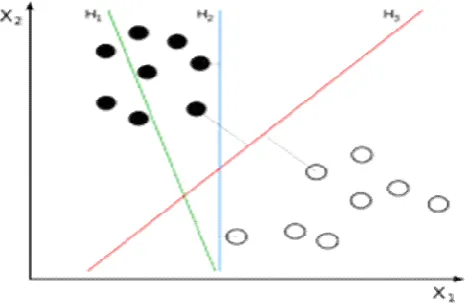
Figure 1. H1 does not separate the classes. H2 does, but only with a
small margin.H3 separates them with the maximum margin
Katta Sugamya et al. A new two-step strategy in which first step is feature extraction using low level features (color, shape and texture) while SVM classifier is used in the second step to handle the noisy positive examples. Thus, an efficient image retrieval algorithm based on color-correlogram for color feature extraction, wavelet transformation for extracting shape features and Gabor wavelet for texture feature extraction is proposed. Nikita Upadhyaya et al. The focus is mostly on extracting features from the queried image and from the images stored in the database for finding the similarity between these features to retrieve images which are similar visually. CBIR becomes tougher once focus goes to reducing the semantic gap or the linguistics gap between low level features and high level semantics.
A.Komali et al. CSIR can be developed by using K-Means algorithm for getting retrieval results of similar image efficiently. By using K-Means algorithm, more number of iterations occurred. In order to reduce the number of iterations we use codebook algorithm. This CSIR can be used in several applications such as photo sharing sites, forensic lab, etc. CLARANS is the normal method which is used to reduce the bugs occurred in the existing algorithms. Sanjiv K. Bhatia et al. The task may be simplified in part by correlating geographical coordinates to observation but that may lead to omission of similar conditions in different regions. Work on an image search engine that can efficiently extract matching image segments from a database of satellite images. This engine is based on an adaptation of RISE (Robust Image Search Engine) that has been used successfully in querying large databases of images.
Conclusion of the related work
The above related work concludes that the scope of research in this area of the of CBIR for satellite images are there. We work to get efficient result in this field of CBIR by using SVM (Support Vector Machine), by using this we get the efficient result.
METHODOLOGY
The proposed work is design of an efficient CBIR for satellite images using SVM.The results are evaluated in terms of precision, recall and accuracy and proved to be improved as discussed the result section.
CBIR: The Content Based Image Retrieval (CBIR) technique uses image content to search and retrieve digital images. Content-based image retrieval systems were introduced to address the problems associated with text-based image retrieval. Content based image retrieval is a set of techniques for retrieving semantically-relevant images from an image database based on automatically-derived image features. The main goal of CBIR is efficiency during image indexing and retrieval, thereby reducing the need for human intervention in the indexing process.
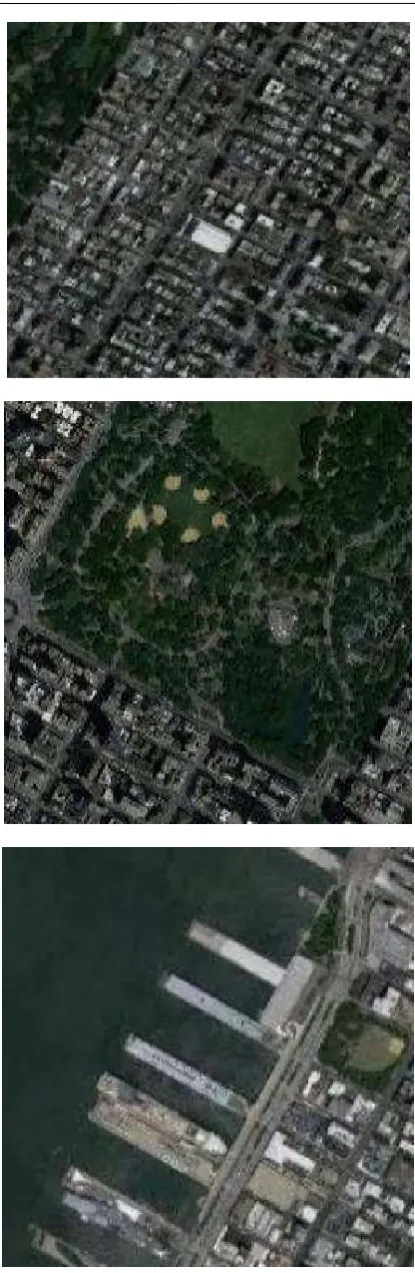
Creation of the Database: Some of the sample images are
Fig. 2. The above figure shows the satellite images from the dataset
Feature Extraction: The proposed CBIR system for satellite
images will be based upon color texture and shape feature extraction.
Color-The color feature is one in every of the essential and
wide utilized in CBIR. Color feature is that a part of the image that cannot be modified with regard to orientation
and size of the object, therefore it's straightforward to analyze it and extract it. Color descriptor extracts the proportion of color within the question image and is employed for similarity activity with the database pictures having a huge or less similar percentage of color to get output pictures that are similar.
Texture-Texture can be illustrated as the occurrence of
visual pattern in an image having the properties of uniformity that are not resulted because of the presence of only single color or intensity in an image. Textural properties are defined for a region in an image or sub image.
Shape-Shape is one of the essential basic visual features
that are used to give data concerning about image content. While analyzing shapes within the image, a representation of an object or shape is done using either shape boundary or shape boundary along with interior content. For accurate retrieving of images, it is required that shape descriptors find similar shapes from the pool of images effectively.
SVM: Support Vector Machines (SVM) is an approximate implementation of structural risk minimization (SRM) principle. It creates a classifier with minimized Vapnik-Chervonenkis (VC) dimension. SVM minimizes an upper bound on generalization error rate. Error rate is bounded by sum of training.
Performance Measures
PRECISION: It is the ratio of the number of relevant
records retrieved to the total number of irrelevant and relevant records retrieved. It is usually expressed as a percentage. PRECISION = Number of Relevant Images Retrieved / Total Number ofimages retrieved
RECALL: It is the ratio of the number of relevant
records retrieved to the total number of relevant records in the database. It is usually expressed as a percentage. RECALL=Number of Relevant Images Retrieval/Number of relevant images in the database
ACCURACY: ACCURACY: final_acc = 100*sum (diag
(cmat)). /sum(cmat(:));fprintf ('SVM (1-against-1):\ naccuracy = %.2f%%\n', final_acc);
Through this code we get the values of the accuracy from the retrieval image
RESULTS
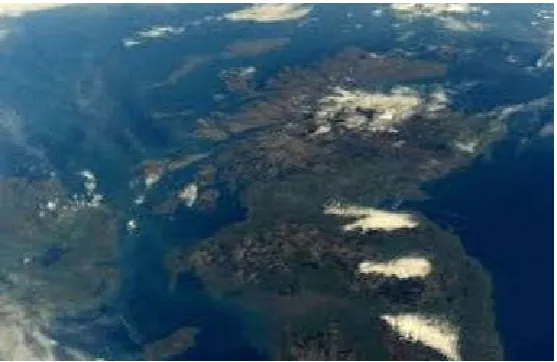
Dataset form images are taken from Google image search Fig.3 shows the image dataset description. The image type is jpg, size 12.9KB and dimensions are 384*256.
Working Methodology: In this section we discuss the steps of
the working of the project:
Performance Evaluation: In this section we calculate the
Fig. 3. Image in the dataset
STEP 1- Initialization Phase
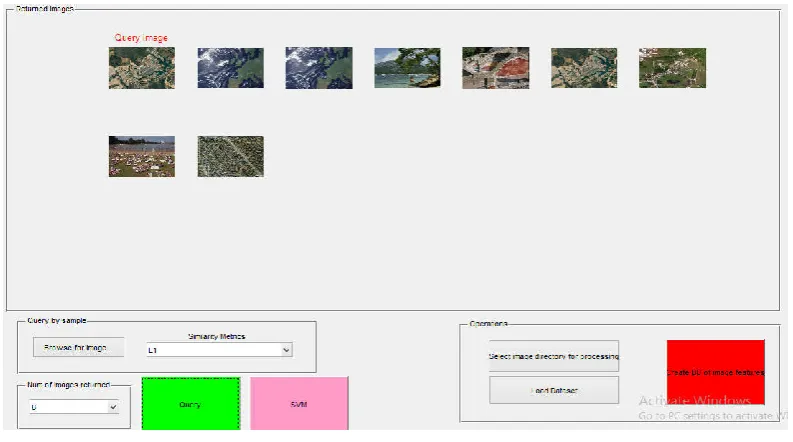
STEP 3: In this section we take an image from datasets and get the number of query images.
[image:5.595.100.497.76.297.2]STEP 4: After getting the query images we procced it to get SVM of it.
Table 1.1 Shows the result of the different values
S.no. Query image Retrieved Precision Recall Accuracy(%)
1. 10 0.1 0.02 85.20%
2. 15 0.15 0.03 85.20%
Comparitive analysis
Through the above table we conclude that the improved result and efficient value of precision,recall and accuracy.From the previous work the result calculated is more then the work done by us.
Conculsion
In this paper, we represented a CBIR system that uses a query image and retrieves relevant images. The results show that SVM is the appropriate method to find color space for color feature extraction. It gives good results as compared to other
3. 5 0.05 0.01 86.40%
4. 8 0.08 0.16 89.00%
5. 10 0.1 0.02 84.60%
6. 12 0.12 0.24 89.20%
7. 10 0.1 0.02 87.60%
8. 15 0.10 0.01 89.20%
[image:6.595.146.447.671.715.2]TOTAL 0.8 0.7 87.05%
Table 1.2. The comparitive analysis
S.No Precision Recall Accuracy
Simardeep Kaur and Dr. Vijay Kumar Banga et al. 2013
0.6 0.5 67.75%
color spaces. As results shows, choice of color features has an impact on image retrieval. When all the three color features are used together, the results are more relevant. The expected designed system will be very efficient and accurate with improved retrieval results in terms of precision recall and accuracy.
REFERENCES
Darshana Mistry Computer Engineering, Gandhinagar Institute Of Technology Color and Texture based Image Retrieval Using SVM for Relevance Feedback
Devyani Soni, K. J. Mathai. Department of Computer Engineering and Applications National Institute of Technical Teachers’ Training and Research, Bhopal. An Efficient Content Based Image Retrieval System using Text, Color Space Approach and Color Correlogram. Jagbir Singh Gill Assistant Professor Department of CSE,
Chandigarh Engineering College Landran, Mohali. CBIR of Trademark Images in different color spaces using XYZ and HSI Volume 6, Issue 5, May (2016).
Katta Sugamya, 2016. Suresh Pabboju A Cbir Classification Using Support Vector Machines March 03-05, R. L. Jalappa Institute of Technology, Doddaballapur, Bangalore, India.
Komali, A., Veera Babu, R. 2015. An Efficient Content Based Image Retrieval System for Color and Shape Using Optimized K-Means Algorithm VOL.15 No.4, Apri. Lakhdar LAIB1 and Samy Ait-Aoudia National High School
of Computer Science ESI, Algiers, algeria Efficient Approach for Content Based Image Retrieval using Multiple SVM in yacbir
Mujtaba Amin Dar, Ishfaq Gull, 2017. Sahil Dalwal Content Based Image Retrieval with SURF, SVM and BAYESIAN Vol. 5, Issue 2, February.
Nikita Upadhyaya and Manish Dixit Department of CSE/IT Madhav Institute of Technology and Science Relating Low
Level Features to High Level Semantics in CBIR, Vol.9, No.3 (2016).
Sanjiv K. 2007. Bhatia1, Ashok Samal RISE-SIMR: A Robust Image Search Engine for Satellite Image Matching and Retrieval ISVC 2007, Part II, LNCS 4842, pp. 245–254.