ISSN Online: 2327-4379 ISSN Print: 2327-4352
DOI: 10.4236/jamp.2018.68141 Aug. 14, 2018 1649 Journal of Applied Mathematics and Physics
An Optimal Parallel Algorithm for Constructing
a Spanning Tree on Proper Circle Trapezoid
Graphs
Hirotoshi Honma, Yoko Nakajima, Shino Nagasaki, Atsushi Sasaki
National Institute of Technology, Kushiro College, Kushiro, Japan
Abstract
Given a simple graph G with n vertices and m edges, the spanning tree prob-lem is to find a spanning tree for a given graph G. This problem has many applications, such as electric power systems, computer network design and circuit analysis. For a simple graph, the spanning tree problem can be solved in O
(
logn)
time with O n m(
+)
processors on the CRCW PRAM. In gen-eral, it is known that more efficient parallel algorithms can be developed by restricting classes of graphs. In this paper, we shall propose a parallel algo-rithm which runs O(
logn)
time with O n(
logn)
processors on the EREW PRAM for constructing on proper circle trapezoid graphs.Keywords
Design and Analysis of Parallel Algorithms, Proper Circle Trapezoid Graphs, Spanning Tree
1. Introduction
Given a simple connected graph G with n vertices, the spanning tree problem is to find a tree that connects all the vertices of G. The spanning tree problem has applications, such as electric power systems, computer network design and cir-cuit analysis [1]. A spanning tree can be found in O n m
(
+)
time using, for example, the depth-first search or breadth-first search. In recent years, a large number of studies have been made to parallelize known sequential algorithms. For simple graphs, Chin et al. presented that the spanning forest can be found in(
log2)
O n time using O n
(
2 log2n)
processors [2]. Moreover, for a connectedgraph, Klein and Stein demonstrated that a spanning tree can be found in How to cite this paper: Honma, H.,
Naka-jima, Y., Nagasaki, S. and Sasaki, A. (2018) An Optimal Parallel Algorithm for Con-structing a Spanning Tree on Proper Circle Trapezoid Graphs. Journal of Applied Mathematics and Physics, 6, 1649-1658. https://doi.org/10.4236/jamp.2018.68141
Received: July 4, 2018 Accepted: August 11, 2018 Published: August 14, 2018
Copyright © 2018 by authors and Scientific Research Publishing Inc. This work is licensed under the Creative Commons Attribution International License (CC BY 4.0).
DOI: 10.4236/jamp.2018.68141 1650 Journal of Applied Mathematics and Physics
(
log)
O n time with O n m
(
+)
processors on the CRCW (Concurrent Read Concurrent Write) PRAM (Parallel Random Access Machine) [3].In general, it is known that more efficient algorithms can be developed by re-stricting classes of graphs. For instance, Wang et al. proposed an optimal parallel algorithm for constructing a spanning tree on permutation graphs that run in
(
log)
O n time using O n
(
logn)
processors on the EREW (Exclusive Read Exclusive Write) PRAM [4]. Wang et al. proposed optimal parallel algorithms for some problems including the spanning tree problem on interval graphs that can be executed in O(
logn)
time with O n(
logn)
processors on the EREW PRAM [5]. Bera et al. presented an optimal parallel algorithm for finding a span-ning tree on trapezoid graphs that take in O(
logn)
time using O n(
logn)
processors on the EREW PRAM [6]. In addition, Honma et al. developed parallel algorithms for finding a spanning tree on circular permutation graphs [7] and circu-lar trapezoid graphs[8]. Both of them take in O(
logn)
time using O n(
logn)
processors on the EREW PRAM.Felsner et al. first introduced circle trapezoid graphs[9]. They also provided an O n
( )
2 time algorithm for solving maximum independent set problem and(
2log)
O n n time algorithm for solving maximum clique problem. Recently, Lin showed that circle trapezoid graphs are superclasses of trapezoid graphs [10].
In this study, we propose a parallel algorithm for spanning tree problem on a proper circle trapezoid graph. It can run in O
(
logn)
time with O n(
logn)
processors on the EREW PRAM. The rest of this paper is organized as follows. Section 2 describes some definitions of circle trapezoid graphs and models and introduces the extended circle trapezoid model, as well as some notation. Section 3 presents some properties on circle trapezoid graphs, which are useful for find-ing a spannfind-ing tree in an efficient manner. Section 4 describes our parallel algo-rithm for the spanning tree problem and its complexity. Finally, Section 5 con-cludes the paper.2. Preliminaries
2.1. Circle Trapezoid Model and Graph
We first illustrate the circle trapezoid model before defining the circle trapezoid graph. There is a unit circle C such that the consecutive integer i, 1≤ ≤i 4n are assigned clockwise on the circumference (n is the number of circle trapezoids). Consider nonintersecting two arcs A′ =
[ ]
a bi i and A′′ =[ ]
c di i along thecir-cumference of C. The point bi (resp., di) is the last point encountered when
traversing A′ (resp., A′′) clockwise. A circle trapezoid CTi is the region in a circle C that lies between two non-crossing chords a di i and b ci i . Without
loss of generality, each circle trapezoid CTi has four corner points a b c di, , ,i i i,
and all corner points are distinct. We assume that circle trapezoids are labeled in increasing order of their corner points ai’s, i.e., CT CTi< j if a ai< j. The
DOI: 10.4236/jamp.2018.68141 1651 Journal of Applied Mathematics and Physics
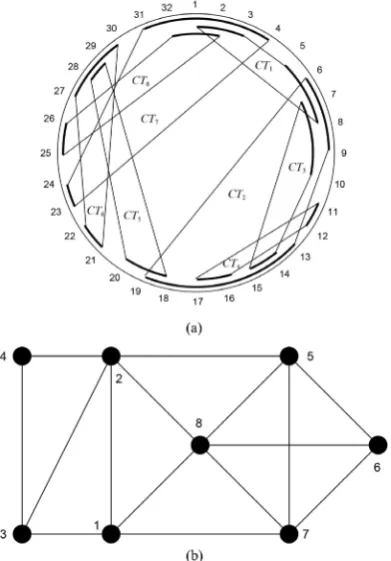
Figure 1(a) illustrates an example of a circle trapezoid model M with eight circle trapezoids. The circle trapezoid with a di> i is called feedback circle trapezoid.
Note that there exist two feedback circle trapezoids (CT CT7, 8) in a circle
trape-zoid model M.
An undirected graph G is a circle trapezoid graph if it can be represented by the following circle trapezoid model; each vertex of the graph corresponds to a circle trapezoid in circle trapezoid model, and two vertices are adjacent in G if and only if their circle trapezoids intersect [9]. Figure 1(b) illustrates a circle trapezoid graph G corresponding to M shown in Figure 1(a). Table 1 shows the details of circle trapezoid model M of Figure 1.
2.2. Extended Circle Trapezoid Model
In the following, we introduce the extended circle trapezoid modelEM constructed from a circle trapezoid model for making the problem easier. We first cut a cir-cle trapezoid model M at point 1 on the circumference and next unroll onto the real horizontal line. Each circle trapezoid CTi =
[
a b c di, , ,i i i]
in M is also changed to a pair of line segment Ii=(
[
a di, i] [
, ,b di i]
)
called interval pair byexecuting the above process. Here, feedback circle trapezoid CTi =
[
a b c di, , ,i i i]
in M is changed to interval pair Ii=(
[
a di, i+4 ,n b] [
i+4 ,n di+4n]
)
for, ,
i i i i
a b c d> . Moreover, copies Ii n− of Ii are created by shifting 4n to the left
respectively, for each Ii, 1≤ ≤i n. Note that both interval pairs Ii and Ii n−
in extended circle trapezoid model EM are corresponding to CTi in M.
The following Algorithm CEM constructs an EM from a M. Figure 2 shows the EM constructed from the M illustrated in Figure 1. Table 2 shows the details of EM of Figure 2.
Algorithm CEM
Input: Corner points
[
a b c di, , ,i i i]
of CTi in M.Begin
For each non feedback circle trapezoid CTi pardo
Create a interval pair Ii=
(
[
a di, i] [
, ,b di i]
)
;For each feedback circle trapezoid CTi pardo
For each b c d ai, ,i i< i
Create a interval pair Ii=
(
[
a di, i+4 ,n b] [
i+4 ,n di+4n]
)
;For 1≤ ≤i n pardo
Create copies Ii n− by shifting 4n to the left for Ii;
End
3. Proper Circle Trapezoid Model and Graph
3.1. Definitions for Proper Circle Trapezoid Graph
DOI: 10.4236/jamp.2018.68141 1652 Journal of Applied Mathematics and Physics
Figure 1. Circle trapezoid model and graph. (a) Circle
trapezoid model M;(b) Circle trapezoid graph G.
[image:4.595.276.472.74.355.2]Figure 2. Extended circle trapezoid model EM.
Table 1. Details of circle trapezoid model M.
i 1 2 3 4 5 6 7 8
ai 1 6 7 11 18 21 23 25
bi 3 9 10 12 20 22 24 26
ci 5 13 14 16 28 27 31 32
di 8 19 15 17 29 30 4 2
Table 2. Details of extended circle trapezoid model EM.
i −7 −6 −5 −4 −3 −2 −1 0 1 2 3 4 5 6 7 8
ai −31 −26 −25 −21 −14 −11 −9 −7 1 6 7 11 18 21 23 25
[image:4.595.208.541.533.612.2]DOI: 10.4236/jamp.2018.68141 1653 Journal of Applied Mathematics and Physics circle trapezoid model EM constructed from M satisfies that c di< j for two
in-terval pairs Ii and Ij
(
i j<)
in EM. The circle trapezoid model Mp isde-fined as proper circle trapezoid model. The graph corresponding to the proper circle trapezoid model is proper circle trapezoid graph Gp. In this study, we
will develop a parallel algorithm for spanning tree problem on proper circle tra-pezoid graphs. The Figure 1 is also an example of Mp and Gp because
i j
c d< for Ii and Ij
(
i j<)
in extended circle trapezoid model EM.Here, some notations that form the basis of our algorithm are defined as fol-lows.
The function nor
( )
i normalizes the interval pair number i in EM within the range 1 to n, which is expressed as( )
if 1,nor
if 1.
i i
i
i n i ≥
= + <
For the example shown in Figure 2, for i=4 and i= −5, we have
( )
nor 4 =4 and v
( )
− =5 3, respectively.The function v kd
( )
computes a vertex number i satisfying d ki= for agiven number k on EM. For the example shown in Figure 2, for k=29 and 13
k= − , we have vd
( )
29 =5 and vd(
−13)
= −6 by d5=29 and d−6= −13,respectively. Moreover, we use nv kd
( )
instead of nor(
v kd( )
)
for simplicity.For the example shown in Figure 2, for k=29 and k= −13, we have
( )
29 5d
nv = and nvd
(
−13)
=2 by vd( )
29 =5 and vd(
−13)
= −6, respec-tively.We next define ldi =max
{
d− +n1,d− +n 2, , di}
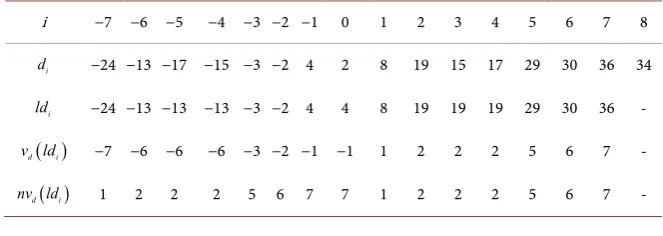
, for − + ≤ ≤ −n 1 i n 1, in EMp.The details of ldi, v dd
( )
i , and nv dd( )
i are shown in Table 3.3.2. Property of Proper Circle Trapezoid Graph
We describe some properties on circle trapezoid graphs which are useful for constructing the algorithm for spanning tree problem on proper circle trapezoid graphs.
For two interval pairs Ii and Ij
(
i j<)
in EM, we say Ii and Ij aredisjoint if di <aj. Moreover, we say Ii contain Ij if b ai< j and dj<ci.
[image:5.595.207.539.615.733.2]Figure 3 shows examples of the cases of disjoint and contain. The following Lemma 1 has been described in [9].
Table 3. Details of extended circle trapezoid model EM.
i −7 −6 −5 −4 −3 −2 −1 0 1 2 3 4 5 6 7 8
i
d −24 −13 −17 −15 −3 −2 4 2 8 19 15 17 29 30 36 34
i
ld −24 −13 −13 −13 −3 −2 4 4 8 19 19 19 29 30 36 -
( )
d i
v ld −7 −6 −6 −6 −3 −2 −1 −1 1 2 2 2 5 6 7 -
( )
d i
DOI: 10.4236/jamp.2018.68141 1654 Journal of Applied Mathematics and Physics
Figure 3. Examples of disjoint and contain. (a) Ii and
j
I are disjoint (d ai< j); (b) Ii contains Ij (b ai< j and c di> j).
Lemma 1 Let CTi and CTj
(
i j<)
be non-feedback circle trapezoids incircle trapezoid model M. Moreover, extended circle trapezoid model EM is constructed from M. CTi and CTj intersect if Ii and Ij are not disjoint
and Ii does not contain Ij in EM.
The following Lemma 2 generalizes Lemma 1. This is very useful to find the edges on circle trapezoid graph.
Lemma 2 G is a circle trapezoid graph corresponding to a circle trapezoid model M, and extended circle trapezoid model EM is constructed from M. For two interval pairs I Ii, j
(
i j<)
, an edge(
nor ,nor( )
i( )
j)
is in G if and only ifat least one of the following conditions satisfies in EM; 1) b ai> j,
2) di>aj and c di< j.
(Proof) By Lemma 1, for two non-feedback circle trapezoids CTi and CTj
do not intersect if and only if (di<aj) or (b ai< j and c di > j) in EM. By the
contra position, for two non-feedback circle trapezoids CTi and CTj
inter-sect if and only if (di >aj) and (b ai> j or c di< j) in EM. Here, (di >aj) and
(b ai> j or c di > j) is logically equal to (di >aj and b ai> j) or (di >aj and
i j
c d< ).
For the condition (di >aj) and (b ai> j), we have b ai> j whenever di >aj.
Thus,
(
nor ,nor( )
i( )
j)
is an edge of CTG G if (b ai> j) or (di >aj andi j
c d< ) for two interval pairs Ii and Ij
(
i j<)
in EM. □We obtain the following Lemma 3 for a proper circle trapezoid model Mp
and graph Gp.
Lemma 3. Gp is a proper circle trapezoid graph corresponding to a proper
circle trapezoid model Mp, and EMp is an extended circle trapezoid model
constructed from Mp. An edge
(
nor ,nor( )
i( )
j)
is in Gp if and only ifi j
d >a for i j< satisfies in the EMp.
(Proof) By Lemma 2, if either of conditions 1) (b ai> j) or 2) (di >aj and
i j
c d< ) for two interval pairs Ii and Ij
(
i j<)
in EMp, an edge( )
( )
(
nor ,nori j)
is in Gp. By definition of proper circle trapezoid graph Gp,DOI: 10.4236/jamp.2018.68141 1655 Journal of Applied Mathematics and Physics Moreover, condition 1) b ai> j satisfies if di>aj holds because a b c di < < <i i i
by the definition of interval pair. Therefore an edge
(
nor ,nor( )
i( )
j)
is in Gpif and only if di >aj for i j< satisfies in the EMp. □
In Lemma 2, we have to test if b ai> j or (di >aj and c di< j) in EM to
check whether
( )
i j, is an edge of normal circle trapezoid graph G. On the other hand, by Lemma 3, we only need to check di >aj holds for EMp todetermine whether an edge
( )
i j, is in proper circle trapezoid graph Gp.The following Lemma 4 is core of solving this problem. An efficient algorithm can be constructed by using the following lemma.
Lemma 4. Gp is a proper circle trapezoid graph corresponding to an Mp,
and EMp is an extended circle trapezoid model constructed from Mp. For
1≤ ≤i n, an edge
(
nv ldd(
i−1)
,i)
is in Gp if ldi−1>ai satisfies in the EMp.(Proof) By the definition, ldi−1=max
{
d− +n1,d− +n 2, , di−1}
. Thus, we have(
1)
1d i
v ld− ≤ −i . By Lemma 3, an edge
(
nor ,nor( )
i( )
j)
is in Gp if and only ifi j
d >a for i j< . Therefore, an edge
(
nv ldd(
i−1)
,i)
is in Gp if ldi−1>aisa-tisfies in the EMp. □
4. Parallel Algorithm
In this section, we propose an algorithm for constructing a spanning tree of a connected proper circle trapezoid graph Gp. We assume that all trapezoids in
the proper circle trapezoid model have been sorted by corner point a in ascend-ing order, that is, Table 1 is given as an input of our algorithm. Algorithm CST returns a spanning tree if a given graph Gp is connected. Instead of using a
sophisticated technique, we propose simple parallel algorithms using only the parallel prefix computation [11] and Brent’s scheduling principle [12].
Algorithm CST
Input: ai and bi, 1≤ ≤i n.
Output: A spanning forest F of G. Initially F be an empty set. Begin
(Step 1) % Initializing
:
F = ∅;
For i, 1≤ ≤i n pardo
[ ]
: 0 M i = ;For i, 1≤ ≤i 2n pardo
[ ]
: 0 P i = ;(Step 2) % Computing M i
[ ]
For i, 1≤ ≤i n pardo[ ]
i : P a =i;[ ]
i : P b =i;For i, 1≤ ≤i 2n pardo
[ ]
: max{
[ ] [ ]
1 , 2 , ,[ ]
}
P i = P P P i ;
For i, 1≤ ≤i n pardo
[ ]
:[ ]
iDOI: 10.4236/jamp.2018.68141 1656 Journal of Applied Mathematics and Physics (Step 3) % Construct a spanning forest
For i, 1≤ ≤i n pardo If i M i>
[ ]
then F F:=
(
i M i,[ ]
)
; EndLemma 5. After executing Step 3 of Algorithm CST, graph T is a spanning tree of proper circle trapezoid graph Gp.
(Proof) Step 1 is a process for initialization. T is empty set and all cki are set
to “0”. For all − + ≤ ≤ −n 1 i n 1, compute ldi: max=
{
d− +n1,d n− +2, , di}
us-ing parallel prefix computation [11].
In Step 2, we set cki=1, 1≤ ≤i n, if ldi−1>ai. In addition, we compute
(
)
(
)
{
1 1}
: max d i | d i , i 1
s = nv ld− nv ld− >i ck = . By Lemma 4, an edge
(
nv ldd(
i−1)
,i)
is in Gp if ldi−1>ai. Thus, a vertex i that cki=1 can have least one edge
from i to other vertex nv ldd
(
i−1)
. Vertex s is the largest nv ldd(
i−1)
satisfying(
1)
d i
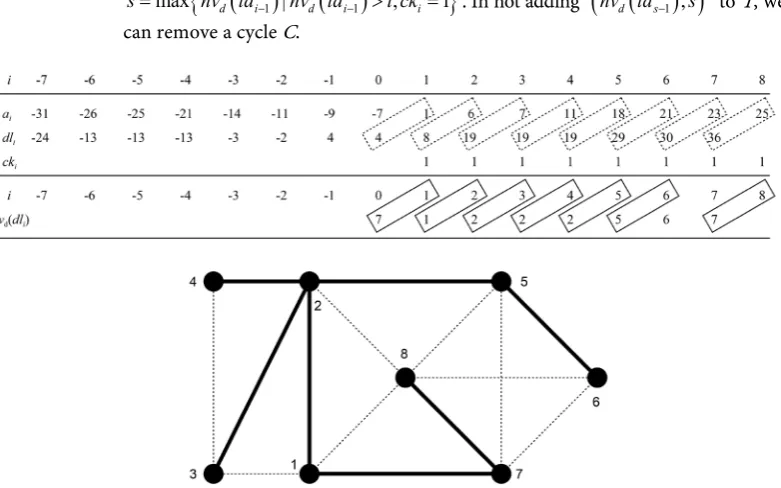
nv ld− >i. For the example shown in Figure 4, we set cki=1 because
1
i i
ld− >a , for 1≤ ≤i n. For the only case of i=1, we have nv ldd
(
i−1)
>i then( )
0 7d
s nv ld= = .
We consider that T is added an edge form i to v ldd
(
i−1)
smaller for i,1≤ ≤i n. By definitions of vd and ld, if v ldd
(
i−1)
corresponds a copy of anon-feedback circle trapezoid, we have nv ldd
(
i−1)
<i. On the other hand, if(
1)
d i
v ld− corresponds a copy of a feedback circle trapezoid, we have
(
1)
d i
nv ld− >i. In the case of 1
n i i=ck n=
∑
, T constructed in above way is con-nected graph that has n vertices. Thus, T is not a tree that has exactly one cycle C. There exist some edge(
nv ldd(
i−1)
,i)
in C such that nv ldd(
i−1)
is feedbackcir-cle trapezoid, because a given Gp is connected. In Step 2, we obtained
(
)
(
)
{
1 1}
max d i | d i , i 1
s= nv ld− nv ld− >i ck = . In not adding
(
nv ldd(
s−1)
,s)
to T, we [image:8.595.145.536.462.706.2]can remove a cycle C.
DOI: 10.4236/jamp.2018.68141 1657 Journal of Applied Mathematics and Physics In Step 3, in the case of
∑
ni=1ck ni= , we add an edge(
nv ldd(
i−1)
,i)
to T forvertex i, 1≤ ≤i n,
i
≠
s
. T is connected with n−1 vertices, that is, T is a tree. In Step 3, we consider the case of∑
in=1ck ni≠ . This implies 1 1n i i=ck n= −
∑
. If1 1
n i i=ck n< −
∑
, this means that a given Gp is disconnected, which is acontra-diction to our hypothesis. Therefore, in the case of
∑
ni=1ck ni= , we add an edge(
)
(
nv ldd i−1 ,i)
to T for vertex i, 1≤ ≤i n, cki=1. T is connected with n−1vertices, that is, T is a tree.
Therefore, after executing Step 3 of Algorithm CST, graph T is a spanning tree of proper circle trapezoid graph Gp. □
Figure 4 shows a spanning tree T constructed from CTG Gp by executing
Algorithm CST.
In the following, we analyze the complexity of Algorithm CST.
In Step 1, an extended circle trapezoid model is constructed from a circle tra-pezoid model in O
( )
1 time using O n( )
processors, which can be imple-mented in O(
logn)
time using O n(
logn)
processors by applying Brent’s scheduling principle [12]. Moreover, all rdi are obtained in O(
logn)
timeusing O n
(
logn)
processors by applying parallel prefix computation [11]. In Step 2, cki and s are computed in O(
logn)
time using O n(
logn)
proces-sors by applying Brent’s scheduling principle. Step 3 can also be implemented in
(
log)
O n time using O n
(
logn)
processors by applying Brent’s scheduling principle. In addition, Algorithm CST can be executed on an EREW PRAM be-cause neither concurrent read nor concurrent write are necessary. Thus, we have the subsequent theorem.Theorem 6. Algorithm CST constructs a spanning tree of a proper circle trapezoid graph in O
(
logn)
time using O n(
logn)
processors on EREW PRAM. □5. Concluding Remarks
In this paper, we presented a parallel algorithm to solve the spanning tree prob-lem on a proper circle trapezoid graph. This algorithm can be impprob-lemented in
(
log)
O n time with O n
(
logn)
processors on an EREW PRAM computation model using only parallel prefix computation [11] and Brent’s scheduling prin-ciple [12] without using a sophisticated technique. Solutions to the spanning problem have applications in electrical power provision, computer network design, and circuit analysis, among others. For this reason, we think this paper is also worthy from both a theoretical and algorithmic point of view. In the future, we will continue this research by extending the results to other classes of graphs.Acknowledgements
DOI: 10.4236/jamp.2018.68141 1658 Journal of Applied Mathematics and Physics
Conflicts of Interest
The authors declare no conflicts of interest regarding the publication of this pa-per.
References
[1] Wilson, R.J. (1996) Introduction to Graph Theory. Prentice Hall, Upper Saddle River.
[2] Chin, F.Y., Lam, J. and Chen, I. (1982) Efficient Parallel Algorithms for Some Graph Problems. Communications of the ACM, 25, 659-665.
https://doi.org/10.1145/358628.358650
[3] Klein, P. and Stein, C. (1990) A Parallel Algorithm for Eliminating Cycle in Undi-rected Graphs. Information Processing Letters, 34, 307-312.
https://doi.org/10.1016/0020-0190(90)90015-P
[4] Wang, Y. L., Chen, H. C. and Lee, C. Y. (1995) An O
(
logn)
Parallel Algorithm for Constructing a Spanning Tree on Permutation Graphs. Information Processing Letters, 56, 83-87. https://doi.org/10.1016/0020-0190(95)00125-V[5] Wang, Y. L., Chiang, K. C. and Yu, M. S. (1998) Optimal Algorithms for Interval Graphs. Journal of Information Science and Engineering, 14, 449-459.
[6] Bera, D., Pal, M. and Pal, T. K. (2003) An Optimal PRAM Algorithm for a Spanning Tree on Trapezoid Graphs. Journal of Applied Mathematics and Computing, 1-2, 21-29. https://doi.org/10.1007/BF02936178
[7] Honma, H., Honma, S. and Masuyama, S. (2009) An Optimal Parallel Algorithm for Constructing a Spanning Tree on Circular Permutation Graphs. IEICE Transactions on Information and Systems, E92-D, 141-148.
https://doi.org/10.1587/transinf.E92.D.141
[8] Honma, H., Nakajima, Y., Igarashi, Y. and Masuyama, S. (2014) Algorithm for Finding Maximum Detour Hinge Vertices of Interval Graphs. IEICE Transactions on Fundamentals of Electronics, E97-A, 1365-1369.
https://doi.org/10.1587/transfun.E97.A.1365
[9] Felsner, S., Müller, R. and Wernisch, L. (1997) Trapezoid Graphs and Generaliza-tion, Geometry and Algorithms. Discrete Applied Mathematics, 74, 13-32.
https://doi.org/10.1016/S0166-218X(96)00013-3
[10] Lin, W. L. (2006) Circular and Circle Trapezoid Graphs. Journal of Science and En-gineering Technology, 2, 11-17.
[11] Gibbons, A. and Rytter, W. (1988) Efficient Parallel Algorithms. Cambridge Uni-versity Press, Cambridge.