OPTIMAL DESIGN OF HIGH-PASS FIR FILTER BY BLACKMAN, RECTANGULAR, TRINGULAR
AND TAYLOR WINDOW TECHNIQUES
*
Puran Lal Khuntey, Gajendra Das, Sashikant Verma
Department of Electrical & Electronics Engineering, Institute of Technology
ARTICLE INFO ABSTRACT
This paper deals with the design of FIR filter using Blackman window, Rectangular window, Tringular window, Taylor window Techniques of order 10. In this paper. The
and phase response of proposed FIR Low
result window technique provides better result in term of magnitude and phase response of High FIR filter.
Copyright©2017, Puran Lal Khuntey et al. This is an open access article distributed under the Creative Commons Att use, distribution, and reproduction in any medium, provided the original work is properly cited.
INTRODUCTION
We are living in an age of information technology. Most of this technology is based on theory of digital signal processing (DSP) and implementation of the theory by devices embedded in what are known as digital signal processors (DSPs). Of course, the theory of DSP and its applications is supported by other disciplines such as computer science and engineering, and advances in technologies such as the design and manufacturing of very large scale integration (VLSI) chips (Shenoi, 2006). A signal carries information, and the objective of signal processing is to extract useful information carried by the signal. The method of information extraction depends on the type of signal and the nature of the information being carried by the signal (Sanjit K. Mitra, 2001
Processing (DSP) is an important field of study that has come about due to advances in Communication theory, digital computer technology, and consumer devices. There is always a driving need to make thing better and DS
techniques for doing this. For example, people enjoy music and to download new songs. However, with slow Internet connection speeds (typically 56 kilobits per second for a dial up modem), downloading a song could take hours. WithMP3 compression software, though, the size of the song is reduced by as much as 90%, and can be downloaded in a matter of
*Corresponding author: Puran Lal Khuntey,
Department of Electrical & Electronics Engineering, Institute of
ISSN: 0975-833X
Article History:
Received 17th December, 2016
Received in revised form 20th January, 2017
Accepted 25th February, 2017
Published online 31st March,2017
Citation: Puran Lal Khuntey, Gajendra Das, Sashikant Verma
rectangular, tringular and taylor window techniques”, Key words:
DSP, FIR, High-Pass FIR Digital Filter, Blackman Window, Rectangular Window, Tringular Window, Taylor Window.
RESEARCH ARTICLE
PASS FIR FILTER BY BLACKMAN, RECTANGULAR, TRINGULAR
AND TAYLOR WINDOW TECHNIQUES
Gajendra Das, Sashikant Verma
and Krishna
Department of Electrical & Electronics Engineering, Institute of Technology
ABSTRACT
This paper deals with the design of FIR filter using Blackman window, Rectangular window, Tringular window, Taylor window Techniques of order 10. In this paper. The
and phase response of proposed FIR Low-pass filter are performed using MATLAB simulation. The result window technique provides better result in term of magnitude and phase response of High FIR filter.
is an open access article distributed under the Creative Commons Attribution License, which use, distribution, and reproduction in any medium, provided the original work is properly cited.
We are living in an age of information technology. Most of this technology is based on theory of digital signal processing (DSP) and implementation of the theory by devices embedded in what are known as digital signal processors (DSPs). Of ry of DSP and its applications is supported by other disciplines such as computer science and engineering, and advances in technologies such as the design and manufacturing of very large scale integration (VLSI) chips A signal carries information, and the objective of signal processing is to extract useful information carried by the signal. The method of information extraction depends on the type of signal and the nature of the information being 2001). Digital Signal Processing (DSP) is an important field of study that has come about due to advances in Communication theory, digital computer technology, and consumer devices. There is always a driving need to make thing better and DSP provides many techniques for doing this. For example, people enjoy music and to download new songs. However, with slow Internet connection speeds (typically 56 kilobits per second for a dial-up modem), downloading a song could take hours. WithMP3
sion software, though, the size of the song is reduced by as much as 90%, and can be downloaded in a matter of
Department of Electrical & Electronics Engineering, Institute of
minutes. The MP3 version of the song is not the same as the original, but is a “good enough” approximation that most users cannot distinguish from the original.
Advantages of DSP
Digital signal processing has following
1) Digital signal processing changing the program in
i.e., these is flexible systems. 2) Better control of accuracy
to analog systems. 3) Digital signals are easily
as magnetic tape without
reproduction of signal.
4) Digital signals can be processed easily transported.
5) Sophisticated signal processing implemented by DSP method. 6) Digital circuits are less
component values.
7) Digital systems are independent and other external parameters. 8) Digital circuits can be
quantities at comparatively 9) Cost of processing per
time-sharing of given International Journal of Current Research
Vol. 9, Issue, 03, pp.47352-47362, March, 2017
OF CURRENT RESEARCH
Puran Lal Khuntey, Gajendra Das, Sashikant Vermaand Krishna Pradeep, 2017. “Optimal design of high International Journal of Current Research, 9, (03), 47352-47362.
PASS FIR FILTER BY BLACKMAN, RECTANGULAR, TRINGULAR
Krishna Pradeep
Department of Electrical & Electronics Engineering, Institute of Technology, Korba
This paper deals with the design of FIR filter using Blackman window, Rectangular window, Tringular window, Taylor window Techniques of order 10. In this paper. The analysis of magnitude pass filter are performed using MATLAB simulation. The result window technique provides better result in term of magnitude and phase response of High-pass
ribution License, which permits unrestricted
. The MP3 version of the song is not the same as the original, but is a “good enough” approximation that most users cannot distinguish from the original. (Michael Weeks, 2007)
following advantages:
processing operations can be changed by in digital programmable system, systems.
accuracy in digital systems compared
easily stored on magnetic media such without loss of quality of
processed off line, i.e., these are
processing algorithms can be method.
less sensitive to tolerances of
independent of temperature, ageing parameters.
be reproduced easily in large vely lower cost.
per signal in DSP is reduced by processor among a number of
OF CURRENT RESEARCH
10) Processor characteristics during processing, as in adaptive filters can be easily adjusted in digital implementation.
11) Digital system can be cascaded without any loading problems.
Disadvantages of DSP
1) Limited to signal with relatively LOW BANDWITH. 2) Flexible -> Easily Modified (Software Base).
3) Handle more complex processing that impossible with analog circuitry.
Applications of DSP in area-wise are as following
1) Telecommunication- Echo cancellation in telephone networks, equalization, telephone dialling application, modems, line repeaters, channel multiplexing, data encryption, video conferencing, cellular phone and FAX.
2) Military- Radar signal processing, sonar signal processing, navigation, secure communications and missile guidance.
3) Consumer electronics- Digital Audio/TV, electronic music synthesizer, educational toys, FM stereo application and sound recording applications.
4) Image processing- Image representation, image
compression, image enhancement, image restoration and image analysis compression, image enhancement, image restoration and image analysis.
5) Speech processing- Speech analysis methods are used in automatic speech recognition, speaker verification and speaker identification.
6) Medicine-Medical diagnostic instrumentation such as computerized tomography (CT), X-ray scanning, Patient monitoring and X-ray storage/enhancement. 7) Signal filtering-Removing of unwanted background
noise, removal of interference, separation of frequency bands and shaping of the signal spectrum. (Salivahanan
et al., 2001)
FIR filter
FIR filters are filters having a transfer function of a polynomial in z- and is an all-zero filter in the sense that the zeroes in the z-plane determine the frequency response magnitude characteristic. The z transform of a N-point FIR filter is given by
H (z) = ∑ ( ) ... (1)
FIR filters are particularly useful for applications where exact linear phase response is required. The FIR filter is generally implemented in a non-recursive way which guarantees a stable filter. FIR filter design essentially consists of two parts
(1)approximation problem
(2) realization problem
The approximation stage takes the specification and gives a transfer function through four steps. They are as follows:
(1)A desired or ideal response is chosen, usually in the frequency domain.
(2)An allowed class of filters is chosen (e.g. the length N for a FIR filters).
(3)A measure of the quality of approximation is chosen. (4)A method or algorithm is selected to find the best filter
transfer function.
The realization part deals with choosing the structure to implement the transfer function which may be in the form of circuit diagram or in the form of a program.
There are essentially three well-known methods for FIR filter design namely:
(1) The window method
(2) The frequency sampling technique
(3) Optimal filter design methods (Salivahanan et al., 2001).
Window techniques
The desired frequency response of any digital filter is periodic in frequency and can be expanded in a fourier series, i.e
Hd(e
jω
)= ∑∞
∞ ( ) ……….(2)
where, h(n)= ∫ ( )
The Fourier coefficient of the series h(n) are identical to the impulse response of a digital filter. There are two difficulties with the implementation of above equation for designing a digital filter. First, the impulse response is of infinite duration and second, the filter is non-causal and unrealizable. No finite amount of delay can make the impulse response realizable Hence the filter resulting from a Fourier series representation. of H( ) is an unrealizable IIR filter (Pranay rahi et al., 2016).
Blackman window function
The Blackman window is defined as
Wb(n) =
0.42 + 0.5cos + 0.08cos , for|n| ≤
0, for|n| >
………..(3)
Rectangular window function
The weighting function for the rectangular window is given by
WR(n) = 1 | | ≤
0, otherwise ……….(4)
Taylor window function
in antenna and phased array synthesis (Mohd. Schariq Mahboob and Rajesh Mehra, 2014).
Tringular window function
The standard triangular window is defined as
( ) =
⌈ ⌉
, ⌊ ⌋ ≤
0, | | > ……… (5)
Simulation
Table 1. Parameter Specification
Parameter Values
Sampling Frequency(Fs) 48000 Hz Cut off Frequency(Fc) 10800Hz
[image:3.595.110.484.262.547.2]Order(N) 10
Table 2. Filter coefficients of Rectangular, Blackman and tringular Window Technique
Filter Coefficient h(n) Window Techniques
Rectangular Blackman Tringular Taylor
h(0)=h(10) -0.04187 0 -0.00781 -0.01166
h(1) =h(9) 0.04351 0.00188 0.01624 0.01861 h(2)= h(8) 0.08794 0.01898 0.04923 0.05681 h(3)= h(7) -0.04575 0.02508 -0.03415 -0.03924 h(4)= h(6) -0.29247 0.26708 -0.27289 -0.29447
[image:3.595.116.487.578.757.2]h(5) 0.51166 0.55019 0.57288 0.54282
Figure 1. Magnitute Blackman window technique
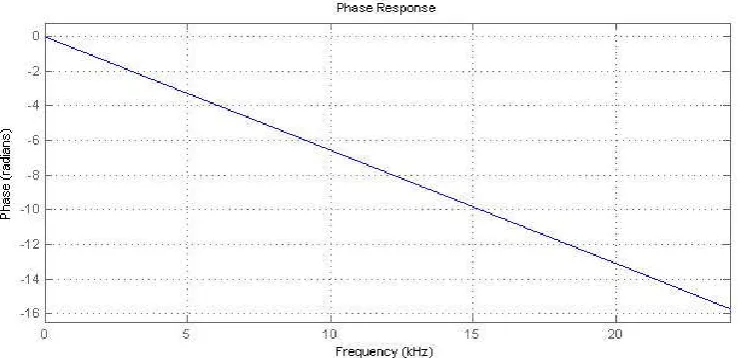
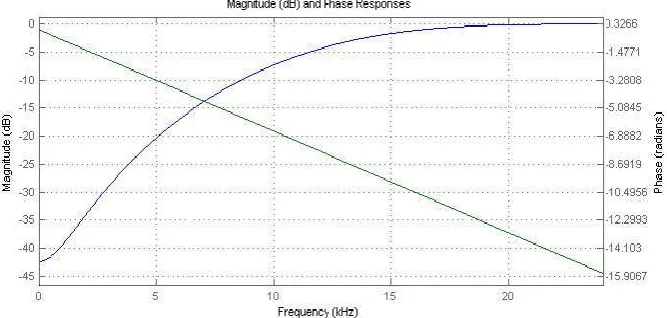
Figure 3. Magnitute and Phase response Blackman window technique
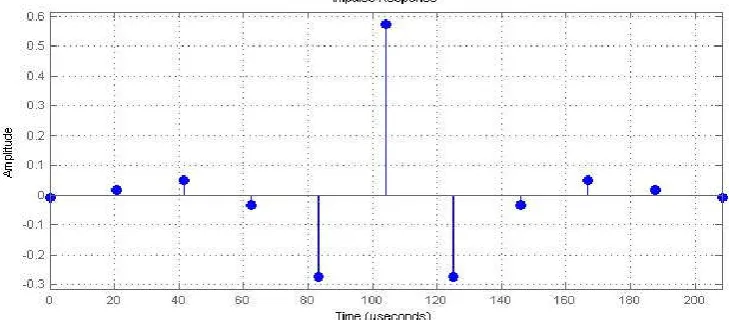
[image:4.595.143.466.258.420.2]Figure 4. Impulse response of Blackman Window technique
Figure 5. Filter coefficient of Blackman window technique
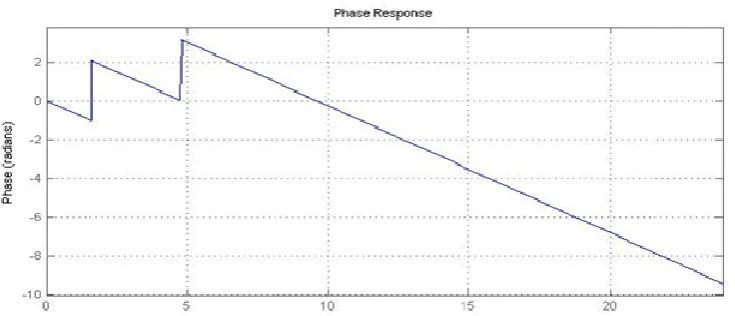
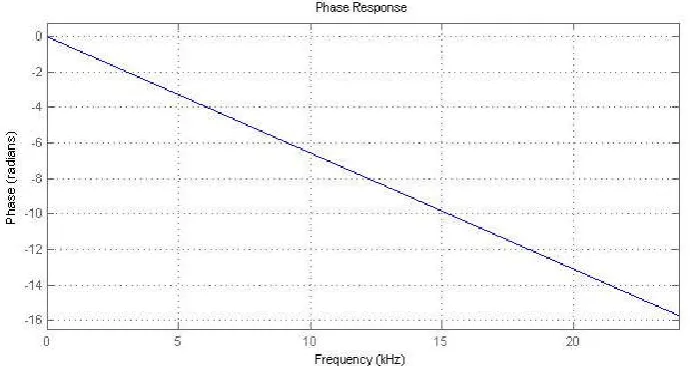
[image:4.595.111.488.601.783.2]Figure 7. Phase response of Rectangular window Technique
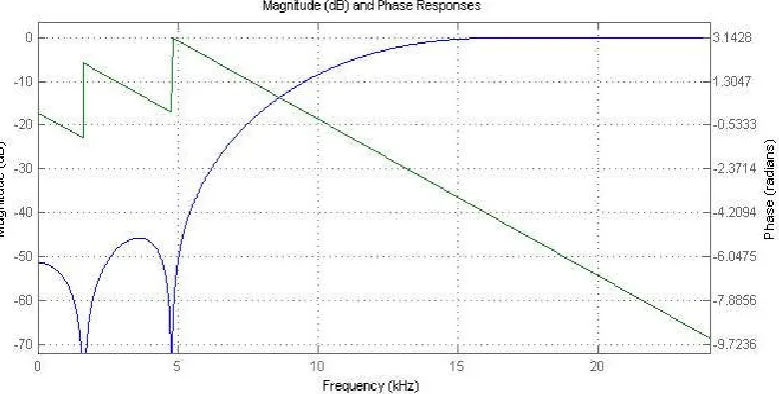
Figure 8. Magnitude and Phase response of Rectangular window Technique
[image:5.595.91.507.542.747.2]Figure 10. Impulse response of Rectangular window Technique
[image:6.595.138.453.253.414.2]Figure 11. Magnitude response of Rectangular window Technique
Figure 12. Filter coefficient of Rectangular window technique
[image:6.595.118.486.610.768.2]Figure 14. Magnitude response and Phase response of Taylar window Technique
Figure 15. Impulse response of Taylor window Technique
[image:7.595.92.501.539.742.2]Figure 17. Time doman and Frequency doman of Taylor window Technique
[image:8.595.105.496.615.784.2]Figure 18. Filter coefficient of Taylor window Technique
Figure 19. Phase response of Tringular window Technique
Figure 21. Impulse response of Tringular window Technique
[image:9.595.140.442.262.431.2]Figure 22. Magnitude response of Tringular window Technique
[image:9.595.107.483.467.624.2]Figure 25. Impulse response of Tringular, Rectangur, Blackman and Taylor window Technique
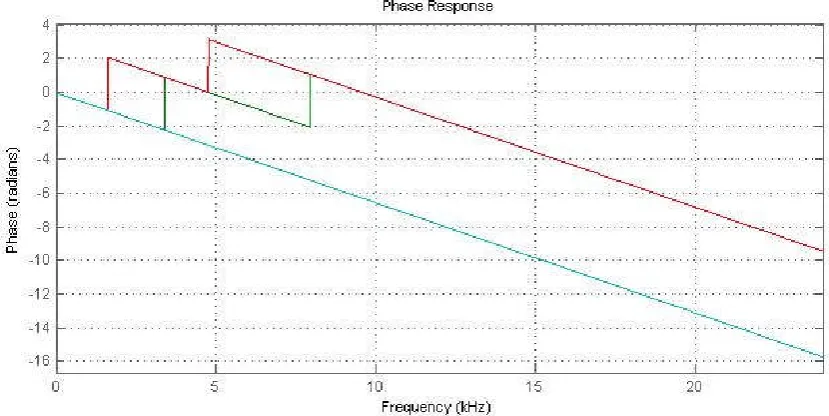
Figure 26. Phase response of Tringular, Rectangular, Blackman and Taylor window Technique
[image:10.595.118.494.552.751.2]Conclusion
In this paper FIR high pass filter has been designed and simulated using Blackman, Tringular, Taylor and Rectangular Window technique. It has been compared leakage factor, mainlobe width and relative sidelobe attenuation of the three window from the simulated result. Rectangular window mainlobe width is increase and decreases the amplitude of sidelobes that is increases the attenuation. Rectangular Window main lobe width (-3dB) is 0.17188 at sampling frequency 48000 Hz, cut off frequency 10800 Hz and order 10 Rectangular window has greater mainlobe width and less leakage factor in comparison of Blackman window Taylor and Tringular window.
REFERENCES
http://www.mathworks.com/access/helpdesk/help/toolbox/sign al/signal.shtml Signal Processing Toolbox, The Math works, Inc., accessed October 25, 2002.
Michael Weeks, 2007 edition. “Digital Signal Processing ” Using MATLAB and Wavelets, Infinity Science Press, pp.1
Mohd. Schariq Mahboob & Rajesh Mehra International
journal of Advanced Research in science in Engineering, IJARSE, Vol.No.3, Issue no 11, Nov 2014, ISSN -2319-8354(E)
Parks T.W. and C.S. Burrus, 1987. “Digital Filter Design”. New York:Wiley.
Pranay rahi, Nikhil Agrawal, G Laxmi Sager, Rahul Suryavansihi 2016. “IJREST” Valume-3, Issue-5.
Proakis J.G. and D.G. Manolakis, 2000. “Digital Signal Processing-Principles, Algorithms and Applications” New Delhi: Prentice-Hall.
Rabiner L.R. and B. Gold, 1975. “Theory and Applications of Digital Signal Processing”. New Jersey: Prentice-Hall. Rabiner, L.R., B. Gold and C.A. McGonegal, 1970. “An
approach to the Approximation Problem for Nonrecursive Digital Filters,” IEEE Trans. Audio and Electroacoustics, vol. AU-18, pp. 83-105.
Salivahanan, S., C Gnanapriya, A Vallavaraj, 2001. “Digital Signal Processing” Tata McGraw-Hill, second edition pp.3,443-448.
Sanjit K. Mitra, 2001. “Digital Signal Processing” a computer based approach second edition McGraw Hill, pp.1.
[image:11.595.110.480.56.277.2]Shenoi, B.A. 2006 edition. ”introduction to digital signal processing and filter design” A John Wiley& Sons INC., Publication.
Figure 28. Magnitude response of Tringular, Rectangular, Blackman and Taylor window Technique
[image:11.595.107.497.358.410.2]RESULTS:-
Blackman, Rectangular, Tringular and Taylor Window TechniqueTable 3. Simulation Result in MATLAB
Window technique Leakage Factor Relative sidelobe atteanuation Mainlobe width (dB)
Blackman 0 -64.6dB 0.35938
Rectangular 9.2 -13dB 0.17188
Tringular 0.17 -28.2dB 0.25
Taylor 0.34 -29.2dB 0.21875