Munich Personal RePEc Archive
Optimal dynamic antitrust fines
Merino Troncoso, Carlos
1 November 2019
Online at
https://mpra.ub.uni-muenchen.de/96781/
Dynamic Antitrust Fines
Carlos Merino Troncoso
∗November 1, 2019
Abstract
Standard antitrust optimal fines rely on a microeconomic static model. [9] describes optimal antitrust dynamic sanctions and its application for EU and US methodology. For the EU fine, and based on this methodology, we find an equilibrium point for a high level of offence (2 times normal profits ) and a high detection probability (0.6).
1
Introduction
An economic explanation of deterrent fines was first studied by G. Becker [2]. Although there is an extensive literature on the topic, the vast mayority is based on a short term static model , see [1, 3, 7, 6]. Examples of optimal fine determination on a dynamic framework are [9, 8, 4, 5]. We follow [9] who studied optimal dynamic fines and its application for the EU and US case. The dynamic model provides a better framework for studying optimal fines, as parameters such as detection probabilities are better explained in a dynamic environment.
2
Optimal Fine : Static model
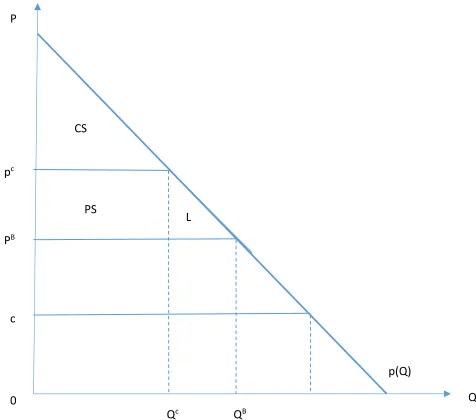
In the below graph for a static model [9] we see that a company searches for positive illicit gains (PS) above normal profits using anticompetitive conduct. The competition agency wants illicit gains to be 0 accepting only profits above c that are due to competitive conduct.
Competition authorities can detect infringements and sanction companies im-posing finess(t), during the infringement duration t. I study the interactions between companies and antitrust agency during T.
Companies maximize total profit and decide to collude, fixing prices above com-petitive prices. The level of gravity of the infringement is represented as the amount of overchargeq(t).
p(Q) CS
PS
L P
0 Q
c pc
PB
[image:3.612.180.418.209.419.2]Qc QB
and dismantling cartels at the lowest budgetary cost. Its activities are summa-rized in the detection probability parameterp(t). I consider the companies profit for colluding above imperfect competitive profitφ(t)>0. Profits in competition are above 0 and equal to a parameter m,φc=m.
3
Optimal Fine: Dynamic model
As in [9], I assume that the company is player 1 and the competition agency is player 2. The detection of cartels are governed by a recursive process that depends on gravity of infringement (collusion degree which is the control variable of the company)q(t), and the detection capacity of the agency isp(t) so that :
˙
F(t) =p(t)q(t)[1−F(t)].
In this caseφ(t) is the probability conditional to being discovered in a timet if never being discovered previously.
There is a state variableF(t) (probability distribution function of time until detection), and two controlsq(t) (firms degree of collusion ) andp(t) (agencys capacity enforcement). Competition agency maximizes the following objective function:
maxR0Te−
rt[CS(q(t))|+C(p(t))[1−F(t)] +s(q(t), p(t))F(t)]dt
−e−rtC1(T)[1−F(T)]. (1)
C(p(t)) is the cost function for the antitrust authority to carry on downraids (salaries, number of downraids, etc.). We use a quadratic costs of law enforce-ment due to price increase of the firm:C(p) = N p2
. The term W(q(t)) is the welfare loss due to the firms price increase. W(q(t)) increases whenqincreases.
s(t) ˙F(t) reflects the expected fine which is detected int. The fines(t) represents the fine at t. The higher the degree of collusion isq(t), the higher the detection probability and the higher the expected fine would be. C1(T) is the terminal
loss of the authority if the colluding firm was not yet caught by timeT. A firm maximizes the following objective function:
maxR0Te−
rt[P S(q(t))[1−F(t)] +P ScompF(t)−s(q(t), p(t))F(t)]dt
+e−rtC2(T)[1−F(T)]. (2)
The term P S(q(t) is the illicit profit of the firm, and −s(q(t), p(t))F(t) is the punishment received by the infringing company int, the fine multiplied by the detection probability: s(q(t), p(t)) that depends of both control variables.
P ScompF(t) reflects the profit of the firm after cartel discovery, once the cartel
is expected to be dismantled, so that P Scomp is above 0. C
2(T) is the final
where K is a positive constant, which is the steepness of the penalty scheme andP imare illicit profits. If we use the linear penalty together with parameter
values of Πm = 1, N = 2, K = 0.5 we obtain the following equations for the
control variables:
dq=1 2q
2q
2
−q3
−4p2
+ 8qp2
+ 2p3
q
2p2q+ 0.5q2−0.5q3+ 4p
dp=1 2q
2
p0.25q
2
p2
+ 8p2
+ 4p3
−q2
2p2
q+ 0.5q2−0
.5q3+ 4
p
(4)
We obtain the following phase graph were OA is the line where dp=0 and OB where dq=0. There is no saddle point in the [0,1] limits of p and q but there is an equilibrium for higher levels of mark-ups and deterrence policies. In fact, the intersection of both lines shows an equilibrium point at p= 0.652573, q = 2.36912, which is out of the bounds for the q control variable.
4
Conclusion
References
[1] Marie-Laure Allain et al. “Are cartel fines optimal? Theory and evidence from the European Union”. In:International Review of Law and Economics
42 (2015), pp. 38 –47. issn: 0144-8188. doi: https://doi.org/10.1016/
j.irle.2014.12.004. url:http://www.sciencedirect.com/science/
article/pii/S0144818814000878.
[2] Gary S. Becker. “Crime and Punishment: An Economic Approach”. In:
Journal of Political Economy 76.2 (1968), pp. 169–217. issn: 00223808,
1537534X.url:http://www.jstor.org/stable/1830482.
[3] Paolo Buccirossi and Giancarlo Spagnolo. “Optimal fines in the era of whistleblowers. Should price fixers still go to prison?” In: Contributions to Economic Analysis 282 (2007), pp. 81–122.
[4] Thomas Fent, Martin Zalesak, and Gustav Feichtinger. “Optimal offending in view of the offender’s criminal record”. In:Central European Journal of Operations Research 7.2 (1999), pp. 111–127.
[5] Nuno Garoupa. “Optimal magnitude and probability of fines”. In:European Economic Review 45.9 (2001), pp. 1765–1771.
[6] Joseph E Harrington. “Optimal cartel pricing in the presence of an antitrust authority”. In:Int. Econ. Rev. (Philadelphia).46.1 (2005), pp. 145–169. [7] William M. Landes. “Optimal Sanctions for Antitrust Violations”. In:The
University of Chicago Law Review50.2 (1983), pp. 652–678.issn: 00419494. url:http://www.jstor.org/stable/1599506.
[8] Siu Fai Leung. “How to make the fine fit the corporate crime?: An analysis of static and dynamic optimal punishment theories”. In: Journal of Public Economics 45.2 (1991), pp. 243–256.
[9] Evgenia Motchenkova. “Determination of optimal penalties for antitrust violations in a dynamic setting”. In: European Journal of Operational Re-search 189.1 (2008), pp. 269 –291. issn: 0377-2217. doi: https : / / doi .
org/10.1016/j.ejor.2007.05.048. url:http://www.sciencedirect.