Corruption and Media Concentration: A
Panel Data Analysis
Cherkaoui Malki, Sofiane
24 August 2017
Online at
https://mpra.ub.uni-muenchen.de/81073/
UFR 02 Sciences Economiques
C
ORRUPTION ANDM
EDIAC
ONCENTRATION:
A
P
ANELD
ATAA
NALYSISPresented and defended by Sofiane CHERKAOUI MALKI
Under the supervision of Ekaterina ZHURAVSKAYA
Abstract
My master thesis studies the relationship between media concentration and corruption based on a panel data analysis, with a panel dataset which provides information about 29 countries over a span of 19 years. Based on a cross-section analysis Djankov, McLiesh, Nenova and Shleifer (2003, JLE) which focused on the relationship between corruption and media state-ownership, I enhance their results thanks to panel data fixed effects, to control for more unobservable effects, and several
robustness checks. As Djankov et al did, we focus on two specific media markets: television (TV) and daily newspapers. Thanks to new data from the book “Who Owns the World‟s Media?” (Noam, 2016), I broaden the spectrum of their article to focus on the correlations between corruption and all types of media concentration (public, private and the industry). I confine their previous results: a positive correlation is found only for public TV with large shares of the market. In fact, I find a negative correlation between public TV shares and corruption for lower levels of state-ownership, especially in the case of developed countries. Contrary to daily newspapers, this result remains after many
robustness checks. I provide evidence that low-levels of state-ownership limit concentration of private media, reducing the risk of media capture. Indeed, competition within the private sector is found to be negatively correlated with corruption. Finally, I find weak evidence for a positive correlation between corruption and media industry concentration in only two cases: when considering all types of media and when considering TV alone.
Keywords: Bureaucratic Corruption, Media Concentration, Media Capture
JEL Codes: D72, D73, L82
help, and for her patience.
Contents:
Introduction
1
Literature Review
3
Press Freedom and Corruption Studies . . . 3
Media Industry Concentration and Corruption Studies . . . 5
Theoretical Starting Point
7
Datasets and Variables Construction
10
First Hypothesis testing
12
Second Hypothesis testing
18
Conclusion
22
Main Tables
23
Appendix
35
Tables . . . 35
Graphs . . . 73
1.
Introduction:
Since 2015, the Media Ownership Monitor, created by Reporters without Borders (Reporters sans frontières, RSF), has been expanding to now reach 10 countries (Cambodia, Colombia, Ghana, Mongolia, Peru, Philippines, Serbia, Tunisia, Turkey and Ukraine). The goal of this new project is to support media pluralism and independence by combating and documenting media ownership concentration. Indeed, as they advocate, media pluralism and independence are both prerequisites for press freedom, which in the end improves political accountability. Henceforth, media ownership concentration can reinforce corruption, by limiting press freedom. Indeed, because of its influence on press freedom, media concentration can influence both extortive corruption and collusive corruption (Brunetti and Weder, 2003). Furthermore, as this RSF project reminded, the risk is even greater when the state regularly intervenes in media markets (e.g. state-ownership, links with media owners, etc.).
Actually, economists have already studied and confirmed the potential relationship between
corruption and media concentration. The first study to focus on this issue was made by Djankov , McLiesh, Nenova, and Shleifer (2003, JLE). Although a positive correlation between corruption, which is defined by Transparency International as “the abuse of entrusted power for private gains”, and media state-ownership has been confirmed, this result should be taken with caution: the database is limited and quite old, no particular robustness checks are displayed, and other studies on the same theme all used Djankov et al database. Moreover, it is a cross-section analysis, not a panel data analysis.
Therefore, our master thesis will be an improvement of the study by Djankov et al rather than just a replication. We will use a different database in order to improve the findings in the media concentration – corruption literature. Fortunately, in 2016, Eli Noam, Professor at the Columbia Business School, and the International Media Concentration Collaboration published the book “Who Owns the World‟s Media?” which compiles information about media concentration in 29 countries over a period of more than 20 years for more than 13 media markets (from news media to platforms and internet media). In particular, they computed indexes and market shares of ultimate owners (i.e. the shareholder which is the decision-maker in last resort) for each media market. Although they have some data about the top multinational media
companies, data availability is still too limited for empirical analysis. Hence, we will focus on two media markets: television and daily newspapers. They were originally the ones chosen by Djankov et al, which makes sense because they are intuitively more likely to have an impact on the public opinion than other types of media. For instance, these two types of media are more likely to have an impact on the mindsets of the population and the decision-makers. As Djankov et al stated: “we focused on newspapers and television since these are the primary sources of news on political, economic, and social issues” (p. 344). Media concentration can be defined as a relative increase in the market shares of an ultimate owner on the market: fewer and fewer ultimate owners having higher and higher market shares levels. So, public and private media concentration definitions follow this definition too. Furthermore, “public” will be used as a synonym for “state-owned” and does not refer to publicly traded firms.
to a panel data analysis, we are able to use fixed effects: year and country fixed effects allow us to control for unobservable characteristics which are common to all countries or constant for all years. All previous studies were cross-sections, so our results will be less biased. Furthermore, thanks to Noam‟s book database, we are able to differentiate between state ownership concentration, private ownership concentration, and industry concentration. Secondly, from a normative approach, we provide precise insights and quantitative criteria for policy-makers. Indeed, subjective measures, which were used for press freedom in a great majority of previous studies, are based on questionnaires which often can‟t guide policies in a precise direction or give precise criteria for policies assessments. For instance, in the first category of the economic subcomponent of the press freedom index from the Freedom House, one of the questions is: “does the state or public media enjoy editorial independence, and do they provide a range of diverse, nonpartisan
viewpoints?” Without providing a clear definition of editorial independence, it is hard to draw precise policies about public ownership to improve press freedom. Often, questions are clearer (e.g. “does the state have a monopoly on any news medium?” in the same category), but the drawbacks are that they are usually easily and already met by developed countries. It means that these indexes create a helpful tool for
developing countries or new democracies, but when all the first easy criteria are met, it becomes harder for policy-makers to use results based on these measures. Using hard measures, like public media market shares or the Herfindhal-Hirschmann Index (HHI) for a whole media market, criteria and policies insights can be more easily drawn from empirical results.
The two questions will we answer about the relationship between media concentration and corruption, for the television and the newspapers markets, are based on Djankov et al findings and on a theory provided by Besley and Prat‟s model (2006). However, as we will show later, this model is just a starting point for our reasoning because it has some defaults. Is media state-ownership positively correlated with corruption? Is media industry concentration positively correlated with corruption?
steadily decreased. Furthermore, omitted variable biases can‟t be totally dismissed. However, we can say that economic freedom, trade openness and especially development are requirements which have to be met in order to make the relationship between public TV and corruption negative. To conclude, we can answer positively to the first question only if some conditions are met and if public TV market shares are
sufficiently high. Interestingly, this is not true for low levels of public TV which are negatively correlated with corruption. So, a global answer to the first question would be no, because the overall impact of public TV on corruption in the general case is negative.
Regarding the second question, the findings are less clear. If we define media industry concentration as the average of the HHI for all the 13 media markets, we find no correlation at all. However, total media industry concentration is likely to be positively correlated with corruption in countries with high defense expenditures and low levels of trade openness. Therefore, we used HHI variables for the TV market and the newspapers market separately. As before, the variables for the newspapers market (i.e. the HHI for the whole newspapers market) do not influence corruption. The industry concentration in the TV market seems to be positively correlated with corruption under some conditions: extreme levels of public TV sector (very high or very low levels), low competition in the private sector of the TV market, low level of development, and high levels of state expenditures, particularly in defense. A possible explanation for the non-significance comes from the opposite directions of the effects of public TV shares and private concentration regarding corruption. Indeed, private sector concentration is positively correlated with corruption, and its relationship with corruption is also quadratic (i.e. decreasing here). Hence, competition within the private sector reduces corruption. Therefore, the ultimate sign of the total industry concentration will depend on which effect between public and private concentration dominates. Henceforth, if the TV market is dominated by a private oligopoly, then total concentration will be positively correlated with corruption. To conclude, we can answer the second question positively, also under some conditions but these conditions are more likely to be met. Hence, we can say that we find weak evidence for a positive correlation between media industry
concentration and corruption, especially in the case of the TV market.
This master thesis is structured as follows. The second part is a literature review. The third part presents a discussion about the first theory on this subject. The fourth part focuses on the choice of datasets and the variables construction. The fifth and the sixth parts display our results and interpretations
respectively about the tests of first hypothesis and the tests of the second hypothesis. The seventh part is the conclusion. The eighth part and the ninth part are respectively the main tables and the appendix. The tenth part contains the references.
2.
Literature Review:
2.1Press Freedom and Corruption Studies:
The first major empirical study on the subject was the article “A Free Press is Bad News for Corruption” by Brunetti and Weder (2003, JPE). This study is part of the literature about the impact of external checks on corruption (e.g. an independent judiciary body). The reasoning is that a free press has higher incentives to search and control corruption than other independent bodies because of
commercialization: only media outlets make extra profits by publishing corruption scoops. According to the authors, a free press has the following features: competitive market, free entry in journalism, free entry in publishing, and freedom from outside pressures (politicians, etc.). In fact, they acknowledge that the impact of press on corruption is conditional to the production process of the press. The cross-country empirical analysis is based on the Freedom House different press freedom indexes, which focus on different aspects of press freedom (law, political environment, and economic environment), and on several subjective measures of corruption, including the CPI. The authors find that a free press reduces corruption, and this result is robust to different specifications, different estimation models (OLS and ordered probit estimation technique), and different measurements. The issue of a possible reverses causality (which could create endogeneity problems) is checked by estimating the same model without repressive regimes, because repressive regimes have a better chance to limit press freedom and so it is in those countries that the probability of reverse causality (i.e. a corrupt regime limiting press freedom) is the highest. A short panel data analysis provided by the authors also confirms their previous results.
The second significant empirical study on the same issue was the scientific paper called “A
Contribution to the Empirics of Press Freedom and Corruption” by Freille, Haque and Kneller (EJPE, 2007). The idea is to use the disaggregated measures of press freedom published by the Freedom House and to apply an Extreme Bound Analysis (EBA) with a database of 51 countries with a time frame of 10 years (1995 to 2004), in order to check the correlation between press freedom and corruption. The EBA is used as a robustness check for correlations: the goal is to see whether the results depend on the specifications used. The idea is to change the controls (in combinations of three in each specification) for every regression until all the possibilities for controls combinations have been exhausted. Then, the estimates for the main
regressor (press freedom indexes here) are ordered, and the following condition needs to be checked: the extreme upper bound (i.e. the highest beta plus the double of its standard errors) and the extreme lower bound (i.e. the lowest beta plus two times its standard errors) are both statistically significant and of the same sign. It confirmed Brunetti and Weder study regarding the impact of the political environment and the economic environment of press freedom on corruption. However, the legal environment of press freedom does not pass the test: its relationship with corruption is insignificant.
regarding the civil society) and higher horizontal accountability (i.e. accountability within the state). Hence, both internal and external controls make a free press more efficient. Moreover, Lindstedt and Naurin
(ISPSR, 2010) investigated the real impact of transparency on corruption, and discovered that a free press was an efficient institution to increase transparency and reduce corruption (at least more efficient than self-imposed transparency rules).
However, we will now focus on the two first studies, which are at the center of our analysis, and we will analyze their limits. The first default would be the lack of data, which is explained by the availability of data on this subject at the time of the study. Then, the type of measurement is problematic: all the measures (except the repressive actions count variable) are perception/subjective measures. An issue will be the policy implications of such results, and these implications are especially not accurate for developed countries. The commercialization incentives theory can be challenged by the possibility of media capture by the state. Rightly, the authors remind readers that collusion between the state and all journalists (or enough of them) is impossible, at least because of coordination failures. However, media capture is still possible because there is no free entry in publishing. And this fact is likely to last: media markets have high and growing fixed costs which a key factor for industry concentration (fact number 1 about media characteristics, Noam‟s book, 2016). Hence, the precise conditions needed for the alignment of journalists‟ incentives and media outlets owners‟ incentives are not yet totally clear. One of these conditions, according to the results
concerning the economic subcomponent of the press freedom index, seems to be the concentration of media ownership. Actually, this subcomponent aggregates many different economic aspects of press freedom (e.g. “the economic situation of a country”, Freedom House Survey, 2008). So, the question of media ownership relationship with corruption is still not solved with these studies. In fact, other studies have focused on the impact of this hard measure concerning press market on corruption.
2.2Media Industry Concentration and Corruption Studies:
The most essential study in this field is the paper named “WhoOwns the Media?” by Djankov et al (2003, JLE). Many papers followed the path of this article and used their database later. For instance, Besley and Prat (AER, 2006) used their database to test their model about the impact of public media concentration on corruption. Another example is the study made by Houston et al. (JFE, 2011): they used Djankov et al database to test the impact of media ownership on corruption in bank lending. Hence, that‟s why it is important to look at the roots of this literature.
begin with, regarding information itself, it is a public good, so the non-exclusivity feature reduces the
possibility of profitability for private owners. Henceforth, state production can help to re-establish allocative efficiency. Then, the production process is characterized by high fixed costs and low marginal costs, which creates increasing returns to scale. Hence, if the economies of scale are not used (e.g. if producers are too many and not big enough), productive efficiency won‟t be reached. Finally, the state-owned media are less likely to be biased by special interests, at least not in the same way private ultimate owners influence their media outlets. For instance, these arguments were used to support the existence of the British Broadcasting Corporation (cf Coase, 1950). The public choice approach would highlight the fact that politicians in power can also influence the editorial policy of the state-owned media. Moreover, competition within the private sector should give rise to a sufficient number of media outlets, with different biases and viewpoints, such that on average information is not biased. Therefore, the authors studied the different consequences of media state-ownership (including the impact on corruption), and they concluded that the public choice approach was more likely to be true.
Djankov et al. made a database of the ultimate owners of newspapers and television in 97 countries in 1999 and 2003. The ultimate owner is defined as the largest shareholder at each level of the chain of indirect ownership. It is the decision-maker as a last resort. The graph B1 is an example of the construction of the ultimate owners variable. Here TVN is owned by the Schneider family through different indirect control deals. They created four categories for the ultimate owners: “the state, families, widely held and other” (p. 350). In our last example, TVN would be considered as family owned. Two important variables were created by the authors: the state-ownership by count, which is the ratio of the number of public newspapers among the five largest newspapers/TV stations, and the state-ownership by share, which represents the percentage of the top five largest newspapers/TV stations total markets shares that is state-owned. For instance, the authors found that 2 out of the top five newspapers in the Philippines are public, and these two public stations have 43.5% of the top five newspapers total market shares. So, the state-ownership by count would be 40% and the state-state-ownership by shares would be 43.5%, for the Philippines. The definition of state-ownership is crucial here: Djankov et al consider that political party ownership is not state-ownership, even if the political party in question holds power. The part of the article which is the most important for us is the fifth part of the article about the consequences of state ownership of the media on political and economic freedom. The authors checked the impact of the state variables on corruption in the Tables 7 in their article (p.370). Public press is significantly positively correlated with corruption, whereas the estimates for public TV are negative and insignificant.
Nevertheless, there are some issues with this study, and it explains why an improvement of this study with a new dataset and a panel data analysis would be useful. Firstly, there is an issue with the dataset: the time frame is limited to two years, 1997 and 2003, which correspond to the last years of era of privatizations and opening to competition. Hence, media state-ownership, especially in TV, was still significant in terms of market shares. Therefore, there might an upward bias in the estimates for TV public ownership: the state ownership impact on corruption might be overestimated, compared to the true long term relationship
owner) might have a different impact on corruption if the rest of the market is a competitive fringe or if the rest of the market is composed of few middle-sized private firms. Their dataset time frame and variables construction can both lead to an upward bias, which can explain the gap between what they found and what we found. Actually, without this upward bias, the correlation between public press and corruption could become insignificant and the correlation between public TV and corruption could become significant (and still negative), which is precisely what we found. Furthermore, the case of political party ownership is an interesting example of a larger problem with their variables construction rules. Even though there aren‟t any clear-cut answers and it should be done on a case by case basis. A media owned by a political party in power or even by a firm with close ties to the political party in power should be considered as public, because it will have the same behavior as state-owned media outlets. Anecdotal historical evidence is provided by the behavior of many politicians while they were in power (e.g. Erdogan or Berlusconi with Mediaset media group). As a result, state-ownership in their dataset might actually be underestimated because of the
restrictive definition of state-ownership. Finally, there is a problem with the empirical analysis provided by the authors. Actually, they only used simple Ordinary Least Squares (OLS) regressions in a cross-country analysis, with only four control variables, and with only 95 observations for each regression. For instance, the results could be biased by specific factors common for all the countries or constant over time.
Henceforth, the correlations would be biased by using simple OLS.
These are the reasons why a refinement of Djankov et al study will be useful. A theoretical first step useful for this is the model made by Besley and Prat, who used the Djankov et al database in order to test their model. Because their model was adapted to Djankov et al data and supported by previous empirical evidence, we will discuss this model in order to extract testable hypotheses. However, we will also explain why this model fails to be supported by our empirical findings, and we will give insights about how this model should be modified in order to be adapted to new empirical evidence. This will help us discuss our empirical results later.
3.
Theoretical Starting Point:
We will now present the theory created by Besley and Prat in order to discuss the impact of media concentration on corruption.
Firstly, we will rapidly present their model. We have the following set-up. It is a two-period voting model, where an incumbent in power is seeking for reelection. The incumbent has the type θ, which can be either good g or bad b. A bad incumbent practices embezzlement and extracts a rent r if he is reelected. Voters don‟t know these parameters, but there is a probability q that the news outlets (n in number) receive a signal which demonstrates that the incumbent is of type b. The payoff of the media i is the following:
{
In fact, voters only buy “informative news”, meaning that media outlets sales are different from zero only when they receive and publish the signal about the bad incumbent in power. The voters are equally
revenues . So a is the audience-related revenues when m is equal to 1, so it represents the
commercialization of the media outlets. It is similar to the two rules of Bertrand (1883) competition (equal shares when equal prices and winning all the market by undercutting). The higher a is, the higher the incentives to be the one to publish the information. However, the bad incumbent can “bribe” media outlets owners in order to prevent his real type to be revealed to the public. If his bribery is successful, he can stay in power for another term. Before the vote and before the publication of the news, the incumbent can
transfer to the media outlet i in order to silence it. However, there is a transaction cost , which makes the transfer paid by the incumbent become when it arrives to the media outlet i. This is precisely media capture. However, the authors notice that the transfer is not necessarily direct bribe to the owner of the media outlet: it can take the form of subsidies or of favorable regulations in other sectors. Then, voters will vote and will systematically reject bad incumbents, if the information asymmetry is resolved thanks to the news outlets publishing the information. It gives two pure strategy equilibria (cf Proposition 1 p. 724):
- If , then the signal is not published and the incumbent is reelected because of media capture - If , then the signal is published and no media is captured.
In fact, the condition is based on the minimal bribe each identical media outlet would need to receive in order to compensate for the opportunity cost of no publication, which at most is equal to a. So, each media outlet owner i needs to receive , but because of the transaction cost, the briber needs to send . Because there are n outlets and the briber can spend at most his rents r, media capture is possible when the following condition is reached:
We will now analyze the equilibria and the comparative statics of the parameters of this model. The variable a represents media commercialization: it is the dependence of media outlets to sales revenues. The variable n represents media pluralism (i.e. the number of independent outlets). The variable τ could represent the media independence regarding the incumbent and so regarding the state. Actually, it is an inverse
measure of the ability to capture media. An increase in any of these three previous variables would lead to a decrease of the probability of media capture, and so it would reduce corruption. In this model, corruption is the sum of the bribes and the embezzlement, which in case of successful media capture is:
∑
It could seem here that the variables a and n increase corruption because they increase the amount of bribes given, but it is not the case if you take the probabilities of the different cases into account. In fact, the measure of corruption in the model can be rewritten, taking probabilities into account:
[ ( ∑
) ]
Here, I is the set of media outlets who accepted the bribe even when the information was published. Hence, we see that the variables a and n will increase the amount of bribes in the case of successful media capture but they will decrease the probability of it happening by increasing the cost of media capture. In another version of the model, the authors endogenized the number of outlets by allowing free entry with an entry cost c. Hence, an increase in the variable c will increase the barriers to entry to the media market, limiting media pluralism and so increasing the probability of media capture, which would increase corruption.
Finally, we will extract testable hypotheses from this model. Actually, the three variables we are interested in are c, n, and τ, or more precisely n(c) (n as a function of c) and τ. Indeed, we are interested in the impact of media industry concentration on corruption and also in the difference between public media concentration and private media concentration regarding their respective impact on corruption. Total, public and private media concentration will have an impact on press freedom because market structure and
ownership structure influence the probability of media capture. Regarding state-ownership of media, it could be modeled here by stating that one media outlet i has a transaction cost : this media outlet i would be easier to capture, or even free to capture. For instance, it could be argue that the incumbent can appoint a favorable administrator at the head of the state-owned media outlet, facilitating media capture. This difference in terms of media independence can be explained by the difference in terms of ownership link with the incumbent. The incumbent can influence more easily the revenues of a media outlet through a direct ownership link. Hence, it is why, contrary to Djankov et al study, party-ownership will be considered as state-ownership as long as the party holds the state power. In addition, it also means that the private media outlets would be the (n(c)-1) other outlets. It is easy to see that it would reduce the media capture cost, even with equal market shares. Hence, just the existence of a public media outlet should increase corruption. However, we are looking for the impact of public media concentration on corruption. A way to find a prediction about this is to compare the case of a public monopoly and the case of a duopoly (with a public firm and a private firm), where in both cases [ ] and . We choose this particular transaction costs structure because here media capture is possible only with public media concentration, which corresponds to switching from the duopoly to public monopoly. Indeed, in this transaction costs structure, press freedom is at its highest point in the private sector because of complete media independence in terms of revenues. Hence, public media concentration acts as a new strategy for the corruption bureaucrat when bribing isn‟t possible anymore. So, our first hypothesis states that state-owned media concentration should be positively correlated with corruption. From the original model, we see that a decrease in the number of media outlets owners increases the probability of media capture, so it increases corruption. Therefore, our second hypothesis is that total media concentration should be positively
correlated with corruption. Finally, regarding private media concentration, there are two conflicting effects. On one hand, an increase in private media concentration leads to an increase in total media concentration, so it should increase corruption. On the other hand, the existence of private media outlets reduces corruption, because it prevents public monopoly (or at least public firm dominant position) from happening. So, the effect is bound to be non-linear: higher levels of private media concentration increase corruption but lower levels actually decrease corruption.
{
However, because we already know that this model is not supported by our empirical evidence, we need to discuss what this model is missing and why we only keep it as a starting point.
In reality, only the second hypothesis directly comes from the authors‟ model. The first hypothesis is extrapolated from it in our last paragraph because there is no differentiation between public and private property in the model. That‟s why the second hypothesis is weakly supported by our analysis, but the first hypothesis is not at all supported by empirical evidence. Indeed, their article models media industry concentration but it is not fitted to differentiate between public and private media concentration. However, even by extrapolating from it, too much is missing from the basic hypotheses to consider this model more than a starting point. Indeed, the most important error is in the strategy set of a media: they can either be captured or they can expose corruption and take part in the Bertrand game between all the free media outlets. One strategy, which is in the core definition of private ownership, is missing: merging. Because of that, private ownership cannot be completely modeled, and so this model fails to take into account the relationship between state-owned media and private media. Hence, the positive impact of moderate levels of public media market shares on competition within the private sector is not taken into account. As a result, only the pro-corruption impact of media state-ownership can be taken into account, which explains why the first result / hypothesis extracted from this model is not supported by empirical evidence. However, the model should have to be significantly changed to take into account this strategy.
We try to modify the model to align theoretical background with our empirical results. We add 6 hypotheses to the model. To begin with, we add two stages to the model before the “media capture stage” we presented above, which becomes stage 3. The stage 1 is an investment choice by the corrupt incumbent in state-ownership of media. In fact, the incumbent can invest X% of his rent in public media in order to create a state-owned media of X% in the next stage. The one-for-one rule is a simplification. The cost for the incumbent is the spending in public property, and the benefit from this investment is to lower the future cost of media capture, because the next added assumption is that the transaction cost for media capture is lower for state-owned media. The incumbent choice is only based on the trade-off between a lower media capture cost and a higher rent for media capture in the future. Hence, we add that the incumbent does not take into account the impact of stage 1 on stage 2: the incumbent only focus on the direct impact on future media capture setting. It could take the form of time inconsistency or limited rationality (e.g. level k game). The stage 2 is a standard Cournot competition with the possibility of merger between private firms. For
- Case 1: X < 20% : a merger occurs, so media capture is highly more likely.
- Case 2: 20% < X < 100%: no merger occurs, so media capture is more likely due to public media. - Case 3: X = 100%: no merger occurs, but media capture does occur.
The idea behind these three cases is the introduction of the non-linear impact of media state-ownership on corruption. Indeed, public media has two conflicting effects on corruption. Public media concentration reduces the cost of media capture and could even lead to a public monopoly, but at the same time it might prevent a large-scale merger which would reduce drastically the number of media outlets and highly facilitate media capture. So, we included the possibility of mergers and the impact of public
ownership on the probability of private mergers, which gives theoretical predictions supported by our empirical evidence. As in Besley and Prat‟s model, media industry concentration still has a pro-corruption effect. Competition within the private sector limits media capture, and moderate levels of investment in public media foster this type of competition. At the same time, there is the risk of public monopoly or at least the risk of lowering the cost of media capture through high levels of media state-ownership.
Henceforth, the impact of public media concentration on corruption should be negative but at a decreasing rate, with a turning point after some level of public media ownership. However, because we didn‟t really go in depth, the non-linearity described is an extreme case, and in a future theoretical model it should be smoothened. Furthermore, we didn‟t focus on what are the consequences on stage 3 mechanics, so a better model should also modify stage 3 as well but it is not at the heart of our study. To conclude, with this reasoning, we could actually adapt Besley and Prat‟s model to be supported by empirical results. It will help us in the discussion of the results. Nevertheless, the two hypotheses of their original model will still be the starting point of our discussion, because it is the only theory which was published to cope with Djankov et al empirical study and this theory was actually supported by previous empirical evidence.
4.
Datasets and Variables Construction:
Firstly, we will discuss the choice of the variables we will use in the empirical analysis.
The dependent variable will be the Corruption Perception Index (CPI), which is one of the most used measures of corruption in scientific studies, and furthermore it is available for a long period of time (since 1995, coinciding with the periods available in Eli Noam‟s book). Even if it is a subjective measure, which implies that corruption perception can differ from corruption experience (cf Donchev and Ujhelyi, 2014), it is a second best choice regarding measures available for our set of countries.
Our regressors are media concentration variables coming from Eli Noam‟s book, Who owns the
world’s media? (2016). There are two types of variables at stake here: count/share variables and
To construct the private HHI, we recomputed market shares of each private firm on the market (excluding firms in “the others” category) as a percentage of the private sector on the specific market. For instance, if there are only two private TV channels in a country and each of them has two percent of the whole TV market, it means that each of them has fifty percent of the market shares belonging to the private sector. Then, we applied the HHI computation technique to these new private sector shares. As a result, the private HHI measure does not take into account the absolute size of the private sector in the market (e.g. in our previous example, we would have the same private HHI if there were only two private firms on the market with half the market shares each). The total HHI for a specific market adapts the same technique to the whole market. In fact, it is the sum of the squares of the market shares both private and public firms, except the ones in the category the others which means that the sum of the market shares used to compute the total HHI variables are not always equal to one. The variable Total HHI is just the average of the total HHI for all media markets. However, considering more than five firms comes with a downside: “the others” category, which gathers all the public and private firms which have less than one percent of the market shares for all the periods and which is excluded from the concentration variables computation. It can be compared to a competitive fringe which varies overtime. It has two consequences. Firstly, the media concentration
variables are not systematically linked. For example, if the share of public TV increases, and the private HHI for TV market increases, the total HHI can actually decrease if the others share increases sufficiently. In this example, it just means that the higher concentration in the private sector comes from the transfer of private firms in the others category because of too small market shares. Secondly, it could bias our results. It creates a systematic downward bias for the total HHI variables and the public shares variables. Indeed, if we could decompose the others category into separate firms, the number of firms with strictly positive market shares taken into account in computation would increase leading to an increase of the total HHI and an increase of the public shares if there are public firms among the others category. But because we can‟t decompose it, it leads to a systematic downward bias for both of these variables. However, it is different for the private HHI variables. By decomposing the others category into separate firms, it would change the composition of the private sector, adding new actors with strictly positive market shares. Hence, the relative size of the firms that were already counted as private firms in the private sector decreases. In our previous example, if we add another firm with 0.5 percent of the market shares, it increases both the size of the market sector (to 2.5 percent of the market) and the number of firms (three firms instead of two firms). So, the private HHI for a market overestimates the concentration within the private sector because of the others category, leading to a systematic upward bias of this measure. Nonetheless, the count measures would not change if the others category was decomposable, because it only takes into account the number of firms (public, private, or all firms) with more than one percent of the market shares during a period. Henceforth, the count measures should be used as a robustness check in the future.
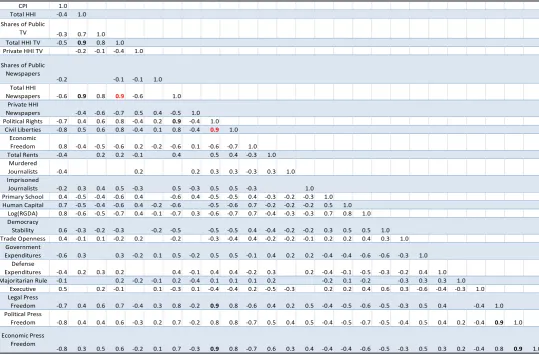
Our control variables choice is inspired by the Djankov et al study (2003) and by the Freille et al study (2007). Table A1 gives the pairwise correlations of all the variables which are determinants of corruption and so which should be used for a press freedom – corruption study. The variables which are highly correlated have to be rejected, namely two of the three press freedom indexes, and one of the two Freedom House‟s freedom indexes. Then, for a panel data analysis, variables which are too constant should be taken out because it could drive the results otherwise. This choice is based on the Graphs B2 to B8. Civil liberties index, democracy stability dummy, executive system dummy, imprisoned journalists count,
We will know motivate the choice of the remaining control variables in detail. It is based on the classification of corruption determinants made by Brunetti and Weder (2003).
First, there are the variables linked to the internal controls of corruption, which are the controls of corruption within the administration. For instance, this category is about the administration quality and independence from political pressures. Here, we have two measures revealing a low-quality bureaucracy which is used for political means. However, these variables actually gather elements from the first and the second category of corruption determinants
The first variable is the murdered journalists count extracted from the Committee to Protect Journalists reports. Bjornskov and Freytag (2016, PC) found that the number of murdered journalists was positively correlated with corruption. They built a game theoretic model to understand this correlation. They explain it by a strategy from the bribers to set an example in order to continue corrupt practices but also to reduce the probability of future bribe rejections or future refusals to get involved in corruption-related activities. The authors also demonstrate empirically that this strategy is used when the threat from press is credible (i.e. when there is sufficient press freedom) and when the overall costs for escalation from corruption to murder is low (i.e. when there is a low-quality bureaucracy).
The second variable is the political subcomponent of the press freedom index created by the Freedom House organization. It aggregates the scores from a questionnaire about different types of political pressures on the press. Especially, some criteria show the use of the state by the political power to limit press freedom. Hence, it partially shows the degree of control of the political power over the administration. Freille et al showed that only two components of the Freedom House‟s press freedom index are convincingly correlated with corruption: the political subcomponent and the economic subcomponent. Actually, the economic subcomponent could be correlated to some extent with our media concentration variables. So, to limit multicollinearity issues, we prefer to use the political component of the press freedom index, to control for press freedom outside of media markets considerations. It is an inverse measure of press freedom (the higher the index, the lower press freedom), so it should be positively correlated with corruption. Because these two subcomponents are highly correlated, using one component instead of the other is not really an issue.
Then, the external controls category takes into account the environment (e.g. citizens involvement in monitoring the state) and the independent checks and balances around the bureaucracy.
The first variable in this category is the logarithm of the Real Gross Domestic Product per Capita (log(RGDPa)). There is strong empirical evidence that development is negatively correlated with corruption (e.g. Mauro, 1995; Treisman 2000; Paldam, 2001; Lambsdorff, 2007; and Lucic et al, 2016). On one hand, corruption fosters rent-seeking and the advent of low-quality institutions leading to lower growth (e.g. Gupta and Terme, 1998; Wei, 2000). The different channels for this direction of causality have been identified by Tanzi and Davoodi (1997). On the other hand, development brings means to combat corruption (e.g. Abed and Davoodi, 2002). The use of the logarithm transformation is there to reduce the magnitude of the data and it was used before in other corruption studies (e.g. Badinger and Nindl, 2014).
The second and third variables are the net primary school enrollment rate from the World Bank and the human capital index from the Penn World Tables. Both are complementary variables about education. Primary school enrollment rate is actually in the original Djankov et al study. The human capital index is here to complete the set of education measures, because it also takes into account higher education.
However, education might increase corruption by increasing the corrupt bureaucrat‟s productivity in corruption-related activities. There are some evidence of a possible positive correlation between corruption and education (e.g. corruption and schooling in Frechette, 2006)
The fourth variable in this category is the trade openness index, computed by the World Bank. The reason it decreases corruption is that trade openness imposes foreign competition and so it diminishes domestic rents extractable by bureaucrats (Ades and Di Tella, 1999). Even if more recent studies showed that the support for this claim is less strong than usually expected when different measures of trade openness and trade restrictions are used (cf Torrez, 2010), the negative impact is still verified in many cases, for instance by using trade liberalizations measures instead (cf Sarwar and Pervaiz, JESD 2013).
Finally, the last category corresponds to the indirect determinants of corruption which create distortions in the economy. We divide it into two types of indirect determinants.
On one side, there are the short term / mid-term indirect determinants, which usually are economic and political variables. The first variable corresponds to economic freedom index from the Heritage Foundation. Economic freedom is found to be negatively correlated in empirical analyses (e.g. Graeff and Mehlkop, 2003 EJPE) because corruption develops on the limitations to economic freedom
(Rose-Ackermann, 1999), for instance by fostering illegal services provision or red taping by civil servants (e.g. trade permits, Shleifer and Vishny, 1993). The second variable is the government intervention index from the Heritage Foundation. It is a function of the overall government expenditures. Government expenditures are positively correlated with corruption under some circumstances (cf Holcombe and Boudreaux, 2015, PC), because it increases the possibility of targeted expenditures, which is a feature of neopatrimonialism (Eisenstadt, 1973), and it offers more opportunities for corrupt civil servants. The last variable corresponds to the defense expenditures. Like government expenditures it can increase corruption, but the effect is clearer because of the higher secrecy involved. Contrary to government expenditures, even in countries with transparent and controlled public expenditures, defense expenditures are still positively correlated with corruption (cf Gupta, Mello and Sharan, 2001, EJPE).
On the other side, other factors can affect corruption in the long run, but their effects will be either absorbed by the fixed effects because they are constant over time or common across countries, or they lack enough variation to be taken into account. Political institutions, ethnic diversity, colonial past, natural rents, religious or ethnic majority, or any other cultural long-term factors can influence but these variables are in this case. For a complete view, see the survey of literature made by Seldadyo and de Haan (2006, EPCS Conference) or the first part of the International Handbook on the Economics of Corruption edited by Susan Rose-Ackerman (2006).
5.
First Hypothesis Testing:
Secondly, we will examine the first results concerning our test of the first hypothesis of Besley and Prat model (2006), namely the positive correlation between corruption and public media ownership.
controls for competition within the private sector using the private HHI market-specific variable. Model 1 will be close to a replication of Djankov et al‟s work. In the cited study, corruption was positively and significantly correlated with press public ownership, but not with television (negative insignificant correlation) and radio public ownership.
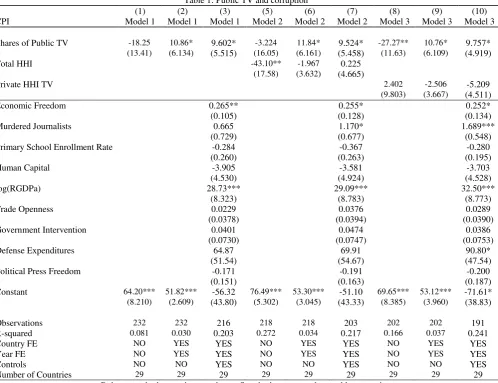
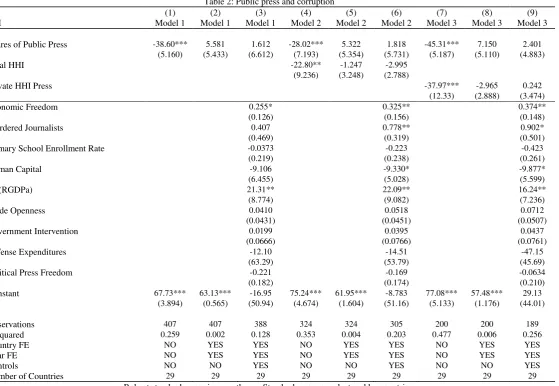
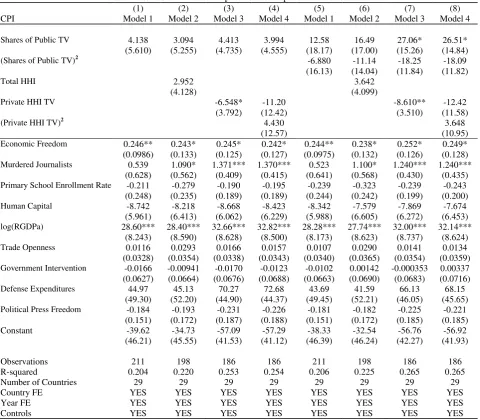
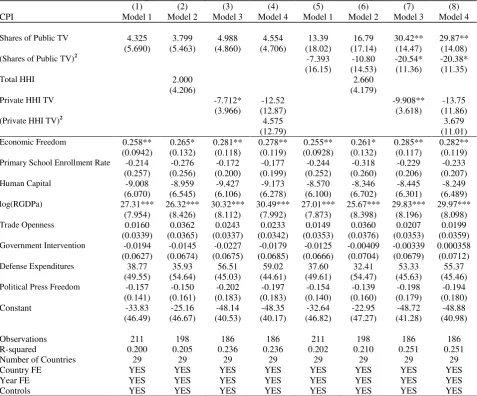
We already see that a fixed effects model gives opposite results compared to the simple OLS model, even without the controls. The country fixed effect and the year fixed effect capture respectively the country specific factors constant over time and the year specific factors constant across countries. The difference comes from the between year effect and the between country effect taken out. The simple OLS regressions in Tables 1 and 2 tend to give results similar to Djankov et al study. The public TV variable is usually not significantly correlated with the CPI, except in model 3 where it is negatively correlated with the CPI, so it is positively correlated with corruption. Regarding public press, it is always negatively correlated with the CPI in simple OLS regressions. However, adding country and year fixed effects completely changes the results (cf Tables 1 and 2 and tables A4 and A5). Public press is no longer significantly correlated with the CPI, even with the controls. Furthermore, in every fixed effects model, public TV ownership is positively correlated with the CPI, so it is negatively correlated with corruption, even with the controls.
The difference in terms of results can be explained by the differences between TV and press. Performing a paired t-test and two two-sample t-tests (one assuming equal variances and one without this assumption) for the total HHI variables and for the public shares variables showed us that the means of the total HHI and the public shares for TV are significantly higher than the means of the total HHI and of the public shares for daily newspapers. Secondly, because our sample of countries is representative of the world media market, we can add that the media market for TV is on average larger (in terms of audience) than the media market for traditional press. These two arguments give us the supply-side and the demand-side explanations for the difference between press and TV regarding the media – corruption relationship. On the demand side, press is not a mass media anymore, so the use of public press ownership to ensure the capacity of media capture by a corrupt regime is too costly with little benefits. Furthermore, on the supply-side, barriers to entry are low due to low fixed costs, so the emergence of a competitive fringe would reduce the effectiveness of media capture. This explains why public press shares variable has no impact on corruption. Public TV ownership used as a way to facilitate media capture is a more effective strategy, because fixed costs are higher, leading to higher potentiality for concentration on this market, and the size of the market is larger. Furthermore, we see from graphic B9 that the more recent the media, the higher the concentration. This graph shows that there is a significant difference between traditional media (press, magazines…) and 20th Century media (television, radio…) in terms of concentration. However, we find a negative correlation between public TV ownership and corruption. This positive association must be quadratic and conditional to some requirements.
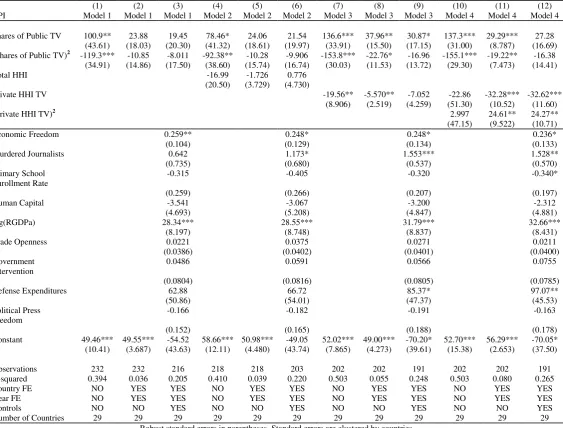
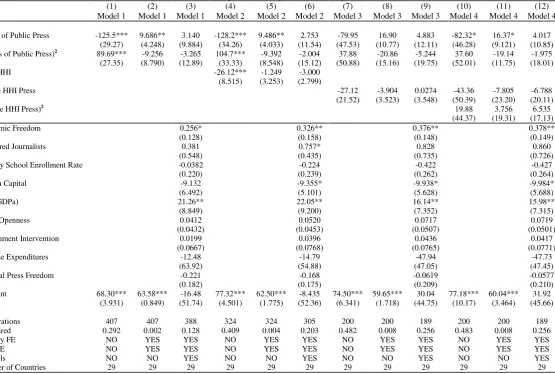
happen more often for public TV than for public press. We can conclude from these tables that public TV is more likely to be positively and significantly correlated with the CPI than public press, but in each case the impact of public media concentration on the CPI is bound to be concave.
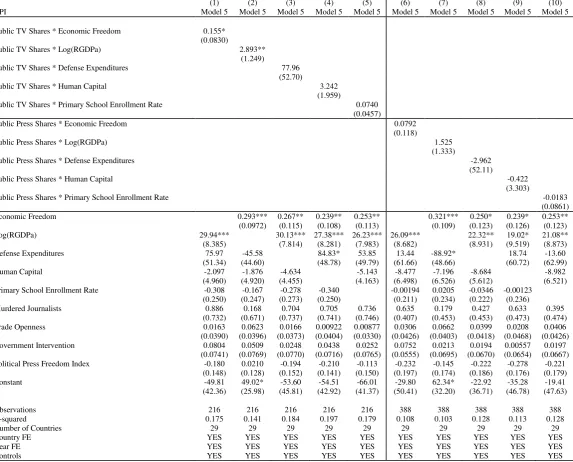
Table 5 and tables A8 to A12 explore the requirements making this relationship more likely. We see that economic freedom, development, and trade openness increase the strength of the relationship between the CPI and public TV ownership, meaning that developed countries with more economic freedom are more likely to have this negative (and quadratic) effect of public TV ownership on corruption. Adding the main effect in tables A11 and A12 show that the strongest requirement is development. Indeed, the estimates for the interaction variable between the log(RGDPa) and the public TV shares are positive and the public TV variable estimates are negative, both being significant in the same regression. Not only development increases the negative impact of public TV on corruption, but the negative estimates for public TV variable show that public TV shares have a positive impact on corruption in a under-developed country / when the development of a country is very low.
We further examine the quadratic impact of public TV on corruption. The main effects were not added because they reduce the sample to less than 20 countries and less than 100 observations. In tables 6 and A13, we investigate the long term effect of public TV on corruption. For a one year lag, the estimates of the public TV variable and of the public TV square variable are respectively positive and negative, both being significant in all the specifications. However, with a two year lag, the estimates are always
insignificant. Not only it confirms our previous results about public TV, but it also shows that state
ownership of television has a medium term effect on corruption. From a policy viewpoint, it means that the privatization of public TV will have direct consequences on corruption, not only the year of the
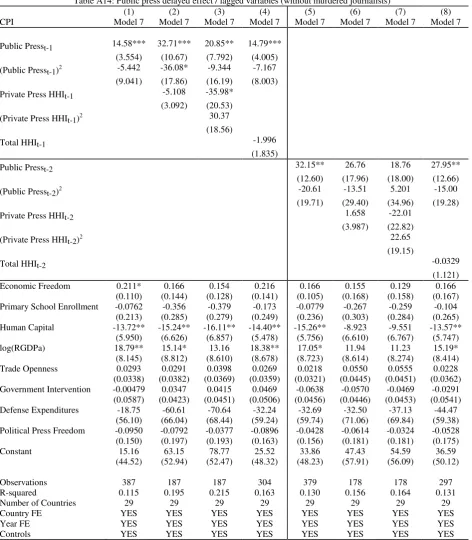
implementation, but also the year after. Interestingly enough, public press might have an effect on corruption, with at least a year lag. Indeed, the estimates for public press in tables 7 and A14 are positive and significant for a year lag, and in some specifications for a two years lag. The estimates for the square variables are negative and significant in some specifications. Hence, public press may have the same impact on corruption as public TV does, but it takes more time to be significant.
We can summarize these results by saying that public press is likely to have no impact on corruption because it is neither a mass media nor prone to natural oligopolies due to low fixed costs, making press capture useless. Public TV ownership has an impact on corruption because its capture can be useful for the opposite reasons. Furthermore, public TV ownership impact on the CPI is positive but decreasing, and the duration of this impact is bound to be two years. However, if public press has an impact on corruption, it is likely to have a year-delayed positive and concave impact on the CPI.
We need to check the results for public TV before going further.
shares variations comes from mergers and acquisitions (M&As) for private players and from privatizations for state-owned firms. Indeed, two common characteristics of media markets are the cost structure, “high and growing fixed costs, low and declining marginal costs” (Fact #1 in Noam‟s book), and the “price deflation” (Fact #4 in Noam‟s book). The first characteristic leads to scale economies and the second one makes competition likely to end in price wars, making anti-competitive strategies preferable (price
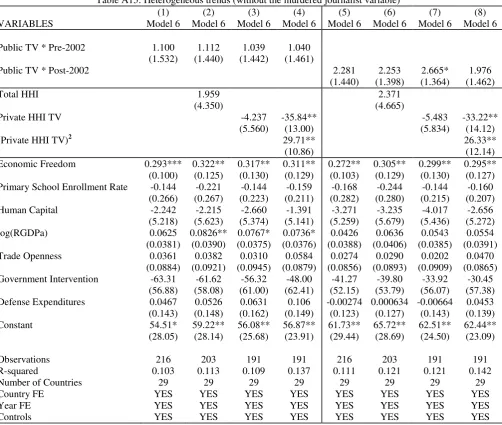
discrimination, price differentiation…). Furthermore, anti-concentration laws were usually abandoned in the same time period. Hence, M&As represent a profitable and frequent strategy on this market. In addition, graph B10 from Noam‟s book demonstrates the weakening of the decrease in terms of public market shares for all regions since the mid 2000‟s. On top of it, we have some empirical evidence of this break. We performed a Chow test for different years in the beginning of the 2000‟s and the Chow test displays a point break in 2002 (with a p-value of 0.00088513, so we can reject the null hypothesis of no structural change). So, our hypothesis is that we will have two opposite trends before and after 2002. Before 2002, so before the end of the privatization processes, the estimates should be negative because public TV was still too
dominant and it still facilitated media capture. However, after 2002, the estimates should be positive because public TV was sufficiently small not to trigger media capture and still sufficiently important to limit private oligopolization of the market.
Tables 8 and A15 display the result for this structural change in trends in 2002. At least, the second part of the hypothesis is true: public TV interaction variable (with the dummy of years after 2002) is positively correlated with the CPI. However, the interaction variable estimates before 2002 are never significant. Hence, we can say that public TV started to have a negative impact on corruption after the privatization era when it was not dominant. It partially justifies our results for public TV: when it is
sufficiently small, it is not interesting for media capture and it deters private oligopolization. Nevertheless, it should be kept in mind that we are trying to test the strength of the correlation found for public TV and to find a possible causal explanation of this phenomenon, but we are not establishing or proving causality. For instance, we can find an alternative explanation for the structural change in 2002. Graph B11 shows the average CPI for all countries for each year. We see that 2002 marks the beginning of a steady increase in the mean CPI. At the same time, as we showed with the graph B10, public TV ownership globally decreased. Hence, the positive quadratic association between corruption and public TV ownership could just be due to our time frame.
Secondly, we need to take care of possible outliers, because it could influence our results. To identify them, we use two types of statistics among the different techniques available (cf Besley et al, 1980).
Studentized and standardized residuals are discrepancy measures, where discrepancy is the difference between the predicted dependent variable and the observed dependent variable. It helps find observations which are unusual compared to the rest of the data set. Cook‟s distance (Cook, 1977) and DFBETAs are both influence measures, where influence is the product of the discrepancy and the leverage (i.e. the
leverage being the impact of an observation on the model‟s predicted dependent variable). While DFBETA is used to measure the particular influence on a unique parameter estimates, Cook‟s distance looks at the influence of an observation on all the parameters estimates. To identify outliers, we should look for
majority of the critical levels above. The graphics of these statistics are gathered in Graph B12. Five observations could be identified as outliers: Brazil in 1996, Finland in 2000, Israel in 2000, Italy in 1996, and Spain in 1996. Except Brazil, all these outliers have a high CPI (especially Finland and Israel) and large public TV market shares. So, it might create an upward bias in our public TV estimates. The results are presented in tables A16 and A17. It still confirms our previous results. First of all, the estimates for the public TV variable are never significant if we don‟t allow for a quadratic impact on corruption. Then, in models 3 and 4 in each table, when we control for private concentration, the public TV estimates are positive and significant, and the squared variable estimates are negative and sometimes significant. Henceforth, it confirms that public TV has a negative impact (at a decreasing rate) on corruption.
Finally, we need to take care of a serial correlation issue. Fixed effects model with clustered standard errors provide heteroscedasticity-corrected standard errors, but it doesn‟t correct autocorrelation in the errors. In fact, we performed a Wooldridge test for autocorrelation in panel data and it confirmed the presence of serial correlation (F(1,11)=39.374, Prob>F=0.0001). Hence, we perform fixed effect estimation with Driscoll and Kraay (1998) standard errors, which provide heteroscedasticity-corrected and
autocorrelation-corrected standard errors. The results are displayed in tables A18 and A19. It still confirms our results concerning public TV. Indeed, the estimates for the public TV and the squares of public TV shares variables are respectively positive and negative, and both are significant in some specifications.
Now, we will discuss these results.
We explain the negative and quadratic impact of public TV on corruption by the trade-off between its impact on competition and its impact on media capture. The idea is that public TV will have two
contradicting consequences on corruption, both depending on the size of the public sector. On one hand, public media are easier to capture because of its deeper links with the state and bureaucrats (appointments, budget …). Hence, it makes its capture more favorable for corrupt bureaucrats. Nevertheless, this media capture effect is increasing in the size of the public sector: if the public sector is too small, it is less
interesting to capture it. Furthermore, because it facilitates media capture, it pushes for a positive correlation between public TV and corruption. On the other hand, public media cannot be part M&As happening on the market until they are privatized. In fact, facts number 1 and 4 from Noam‟s book (high fixed costs and price deflation) show that less aggressive strategies such as M&As are more profitable than open competition for market shares, because open competition could trigger price wars. Moreover, because of the fixed costs in broadcast TV markets, it promotes natural oligopolies. Hence, public TV imposes more aggressive strategies on the private players, and so it limits private oligopolization of the market. This competition effect is
combination of the two gives this parabola shape. Therefore, the reason why Djankov et al. found
contradicting results can be explained both by the statistical methods used but also by the time frame, the end of the 1990‟s, when the privatization process wasn‟t complete and anti-concentration laws were still relatively widespread.
Contrary to the media capture effect which is straightforward, we need to prove the competition effect. To prove that the competition effect is at least non-null but constant, the necessary and sufficient condition needed is that public TV shares should increase the positive impact private sector competition has on the CPI. The results of this test are displayed in tables 9 and A20. The estimates of the interaction
variable between public TV shares and private HHI for TV are negative, while the estimates for the two variables separated are respectively positive and negative. We should add that these estimates are always significant, and the square of the public TV variable is still negative (even though it is not significant). It means that public TV shares variable has a negative impact on the relationship between private sector concentration and the CPI. But because the private HHI for TV is an inverse measure for competition within the TV private sector, it means that public TV has a positive impact on the relationship between private sector competition and the CPI. In other words, public TV makes private competition even worse for corruption, or even better for the CPI. In addition, because of the estimates of these two variables separated, public TV still has a positive but concave impact on the CPI (even when private concentration tends to 0), and private sector concentration has still a negative and increasing negative impact on the CPI (even when public sector is residual). Hence, the competition effect of the public TV sector is verified and it is the reason why smaller levels of state ownership in the TV market can decrease corruption.
These results are insightful to find new policy viewpoints regarding the improvement of press freedom. Although it still confirms that developing countries with weak economic freedom should beware state-ownership in media, governments in developed countries should take into account the downsides in terms of concentration within the private sector when assessing privatization in media markets. Indeed, if the state-owned media already have small market shares, privatization could lead to more corruption in the future by reducing the competitive pressure on the private ultimate owners. Without anti-concentration laws, the likeliness of private oligopolization of the market after privatization will be even higher. In fact, it contradicts the conclusion of Djankov et al, which favored the public choice approach over the public interest (Pigouvian) approach on the basis of their results. However, it seems that both theoretical
these effects are missed is because the M&As strategy as a way to avoid competition in the advent of high fixed costs and low marginal costs, which is a key in our reasoning, is not really taken into account.
As a result, we can conclude that the first hypothesis about public ownership of media is true only for higher levels of public TV, but smaller levels of state ownership in the TV market can decrease corruption, on condition of some requirements, the most important one being development. Hence, we can say that in general, the first hypothesis is not supported by our dataset. Our robustness checks confirm that the correlation is strong, but we insist that it is not causality. However, from a normative viewpoint, privatization of public media, especially in developed countries, should be assessed and the impact on private sector concentration should be a determining criterion in this assessment.
6.
Second Hypothesis Testing:
Thirdly, we will test the second hypothesis from Besley and Prat‟s model, which states that total media concentration should be positively correlated with corruption.
To begin with, we will examine total HHI variable impact on corruption.
From the tables which used total HHI as a control, we can see that this variable estimates are rarely significant. In fact, the estimates for this variable are negative and significant only in the model 2
specification, without controls and without country and year fixed effects (cf Table 1 regression (5), table 2 regression (4), and table 4 (4)). Other specifications are used in tables 10 and A21, but it confirms that total HHI has usually no significant impact on corruption. A Woolridge test for autocorrelation showed that we have a problem of serial correlation (F(1,25)=99.047, Prob>F=0.0000). Hence, we used Driscoll-Kraay standard errors to correct standard errors for autocorrelation. Results are presented in tables A22 and A23. It confirms the non-significance of total HHI estimates.
Hence, we need to find the requirements which could influence total concentration impact on corruption. Results are displayed in tables 11 and A23 to A25. We will first focus on tables 11 and A23, which look at heterogeneous effects with covariates. Two covariates seem to be important: trade openness and defense expenditures. Regarding trade openness, the estimates for the interaction variable with the total HHI are positive and significant (at least once), while the estimates for the total HHI variables in the same regressions are both negative and significant. It shows that trade openness reduces the negative impact of total HHI on the CPI. That‟s why when trade openness tends to be inexistent (cf estimates of total HHI in the same regression), total media concentration has a clear negative impact on the CPI, meaning a clear positive impact on corruption. Regarding defense expenditures, the estimates for the interaction variable with the total HHI are both negative and significant, while the estimates for the total HHI alone are insignificant. Hence, we can say that defense expenditures worsen the negative impact of total media
at all on corruption. Therefore, we can conclude that total HHI may increase corruption, but it should be the case only in countries with high defense expenditures and low trade openness.
Then, we will examine the total HHI for TV and press markets. In fact, as we saw with public TV and public press, media concentration might have a different impact depending on the type of media.
We will begin by observing the impact of total TV concentration on corruption. Similarly to total HHI, the total TV HHI seems not to have an impact on the CPI, except without controls and fixed effects where it is negative and significant (cf Tables 12 and A26). It can be explained by the existence of
conflicting forces inside this concentration variable. On one hand, there is the quadratic relationship between public TV and the CPI, which is confirmed again in these tables. Hence, when we control for it (cf
regressions 7 and 8), the total HHI estimates tends to be negative (but insignificant) and the estimates for the squared total HHI variable are positive and sometimes significant. So, when we control for public TV concentration, what is left in the total TV HHI variable variation is the private sector concentration, which has a negative and convex impact on the CPI. On the other hand, we have the opposite results when we control for private sector concentration (cf regressions 9 and 10). Therefore, the total concentration for the TV market has an insignificant impact on corruption because of these two conflicting forces. However, we can still find some requirements to make it more likely to have a negative impact on corruption. The results are displayed in tables A27 to A29. Regarding the covariates, tables A27 and A28 highlights the impact of three control variables: the logarithm of the real GDP per capita, the government expenditures variable and the defense expenditures variable. The development interaction variable estimates are positive and
significant, while the total TV HHI estimates are negative and significant at the same time. In addition, the estimates for government intervention are negative and significant while the estimates for total TV HHI are positive and significant. It is the same for the defense expenditures variable, except its estimates are negative but insignificant. Therefore, high development and low state intervention, especially in defense, are two important requirements improving the impact of total TV HHI concentration on the CPI. Table A29
confirms our hypothesis about the conflicting forces inside the total TV HHI variable. Indeed, the public TV interaction variable estimates are positive and significant, while the total HHI TV estimates alone in the same regressions are not significant. Furthermore, the estimates for private TV concentration are negative (and sometimes significant), while the total TV HHI estimates are positive and significant. Hence, it shows that public TV concentration (up to a certain level) and private TV competition improve the impact of total TV concentration on the CPI.
total press concentration actually has an impact on corruption. Regarding control variables, the results are displayed in tables A32 and A33, and three covariates seem to be significant: human capital index, log(RGDPa) and trade openness. In each case, the interaction variables estimates are negative and significant, while the total press HHI estimates alone are positive and significant (except in the trade openness interaction regression) and the other variables estimates alone are positive and significant (except for the human capital variable). Hence, there are two interpretations for these results. Firstly, it could mean that total press HHI in developing countries with low human capital index and with low trade openness rate has a positive impact on the CPI. In fact, in poor countries, a concentrated press might be a good way to stand up against corruption in the state. Even if media capture might be more interesting if press is concentrated, the state is likely to be too poor to capture it if the press is strong enough. However, when development comes (which will be correlated with an increase of trade openness and human capital level), concentrated press actually makes media capture more likely and so press concentrations has then a negative impact on the CPI. It explains the negative signs for the interaction variables: as human capital, development and trade openness improve, concentrated press stops being useful against corruption, because now media capture by the state is feasible. However, we should be cautious with this interpretation because press is rarely concentrated, so there might be too few cases confirming this interpretation. The second interpretation is much more likely. Because in many cases the press is not concentrated, the estimates for the total press HHI variable and the control variables are not representative of a large number of observations. That‟s why the estimates for human capital, development and trade openness