Steps to Excellence: Simple Inference with Refined Scoring of
Dependency Trees
Yuan Zhang, Tao Lei, Regina Barzilay, Tommi Jaakkola
Massachusetts Institute of Technology
{yuanzh, taolei, regina, tommi}@csail.mit.edu
Amir Globerson
The Hebrew University [email protected]
Abstract
Much of the recent work on depen-dency parsing has been focused on solv-ing inherent combinatorial problems as-sociated with rich scoring functions. In contrast, we demonstrate that highly ex-pressive scoring functions can be used with substantially simpler inference pro-cedures. Specifically, we introduce a sampling-based parser that can easily han-dle arbitrary global features. Inspired by SampleRank, we learn to take guided stochastic steps towards a high scoring parse. We introduce two samplers for traversing the space of trees, Gibbs and Metropolis-Hastings with Random Walk. The model outperforms state-of-the-art re-sults when evaluated on 14 languages of non-projective CoNLL datasets. Our sampling-based approach naturally ex-tends to joint prediction scenarios, such as joint parsing and POS correction. The resulting method outperforms the best re-ported results on the CATiB dataset, ap-proaching performance of parsing with gold tags.1
1 Introduction
Dependency parsing is commonly cast as a max-imization problem over a parameterized scoring function. In this view, the use of more expres-sive scoring functions leads to more challenging combinatorial problems of finding the maximiz-ing parse. Much of the recent work on parsmaximiz-ing has been focused on improving methods for solving the combinatorial maximization inference prlems. Indeed, state-of-the-art results have been
ob-1The source code for the work is available at
http://groups.csail.mit.edu/rbg/code/ global/acl2014.
tained by adapting powerful tools from optimiza-tion (Martins et al., 2013; Martins et al., 2011; Rush and Petrov, 2012). We depart from this view and instead focus on using highly expressive scor-ing functions with substantially simpler inference procedures. The key ingredient in our approach is how learning is coupled with inference. Our com-bination outperforms the state-of-the-art parsers and remains comparable even if we adopt their scoring functions.
Rich scoring functions have been used for some time. They first appeared in the context of rerank-ing (Collins, 2000), where a simple parser is used to generate a candidate list which is then reranked according to the scoring function. Because the number of alternatives is small, the scoring func-tion could in principle involve arbitrary (global) features of parse trees. The power of this method-ology is nevertheless limited by the initial set of alternatives from the simpler parser. Indeed, the set may already omit the gold parse. We dispense with the notion of a candidate set and seek to ex-ploit the scoring function more directly.
In this paper, we introduce a sampling-based parser that places few or no constraints on the scoring function. Starting with an initial candi-date tree, our inference procedure climbs the scor-ing function in small (cheap) stochastic steps to-wards a high scoring parse. The proposal distri-bution over the moves is derived from the scoring function itself. Because the steps are small, the complexity of the scoring function has limited im-pact on the computational cost of the procedure. We explore two alternative proposal distributions. Our first strategy is akin to Gibbs sampling and samples a new head for each word in the sentence, modifying one arc at a time. The second strat-egy relies on a provably correct sampler for first-order scores (Wilson, 1996), and uses it within a Metropolis-Hastings algorithm for general scoring functions. It turns out that the latter optimizes the
score more efficiently than the former.
Because the inference procedure is so simple, it is important that the parameters of the scoring function are chosen in a manner that facilitates how we climb the scoring function in small steps. One way to achieve this is to make sure that im-provements in the scoring functions are correlated with improvements in the quality of the parse. This approach was suggested in the SampleRank framework (Wick et al., 2011) for training struc-tured prediction models. This method was origi-nally developed for a sequence labeling task with local features, and was shown to be more effec-tive than state-of-the-art alternaeffec-tives. Here we ap-ply SampleRank to parsing, apap-plying several mod-ifications such as the proposal distributions men-tioned earlier.
The benefits of sampling-based learning go be-yond stand-alone parsing. For instance, we can use the framework to correct preprocessing mis-takes in features such as part-of-speech (POS) tags. In this case, we combine the scoring func-tion for trees with a stand-alone tagging model. When proposing a small move, i.e., sampling a head of the word, we can also jointly sample its POS tag from a set of alternatives provided by the tagger. As a result, the selected tag is influ-enced by a broad syntactic context above and be-yond the initial tagging model and is directly opti-mized to improve parsing performance. Our joint parsing-tagging model provides an alternative to the widely-adopted pipeline setup.
We evaluate our method on benchmark multi-lingual dependency corpora. Our method outper-forms the Turbo parser across 14 languages on av-erage by 0.5%. On four languages, we top the best published results. Our method provides a more effective mechanism for handling global features than reranking, outperforming it by 1.3%. In terms of joint parsing and tagging on the CATiB dataset, we nearly bridge (88.38%) the gap between in-dependently predicted (86.95%) and gold tags (88.45%). This is better than the best published results in the 2013 SPMRL shared task (Seddah et al., 2013), including parser ensembles.
2 Related Work
Earlier works on dependency parsing focused on inference with tractable scoring functions. For in-stance, a scoring function that operates over each single dependency can be optimized using the
maximum spanning tree algorithm (McDonald et al., 2005). It was soon realized that using higher order features could be beneficial, even at the cost of using approximate inference and sacrificing op-timality. The first successful approach in this arena was reranking (Collins, 2000; Charniak and John-son, 2005) on constituency parsing. Reranking can be combined with an arbitrary scoring func-tion, and thus can easily incorporate global fea-tures over the entire parse tree. Its main disadvan-tage is that the output parse can only be one of the few parses passed to the reranker.
Recent work has focused on more powerful in-ference mechanisms that consider the full search space (Zhang and McDonald, 2012; Rush and Petrov, 2012; Koo et al., 2010; Huang, 2008). For instance, Nakagawa (2007) deals with tractabil-ity issues by using sampling to approximate marginals. Another example is the dual decompo-sition (DD) framework (Koo et al., 2010; Martins et al., 2011). The idea in DD is to decompose the hard maximization problem into smaller parts that can be efficiently maximized and enforce agree-ment among these via Lagrange multipliers. The method is essentially equivalent to linear program-ming relaxation approaches (Martins et al., 2009; Sontag et al., 2011), and also similar in spirit to ILP approaches (Punyakanok et al., 2004).
A natural approach to approximate global in-ference is via search. For instance, a transition-based parsing system (Zhang and Nivre, 2011) incrementally constructs a parsing structure us-ing greedy beam-search. Other approaches op-erate over full trees and genop-erate a sequence of candidates that successively increase the score (Daum´e III et al., 2009; Li et al., 2013; Wick et al., 2011). Our work builds on one such approach — SampleRank (Wick et al., 2011), a sampling-based learning algorithm. In SampleR-ank, the parameters are adjusted so as to guide the sequence of candidates closer to the target struc-ture along the search path. The method has been successfully used in sequence labeling and ma-chine translation (Haddow et al., 2011). In this paper, we demonstrate how to adapt the method for parsing with rich scoring functions.
3 Sampling-Based Dependency Parsing with Global Features
arbitrary global features. We begin with the no-tation before addressing the decoding and learning algorithms. Finally, we extend our model to a joint parsing and POS correction task.
3.1 Notations
We denote sentences byx and the corresponding dependency trees byy ∈ Y(x). HereY(x)is the set of valid (projective or non-projective) depen-dency trees for sentence x. We use xj to refer
to thejth word of sentencex, andhj to the head
word ofxj. A training set of sizeN is given as a set of pairsD={(x(i), y(i))}N
i=1wherey(i)is the
ground truth parse for sentencex(i).
We parameterize the scoring functions(x, y)as
s(x, y) =θ·f(x, y) (1)
wheref(x, y)is the feature vector associated with treeyfor sentencex. We do not make any assump-tions about how the feature function decomposes. In contrast, most state-of-the-art parsers operate under the assumption that the feature function de-composes into a sum of simpler terms. For exam-ple, in the second-order MST parser (McDonald and Pereira, 2006), all the feature terms involve arcs or consecutive siblings. Similarly, parsers based on dual decomposition (Martins et al., 2011; Koo et al., 2010) assume thats(x, y)decomposes into a sum of terms where each term can be maxi-mized overyefficiently.
3.2 Decoding
The decoding problem consists of finding a valid dependency tree y ∈ Y(x) that maximizes the score s(x, y) = θ ·f(x, y) with parameters θ. For scoring functions that extend beyond first-order arc preferences, finding the maximizing non-projective tree is known to be NP-hard (McDonald and Pereira, 2006). We find a high scoring tree through sampling, and (later) learn the parameters
θso as to further guide this process.
Our sampler generates a sequence of depen-dency structures so as to approximate independent samples from
p(y|x, T, θ)∝exp (s(x, y)/T) (2) The temperature parameter T controls how con-centrated the samples are around the maximum of s(x, y) (e.g., see Geman and Geman (1984)). Sampling from target distributionpis typically as hard as (or harder than) that maximizing s(x, y).
Inputs: θ, x,T0 (initial temperature),c(temperature
update rate), proposal distributionq.
Outputs:y∗
T ←T0
Sety0to some random tree y∗←y0
repeat
y0←q(·|x, yt, T, θ)
ifs(x, y0)> s(x, y∗)then
y∗←y0
α= minh1,p(yp(y0t)q(y)q(yt0||yyt0))
i
Sample Bernouli variableZwithP[Z= 1] =α.
ifZ = 0then yt+1←yt
else
yt+1←y0
t←t+ 1 T ←c·T untilconvergence
[image:3.595.309.526.65.275.2]return y∗
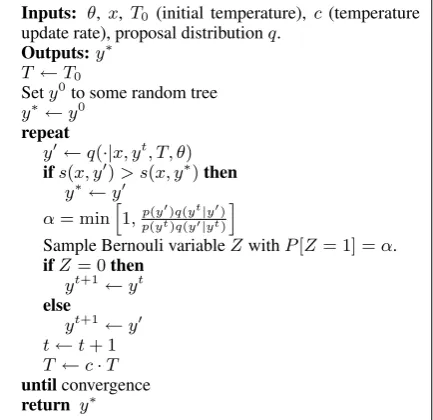
Figure 1: Sampling-based algorithm for decoding (i.e., approximately maximizings(x, y)).
We follow here a Metropolis-Hastings sampling algorithm (e.g., see Andrieu et al. (2003)) and explore different alternative proposal distributions
q(y0|x, y, θ, T). The distribution q governs the
small steps that are taken in generating a sequence of structures. The target distributionp folds into the procedure by defining the probability that we will accept the proposed move. The general struc-ture of our sampling algorithm is given in Figure 1. 3.2.1 Gibbs Sampling
Perhaps the most natural choice of the proposal distributionqis a conditional distribution fromp. This is feasible if we restrict the proposed moves to only small changes in the current tree. In our case, we choose a wordjrandomly, and then sam-ple its headhj according topwith the constraint
that we obtain a valid tree (when projective trees are sought, this constraint is also incorporated). For this choice of q, the probability of accepting the new tree (α in Figure 1) is identically one. Thus new moves are always accepted.
3.2.2 Exact First-Order Sampling
Inputs:x,yt,θ,K(number of heads to change).
Outputs:y0
fori= 1to|x|do inT ree[i]←false ChangeNode[i]←false
SetChangeNodeto true forKrandom nodes.
head[0]← −1
fori= 1to|x|do u←i
while notinT ree[u]do ifChangeNode[u]then
head[u]←randomHead(u, θ)
else
head[u]←yt(u) u←head[u]
ifLoopExist(head)then
EraseLoop(head)
u←i
while notinT ree[u]do inT ree[u]←true u←head[u]
[image:4.595.309.525.62.223.2]return Construct treey0from the head array.
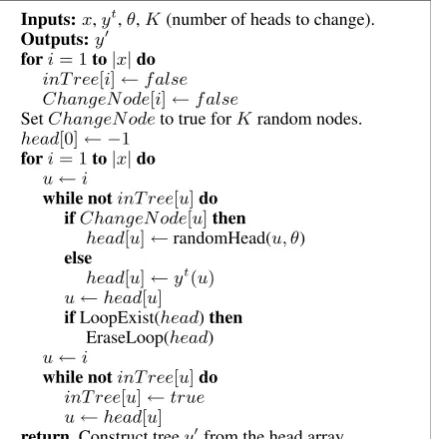
Figure 2: A proposal distribution q(y0|yt) based
on the random walk sampler of Wilson (1996). The function randomHead samples a new head for nodeu according to the first-order weights given byθ.
the model corresponds to a first-order parser. One such sampling algorithm is the random walk sam-pler of Wilson (1996). It can be used to obtain i.i.d. samples from distributions of the form:
p(y)∝ Y
i→j∈y
wij, (3)
whereycorresponds to a tree with a spcified root andwij is the exponential of the first-order score.
yis always a valid parse tree if we allow multiple children of the root and do not impose projective constraint. The algorithm in Wilson (1996) iter-ates over all the nodes, and for each node performs a random walk according to the weightswij until
the walk creates a loop or hits a tree. In the first case the algorithm erases the loop and continues the walk. If the walk hits the current tree, the walk path is added to form a new tree with more nodes. This is repeated until all the nodes are included in the tree. It can be shown that this procedure gen-erates i.i.d. trees fromp(y).
Since our features do not by design correspond to a first-order parser, we cannot use the Wilson algorithm as it is. Instead we use it as the proposal function and sample a subset of the dependen-cies from the first-order distribution of our model, while fixing the others. In each step we uniformly sample K nodes to update and sample their new
1! 2!
not→Monday→not ssssssssssss "loop erased"""→!was
Black→Monday→was
ROOT! It! was! not! Black! Monday! 2!
1! 3!
ROOT! It! was! not! Black! Monday! (b) walk path:!
(c) walk path:! (a) original tree!
ROOT! It! was! not! Black! Monday!
Figure 3: An illustration of random walk sam-pler. The index on each edge indicates its order on each walk path. The heads of the red words are sampled while others are fixed. The blue edges represent the current walk path and the black ones are already in the tree. Note that the walk direc-tion is opposite to the dependency direcdirec-tion. (a) shows the original tree before sampling; (b) and (c) show the walk path and how the tree is gener-ated in two steps. The loopnot→Monday→not
in (b) is erased.
heads using the Wilson algorithm (in the experi-ments we useK = 4). Note that blocked Gibbs sampling would be exponential inK, and is thus very slow already atK = 4. The procedure is de-scribed in Figure 2 with a graphic illustration in Figure 3.
3.3 Training
In this section, we describe how to learn the adjustable parameters θ in the scoring function. The parameters are learned in an on-line fash-ion by successively imposing soft constraints be-tween pairs of dependency structures. We intro-duce both margin constraints and constraints per-taining to successive samples generated along the search path. We demonstrate later that both types of constraints are essential.
We begin with the standard margin constraints. An ideal scoring function would always rank the gold parse higher than any alternative. Moreover, alternatives that are far from the gold parse should score even lower. As a result, we require that
s(x(i), y(i))−s(x(i), y)≥∆(y(i), y) ∀y (4)
where∆(y(i), y)is the number of head mistakes
inyrelative to the gold parsey(i). We adopt here
[image:4.595.74.290.63.283.2]de-pendence on y(i) is implied from context. Note
that Equation 4 contains exponentially many con-straints and cannot be enforced jointly for general scoring functions. However, our sampling proce-dure generates a small number of structures along the search path. We enforce only constraints cor-responding to those samples.
The second type of constraints are enforced be-tween successive samples along the search path. To illustrate the idea, consider a parsey that dif-fers fromy(i) in only one arc, and a parsey0 that
differs fromy(i)in ten arcs. We cannot necessarily
assume thats(x, y)is greater thans(x, y0)without
additional encouragement. Thus, we can comple-ment the constraints in Equation 4 with additional pairwise constraints (Wick et al., 2011):
s(x(i), y)−s(x(i), y0)≥Err(y0)−Err(y) (5)
where similarly to Equation 4, the difference in scores scales with the differences in errors with re-spect to the targety(i). We only enforce the above
constraints for y, y0 that are consecutive samples
in the course of the sampling process. These con-straints serve to guide the sampling process de-rived from the scoring function towards the gold parse.
We learn the parametersθin an on-line fashion to satisfy the above constraints. This is done via the MIRA algorithm (Crammer and Singer, 2003). Specifically, if the current parameters areθt, and
we enforce constraint Equation 5 for a particular pairy, y0, then we will findθt+1that minimizes
min ||θ−θt||2+Cξ
s.t. θ·(f(x, y)−f(x, y0))≥Err(y0)−Err(y)−ξ
(6)
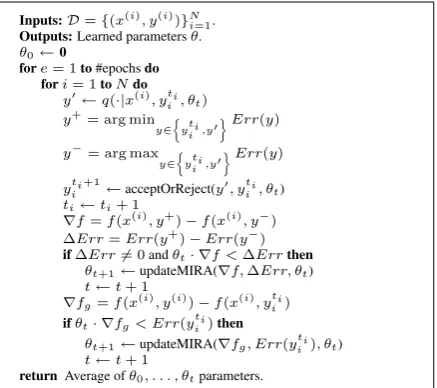
The updates can be calculated in closed form. Fig-ure 4 summarizes the learning algorithm. We re-peatedly generate parses based on the current pa-rametersθtfor each sentencex(i), and use
succes-sive samples to enforce constraints in Equation 4 and Equation 5 one at a time.
3.4 Joint Parsing and POS Correction
It is easy to extend our sampling-based parsing framework to joint prediction of parsing and other labels. Specifically, when sampling the new heads, we can also sample the values of other variables at the same time. For instance, we can sample the POS tag, the dependency relation or morphology information. In this work, we investigate a joint
Inputs:D={(x(i), y(i))}N i=1.
Outputs:Learned parametersθ.
θ0←0
fore= 1to#epochsdo
fori= 1toNdo
y0←q(·|x(i), yti i , θt)
y+= arg min
y∈
yi ,yti 0Err(y) y−= arg max
y∈
ytii ,y0Err(y) yiti+1←acceptOrReject(y0, ytii , θt)
ti←ti+ 1
∇f=f(x(i), y+)−f(x(i), y−)
∆Err=Err(y+)−Err(y−)
if∆Err6= 0andθt· ∇f <∆Errthen
θt+1←updateMIRA(∇f,∆Err, θt)
t←t+ 1
∇fg=f(x(i), y(i))−f(x(i), ytii )
ifθt· ∇fg< Err(ytii )then
θt+1←updateMIRA(∇fg, Err(ytii ), θt)
t←t+ 1
[image:5.595.308.527.62.256.2]returnAverage ofθ0, . . . , θtparameters.
Figure 4: SampleRank algorithm for learning. The rejection strategy is as in Figure 1. yti
i is thetith
tree sample of x(i). The first MIRA update (see
Equation 6) enforces a ranking constraint between two sampled parses. The second MIRA update en-forces constraints between a sampled parse and the gold parse. In practice several samples are drawn for each sentence in each epoch.
POS correction scenario in which only the pre-dicted POS tags are provided in the testing phase, while both gold and predicted tags are available for the training set.
We extend our model such that it jointly learns how to predict a parse tree and also correct the pre-dicted POS tags for a better parsing performance. We generate the POS candidate list for each word based on the confusion matrix on the training set. Letc(tg, tp)be the count when the gold tag istg
and the predicted one istp. For each wordw, we
first prune out its POS candidates by using the vo-cabulary from the training set. We don’t prune anything ifw is unseen. Assuming that the pre-dicted tag forwistp, we further remove those tags t if their counts are smaller than some threshold
c(t, tp)< α·c(tp, tp)2.
After generating the candidate lists for each word, the rest of the extension is rather straight-forward. For each sampling, letHbe the set of candidate heads andT be the set of candidate POS tags. The Gibbs sampler will generate a new sam-ple from the spaceH × T. The other parts of the algorithm remain the same.
2In our work we chooseα= 0.003, which gives a 98.9%
arc!
head bigram!
!
h h m m+1
arbitrary sibling! …!
h m s
h m
consecutive sibling!
h m s
grandparent!
g h m
grand-sibling!
g h m s
tri-siblings!
h m s t
grand-grandparent!
g h m
gg
outer-sibling-grandchild!
h m gc s h s m gc
[image:6.595.76.288.63.219.2]inner-sibling-grandchild!
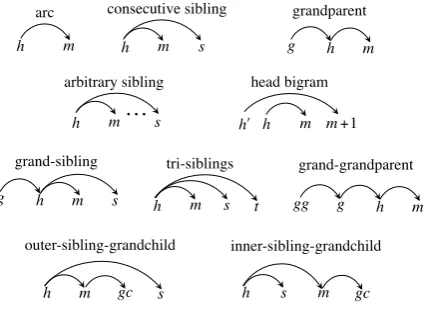
Figure 5: First- to third-order features.
4 Features
First- to Third-Order Features The feature templates of first- to third-order features are mainly drawn from previous work on graph-based parsing (McDonald and Pereira, 2006), transition-based parsing (Nivre et al., 2006) and dual decomposition-based parsing (Martins et al., 2011). As shown in Figure 5, thearcis the basic structure for first-order features. We also define features based on consecutive sibling, grandpar-ent, arbitrary sibling, head bigram, grand-sibling and tri-siblings, which are also used in the Turbo parser (Martins et al., 2013). In addition to these first- to third-order structures, we also consider grand-grandparent and sibling-grandchild struc-tures. There are two types of sibling-grandchild structures: (1) inner-sibling when the sibling is between the head and the modifier and (2) outer-sibling for the other cases.
Global Features We used feature shown promis-ing in prior rerankpromis-ing work Charniak and Johnson (2005), Collins (2000) and Huang (2008).
• Right Branch This feature enables the model to prefer right or left-branching trees. It counts the number of words on the path from the root node to the right-most non-punctuation word, normalized by the length of the sentence. • Coordination In a coordinate structure, the two
adjacent conjuncts usually agree with each other on POS tags and their span lengths. For in-stance, incats and dogs, the conjuncts are both short noun phrases. Therefore, we add differ-ent features to capture POS tag and span length consistency in a coordinate structure.
• PP AttachmentWe add features of lexical
[image:6.595.324.506.63.94.2]tu-eat! with! knife! and! fork!
Figure 6: An example of PP attachment with coor-dination. The arguments should beknifeandfork, notand.
ples involving the head, the argument and the preposition of prepositional phrases. Generally, this feature can be defined based on an instance of grandparent structure. However, we also han-dle the case of coordination. In this case, the ar-guments should be the conjuncts rather than the coordinator. Figure 6 shows an example. • Span LengthThis feature captures the
distribu-tion of the binned span length of each POS tag. It also includes flags of whether the span reaches the end of the sentence and whether the span is followed by the punctuation.
• Neighbors The POS tags of the neighboring words to the left and right of each span, together with the binned span length and the POS tag at the span root.
• ValencyWe consider valency features for each POS tag. Specifically, we add two types of va-lency information: (1) the binned number of non-punctuation modifiers and (2) the concate-nated POS string of all those modifiers.
• Non-projective Arcs A flag indicating if a de-pendency is projective or not (i.e. if it spans a word that does not descend from its head) (Mar-tins et al., 2011). This flag is also combined with the POS tags or the lexical words of the head and the modifier.
POS Tag Features In the joint POS correction scenario, we also add additional features specifi-cally for POS prediction. The feature templates are inspired by previous feature-rich POS tagging work (Toutanova et al., 2003). However, we are free to add higher order features because we do not rely on dynamic programming decoding. In our work we use feature templates up to 5-gram. Table 1 summarizes all POS tag feature templates.
5 Experimental Setup
1-gram htii,hti, wi−2i,hti, wi−1i,hti, wii,hti, wi+1i,
hti, wi+2i
2-gram hti−1, tii,hti−2, tii,hti−1, ti, wi−1i,
hti−1, ti, wii
3-gram hti−1, ti, ti+1i,hti−2, ti, ti+1,i,hti−1, ti, ti+2i,
hti−2, ti, ti+2i
4-gram hti−2, ti−1, ti, ti+1i,hti−2, ti−1, ti, ti+2i,
hti−2, ti, ti+1, ti+2i
[image:7.595.70.293.61.159.2]5-gram hti−2, ti−1, ti, ti+1, ti+2i
Table 1: POS tag feature templates. ti andwi
de-notes the POS tag and the word at the current posi-tion.ti−xandti+xdenote the left and right context
tags, and similarly for words.
contain non-projective dependency trees. We use all sentences in CoNLL datasets during training and testing. We also use the Columbia Arabic Treebank (CATiB) (Marton et al., 2013). CATiB mostly includes projective trees. The trees are an-notated with both gold and predicted versions of POS tags and morphology information. Follow-ing Marton et al. (2013), for this dataset we use 12 core POS tags, word lemmas, determiner fea-tures, rationality features and functional genders and numbers.
Some CATiB sentences exceed 200 tokens. For efficiency, we limit the sentence length to 70 to-kens in training and development sets. However, we do not impose this constraint during testing. We handle long sentences during testing by apply-ing a simple split-merge strategy. We split the sen-tence based on the ending punctuation, predict the parse tree for each segment and group the roots of resulting trees into a single node.
Evaluation Measures Following standard prac-tice, we use Unlabeled Attachment Score (UAS) as the evaluation metric in all our experiments. We report UAS excluding punctuation on CoNLL datasets, following Martins et al. (2013). For the CATiB dataset, we report UAS including punctu-ation in order to be consistent with the published results in the 2013 SPMRL shared task (Seddah et al., 2013).
BaselinesWe compare our model with the Turbo parser and the MST parser. For the Turbo parser, we directly compare with the recent published re-sults in (Martins et al., 2013). For the MST parser, we train a second-order non-projective model us-ing the most recent version of the code3.
We also compare our model against a discrim-inative reranker. The reranker operates over the
3http://sourceforge.net/projects/mstparser/
top-50 list obtained from the MST parser4. We
use a 10-fold cross-validation to generate candi-date lists for training. We then train the reranker by running 10 epochs of cost-augmented MIRA. The reranker uses the same features as our model, along with the tree scores obtained from the MST parser (which is a standard practice in reranking). Experimental DetailsFollowing Koo and Collins (2010), we always first train a first-order pruner. For each word xi, we prune away the incoming
dependencies hhi, xii with probability less than
0.005 times the probability of the most likely head, and limit the number of candidate heads up to 30. This gives a 99% pruning recall on the CATiB development set. The first-order model is also trained using the algorithm in Figure 4. Af-ter pruning, we tune the regularization parameAf-ter
C = {0.1,0.01,0.001} on development sets for different languages. Because the CoNLL datasets do not have a standard development set, we ran-domly select a held out of 200 sentences from the training set. We also pick the training epochs from
{50,100,150} which gives the best performance on the development set for each language. After tuning, the model is trained on the full training set with the selected parameters.
We apply the Random Walk-based sampling method (see Section 3.2.2) for the standard de-pendency parsing task. However, for the joint parsing and POS correction on the CATiB dataset we do not use the Random Walk method because the first-order features in normal parsing are no longer first-order when POS tags are also vari-ables. Therefore, the first-order distribution is not well-defined and we only employ Gibbs sampling for simplicity. On the CATiB dataset, we restrict the sample trees to always be projective as de-scribed in Section 3.2.1. However, we do not im-pose this constraint for the CoNLL datasets.
6 Results
Comparison with State-of-the-art Parsers Ta-ble 2 summarizes the performance of our model and of the baselines. We first compare our model to the Turbo parser using the Turbo parser fea-ture set. This is meant to test how our learning and inference methods compare to a dual decom-position approach. The first column in Table 2
4The MST parser is trained in projective mode for
Our Model (UAS) Turbo (UAS) MST 2nd-Ord.
(UAS) Best Published UAS RerankerTop-50 RerankerTop-500
Turbo Feat. Full Feat.
Arabic 79.86 80.21 79.64 78.75 81.12 (Ma11) 79.03 78.91
Bulgarian 92.97 93.30 93.10 91.56 94.02 (Zh13) 92.81
-Chinese 92.06 92.63 89.98 91.77 91.89 (Ma10) 92.25
-Czech 90.62 91.04 90.32 87.30 90.32 (Ma13) 88.14
-Danish 91.45 91.80 91.48 90.50 92.00 (Zh13) 90.88 90.91
Dutch 85.83 86.47 86.19 84.11 86.19 (Ma13) 81.01
-English 92.79 92.94 93.22 91.54 93.22 (Ma13) 92.41
-German 91.79 92.07 92.41 90.14 92.41 (Ma13) 91.19
-Japanese 93.23 93.42 93.52 92.92 93.72 (Ma11) 93.40
-Portuguese 91.82 92.41 92.69 91.08 93.03 (Ko10) 91.47
-Slovene 86.19 86.82 86.01 83.25 86.95 (Ma11) 84.81 85.37
Spanish 88.24 88.21 85.59 84.33 87.96 (Zh13) 86.85 87.21
Swedish 90.48 90.71 91.14 89.05 91.62 (Zh13) 90.53
-Turkish 76.82 77.21 76.90 74.39 77.55 (Ko10) 76.35 76.23
Average 88.87 89.23 88.72 86.86 89.33 87.92
-Table 2: Results of our model, the Turbo parser, and the MST parser. “Best Published UAS” includes the most accurate parsers among Nivre et al. (2006), McDonald et al. (2006), Martins et al. (2010), Martins et al. (2011), Martins et al. (2013), Koo et al. (2010), Rush and Petrov (2012), Zhang and McDonald (2012) and Zhang et al. (2013). Martins et al. (2013) is the current Turbo parser. The last two columns shows UAS of the discriminative reranker.
shows the result for our model with an average of 88.87%, and the third column shows the results for the Turbo parser with an average of 88.72%. This suggests that our learning and inference pro-cedures are as effective as the dual decomposition method in the Turbo parser.
Next, we add global features that are not used by the Turbo parser. The performance of our model is shown in the second column with an average of 89.23%. It outperforms the Turbo parser by 0.5% and achieves the best reported performance on four languages. Moreover, our model also outper-forms the 88.80% average UAS reported in Mar-tins et al. (2011), which is the top performing sin-gle parsing system (to the best of our knowledge). Comparison with RerankingAs column 6 of Ta-ble 2 shows, our model outperforms the reranker by 1.3%5. One possible explanation of this
perfor-mance gap between the reranker and our model is the small number of candidates considered by the reranker. To test this hypothesis, we performed experiments with top-500 list for a subset of lan-guages.6 As column 7 shows, this increase in the
list size does not change the relative performance of the reranker and our model.
Joint Parsing and POS Correction Table 3 shows the results of joint parsing and POS cor-rection on the CATiB dataset, for our model and
5Note that the comparison is conservative because we
can also add MST scores as features in our model as in reranker. With these features our model achieves an average UAS 89.28%.
6We ran this experiment on 5 languages with small
datasets due to the scalability issues associated with rerank-ing top-500 list.
state-of-the-art systems. As the upper part of the table shows, the parser with corrected tags reaches 88.38% compared to the accuracy of 88.46% on the gold tags. This is a substantial increase from the parser that uses predicted tags (86.95%).
To put these numbers into perspective, the bot-tom part of Table 3 shows the accuracy of the best systems from the 2013 SPMRL shared task on Arabic parsing using predicted information (Sed-dah et al., 2013). Our system not only out-performs the best single system (Bj¨orkelund et al., 2013) by 1.4%, but it also tops the ensem-ble system that combines three powerful parsers: the Mate parser (Bohnet, 2010), the Easy-First parser (Goldberg and Elhadad, 2010) and the Turbo parser (Martins et al., 2013)
[image:8.595.101.499.62.200.2]Dev. Set (≤70) Testing Set
POS Acc. UAS POS Acc. UAS
Gold - 90.27 - 88.46
Predicted 96.87 88.81 96.82 86.95
POS Correction 97.72 90.08 97.49 88.38
CADIM 96.87 87.4- 96.82 85.78
IMS-Single - - - 86.96
[image:9.595.311.525.61.183.2]IMS-Ensemble - - - 88.32
Table 3: Results for parsing and corrective tagging on the CATiB dataset. The upper part shows UAS of our model with gold/predicted information or POS correction. Bottom part shows UAS of the best systems in the SPMRL shared task. IMS-Single (Bj¨orkelund et al., 2013) is the best single parsing system, while IMS-Ensemble (Bj¨orkelund et al., 2013) is the best ensemble parsing system. We also show results for CADIM (Marton et al., 2013), the second best system, because we use their predicted features.
0 20 40 60 80 100 2.648
2.65 2.652 2.654 2.656 2.658x 10
4
Toks/sec
Score
Gibbs Random Walk
(a) Arabic
0 100 200 300 400 500 600 700 800 1.897
1.898 1.899 1.9
x 104
Toks/sec
Score
Gibbs Random Walk
(b) Chinese
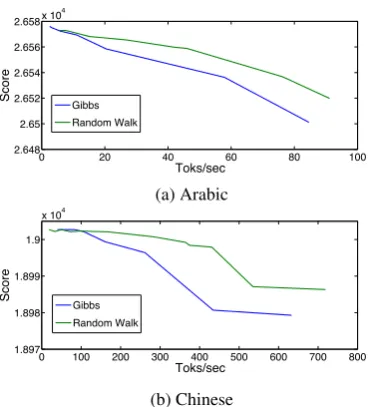
Figure 7: Total score of the predicted test trees as a function of the decoding speed, measured in the number of tokens per second.
iteration of this sampler makes multiple changes to the tree, in contrast to a single-edge change of Gibbs sampler.
The Effect of Constraints in LearningOur train-ing method updates parameters to satisfy the pair-wise constraints between (1) subsequent samples on the sampling path and (2) selected samples and the ground truth. Figure 8 shows that applying both types of constraints is consistently better than using either of them alone. Moreover, these re-sults demonstrate that comparison between subse-quent samples is more important than comparison against the gold tree.
Decoding SpeedOur sampling-based parser is an
Danish Japanese Portuguese Swedish
89 90 91 92 93 94
UAS(%)
[image:9.595.83.282.61.130.2]Both Neighbor Gold
Figure 8: UAS on four languages when train-ing with different constraints. “Neighbor” corre-sponds to pairwise constraints between subsequent samples, “Gold” represents constraints between a single sample and the ground truth, “Both” means applying both types of constraints.
anytime algorithm, and therefore its running time can be traded for performance. Figure 7 illustrates this trade-off. In the experiments reported above, we chose a conservative cooling rate and contin-ued to sample until the score no longer changed. The parser still managed to process all the datasets in a reasonable time. For example, the time that it took to decode all the test sentences in Chinese and Arabic were 3min and 15min, respectively. Our current implementation is in Java and can be fur-ther optimized for speed.
7 Conclusions
This paper demonstrates the power of combining a simple inference procedure with a highly expres-sive scoring function. Our model achieves the best results on the standard dependency parsing bench-mark, outperforming parsing methods with elabo-rate inference procedures. In addition, this frame-work provides simple and effective means for joint parsing and corrective tagging.
Acknowledgments
This research is developed in collaboration with the Arabic Language Technologies (ALT) group at Qatar Computing Research Institute (QCRI) within the IYASproject. The authors acknowledge
[image:9.595.85.271.297.501.2]References
Christophe Andrieu, Nando De Freitas, Arnaud Doucet, and Michael I Jordan. 2003. An
introduc-tion to mcmc for machine learning. Machine
learn-ing, 50(1-2):5–43.
Anders Bj¨orkelund, Ozlem Cetinoglu, Rich´ard Farkas,
Thomas Mueller, and Wolfgang Seeker. 2013.
(re)ranking meets morphosyntax: State-of-the-art
results from the SPMRL 2013 shared task. In
Pro-ceedings of the Fourth Workshop on Statistical Pars-ing of Morphologically-Rich Languages, pages 135– 145, Seattle, Washington, USA, October. Associa-tion for ComputaAssocia-tional Linguistics.
Bernd Bohnet. 2010. Top accuracy and fast
depen-dency parsing is not a contradiction. In COLING,
pages 89–97.
Sabine Buchholz and Erwin Marsi. 2006. Conll-x shared task on multilingual dependency parsing. In
Proceedings of the Tenth Conference on Computa-tional Natural Language Learning, pages 149–164. Association for Computational Linguistics.
Eugene Charniak and Mark Johnson. 2005. Coarse-to-fine n-best parsing and maxent discriminative
reranking. InProceedings of the 43rd Annual
Meet-ing on Association for Computational LMeet-inguistics, pages 173–180. Association for Computational Lin-guistics.
Michael Collins. 2000. Discriminative reranking for
natural language parsing. In Proceedings of the
Seventeenth International Conference on Machine Learning, ICML ’00, pages 175–182.
Koby Crammer and Yoram Singer. 2003. Ultracon-servative online algorithms for multiclass problems.
The Journal of Machine Learning Research, 3:951– 991.
Hal Daum´e III, John Langford, and Daniel Marcu.
2009. Search-based structured prediction. Machine
learning, 75(3):297–325.
Stuart Geman and Donald Geman. 1984. Stochas-tic relaxation, gibbs distributions, and the bayesian
restoration of images. Pattern Analysis and Machine
Intelligence, IEEE Transactions on, (6):721–741. Yoav Goldberg and Michael Elhadad. 2010. An
effi-cient algorithm for easy-first non-directional
depen-dency parsing. InHuman Language Technologies:
The 2010 Annual Conference of the North American Chapter of the Association for Computational Lin-guistics, pages 742–750. Association for Computa-tional Linguistics.
Barry Haddow, Abhishek Arun, and Philipp Koehn. 2011. Samplerank training for phrase-based
ma-chine translation. InProceedings of the Sixth
Work-shop on Statistical Machine Translation, pages 261– 271. Association for Computational Linguistics.
Liang Huang. 2008. Forest reranking: Discriminative
parsing with non-local features. InACL, pages 586–
594.
Terry Koo and Michael Collins. 2010. Efficient
third-order dependency parsers. In Proceedings of the
48th Annual Meeting of the Association for Com-putational Linguistics, pages 1–11. Association for Computational Linguistics.
Terry Koo, Alexander M Rush, Michael Collins, Tommi Jaakkola, and David Sontag. 2010. Dual decomposition for parsing with non-projective head
automata. InProceedings of the 2010 Conference
on Empirical Methods in Natural Language Pro-cessing, pages 1288–1298. Association for Compu-tational Linguistics.
Quannan Li, Jingdong Wang, Zhuowen Tu, and David P Wipf. 2013. Fixed-point model for
struc-tured labeling. InProceedings of the 30th
Interna-tional Conference on Machine Learning (ICML-13), pages 214–221.
Andr´e FT Martins, Noah A Smith, and Eric P Xing. 2009. Concise integer linear programming
formula-tions for dependency parsing. InProceedings of the
Joint Conference of the 47th Annual Meeting of the ACL and the 4th International Joint Conference on Natural Language Processing of the AFNLP: Vol-ume 1-VolVol-ume 1, pages 342–350. Association for Computational Linguistics.
Andr´e FT Martins, Noah A Smith, Eric P Xing, Pe-dro MQ Aguiar, and M´ario AT Figueiredo. 2010. Turbo parsers: Dependency parsing by
approxi-mate variational inference. In Proceedings of the
2010 Conference on Empirical Methods in Natural Language Processing, pages 34–44. Association for Computational Linguistics.
Andr´e FT Martins, Noah A Smith, Pedro MQ Aguiar, and M´ario AT Figueiredo. 2011. Dual
decompo-sition with many overlapping components. In
Pro-ceedings of the Conference on Empirical Methods in Natural Language Processing, pages 238–249. As-sociation for Computational Linguistics.
Andr´e FT Martins, Miguel B Almeida, and Noah A Smith. 2013. Turning on the turbo: Fast third-order
non-projective turbo parsers. InProceedings of the
51th Annual Meeting of the Association for Compu-tational Linguistics. Association for Computational Linguistics.
Yuval Marton, Nizar Habash, Owen Rambow, and Sarah Alkhulani. 2013. Spmrl13 shared task
sys-tem: The cadim arabic dependency parser. In
Pro-ceedings of the Fourth Workshop on Statistical Pars-ing of Morphologically-Rich Languages, pages 76– 80.
Ryan T McDonald and Fernando CN Pereira. 2006. Online learning of approximate dependency parsing
R. McDonald, F. Pereira, K. Ribarov, and J. Hajic. 2005. Non-projective dependency parsing using
spanning tree algorithms. InProceedings of the
con-ference on Human Language Technology and Em-pirical Methods in Natural Language Processing, pages 523–530.
Ryan McDonald, Kevin Lerman, and Fernando Pereira. 2006. Multilingual dependency analysis with a
two-stage discriminative parser. In Proceedings of the
Tenth Conference on Computational Natural Lan-guage Learning, pages 216–220. Association for Computational Linguistics.
Tetsuji Nakagawa. 2007. Multilingual dependency
parsing using global features. In EMNLP-CoNLL,
pages 952–956.
Joakim Nivre, Johan Hall, Jens Nilsson, G¨uls¸en Eryiit, and Svetoslav Marinov. 2006. Labeled pseudo-projective dependency parsing with support vector
machines. In Proceedings of the Tenth
Confer-ence on Computational Natural Language Learning, pages 221–225. Association for Computational Lin-guistics.
Vasin Punyakanok, Dan Roth, Wen-tau Yih, and Dav Zimak. 2004. Semantic role labeling via integer
linear programming inference. In Proceedings of
the 20th international conference on Computational Linguistics, page 1346. Association for Computa-tional Linguistics.
Alexander M Rush and Slav Petrov. 2012. Vine prun-ing for efficient multi-pass dependency parsprun-ing. In
Proceedings of the 2012 Conference of the North American Chapter of the Association for Computa-tional Linguistics: Human Language Technologies, pages 498–507. Association for Computational Lin-guistics.
Djam´e Seddah, Reut Tsarfaty, Sandra K¨ubler, Marie Candito, Jinho D Choi, Rich´ard Farkas, Jennifer Foster, Iakes Goenaga, Koldo Gojenola Gallete-beitia, Yoav Goldberg, et al. 2013. Overview of the spmrl 2013 shared task: A cross-framework evalua-tion of parsing morphologically rich languages. In
Proceedings of the Fourth Workshop on Statistical Parsing of Morphologically-Rich Languages, pages 146–182.
D. Sontag, A. Globerson, and T. Jaakkola. 2011. In-troduction to dual decomposition for inference. In
Optimization for Machine Learning, pages 219–254. MIT Press.
Mihai Surdeanu, Richard Johansson, Adam Meyers, Llu´ıs M`arquez, and Joakim Nivre. 2008. The conll-2008 shared task on joint parsing of
syntac-tic and semansyntac-tic dependencies. In Proceedings of
the Twelfth Conference on Computational Natural Language Learning, pages 159–177. Association for Computational Linguistics.
Kristina Toutanova, Dan Klein, Christopher D Man-ning, and Yoram Singer. 2003. Feature-rich part-of-speech tagging with a cyclic dependency network. InProceedings of the 2003 Conference of the North American Chapter of the Association for Computa-tional Linguistics on Human Language Technology-Volume 1, pages 173–180. Association for Compu-tational Linguistics.
Michael L. Wick, Khashayar Rohanimanesh, Kedar Bellare, Aron Culotta, and Andrew McCallum. 2011. Samplerank: Training factor graphs with atomic gradients. In Lise Getoor and Tobias
Schef-fer, editors, Proceedings of the 28th International
Conference on Machine Learning, ICML 2011, pages 777–784.
David Bruce Wilson. 1996. Generating random span-ning trees more quickly than the cover time. In
Proceedings of the twenty-eighth annual ACM sym-posium on Theory of computing, pages 296–303. ACM.
Hao Zhang and Ryan McDonald. 2012. Generalized higher-order dependency parsing with cube
prun-ing. InProceedings of the 2012 Joint Conference on
Empirical Methods in Natural Language Process-ing and Computational Natural Language LearnProcess-ing, pages 320–331. Association for Computational Lin-guistics.
Yue Zhang and Joakim Nivre. 2011. Transition-based dependency parsing with rich non-local features. In
Proceedings of the 49th Annual Meeting of the Asso-ciation for Computational Linguistics: Human Lan-guage Technologies: short papers-Volume 2, pages 188–193. Association for Computational Linguis-tics.
Hao Zhang, Liang Huang Kai Zhao, and Ryan McDon-ald. 2013. Online learning for inexact hypergraph