35
Multi-Team: A Multi-attention, Multi-decoder Approach to
Morphological Analysis.
Ahmet ¨Ust ¨un Rob van der Goot Gosse Bouma Gertjan van Noord
University of Groningen
{a.ustun, r.van.der.goot, g.bouma, g.j.m.van.noord}@rug.nl
Abstract
This paper describes our submission to SIG-MORPHON 2019 Task 2: Morphological analysis and lemmatization in context. Our model is a multi-task sequence to sequence neural network, which jointly learns morpho-logical tagging and lemmatization. On the encoding side, we exploit character-level as well as contextual information. We introduce a multi-attention decoder to selectively focus on different parts of character and word se-quences. To further improve the model, we train on multiple datasets simultaneously and use external embeddings for initialization. Our final model reaches an average morphological tagging F1 score of 94.54 and a lemma accu-racy of 93.91 on the test data, ranking respec-tively 3rd and 6th out of 13 teams in the SIG-MORPHON 2019 shared task.
1 Introduction
This paper presents our model for the SIGMOR-PHON 2019 Task 2 on morphological analysis and lemmatization in context (McCarthy et al.,2019). The task is to generate a lemma and a sequence of morphological tags, which are called morphosyn-tactic descriptions (MSD), for each word in a given sentence. This task is important because it can be used to improve several downstream NLP applications such as grammatical error correc-tion (Ng et al., 2014), machine translation ( Con-forti et al.,2018) and multilingual parsing (Zeman et al.,2018). Table1shows the lemma and mor-phological tags of:Johnny likes cats.
The first sub-task, Lemmatization, is to trans-form an inflected word trans-form to its lemma which is its base-form (or dictionary form), as in the exam-ple oflikestolike. The second sub-task, morpho-logical tagging, is to predict morphomorpho-logical prop-erties of words as a sequence of tags, including a part of speech tag. These morphological tags spec-ify the inflections encoded in word-forms. In the
Orig Johnny likes cats .
Lemma Johnny like cat .
[image:1.595.312.520.223.268.2]MSD PROPN;SG V;SG;3;IND;PRS N;PL
Table 1: Example sentence, annotated with lemmas and morphological tags.
example sentence, the wordlikesis annotated with a morphological tag set of {V,SG,3,IND,PRS}. Both tasks are dependent on context. For example, while walking is annotated with the lemmawalk
and tag set{N,SG}in the sentence: The beach is within walking distance; it is annotated with walk-ingand{V.PTCP;PRS;V}in: I was walking.
These two tasks have a clear relation; in most languages the categories found in the morpholog-ical tags indicate how the lemma of the word was inflected to the word-form. In other words, syn-tactic inflections have a strong correlation with the morphological properties of the words.
Our approach to solve both of these tasks consists of an encoder and two separate de-coders within a multi-task architecture based on a sequence-to-sequence network. The shared encoder reads words and sentences to learn character-level and word-level representations. The decoders then separately generate lemmas and morphological tags using these representations by using multiple attention mechanisms. Our contri-butions are threefold:
• We introduce the use of multiple attention mechanisms that selectively focus character and word sequences in the sentence context.
• We evaluate the effect of a variety of types of ex-ternal embeddings for lemmatization and mor-phological tagging.
using dataset embeddings.
2 Related work
Our system is based on three main approaches which are heavily studied in existing literature. These are sequence-to-sequence learning, multi-task learning and multi-lingual learning.
Recent work on computational morphol-ogy showed that neural sequence-to-sequence (seq2seq) models (Sutskever et al., 2014;
Bahdanau et al., 2014) have yielded new state-of-the-art performance on various tasks including morphological reinflection and lemmatiza-tion (Cotterell et al.,2016,2017,2018). Building on this, Dayanık et al. (2018) utilize different levels of representations such as character-level, word-level and sentence-level in the encoder of their seq2seq architecture based on previous work (Heigold et al.,2017).
Multi-task learning approaches for jointly learn-ing related tasks have been successfully employed on syntactic and semantic tasks (Søgaard and Goldberg,2016;Plank et al., 2016). In the con-text of morphological analysis, this has been used by Kementchedjhieva et al. (2018), who jointly learn morphosyntactic tags and inflections for a word in a given context, and use a shared encoder within a multi-task architecture consisting of mul-tiple decoder similar to our model.
Multi-lingual learning approaches which ben-efit from joint learning for multiple languages is also studied on various tasks with different archi-tectures.Ammar et al.(2016) uses a language em-bedding that contains information considering the language, word-order properties and typological properties for dependency parsing. In multilingual neural machine translation, Johnson et al. (2017) use a special token to indicate the target language. In this work, our model uses the approach ofSmith et al.(2018) who introduce the treebank embed-ding approach to combine several treebanks for a single language or closely related languages.
Most similar to our model, Kondratyuk et al.
(2018) use a joint decoder approach for morpho-logical tagging and lemmatization. However, our model differs from theirs in substantial ways. Our model employs an encoder-decoder architecture which utilizes different levels of attention com-ponents with a multi-lingual/multi-dataset signal. Moreover, our model solves the tagging problem as a sequential prediction task instead of multi-layer classification so that we can use the same
architecture for both lemmatization and tagging which are described in Section3.2and3.3.
3 System Description
Our model is inspired by the architecture ofDayanık et al.(2018). We employ an encoder-decoder model over the character and word se-quences. FollowingDayanık et al.(2018), the en-coder in our model consists of two parts. First, a word encoder which runs on the character level, is used to generate embeddings for each word (Sec-tion3.1.1). Second, a context encoder is initialized with these word embeddings, and runs on the sen-tence level (Section 3.1.4). We also experiment with two methods to complement the word-level embeddings (Section3.1.2and3.1.3).
The representations at the different levels which are generated by the encoder are then passed into the decoders. UnlikeDayanık et al.(2018) which uses one decoder for both the lemmas and the mor-phological tags, we use two different decoders in a multi-task architecture. The tag decoder pro-duces a set of morphological tags by using word representations and joint attention mechanism that one attention focuses on words and other focuses on characters (Section3.2). The lemma decoder produces a lemma by using the same information complemented with output embeddings of the tag decoder (Section3.3).
Multi-task Learning The decoders work jointly in a multi-task fashion and they share all internal representations of the encoder. The whole network is trained by backpropagating the sum of the losses of the decoders without any weighting:
L(θ) = Ltag+Llemma (1)
where the morphological tag loss Ltag and the
lemma lossLlemmaare separately computed as the negative log likelihood loss over their softmax out-puts.
Notation Given a sentenceS = w1, ..., wn and wi =c1, ..., cmwherewdenotes words andc
de-notes characters, our model processes S and w
in encoders and jointly produces a set of mor-phological tags ti = ti,1, ..., ti,γ and a lemma
li=li,1, ..., li,φwhich is a sequence of characters.
3.1 Encoder
e
siw1 w2 w3 w4
eci ewi edi
Dataset Ext
−−→
hci,1 ←h−−ci,m−
e
ci [image:3.595.340.517.61.220.2]<w> c a t s <\w>
Figure 1: Overview of the encoder when processing the third word of the sentence: “Johnny likes cats .”. Red:word level embeddings. Green: Character level embeddings.
3.1.1 Word Encoder
We use a bidirectional GRU layer (Cho et al.,
2014) to encode character sequences in the word encoder. We first pass each character of a wordwi
to an embedding layer to map them into the fixed dimensional character embeddings. The bi-GRUs process character embeddings in both directions and produce the hidden states hci,1, ..., hci,m. The resulting word embeddingec
i is computed by
con-catenating the final states of forward and backward GRUs for the given word:
hci,1:m = bi-GRU(ci,1:m) (2)
eci = [−−→hi,mc ;←−hci,1] (3)
3.1.2 Word-Surface Embeddings
In addition to the character-level word embed-dings, we use surface-level word embeddings which are either learned in a standalone embed-ding layer or taken from the pre-trained external embeddings. Word-surface embeddings are de-noted by ewi . For the unknown words, we used a word droupout to overcome the sparsity issue. FollowingKiperwasser and Goldberg(2016), we replace unknown tokens with a probability that is inversely proportional to the frequency of the word so that the word representation for an unknown to-ken is learned based on infrequent words and their context.
3.1.3 Dataset Embeddings
In order to train our model on multiple datasets at once, we use dataset embedding eda for each
N PL <\w>
character attention
context attention
eci
es n
[image:3.595.76.290.62.236.2]ti,1:γ
Figure 2: An overview of the morphological tag de-coder.
datasetawhich is mapped into a fixed dimensional vector in an embedding layer. The idea of dataset embeddings is introduced bySmith et al. (2018). These embeddings enable us to combine multiple datasets without losing their monolingual and het-erogeneous characters. The strategy that we use to pick and combine datasets is described in Sec-tion4.2
3.1.4 Context Encoder
In order to encode sentence level contextual infor-mation, we use another bidirectional GRU layer. For a given sentence, we first concatenate the out-put of the word encodereci, the word-surface em-beddingewi and the dataset embeddingeda, for each word in the sentence. The resulting embedding se-quenceein1 , ..., einn is then passed into the bi-GRU. The output of the bi-GRU is a sequence of em-beddingses
1, ..., esneach representing a word in the
sentence:
eini = [eci;ewi ;eda] (4)
es1:n = bi-GRU(ein1:n) (5)
3.2 Tag Decoder
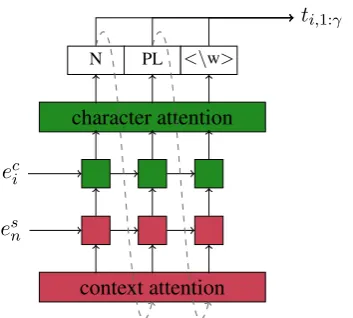
As the tag decoder shows in Figure2, we use a 2 layer stacked bidirectional GRU as the tag decoder to generate morphological tags ti = ti,1, ..., ti,γ
for the target wordwi in a given sentence. In or-der to utilize both character-level representations and contextual representations during decoding, we initialize the first layer of the decoder with the context-level word embeddingesi and the sec-ond layer of the decoder with the character-level word embeddingeci after passing them through a
tags over a softmax layer based on the final hidden stateseht, which are computed in a joint attention
mechanism described in the following section.
e
ht = decoder(ht, cct, cst) (6)
p(ti,t|eht) = softmax(eht) (7)
3.2.1 Joint Context and Character Attention We employ two different attention mechanisms to allow the decoder to focus on multiple parts of the sentence and the target word at the same time. We use the attention mechanism introduced by Bah-danau et al.(2014) for the context attention layer. In the context attention, the alignment vectorast, which consists of weights for each word in the sentence, is computed based on the previous hid-den state ht−1 at the top layer of the stacked
bi-GRU and context-level embeddings es of words by using the concatfunction described in Luong et al. (2015). The sentence-level context vector
cs
t which is calculated as a weighted average over
word embeddings, is then passed into a simple concatenation layer Wcs to produce the new hid-den statehtthrough the stacked bi-GRU:
ast(i) = aligns(ht−1, esi) (8)
cst = X
i
astesi (9)
ht = bi-GRU(Wcs[cts;ht−1], ht−1)(10)
Together with the context attention, we also em-ploy a character-level attention model to take into account the entire output of the word encoder. We use the global attention mechanism with the
generalscore function for alignment vectors ( Lu-ong et al.,2015), for the character attention. The source-side character-level attention vector cct is computed as a weighted average of the outputs of the word encoder, each denoted by hci,j. The resulting output state eht of the tag decoder is
then generated by concatenating the current hid-den state at the top of the stacked bi-GRU ht
and the context vectorcct in a concatenation layer which has atanhactivation:
act(j) = alignc(ht, hci,j) (11)
cct = X
j
acthci,j (12)
eht = tanh(Wcc[cct;ht]) (13)
3.3 Lemma Decoder
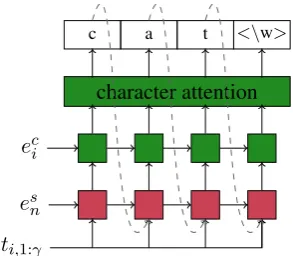
The lemma decoder (Figure3) produces one char-acter at a time to sequentially form a lemmali =
c a t <\w>
character attention
eci
esn
[image:4.595.329.476.61.189.2]ti,1:γ
Figure 3: An overview of the lemma decoder.
li,1, ..., li,φ for a target word wi. Similar to the
tag encoder, we use a 2 layer stacked bi-GRU as lemma decoder. The initial states of the decoder layers are taken from the word encoder outputeci
and the context encoder output esi through a relu
layer similarly as in the tag decoder. The output of the lemma decoderli,t is conditioned on the
cur-rent state of the decoderht, the character attention
cct and the morphological tags ti,1:γ of the target
word. The probability of the output lemma char-acters are then predicted through a softmax layer.
e
ht = decoder(ht, cct, ti,1:γ) (14)
p(li,t|eht) = softmax(eht) (15)
In order to exploit morphological features during lemmatization, we give the morphological tagsti:γ
which are predicted by the tag decoder, as part of input to the lemma decoder. Independent of their order, the entire set of the tags are encoded by a simplefeed-forwardlayer as described in the base-line model (Malaviya et al.,2019) and the result-ing vector is concatenated with the input embed-dings for each target word.
The last part of the lemma decoder is the atten-tion network which is the same character-level at-tention model as in the tag decoder. The character attention mechanism allows the lemma decoder to compute an attention vectorcctbased on the output states of the word encoder. The attention vector is then passed into a concatenation layer to generate the output stateehtof the decoder for each lemma
characterli,t.
act(j) = alignc(ht, hci,j) (16)
cct = X
j
acthci,j (17)
Parameter Val. Parameter Val.
teacher forcing ratio 0.5 dataset embbedding size (ed a) 32 dropout 0.25 word enc. hidden size (hc
i) 1,024 patience 4 context enc. hidden size (hs
i) 1,024 word enc. input size 128 dec. input size 128 word embedding size (ew
[image:5.595.75.290.63.126.2]i) 256 dec. hidden size (ht) 1,024
Table 2: Default hyperparameter settings. Encoder and decoder are denoted byencanddecrespectively.
4 Setup
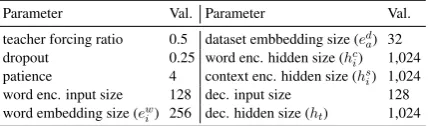
In this section we will give the details regarding our experimental setup. The hyperparameters we used in our experiments are shown in Table 2. These hyperparameters have been tuned on the datasets described in Section 5.1. For the train-ing, we used ADAM (Kingma and Ba,2014) and we applied an early stopping strategy with a min-imum number of 100 epochs. We stop training if there is no improvement in the development set for 4 consecutive epochs (patience).
4.1 External Embeddings
Because of time-constraints and the large num-ber of languages in the dataset, we used out-of-the-box embeddings. We compared the perfor-mance of three well-known pre-trained embedding repositories for different training methods. We use two word-based embeddings: Polyglot em-beddings (Al-Rfou et al.,2013), and FastText em-beddings (Grave et al., 2018). For FastText, two sets of pre-trained embeddings are available: one is trained only on Wikipedia (Bojanowski et al.,
2017), whereas the newer versions are also trained on CommonCrawl (Grave et al.,2018). Whenever available, we pick the newer embeddings, but for many low-resource languages we fall back to the older, smaller version. We also experiment with context-based embeddings, namely ELMo embed-dings (Peters et al.,2018), we use the pre-trained models fromChe et al.(2018).
All of these embeddings have been trained us-ing the default settus-ings for the embeddus-ing type, hence their dimensions are substantially different (Polyglot; 64, FastText:300, ELMo:1,024) . We decided not to transform these, as their default di-mensions are tuned towards their training algo-rithm and we want to provide a fair comparison for all out-of-the-box settings.
4.2 Dataset Embeddings
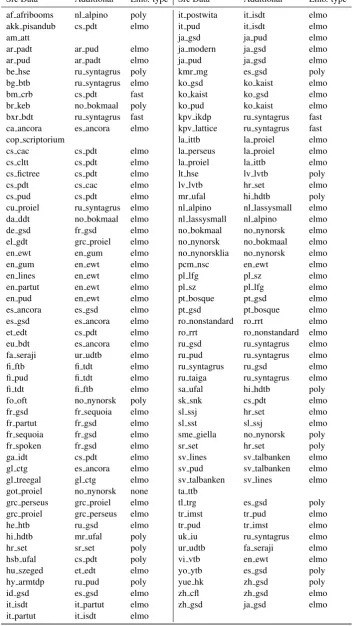
For the dataset embeddings, we only consider combining pairs of two for efficiency reasons. To ensure that we match datasets which are informa-tive, we use word overlap (excluding numberals and punctuation). As this method is expected to be most benficial for small datasets, we searched for datasets which are closest (ie. have a large word overlap) to the 50 smallest datasets. The final pairs of datasets can be found in AppendixA.
5 Experiments
In this section, we will describe the data used in our experiments as well as evaluate the effective-ness of our external embeddings setup and the dataset embeddings with in a variety of settings. In all experiments we use +E and -E to indicate the model with and without external embeddings, and +D and -D for dataset embeddings.
5.1 Data
The test data of SIGMORPHON 2019 task 2 con-sists of a collection of datasets released in the Uni-versal Dependencies project (Nivre et al., 2018), which are automatically converted to the Uni-Morph Schema (McCarthy et al.,2018). In total, we evaluate our model on 107 datasets, covering 66 languages.
After empirically looking at the trade-off be-tween data-size and training time, we decided to limit each dataset to its first 250,000 tokens for all experiments. This speeded up the training consid-erably, with almost no loss in performance.
For the tuning of our model, we selected a sub-set of datasets from the main benchmark. More specifically, we aimed to get a diversion of language-family, size, and morphological richness (here proxied by the average amount of morpho-logical tags per word). To ensure we do not overfit on a specific dataset/annotation, we selected two datasets for each of these languages. The selected datasets are shown in Table3.
5.2 Baseline
none poly fast elmo
90 91 92 93 94 95 96
[image:6.595.310.525.65.178.2]lemma acc morph f1
Figure 4: Results of our model when using a variety of types of external embeddings.
as extra information to improve the lemmatiza-tion. The lemmatizer, which is based onWu et al.
(2018), uses a hard attention mechanism within an encoder-decoder model. Unlike the previous mod-els, the morphological tags are explicitly given to the lemmatizer to indicate the morpho-syntactic features of words. The lemmatizer combines the given morphological tags with a character encod-ing to predict the lemma.
5.3 External Embeddings
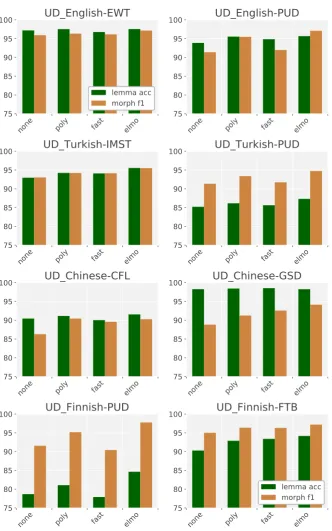
In Figure 4, we plotted the average performance of our model when the different types of embed-dings are used to initialize the word-surface em-beddings (detailed results are in AppendixB). The results show that a performance boost of approx-imately 2.5% can be obtained for lemmatization and 5% for morphological tagging. Especially the ELMo embeddings perform very well, and result in an improvement of 3.77 and 6.35 percentage points. The Polyglot embeddings perform surpris-ingly well, considering they only have an embed-ding size of 64. In addition to the reported settings, we also experimented with concatenating the vec-tors from all types of external embeddings. How-ever, our empirical results showed that this per-formed worse compared to using any of the
em-Dataset Language Family Sents words tag/word
en ewt IE,Germanic 13,297 204,857 1.95 en pud IE,Germanic 800 16,927 1.88 tr imst Turkic,Southwestern 4,508 46,417 3.58 tr pud Turkic,Southwestern 800 13,380 2.78 zh cfl Sino-Tibetan 360 5,688 1.00 zh gsd Sino-Tibetan 3,997 98,734 1.06 fi pud Uralic,Finnic 800 12,556 2.97 fi ftb Uralic,Finnic 14,978 127,536 3.07
Table 3: The datasets which we used to tune our mod-els, with data properties based on the training split. IE: Indo-European
Small (concat) Small (+D) Large (concat) Large (+D)
90 91 92 93 94 95 96
[image:6.595.76.287.66.160.2]lemma acc morph f1
Figure 5: Average results of our model when using sim-ple dataset concatenation versus using dataset embed-dings (+D) on 4 small datasets and 4 large datasets
beddings in isolation.
Because not all types of embeddings are avail-able for all languages, we use fallback options for the test data. We choose embeddings in the fol-lowing order: ELMo, Polyglot, FastText. After this selection, three languages still have no embed-dings (Akkadian, Coptic and Naija), we omitted datasets in these languages from the external em-bedding experiments.
5.4 Dataset Embeddings
To test whether the dataset embeddings are neces-sary, we compare them with a naive approach to combine datasets: simply training on the concate-nation of both datasets. The average results on 4 small datasets and 4 large datasets which are given in Table3, are compared separately in Figure5. In both small and large settings, using dataset embed-dings improves the performance in both morpho-logical tagging and lemmatization, however the effect of dataset embeddings is higher on small datasets, especially in the morphological tagging task. For the detailed results on our tune datasets, we refer to AppendixC.
6 Results
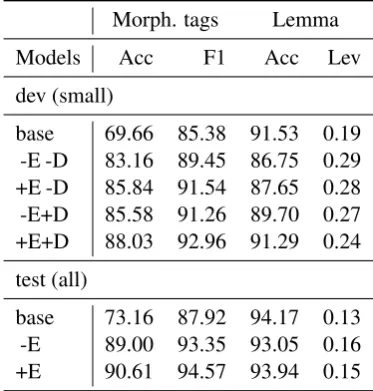
[image:6.595.74.288.609.718.2]four settings per dataset, we refer to AppendixD; here we see that the best setting is generally to use dataset embeddings when available.
6.1 Morphological Tagging
For the morphological tagging task, external em-beddings show to be more beneficial for the tag-ging task, whereas the dataset embeddings are par-ticularly beneficial for lemmatization, but combin-ing them leads to the best scores for both tasks. Furthermore, our model outperforms the baseline by a large margin. This is because, while the baseline has a separate component for morpholog-ical tagging, our model learns both tasks jointly. This approach implicitly enables the decoder to access lemma information for morphological tag-ging. Besides, we use a multi-attention strategy which combines word level and character level at-tentions which improves the tagging performance.
6.2 Lemmatization
In contrast to the results on the development data, the baseline outperforms our model on the test data (Table 7). Especially on small datasets which are not paired with another dataset, such asUD Akkadian-PISANDUB, the baseline per-forms better with a large margin.
There are two main reasons for this perfor-mance difference. First, the baseline uses a hard attention to model alignment distribution explic-itly, whereas, our model uses soft attention for both tasks. The results show that a hard attention mechanism performs better on the lemmatization, confirming the findings of Wu et al. (2018). In-tegrating a lemma decoder having hard attention with a morphological tag decoder which employs soft attention, could be explored in future studies. Second, as explained in the previous section, we optimize for both tasks jointly without any weight-ing. Although this is more elegant, as only one model is trained, it might not lead to the most op-timal performance.
7 Conclusion
In this paper, we presented our model for the Sig-morphon 2019 Task 2 on morphological analysis and lemmatization. We use an encoder-decoder model by utilizing multi-task learning approach. A shared encoder runs on the character and sen-tence level and two separate decoders jointly learn to generate morphological tags and the lemma for
Morph. tags Lemma
Models Acc F1 Acc Lev
dev (small)
base 69.66 85.38 91.53 0.19 -E -D 83.16 89.45 86.75 0.29 +E -D 85.84 91.54 87.65 0.28 -E+D 85.58 91.26 89.70 0.27 +E+D 88.03 92.96 91.29 0.24
test (all)
base 73.16 87.92 94.17 0.13 -E 89.00 93.35 93.05 0.16 +E 90.61 94.57 93.94 0.15
Table 7: Average results for all evaluation metrics for development and test data. +E: use external em-beddings for initialization, +D: use dataset embedding strategy. On the development data, we report the aver-age over the datasets where predictions of all settings were available.
each word.
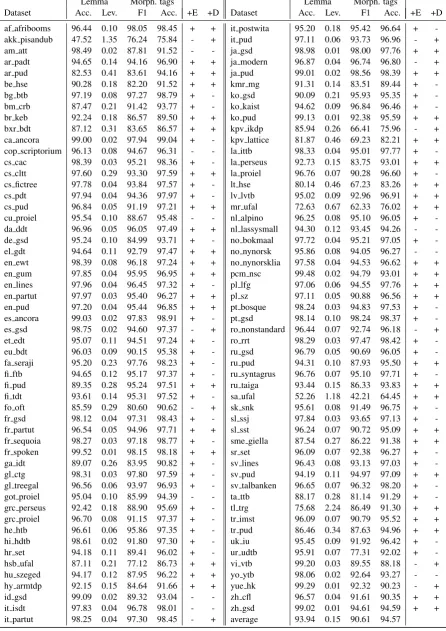
Our system achieved an average morphological tagging F1 score of 94.57 and an average lemma accuracy score of 93.94 on the test data. The ex-perimental analysis showed that:
• Employing a multi-task achitecture having mul-tiple levels of attention mechanism improved the morphological tagging over the baseline strategy.
• Using the pre-trained embeddings substantially improved our scores for both tasks.
• Applying a multi-lingual/dataset strategy by learning special embeddings also improved our scores, specifically for small datasets. On 50 datasets (Table7), the multi-dataset strategy im-proved the performance of our model substan-tially, by 2.95 (accuracy) on lemmatization and 1.81 (F1) on morphological tagging.
• Furthermore, these improvements are highly complementary: using dataset embeddings si-multaneously with external embeddings leads to superior performance.
[image:7.595.322.509.63.259.2]Lemma Morph. tags Lemma Morph. tags
Dataset Acc. Lev. F1 Acc. +E +D Dataset Acc. Lev. F1 Acc. +E +D
[image:8.595.75.522.73.705.2]af afribooms 96.44 0.10 98.05 98.45 + + it postwita 95.20 0.18 95.42 96.64 + -akk pisandub 47.52 1.35 76.24 75.84 - + it pud 97.11 0.06 93.73 96.96 - + am att 98.49 0.02 87.81 91.52 - - ja gsd 98.98 0.01 98.00 97.76 + + ar padt 94.65 0.14 94.16 96.90 + + ja modern 96.87 0.04 96.74 96.80 - + ar pud 82.53 0.41 83.61 94.16 + + ja pud 99.01 0.02 98.56 98.39 + + be hse 90.28 0.18 82.20 91.52 + + kmr mg 91.31 0.14 83.51 89.44 + -bg btb 97.19 0.08 97.27 98.79 + - ko gsd 90.09 0.21 95.93 95.35 + -bm crb 87.47 0.21 91.42 93.77 + - ko kaist 94.62 0.09 96.84 96.46 + -br keb 92.24 0.18 86.57 89.50 + + ko pud 99.13 0.01 92.38 95.59 + + bxr bdt 87.12 0.31 83.65 86.57 + + kpv ikdp 85.94 0.26 66.41 75.96 - + ca ancora 99.00 0.02 97.94 99.04 + - kpv lattice 81.87 0.46 69.23 82.21 + + cop scriptorium 96.13 0.08 94.67 96.31 - - la ittb 98.33 0.04 95.01 97.77 + -cs cac 98.39 0.03 95.21 98.36 + - la perseus 92.73 0.15 83.75 93.01 + + cs cltt 97.60 0.29 93.30 97.59 + + la proiel 96.76 0.07 90.28 96.60 + -cs fictree 97.78 0.04 93.84 97.57 + - lt hse 80.14 0.46 67.23 83.26 + + cs pdt 97.94 0.04 94.36 97.97 + - lv lvtb 95.02 0.09 92.96 96.91 + + cs pud 96.84 0.05 91.19 97.21 + + mr ufal 72.63 0.67 62.33 76.02 + + cu proiel 95.54 0.10 88.67 95.48 - - nl alpino 96.25 0.08 95.10 96.05 + -da ddt 96.96 0.05 96.05 97.49 + + nl lassysmall 94.30 0.12 93.45 94.26 - -de gsd 95.24 0.10 84.99 93.71 + - no bokmaal 97.72 0.04 95.21 97.05 + -el gdt 94.64 0.11 92.79 97.47 + + no nynorsk 95.86 0.08 94.05 96.27 - -en ewt 98.39 0.08 96.18 97.24 + + no nynorsklia 97.58 0.04 94.53 96.62 + + en gum 97.85 0.04 95.95 96.95 + + pcm nsc 99.48 0.02 94.79 93.01 + + en lines 97.96 0.04 96.45 97.32 + - pl lfg 97.06 0.06 94.55 97.76 + + en partut 97.97 0.03 95.40 96.27 + + pl sz 97.11 0.05 90.88 96.56 + + en pud 97.20 0.04 95.44 96.85 + + pt bosque 98.24 0.03 94.83 97.53 + -es ancora 99.03 0.02 97.83 98.91 + - pt gsd 98.14 0.10 98.24 98.37 + -es gsd 98.75 0.02 94.60 97.37 - + ro nonstandard 96.44 0.07 92.74 96.18 - + et edt 95.07 0.11 94.51 97.24 + - ro rrt 98.29 0.03 97.47 98.42 + -eu bdt 96.03 0.09 90.15 95.38 + - ru gsd 96.79 0.05 90.69 96.05 + -fa seraji 95.20 0.23 97.76 98.23 + - ru pud 94.31 0.10 87.93 95.50 + + fi ftb 94.65 0.12 95.17 97.37 + - ru syntagrus 96.76 0.07 95.10 97.71 + -fi pud 89.35 0.28 95.24 97.51 + + ru taiga 93.44 0.15 86.33 93.83 + + fi tdt 93.61 0.14 95.31 97.52 + - sa ufal 52.26 1.18 42.21 64.45 + + fo oft 85.59 0.29 80.60 90.62 - + sk snk 95.61 0.08 91.49 96.75 + -fr gsd 98.12 0.04 97.31 98.43 + - sl ssj 97.84 0.03 93.65 97.13 + -fr partut 96.54 0.05 94.96 97.71 + + sl sst 96.24 0.07 90.72 95.09 + + fr sequoia 98.27 0.03 97.18 98.77 + - sme giella 87.54 0.27 86.22 91.38 + + fr spoken 99.52 0.01 98.15 98.18 + + sr set 96.09 0.07 92.38 96.27 + -ga idt 89.07 0.26 83.95 90.82 + - sv lines 96.43 0.08 93.13 97.03 + -gl ctg 98.31 0.03 97.80 97.59 + - sv pud 94.19 0.11 94.97 97.09 + + gl treegal 96.56 0.06 93.97 96.93 + - sv talbanken 96.65 0.07 96.32 98.20 + -got proiel 95.04 0.10 85.99 94.39 - - ta ttb 88.17 0.28 81.14 91.29 + -grc perseus 92.42 0.18 88.90 95.69 + - tl trg 75.68 2.24 86.49 91.30 + + grc proiel 96.70 0.08 91.15 97.37 + - tr imst 96.09 0.07 90.79 95.52 + + he htb 96.61 0.06 95.86 97.35 + - tr pud 86.46 0.34 87.63 94.96 + + hi hdtb 98.61 0.02 91.80 97.30 + - uk iu 95.45 0.09 91.92 96.42 + -hr set 94.18 0.11 89.41 96.02 + - ur udtb 95.91 0.07 77.31 92.02 + -hsb ufal 87.11 0.21 77.12 86.73 + + vi vtb 99.20 0.03 89.55 88.18 - + hu szeged 94.17 0.12 87.95 96.22 + + yo ytb 98.06 0.02 92.64 93.27 - -hy armtdp 92.15 0.15 84.64 91.66 + + yue hk 99.29 0.01 92.32 90.23 - + id gsd 99.09 0.02 89.32 93.04 - - zh cfl 96.57 0.04 91.61 90.35 + + it isdt 97.83 0.04 96.78 98.01 - - zh gsd 99.02 0.01 94.61 94.59 + + it partut 98.25 0.04 97.30 98.45 - + average 93.94 0.15 90.61 94.57
Acknowledgements
We would like to thank all our colleagues and the anonymous reviewers. Furthermore, we would like to thank the Center for Information Technol-ogy of the University of Groningen for their sup-port and for providing access to the Peregrine high performance computing cluster.
References
Rami Al-Rfou, Bryan Perozzi, and Steven Skiena. 2013. Polyglot: Distributed word representations for multilingual NLP. InProceedings of the Seven-teenth Conference on Computational Natural Lan-guage Learning, pages 183–192, Sofia, Bulgaria. Association for Computational Linguistics.
Waleed Ammar, George Mulcaire, Miguel Ballesteros, Chris Dyer, and Noah A Smith. 2016. Many lan-guages, one parser. Transactions of the Association for Computational Linguistics, 4:431–444.
Dzmitry Bahdanau, Kyunghyun Cho, and Yoshua Ben-gio. 2014. Neural machine translation by jointly learning to align and translate. arXiv preprint arXiv:1409.0473.
Piotr Bojanowski, Edouard Grave, Armand Joulin, and Tomas Mikolov. 2017. Enriching word vectors with subword information. Transactions of the Associa-tion for ComputaAssocia-tional Linguistics, 5:135–146.
Wanxiang Che, Yijia Liu, Yuxuan Wang, Bo Zheng, and Ting Liu. 2018. Towards better UD parsing: Deep contextualized word embeddings, ensemble, and treebank concatenation. InProceedings of the CoNLL 2018 Shared Task: Multilingual Parsing from Raw Text to Universal Dependencies, pages 55–64, Brussels, Belgium. Association for Compu-tational Linguistics.
Kyunghyun Cho, Bart van Merrienboer, Caglar Gul-cehre, Dzmitry Bahdanau, Fethi Bougares, Holger Schwenk, and Yoshua Bengio. 2014. Learning phrase representations using rnn encoder–decoder for statistical machine translation. InProceedings of the 2014 Conference on Empirical Methods in Nat-ural Language Processing (EMNLP), pages 1724– 1734.
Costanza Conforti, Matthias Huck, and Alexander Fraser. 2018. Neural morphological tagging of lemma sequences for machine translation. In Pro-ceedings of the 13th Conference of the Association for Machine Translation in the Americas (Volume 1: Research Papers), volume 1, pages 39–53.
Ryan Cotterell, Christo Kirov, John Sylak-Glassman, G´eraldine Walther, Ekaterina Vylomova, Arya D McCarthy, Katharina Kann, Sebastian Mielke, Gar-rett Nicolai, Miikka Silfverberg, et al. 2018.
The conll–sigmorphon 2018 shared task: Uni-versal morphological reinflection. arXiv preprint arXiv:1810.07125.
Ryan Cotterell, Christo Kirov, John Sylak-Glassman, G´eraldine Walther, Ekaterina Vylomova, Patrick Xia, Manaal Faruqui, Sandra K¨ubler, David Yarowsky, Jason Eisner, et al. 2017. Conll-sigmorphon 2017 shared task: Universal morpho-logical reinflection in 52 languages. arXiv preprint arXiv:1706.09031.
Ryan Cotterell, Christo Kirov, John Sylak-Glassman, David Yarowsky, Jason Eisner, and Mans Hulden. 2016. The sigmorphon 2016 shared taskmorpholog-ical reinflection. In Proceedings of the 14th SIG-MORPHON Workshop on Computational Research in Phonetics, Phonology, and Morphology, pages 10–22.
Erenay Dayanık, Ekin Aky¨urek, and Deniz Yuret. 2018. Morphnet: A sequence-to-sequence model that combines morphological analysis and disam-biguation. arXiv preprint arXiv:1805.07946.
Edouard Grave, Piotr Bojanowski, Prakhar Gupta, Ar-mand Joulin, and Tomas Mikolov. 2018. Learning word vectors for 157 languages. In Proceedings of the International Conference on Language Re-sources and Evaluation (LREC 2018).
Georg Heigold, Guenter Neumann, and Josef van Gen-abith. 2017. An extensive empirical evaluation of character-based morphological tagging for 14 lan-guages. In Proceedings of the 15th Conference of the European Chapter of the Association for Compu-tational Linguistics: Volume 1, Long Papers, pages 505–513.
Melvin Johnson, Mike Schuster, Quoc V Le, Maxim Krikun, Yonghui Wu, Zhifeng Chen, Nikhil Thorat, Fernanda Vi´egas, Martin Wattenberg, Greg Corrado, et al. 2017. Googles multilingual neural machine translation system: Enabling zero-shot translation.
Transactions of the Association for Computational Linguistics, 5:339–351.
Yova Kementchedjhieva, Johannes Bjerva, and Is-abelle Augenstein. 2018. Copenhagen at conll– sigmorphon 2018: Multilingual inflection in context with explicit morphosyntactic decoding. Proceed-ings of the CoNLL SIGMORPHON 2018 Shared Task: Universal Morphological Reinflection, pages 93–98.
Diederik P Kingma and Jimmy Ba. 2014. Adam: A method for stochastic optimization. arXiv preprint arXiv:1412.6980.
Daniel Kondratyuk, Tom´aˇs Gavenˇciak, Milan Straka, and Jan Hajiˇc. 2018. Lemmatag: Jointly tagging and lemmatizing for morphologically rich languages with brnns. InProceedings of the 2018 Conference on Empirical Methods in Natural Language Pro-cessing, pages 4921–4928.
Thang Luong, Hieu Pham, and Christopher D Man-ning. 2015. Effective approaches to attention-based neural machine translation. In Proceedings of the 2015 Conference on Empirical Methods in Natural Language Processing, pages 1412–1421.
Chaitanya Malaviya, Shijie Wu, and Ryan Cot-terell. 2019. A simple joint model for improved contextual neural lemmatization. arXiv preprint arXiv:1904.02306.
Arya D. McCarthy, Miikka Silfverberg, Ryan Cotterell, Mans Hulden, and David Yarowsky. 2018. Mar-rying Universal Dependencies and Universal Mor-phology. In Proceedings of the Second Workshop on Universal Dependencies (UDW 2018), pages 91– 101, Brussels, Belgium. Association for Computa-tional Linguistics.
Arya D. McCarthy, Ekaterina Vylomova, Shijie Wu, Chaitanya Malaviya, Lawrence Wolf-Sonkin, Gar-rett Nicolai, Christo Kirov, Miikka Silfverberg, Se-bastian Mielke, Jeffrey Heinz, Ryan Cotterell, and Mans Hulden. 2019. The SIGMORPHON 2019 shared task: Crosslinguality and context in morphol-ogy. In Proceedings of the 16th SIGMORPHON Workshop on Computational Research in Phonetics, Phonology, and Morphology, Florence, Italy. Asso-ciation for Computational Linguistics.
Hwee Tou Ng, Siew Mei Wu, Ted Briscoe, Christian Hadiwinoto, Raymond Hendy Susanto, and Christo-pher Bryant. 2014. The conll-2014 shared task on grammatical error correction. InProceedings of the Eighteenth Conference on Computational Natural Language Learning: Shared Task, pages 1–14.
Joakim Nivre, Mitchell Abrams, ˇZeljko Agi´c, Lars Ahrenberg, Lene Antonsen, Katya Aplonova, Maria Jesus Aranzabe, Gashaw Arutie, Masayuki Asahara, Luma Ateyah, Mohammed Attia, Aitz-iber Atutxa, Liesbeth Augustinus, Elena Bad-maeva, Miguel Ballesteros, Esha Banerjee, Sebas-tian Bank, Verginica Barbu Mititelu, Victoria Bas-mov, John Bauer, Sandra Bellato, Kepa Bengoetxea, Yevgeni Berzak, Irshad Ahmad Bhat, Riyaz Ah-mad Bhat, Erica Biagetti, Eckhard Bick, Rogier Blokland, Victoria Bobicev, Carl B¨orstell, Cristina Bosco, Gosse Bouma, Sam Bowman, Adriane Boyd, Aljoscha Burchardt, Marie Candito, Bernard Caron, Gauthier Caron, G¨ulsen Cebiro˘glu Eryi˘git, Flavio Massimiliano Cecchini, Giuseppe G. A. Celano, Slavom´ır ˇC´epl¨o, Savas Cetin, Fabricio Chalub, Jinho Choi, Yongseok Cho, Jayeol Chun, Silvie Cinkov´a, Aur´elie Collomb, Ca˘grı C¨oltekin, Miriam Connor, Marine Courtin, Elizabeth David-son, Marie-Catherine de Marneffe, Valeria de Paiva,
Schnei-der, Sebastian Schuster, Djam´e Seddah, Wolfgang Seeker, Mojgan Seraji, Mo Shen, Atsuko Shi-mada, Muh Shohibussirri, Dmitry Sichinava, Na-talia Silveira, Maria Simi, Radu Simionescu, Katalin Simk´o, M´aria ˇSimkov´a, Kiril Simov, Aaron Smith, Isabela Soares-Bastos, Carolyn Spadine, Antonio Stella, Milan Straka, Jana Strnadov´a, Alane Suhr, Umut Sulubacak, Zsolt Sz´ant´o, Dima Taji, Yuta Takahashi, Takaaki Tanaka, Isabelle Tellier, Trond Trosterud, Anna Trukhina, Reut Tsarfaty, Francis Tyers, Sumire Uematsu, Zdeˇnka Ureˇsov´a, Larraitz Uria, Hans Uszkoreit, Sowmya Vajjala, Daniel van Niekerk, Gertjan van Noord, Viktor Varga, Eric Villemonte de la Clergerie, Veronika Vincze, Lars Wallin, Jing Xian Wang, Jonathan North Washing-ton, Seyi Williams, Mats Wir´en, Tsegay Wolde-mariam, Tak-sum Wong, Chunxiao Yan, Marat M. Yavrumyan, Zhuoran Yu, Zdenˇek ˇZabokrtsk´y, Amir Zeldes, Daniel Zeman, Manying Zhang, and Hanzhi Zhu. 2018. Universal dependencies 2.3. LIN-DAT/CLARIN digital library at the Institute of For-mal and Applied Linguistics ( ´UFAL), Faculty of Mathematics and Physics, Charles University.
Matthew Peters, Mark Neumann, Mohit Iyyer, Matt Gardner, Christopher Clark, Kenton Lee, and Luke Zettlemoyer. 2018. Deep contextualized word rep-resentations. In Proceedings of the 2018 Confer-ence of the North American Chapter of the Associ-ation for ComputAssoci-ational Linguistics: Human Lan-guage Technologies, Volume 1 (Long Papers), pages 2227–2237, New Orleans, Louisiana. Association for Computational Linguistics.
Barbara Plank, Anders Søgaard, and Yoav Goldberg. 2016. Multilingual part-of-speech tagging with bidirectional long short-term memory models and auxiliary loss. arXiv preprint arXiv:1604.05529.
Aaron Smith, Bernd Bohnet, Miryam de Lhoneux, Joakim Nivre, Yan Shao, and Sara Stymne. 2018.82 treebanks, 34 models: Universal dependency pars-ing with multi-treebank models. InProceedings of the CoNLL 2018 Shared Task: Multilingual Pars-ing from Raw Text to Universal Dependencies, pages 113–123, Brussels, Belgium. Association for Com-putational Linguistics.
Anders Søgaard and Yoav Goldberg. 2016. Deep multi-task learning with low level tasks supervised at lower layers. InProceedings of the 54th Annual Meeting of the Association for Computational Lin-guistics (Volume 2: Short Papers), volume 2, pages 231–235.
Ilya Sutskever, Oriol Vinyals, and Quoc V Le. 2014. Sequence to sequence learning with neural net-works. InAdvances in neural information process-ing systems, pages 3104–3112.
Shijie Wu, Pamela Shapiro, and Ryan Cotterell. 2018.
Hard non-monotonic attention for character-level transduction. In Proceedings of the 2018 Confer-ence on Empirical Methods in Natural Language
Processing, pages 4425–4438, Brussels, Belgium. Association for Computational Linguistics.
A Matching of Datasets
Src Data Additional Emb. type Src Data Additional Emb. type
af afribooms nl alpino poly it postwita it isdt elmo akk pisandub cs pdt elmo it pud it isdt elmo
am att ja gsd ja pud elmo
ar padt ar pud elmo ja modern ja gsd elmo
ar pud ar padt elmo ja pud ja gsd elmo
be hse ru syntagrus poly kmr mg es gsd poly
bg btb ru syntagrus elmo ko gsd ko kaist elmo
bm crb cs pdt fast ko kaist ko gsd elmo
br keb no bokmaal poly ko pud ko kaist elmo
bxr bdt ru syntagrus fast kpv ikdp ru syntagrus fast ca ancora es ancora elmo kpv lattice ru syntagrus fast
cop scriptorium la ittb la proiel elmo
cs cac cs pdt elmo la perseus la proiel elmo
cs cltt cs pdt elmo la proiel la ittb elmo
cs fictree cs pdt elmo lt hse lv lvtb poly
cs pdt cs cac elmo lv lvtb hr set elmo
cs pud cs pdt elmo mr ufal hi hdtb poly
cu proiel ru syntagrus elmo nl alpino nl lassysmall elmo da ddt no bokmaal elmo nl lassysmall nl alpino elmo de gsd fr gsd elmo no bokmaal no nynorsk elmo el gdt grc proiel elmo no nynorsk no bokmaal elmo en ewt en gum elmo no nynorsklia no nynorsk elmo
en gum en ewt elmo pcm nsc en ewt elmo
en lines en ewt elmo pl lfg pl sz elmo
en partut en ewt elmo pl sz pl lfg elmo
en pud en ewt elmo pt bosque pt gsd elmo
es ancora es gsd elmo pt gsd pt bosque elmo
es gsd es ancora elmo ro nonstandard ro rrt elmo et edt cs pdt elmo ro rrt ro nonstandard elmo eu bdt es ancora elmo ru gsd ru syntagrus elmo fa seraji ur udtb elmo ru pud ru syntagrus elmo
fi ftb fi tdt elmo ru syntagrus ru gsd elmo
fi pud fi tdt elmo ru taiga ru syntagrus elmo
fi tdt fi ftb elmo sa ufal hi hdtb poly
fo oft no nynorsk poly sk snk cs pdt elmo
fr gsd fr sequoia elmo sl ssj hr set elmo
fr partut fr gsd elmo sl sst sl ssj elmo
fr sequoia fr gsd elmo sme giella no nynorsk poly
fr spoken fr gsd elmo sr set hr set poly
ga idt cs pdt elmo sv lines sv talbanken elmo gl ctg es ancora elmo sv pud sv talbanken elmo gl treegal gl ctg elmo sv talbanken sv lines elmo got proiel no nynorsk none ta ttb
grc perseus grc proiel elmo tl trg es gsd poly grc proiel grc perseus elmo tr imst tr pud elmo
he htb ru gsd elmo tr pud tr imst elmo
hi hdtb mr ufal poly uk iu ru syntagrus elmo
hr set sr set poly ur udtb fa seraji elmo
hsb ufal cs pdt poly vi vtb en ewt elmo
hu szeged et edt elmo yo ytb es gsd poly
hy armtdp ru pud poly yue hk zh gsd poly
id gsd es gsd elmo zh cfl zh gsd elmo
it isdt it partut elmo zh gsd ja gsd elmo
[image:12.595.123.477.94.721.2]it partut it isdt elmo
B External Embeddings per Dataset
none poly fast elmo
75 80 85 90 95
100
UD_English-EWT
lemma acc morph f1
none poly fast elmo
75 80 85 90 95
100
UD_English-PUD
none poly fast elmo
75 80 85 90 95
100
UD_Turkish-IMST
none poly fast elmo
75 80 85 90 95
100
UD_Turkish-PUD
none poly fast elmo
75 80 85 90 95
100
UD_Chinese-CFL
none poly fast elmo
75 80 85 90 95
100
UD_Chinese-GSD
none poly fast elmo
75 80 85 90 95
100
UD_Finnish-PUD
none poly fast elmo
75 80 85 90 95
100
UD_Finnish-FTB
[image:13.595.134.467.80.612.2]lemma acc morph f1
C Dataset Embeddings per Dataset
concat (-D)
+D
85.0 87.5 90.0 92.5 95.0 97.5
100.0
UD_English-EWT
lemma acc morph f1
concat (-D)
+D
85.0 87.5 90.0 92.5 95.0 97.5
100.0
UD_English-PUD
concat (-D)
+D
85.0 87.5 90.0 92.5 95.0 97.5
100.0
UD_Turkish-IMST
concat (-D)
+D
85.0 87.5 90.0 92.5 95.0 97.5
100.0
UD_Turkish-PUD
concat (-D)
+D
85.0 87.5 90.0 92.5 95.0 97.5
100.0
UD_Chinese-CFL
concat (-D)
+D
85.0 87.5 90.0 92.5 95.0 97.5
100.0
UD_Chinese-GSD
concat (-D)
+D
85.0 87.5 90.0 92.5 95.0 97.5
100.0
UD_Finnish-PUD
concat (-D)
+D
85.0 87.5 90.0 92.5 95.0 97.5
100.0
UD_Finnish-FTB
[image:14.595.133.467.81.615.2]lemma acc morph f1
D Results of External and Treebank Embeddings on Development Data
Dataset Base -E-D -E+D +E-D +E+D Lem Mor Dataset Base -E-D -E+D +E-D +E+D Lem Mor
af afribooms 95.48 95.14 95.95 96.63 97.03 96.49 97.57 it postwita 92.19 95.12 0.00 96.19 0.00 95.24 97.14 akk pisandub 74.76 63.65 64.76 59.64 63.07 46.67 82.85 it pud 94.14 94.06 97.02 90.29 96.80 97.25 96.79
am att 93.53 95.51 0.00 93.77 0.00 98.90 92.12 ja gsd 93.98 96.96 97.27 98.08 98.21 98.91 97.52
ar padt 93.40 93.74 90.05 93.93 95.92 94.90 96.94 ja modern 94.26 94.61 96.55 94.19 96.47 96.45 96.65
ar pud 86.58 84.28 76.56 88.02 88.65 82.70 94.60 ja pud 92.91 95.16 98.34 97.02 99.02 99.46 98.59
be hse 84.82 80.69 88.10 81.32 89.13 87.48 90.78 kmr mg 89.17 87.36 0.00 87.81 0.00 88.57 87.06
bg btb 95.57 97.43 0.00 97.97 0.00 97.15 98.79 ko gsd 89.38 91.49 0.00 92.82 0.00 90.45 95.19
bm crb 88.86 91.34 0.00 91.50 0.00 88.70 94.30 ko kaist 91.99 94.89 0.00 95.57 0.00 94.69 96.45
br keb 91.00 86.51 0.00 89.14 91.39 91.49 91.29 ko pud 93.89 94.02 96.57 96.32 97.55 98.80 96.30
bxr bdt 83.66 83.46 86.34 84.33 86.36 86.83 85.89 kpv ikdp 67.44 61.19 73.16 60.82 72.83 71.08 75.24
ca ancora 96.91 98.43 0.00 99.08 0.00 99.11 99.06 kpv lattice 75.14 63.65 74.16 62.89 76.29 78.57 74.01 cop scriptorium 94.53 95.53 0.00 94.54 0.00 95.12 95.94 la ittb 95.85 97.89 0.00 98.17 0.00 98.39 97.94
cs cac 95.86 97.31 0.00 98.30 0.00 98.34 98.26 la perseus 83.11 82.97 89.34 87.26 91.25 90.80 91.70
cs cltt 95.53 94.32 97.20 93.19 97.67 97.82 97.51 la proiel 94.03 95.05 0.00 96.74 0.00 96.88 96.59
cs fictree 94.10 96.09 0.00 97.85 0.00 97.99 97.72 lt hse 76.09 70.49 74.93 76.93 81.48 80.69 82.27
cs pdt 95.26 96.96 0.00 98.00 0.00 98.02 97.98 lv lvtb 92.38 93.88 0.00 95.67 95.70 94.73 96.67
cs pud 89.85 88.22 96.04 94.17 96.94 97.05 96.83 mr ufal 76.22 74.79 76.64 74.80 77.87 76.71 79.02
cu proiel 93.47 94.94 0.00 94.78 0.00 95.00 94.87 nl alpino 94.25 95.77 0.00 96.17 0.00 96.35 95.99
da ddt 93.74 91.53 95.66 97.19 97.35 97.01 97.68 nl lassysmall 92.62 95.05 0.00 94.19 0.00 95.16 94.95
de gsd 0.00 93.59 94.35 94.44 0.00 95.23 93.64 no bokmaal 95.53 97.45 0.00 97.62 0.00 97.91 97.32
el gdt 95.23 95.83 95.36 95.76 96.00 94.50 97.50 no nynorsk 0.00 97.23 0.00 96.26 0.00 97.34 97.13
en ewt 93.99 94.49 96.41 97.66 97.78 98.26 97.29 no nynorsklia 91.80 95.52 95.25 95.61 96.99 97.79 96.18
en gum 93.74 92.04 96.04 93.90 97.53 97.80 97.26 pcm nsc 89.24 95.87 96.10 95.86 96.17 100.00 92.35
en lines 94.61 96.24 0.00 97.60 0.00 98.01 97.20 pl lfg 92.07 95.56 95.66 96.82 97.43 97.03 97.84
en partut 93.33 95.15 96.05 96.11 97.24 98.24 96.25 pl sz 91.10 93.78 95.00 96.15 97.09 97.37 96.80
en pud 91.62 92.70 95.00 96.23 97.07 97.20 96.94 pt bosque 94.88 97.08 0.00 97.91 0.00 98.32 97.50
es ancora 96.87 98.27 98.38 98.89 0.00 98.96 98.83 pt gsd 0.00 97.44 0.00 98.14 0.00 97.94 98.35
es gsd 0.00 97.62 98.14 98.13 0.00 98.68 97.59 ro nonstandard 93.62 95.73 96.20 96.11 0.00 96.32 96.09
et edt 93.31 94.50 0.00 96.20 0.00 94.99 97.42 ro rrt 95.56 97.39 97.46 98.20 0.00 98.23 98.16
eu bdt 91.94 94.76 0.00 95.80 0.00 96.03 95.57 ru gsd 55.99 94.85 0.00 96.93 0.00 97.10 96.75
fa seraji 0.00 95.90 0.00 96.61 0.00 95.27 97.96 ru pud 89.25 88.21 94.70 94.07 95.94 95.06 96.82
fi ftb 92.27 94.23 94.65 96.13 0.00 94.81 97.45 ru syntagrus 94.37 96.66 0.00 97.25 0.00 96.75 97.75
fi pud 88.69 86.82 92.50 90.42 93.12 87.97 98.27 ru taiga 85.09 85.38 92.94 91.17 94.70 94.28 95.13
fi tdt 89.32 94.30 94.31 95.56 0.00 93.43 97.70 sa ufal 68.45 61.87 64.32 62.96 67.69 63.92 71.46
fo oft 88.93 88.18 89.65 87.98 89.28 88.11 91.19 sk snk 92.44 93.12 0.00 96.52 0.00 96.20 96.85
fr gsd 96.43 97.93 97.73 98.30 0.00 98.13 98.47 sl ssj 92.97 95.59 0.00 97.35 0.00 97.60 97.09
fr partut 94.09 94.62 96.89 96.54 97.47 97.10 97.83 sl sst 89.78 89.19 94.26 93.20 95.98 96.89 95.06
fr sequoia 95.59 96.64 97.98 98.49 0.00 98.43 98.54 sme giella 89.69 89.60 87.56 88.27 90.44 88.32 92.56
fr spoken 96.34 96.71 97.92 97.94 98.63 99.41 97.84 sr set 93.82 95.64 0.00 95.91 0.00 95.84 95.98
ga idt 86.92 84.13 0.00 90.14 0.00 89.15 91.13 sv lines 93.54 93.97 95.07 96.98 0.00 96.90 97.07
gl ctg 95.09 97.48 97.97 98.15 0.00 98.38 97.92 sv pud 91.08 89.84 93.61 95.03 95.68 94.48 96.88
gl treegal 92.77 93.38 95.64 96.29 94.91 96.03 96.55 sv talbanken 0.00 96.13 95.95 97.61 0.00 96.85 98.38
got proiel 94.19 95.40 0.00 95.00 0.00 95.63 95.17 ta ttb 93.31 89.73 0.00 91.46 0.00 91.15 91.76
grc perseus 0.00 93.48 0.00 94.02 0.00 92.46 95.57 tl trg 68.66 73.36 70.36 69.13 78.62 76.00 81.25
grc proiel 0.00 95.73 0.00 97.06 0.00 96.72 97.41 tr imst 90.73 93.46 93.81 95.40 95.43 95.50 95.35
he htb 94.31 95.82 96.55 96.87 0.00 96.47 97.27 tr pud 87.86 88.63 90.39 90.83 91.74 87.96 95.52
hi hdtb 96.36 97.43 97.55 97.93 97.71 98.53 97.32 uk iu 91.39 92.41 94.06 95.75 0.00 95.24 96.25
hr set 93.21 93.27 0.00 95.25 0.00 94.20 96.30 ur udtb 92.12 92.85 0.00 93.59 0.00 95.61 91.57
hsb ufal 84.64 82.83 82.98 84.67 84.79 86.28 83.31 vi vtb 89.39 93.37 94.48 94.13 0.00 99.40 89.56
hu szeged 91.06 91.65 91.03 90.94 94.70 93.42 95.98 yo ytb 88.72 92.41 91.38 89.07 0.00 94.40 90.42
hy armtdp 0.00 92.02 0.00 92.69 93.08 93.16 93.01 yue hk 85.19 90.97 94.10 89.32 93.94 98.97 89.22
id gsd 92.75 96.05 0.00 95.89 0.00 99.08 93.03 zh cfl 85.31 89.34 93.05 91.33 93.86 96.26 91.46
it isdt 95.73 97.83 97.62 97.12 97.80 97.63 98.02 zh gsd 91.34 94.15 95.04 96.57 96.79 99.06 94.52
[image:15.595.71.521.86.650.2]it partut 95.36 95.59 98.11 97.84 97.73 97.85 98.37