www.wjpr.net Vol 4, Issue 05, 2015.
1235
OPTIMIZATION STUDIES FOR CLOZAPINE
BIOTRANSFORMATION TO ITS ACTIVE METABOLITE -
NORCLOZAPINE USING FUNGI.
S. Varalaxmi and M. Vidyavathi*
Institute of Pharmaceutical Technology, Sri Padmavathimahilavisvavidyalayam Tirupathi.
ABSTRACT
Clozapine is an antipsychotic drug which is used for treatment of schizophrenia. It is metabolised by CYP1A2 enzyme to its active metabolite norclozapine in human beings. The biotransformation of clozapine was performed by eight strains of fungi using fermentation technique and HPLC analysis. Among which a filamentous fungus Cunninghamella elegans has shown ability to biotransform clozapine to its active metabolite, norclozapine which was identified by HPLC, Mass spectroscopy and 1HNMR studies. Then the influence of different parameters like change in media components such as carbon and nitrogen sources used in media, incubation period and agitation speeds on metabolite production was investigated and also their respective cell dry weights were determined during optimization studies. Among different carbon and nitrogen sources used, maximum metabolite was formed when dextrose and yeast extract were used as carbon and nitrogen sources respectively. The influence of different concentrations of dextrose and yeast on the metabolite production was also investigated. Maximum biotransformation was observed at 2% dextrose, 0.001% yeast extract, 48th hour of incubation period and at 120 rpm. Based upon the results, it can be concluded that there is an influence of media components and their concentration, incubation period and agitation speeds on extent of biotransformation of clozapine to its active metabolitenorclozapine by fungus. Optimized conditions were determined in present study for maximum production of norclozapine.
KEYWORDS: Clozapine, fungal biotransformation, active metabolite, norclozapine, Cunninghamella elegans.
Volume 4, Issue 5, 1235-1245. Research Article ISSN 2277– 7105
Article Received on 28 Feb 2015,
Revised on 19 March 2015, Accepted on 12 April 2015
*Correspondence for
Author
M. Vidyavathi
Institute of
Pharmaceutical
Technology, Sri
Padmavathimahilavisvavi
www.wjpr.net Vol 4, Issue 05, 2015.
1236 INTRODUCTION: Drug biotransformation is defined as the transformation of drugs from one chemical form to other form which occurs mainly by specialised enzymatic systems. Biotransformation involves conversion of lipophilic compounds [drugs] into highly polar derivatives which can be easily excreted out of the body. Hence Drug metabolism can also be termed as a detoxification mechanism.[1,2] Drug metabolism and toxicity studies of metabolites plays a vital role in drug development. Identification of the metabolites from clinical samples and animal sources is hindered by minimum quantity of material obtained.[3] Microbial biotransformation involves the chemical transformation of substrates to desired products by using microorganisms [bacteria and fungus].[4,5] Recently Microbial biotransformation is majorly used for the creation of novel and useful metabolites of almost all classes of drugs which is a substitute for chemical synthesis to prepare pharmacologically active compounds.[6] Among different microorganisms the fungi belonging to Cunninghamella species, possess cytochrome P-450 monooxygenase systems which is similar to mammals. Hence microbial biotransformation studies have been proposed as a complementary in vitro model for mammalian drug metabolism.[3] One of the advantages of microbial models is the production of milligram quantity of metabolites by preparative-scale fermentation for complete structural elucidation and for further pharmacological and toxicological studies with minimum cost.[7-9] Clozapine is an atypical or new generation antipsychotic drug.It is mainly used in individuals with schizophrenia who are either resistant or intolerant to other antipsychotic drugs[10].It is metabolised by CYP1A2 enzyme to its active metabolite norclozapine in human beings.[11] Thus the research work was carried out to screen different microorganisms for metabolism of clozapine to its active metabolite norclozapine as synthesis of metabolites by other methods exposes to number of obstacles. An effect of different conditions on the metabolite production was performed using different carbon and nitrogen sources at different concentrations, incubation period and agitation speeds.
MATERIALS AND METHODS Microorganisms
www.wjpr.net Vol 4, Issue 05, 2015.
1237 Chemicals
Clozapine was obtained as gift sample frommylan laboratories, Hyderbad, India. All the solvents used for analysis were HPLC grade. The remaining chemicals and culture media components were purchased from Qualigens & S.D. fine chemicals, Mumbai, India.
Fermentation technique
The fermentation technique was carried out in 250ml Erlenmeyer flask containing 50ml of broth media containing Potato chips [20gm/100ml, steamed for 30 min], dextrose 2gm, yeast extract10mg, distilled water upto 100ml [final pH 5.6]. Study consisted of one drug control which has drug and incubated without organism, culture control consisted of broth medium inoculated with a loopful of respective fungi. Sample flask consisted of both drug and culture. Two controls and sample flasks were incubated on orbital shaker under identical conditions to obtain the prominent growth of microorganisms for biotransformation study.
Extraction procedure
The incubated flasks were taken out from shaker incubator and heated on water bath at 50°C for 30 min for inactivation of grown microbes. Then, these were transferred into centrifuge tubes and centrifuged at 3000 rpm for 10 min [R8C: Remi instruments, Mumbai, India]. The supernatant obtained was collected in separate boiling tubes. Drug and its metabolitewere extracted from the supernatant by usingethylacetate.[12] Then organic layer was collected and air dried. The dried extract was reconstituted with mobile phase for HPLC analysis.
Optimization studies
Optimization studies were conducted to find the most suitable conditions to be maintained during fermentation for obtaining maximium metabolite by fungal biotransformation. These studies were performed using the fermentation procedure explained as above and by changing the incubation conditions like composition of media, incubation period and agitation speeds as shown in Table 1. All the samples collected during optimization studies are also extracted and analysed by HPLC similarily. The percentage metabolite formed was calculated from the peak area of metabolite obtained during HPLC analysis.
ANALYTICAL METHODS
High pressure liquid chromatography
www.wjpr.net Vol 4, Issue 05, 2015.
1238 [HPLC] method. The HPLC system [Waters, USA] consisted of Waters 515 solvent delivery module and Waters 2489 UV-visible spectrophotometric detector. The mobile phase comprised of Sodium Sodium acetate buffer [pH – 5] [50:40:10v/v] with a flow rate of 1ml/min. The column used was C-18 [stainless steel column of 25 cm length and 4.6 mm internal diameter packed with porous silica spheres of 5 µ diameter, 100 Å pore diameter – II 5C-18 rs – 100a, 5 µm, 4.6 x 250 mm]. The wavelength was set as 250nm and sensitivity at 0.001 a.u.f.s.[13] The percentage of metabolite was calculated based on the area of peak obtained in HPLC analysis and percentage of metabolite formed under different optimized conditions was calculated and compared.
Determination of biomass production
The biomass production at different conditions was determined as it was correlated with the quantity of metabolite produced under same conditions by the following procedure. An empty eppendroff tube is weighed [w1]. Fixed amount of filtered suspension cell material is added into the eppendroff tube. The eppendroff tube [cell material] is weighed again[w2]. The eppendroff tube with the cell material is placed into an oven at 60 °C until consecutive readings are obtained. The eppendroff tube [including dried cell material] is weighed again [w3]. cell dry weight was calculated by using below formula.[14]
Cell dry weight = [w3-w1] / [w2-w1].
RESULTS
www.wjpr.net Vol 4, Issue 05, 2015.
1239 Figure1. HPLC chromatogram of clozapine from culture extracts of Cunninghamella elegans
Table 1: List of optimization parameters studied and their results. Optimization
parameters
% Metabolite
Cell dry weight [mg/50ml] Carbon sources
Dextrose 73* 23.68*
Ribose 64 20.60
Starch 42 13.49
Nitrogen sources
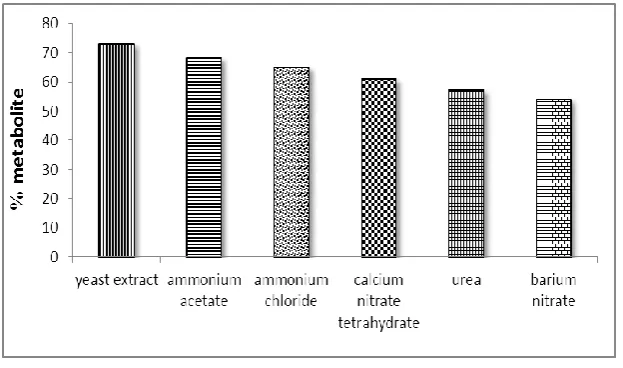
Ammonium acetate 68 22.01
Ammonium chloride 65 21.04
Calcium nitrate 61 19.65
Barium nitrate 54 16.98
Urea 57 18.47
Yeast extract 73* 23.80*
% of dextrose
1 69 22.25
2 73* 23.66*
3 70 22.68
4 68 21.82
5 60 19.41
6 56 17.99
% of yeast extract
0.005 63 20.36
0.01 73* 23.67*
0.02 57 18.47
Incubation periods[hrs]
6 0 0
12 3 1.6
www.wjpr.net Vol 4, Issue 05, 2015.
1240
48 73* 23.01*
60 61 19.65
Agitation speeds[rpm]
60 35 11.12
80 42 13.49
100 60 19.41
120 73* 23.12*
160 48 15.39
“*” – Maximum % of metabolite and cell dry weight formed.
Figure 2: Graphical representation of influence of different carbon sources on metabolite production.
Figure 3: Graphical representation of influence of different nitrogen sources on metabolite production
Dextrose and yeast extract were selected as the best carbon and nitrogen sourcesbased on percentage metabolite formed in the above results. Then the effect of their concentration on metabolite production so as to optimize the conditions that favours the maximum growth of
[image:6.595.143.455.460.644.2]www.wjpr.net Vol 4, Issue 05, 2015.
1241 Cunninghamella elegans collect the norclozapine[metabolite]in large amounts was studied and results are shown in Table 2 and in Figure 2, Figure 3.
Table 2: Effect of concentration of carbon and nitrogen sources on formation of metabolite.
Concentration of carbon
and nitrogen sources % metabolite
Cell dry weight [DCW]mg/50ml % of dextrose
1 69 22.25
2 73* 23.66*
3 70 22.49
4 68 22.02
5 60 19.41
6 56 17.99
% of yeast extract
0.005 63 20.36
0.01 73* 23.67*
0.02 57 18.47
“*” – Maximum % of metabolite and cell dry weight formed.
DISCUSSION
The production of metabolites of drugs by microbial biotransformation process may vary with different environmental conditions and media composition.[15,16] It was also reported that production of the metabolites by microorganisms was influenced by the media composition and different concentrations of carbon and nitrogen sources used.[17,18]
The effect of different carbon and nitrogen sources on the metabolite production and its cell dry weight were determined as the media components influence the physical and chemical integrity of the cells of microorganisms.[14] The percentage yield of metabolites can be increased by optimizing the physical and chemical factors which effect the growth of microorganisms.[19-28]
www.wjpr.net Vol 4, Issue 05, 2015.
1242 have shown maximum metabolite production than other carbon sources and nitrogen sources since these are readily absorbable and easily employed by fungi.[14]
Among the selected concentrations of carbon and nitrogen sources, 2% of dextrose and 0.01% of yeast extract shown maximum metabolite production because as the concentrations of carbon and nitrogen sources are increased, the decrease of enzyme production may be due to inhibition at higher concentrations similar to the reports of V. Varalakshmiet al.[29]
The microbial biotransformation was carried out for a period of 60 hrs and the samples were withdrawn and analysed at regular intervals. The maximum metabolite production with maximum cell dry weight was found after incubation to 48 hrs. Fermentation above 48hrs showed a decrease in enzyme production, may be due to the inactivation of the enzymes because of the proteolytic activity or the growth of the organism might have reached a lag stage which may no longer balance its steady growth with the available nutrient resources. At higher incubation periods, the decrease in enzyme activity may also be due to depletion of nutrients in broth media and accumulation of end products which are toxic in nature.[29]
In the present study, the maximum metabolite of 73% and cell dry weight of 23.67mg/50ml was found when agitation intensity was kept at 120 rpm. lower metabolite production at higher agitation speeds may be due to breakage of the fungal cell at high speeds and at lower agitation speeds also less amount of metabolite was produced may be due to improper mixing of the medium.[30,31] Different agitation speeds seemed to provide different distribution and transportation of air and nutrients to the cells[32], hence the extent of microbial metabolism of drugs varies based on speed of agitation during fermentation studies.
CONCLUSION
www.wjpr.net Vol 4, Issue 05, 2015.
1243 maximum yields using the above optimized conditions for further pharmacological and toxicological studies.
REFERENCES
1. M Coleman, Human Drug Metabolism: An Introduction, 1st Ed., John Wiley & Sons, UK., 2010; 13–18.
2. G G Gibson and P Skett, Introduction to Drug Metabolism, 3rd Ed. Nelson Thornes Publishers, UK., 2001; 1–194.
3. Abourashed EA, Clark AM, Hufford CD. Microbial models of mammalian metabolism of xenobiotics:An updated review. Curr Med Chem., 1999; 6: 359-374.
4. Muffler K, Leipold D, Scheller M. C, Haas C, Steingroewer J, Bley T, Neuhaus H. E, Mirata,M. A, Schrader J, Ulber R. Biotransformation of triterpenes. Process Biochemistry., 2011; 46: 1-15.
5. Baiping M, Bing F, Hongzhi H, Yuwen C. Biotransformation of Chinese Herbs and Their Ingredients.Mode Tradit Chin Med Mater Med., 2010; 12: 150-154.
6. Demyttenaere J. C. R. Biotransformation of terpenoids by microorganisms. Studies in Natural Products Chemistry., 2001; 25: 125–178.
7. Rao GP, Davis PJ. Biotransformations of HP 749 [besipirdine] using Cunninghamella elegans. Drug Metab Dispos., 1997; 25: 709-715.
8. Moody JD, Freeman JP, Cerniglia CE. Biotransformation of doxepin by Cunninghamella elegans. Drug MetabDispos., 1999; 27: 1157-1164.
9. Duhart BT, Zhang D, Deck J, Freeman JP, Cerniglia CE. Biotransformation of protriptyline by filamentous fungi and yeasts.Xenobiotica, 1999; 29: 733-746.
10.Mohamed Sabaawi, Nirbhay N. Singh, Jose de Leon. Guidelines for the use of Clozapine in individuals with developmental disabilities. Res Dev Dis., 2006; 27: 309–336.
11.Trevor I. Prior, Glen B. Baker. Interactions between the cytochrome P450 system and the second-generation antipsychotics.J Psychiatry Neurosci., 2003; 28(2): 99-112.
12.Wohlfarth A, Toepfner N, Hermanns-Clausen M, Auwarter V. Sensitive quantification of clozapine and its main metabolites norclozapine and clozapine-N-oxide in serum and urine using LC-MS/MS after simple liquid-liquid extraction work-up. Anal Bioanal Chem., 2011; 400(3): 737-746.
www.wjpr.net Vol 4, Issue 05, 2015.
1244 chromatography with ultraviolet absorbance detection. J Chromatogr B Biomed Sci Appl., 1997; 690[1-2]: 211-222.
14.Vidyavathi.M, Sarika.B, Varalakshmi.S. Effectof different parameters during fermentation on biotransformation of fenofibrate by Aspergillusterreus.Int J. Pharm Pharm Sci., 2013; 5(4): 76-81.
15.Pelczar MJ, Chan ECS, Krieg NR. Microbiolgy. In: Microbial metabolism- Energy production.5th ed. Tata McGraw-Hill, New Delhi, India., 1993: 171-195.
16.PelczarMicheal J, ECS Chan, Noel R Krieg. Microbial metabolism. In: Microbiology, 5th ed. Tata McGraw-Hill Publishing Company Limited. New Delhi, India., 1996; 196-226. 17.Prasad GS, Girisham S, Reddy SM, Srisailam K. Biotransformation of albendazole by
Cunninghamella blakesleeana: effect of carbon and nitrogen source. World. J. Microbiol.
Biotechnol., 2008; 24: 2055-2059.
18.Shyam Prasad G, Narasimha Rao K, Girisham S, Madhusudan Reddy S. Biotransformation of albendazole by Cunninghamella blakesleeana: influence of incubation time, media, vitaminsand solvents. Iranian J.biotec., 2009; 7(4): 205-215. 19.Thakur D, Bora, T. C. Bordoloi, and Mazumdar S.Influence of nutrition and culturing
conditions for optimum growth and antimicrobial metabolite production by Streptomyces sp. J Med Mycol., 2009; 19: 161-167.
20.Miao L, Kwong TFN, Qian PY. Effect of culture conditions on mycelial growth, antibacterial activity, and metabolite profiles of the marine-derived fungus Arthrinium c.f. saccharicola. Appl. Microbiol. Biotechnol., 2006; 72: 1063-1073.
21.Kumara, K.L.W and Rawal, R.D. Influence of carbon, nitrogen, temperature and pH on the growth and sporulation of some Indian isolates of Colletotrichum gloeosporioides causing anthracnose disease of papaya [Carrica papaya L]. Trop. Agric. Res. Exten., 2008; 11: 7-12.
22.Zain ME, Razak AA, El-Sheikh HH, Soliman HG, Khalil AM.Influence of growth medium on diagnostic characters of Aspergillus and Penicillium species.Afr. J. Microbiol. Res., 2009; 3(5): 280-286.
23.Gautam SP, Bundela PS, Pandey AK, Awasthi MK, Sarsaiya S.Optimization for the production of cellulase enzyme from municipal solid waste residue by two novel cellulolytic fungi. Ann. Environ. Sci., 2011; 5: 23-34.
www.wjpr.net Vol 4, Issue 05, 2015.
1245 25.Gogoi DK, DekaBoruah HP, Saikia R, Bora TC.Impact of submerged culture conditions on growth and bioactive metabolite produced by endophyteHypocrea sp. NSF-08 isolated from Dilleniaindica. Linn of North-East India.World J. Microbiol. Biotechnol., 2008; 24: 79-87.
26.Ritchie F, Bain RA, McQuilken MP.Effects of nutrient status, temperature and pH on mycelial growth, sclerotial production and germination of Rhizoctoniasolani from potato. J. Plant Pathol., 2009; 91: 589-596.
27.Jain P, Pundir RK.Effect of fermentation medium, pH and temperature variations on antibacterial soil fungal metabolite production.J. Agric. Technol. 2011; 7: 247-269. 28.Sudarkodi.C, Subha. K, Kanimozhi. K,Panneerselvam. A. Optimization and production of
itaconic acid using Aspergillusflavus.Adv App Sci Res., 2012; 3(2): 1126-1131.
29.V.Varalakshmi, K. Jaya Raju. Optimization of l-asparaginase production by Aspergillusterreus MTCC 1782 using bajra seed flour under solid state fermentation. Int J. Res Eng Tec., 2013; 2(9): 121-129.
30.Jimenez RP, Pena C, Ramirez O T, Galindo E. Specific growth rate determines themolecular mass of the alginate produced by Azotobactervinelandii. Biochem. Eng. J, 2005; 25: 187-193.
31.Pena C, Millan M, Galindo E. Production of alginate by Azotobactervinelandiiin astirred fermentor simulating the evolution of power input observed in shake flasks. Process. Biochem., 2008; 43: 775-778.