Project Management
Professional Exam
STUDY GUIDE
Kim Heldman
Includes Over Two Hours of Bonus
Audio on the CD
PMP
Includes Real-World Scenarios
and Leading-Edge Exam Prep
Software Featuring:
• Custom Test Engine
• Hundreds of Sample Questions
• Chapter Review in Audio Format
• Electronic Flashcards
• Entire Book in PDF
Fifth Edition
®PMP
P
roject Management
P
rofessional Exam
STUDY GUIDE
Heldman
Fifth Edition SYBEX TEST ENGINE:Test your knowledge with advanced testing software. Includes all chapter review questions and bonus exams.
ELECTRONIC FLASHCARDS:
Reinforce your understanding with electronic fl ashcards.
AUDIO INSTRUCTION:
Fine-tune your project management skills with more than two hours of audio instruction from author Kim Heldman.
Study anywhere, any time, and approach the exam with confi dence.
FEATURED ON THE CD
C A T E G O R Y
COMPUTERS/Certifi cation Guides
ISBN: 978-0-470-45558-6
Prepare for the latest Project Management Professional (PMP
®)
certifi cation exam with this new edition of the PMP Study Guide,
which covers all essential procedures and concepts from A Guide
to the Project Management Body of Knowledge (PMBOK
®Guide),
Fourth Edition. Learn risk planning, scheduling, cost control,
choosing a team, and more. Every chapter includes “How This
Applies to Your Current Project” and real-world examples; the
book also prepares you for the Certifi ed Associate in Project
Management (CAPM
®) exam. Inside, fi nd:
Full coverage of all exam objectives in a systematic approach, so you can be confi dent you’re getting the instruction you need for the exam
Real-world scenarios that put what you’ve learned in the context of actual job roles
Challenging review questions in each chapter to prepare you for exam day
Exam Essentials, a key feature in each chapter that identifi es critical areas you must become profi cient in before taking the exam
A handy tear card that maps every offi cial exam objective to the corresponding chapter in the book, so you can track your exam prep objective by objective
Kim Heldman, PMP, is the Chief Information Offi cer for the Colorado Department of Transportation. She has over 19 years of experience in project management and consulting. Kim is the author of several books on project management, including the previous four editions of the bestselling PMP: Project Management Professional Exam Study Guide.
Prepare for the Latest Project
Management Professional Exam
A B O U T T H E A U T H O R
Look inside for complete coverage
of all exam objectives.
www.sybex.com
®
Updated
for the
Project Management
Body of Knowledge
(PMBOK
®Guide),
PMP
®
Project Management
Professional Exam
Study Guide
PMP
®
Project Management
Professional Exam
Study Guide
Fifth Edition
Acquisitions Editor: Jeff Kellum Development Editor: Alexa Murphy
Technical Editors: Terri Wagner and Brett Feddersen Production Editor: Christine O’Connor
Copy Editor: Judy Flynn Production Manager: Tim Tate
Vice President and Executive Group Publisher: Richard Swadley Vice President and Publisher: Neil Edde
Project Manager 1: Laura Moss-Hollister Associate Producer: Angie Denny Quality Assurance: Josh Frank Book Designers: Judy Fung, Bill Gibson
Compositor: Craig Woods, Happenstance Type-O-Rama Proofreader: Publication Services, Inc.
Indexer: Nancy Guenther
Project Coordinator, Cover: Lynsey Stanford Cover Designer: Ryan Sneed
Copyright © 2009 by Wiley Publishing, Inc., Indianapolis, Indiana Published simultaneously in Canada
ISBN: 978-0-470-45558-6
No part of this publication may be reproduced, stored in a retrieval system or transmitted in any form or by any means, electronic, mechanical, photocopying, recording, scanning or otherwise, except as permitted under Sections 107 or 108 of the 1976 United States Copyright Act, without either the prior written permission of the Publisher, or authorization through payment of the appropriate per-copy fee to the Copyright Clearance Center, 222 Rosewood Drive, Danvers, MA 01923, (978) 750-8400, fax (978) 646-8600. Requests to the Publisher for permission should be addressed to the Permissions Department, John Wiley & Sons, Inc., 111 River Street, Hoboken, NJ 07030, (201) 748-6011, fax (201) 748-6008, or online at http://www.wiley.com/go/permissions.
Limit of Liability/Disclaimer of Warranty: The publisher and the author make no representations or warranties with respect to the accuracy or completeness of the contents of this work and specifically disclaim all warranties, including without limitation warranties of fitness for a particular purpose. No warranty may be created or extended by sales or promotional materials. The advice and strategies contained herein may not be suitable for every situation. This work is sold with the understanding that the publisher is not engaged in rendering legal, accounting, or other professional services. If professional assistance is required, the services of a competent professional person should be sought. Neither the publisher nor the author shall be liable for damages arising herefrom. The fact that an organization or Web site is referred to in this work as a citation and/or a potential source of further information does not mean that the author or the publisher endorses the information the organization or Web site may provide or recommendations it may make. Further, readers should be aware that Internet Web sites listed in this work may have changed or disap-peared between when this work was written and when it is read.
For general information on our other products and services or to obtain technical support, please contact our Cus-tomer Care Department within the U.S. at (877) 762-2974, outside the U.S. at (317) 572-3993 or fax (317) 572-4002. Wiley also publishes its books in a variety of electronic formats. Some content that appears in print may not be available in electronic books.
Library of Congress Cataloging-in-Publication Data. Heldman, Kim.
PMP : project management professional exam study guide / Kim Heldman. — 5th ed. p. cm.
A study guide to : A guide to the project management body of knowledge (PMBOK guide). Includes index.
ISBN 978-0-470-45558-6 (paper/cd-rom)
1. Project management—Examinations, questions, etc. I. Guide to the project management body of knowledge (PMBOK guide) II. Title.
HD69.P75H445 2009 658.4’04—dc22
2009010841
Dear Reader,
Thank you for choosing PMP: Project Management Professional Exam Study Guide, Fifth
Edition. This book is part of a family of premium-quality Sybex books, all of which are
written by outstanding authors who combine practical experience with a gift for teaching. Sybex was founded in 1976. More than thirty years later, we’re still committed to produc-ing consistently exceptional books. With each of our titles we’re workproduc-ing hard to set a new standard for the industry. From the paper we print on, to the authors we work with, our goal is to bring you the best books available.
I hope you see all that reflected in these pages. I’d be very interested to hear your com-ments and get your feedback on how we’re doing. Feel free to let me know what you think about this or any other Sybex book by sending me an email at [email protected], or if you think you’ve found a technical error in this book, please visit http://sybex.custhelp.com.
Customer feedback is critical to our efforts at Sybex. Best regards,
Neil Edde
To BB, my forever love
Acknowledgments
Thank you for buying the PMP Project Management Professional Study Guide Fifth Edition to help you study and prepare for the PMP® exam. Thousands of readers worldwide have
used previous editions of this book to help them study for and pass the exam. Because of their success and their recommendations to friends and co-workers, we’ve been able to keep this study guide up-to-date to match the changes made in the PMBOK® Guide Fourth Edition.
I would also like to thank the countless instructors who use my book in their PMP prep classes. I’ve heard from many of you over the past few months wondering when this edition would be available. Thank you for your continued interest in using the Study Guide in your classes. A big thanks to all the PMI chapters who use this book in their classes as well.
A huge thank you goes to Neil Edde, vice president and publisher at Sybex, for giving me the opportunity to revise and update this edition. Neil took a chance way back when on the first edition of this book. I can’t thank him enough for having the foresight at that time to believe in this little known exam.
This book clearly fits the definition of a project, and the team at Sybex is one of the best project teams you’ll ever find. I appreciate all the hard work and dedication everyone on the team put into producing this book. A special thanks goes to Jeff Kellum, acquisitions editor. Jeff and I have worked on several editions of this book together and I appreciate his diligence and insightful ideas for updates to the book over the years. It’s always a pleasure to work with Jeff.
Next I’d like to thank Alexa Murphy, development editor, for her diligent work in help-ing me make this edition the best it can be. Her recommendations and clarifications helped make the text much stronger. A big thanks also goes to Christine O’Connor, production editor, for her insightful suggestions and comments and for keeping the latter stages of the book on track. And thanks also to Judy Flynn, copyeditor, for all her help.
There were many folks involved behind the scenes who also deserve my thanks. They are Publication Services, Inc., proofreaders, and Nancy Guenther, indexer.
Next I’d like to thank Terri Wagner, technical editor, for her keen eye and valuable sug-gestions for improvements to the text. Terri is the president of Mentor Source, Inc. and uses this book in her classes. Her suggestions came from years of classroom exposure and student questions and suggestions. I have had the pleasure of working with Terri on several occasions and would recommend her classes. Thanks, Terri, for helping make this the best edition of the Study Guide ever!
I have a special heartfelt thanks for Brett Feddersen, who served as the final technical editor on the book. I have had the great pleasure of working with Brett over the last several years and have delighted in our friendship and in watching him stretch and grow professionally while dealing with the many challenges that came his way. If you are ever in need of the best project manager in the world, Brett is your man (but you can’t have him because he works for me!).
About the Author
Kim Heldman, MBA, PMP, is the deputy enterprise architect for the state of Colorado and the chief information officer for the Colorado Department of Transportation. Kim is responsible for managing projects with IT components ranging from small in scope and budget to multimillion dollar, multiyear projects. She has over 19 years experience in information technology project management. Kim has served in a senior leadership role for over 11 years and is regarded as a strategic visionary with an innate ability to collaborate with diverse groups and organizations, instill hope, improve morale, and lead her teams in achieving goals they never thought possible.
Kim has extensive experience in the government sector managing projects of various size and scope. Currently, Kim is working with the governor’s Office of Information Tech-nology assisting in the oversight of one of the largest projects ever undertaken in the state of Colorado. She is also about to kick off a major upgrade project for the Department of Transportation’s ERP system.
In addition to her project management experience, Kim also has experience managing application development, web development, network operations, infrastructure, security, and customer service teams.
Kim wrote the first edition of the PMP Project Management Professional Study Guide, published by Sybex, in 2002. Since then, thousands of people worldwide have used the Study Guide in preparation for the PMP® Exam. Kim is also the author of Project
Manage-ment JumpStart 2nd Edition and Project Manager’s Spotlight on Risk ManageManage-ment and co-author of Excel 2007 for Project Managers. Kim has also published several articles and is currently working on a leadership book.
Most of the Real World Scenarios in the Study Guide are based on Kim’s real life experiences. The names and circumstances have been changed to protect the innocent.
Contents at a Glance
Introduction xxiii
Assessment Test xxxi
Chapter 1 What Is a Project? 1
Chapter 2 Creating the Project Charter 43
Chapter 3 Developing the Project Scope Statement 95
Chapter 4 Creating the Project Schedule 147
Chapter 5 Developing the Project Budget 197
Chapter 6 Risk Planning 231
Chapter 7 Planning Project Resources 285
Chapter 8 Developing the Project Team 333
Chapter 9 Conducting Procurements and Sharing Information 377
Chapter 10 Measuring and Controlling Project Performance 413
Chapter 11 Controlling Work Results 447
Chapter 12 Applying Professional Responsibility 493
Appendix A Process Inputs and Outputs 539
Appendix B About the Companion CD 559
Glossary 563
Contents
Introduction xxiii
Assessment Test xxxi
Chapter 1 What Is a Project? 1
Is It a Project? 2
Projects versus Operations 3
Stakeholders 5
Project Characteristics 6 What Is Project Management? 7
Programs 8
Portfolios 8
Project Management Offices 9 Skills Every Good Project Manager Needs 10 Communication Skills 11 Organizational and Planning Skills 11
Budgeting Skills 12
Conflict Management Skills 12 Negotiation and Influencing Skills 13
Leadership Skills 13
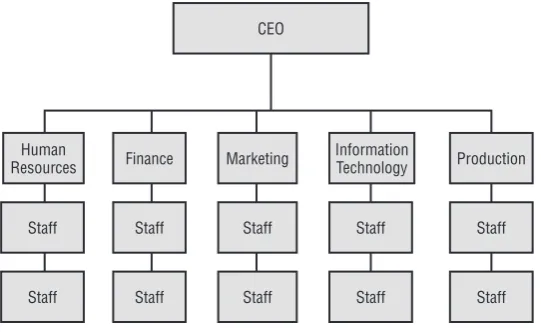
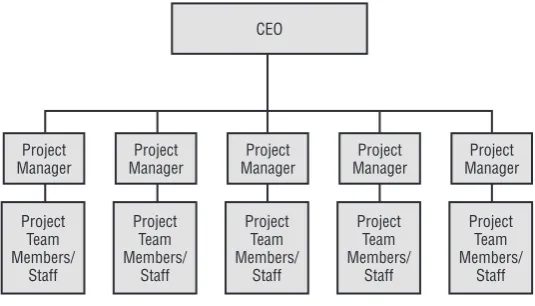
Team-Building and Motivating Skills 13 Understanding Organizational Structures 14 Functional Organizations 15 Projectized Organizations 18 Matrix Organizations 20 Understanding Project Life Cycles and Project
Management Processes 23
Project Phases and Project Life Cycles 23 Project Management Process Groups 26 Understanding How This Applies to Your Next Project 31
Summary 33
Exam Essentials 33
Key Terms 35
Review Questions 36
Answers to Review Questions 41
Chapter 2 Creating the Project Charter 43
xiv Contents
Project Cost Management 48 Project Quality Management 49 Project Human Resource Management 50 Project Communications Management 50 Project Risk Management 52 Project Procurement Management 52 Understanding How Projects Come About 53
Needs and Demands 54
Feasibility Studies 56
Selecting and Prioritizing Projects 57 Using Project Selection Methods 58 Kicking Off the Project Charter 66 Project Statement of Work 67
Business Case 67
Enterprise Environmental Factors 68 Organizational Process Assets 68 Expert Judgment Tool and Technique 70 Formalizing and Publishing the Project Charter 70
Key Stakeholders 71
Pulling the Project Charter Together 72 Project Charter Sign-Off 73 Identifying Stakeholders 74 Identify Stakeholders Inputs 74 Stakeholder Analysis 75 Stakeholder Register and Strategy 77 Introducing the Kitchen Heaven Project Case Study 78 Understanding How This Applies to Your Next Project 82
Summary 83
Exam Essentials 84
Key Terms 86
Review Questions 87
Answers to Review Questions 92
Chapter 3 Developing the Project Scope Statement 95
Developing the Project Management Plan 96
Developing Inputs 97
Documenting the Project Management Plan 99 Collecting Requirements 101 Using the Tools and Techniques of Collect Requirements 102 Documenting Requirements 104 Documenting the Scope Management Plan 108
Defining Scope 108
Product Analysis 110
Contents xv
Writing the Project Scope Statement 112 Understanding the Scope Statement Components 112 Approving and Publishing the Project Scope Statement 119 Updating the Project Documents 119 Creating the Work Breakdown Structure 120 Gathering the WBS Inputs 121 Decomposing the Deliverables 122 Constructing the WBS 123 Creating WBS Process Outputs 130 Understanding How This Applies to our Next Project 134
Summary 136
Exam Essentials 136
Key Terms 138
Review Questions 139
Answers to Review Questions 145
Chapter 4 Creating the Project Schedule 147
Defining Activities 148
Define Activities Process Inputs 149 Tools and Techniques for Defining Activities 149 Define Activities Outputs 149 Understanding the Sequence Activities Process 150 Sequence Activities Tools and Techniques 151 Sequence Activities Outputs 155 Estimating Activity Resources 156 Estimate Activity Resources Inputs 157 Estimating Activity Resources Tools and Techniques 157 Estimate Activity Resources Outputs 158 Estimating Activity Durations 159 Estimate Activity Durations Inputs 159 Estimate Activity Durations Tools and Techniques 160 Estimate Activity Durations Outputs 162 Developing the Project Schedule 163 Develop Schedule Inputs 164 Develop Schedule Tools and Techniques 165 Scheduling Process Outputs 176 Understanding How This Applies to Your Next Project 184
Summary 185
Exam Essentials 186
Key Terms 188
Review Questions 189
xvi Contents
Chapter 5 Developing the Project Budget 197
Creating the Project Cost Management Plan 198
Estimating Costs 200
Estimate Costs Inputs 201 Tools and Techniques to Estimate Costs 203 Estimate Costs Process Outputs 204 Establishing the Cost Budget Baseline 206 Determine Budget Inputs 206 Determine Budget Tools and Techniques 207 Determine Budget Process Outputs 208 Communicating the Plan 211 Plan Communications Inputs 211 Tools and Techniques for Plan Communications 212 Communications Requirements Analysis 212 Communications Technology 215 Communications Models 215 Communications Methods 216 Communications Management Plan 216 Understanding How This Applies to Your Next Project 220
Summary 220
Exam Essentials 221
Key Terms 222
Review Questions 223
Answers to Review Questions 228
Chapter 6 Risk Planning 231
Planning for Risks 232
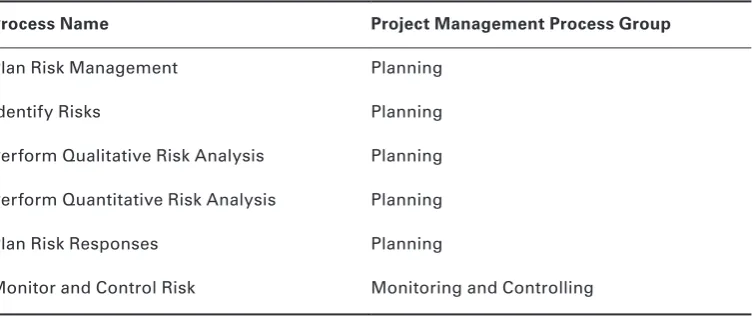
Planning Your Risk Management 233 Plan Risk Management Inputs 233 Tools and Techniques for Plan Risk Management 234 Creating the Risk Management Plan 236 Identifying Potential Risk 240 Identify Risks Inputs 241 Tools and Techniques for Identify Risks 242 Identify Risks Outputs 248 Analyzing Risks Using Qualitative Techniques 249 Perform Qualitative Risk Analysis Inputs 249 Tools and Techniques for Perform Qualitative
Risk Analysis 250
Ranking Risks in the Risk Register 257
Quantifying Risk 257
Tools and Techniques for Perform Quantitative
Risk Analysis 258
Contents xvii
Developing a Risk Response Plan 263 Tools and Techniques for Plan Risk Responses 264 Plan Risk Responses Outputs 268 Understanding How This Applies to Your Next Project 272
Summary 273
Exam Essentials 274
Key Terms 276
Review Questions 277
Answers to Review Questions 282
Chapter 7 Planning Project Resources 285
Procurement Planning 286 Plan Procurements Inputs 287 Tools and Techniques for Plan Procurements 289 Plan Procurements Outputs 293 Developing the Human Resource Plan 298 Develop Human Resource Plan Inputs 298 Develop Human Resource Plan Tools and Techniques 300 Develop Human Resource Plan Outputs 303
Quality Planning 305
Plan Quality Inputs 306 Tools and Techniques for Plan Quality 307 Plan Quality Outputs 314 Bringing It All Together 317 Understanding How This Applies to Your Next Project 321
Summary 322
Exam Essentials 323
Key Terms 324
Review Questions 325
Answers to Review Questions 330
Chapter 8 Developing the Project Team 333
Executing the Project Plan 334
Executing Inputs 336
Tools and Techniques of Direct and Manage
Project Execution 336
xviii Contents
Managing Project Teams 357 Tools and Techniques for Managing Teams 358 Managing Project Team Outputs 362 Understanding How This Applies to Your Next Project 365
Summary 367
Exam Essentials 368
Key Terms 369
Review Questions 370
Answers to Review Questions 375
Chapter 9 Conducting Procurements and
Sharing Information 377
Conducting Procurements 378 Conduct Procurements Tools and Techniques 379 Conduct Procurements Outputs 385 Laying Out Quality Assurance Procedures 387 Inputs to Perform Quality Assurance 388 Perform Quality Assurance Tools and Techniques 388 Perform Quality Assurance Outputs 390 Distributing Project Information 390 Tools and Techniques of Distribute Information 391 Output of Distribute Information 395 Managing Stakeholder Expectations 396 Manage Stakeholder Expectations Inputs 397 Tools and Techniques for Manage Stakeholder
Expectations 397
Manage Stakeholder Outputs 397 Understanding How This Applies to Your Next Project 401
Summary 402
Exam Essentials 403
Key Terms 404
Review Questions 405
Answers to Review Questions 410
Chapter 10 Measuring and Controlling Project Performance 413
Monitoring and Controlling Project Work 414 Monitor and Control Project Work Inputs 415 Monitor and Control Project Work Outputs 416 Administering Procurements 416
Contracting Inputs 417
Contents xix
Establishing Performance Measurements 423 Report Performance Inputs 424 Report Performance Tools and Techniques 424 Report Performance Outputs 426 Managing Perform Integrated Change Control 427
How Change Occurs 428
Change Control Concerns 428 Configuration Management 430 Change Control System 430 Perform Integrated Change Control Inputs, Tools
and Techniques, and Outputs 434 Understanding How This Applies to Your Next Project 436
Summary 437
Exam Essentials 438
Key Terms 439
Review Questions 440
Answers to Review Questions 445
Chapter 11 Controlling Work Results 447
Monitoring and Controlling Risk 448 Monitor and Control Risks Inputs 449 Monitor and Control Risks Tools and Techniques 449 Monitor and Control Risks Outputs 451 Managing Cost Changes 451 Control Costs Inputs 452 Control Costs Tools and Techniques 452 Control Costs Outputs 460 Monitoring and Controlling Schedule Changes 463 Control Schedule Inputs 463 Schedule and Control Tools and Techniques 464 Control Schedule Outputs 465 Utilizing Perform Quality Control Techniques 466 Perform Quality Control Inputs 466 Perform Quality Control Tools and Techniques 466 Perform Quality Control Outputs 474 Verifying Project Scope 475
Controlling Scope 476
Control Scope Inputs 477 Control Scope Tools and Techniques 477 Control Scope Outputs 477 Understanding How This Applies to Your Next Project 480
xx Contents
Exam Essentials 483
Key Terms 484
Review Questions 485
Answers to Review Questions 490
Chapter 12 Applying Professional Responsibility 493
Formulating Project Closeout 494 Characteristics of Closing 495
Project Endings 495
Closing Out the Project 498 Close Project or Phase Inputs 499 Close Project or Phase Tools and Techniques 499 Close Project or Phase Outputs 500 Closing Out the Procurements 502 Close Procurements Inputs 503 Close Procurements Tools and Techniques 504 Close Procurements Outputs 504
Celebrate! 505
Releasing Project Team Members 506 Balancing Stakeholders’ Interests at Project Close 506
Competing Needs 507
Dealing with Issues and Problems 507 Balancing Constraints 508 Professional Responsibility 509
Responsibility 510
Respect 513
Fairness 516
Honesty 519
Role Delineation Study 520 Applying Professional Knowledge 520 Project Management Knowledge 521 Education Providers 521
Industry Knowledge 521
Understanding How This Applies to Your Next Project 525
Summary 526
Exam Essentials 528
Key Terms 529
Review Questions 530
Answers to Review Questions 536
Appendix A Process Inputs and Outputs 539
Initiating Processes 540
Contents xxi
Executing Processes 550
Monitoring and Controlling Processes 553
Closing Processes 558
Appendix B About the Companion CD 559
What You’ll Find on the CD 560
Sybex Test Engine 560
PDF of Glossary of Terms 560
Adobe Reader 561
Electronic Flashcards 561
System Requirements 561
Using the CD 561
Troubleshooting 562
Customer Care 562
Glossary 563
Introduction
This book was designed for anyone thinking of taking the Project Management Profes-sional (PMP®) exam sponsored by the Project Management Institute (PMI®). This
certifi-cation is growing in popularity and demand in all areas of business. PMI has experienced explosive growth in membership over the last few years, and more and more organizations are recognizing the importance of project management certification.
Although this book is written primarily for those of you taking the PMP®
exam, you can also use this book to study for the Certified Associate in Project Management (CAPM®) exam. The exams are similar in style, and
the information covered in this book will help you with either exam.
This book has been updated to reflect the latest edition of A Guide to the Project
Manage-ment Body of Knowledge (PMBOK® Guide), Fourth Edition. It assumes you have knowledge
of general project management practices, although not necessarily specific to the PMBOK® Guide. It’s written so that you can skim through areas you are already familiar with, picking
up the specific PMBOK® Guide terminology where needed to pass the exam. You’ll find that
the project management processes and techniques discussed in this book are defined in such a way that you’ll recognize tasks you’ve always done and be able to identify them with the
PMBOK® Guide process names or methodologies.
PMI offers the most recognized certification in the field of project management, and this book deals exclusively with its procedures and methods. Project management consists of many methods, each with its own terminology, tools, and procedures. If you’re familiar with another organized project management methodology, don’t assume you already know the PMBOK® Guide processes. I strongly recommend that you learn all of the processes—
their key inputs, tools and techniques, and outputs. Take the time to memorize the key terms found at the end of every chapter as well. Sometimes just understanding the defini-tion of a term will help you answer a quesdefini-tion. It might be that you’ve always done that particular task or used the methodology described but called it by another name. Know the name of each process and its primary purpose.
All of the process group names—including their inputs, tools and tech-niques, outputs, and descriptions—found throughout this book are from the PMBOK® Guide.
What Is the PMP Certification?
xxiv Introduction
and ethics in this field and offers publications, training, seminars, chapters, special interest groups, and colleges to further the project management discipline.
The PMI was founded in 1969 and first started offering the PMP® certification exam
in 1984. PMI is accredited as an American National Standards Institute (ANSI) standards developer and also has the distinction of being the first organization to have its certification program attain International Organization for Standardization (ISO) 9001 recognition.
The PMI boasts a worldwide membership of more than 265,000, with members from 170 different countries. Local PMI chapters meet regularly and allow project managers to exchange information and learn about new tools and techniques of project management or new ways to use established techniques. I encourage you to join a local chapter and get to know other professionals in your field.
Why Become PMP Certified?
The following benefits are associated with becoming PMP certified: It demonstrates proof of professional achievement.
N N
It increases your marketability.
N N
It provides greater opportunity for advancement in your field.
N N
It raises customer confidence in you and in your company’s services.
N N
Demonstrates Proof of Professional Achievement
PMP® certification is a rigorous process that documents your achievements in the field of
project management. The exam tests your knowledge of the disciplined approaches, method-ologies, and project management practices as described in the PMBOK® Guide.
You are required to have several years of experience in project management before sitting for the exam, as well as 35 hours of formal project management education. Your certification assures employers and customers that you are well grounded in project management practices and disciplines. It shows that you have the hands-on experience and a mastery of the processes and disciplines to manage projects effectively and motivate teams to produce successful results.
Increases Your Marketability
Introduction xxv
A certification will always make you stand out above the competition. If you’re certified and you’re competing against a project manager without certification, chances are you’ll come out as the top pick. As a hiring manager, all other things being equal, I will usually opt for the candidate who has certification over the candidate who doesn’t have it. Certification tells potential employers you have gone the extra mile. You’ve spent time studying techniques and methods as well as employing them in practice. It shows dedication to your own professional growth and enhancement and to adhering to and advancing professional standards.
Provides Opportunity for Advancement
PMP® certification displays your willingness to pursue growth in your professional career and
shows that you’re not afraid of a little hard work to get what you want. Potential employers will interpret your pursuit of this certification as a high-energy, success-driven, can-do attitude on your part. They’ll see that you’re likely to display these same characteristics on the job, which will help make the company successful. Your certification displays a success-oriented, motivated attitude that will open up opportunities for future career advancements in your current field as well as in new areas you might want to explore.
Raises Customer Confidence
Just as the PMP certification assures employers that you’ve got the background and expe-rience to handle project management, it assures customers that they have a competent, experienced project manager at the helm. Certification will help your organization sell customers on your ability to manage their projects. Customers, like potential employers, want the reassurance that those working for them have the knowledge and skills necessary to carry out the duties of the position and that professionalism and personal integrity are of utmost importance. Individuals who hold these ideals will translate their ethics and profes-sionalism to their work. This enhances the trust customers will have in you, which in turn will give you the ability to influence them on important project issues.
How to Become PMP Certified
You need to fulfill several requirements in order to sit for the PMP exam. The PMI has detailed the certification process quite extensively at its website. Go to www.pmi.org , and click the Professional Development and Careers tab to reveal the Certifications selection and get the latest information on certification procedures and requirements.
xxvi Introduction
In addition to filling out the application and documenting your formal project management training, there is one set of criteria you’ll need to meet to sit for the exam. The criteria in this set fall into two categories. You need to meet the requirements for only one of these categories:
Category 1 is for those who have a baccalaureate degree. You’ll need to provide proof,
N N
via transcripts, of your degree with your application. In addition, you’ll need to complete verification forms—found at the PMI website—that show 4,500 hours of project manage-ment experience that spans a minimum of three years and no more than six years. Category 2 is for those who do not have a baccalaureate degree but do hold a high
N N
school diploma or equivalent. You’ll need to complete verification forms documenting 7,500 hours of project management experience that spans a minimum of five years and no more than eight years.
The exam fee at the time this book is being published is $405 for PMI members in good standing and $555 for non-PMI members. Testing is conducted at Thomson Prometric centers. You can find a center near you on the PMI website. You have six months from the time PMI receives and approves your completed application to take the exam. You’ll need to bring a form of identification such as a driver’s license with you to the Thomson Prometric center on the test day. You will not be allowed to take anything with you into the testing center. You will be given a calculator, pencils, and scrap paper. You will turn in all scrap paper, including the notes and squiggles you’ve jotted during the test, to the center upon completion of the exam.
The exam is scored immediately, so you will know whether you’ve passed at the conclusion of the test. You’re given four hours to complete the exam, which consists of 200 randomly generated questions. Only 175 of the 200 questions are scored. A passing score requires you to answer 106 of the 175 questions correctly. Twenty-five of the 200 questions are “pretest” questions that will appear randomly throughout the exam. These 25 questions are used by PMI to determine statistical information and to determine whether they can or should be used on future exams. The questions on the exam cover the following process groups and areas: Initiating N N Planning N N Executing N N
Monitoring and Controlling
N N Closing N N Professional Responsibility N N
All unanswered questions are scored as wrong answers, so it benefits you to guess at an answer if you’re stumped on a question.
Introduction xxvii
How to Become CAPM Certified
If you find you don’t have quite enough experience or education to sit for the PMP exam, you should consider sitting for the Certified Associate in Project Management (CAPM) exam. The CAPM exam is structured like the PMP exam only the requirements are not as strict as they are for the PMP. CAPM candidates typically work in a supporting role with a project manager or as a subproject manager. Like the PMP, CAPM has two categories of requirements; each category requires 23 hours of project management education:
Category 1 is for those who have a baccalaureate degree. You’ll need to provide proof,
N N
via transcripts, of your degree with your application. In addition, you’ll need to complete verification forms that show 1,500 hours of project management experience that spans a minimum of two years and no more than three years.
Category 2 is for those who do not have a baccalaureate degree but do have a high
N N
school diploma or equivalent. You’ll need to complete verification forms documenting 2,500 hours of project management experience that spans a minimum of two years and no more than three years.
The CAPM® exam fee at the time of this publication is $225 for PMI members in good standing and $300 for non-PMI members.
Included on the CD with this book is a sample CAPM exam. If you’re sitting for the CAPM exam, I encourage you to answer all of the end-of-chapter questions and take the bonus exams in addition to the sample CAPM exam. You’ll get a much broader sense of the types of questions and the topics you’ll encounter on the actual exam by using all of the sample questions provided in this book and on the CD.
Who Should Buy This Book?
If you are serious about passing the PMP exam (or the CAPM exam for that matter), you should buy this book and use it to study for the exam. This book is unique in that it walks you through the project processes from beginning to end, just as projects are performed in practice. When you read this book, you will benefit by learning specific
PMBOK® Guide processes and techniques coupled with real-life scenarios that describe
xxviii Introduction
How to Use This Book and CD
We’ve included several testing features, both in the book and on the companion CD. Following this introduction is an assessment test that you can use to check your readiness for the actual exam. Take this test before you start reading the book. It will help you identify the areas you may need to brush up on. The answers to the assessment test appear after the last question of the test. Each answer includes an explanation and a note telling you in which chapter this material appears.
An Exam Essentials section appears at the end of every chapter to highlight the topics you’ll most likely find on the exam and help you focus on the most important material covered in the chapter so that you’ll have a solid understanding of those concepts. How-ever, it isn’t possible to predict what questions will be covered on your particular exam, so be sure to study everything in the chapter.
Like the exam itself, this Study Guide is organized in terms of process groups and the natural sequence of events a project goes through in its life cycle. By contrast, in other study guides, material is organized by Knowledge Area— Human Resource Management, Communications Management, and so on— and it can be confusing when studying for the exam to map the processes in each Knowledge Area to process groups.
Review questions are also provided at the end of every chapter. You can use these to gauge your understanding of the subject matter before reading the chapter and to point out the areas in which you need to concentrate your study time. As you finish each chapter, answer the review questions and then check to see whether your answers are right—the cor-rect answers appear on the pages following the last question. You can go back to reread the section that deals with each question you got wrong to ensure that you answer the question correctly the next time you are tested on the material. If you can answer at least 80 percent of the review questions correctly, you can probably feel comfortable moving on to the next chapter. If you can’t answer that many correctly, reread the chapter, or the section that seems to be giving you trouble, and try the questions again. You’ll also find more than 200 flashcard questions on the CD for on-the-go review. Download them right onto your PDA device for quick and convenient reviewing.
Introduction xxix
In addition to the assessment test and the review questions, you’ll find bonus exams on the CD. Take these practice exams just as if you were actually taking the exam (that is, without any reference material). When you have finished the first exam, move on to the next exam to solidify your test-taking skills. If you get more than 85 percent of the answers correct, you’re ready to take the real exam.
The CD also contains an audio file that you can download to your favorite MP3 player to hear a recap of the key elements covered in each chapter.
Finally, you will notice various Real-World Scenario sidebars throughout each chapter. These are designed to give you insight into how the various processes and topic areas apply to real-world situations.
Additionally, if you are going to travel but still need to study for the PMP exam and you have a laptop with a CD drive, you can take this entire book with you just by taking the CD. This book is available in PDF (Adobe Acrobat), so it can be easily read on any computer.
Also on the CD in PDF is the appendix, “Process Inputs and Outputs.”
For those of you who purchased the Deluxe Edition, you’ll find a series of scenarios and exercises that map to each chapter. These workbook exercises are designed to help you put the theories you’ve learned in each chapter into practice.
The Exam Objectives
Behind every certification exam, you can be sure to find exam objectives—the broad topics in which the exam developers want to ensure your competency. The official PMP exam objectives are listed at the beginning of every chapter in this book.
Exam objectives are subject to change at any time without prior notice and at PMI’s sole discretion. Please visit the Certification page of the PMI’s website, www.pmi.org, for the most current listing of exam objectives.
How to Contact the Author
xxx Introduction
Sybex strives to keep you supplied with the latest tools and information you need for your work. Please check the website at www.sybex.com, where we’ll post additional content and updates that supplement this book if the need arises. Enter PMP Project Management
Professional Study Guidein the Search box (or type the book’s ISBN—9780470455586),
Assessment Test
1. The project sponsor has approached you with a dilemma. The CEO announced at the annual stockholders meeting that the project you’re managing will be completed by the end of this year. The problem is that this is six months prior to the scheduled completion date. It’s too late to go back and correct her mistake, and stockholders are expecting implementation by the announced date. You must speed up the delivery date of this project. Your primary constraint before this occurred was the budget. Choose the best action from the options listed to speed up the project.
A. Hire more resources to get the work completed faster.
B. Ask for more money so that you can contract out one of the phases you had planned to do with in-house resources.
C. Utilize negotiation and influencing skills to convince the project sponsor to speak with the CEO and make a correction to her announcement.
D. Examine the project plan to see whether there are any phases that can be fast tracked, and then revise the project plan to reflect the compression of the schedule.
2. These types of dependencies can create arbitrary total float values and limit your scheduling options.
A. Discretionary
B. External
C. Mandatory
D. Hard logic
3. Project managers spend what percentage of their time communicating?
A. 90
B. 85
C. 75
D. 50
4. Inspections are also called each of the following except for which one?
A. Reviews
B. Assessment
C. Walk-throughs
D. Audits
5. The primary function of the Closing processes is to perform which of the following?
A. Formalize lessons learned and distribute this information to project participants.
B. Perform audits to verify the project results against the project requirements.
C. Formalize project completion and disseminate this information to project participants.
xxxii Assessment Test
6. During your project meeting, a problem was discussed, and a resolution to the problem was reached. During the meeting, the participants started wondering why they thought the prob-lem was such a big issue. Sometime after the meeting, you received an email from one of the meeting participants saying they’ve changed their mind about the solution reached in the meeting and need to resurface the problem. The solution reached during the initial project meeting is a result of which of the following conflict resolution techniques?
A. Confrontation
B. Forcing
C. Smoothing
D. Storming
7. What are decision models?
A. Project selection criteria
B. Project selection methods
C. Project selection committees
D. Project resource and budget selection methods
8. You’ve been assigned as a project manager on a research and development project for a new dental procedure. You’re working in the Scope Management Knowledge Area. What is the purpose of the project scope management plan?
A. The project scope management plan describes and documents a scope baseline to help make future project decisions.
B. The project scope management plan decomposes project deliverables into smaller units of work.
C. The project scope management plan describes how project scope will be developed and how changes will be managed.
D. The project scope management plan describes how cost and time estimates will be developed for project scope changes.
9. All of the following statements are true regarding Ishikawa diagrams in the Identify Risks process except which one?
A. Ishikawa diagrams are also called cause-and-effect diagrams.
B. Ishikawa diagrams are also called fishbone diagrams.
C. Ishikawa diagrams are part of the diagramming tool and technique of this process.
D. Ishikawa diagrams show the steps needed to identify the risk.
10. All of the following are outputs of the Perform Integrated Change Control process except for which one?
A. Change request status updates
B. Project management plan updates
C. Organizational process assets updates
Assessment Test xxxiii
11. What is one of the most important skills a project manager can have?
A. Negotiation skills
B. Influencing skills
C. Communication skills
D. Problem-solving skills
12. All of the following are a type of project ending except for which one?
A. Extinction
B. Starvation
C. Desertion
D. Addition
13. You are the project manager for a construction company that is building a new city and county office building in your city. Your CCB recently approved a scope change. You know that scope change might come about as a result of all of the following except which one?
A. Schedule revisions
B. Product scope change
C. Changes to the agreed-upon WBS
D. Changes to the project requirements
14. You are the project manger for Xylophone Phonics. It produces children’s software programs that teach basic reading and math skills. You’re performing cost estimates for your project and don’t have a lot of details yet. Which of the following techniques should you use?
A. Analogous estimating techniques, because this is a form of expert judgment that uses historical information from similar projects
B. Bottom-up estimating techniques, because this is a form of expert judgment that uses historical information from similar projects
C. Monte Carlo analysis, because this is a modeling technique that uses simulation to determine estimates
D. Parametric modeling, because this is a form of simulation used to determine estimates
15. Project managers have the highest level of authority and the most power in which type of organizational structure?
A. Projectized
B. Strong matrix
C. Functional
xxxiv Assessment Test
16. This process is concerned with determining the information stakeholders will need throughout the project and the methods of communication.
A. Distribute Information
B. Report Performance
C. Plan Communications
D. Identify Stakeholder Needs
17. All of the following statements are true regarding risk events except which one? Choose the least correct answer.
A. Project risks are uncertain events.
B. If risks occur, they can have a positive or negative effect on project objectives.
C. Unknown risks are threats to the project objectives, and nothing can be done to plan for them.
D. Risks that have more perceived rewards to the organization than consequences should be accepted.
18. This process applies evaluation criteria to the bids and proposals received from potential vendors.
A. Plan Procurements
B. Administer Procurements
C. Conduct Procurements
D. Perform Quality Assurance
19. You are the project manger for Xylophone Phonics. This company produces children’s soft-ware programs that teach basic reading and math skills. You are ready to assign project roles, responsibilities, and reporting relationships. Which project Planning process are you working on?
A. Estimate Activity Resources
B. Develop Human Resource Plan
C. Acquire Project Team
D. Plan Organizational Resources
20. You know that PV = 470, AC = 430, EV = 480, EAC = 500, and BAC = 525. What is VAC?
A. 70
B. 20
C. 25
Assessment Test xxxv
21. You are a project manager who has recently held a project team kickoff meeting where all the team members were formally introduced to each other. Some of the team members know each other from other projects and have been working with you for the past three weeks. Which of the following statements is true?
A. Team building improves the knowledge and skills of team members.
B. Team building builds feelings of trust and agreement among team members, which can improve morale.
C. Team building can create a dynamic environment and cohesive culture to improve productivity of both the team and the project.
D. Team building occurs throughout the life of the project and can establish clear expec-tations and behaviors for project team members, leading to increased productivity.
22. You are a project manager for the Swirling Seas Cruises food division. You’re considering two different projects regarding food services on the cruise lines. The initial cost of Project Fish’n for Chips will be $800,000, with expected cash inflows of $300,000 per quarter. Project Picnic’s payback period is six months. Which project should you recommend?
A. Project Fish’n for Chips, because its payback period is two months shorter than Project Picnic’s
B. Project Fish’n for Chips, because the costs on Project Picnic are unknown
C. Project Picnic, because Project Fish’n for Chips’s payback period is four months longer than Project Picnic’s.
D. Project Picnic, because Project Fish’n for Chips’s payback period is two months longer than Project Picnic’s.
23. Which of the following compression techniques increases risk?
A. Crashing
B. Resource leveling
C. Fast tracking
D. Lead and lag
24. Name the ethical code you’ll be required to adhere to as a PMP.
A. Project Management Policy and Ethics Code
B. PMI Standards and Ethics Code of Conduct
C. Project Management Code of Professional Ethics
xxxvi Assessment Test
25. You have been assigned to a project that will allow job seekers to fill out applications and submit them via the company website. You report to the VP of human resources. You are also responsible for screening applications for the information technology division and setting up interviews. The project coordinator has asked for the latest version of your changes to the online application page for his review. Which organizational structure do you work in?
A. Functional organization
B. Weak matrix organization
C. Projectized organization
D. Balanced matrix organization
26. You are the project manager for Lucky Stars Candies. You’ve identified the requirements for the project and documented them where?
A. In the requirements document, which will be used as an input to the Create WBS process
B. In the project scope statement, which is used as an input to the Create WBS process
C. In the product requirements document, which is an output of the Define Scope process
D. In the project specifications document, which is an output of the Define Scope process
27. What is the purpose of the project charter?
A. To recognize and acknowledge the project sponsor
B. To recognize and acknowledge the existence of the project and commit organizational resources to the project
C. To acknowledge the existence of the project team, project manager, and project sponsor
D. To describe the selection methods used to choose this project over its competitors
28. Which of the following are tools and techniques of the Identify Stakeholder process?
A. Stakeholder analysis and expert judgment
B. Stakeholder analysis, expert judgment, and stakeholder register
C. Stakeholder analysis
D. Stakeholder analysis, stakeholder management strategy, and expert judgment
29. You are a project manager working on a software development project. You’ve developed the risk management plan, identified risks, and determined risk responses for the risks. A risk event occurs, and you implement the response. Then, another risk event occurs as a result of the response you implemented. What type of risk is this called?
A. Trigger risk
B. Residual risk
C. Secondary risk
Assessment Test xxxvii
30. You are working on a project that will upgrade the phone system in your customer service center. You have used analogous estimating, parametric estimating, bottom-up estimating, and three-point estimates to determine activity costs. Which process does this describe?
A. Estimating Activity Resources
B. Estimate Costs
C. Determine Budget
D. Estimating Activity Costs
31. Failure costs are also known as which of the following?
A. Internal costs
B. Cost of poor quality
C. Cost of keeping defects out of the hands of customers
D. Prevention costs
32. Feeding buffers and the project buffer are part of which of the following Develop Schedule tool and technique?
A. Critical path method
B. Schedule network analysis
C. Applying leads and lags
D. Critical chain method
33. You are working on a project that will upgrade the phone system in your customer service center. You have used bottom-up estimating techniques to assign costs to the project activi-ties and have determined the cost performance baseline. Which of the following statements is true?
A. You have completed the Estimate Cost process and now need to complete the Deter-mine Budget process to develop the project’s cost performance baseline.
B. You have completed the Estimate Cost process and established a cost performance baseline to measure future project performance against.
C. You have completed the Determine Budget process and now need to complete the Schedule Development process to establish a project baseline to measure future project performance against.
D. You have completed the Determine Budget process, and the cost performance baseline will be used to measure future project performance.
34. Each of the following statements describes an element of the Develop Project Management Plan process except for which one?
A. Project charter
B. Outputs from other planning processes
C. Configuration management system
xxxviii Assessment Test
35. There are likely to be team loyalty issues in a matrixed environment. All of the following are true regarding this situation as it pertains to the Manage Project Team process except for which one?
A. Two of the tools and techniques you might use to manage these relationships effectively are communications methods and conflict management.
B. In this type of structure, team members report to both a functional manager and a project manager. Both managers should have input to the project performance appraisal for this team member, which is a tool and technique of this process.
C. The project manager is generally responsible for managing this relationship.
D. The effective management of these reporting relationships is often a critical success factor for the project.
36. Monte Carlo analysis can help predict the impact of risks on project deliverables. This is an element of one of the tools and techniques of which of the following processes?
A. Plan Risk Responses
B. Perform Quantitative Risk Analysis
C. Identify Risks
D. Perform Qualitative Risk Analysis
37. All of the following statements are true regarding configuration management except which one?
A. Configuration management requires acceptance decisions for all change requests to be made through the CCB.
B. Change control systems are a subset of the configuration management system.
C. Configuration management focuses on the specifications of the deliverables of the project.
D. Configuration management validates and improves the project by evaluating the impact of each change.
38. Which performance measurement tells you what the projected total cost of the project will be at completion?
A. ETC
B. EV
C. AC
D. EAC
39. Which of the following contracts should you use for projects that have a degree of uncer-tainty and require a large investment early in the project life cycle?
A. Fixed price
B. Cost reimbursable
C. Lump sum
Assessment Test xxxix
40. According to the PMBOK® Guide, the project manager is identified and assigned during which process?
A. During the Develop Project Charter process
B. At the conclusion of the Develop Project Charter process
C. Prior to beginning the Planning processes
D. Prior to beginning the Define Scope process
41. All of the following are tools and techniques of the Close Procurements process except for which one?
A. Expert judgment
B. Procurement audits
C. Negotiated settlements
D. Records management system
42. The inputs of the Report Performance process include all of the following except for which one?
A. Work performance information
B. Work performance measurements
C. Budget forecasts
D. Performance reviews
43. All of the following statements are true regarding risks except for which one?
A. Risks might be threats to the objectives of the project.
B. Risks are certain events that may be threats or opportunities to the objectives of the project.
C. Risks might be opportunities to the objectives of the project.
D. Risks have causes and consequences.
44. Which performance measurement tells you the cost of the work that has been authorized and budgeted for a WBS component?
A. PV
B. EV
C. AC
D. BCWP
45. Which of the following statements is true regarding the Project Management Knowledge Areas?
A. They include Initiation, Planning, Executing, Monitoring and Controlling, and Closing.
B. They consist of nine areas that bring together processes that have things in common.
xl Assessment Test
46. You have just prepared an RFP for release. Your project involves a substantial amount of contract work detailed in the RFP. Your favorite vendor drops by and offers to give you and your spouse the use of their company condo for your upcoming vacation. It’s located in a beautiful resort community that happens to be one of your favorite places to go for a get-away. What is the most appropriate response?
A. Thank the vendor, but decline the offer because you know this could be considered a conflict of interest.
B. Thank the vendor, and accept. This vendor is always offering you incentives like this, so this offer does not likely have anything to do with the recent RFP release.
C. Thank the vendor, accept the offer, and immediately tell your project sponsor so they’re aware of what you’re doing.
D. Thank the vendor, but decline the offer because you’ve already made another arrange-ment for this vacation. Ask them whether you can take a rain check and arrange another time to use the condo.
47. What are the Define Scope process tools and techniques?
A. Cost benefit analysis, scope baseline, expert judgment, and facilitated workshops
B. Product analysis, alternatives identification, and expert judgment
C. Product analysis, alternatives identification, expert judgment, and facilitated workshops
D. Alternatives identification, stakeholder analysis, and expert judgment
48. You are the project manager for Heartthrobs by the Numbers Dating Services. You’re working on an updated Internet site that will display pictures as well as short bios of pro-spective heartbreakers. You have your activity list and resource requirements in hand and are planning to use parametric estimates and reserve analysis to determine activity dura-tions. Which of the following statements is true?
A. You are using inputs from the Estimate Activity Duration process.
B. You are using tools and techniques of the Estimate Cost process.
C. You are using tools and techniques of the Estimate Activity Durations process.
D. You are using inputs of the Estimate Costs process.
49. Your team is developing the risk management plan. Which tool and technique of this pro-cess is used to develop risk cost elements and schedule activities that will be included in the project budget and schedule?
A. Planning meetings and analysis
B. Strategies for both threats and opportunities
C. Information gathering techniques
D. Risk data quality assessment
50. What type of organization experiences the least amount of stress during project closeout?
A. Projectized
B. Functional
Assessment Test xli
51. You are the project manager for Xylophone Phonics. It produces children’s software programs that teach basic reading and math skills. You are performing the Plan Quality process and are identifying nonproductive activities. Part of this involves capturing information such as process boundaries, process configurations, and process metrics. Which of the following does this describe?
A. The process improvement plan
B. The quality management plan
C. The quality metrics
D. The cost of quality
52. You need to convey some very complex, detailed information to the project stakeholders. What is the best method for communicating this kind of information?
A. Verbal
B. Vertical
C. Horizontal
D. Written
53. You are the project manager for Heartthrobs by the Numbers Dating Services. You’re working on an updated Internet site that will display pictures as well as short bios of pro-spective heartbreakers. You’ve just completed your project staff assignments and published the project team directory. Which process are you in?
A. Develop Human Resource Plan
B. Manage Project Team
C. Develop Project Team
D. Acquire Project Team
54. You are a project manager for Waterways Houseboats, Inc. You’ve been asked to perform a cost-benefit analysis for two proposed projects. Project A costs $2.4 million, with potential benefits of $12 million and future operating costs of $3 million. Project B costs $2.8 million, with potential benefits of $14 million and future operating costs of $2 million. Which project should you recommend?
A. Project A, because the cost to implement is cheaper than Project B
B. Project A, because the potential benefits plus the future operating costs are less in value than the same calculation for Project B
C. Project B, because the potential benefits minus the implementation and future operat-ing costs are greater in value than the same calculation for Project A
xlii Assessment Test
55. These diagrams rank-order factors for corrective action by frequency of occurrence. They are also a type of histogram.
A. Control charts
B. Process flowcharts
C. Scatter diagrams
D. Pareto charts
56. You are a project manager working in a foreign country. You observe that some of your project team members are having a difficult time adjusting to the new culture. You provided them with training on cultural differences and the customs of this country before arriving, but they still seem uncomfortable and disoriented. Which of the following statements is true?
A. This is the result of working with teams of people from two different countries.
B. This condition is known as culture shock.
C. This is the result of jet lag and travel fatigue.
D. This condition is known as global culturalism.
57. Your project involves the research and development of a new food additive. You’re ready to release the product to your customer when you discover that a minor reaction might occur in people with certain conditions. The reactions to date have been very minor, and no known long-lasting side effects have been noted. As project manager, what should you do?
A. Do nothing because the reactions are so minor that very few people will be affected.
B. Inform the customer that you’ve discovered this condition and tell them you’ll research it further to determine its impacts.
C. Inform your customer that there is no problem with the additive except for an extremely small percentage of the population and release the product to them.
D. Tell the customer you’ll correct the reaction problems in the next batch, but you’ll release the first batch of product to them now to begin using.
58. The project manager has the greatest influence over quality during which process?
A. Plan Quality
B. Perform Quality Assurance
C. Perform Quality Control
D. Perform Quality Change Control
59. You are the project manager for a construction company that is building a new city and county office building in your city. You recently looked over the construction site to deter-mine whether the work to date was conforming to the requirements and quality standards. Which tool and technique of the Perform Quality Control process are you using?
A. Defect repair review
B. Inspection
C. Sampling
Assessment Test xliii
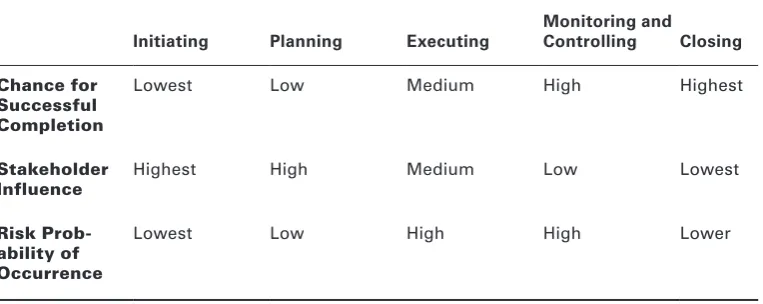
60. All of the following statements are true of the project Closing processes except for which one?
A. Probability for success is greatest in the project Closing processes.
B. The project manager’s influence is greatest in the project Closing processes.
C. The stakeholders’ influence is least in the project Closing processes.
D. Risk is greatest in the project Closing processes.
61. You are refining the product description for your company’s new line of ski boots. Which of the following statements is true?
A. You are in the Initiating processes of your project and know that the product descrip-tion will contain more detail in this stage and that a decreasing amount of detail will be added to it as the project progresses.
B. You are in the Planning processes of your project and know that the product descrip-tion will contain less detail in this stage and greater detail as the project progresses.
C. You are in the Planning processes of your project and know that the product descrip-tion should contain the most detail possible at this stage because this is critical infor-mation for the Planning process.
D. You are in the Initiating process of your project and know that the product description will contain less detail in this stage and greater detail as the project progresses.
62. Every status meeting should have time allotted for Risk Monitoring and Control. Which of the following sentences is not true?
A. Risk identification and monitoring should occur throughout the life of the project.
B. Risk audits should occur throughout the life of the project and are specifically inter-ested in measuring the team’s performance in the Identify Risk and Monitor and Control Risk processes.
C. Risks should be monitored for their status and to determine whether the impacts to the objectives have changed.
D. Technical performance measurement variances may indicate that a risk is looming and should be reviewed at status meetings.
63. The business need, product scope description, and strategic plan together describe elements of which of the following?
A. Organizational process ass