RP-HPLC METHOD DEVELOPMENT FOR THE QUANTITATIVE
DETERMINATION OF DEXAMETHASONE IN HERBAL
FORMULATION
Venkata Sairam K1*, J C Thejaswini1, M V Prudhvi Raju1, R S Chandan1,
B M Gurupadayya1, K Mruthunjaya2
1
Department of Pharmaceutical Analysis, JSS College of Pharmacy, JSS University, Mysore
2
Department of Pharmacognosy, JSS College of Pharmacy, JSS University, Mysore -570 015.
ABSTRACT
A simple, sensitive method for the determination of dexamethasone used as an adulterant in herbal formulation was developed using reverse phase high performance liquid chromatographic method (RP-HPLC). The analysis was performed on cyano (250 × 4.6mm, 5μm)
column using 0.1% ortho phosphoric acid and acetonitrile (80: 20 v/v) as mobile phase at flow rate 1.2 mL/min. The eluents were monitored with UV detector at 242 nm. In the developed method dexamethasone elutes at a retention time of 8.8 min. The proposed method is having linearity in the concentration range from 5 to 60 µg/mL of dexamethasone. The present method was validated with respect to system suitability, linearity, precision, limit of detection (LOD) and limit of quantification (LOQ), accuracy (recovery) and robustness. The proposed method can be readily utilized for the detection of
dexamethasone as an adulterant in herbal formulation.
KEYWORDS: Dexamethasone, Herbal formulation, RP-HPLC.
1.1 INTRODUCTION
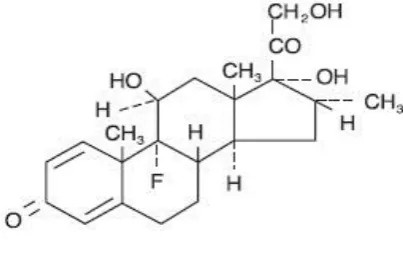
Dexamethasone[1] is chemically known as 9-fluoro-11β,17-dihydroxy-16α-methyl-21-(phosphonooxy) pregna-1, 4-diene-3,20-dione (Fig 1). It is steroidal prescription drug used to treat inflammatory conditions like arthritis, allergies and skin problems like psoriasis and eczema.
Volume 4, Issue 2, 1148-1157. Research Article ISSN 2277– 7105
Article Received on 24 Nov 2014,
Revised on 19 Dec 2014, Accepted on 13 Jan 2015
*Correspondence for
Author
Venkata Sairam K
Department of
Pharmaceutical Analysis, JSS College of
Pharmacy, JSS
University, Mysore -570 015, Karnataka, India.
Figure 1: Structure of Dexamethasone.
Herbal medicines are increasingly being used in both preventative and treatment based medicines and tonics because consumers perceive herbals as natural, safe, harmless and free from adverse side effects. However, several reports[2,3] exist of adulteration of herbal formulations with synthetic drugs such as corticosteroids, steroidal/non-steroidal inflammatory agents, allergic, skin products etc. Herbal formulations intended for anti-inflammatory, anti-allergic, anti-asthmatic effect etc. are most likely to be adultered with corticosteroids for faster action. Adulteration[4-6] of herbal drugs with synthetic adulterants can lead to many complications including herb-drug interactions. Dexamethasone is one of the most frequently used adulterant in herbal formulation[7] because it gives immediate relief from allergic symptoms due to suppression of immune system.
Literature available for the identification and quantitative determination of dexamethasone in herbal formulation is scanty. Yoe-Ray Ku et al., carried out studies on systematic evaluation and comparision of the recoveries of eight steroids from spiked traditional chinese medicine (TCM) extract using silica gel solid-phase extraction (SPE) are reported. Yun Sik Nam et al., Monitoring of clobetasol propionate and betamethasone dipropionate as undeclared steroids in cosmetic products used for the treatment of eczema, seborrhoea and psoriasis, without any indication on the label of the cosmetic products.
The present study was aimed at developing a simple, sensitive, rapid, reproducible, precise and accurate HPLC method to identify and quantify dexamethasone in herbal formulation.
2. MATERIALS AND METHODS
2.1 Chemicals and reagents
other chemicals used are analytical reagent grade (AR grade) like ortho phosphoric acid procured from Loba Chemie, Mumbai, India.
2.2 Instrumentation and analytical conditions
Shimadzu HPLC (LC Solutions handling system) with LC- 2010AHT Prominence liquid
chromatograph and SPD-20A prominence UV/Visible detector was employed for present study. In addition, Shimadzu electronic balance, and micropore filtration assembly were used in this study.
The chromatographic determination was performed using 0.1% ortho phosphoric acid and acetonitrile in the ratio of 80:20 (v/v) as mobile phase and a stationary phase of stainless steel column phenomenex- cyano column (250 × 4.6mm, 5μm). The column oven temperature is
maintained at 40°C.The chromatography run time was maintained up to 12.0 min with flow rate at 1.2 mL/min with injection volume 10 µL and the eluent was monitored at 242 nm.
2.3 Preparation of stock solutions
2.3.1 Preparation of standard stock solution
Accurately weighed 100.0 mg of dexamethasone (bulk drug) was dissolved in 50.0 mL of mobile phase in 100 mL volumetric flask and sonicated for five minutes until it dissolves the material and the volume was made up with mobile phase. From this 10.0 mL of solution was taken and diluted to 100 mL (stock solution). Solution was filtered through 0.45 µm filter paper.
2.3.2 Preparation of calibration curve
Aliquots of dexamethasone ranging from 0.5 – 6.0 mL were pipetted into a series of 10 Ml volumetric flask and diluted to the mark with mobile phase. The linearity range of dexamethasone was found to be 5.0 – 60.0 µg/mL. The calibration curve was constructed by plotting peak area against concentration.
2.3.3 Preparation of sample extract
collected and extracted with chloroform thrice (125 mL x 3) and discarded chloroform extract. Finally volume of water extract is made up to 500 mL with water.
2.4 Optimization of the method
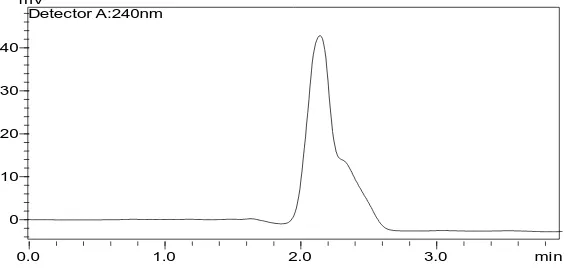
The optimization of the analytical procedure has been carried out by varying the stationary phase, mobile phase composition, flow rate of the mobile phase. In the present investigation the best separation of dexamethasone from interferences in formulation was achieved using a stationary phase of phenomenex cyano column (250mm X 4.6mm, 5µm) in comparision with that of phenomenex C18 column(250mm X 4.6mm, 5µm). With C18 column, the drug peak was eluted at a lower retention time which was merging with the formulation peaks (Fig 4 & 5). Various solvent systems such as acetonitrile: water, methanol: water, 0.1% ortho phosphoric acid: acetonitrile were tried in different ratios to get good chromatogram. Best results were obtained with mobile phase of acetonitrile, 0.1% orthophosphoric acid (20:80 v/v) (Fig 2).
0.0 2.5 5.0 7.5 10.0 min
0 5000 10000 15000 20000
uV
Fig2: chromatogram for standard drug (Dexamethasone).
3. METHOD VALIDATION
The method was validated for the parameters like system suitability, specificity, linearity, limit of detection (LOD), limit of quantification (LOQ), accuracy, precision, ruggedness and robustness in accordance with International Conference of Harmonization (ICH) Guidelines.[8, 9]
3.1 System suitability testing
Table 1: System suitability parameters of the proposed analytical method for
Dexamethasone
Parameter Dexamethasone
Theoretical plates/meter 2875
HETP 79.9
Symmetric factor 0.914
Retention time in
minutes (Rt) 8.8
Tailing factor 1.1
Capacity factor 0.798
3.2 Linearity
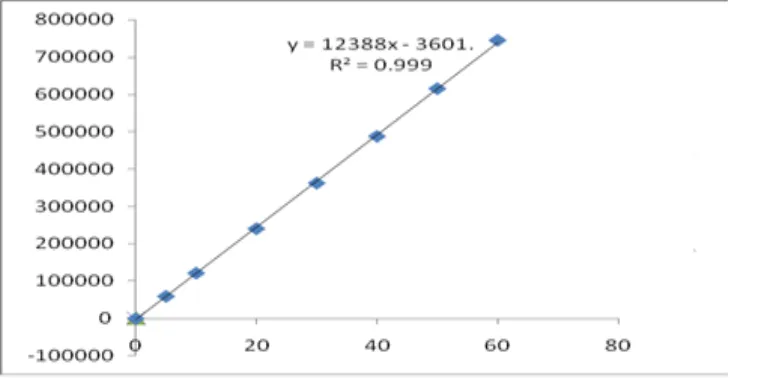
[image:5.595.160.438.112.235.2]The calibration curve was established by plotting the peak areas of dexamethasone versus the concentrations of dexamethasone samples. Linear correlations were found between peak areas and dexamethasone concentration (Fig. 3) and are described by the regression equations:
Figure 3: Calibration graph of Dexamethasone.
Y= 12388x + 3601; r2 0.999, where r2is the correlation coefficient. The Beer’s law is obeyed in the concentration range of 5-60 µg/mL. The results of the study are shown in (Table 2).
Table 2: The regression characteristics of the proposed method
Parameter Values
Range (g/mL) 5-60
Regression Equation Y= 12388x - 3601 Regression coefficient (r2) 0.999
Slope 12388
[image:5.595.111.491.364.553.2]3.3 Accuracy (Recovery study)
Accuracy of the method was studied by recovery experiments. The recovery was performed at three levels 80, 100 and 120% as per ICH guide lines. The present recovery experiments were performed at three levels concentrations (18, 20, 22 µg/mL) by adding known amount of pure drug to the previously analyzed herbal sample solution (sample solution of known concentration 10 µg/mL). The results of the study are shown in (Table 3).
Table 3: Percent recovery studies of the method
Name of the Drug
Sample ID Amount added (μg/ml)
Amount recovered (μg/ml) n=3
Percentage recovery
Average Percentage recovery
Dexamethasone
80% 18 17.10 94.96
95.67
100% 20 18.93 94.86
120% 22 21.40 97.26
3.4 Limit of Detection (LOD) and Limit of Quantification (LOQ)
The LOD and LOQ of were determined by using standard deviation of the response and slope approach as defined in International Conference on Harmonization (ICH) guidelines .The limit of detection was found to be 129 ng and limit of quantification was found to be 388ng.
3.5 Precision
Precision of the method was evaluated in terms of intra-day and inter- day precision. 5µg/mL concentration of dexamethasone was analyzed in six replicates on the same day (intra-day precision) and in five consecutive days (inter-day precision). The peak-area based intra-day RSD value was 1.0 %. The inter-day precision showed higher RSD values of 1.12 %. The results of the study are shown in (Table 4).
Table 4: Intraday and interday precision
Replicates Interday Intraday
1 60239 59639
2 62784 60286
3 63729 63694
4 60482 59299
5 63523 60491
6 61329 61014
Average 62372 60237
Standard deviation 695.4 605.8
3.6 Ruggedness
Method ruggedness was checked by varying the lot number and manufactures of reagents Orthophosphoric acid), solvents (HPLC grade water, acetonitrile) procured from Qualigens Fine chemicals (Mumbai, India) and column (phenomenex Cyano -250 x 4.6 mm; 5 µm). The effect of changes was observed on chromatographic parameters like retention time, tailing factor, resolution, peak area and theoretical plates. The results obtained show no significant variation in above parameters indicating ruggedness of method.
3.7 Robustness
The robustness of an analytical method is a measure of its capacity to remain unaffected by small but deliberate variation in method parameters and provides an indication of its reliability during normal usage. Robustness is done by slightly varying the experimental conditions like the proportions of the mobile phase (±2% on total proportion), column temperature (40ºC ± 5ºC), flow rate (1.2 mL/min ± 0.2 mL) and wavelength (242 nm ± 2 nm) of detection. The effect of changes was observed on chromatographic parameters like retention time, tailing factor, resolution, peak area and theoretical plates. The results obtained show no significant variation in above parameters indicating robustness of method.
3.8 Application of method for estimation of dexamethasone by spiking into herbal
formulation
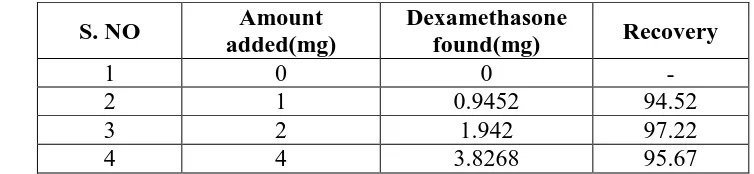
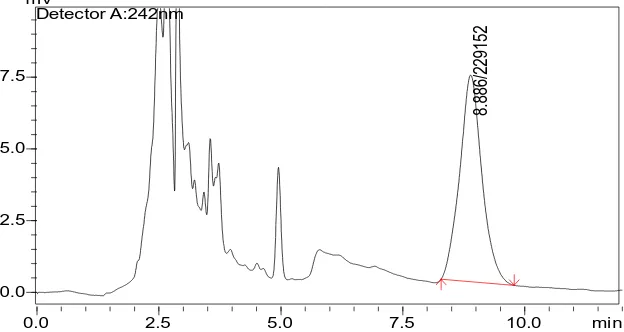
[image:7.595.101.478.609.696.2]A known amount of standard drug was added to herbal formulation and then the sample is extracted by liquid-liquid extraction (extraction of sample powder (formulation) with water followed by extraction with chloroform). Water extract is collected and analysed in HPLC. The drug peak is obtained at a retention time of 8.8 min (Fig 6). The values are compiled and reported in (Table-5).
Table 5: Recovery of Dexamethasone added to herbal medicine
S. NO Amount
added(mg)
Dexamethasone
found(mg) Recovery
1 0 0 -
2 1 0.9452 94.52
3 2 1.942 97.22
4 4 3.8268 95.67
4. RESULTS AND DISCUSSION
The objective of present study was to develop a rapid and sensitive HPLC method for the quantitative determination of dexamethasone in herbal formulation using most commonly employed HPLC method. In the proposed method cyano column was used and eluents were monitored at 242 nm. Mobile phase consisting of 0.1% ortho phosphoric acid, acetonitrile in the ratio of 80:20 (v/v) with a flow rate of 1.2 mL/min, run time 12.0 min and retention time was 8.8 min had given immaculate results when compared to other methods. The system suitability parameters have been determined and values were tabulated in (Table I). A plot of ratio of peak area against concentration (µg/mL) gave a linear regression (r2=0.999) over the concentration range 5 - 60 µg/mL.
The proposed method was also validated for intra and inter day variation and %CV was found to be 1.0 %. The lowest level of quantification was observed to be 388 ng/mL which indicates the sensitivity of method. The accuracy of HPLC method was assessed by adding known amount of the drug to pre analyzed sample solution.
A known amount of dexamethasone was added to herbal medicine and the overall recovery was estimated by standard addition method. The % recovery (95.67%) indicating that proposed method is accurate. Although the presence of interference in herbal medicine did not obviously interfere with the identification of dexamethasone, those interferences could be moved efficiently with Liquid Liquid Extraction (LLE). Robustness results obtained showed no significant variation in parameters (retention time, tailing factor, resolution, peak area and theoretical plates) indicating robustness of method. In comparison with other published methods for determination of dexamethasone the advantages of this method are ease of operation, short analysis time (total run time < 12 minutes, which is important for routine analysis) and satisfactory limit of quantification.
0.0 1.0 2.0 3.0 min
0 10 20 30 40
mV
[image:8.595.159.444.604.740.2]0.0 2.5 5.0 7.5 10.0 min -10
0 10 20 30 40
mV
[image:9.595.134.466.82.248.2]Detector A:242nm
Fig 5: chromatogram of herbal extract without Dexamethasone.
0.0 2.5 5.0 7.5 10.0 min
0.0 2.5 5.0 7.5
mV
Detector A:242nm
8.
88
6/
22
91
52
Fig 6: Chromatogram of herbal extract with Dexamethasone using cyano column.
5. CONCLUSION
It is important to develop a fast and efficient method to detect dexamethasone in herbal medicine. In this study we have developed a method combining LLE and HPLC. The developed method was found to be simple, sensitive, accurate, precise and reproducible. It can be used for routine quantitative determination of dexamethasone as adulterant in herbal formulations.
6. ACKNOWLEDGEMENT
[image:9.595.143.455.294.460.2]REFERENCES
1. Thomas LL, David AW, Victoria F, Roche, William ZS. Foye’s principles of medicinal chemistry, 6th ed.; Wolters Kluwer (Lippincott Williams & Wilkins P. S), New Delhi, 2008.
2. Hitendra DK, Joseph T, Cheng LC, Min EN, Paul AT. Necrotising fasciitis caused by adulterated traditional asian medicine: a case report. J Orthop Surg, 2009; 17: 223-6. 3. Manish K, Vivekananda M, Hemalatha S. Detection of metformin hydrochloride in a
traditionally used indian herbal drug for antidiabetic: a case report. Int J Pharm Biol Sci, 2011; 2: 307-13.
4. Yoe-Ray K, Yi-Chu L, Jer-Huei L. Solid-phase extraction and high-performance liquid chromatographic analysis of prednisone adulterated in a foreign herbal medicine. J Food Drug Anal, 2001; 9: 150-2.
5. Yoe-Ray Ku, Kuo-Ching Wen, Li-Kang H, Yuan-Shiun C. Solid-phase extraction and high-performance liquid chromatographic determination of steroids adulterated in traditional chinese medicine. J Food Drug Anal, 1999; 7: 123-30.
6. Yun SN, Keun KI, Kang-Bong L. Monitoring of clobetasol propionate and betamethasone dipropionate as undeclared steroids in cosmetic products manufactured in Korea. Forensic Sci Int, 2011; 02: 27.
7. Savaliya AA, Prasad B, Raijada DK, Singh S. Detection and characterization of synthetic steroidal and non-steroidal anti-inflammatory drugs in Indian ayurvedic/herbal products using LC-MS/TOF. Drug Test Anal, 2009; 1: 372-81.
8. International Conference of Harmonization, Q2A: Text on validation of analytical procedures. (1995) US FDA Federal Register, V. 60, March, 11260–11273.