Open Access
Software
ArrayMining: a modular web-application for microarray analysis
combining ensemble and consensus methods with cross-study
normalization
Enrico Glaab, Jonathan M Garibaldi and Natalio Krasnogor*
Address: School of Computer Science, Nottingham University, Jubilee Campus, Wollaton Road, Nottingham, UK
Email: Enrico Glaab - [email protected]; Jonathan M Garibaldi - [email protected]; Natalio Krasnogor* - [email protected] * Corresponding author
Abstract
Background: Statistical analysis of DNA microarray data provides a valuable diagnostic tool for the investigation of genetic components of diseases. To take advantage of the multitude of available data sets and analysis methods, it is desirable to combine both different algorithms and data from different studies. Applying ensemble learning, consensus clustering and cross-study normalization methods for this purpose in an almost fully automated process and linking different analysis modules together under a single interface would simplify many microarray analysis tasks.
Results: We present ArrayMining.net, a web-application for microarray analysis that provides easy access to a wide choice of feature selection, clustering, prediction, gene set analysis and cross-study normalization methods. In contrast to other microarray-related web-tools, multiple algorithms and data sets for an analysis task can be combined using ensemble feature selection, ensemble prediction, consensus clustering and cross-platform data integration. By interlinking different analysis tools in a modular fashion, new exploratory routes become available, e.g. ensemble sample classification using features obtained from a gene set analysis and data from multiple studies. The analysis is further simplified by automatic parameter selection mechanisms and linkage to web tools and databases for functional annotation and literature mining.
Conclusion: ArrayMining.net is a free web-application for microarray analysis combining a broad choice of algorithms based on ensemble and consensus methods, using automatic parameter selection and integration with annotation databases.
Background
DNA microarray experiments provide a powerful means to improve our understanding of diseases with a genetic basis or contribution. Commercial microarray chips for highly accurate diagnosis of several cancers are already available on the market [1,2] and pharmaceutical compa-nies are using DNA-chip technology to identify new drug targets.
The fast accumulation of gene expression data in public online databases and the great variety of available analysis methods, however, also pose new challenges. Integrating data from different sources, choosing appropriate normal-ization, analysis and cross-validation methods and select-ing suitable parameters requires substantial time and effort. Since different algorithms have different strengths and similar data from independent studies is often
availa-Published: 28 October 2009
BMC Bioinformatics 2009, 10:358 doi:10.1186/1471-2105-10-358
Received: 8 May 2009 Accepted: 28 October 2009
This article is available from: http://www.biomedcentral.com/1471-2105/10/358 © 2009 Glaab et al; licensee BioMed Central Ltd.
ble, it is desirable to combine multiple methods and/or data sets to obtain more robust and accurate results. This creates ample opportunities for ensemble methods and cross-study normalization techniques.
Although statistical programming frameworks like R [3] and Matlab [4] allow users to develop and apply complex scripts for expression data analysis, they are difficult to use for non-experts and there is a high risk of deviating from standard guidelines. To obviate the need for specialized programming skills and manual software installations, several web-based tools for gene expression analysis have been presented in recent years. Currently available inte-grative online analysis services include GEPAS [5], Expres-sion Profiler [6], ASTERIAS [7], EzArray [8], CARMAweb [9],
MAGMA [10], ArrayPipe [11], RACE [12], WebArray [13] and MIDAW [14]. These web-based systems provide methods for a multitude of data pre-processing and anal-ysis purposes ranging from image analanal-ysis, missing value imputation, single-study normalization, gene filtering and gene name conversion to higher-level analysis meth-ods for clustering, gene selection and gene annotation, prediction, data visualization and gene set enrichment analysis, among others.
Additionally, numerous web-applications have been developed and optimized for single, specific analysis tasks, e.g. biclustering of genes and samples [15], co-clus-tering of genes with similar functional annotation [16], framework inference for regulatory networks [17] and cross-species clustering [18]. Although various tools pro-vide a choice and comparison between different algo-rithms for one analysis task, to the best of our knowledge, currently no integrative analysis software enables the user to easily combine multiple methods together using ensemble learning and consensus clustering techniques. Previous studies have shown that microarray analysis can profit from ensemble feature selection, ensemble predic-tion and consensus clustering methods both in terms of robustness and accuracy [19-22], suggesting that there is significant potential still to be exploited with these approaches.
Similarly, it would be desirable not only to combine dif-ferent algorithms but also difdif-ferent data sets for a com-mon organism and phenotype. Although currently available cross-study normalization methods are based on simplified assumptions and limited in applicability and accuracy, various successful applications [23,24] have shown that the benefits of an increased sample size can outweigh the loss of information due to the normaliza-tion process.
For these reasons, we have developed a new web-applica-tion that provides access to multiple algorithms for each
of the most common tasks in statistical microarray analy-sis, namely gene selection, sample clustering, sample clas-sification and gene set analysis, based on a single, easy-to-use interface. In contrast to other web-tools, in which the results of individual methods are made available, here, ensemble feature selection, ensemble prediction and con-sensus clustering approaches are provided. Likewise, instead of using only data from a single study, different cross-study normalization methods are made available to integrate similar data from different studies and compare the results based on density and quantile-quantile plots.
Apart from these combinations of data sets and methods within an analysis module, different modules have been interlinked, enabling for example the integration of gene set analysis with classification or cross-study analysis with gene selection or clustering. Other new features include access to an in-house developed rule-based evolutionary classification algorithm, automatic parameter selection mechanisms on all modules, the availability of specific cancer-related gene sets for enrichment analysis in addi-tion to gene sets from KEGG and GO, and a 3D-VRML-vis-ualization of clustering results using the authors' new R software package "vrmlgen" [25].
Since the above methods and features are not available on other microarray-related web-tools, and similarly, other tool sets include methods distinct from our system, we see our service as a complement rather than an alternative to existing services.
In the following we provide an overview of the workflow and describe all features in detail.
Implementation and workflow
The ArrayMining.net tool set consists of five main mod-ules for microarray analysis: Cross-Study Normalization,
ArrayMining.net is based on software written in the pro-gramming languages R [3] and C++ and a PHP-interface combining all implementations together on an Apache web server. The system uses in-house algorithms and implementations as well as standard packages from the Bioconductor project [28]. All modules are easily extensi-ble and the authors encourage users to contribute with feature requests or their own analysis scripts. A regularly updated illustration of the workflow and features on our server is available online (see Availability section). Below we describe each of the modules in detail.
Cross-study normalization module
Current microarray studies often only contain a small number of samples, resulting in limited robustness and reliability of statistical analyses. To alleviate this problem five cross-study normalization methods have been made available on ArrayMining.net to combine samples from two different studies: An approach based on linked gene-and sample-clustering (XPN [23]), an empirical Bayes method (EB [29]), a median rank score based method (MRANK [24]), an outlier-removing discretization tech-nique (NorDi [30]) and a quantile discretization proce-dure (QDISC [24]). While the first three methods provide continuous-valued outputs, the last two are based on dis-cretization to filter out noise, exploiting the fact that for higher-level analysis often only a general categorization of gene expression levels in different conditions is required (e.g. "unaltered", "up"- or "down"-regulated), but poten-tially resulting in a higher loss of biological information. The input data sets can originate from different microar-ray platforms, but the associated gene sets need to overlap significantly and the samples should be derived from the same tissue type under comparable biological conditions. As a result, the combined data can be downloaded or for-warded to other modules, and density and quantile-quan-tile plots are generated to compare different algorithms.
Gene selection module
Identifying differentially expressed genes is a common starting point for the biological interpretation of microar-ray data. Our gene selection module enables the compar-ison and combination of a diverse choice of methods for this purpose: The Empirical Bayes t-statistic (eBayes) [31,32], the Significance Analysis in Microarrays method (SAM) [33], a correlation-based combinatorial feature selection approach (CFS) [34], a ranking method based on Random Forest classification (RF-MDA) [35] and a Partial-Least-Squares based filter (PLS-CV) [36] using the weight vectors defining the first latent components in cross-validated PLS-models. To exploit the synergies of different algorithms, we have implemented a method to compute aggregated gene ranks from the sum of ranks of individual methods (ENSEMBLE). The resulting outcome reports provide a ranked list of genes, in which known
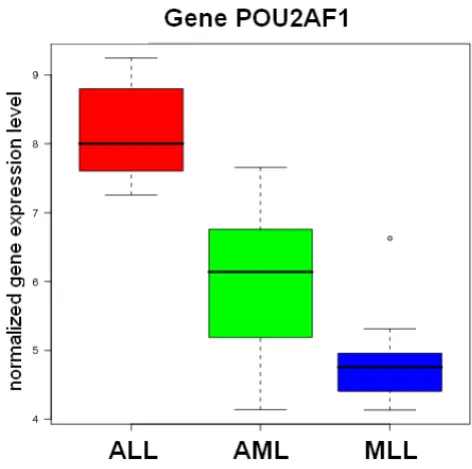
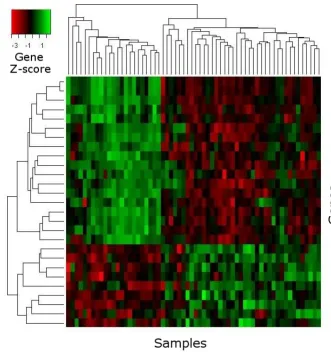
gene identifiers become clickable navigation items, refer-ring the user to related entries in functional annotation databases and literature search engines. Additionally, box plots and heat maps (see Fig. 1 and 2) visualize the expres-sion values of top-ranked genes across different sample-groups. If the supplied data uses common gene identifiers (Entrez Gene ID, NCBI GI accession, Unigene ID, RefSeq Genomic ID, etc.), the list of selected genes can be for-warded to external analysis tools, e.g. the functional anno-tation clustering service of the DAVID web database [37].
Class discovery module
Clustering methods allow experimenters to identify natu-ral groupings among microarray samples based on their expression patterns across the genes. To account for the great variety of existing scoring and search space explora-tion methods, our class discovery module includes both partition-based and hierarchical clustering algorithms, an evaluation based on multiple validity indices and a con-sensus clustering method. Currently, the partition-based clustering methods available are k-Means, PAM [38], SOM
[39] and SOTA [40], and the hierarchical clustering meth-ods are Average Linkage Agglomerative Clustering, Divisive Analysis Clustering and a combination between the
[image:3.612.313.549.389.624.2]Boxplots
Figure 1
agglomerative and divisive approach, Hybrid Hierarchical Clustering [41]. To combine the information content from multiple clusterings into a single representative solution, we have implemented our own consensus clustering approach, which maximizes a score for the agreement between sample-pair assignments of the consensus clus-tering and all input clusclus-terings using a fast simulated annealing approach [42]. This method was developed based on experiences from earlier work on protein struc-ture similarity clustering [43], which showed that consen-sus methods can increase the robustness and reliability of statistical analyses on biological data sets. For each algo-rithm the number of clusters is estimated automatically by means of multiple validity indices and a refined estimate can be obtained by combining all pairs of algorithms and validity indices. Optionally, different types of data stand-ardization and two gene filtering methods can be applied prior to the analysis. This includes a classical variance-based filter as well as a recently published parameter-free method, which can distinguish between uncorrelated,
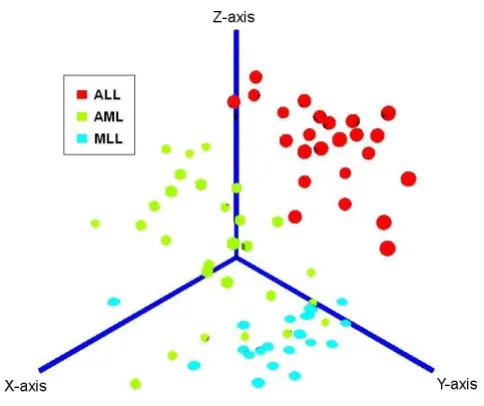
uninformative genes and regulators with high correlation to other genes [44]. An alternative filtering approach is to first use the gene set analysis module (see below) to extract "meta-genes" representing biological pathways and forward this data to the class discovery module. As a result for each analysis, the user will obtain a tabular sum-mary of the calculated validity indices and clustering results and various graphical outputs including a silhou-ette-plot [45], a 2D principal components plot and a 3D VRML-visualization (see Fig. 3), including density estima-tion contour surfaces based on an Independent Compo-nent Analysis of the data and our software-package "vrmlgen" for the R programming language [3] (freely available at Ref. [25] and the official R package archive, CRAN).
Class Assignment module
[image:4.612.134.466.86.441.2]An important goal behind microarray analysis is to improve the diagnosis of diseases with genetic compo-nents by predicting the disease type based on labeled Heat map
Figure 2
training data. The third module on our web-server is therefore dedicated to supervised learning methods, including various common methods for microarray sam-ple classification (SVM [46], RF [35], PAM [38] and kNN). We also provide access to an in-house developed rule-based machine learning approach, BioHEL [47], which learns structured classification rule sets, known as "deci-sion lists", by applying a genetic algorithm within an iter-ative rule learning (IRL) framework. BioHEL has previously been shown to achieve high prediction accura-cies on complex biological data sets [48], while being based on easily interpretable "if-then-else"-rules. The pre-diction methods can be evaluated and compared based on the widely accepted external two-level cross-validation methodology [49], using automatic parameter optimiza-tion within a nested cross-validaoptimiza-tion. As with the other modules, an ensemble of algorithms is available both for selection and prediction to obtain more robust results. Moreover, since prediction models derived from training data of a single study can typically not be applied to sam-ples from other platforms and laboratories, the combina-tion of cross-study normalizacombina-tion (see above) with prediction provides a means to obtain more general mod-els based on a larger sample size.
The results for an analysis contain various performance measures for evaluation and Z-scores for the genes that were most frequently selected across different cross-vali-dation cycles. To obtain more insights on these genes, similar analysis plots and annotation tools are available as for the gene selection module.
Gene Set Analysis module
Two common problems in microarray analysis are high noise levels for single genes and a high number of redun-dant or uninformative genes. Using gene set analysis (GSA) to aggregate functionally related genes into gene sets and summarizing their expression values to a robust "meta"-gene expression vector is a promising approach to overcome some of these limitations [50]. Moreover, dif-ferentially expressed gene sets can provide insights on the differences between the biological conditions of the sam-ples on the level of molecular modules and biochemical pathways. Our gene set analysis module provides access to three functional annotation sources to identify function-ally related genes in a data set and extract corresponding gene sets: The Gene Ontology Database [51], the KEGG data base [52], and a collection of 37 cancer-related gene sets from the van Andel Institute in Michigan [53]. Alter-natively, users can specify their own gene sets using the gene identifiers for the data set of interest. Since common non-parametric GSA methods are often computationally expensive or provide only rough estimates of a gene's sig-nificance score, we compute p-values based on the para-metric PAGE-method [53], requiring a minimum gene set size of approx. 10 genes. To adjust for multiple testing, the Benjamini-Hochberg method [54] is used.
Summarized meta-gene expression vectors for a gene set are obtained by transforming the expression levels using Principal Component Analysis (PC-GSA) or Multidimen-sional Scaling (MDS-GSA).
The outcome is presented as a ranked list of gene sets and additionally contains box plots and heat maps similar to those on the gene selection module. Meta-gene expression values derived from the gene sets can be downloaded or forwarded to other analysis modules, e.g. to be used as predictors in sample classification.
Results
[image:5.612.55.297.85.288.2]Providing example results for all modules and algorithms on ArrayMining.net would exceed the scope of this paper. However, we have included some results obtained with the well-known three-class leukemia data set by Arm-strong et al. [55] [see Additional file 1]. This includes the list of the 30 top-ranked genes using the ENSEMBLE gene selection method, as well as a heat map, box plots, a ranked list of cancer gene sets from the gene set analysis module, sample classification results, a VRML-file visual-izing the results from an Independent Component Analy-sis computed on the class discovery module (shown in Fig. 3) and a discussion of all results. In summary, nearly all of the selected genes with available annotation data are known or likely to be differentially expressed in different leukemia types. An example box plot for a top-ranked gene - the transcriptional regulator POU2AF1, which has Independent Component Analysis
Figure 3
been implicated in lymphoma and leukemia develop-ment [56] - is shown in Fig. 1. We also show results for a combination of two modules, obtaining an average sam-ple classification accuracy of 87% (external 10-fold cross-validation) on the Class Assignment module when using meta-genes derived from the gene set analysis module as robust input features. On the class discovery module, the clustering and validity methods were able to perfectly dis-tinguish two leukemia subtypes in the data, Mixed Line-age Leukemia (MLL) and Acute Lymphoblastic Leukemia (ALL), while the samples for a third subtype, Acute Mye-loid Leukemia (AML), could only partly be separated from the other two groups. However, when visualizing the pre- filtered data using an Independent Component Anal-ysis, the three leukemia groups were well separated in 3D-space with only a small overlap between the MLL and the AML group, although all results were generated in a fully automatic process [see Additional file 2 for a VRML-visu-alization of the data].
Since these examples cover only some of the available fea-tures, various well-known microarray cancer data sets are available on the different analysis modules to enable the user to more fully explore the capabilities of ArrayMin-ing.net without needing to upload new data.
Conclusion
We have developed a new web-application that provides a simple and fast way to analyze arbitrary DNA-chip data and other high-dimensional data sets. Ensemble, consen-sus and cross-study normalization methods help to increase the robustness and accuracy of the outcomes, and automatic parameter selection mechanisms and a direct linkage to functional annotation data bases (ENSEMBL, DAVID, etc.) relieve the user of time-consuming routine tasks. For each of the major statistical analysis tasks - fea-ture selection, clustering, prediction and gene set analysis - several analysis methods are available and can be com-pared, combined or interlinked in many ways. In contrast to other software products for microarray analysis, the user is neither tied to a particular methodology nor needs to understand in detail the inner working of the algo-rithms. New researchers in the field can use the web-tool without the risk of deviating from standard validation guidelines.
For the next version of the server, we are planning to add a new module for co-expression network analysis and the possibility to integrate additional clinical or biological data.
Availability and requirements
The web-application, video tutorials and an illustration of the features and workflow are freely accessible at http:// www.arraymining.net.
Authors' contributions
EG participated in the conceptual design of the web-appli-cation, implemented the algorithms and PHP-interface and drafted the manuscript. NK took part in the concep-tual design of the web-application and helped to draft the manuscript. JMG helped to draft the manuscript. JMG and NK wrote the grant application upon which this project was built. All authors read, made corrections and approved the final manuscript.
Additional material
Acknowledgements
We acknowledge support by the Marie-Curie Early-Stage-Training pro-gramme (grant MEST-CT-2004-007597), by the UK Engineering and Physi-cal Sciences Research Council (EP/E017215/1) and the Biotechnology and Biological Sciences Research Council (BB/F01855X/1).
References
1. Wittner B, Sgroi D, Ryan P, Bruinsma T, Glas A, Male A, Dahiya S, Habin K, Bernards R, Haber D, et al.: Analysis of the MammaPrint breast cancer assay in a predominantly postmenopausal cohort. Clin Cancer Res 2008, 14(10):2988.
2. Horlings H, Warmoes M, Kerst J, Helgason H, De Jong D, Van't Veer L: Successful classification of metastatic carcinoma of known primary using the CUPPRINT. J Clin Oncol 2006, 24:20028. 3. Ihaka R, Gentleman R: R: A Language for Data Analysis and
Graphics. J Comput Graph Stat 1996, 5(3):299-314. 4. The MathWorks Inc: Matlab. Natick, MA 1998.
5. Tarraga J, Medina I, Carbonell J, Huerta-Cepas J, Minguez P, Alloza E, Al-Shahrour F, Vegas-Azcarate S, Goetz S, Escobar P, et al.: GEPAS, a web-based tool for microarray data analysis and interpre-tation. Nucleic Acids Res 2008, 31(13):3461-3467.
6. Kapushesky M, Kemmeren P, Culhane A, Durinck S, Ihmels J, Korner C, Kull M, Torrente A, Sarkans U, Vilo J, et al.: Expression Profiler: next generation-an online platform for analysis of microar-ray data. Nucleic Acids Res 2004:W465.
7. Diaz-Uriarte R, Alibes A, Morrissey E, et al.: Asterias: integrated analysis of expression and aCGH data using an open-source, web-based, parallelized software suite. Nucleic Acids Res
2007:W75.
8. Zhu Y, Zhu Y, Xu W: EzArray: A web-based highly automated Affymetrix expression array data management and analysis system. BMC Bioinformatics 2008, 9:46.
9. Rainer J, Sanchez-Cabo F, Stocker G, Sturn A, Trajanoski Z: CAR-MAweb: comprehensive R-and bioconductor-based web
Additional file 1
Results for an example analysis with ArrayMining.net. The document provided contains the results and a discussion for an example analysis of microarray data with ArrayMining.net.
Click here for file
[http://www.biomedcentral.com/content/supplementary/1471-2105-10-358-S1.pdf]
Additional file 2
Example VRML-visualization of an Independent Component Analysis. This file contains an example VRML-visualization of an Independent Component Analysis for the microarray data set by Armstrong et al. [55] (a VRML browser plugin or viewing software is required to open the file).
Click here for file
service for microarray data analysis. Nucleic Acids Res
2006:W498.
10. Rehrauer H, Zoller S, Schlapbach R: MAGMA: analysis of two-channel microarrays made easy. Nucleic Acids Research
2007:W86.
11. Hokamp K, Roche F, Acab M, Rousseau M, Kuo B, Goode D, Aeschliman D, Bryan J, Babiuk L, Hancock R, et al.: ArrayPipe: a flexible processing pipeline for microarray data. Nucleic Acids Res 2004:W457.
12. Psarros M, Heber S, Sick M, Thoppae G, Harshman K, Sick B: RACE: remote analysis computation for gene expression data. Nucleic Acids Res 2005:W638.
13. Xia X, McClelland M, Wang Y: WebArray: an online platform for microarray data analysis. BMC Bioinformatics 2005, 6:306. 14. Romualdi C, Vitulo N, Favero M, Lanfranchi G: MIDAW: a web tool
for statistical analysis of microarray data. Nucleic Acids Res
2005:W644.
15. Wu C, Fu Y, Murali T, Kasif S: Gene expression module discov-ery using Gibbs sampling. Genome Inform 2004, 15:239-248. 16. Lee J, Sinkovits R, Mock D, Rab E, Cai J, Yang P, Saunders B, Hsueh R,
Choi S, Subramaniam S, et al.: Components of the antigen processing and presentation pathway revealed by gene expression microarray analysis following B cell antigen receptor (BCR) stimulation. BMC Bioinformatics 2006, 7:237. 17. Aburatani S, Goto K, Saito S, Toh H, Horimoto K: ASIAN: a web
server for inferring a regulatory network framework from gene expression profiles. Nucleic Acids Res 2005:W659. 18. Lu Y, He X, Zhong S: Cross-species microarray analysis with
the OSCAR system suggests an INSR -> Pax6 -> NQO1 neuro-protective pathway in aging and Alzheimer's disease. Nucleic Acids Res 2007:W105.
19. Saeys Y, Abeel T, Peer Y: Robust Feature Selection Using Ensemble Feature Selection Techniques. In Proceedings of the European Conference on Machine Learning and Knowledge Discovery in Databases-Part II Springer-Verlag Berlin, Heidelberg; 2008:313-325. 20. Tan A, Gilbert D: Ensemble machine learning on gene
expres-sion data for cancer classification. Appl Bioinformatics 2003, 2(3 Suppl):S75-S83.
21. Monti S, Tamayo P, Mesirov J, Golub T: Consensus clustering: a resampling-based method for class discovery and visualiza-tion of gene expression microarray data. Machine Learning
2003, 52:91-118.
22. Swift S, Tucker A, Vinciotti V, Martin N, Orengo C, Liu X, Kellam P:
Consensus clustering and functional interpretation of gene-expression data. Genome Biol 2004, 5(11):R94.
23. Shabalin A, Tjelmeland H, Fan C, Perou C, Nobel A: Merging two gene-expression studies via cross-platform normalization. Bioinformatics 2008, 24(9):1154.
24. Warnat P, Eils R, Brors B: Cross-platform analysis of cancer microarray data improves gene expression based classifica-tion of phenotypes. BMC Bioinformatics 2005, 6:265.
25. VRMLGen R software package [http://bree.cs.nott.ac.uk/vrml gen]
26. Irizarry R, Bolstad B, Collin F, Cope L, Hobbs B, Speed T: Summa-ries of Affymetrix GeneChip probe level data. Nucleic Acids Res
2003, 31(4):e15.
27. Edgar R, Domrachev M, Lash A: Gene Expression Omnibus: NCBI gene expression and hybridization array data reposi-tory. Nucleic Acids Res 2002, 30:207-210.
28. Gentleman R, Carey V, Bates D, Bolstad B, Dettling M, Dudoit S, Ellis B, Gautier L, Ge Y, Gentry J, et al.: Bioconductor: open software development for computational biology and bioinformatics. Genome Biol 2004, 5(10):R80.
29. Walker W, Liao I, Gilbert D, Wong B, Pollard K, McCulloch C, Lit L, Sharp F: Empirical Bayes accomodation of batch-effects in microarray data using identical replicate reference samples: application to RNA expression profiling of blood from Duch-enne muscular dystrophy patients. BMC Genomics 2008, 9:494. 30. Martinez R, Pasquier C, Pasquier N: GenMiner: Mining Informa-tive Association Rules from Genomic Data. Proceedings of the 2007 IEEE International Conference on Bioinformatics and Biomedicine
2007:15-22.
31. Lonnstedt I, Speed T: Replicated microarray data. Stat Sin 2002,
12:31-46.
32. Smyth G: Linear models and empirical Bayes methods for assessing differential expression in microarray experiments. Stat Appl Genet Mol Biol 2004, 3:3.
33. Tusher V, Tibshirani R, Chu G, et al.: Significance analysis of microarrays applied to the ionizing radiation response. Proc Natl Acad Sci USA 2001, 98(9):5116-5121.
34. Hall MA: Correlation-based Feature Selection for Discrete and Numeric Class Machine Learning. Proc. 17th International Conf. on Machine Learning, Morgan Kaufmann, San Francisco, CA
2000:359-366.
35. Breiman L: Random Forests. Machine Learning 2001, 45:5-32. 36. Boulesteix A, Strimmer K: Partial least squares: a versatile tool
for the analysis of high-dimensional genomic data. Brief Bioin-form 2007, 8:32-44.
37. Dennis G, Sherman B, Hosack D, Yang J, Gao W, Lane H, Lempicki R:
DAVID: database for annotation, visualization, and inte-grated discovery. Genome Biol 2003, 4(9):R60.
38. Tibshirani R, Hastie T, Narasimhan B, Chu G: Diagnosis of multiple cancer types by shrunken centroids of gene expression. Proc Natl Acad Sci USA 2002, 99(10):6567-6572.
39. Kohonen T: Self-Organizing Maps Berlin: Springer Verlag; 2001. 40. Herrero J, Valencia A, Dopazo J: A hierarchical unsupervised
growing neural network for clustering gene expression pat-terns. Bioinformatics 2001, 17(2):126-136.
41. Chipman H, Tibshirani R: Hybrid hierarchical clustering with applications to microarray data. Biostatistics 2006, 7(2):286-301. 42. Szu H: Fast simulated annealing. AIP Conference Proceedings 1986,
151:420.
43. Barthel D, Hirst J, Blazewicz J, Burke E, Krasnogor N: ProCKSI: A decision support system for protein (structure) comparison, knowledge, similarity and information. BMC Bioinformatics
2007, 8:416.
44. Tritchler D, Parkhomenko E, Beyene J: Filtering genes for cluster and network analysis. BMC Bioinformatics 2009, 10:193. 45. Rousseeuw P: Silhouettes: a graphical aid to the interpretation
and validation of cluster analysis. J Comput Appl Mat 1987,
20:53-65.
46. Chang CC, Lin CJ: LIBSVM: a library for support vector machines 2001 [http://www.csie.ntu.edu.tw/~cjlin/libsvm].
47. Bacardit J, Burke E, Krasnogor N: Improving the scalability of rule-based evolutionary learning. Memetic Computing 2009,
1:55-67.
48. Bacardit J, Stout M, Hirst J, Krasnogor N: Data Mining in Proteom-ics with Learning Classifier Systems. In Learning Classifier Sys-tems in Data Mining Edited by: Bull L, Bernado Mansilla E, Holmes J. Springer; 2008:17-46.
49. Wood I, Visscher P, Mengersen K: Classification based upon gene expression data: bias and precision of error rates. Bioinformat-ics 2007, 23(11):1363.
50. Guo Z, et al.: Towards precise classification of cancers based on robust gene functional expression profiles. BMC Bioinfor-matics 2005, 6:58.
51. Ashburner M, Ball C, Blake J, Botstein D, Butler H, Cherry J, Davis A, Dolinski K, Dwight S, Eppig J, et al.: Gene Ontology: tool for the unification of biology. Nat Genet 2000, 25:25-29.
52. Kanehisa M, Goto S: KEGG: Kyoto encyclopedia of genes and genomes. Nucleic Acids Res 2000, 28:27.
53. Kim S, Volsky D: PAGE: parametric analysis of gene set enrich-ment. BMC Bioinformatics 2005, 6:144.
54. Benjamini Y, Hochberg Y: Controlling the false discovery rate: a practical and powerful approach to multiple testing. J Roy Sta-tist Soc Ser B (Methodological) 1995, 57:289-300.
55. Armstrong S, Staunton J, Silverman L, Pieters R, den Boer M, Minden M, Sallan S, Lander E, Golub T, Korsmeyer S: MLL translocations specify a distinct gene expression profile that distinguishes a unique leukemia. Nat Genet 2001, 30:41-47.
56. Galiéque Z, Quief S, Hildebrand M, Denis C, Lecocq G, Collyn-d'Hooghe M, Bastard C, Yuille M, Dyer M, Kerckaert J: The B cell transcriptional coactivator BOB1/OBF1 gene fuses to the LAZ3/BCL6 gene by t(3;11)(q27;q23.1) chromosomal trans-location in a B cell leukemia line (Karpas 231). Leukemia 1996,