Crystal structure of 5,5
000-dibromo-3,3
000-di-tert
-butyl-6,6
000-dimethylbiphenyl-2,2
000-diol
Rika Obata,aShigeru Ohba,a* Yasuaki Einagaband Shigeru Nishiyamab
aResearch and Education Center for Natural Sciences, Keio University, Hiyoshi 4-1-1, Kohoku-ku, Yokohama 223-8521, Japan, andbDepartment of Chemistry, Faculty of Science and Technology, Keio University; and JST-CREST/ACELL, Hiyoshi 3-14-1, Kohoku-ku, Yokohama 223-8522, Japan. *Correspondence e-mail: [email protected]
Received 25 March 2015; accepted 28 March 2015
Edited by H. Stoeckli-Evans, University of Neuchaˆtel, Switzerland
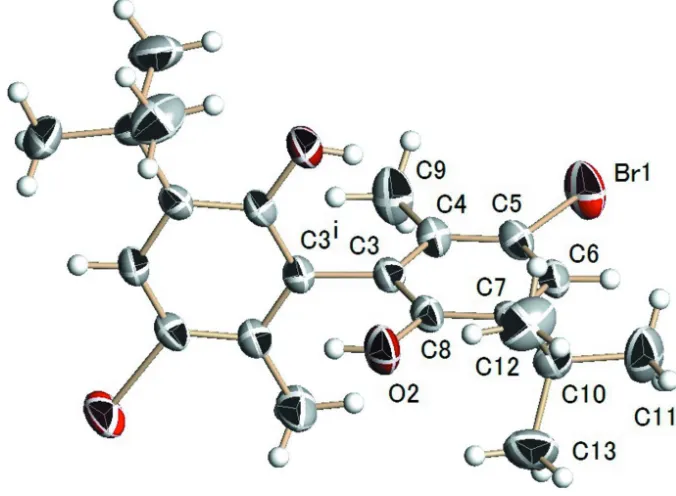
The whole molecule of the title compound, C22H28Br2O2, is
generated by twofold rotation symmetry. The dihedral angle of the biphenyl moiety is 85.05 (11). The hydroxy groups show intramolecular O—H interactions without any other hydrogen-bond acceptors. In the crystal, there are no other significant intermolecular interactions present.
Keywords:crystal structure; biphenyl; axial chirality; O—H inter-actions.
CCDC reference:1056738
1. Related literature
For the synthesis of the title compound using a transition-metal catalyst, see: Kubotaet al.(2012). For the determination of the absolute configuration of the corresponding (+)-chloro derivative,viz. S, see: Gutierrez et al.(2010). For the crystal structure of a similar compound, i.e. 5,50-dimethoxy-6,60
-di-methylbiphenyl-2,20-diol dichloromethane solvate, see: Guoet
al.(2011).
2. Experimental
2.1. Crystal data
C22H28Br2O2
Mr= 484.24 Orthorhombic,Pba2 a= 7.3680 (5) A˚ b= 22.4243 (14) A˚ c= 6.6148 (4) A˚
V= 1092.91 (12) A˚3 Z= 2
MoKradiation
= 3.72 mm1
T= 299 K
0.160.150.10 mm
2.2. Data collection
Bruker D8 VENTURE diffractometer
Absorption correction: multi-scan (SADABS; Bruker, 2014) Tmin= 0.630,Tmax= 0.773
9406 measured reflections 1966 independent reflections 1615 reflections withI> 2(I) Rint= 0.036
2.3. Refinement
R[F2> 2(F2)] = 0.031 wR(F2) = 0.065
S= 1.06 1966 reflections 123 parameters 1 restraint
H-atom parameters constrained
max= 0.48 e A˚
3
min=0.21 e A˚
3
Absolute structure: Flackx determined using 621 quotients [(I+)(I
)]/[(I+)+(I
)] (Parsons et al., 2013)
Absolute structure parameter: 0.034 (9)
Table 1
Hydrogen-bond geometry (A˚ ,).
Cgis the centroid of benzene ring C3–C8.
D—H A D—H H A D A D—H A
O2—H2 Cgi
0.82 2.54 3.047 (5) 122
Symmetry code: (i)xþ2;yþ2;z.
Data collection: APEX2 (Bruker, 2014); cell refinement: SAINT (Bruker, 2014); data reduction:SAINT; program(s) used to solve structure:SHELXS97(Sheldrick, 2008); program(s) used to refine structure: SHELXL2014 (Sheldrick, 2015); molecular graphics: SHELXTL(Sheldrick, 2008); software used to prepare material for publication:SHELXL2014andpublCIF(Westrip, 2010).
Acknowledgements
We are grateful to Nippon Soda Co. Ltd for the kind gift of 4-bromo-2-tert-butyl-5-methylphenol. This research was supported by grants from the Research and Education Center for Natural Sciences, Keio University (to SO), and Keio Gijuku Academic Development Funds (to RO).
Supporting information for this paper is available from the IUCr electronic archives (Reference: SU5104).
data reports
o278
Obataet al. doi:10.1107/S2056989015006313 Acta Cryst.(2015).E71, o278–o279References
Bruker (2014).APEX2,SAINTandSADABS. Bruker AXS Inc., Madison, Wisconsin, USA.
Guo, F., Konkol, L. C. & Thomson, R. J. (2011).J. Am. Chem. Soc.133, 18–20. Gutierrez, E. G., Moorhead, E. J., Smith, E. H., Lin, V., Ackerman, L. K. G., Knezevic, C. E., Sun, V., Grant, S. & Wenzel, A. G. (2010).Eur. J. Org. Chem.pp. 3027–3031.
Kubota, Y., Shirakawa, S., Inoue, T. & Maruoka, K. (2012).Tetrahedron Lett.
53, 3739–3741.
Parsons, S., Flack, H. D. & Wagner, T. (2013).Acta Cryst.B69, 249–259. Sheldrick, G. M. (2008).Acta Cryst.A64, 112–122.
supporting information
sup-1
Acta Cryst. (2015). E71, o278–o279
supporting information
Acta Cryst. (2015). E71, o278–o279 [https://doi.org/10.1107/S2056989015006313]
Crystal structure of 5,5
′
-dibromo-3,3
′
-di-
tert
-butyl-6,6
′
-dimethylbiphenyl-2,2
′
-diol
Rika Obata, Shigeru Ohba, Yasuaki Einaga and Shigeru Nishiyama
S1. Synthesis and crystallization
The synthesis of the title compound, (I), is described in Fig. 2. It was prepared using iodine-mediated coupling method
from 4-bromo-2-tert-butyl-5-methylphenol. To the solution of 4-bromo-2-tert-butyl-5-methylphenol (0.242 g, 1 mmol) in
dichloromethane (1 mL) was added N-iodosuccinimide (abbreviated to NIS, 0.225 g, 1 mmol) and 3% H2O2 (1 mL). After
shaking (200 rpm) the reaction mixture for 24 h at room temperature, it was poured into saturated Na2S2O3 solution, and
extracted with chloroform. The organic layer was washed with saturated NaCl and dried over anhydrous Na2SO4. The
mixture was evaporated and purified by silica-gel column chromatography to give title compound (I) as white solid
(yield: 0.138 g, 57%). 1H-NMR (400 MHz, CDCl
3) 1.32 (18H, s), 1.92 (6H, s), 4.80 (2H, s), 7.47 (2H, s). Tof-MS ES(-)
Anal. 481.0357, Calcd. 481.0378 for C22H27O2Br2. The crystals were grown by slow evaporation from a toluene/n-hexane
(1/4) solution.
S2. Refinement
Crystal data, data collection and structure refinement details are summarized in the experimental table. The hydroxyl H
atom was located from a difference Fourier map but was refined as riding (AFIX 147) with Uiso(H) = 1.5Ueq(O). C-Bound
H atoms were included in calculated positions and refined as riding: C—H = 0.93–0.96 Å with Uiso(H) = 1.5Ueq(C) for
Figure 1
The molecular structure of the title compound, with atom labelling. Displacement ellipsoids are drawn at the 50%
[image:4.610.133.471.74.322.2]probability level.
Figure 2
The synthesis of the title compound, (I).
5,5′-Dibromo-3,3′-di-tert-butyl-6,6′-dimethylbiphenyl-2,2′-diol
Crystal data
C22H28Br2O2
Mr = 484.24
Orthorhombic, Pba2 a = 7.3680 (5) Å b = 22.4243 (14) Å c = 6.6148 (4) Å V = 1092.91 (12) Å3
Z = 2 F(000) = 492
Dx = 1.472 Mg m−3
Mo Kα radiation, λ = 0.71073 Å Cell parameters from 4121 reflections θ = 2.9–23.6°
µ = 3.72 mm−1
supporting information
sup-3
Acta Cryst. (2015). E71, o278–o279 Data collection
Bruker D8 VENTURE diffractometer
Radiation source: fine-focus sealed tube ω scans
Absorption correction: multi-scan (SADABS; Bruker, 2014) Tmin = 0.630, Tmax = 0.773
9406 measured reflections
1966 independent reflections 1615 reflections with I > 2σ(I) Rint = 0.036
θmax = 25.3°, θmin = 2.9°
h = −8→8 k = −26→26 l = −7→7
Refinement
Refinement on F2
Least-squares matrix: full R[F2 > 2σ(F2)] = 0.031
wR(F2) = 0.065
S = 1.06 1966 reflections 123 parameters 1 restraint
Primary atom site location: structure-invariant direct methods
Hydrogen site location: inferred from neighbouring sites
H-atom parameters constrained w = 1/[σ2(F
o2) + (0.0176P)2 + 0.3778P]
where P = (Fo2 + 2Fc2)/3
(Δ/σ)max = 0.001
Δρmax = 0.48 e Å−3
Δρmin = −0.21 e Å−3
Absolute structure: Flack x determined using 621 quotients [(I+)-(I-)]/[(I+)+(I-)] (Parsons et al.,
2013)
Absolute structure parameter: 0.034 (9)
Special details
Geometry. All e.s.d.'s (except the e.s.d. in the dihedral angle between two l.s. planes) are estimated using the full covariance matrix. The cell e.s.d.'s are taken into account individually in the estimation of e.s.d.'s in distances, angles and torsion angles; correlations between e.s.d.'s in cell parameters are only used when they are defined by crystal symmetry. An approximate (isotropic) treatment of cell e.s.d.'s is used for estimating e.s.d.'s involving l.s. planes.
Fractional atomic coordinates and isotropic or equivalent isotropic displacement parameters (Å2)
x y z Uiso*/Ueq
Br1 1.18668 (8) 0.81211 (2) 0.48288 (15) 0.0681 (2)
O2 0.7528 (4) 0.98204 (13) 0.9897 (9) 0.0576 (8)
H2 0.7777 1.0166 0.9607 0.086*
C3 0.9856 (6) 0.96676 (17) 0.7429 (7) 0.0352 (10)
C4 1.0903 (6) 0.9290 (2) 0.6223 (7) 0.0388 (11)
C5 1.0536 (6) 0.8689 (2) 0.6397 (7) 0.0399 (11)
C6 0.9212 (6) 0.84644 (19) 0.7649 (7) 0.0394 (11)
H6 0.9023 0.8054 0.7685 0.047*
C7 0.8150 (6) 0.88292 (19) 0.8859 (7) 0.0360 (10)
C8 0.8518 (6) 0.94415 (19) 0.8707 (7) 0.0370 (11)
C9 1.2322 (7) 0.9538 (2) 0.4852 (15) 0.0650 (14)
H9A 1.1993 0.9460 0.3473 0.098*
H9B 1.3467 0.9353 0.5143 0.098*
H9C 1.2417 0.9960 0.5058 0.098*
C10 0.6668 (5) 0.8582 (2) 1.0234 (8) 0.0428 (15)
C11 0.6564 (7) 0.7905 (2) 1.0111 (14) 0.074 (2)
H11A 0.6243 0.7789 0.8761 0.111*
H11B 0.5661 0.7762 1.1039 0.111*
C12 0.7053 (8) 0.8746 (3) 1.2449 (9) 0.0756 (18)
H12A 0.8260 0.8623 1.2802 0.113*
H12B 0.6195 0.8548 1.3311 0.113*
H12C 0.6944 0.9170 1.2619 0.113*
C13 0.4827 (6) 0.8829 (2) 0.9625 (15) 0.0760 (17)
H13A 0.4791 0.9249 0.9894 0.114*
H13B 0.3893 0.8632 1.0387 0.114*
H13C 0.4634 0.8760 0.8208 0.114*
Atomic displacement parameters (Å2)
U11 U22 U33 U12 U13 U23
Br1 0.0866 (4) 0.0458 (3) 0.0718 (4) 0.0118 (2) 0.0311 (4) −0.0118 (4)
O2 0.0646 (19) 0.0366 (16) 0.072 (2) 0.0049 (14) 0.018 (3) −0.009 (3)
C3 0.040 (3) 0.030 (2) 0.036 (3) 0.0016 (19) −0.004 (2) 0.001 (2)
C4 0.048 (3) 0.033 (3) 0.035 (3) 0.003 (2) 0.002 (2) 0.000 (2)
C5 0.048 (3) 0.035 (3) 0.037 (3) 0.009 (2) 0.003 (2) −0.003 (2)
C6 0.046 (3) 0.028 (2) 0.045 (3) 0.002 (2) −0.002 (2) −0.002 (2)
C7 0.036 (3) 0.034 (2) 0.038 (2) 0.008 (2) −0.005 (2) −0.002 (2)
C8 0.042 (3) 0.031 (3) 0.038 (2) 0.006 (2) 0.000 (2) −0.005 (2)
C9 0.084 (3) 0.048 (3) 0.063 (3) 0.003 (2) 0.033 (5) −0.003 (5)
C10 0.035 (3) 0.045 (3) 0.048 (4) −0.0010 (19) 0.008 (3) 0.003 (2)
C11 0.070 (3) 0.048 (3) 0.104 (6) −0.013 (2) 0.036 (5) 0.008 (4)
C12 0.078 (4) 0.099 (5) 0.049 (4) −0.021 (4) 0.010 (3) 0.002 (3)
C13 0.039 (3) 0.086 (4) 0.103 (5) 0.005 (2) 0.012 (4) 0.020 (5)
Geometric parameters (Å, º)
Br1—C5 1.913 (4) C9—H9B 0.9600
O2—C8 1.369 (6) C9—H9C 0.9600
O2—H2 0.8200 C10—C13 1.520 (7)
C3—C8 1.394 (6) C10—C11 1.521 (7)
C3—C4 1.396 (6) C10—C12 1.537 (8)
C3—C3i 1.506 (8) C11—H11A 0.9600
C4—C5 1.379 (6) C11—H11B 0.9600
C4—C9 1.491 (8) C11—H11C 0.9600
C5—C6 1.375 (6) C12—H12A 0.9600
C6—C7 1.386 (6) C12—H12B 0.9600
C6—H6 0.9300 C12—H12C 0.9600
C7—C8 1.403 (6) C13—H13A 0.9600
C7—C10 1.526 (6) C13—H13B 0.9600
C9—H9A 0.9600 C13—H13C 0.9600
C8—O2—H2 109.5 C13—C10—C11 107.7 (4)
C8—C3—C4 121.1 (4) C13—C10—C7 110.4 (5)
C8—C3—C3i 117.3 (4) C11—C10—C7 111.5 (4)
C4—C3—C3i 121.6 (4) C13—C10—C12 109.3 (5)
supporting information
sup-5
Acta Cryst. (2015). E71, o278–o279
C5—C4—C9 123.5 (4) C7—C10—C12 110.5 (4)
C3—C4—C9 120.5 (4) C10—C11—H11A 109.5
C6—C5—C4 123.2 (4) C10—C11—H11B 109.5
C6—C5—Br1 116.5 (3) H11A—C11—H11B 109.5
C4—C5—Br1 120.3 (3) C10—C11—H11C 109.5
C5—C6—C7 122.2 (4) H11A—C11—H11C 109.5
C5—C6—H6 118.9 H11B—C11—H11C 109.5
C7—C6—H6 118.9 C10—C12—H12A 109.5
C6—C7—C8 115.3 (4) C10—C12—H12B 109.5
C6—C7—C10 122.2 (4) H12A—C12—H12B 109.5
C8—C7—C10 122.5 (4) C10—C12—H12C 109.5
O2—C8—C3 120.0 (4) H12A—C12—H12C 109.5
O2—C8—C7 117.6 (4) H12B—C12—H12C 109.5
C3—C8—C7 122.4 (4) C10—C13—H13A 109.5
C4—C9—H9A 109.5 C10—C13—H13B 109.5
C4—C9—H9B 109.5 H13A—C13—H13B 109.5
H9A—C9—H9B 109.5 C10—C13—H13C 109.5
C4—C9—H9C 109.5 H13A—C13—H13C 109.5
H9A—C9—H9C 109.5 H13B—C13—H13C 109.5
H9B—C9—H9C 109.5
C8—C3—C4—C5 −0.5 (6) C3i—C3—C8—O2 0.0 (6)
C3i—C3—C4—C5 178.5 (4) C4—C3—C8—C7 0.1 (7)
C8—C3—C4—C9 179.6 (5) C3i—C3—C8—C7 −179.0 (4)
C3i—C3—C4—C9 −1.4 (7) C6—C7—C8—O2 −178.9 (4)
C3—C4—C5—C6 0.9 (7) C10—C7—C8—O2 1.9 (6)
C9—C4—C5—C6 −179.3 (6) C6—C7—C8—C3 0.1 (6)
C3—C4—C5—Br1 179.9 (3) C10—C7—C8—C3 −179.1 (4)
C9—C4—C5—Br1 −0.2 (7) C6—C7—C10—C13 −118.6 (5)
C4—C5—C6—C7 −0.8 (7) C8—C7—C10—C13 60.5 (6)
Br1—C5—C6—C7 −179.8 (3) C6—C7—C10—C11 1.0 (6)
C5—C6—C7—C8 0.3 (7) C8—C7—C10—C11 −179.8 (5)
C5—C6—C7—C10 179.4 (4) C6—C7—C10—C12 120.4 (5)
C4—C3—C8—O2 179.0 (4) C8—C7—C10—C12 −60.5 (6)
Symmetry code: (i) −x+2, −y+2, z.
Hydrogen-bond geometry (Å, º)
Cg is the centroid of benzene ring C3–C8.
D—H···A D—H H···A D···A D—H···A
O2—H2···Cgi 0.82 2.54 3.047 (5) 122