Users’ experiences of an online intervention for Bipolar Disorder: important lessons for
design and evaluation
Alyson L. Dodd
1, 2Sara Mallinson
3Martin Griffiths
2Richard Morriss
4Steven H. Jones
2Fiona Lobban
21
Department of Psychology, Faculty of Health & Life Sciences, Northumbria University,
Newcastle-upon-Tyne, United Kingdom
2
Spectrum Centre for Mental Health Research, Division of Health Research, Faculty of Health
& Medicine, Lancaster University, Lancaster, United Kingdom
3
Alberta Health Services/Community Health Sciences, University of Calgary, Canada
4
Department of Psychiatry and Applied Psychology, Institute of Mental Health, University of
Nottingham, Nottingham, United Kingdom
Corresponding author: Dr Alyson Dodd, Department of Psychology, Northumberland
Building, Northumbria University, Newcastle-upon-Tyne, United Kingdom. Tel: 0191 243
ABSTRACT
Background:The evidence-base for digital interventions for physical and mental health, including
severe and enduring mental health difficulties, is increasing. In a feasibility trial, web-based Enhanced
Relapse Prevention (ERPonline) for bipolar disorder demonstrated high recruitment and retention
rates. Relative to participants in the waitlist control group, those who received ERPonline showed
increased monitoring for early warning signs of relapse and had developed more positive illness
models.
Objective:To understand users’ motivations and barriers for taking part in an online/telephone-based
trial, and for engagement with ERPonline.
Methods:Participants from the trial who had been allocated to receive ERPonline were purposively
sampled to participate in telephone-based, in-depth qualitative interviews about their experiences.
Interviews (n =19) were analysed using framework analysis to identify themes relevant to study
aims.
Findings:Participants took part due to the convenient, flexible, and rewarding aspects of the trial
design, as well as a desire to improve the mental health of themselves and others. Barriers included
extensive assessments, practical difficulties, and mood. ERPonline was was generally considered to
be accessible, relevant and straightforward, but there were individual preferences regarding design,
content, and who it was for. Several participants reported positive changes, but there was a sense that
digital interventions should not replace routine care.
Conclusions:There are a number of barriers and facilitators to consider when evaluating and
implementing digital interventions. Individual preferences and human contact were key factors for
both trial design and engagement with an online intervention.
Clinical Implications:Digital interventions should be co-produced, personalised, interactive, and
embedded as one component in a broader package of care.
BACKGROUND
Evidence for feasibility, acceptability, and efficacy of web-based mental health interventions is growing
rapidly, particularly for conditions like anxiety and depression.[1] Early evidence indicates that online
interventions may have similar utility for more severe and enduring conditions, such as bipolar disorder
(BD) and psychosis.[2,3] Unfortunately, there are insufficient definitive trials to support the scale-up
and spread of web-based interventions for people with BD. We know that people with mental health
problems may have challenges in engaging with web-based interventions [4] and that levels of use are
likely to be even lower in real world settings than in research settings.[5] Therefore, it is important to
examine users’ subjective experiences of emerging web-based interventions to better understand the
factors shaping recruitment, retention and engagement. By identifying and addressing barriers and
facilitators to each stage, we can increase the likelihood of people engaging with programs within and
outside trial settings.
For this purpose we built in a nested qualitative study into an online feasibility trial of Enhanced Relapse
Prevention (ERPonline) for BD (trial registration number: ISRCTN56908625).[6] Participants who
received ERPonline were invited to interview, as they were able to feedback on multiple aspects of the
feasibility trial; both user views of the intervention, and the research process. ERPonline is a
self-directed web-based intervention to help people develop a coherent working model of their mood
changes, recognise and manage triggers and early warning signs (EWS), and develop effective coping
strategies (see Table 1). Although ERPonline is an unsupported intervention, participants were able to
submit technical support queries and potential contributions to a ‘frequently asked questions’ page via
the website. The main study was a single blind randomised controlled trial. Participants (n =96) were
randomly allocated to receive access to ERPonline for 12 months, or to a waitlist control (WLC) arm.
Both arms received treatment as usual throughout, and the WLC were given access to ERPonline when
the trial ended. Observer-rated assessments were conducted by research assistants via telephone every
12 weeks from baseline to 48 weeks, with additional online self-report questionnaires every 24 weeks.
follow-up assessment being due, to facilitate retention and allow participants to raise any questions or concerns
they had about the trial. For further details on the program content, trial design and findings of the
[image:4.595.77.545.191.765.2]overall study see Lobban et al.[6,7]
Table 1: Intervention modules in ERPonline [6,7]
Getting started
How to use the site
Tips for navigation and getting the best
from modules, overview of ERPonline
(rationale/aims, how to involve a
supporter)
What is bipolar?
Information about bipolar disorder:
theories about causes, impact, existing
treatments
Key modules
Mood Charting
Online tool to monitor mood daily basis in
order to identify deviations from usual
mood and early signs of a mood episode
Life Charting
Charting tool for past mood episodes,
identifying triggers and developing
effective coping strategies for early
warning signs (EWS)
Identifying triggers
Focuses on identifying triggers of previous
mood episodes to develop a personalised
plan for managing triggers
Early warning signs (high
mood) and coping strategies
Focuses on identifying EWS of high mood
to develop a relapse signature for
Specific moods
Evaluate own strategies currently used to
manage (hypo)mania and introduction to
helpful coping strategies
Early warning signs (low
mood) and coping strategies
Focuses on identifying EWS of high mood
to develop a relapse signature for
depression.
Evaluate own strategies currently used to
manage depression and introduction to
helpful coping strategies
Wrapping things up
Staying well strategies
Recognising and managing/regulating
stress levels and social rhythms, and the
impact on interpersonal relationships on
mood.
Staying well plan
Develop personalised plan comprising
own staying well strategies and EWS, and
helpful coping strategies for mood
management
OBJECTIVE
To understand the subjective experience of: i) taking part in an RCT delivered primarily online ii) using
ERPonline.
In the trial, inclusion criteria were i) research diagnosis of BD 1 or 2 assessed using the SCID; ii)
telephone and internet access, iii) ability to understand written and spoken English, iv) at least 3
lifetime relapses, one within the previous 2 years, and v) aged 18 years or over. During online consent
for the trial, all participants in the intervention arm (n= 46) were invited to take part in a qualitative
interview about their experiences. Purposive sampling of those who agreed was used to capture a
balance of gender, age and amount of time spent on the ERPonline website. Nineteen people were
interviewed.
Procedure
A member of the research team (MG) conducted all the topic guided qualitative interviews by
telephone. The topic guide [8] was created by the research team with support from the Service User
Reference Group (SURG), who also helped refine the phrasing and flow of questions and prompts
through pilot interviews. The topic guide provided structure to the interviews, whilst allowing some
flexibility to manage the flow of the interview and raise new issues where appropriate. Interviews
covered the following: participation in research; barriers and facilitators to using ERPonline; and
reflections on using online support. Participants were given a £10 shopping voucher as a thank you.
Data Analysis
Interviews were digitally recorded and transcribed verbatim. Transcripts were analysed using
indexing and charting methods inspired by Framework Analysis, chosen for its structured approach to
re-ordering and analysing data as study was nested in an evaluation of a novel intervention, with
specific issues to explore.[9] Initially, all transcripts were independently read by the interviewer (MG)
and a second member of the research team in order to develop a tentative coding frame with thematic
headings. The themes were a blend ofa prioriresearch interests (related to the direction provided by
the topic guide) and thoughts/ideas that had arisen in the interviews. Preliminary codes were tested on
a small number of transcripts and were then were checked by the SURG to help establish the validity
After addressing feedback from the SURG, the coding frame and themes were agreed and the team
began applying it to the transcripts. Data were summarised into individual thematic tables, helping the
team to focus on key information and patterns in the data. Where necessary, themes were refined as
the analysis proceeded and divergent data were captured.
FINDINGS
Interviews lasted between 22 and 88 minutes. Our findings are structured around the following key
themes: the experiences of taking part in the research – in particular the barriers and facilitators to
both recruitment and retention; engagement with the ERPonline website; who ERPonline should be
aimed at; the likely positive changes that may come from using the site, and the role such an online
intervention can have in broader mental health services. These themes are elaborated in detail below.
Experience of taking part in the research: Barriers and facilitators
Recruitment
The trial had good recruitment and retention rates and distinctive sample characteristics.[6] These
characteristics (low relapse, more likely to be highly educated and in employment) were mirrored
here; 73% (n= 14) were educated to degree level or higher, and the same proportion were currently
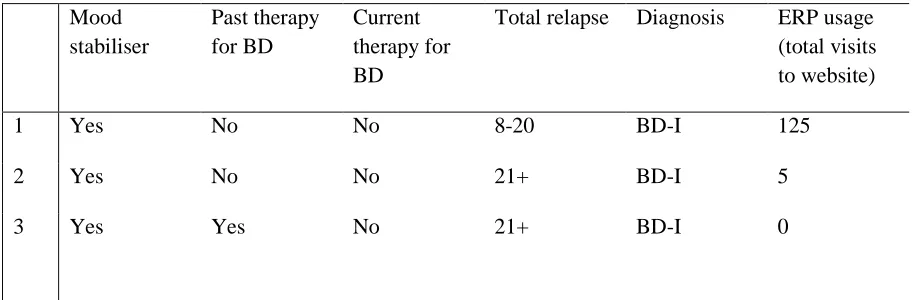
employed. The mean age was 42 years and 53% (n =10) were female. Clinical characteristics are
[image:7.595.71.532.609.759.2]given in Table 2.
Table 2: Participant clinical characteristics
Mood stabiliser
Past therapy for BD
Current therapy for BD
Total relapse Diagnosis ERP usage (total visits to website)
1 Yes No No 8-20 BD-I 125
2 Yes No No 21+ BD-I 5
4 Yes Yes Yes 21+ BD-II 123
5 Yes No No 21+ BD-I 3650
6 Yes Yes No 1-7 BD-I 1
7 No No No 21+ BD-I 29
8 No No No 21+ BD-I 2016
9 Yes Yes No 21+ BD-I 182
10 Yes Yes Yes 21+ BD-I 62
11 Unknown/no Yes No 21+ BD-I 9
12 Yes No No 8-20 BD-I 85
13 Yes Yes No 8-20 BD-II 207
14 Yes Yes Yes 8-20 BD-I 96
15 Unknown/no Yes No 1-7 BD-I 173
16 Yes Yes No 21+ BD-I 515
17 Yes Yes No 8-20 BD-I 242
19 Yes No No 8-20 BD-I 129
Interview feedback suggests that the diverse modes and sources of recruitment sources (e.g. mental
health services, the internet, and traditional media) underpinned successful recruitment. In addition,
most people found registration and consent straightforward, helping to preserve interest in the
program in the early stages. Intrinsic motivators for participation included curiosity and interest
around new ideas and supporting research on BD.
“I was intrigued about new research and any new tools that could be available for people with mental
health problems especially BD. And my son also has BD.”(8)
Alongside being motivated to take part to help understand and manage their mood through accessible
support, the most frequently mentioned facilitator was a desire to help other people and be part of a
“wider community”.
“I felt that…this might be a useful tool for me to stay on top of the condition and I just felt motivated
to kind of be part of the community of people who are looking to tackle this condition and provide my
input.”(6)
Retention
Key facilitators for high retention were positive human contact from researchers, and trusting that the
intervention and trial protocol had been developed by people with relevant expertise and lived
experience.[6] This human contact would not have featured in a completely online trial using only
self-report measures, and should not be underestimated as it explain higher retention rates compared
to online trials without researcher contact.[10] Facilitators are elaborated in more depth here.
Intrinsic motivators included commitment to continuing the process and a sense of ERPonline
“I committed to, you know, see it through. And if I’ve committed to seeing something through then
unless I’ve got a problem with it, I will do that.”(5)
“I hoped that the ERP would really help me, really be a useful tool to help me manage my
Bipolar[…] I thought maybe there’d be some new or different things on it that I hadn’t already
thought of or knew about.”(18)
Reward was another facilitator. While several participants said they were pleased to have been allocated
to the treatment arm, many acknowledged this did not matter as the WLC design ensured they would
have access afterwards anyway (notably, retention was higher in the WLC arm in the trial).[6]
Participants also appreciated the shopping vouchers given after follow-up assessments.
“…whichever group you were in you still got access to it. So I thought it was definitely worth
persevering with…Yeah, that [Amazon vouchers] was definitely a good incentive”(17)
While acknowledging vouchers were pleasant, convenience and flexibility appeared to be more
important facilitators. Researchers arranged follow-up assessments in the evenings where necessary.
User-centred arrangements allowed people to integrate participation into their daily routines with
relative ease.
“There were no problems as such because the interviews were timed to my, you know, when it was
convenient for me[…]having both e-mail and telephone communication was good it meant that I
could say when I was free.”(7)
Three people commented that telephone interviews were preferable to face-to-face due to ease of
setting up, and feeling more comfortable answering sensitive questions without an interviewer
physically present. Many participants felt the interviews were routine due to having a long history of
being “out” as bipolar and of divulging personal experiences in research and/or to mental health
“…I find every time I do an interview like that or a questionnaire it does help me focus which is
usually quite helpful and just summarise for myself, right this is how I’ve been the last few months,
this is how I am now. And it helps me keep on track...”(3)
However, there were comments about extensive, repetitive and time-consuming data collection. Past
experience with clinical and research assessments may have made this less of a barrier. This raises the
question of whether the trial design suited those who had been more recently diagnosed and had less
experience of research.
“…you get used to sharing your thoughts with people[…]when I was first ill sharing your thoughts
with people was quite difficult. But having sort of coped this long I’ve had to share my thoughts with
quite a lot of people down the line so it’s more a question of you kind of get used to doing it, yeah?”
(9)
One participant reported difficulty remembering mood experiences between follow-ups, and three
forgot appointments. Reminder emails and general communication were practical and appreciated.
“…my mood at that time for the last appointment I think was quite high and my concentration was
bad. I essentially forgot the appointment […] So it kind of wasn’t me not wanting to do it so much as
forgetting...”(3)
Mood was a barrier to engaging with follow-up assessments. Three participants found assessments
challenging or “emotionally draining”.
“It was a little uncomfortable at times but that’s because they’re uncomfortable experiences really. So
the questions are phrased in a very sensitive way and […] they didn’t make me upset sort of thing […]
when you look back you kind of think, oh my God. I was in quite a state at one time.”(7)
Whilst it did not jeopardise their ongoing participation, one participant questioned whether it may
mood symptoms. As such, it is important to bear in mind the sensitive nature of assessments about
mood that can seem routine for some, but triggering for others, in all trials.
Engagement with ERPonline site
Activity levels across the whole sample allocated to ERPonline were skewed in the trial.[6] Those
who participated in the interviews were sampled across the range of usage levels (which varied
between 0 and 3203 number of page views, median 85 in the main trial).[6] Participants’ accounts of
what determined when and how they used ERPonline illustrated barriers and facilitators to
engagement specific to BD and others likely to have relevance to online interventions more generally.
Facilitators
Participants commented that they liked how ERPonline looked and its easy-to-navigate modular
structure. Most viewed ERPonline as straightforward, normalising, and clearly worded.
“It looks like a well-designed site[…]you can come across all sorts of sites that just aren’t user
friendly whatsoever[…]it was clear what you had to do and where you had to go. I particularly
enjoyed it when it said you’ve completed a module. I don’t know how you feel good when it says
you’ve completed a module.”(19)
In line with a systematic review of the acceptability of digital interventions for severe mental health
difficulties,[11] personalised and interactive elements such as videos of people sharing their lived
experience, mood and life charting, and relapse prevention strategies were well-liked.
“It’s not just kind of like if you were to read a book[…]it’s more than just education and information
because you’re actually able to put in your own stuff to personalise it and make it relevant to you.”
(15)
In line with this, life and mood charting modules were the most frequently visited during the trial.[6]
with the material and the personal experiences depicted in videos, facilitating self-awareness and
feeling less isolated. ERPonline was developed purposely for managing BD, which set it apart from
other support.
“…it’s for people with BD. And it gives you far more information about the causes of BD, or possible
causes of BD[…] if people haven’t done a WRAP [Wellness Recovery Action Plan] plan, this is
something [that is] far more focussed on BD that would be probably as helpful to some people that
don’t want to do something in a group for example.”(8)
Given this, several participants appreciated ERPonline being there and would recommend it to anyone
with BD. A few participants went beyond this to state that ERPonline would be useful for people with
recurrent depression, and relatives - supporting the need for web-based support for relatives, for
which there is growing evidence.[12]
“I’d recommend it to anybody that’s, not even necessarily got Bipolar, but if they’re just a regular
sufferer from a depression. Because I think your bits on the lows are really good as[…]they’re
separated aren’t they so people that just suffer the lows would find this really useful[…]I haven’t
recommended it to my family yet because they’re [overseas] but, you know, families could easily use
this to[…]work through and get a bit of a better idea with what’s going on with their loved one.”(11)
In line with previously reported findings that perceived trustworthiness of the team was important for
retention and engagement in both trial arms,[6] seven participants reported feeling at ease with using
the website due to the expertise of the research team. One noted that the information on BD that is
available on the internet ranges in its accuracy, so trusted sources are valuable. Another likened the
appearance of ERPonline to a ‘government’ medical website, which reassured them.
As would be expected given they consented to participate in a trial of a web-based intervention, this
format was not raised as an issue, as with other online interventions. [13,14] Participants described
“You did feel like there were real human beings behind it. And so, I think, that did make you feel like
you had[…]a relationship and wanting to go back and fill your mood chart in again. You sort of felt
like[…]if you didn’t do your mood chart for that day you were sort of letting the chart down in a
way.”(16)
Barriers
Extrinsic barriers included time constraints and competing demands, such as work, hobbies, and
social life. This is in line with previous studies exploring user views of web interventions for BD and
beyond.[13,14,15] Many stated that they felt obliged to use ERPonline due to the research, and that
they hadn’t used it as much as they should, which raises questions engagement in a real world setting.
Suggested solutions included reminders, and help to prioritise modules that had not been accessed.
“I haven’t made the decision to use the website or I haven’t been getting reminders from you enough
that I should be using the website[…]Too busy, I haven’t clocked on[…]It’s just generally being busy
and focusing on other things.” (6)
Access to private space was also an issue, with participants stating they did not want to use ERPonline
in public, at work, or in front of their family at home. They were concerned about interruption and
inadvertently divulging personal information. Privacy is a key concern about digital approaches.[11]
“…when you’re putting in your information about your illness and stuff, I don’t know I feel like that’s
personal so I wouldn’t really want to do that in front of other people.”(19)
One participant actively disliked how ERPonline looked, preferring more muted colours.
“I just found them too bright and childish.”(4)
Some Smartphone apps for supporting severe mental health problems (e.g. ACTISSIST) allow
customisation of appearance within parameters.[16] It remains to be seen if this improves usage, but is
A need for more built-in technical and emotional support with digital interventions was highlighted by
participants, with computer literacy raised as a potential issue, and one participant suggesting having a
“computer therapist on screen”.
A further participant felt the content lacked “bite” and was too superficial, whilst acknowledging that
this may depend on individual knowledge and experience.
“I would have liked to have seen a lot more information at different levels. Sort of the starter
and then directing into here is - if you want to get right under the hood of this stuff, then
here’s the information.”(4)
This is in line with views on other web-based interventions (e.g., Online Bipolar Education Program)
where simplistic and impersonal information was viewed negatively.[13] There were also mixed
views on how interactive and personalised ERPonline was. There is evidence from the wider literature
that these elements are valuable, and perceiving added value is important for engagement.[11,15,17]
Efforts must be made to meet different needs by featuring more opportunity for personalisation. This
is relevant to mixed views that emerged regarding who should be offered ERPonline and when.
Who is ERPonline for?
Some participants believed ERPonline was more useful for those with an established diagnosis.
Others stated the opposite and felt that information was pitched at those coming to terms with a new
diagnosis, and was overly basic for those with more experience. This may explain quantitative
findings that introductory modules, including ‘What is Bipolar?’, were among the least frequently
accessed.[6]
“…it was for people for really didn’t know an awful lot. It might be fine for people who have just
been newly diagnosed[…]and maybe struggling with, you know, at the early stages of the illness.”(4)
“I find that when I’m not feeling well that I go back and do it and when I’m feeling well, I’ve got
other things I want to do and I can’t be bothered…I haven’t done it for quite a little while because I
felt well.” (9)
Others perceived difficulties using the website when unwell, in line with views on other web
interventions for both mental and physical health.[5,13,15] This has implications for retention to
online data collection.
Whilst no specific negative impacts were identified, one participant did express concern that mood
charting could lead to unhelpful rumination for some people. Any indication of potential harm is
important and future research must explore this issue further:
“…mood mapping for me induces rumination. It doesn’t help. And, as I say, it can be difficult to
remember certain things and stuff like that. So you’re looking obviously retrospectively and writing
things down and that depends on your own mood at the times. So you’re reflecting on something in
the past through the eyes of your current mood…and I found that quite destructive actually.”(4)
Positive changes
Seven participants reported that they had already been using strategies before ERPonline (e.g., mood
charting). Eleven reported being more sensitive to triggers and EWS, and better able to proactively
and effectively use coping strategies.
“It’s just keeping an eye when I’m a little bit more lively. Making sure I still go to bed at a sensible
time. Eating better. Just routine…But most important is the mood monitoring daily…Because without
it I won’t know whether I’m going up or down.”(1)
Recognition of their own mood patterns after using ERPonline was specifically mentioned by two
“It’s actually made a massive difference to me[…]Well I’ve identified the cycle[…]And that is huge
because it means that I can reduce drugs at certain times, increase them at other times[…]and that
will benefit my health in the long run because obviously the mood stabilisers and anti-psychotics do
have side effects.”(1)
Beyond identification of EWS and implementing coping strategies to avoid relapse, further positive
change included having more acceptance over their condition, increased confidence, and a renewed a
sense of control across many domains of functioning. This mirrors findings that ERPonline was
related to more monitoring for EWS and positive illness models,[6] as was the case for online
psychoeducation.[10]
“…it [ERPonline] gave me the confidence to actually embark on a relationship for the first time in 5
years. Which is going really, really well. And I think it’s partly that I felt like less of a freak because I
knew that there’s a website there and there’s loads of people on the research project. There’s even
more people than that got the same symptoms that are described on the website. So that’s been a big
help. It’s just given me more confidence..” (2)
This suggests web interventions are able to influence mechanisms of change, even in a basic form, but
there is limited quantitative evidence that this has a reciprocal impact on outcomes. However, one
participant gave a solid example of how she prevented a relapse because of ERPonline.
“… I was getting a bit high in mood earlier in the month[…]and my husband was quite worried about
me. So that’s when I printed off the staying well plan[…]and took it to the doctor and just sort of
showed him to sort of explain how I work really… So possibly it helped to prevent a relapse because I
was my mood was changing quite a lot[…]and I feel like possibly I prevented - I did prevent a
relapse”(19)
Participants typically had a long clinical history. Most had not used an online intervention before, but
had used the internet for finding information and forums. The majority felt that ERPonline offered a
more tailored, comprehensive, and interactive approach by comparison.
“Well it’s just like a complete package really. I mean it wasn’t as thorough as some of the BP
[Bipolar] information you can get but as a complete package. I haven’t seen anything like that at
all...Well it’s like an A-Z of Bipolar and how you manage the condition. And how you get to know
yourself. And the condition in yourself.”(1)
Many people mentioned having had previous psychological therapy and felt that these approaches
were helpful. ERPonline was perceived as maintaining and reinforcing usual care, and participants
recognised that it could be easily integrated. A key finding reported elsewhere [6] was that online
should not replace face-to-face support; this concern has been raised with other digital
interventions.[17] However, four participants expressed preference for aspects of ERPonline; personal
control of the frequency and timing of engagement, and not contending with interpersonal dynamics,
waiting lists or large caseloads. Three participants specifically said they had shared ERPonline with
their psychiatrist or care co-ordinator. Others were prompted to seek treatment due to using the
website, raising an important question about whether service use increases by using online
interventions, or whether services are accessed more quickly, reducing further usage down the line:
“…seeing it written down made me think, yeah, actually I need to go [to doctor] about this.”(13)
Two people referred to ERPonline as part of apersonalised“toolbox” of options, resonating with
findings that people with BD who had not relapsed for two years, and were high functioning, used
three or four proactive approaches to staying well.[18]
“Mental health comes as a package which needs to be catered to the individual and the more
information you have, the more tools you have in your box, the more likely you are to be able to live a
DISCUSSION
Recruitment, retention and engagement
Participants in this study were describing their experiences of taking part in the ERPonline trial and
generally spoke favourably about the trial design, which was conducted via telephone and
internet.[6,7] Online trials offer low cost evaluation of interventions, but it is important to consider
both intrinsic and extrinsic motivators for participating. For this group, who were generally high
functioning and recruited mostly outside of mental health services despite reporting high past usage,
these were convenience and flexibility, reward, improving mental health, and a desire to help others
and to be part of a community. Human contact as part of the experience was crucial. Barriers were
extensive follow-up assessments, forgetting appointments, difficulties remembering past mood, and
current mood.
Perceived strengths of the ERPonline website design included ease of navigation and use,
interactivity, and relevant, comprehensive content. The opportunity to develop individualised staying
well plans and mood charts, and specific focus on bipolar, supported the feeling of personal relevance.
Perceived lack of technical and emotional support was a barrier, again highlighting the need for
human contact. Appearance and content were not universally liked. Some found the depth of
information superficial and lacking novelty, while many participants found it useful and enlightening.
There was some discrepancy over whether ERPonline was purely an information source versus an
interactive, personalised intervention. This highlights the range of mixed perspectives and
preferences.
Opinion also differed on when ERPonline should be offered, to whom, and alongside what. Different
views and ways of using ERPonline emphasise the importance of personalisation and choice in online
interventions to meet diverse needs and preferences. Needs are likely to be different depending on
What did ERPonline change?
ERPonline resulted in more positive models of BD and EWS monitoring,[6] highlighting that trials
should evaluate impact on mechanisms as well as outcomes. These outcomes were elaborated here.
Many participants reported that ERPonline brought about a sense of well-being through feeling less
isolated, increased confidence, being proactive about engaging in self-management, and seeking
treatment. Enhanced well-being and self-efficacy, and decreased internalised stigma, are potentially
important outcomes for future trials. Participants noted overlap with existing coping strategies and
care planning, and potential for integration with routine services, meaning interventions like this may
be good for reinforcing existing support.
Limitations
Participants from the WLC were not interviewed, although questionnaire data collected online and
reported elsewhere showed similar views regarding online trial designs and the need for web
interventions to enhance rather than replace face-to-face services.[6]
The current sample were mostly recruited online, had low relapse throughout,[6] and none of the
participants had dropped out of the trial when they were interviewed, although at least four had used
the website very little or not at all (Table 2). It is likely that, as in the Bipolar Education Program
trial,[13] non-adherence will be higher in those recruited from a clinical setting or experiencing more
severe mood disruption.
As this was purposeful qualitative research within the context of a feasibility trial, not an exploration
of an undefined or unknown experience, framework analysis was used. This can be seen as
constraining the data. However, interviews were topic guided, allowing the researchers to explore
emerging ideas (which would not be achieved from a survey).
These findings are from a feasibility trial of one web-based intervention for BD, yet in line with a
systematic review of barriers and facilitators to using mental health interventions online,[4] this study
highlighted several important factors to bear in mind when designing online interventions and the
trials to evaluate them.
There were individual preferences in look and feel, and strong indications that online interventions
need to be interactive, trustworthy and embedded in a broader social relationship. A diversity of
approach is required to give people choice and a range of options to allow them to meet their own
needs. Given heterogeneity about what people want and when they want it, and evidence that people
can view digital interventions as irrelevant to their individual needs,[17] digital interventions could
offer personalised pathways. Meaningful co-production would help with this, as well as alleviating
issues of trust.
It is vital to ensure that web interventions are appropriately resourced. Technical and non-technical
support is important to uphold accessibility, motivate people to engage, and ensure use is part of a
broader support package. This could be done by involving healthcare professionals or engaging peer
supporters, as is being done in the online Relatives Education And Coping Toolkit (REACT) trial.[19]
It is difficult to track and encourage usage of online interventions, where there is no expectation to
attend face-to-face sessions. It is unclear if motivation to engage would be present without human
contact, and there is already evidence that people are using online interventions for less time in the
real world.[5] It may be that people are more likely to stop using web interventions if expectations are
disappointed. The importance of investigating ‘hypothetical acceptability’ prior to use has been
highlighted and is an important consideration for future trials.[11]
Future Directions
These findings have broad implications for how to develop, evaluate, and implement digital
level of usage is most effective and how can users be supported to engage at that level? How can
professionals and other supporters be involved in supporting digital interventions, and where do these
fit into healthcare? These questions are important given the growing number of digital interventions
for mental health conditions that are currently under development.
Acknowledgements
Ethical approval was obtained from the UK National Research Ethics Service and Lancaster
University Research Ethics Committee. The ERPonline feasibility trial was funded by the National
Institute for Health Research Research for Patient Benefit scheme (PB-PG-0211-10001). This trial is
registered with the ISRCTN (56908625) since 26/03/13.
The authors developed the ERPonline intervention so this is not an independent evaluation. There are
no further conflicts of interest.
Author contributions: AD was trial manager and prepared the current manuscript; SM was a
co-investigator who supported the PI in the design of this nested qualitative study, provided
methodological supervision to MG, and contributed to analysis; MG collected and analysed the data;
SJ and RM were co-investigators and contributed to the design, analysis and interpretation of data; FL
was the Principal Investigator of the ERPonline feasibility trial and as such led the design,
implementation, analysis and write up of all aspects of the research. All authors have commented on
![Table 1: Intervention modules in ERPonline [6,7]](https://thumb-us.123doks.com/thumbv2/123dok_us/8568711.367819/4.595.77.545.191.765/table-intervention-modules-in-erponline.webp)