warwick.ac.uk/lib-publications
Manuscript version: Author’s Accepted Manuscript
The version presented in WRAP is the author’s accepted manuscript and may differ from the published version or Version of Record.
Persistent WRAP URL:
http://wrap.warwick.ac.uk/106498
How to cite:
Please refer to published version for the most recent bibliographic citation information. If a published version is known of, the repository item page linked to above, will contain details on accessing it.
Copyright and reuse:
The Warwick Research Archive Portal (WRAP) makes this work by researchers of the University of Warwick available open access under the following conditions.
© 2018, Elsevier. Licensed under the Creative Commons Attribution-NonCommercial-NoDerivatives 4.0 International http://creativecommons.org/licenses/by-nc-nd/4.0/.
Publisher’s statement:
Please refer to the repository item page, publisher’s statement section, for further information.
Two-step method for radiative transfer calculations in a developing
pool fire at the initial stage of its suppression by a water spray
Leonid A. Dombrovskya,b,c,1, Siaka Dembelea, Jennifer X. Wend, and Ivan Sikicd
a Department of Mechanical & Automotive Engineering, Kingston University, London, SW15 3DW, UK b Joint Institute for High Temperatures, 17A Krasnokazarmennaya St, Moscow, 111116, Russia
c
The University of Tyumen, 6 Volodarsky St, Tyumen, 625003, Russia d School of Engineering, University of Warwick, Coventry CV4 7AL, UK
Abstract
A procedure based on two-step method is suggested to simplify time-consuming spectral
radiative transfer calculations in open flames containing scattering particles. At the first step of
the problem solution, the P1 approximation is used to calculate the divergence of radiative flux,
and it is sufficient to determine the flame parameters. The second step of solution is necessary
to obtain the radiation field outside the flame, and this can be made independently using the
ray-tracing procedure and the transport source function determined at the first step. Such a splitting
of the complete problem results in much simpler algorithm than those used traditionally. It has
been proved in previous papers that the combined two-step method is sufficiently accurate in
diverse engineering applications. At the same time, the computational time decreases in about
two orders of magnitude as compared with direct methods. An axisymmetric pool fire at the
initial stage of fire suppression by a water spray is considered as the case problem. It is shown
that evaporating small water droplets characterised by a strong scattering of infrared radiation
are mainly located in regions near the upper front of the flame and one can observe the scattered
radiation. This effect can be used in probe experiments for partial validation of transient
Computational Fluid Dynamics (CFD) simulations.
Keywords: radiation; developing pool fire; fire suppression; water droplets;
computational method.
1 Corresponding author. Tel. +7 910 408 0186
Nomenclature
𝐴 area of boundary surface
𝑎 radius of droplet
𝑐 specific heat capacity
𝐷 radiation diffusion coefficient
𝐸 normalized coefficient
𝑓𝜈 volume fraction of droplets
𝐹 function introduced by Eq. (10)
𝐺 irradiation
𝑔 acceleration of gravity
𝐼 radiation intensity
𝐾 coefficient introduced by Eq. (24b)
𝑘 thermal conductivity
𝐿 latent heat of evaporation
𝑙 coordinate along the ray
𝑚 complex index of refraction
𝑛 index of refraction
𝑄 efficiency factor
𝑞⃗ radiative flux
𝑟 radial coordinate
𝑟⃗ spatial coordinate
𝑆 radiative source function
𝑠 flame thickness along the ray
𝑇 temperature
𝑡 time
𝑢 velocity
𝑥 diffraction parameter
𝑉 volume
𝑊 divergence of radiative flux
𝑧 axial coordinate
Greek symbols
𝛼 absorption coefficient
𝛽 extinction coefficient
𝛾 coefficient introduced by Eq. (24b)
𝜀 spectral emissivity
𝜁 coefficients in Eq. (25c)
𝜂 dynamic viscosity
𝑘 index of absorption
𝜆 wavelength of radiation
𝜇̅ asymmetry factor of scattering
𝜇0 cosine of scattering angle
𝜉 coefficient in Eq. (25a)
𝜌 density
𝜎 scattering coefficient
𝜏 optical thickness
𝜒 functional (9)
Φ scattering phase function
𝜑 coefficient introduced by Eq. (25c)
𝜓 coefficient introduced by Eq. (24b)
Ω
⃗⃗⃗ unit vector of direction
Subscripts and superscripts a absorption
b blackbody
cl cloud
d droplet
eq equilibrium
g gas
j spectral band number
max maximum
rel relaxation
s scattering
sat saturation
tr transport
w water, wall
λ spectral
0 initial value
1. Introduction
Radiative transfer calculations are the most time-consuming in CFD simulation of fires.
Therefore, the use of a simple but sufficiently accurate method for the radiative transfer is critically
important to improve the computational costs of CFD codes. A numerical analysis of suppression of
fires by water sprays is possible only with the use of spectral models because the optical properties
of water droplets cannot be considered on the basis of a gray model [1]. In most cases, there is no
need for a very detailed radiation field in CFD calculations. Only the total or integral (over the
spectrum) radiative flux divergence is important because this term is needed in the energy equation
that couples thermal radiation with other modes of heat transfer. It means that one can consider a
differential approach instead of the radiative transfer equation (RTE). Such a choice is really
systems [1, 2]. The P1 (the first-order approximation of the spherical harmonics method) [1–4] is
the simplest method of this type, and there is a very positive long-time experience of using this
approach in diverse multi-dimensional problems [1, 5–17]. It appears to be sufficiently accurate in
the case when one needs only the divergence of radiative flux in the energy equation. Moreover, it
was shown in recent paper [18] that the P1 error is sometimes less than that of the finite-volume
method.
It was demonstrated in early papers [19–21] that P1 approximation may give incorrect values of
radiative flux near the boundaries of the computational region in the case of a strong decrease of
temperature or extinction coefficient of the medium towards the region boundaries. Unfortunately,
this is the case for open flames. Therefore, the second step of the computational radiative transfer
model is necessary. This can be done using the transport approximation [12] and a ray-tracing
procedure for the RTE with the transport source function determined at the first step of solution. In
particular, this combined two-step method presented in papers [5, 19, 20] was successfully
employed in recent paper [17] to calculate radiative heat transfer from supersonic flow with
suspended particles to a blunt body.
The present study is focused on applicability of the earlier developed combined two-step method
to the flames typical of pool fires. The small developing flame just before its suppression by water
sprays and also at the initial probe stage of suppression is considered. It should be noted that
radiation scattering by evaporating droplets is important even at the beginning of fire suppression
and this effect is favourable for the P1 accuracy because of more smooth angular dependence of the
spectral radiation intensity [1].
Following paper [22], we consider infrared radiation outside the absorption band of water to
focus on the effect of radiation scattering by water droplets. The simple box model is used for
spectral absorption coefficient of molecular gases, but this choice is not critical for the present study
because it is focused on a general approach for the radiative transfer calculations and also on
infrared scattering by evaporating water droplets outside the absorption bands of water. A numerical
solution for the conventional axisymmetric flame (after averaging the numerical results for the 3-D
flow field) is considered because this simplification in the flame data is acceptable for the present
study.
2. An estimate of the radiation effect on the flow field calculations
The effect of radiation on the flow field of a small developing flame before the flame
suppression is considered. The fire scenario for the case problem is based on a 28 cm diameter
methane gas flame, burning in the open quiescent environment with a heat release rate of 53 kW.
FireFOAM code [23], compatible with OpenFOAM version 2.2.x. The combustion sub-model used
in this code is based on the Eddy Dissipation Concept (EDC) proposed in paper [24] for RANS
(Reynolds-Averaged Navier–Stokes) applications and extended to LES in [25]. The radiative
transfer equation is solved using the FVM code, which is open accessible. Gas radiation is treated
with the box model approach based on the exponential wide band model to calculate the equivalent
band absorption coefficient [26]. The flow field in the present study was computed using FireFoam.
The calculated transient flame is three-dimensional, but deviations of the main parameters from
the axisymmetric case are not significant. Therefore, we consider similar axisymmetric fields
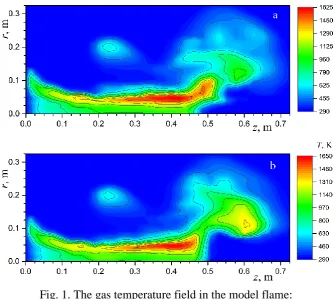
obtained by an averaging in a selected axial cross section of the real developing flame at 𝑡 = 1s. A
comparison of two temperature fields shown in Fig. 1 indicates that the effect of thermal radiation
on the flame formation is relatively small at early stages of flame development. In particular, the
maximum temperature in the flame is underestimated by about 1.5 % in the calculation without
taking into account radiation. Nevertheless, thermal radiation should be taken into account because
of its considerable effect on the parameters at the upper “head” of the flame (compare Figs. 1a and
1b). In light of this observation, rather than using detailed and time-consuming methods for
radiative transfer calculations, a much simpler P1 approximation seems to be reasonable. Of course,
the error of this simple approach should be additionally verified to be sure that it is acceptable for
the developing flame calculations. As to the radiative flux from the flame, it can be calculated using
[image:5.595.131.467.462.761.2]a ray-tracing procedure at the second step of solution independently of the CFD calculations.
Fig. 1. The gas temperature field in the model flame:
3. Two-step method for radiative transfer calculations
The general theoretical model for transfer of thermal radiation in a flame should be based on the
radiative transfer equation (RTE) which takes into account emission, absorption, and scattering of
radiation in the medium. A special feature of the fire suppression problem is the anisotropic
scattering of radiation by relatively cold water droplets. In this case, the RTE can be written as
follows [1] (hereafter, we omit the subscript “𝜆” in the medium radiative properties for brevity):
Ω
⃗⃗⃗∇𝐼λ(r⃗, Ω⃗⃗⃗) + 𝛽𝐼λ(r⃗, Ω⃗⃗⃗) = 4𝜋𝜎 ∫(4𝜋)𝐼λ(r⃗, Ω⃗⃗⃗′)Φ(Ω⃗⃗⃗′. Ω⃗⃗⃗ )𝑑Ω⃗⃗⃗′ + 𝛼g𝐼b[𝑇g(r⃗)] (1)
The physical meaning of Eq. (1) is evident: variation of the spectral radiation intensity, 𝐼λ, in
direction Ω⃗⃗⃗ takes place due to self-emission of thermal radiation by gases (the last term, 𝐼b(𝑇) is the
Planck function), extinction by absorption and also by scattering in other directions (the second
term), as well as due to scattering from other directions (the integral term). The spectral extinction
coefficient 𝛽 is a sum of the absorption coefficient, 𝛼 = 𝛼g+ 𝛼d, (both gas and water droplets
contribute to absorption) and the scattering coefficient, 𝜎 of a conventional continuous medium of
droplets. These spectral coefficients and the scattering phase function, Φ, depend on spatial
coordinate 𝑟⃗.
The integration of RTE (1) over all values of the solid angle gives the following important
expression for divergence of the spectral radiative flux [1]:
∇q⃗⃗λ = 4𝜋𝛼g𝐼b(𝑇g) − 𝛼𝐺λ (2)
which can be treated as a local balance of the spectral radiation energy. The spectral radiative flux
and irradiation function are defined as follows:
q⃗⃗λ(Ω⃗⃗⃗) = ∫(4𝜋)𝐼λ(r⃗, Ω⃗⃗⃗)Ω⃗⃗⃗𝑑Ω⃗⃗⃗ 𝐺λ(r⃗) = ∫(4𝜋)𝐼λ(r⃗, Ω⃗⃗⃗)𝑑Ω⃗⃗⃗ (3)
The first term in the right-hand side of Eq. (2) is the emission, whereas the second term is the
radiation absorption by both the gases and water droplets.
A complete and accurate solution to the RTE in scattering media is a very complicated task. One
can find many studies in the literature on specific numerical methods developed to obtain more
accurate spatial and angular characteristics of the radiation intensity field. Several modifications of
the discrete ordinates method (DOM), finite-volume method (FVM), and statistical Monte Carlo
(MC) methods are the most popular tools employed by many authors (see [1–4] for the details). The
main difficulty of accurate radiative transfer calculations is related with the angular dependence of
radiation intensity. Fortunately, this angular dependence appears to be rather simple in many
important applied problems. It enables one to use this property of solution to derive relatively
All the differential approximations for RTE are based on simple assumptions concerning the
angular dependence of the spectral radiation intensity 𝐼λ. These assumptions enable us to deal with a
limited number of functions 𝐼λi(𝑟⃗) instead of function 𝐼λ(𝑟⃗, Ω⃗⃗⃗) and turn to the system of the ordinary
differential equations by the use of integration of RTE. With the use of the spherical harmonics
method, the spectral radiation intensity is presented in a series of spherical functions. In the first
approximation of this method, P1, the following linear dependence is assumed [1]:
𝐼λ(r⃗, Ω⃗⃗⃗) = 4𝜋1 [𝐺λ(r⃗) + 3Ω⃗⃗⃗𝑞⃗λ(r⃗)] (4)
By multiplying Eq. (1) by Ω⃗⃗⃗ and integrating it over a solid angle, one can find that the radiative flux
is related to the irradiation by equation
q⃗⃗λ = −𝐷∇𝐺λ (5)
where 𝐷 = 3𝛽1
tr is the spectral radiation diffusion coefficient, 𝛽tr= 𝛼 + 𝜎tr is the transport
extinction coefficient, 𝜎tr = 𝜎. (1 − 𝜇̅) is the transport scattering coefficient, 𝜇̅ is the asymmetry
factor of scattering introduced as follows:
𝜇̅ = 4𝜋1 ∫(4𝜋)𝐼λ(Ω⃗⃗⃗′. Ω⃗⃗⃗)Φ(Ω⃗⃗⃗′. Ω⃗⃗⃗ )𝑑Ω⃗⃗⃗′ (6)
Note that Eq. (5) is obtained for an arbitrary scattering function but it is the same as that for the
transport approximation when this function is replaced by a sum of the isotropic component and the
term describing the peak of forward scattering [1, 12]:
Φ(𝜇0) = (1 − 𝜇̅ ) + 2𝜇̅𝛿(1 − 𝜇0 ) (7)
where 𝜇0 = Ω⃗⃗⃗. Ω⃗⃗⃗′ is the cosine of the angle of scattering. It means that P1 approximation is
insensitive to details of the scattering function and the asymmetry factor of scattering is the only
parameter of scattering anisotropy taken into account in this approach. The latter does not lead to
considerable errors in radiative heat transfer calculations in the practically important case of
multiple scattering [1, 12].
Substituting Eq. (5) into the radiation energy balance (2) we obtain the nonhomogeneous
modified Helmholtz equation for the spectral irradiation:
−∇(𝐷∇𝐺λ) + 𝛼𝐺λ = 4𝜋𝛼g𝐼b(𝑇g) (8)
The Marshak boundary conditions are used to complete the P1 boundary-value problem [1]. One
can also proceed to the variational formulation of the problem when the solution yields the
minimum of the following functional [1, 5]:
𝜒𝜆 = ∫ [𝐷2∇𝐺λ+𝛼2Gλ2− 4𝜋𝛼
g𝐼b(𝑇g)𝐺λ] 𝑑𝑉
𝑉 + ∫
𝜀w
2(2−𝜀w)
𝐴 [
Gλ2
2 − 4𝜋𝐼b(𝑇w)𝐺λ] 𝑑𝐴 (9)
where 𝑇w and 𝜀w are the temperature and hemispherical emissivity of boundary surfaces. The first
whereas the second integral takes into account the conditions at the region boundary. The order of
the differential operator in Eq. (9) is reduced by one compared with Eq. (8). As a result, the local
linear approximations of function 𝐺λ in triangle finite elements are sufficient. The final-element
method (FEM) [27, 28] can be used to solve the variational problem for functional (8) as it was
done in papers [9, 17, 29]. The FEM is very convenient because this method is flexible and
applicable for computational regions of complex shape.
It should be recalled that the box spectral model with constant values of absorption coefficient in
a set of spectral bands is used in the current version of the CFD code FireFOAM. According to this
spectral model, the Planck function, 𝐼b(𝑇) , in Eq. (8) is replaced by the following integral:
𝐹b,j(𝑇) = ∫λ2,j𝐼b(𝑇)𝑑𝜆
λ1,j (10)
As a result, the integral value of irradiation, 𝐺j, for every band of number “j” is obtained instead of
the spectral irradiation. A contribution of the spectral band to the divergence of the integral (over
the spectrum) radiative flux is given by the following relation:
∇q⃗⃗j= 4𝜋𝛼g,j𝐹b,j(𝑇g) − 𝛼j𝐺j (11)
Let consider the computational data for CO2 absorption band with wavelength boundaries of
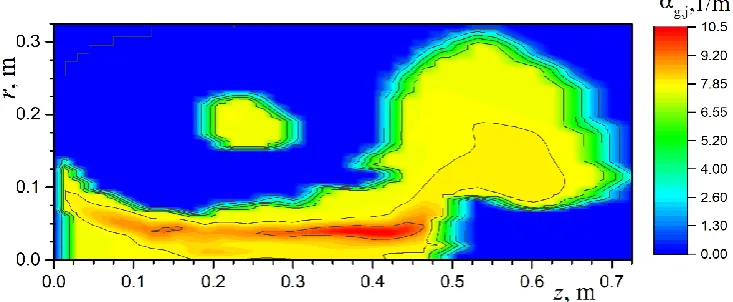
𝜆1 = 4.1494μm and 𝜆2 = 4.5851μm for the model flame with temperature field shown in Fig. 1b.
The absorption coefficient in this spectral band calculated with the box gas radiation model is
[image:8.595.116.483.453.604.2]plotted in Fig. 2.
Fig. 2. Absorption coefficient calculated for the CO2 absorption band.
The radial optical thickness, of the hottest region of the flame without water droplets is easily
estimated by multiplying the absorption coefficient, 𝛼g,j, by the geometrical thickness, Δ𝑟, of this
thin region. The calculations carried out by the authors show that a value of 𝜏 that is much smaller
than unity is obtained. It means that the upper estimate of the radiative heat losses based on the
optically thin approximation may be applicable in this scenario specific to the initial development
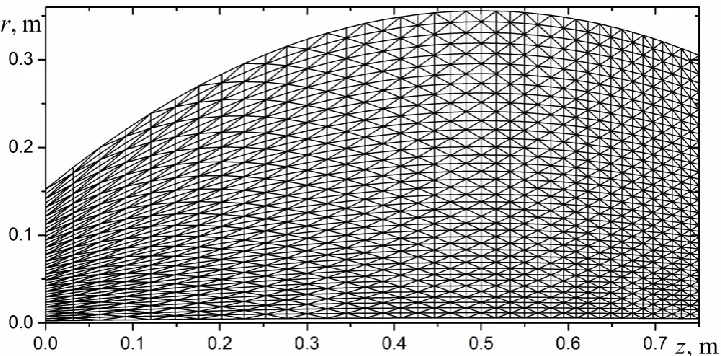
The non-uniform triangulation of the computational region, which includes the main part of the
temperature field of Fig. 1b, is shown in Fig. 3. The left boundary of the region is the surface of the
liquid fuel. The smaller areas of finite elements were made in the region of more optically dense
medium. The total number of triangular elements is 2x40x40=3200. As usually, the radial
coordinates of all the nodes were increased by the first radial interval of the mesh to avoid the
formal difficulties in numerical calculations near the axis [1]. The finite elements near the front of
the developing flame should be relatively small (as it is shown in Fig. 3) because of an expected
increase in extinction in this part of the flame containing numerous absorbing and scattering water
droplets. Note that triangular elements at a small distance from the liquid fuel look not good
because of a significant difference between the radial and axial dimensions of the triangles.
However, additional calculations showed that this weakness is not critical in the case of the
[image:9.595.118.479.315.493.2]optically thin developing flame.
Fig. 3. Finite-element triangulation of the computational region.
The following dimensionless function is calculated using various approaches:
𝑊̅j = ∇𝑞⃗⃗j
4𝜋𝛼g,j(𝑇g,max)𝐹b,j(𝑇g,max) (12)
This function is convenient to compare the results of calculations with those obtained in the
optically thin limit when there is no need to solve the equations presented above because the
following simplest relation is true for the radiative flux divergence [3, 4]:
∇𝑞⃗j = 4𝜋𝛼g,j𝐹b,j(𝑇g) (13)
The results of calculations are presented in Fig. 4. The FVM calculations are carried out using
FireFoam. One can see that the difference between the computational data obtained using the
optically thin approximation, P1 method, and FVM are similar to each other and the first of these
give very close values of the radiative flux divergence, whereas the computational time of the P1
calculations is about two orders of magnitude less than that of the regular FVM procedure used in
the CFD code FireFoam. The results obtained confirm good accuracy of P1 approximation which
can be employed for very fast and reliable radiation calculations for the developing flames and can
be recommended for implementation into any general CFD code. It should be recalled that P1 is
even more accurate in the case of a scattering medium [1] and can be used in radiative heat transfer
[image:10.595.109.492.202.593.2]calculations for the flames with water droplets as applied to the flame suppression problem.
Fig. 4. The divergence of radiative flux in the CO2 absorption band:
a – optically thin approximation, b – P1 calculation, c – FVM calculation.
The P1 model is considered for calculations of the radiation term in the energy equation only.
This is really important for the CFD flame calculations, but insufficient to determine the radiative
flux outside the flame. Fortunately, the transport approximation can be employed to simplify the
RTE, which can be written in the same way as that for isotropic scattering, i.e., with Φ = 1 [1, 5,
12]:
Ω
where 𝑆λ is the so-called source function. The spectral radiation intensity can be calculated by direct
integration of Eq. (14). This procedure is very simple in the case of an open flame when no
radiation illuminates the flame surface and the formal solution along the ray 𝑠⃗ is as follows:
𝐼λ(𝑠) = ∫ 𝑆os λ(𝑙)𝑒𝑥𝑝 [∫ 𝛽ol tr(𝑙′)𝑑𝑙′− ∫ 𝛽os tr(𝑙′)𝑑𝑙′ ] 𝑑𝑙
(15)
Eq. (14) can be rewritten as applied to a set of spectral bands considered in the box model. In the
combined two-step method of the present paper, the source function is calculated at the first step
using of the P1 solution for irradiation 𝐺λ. After that, a ray-tracing procedure for the transport RTE
solution should be used at the second step to calculate accurately the radiative flux to an arbitrary
surface outside the flame, if necessary. It is interesting that there is a potential possibility of
comparison of computational predictions with experimental data for the radiation of pool fire
flames [30].
4. Computational model for the probe stage of fire suppression
The effects of water sprays on the flow field parameters of the flame should be taken into
account in computational studies for the regular developed regime of fire suppression, and this is an
important engineering problem [31–34]. However, the problem is significantly simplified at the
probe stage of fire suppression suggested in [22] because this preliminary stage of fire suppression
is characterized by a very small flow rate of water. The observations at the probe stage could show
us some details of behavior of evaporating water droplets in the flame.
A short-time probe stage of fire suppression is considered in the present paper. Therefore, the
motion, heating, and evaporation of single droplets can be studied without account for any feedback
effects. The radiative power absorbed by droplets is neglected because it is much less than the heat
supplied to the droplets by convective heat transfer from hot combustion gases in the flame. In more
detailed calculations, the effect of radiation can be taken into account as it was done in recent
papers on shielding of fire radiation by water mists [35, 36] and also in the problem of a space
vehicle shielding from solar radiation by a cloud of sublimating particles [37].
The interaction of water sprays with fires has been modeled computationally in many papers
during the last two decades [38–45], but there is no need to discuss here the state-of-the-art in this
field because of the main focus on the radiative transfer problem. Of course, there is a size
distribution of water droplets at the initial cross section of the spray. However, the assumption of
independent behavior of droplets makes it possible to consider a set of solutions for droplets of
different size in the expected range of the initial droplet size distribution. The trajectories of
droplets moving along the flame axis are considered. The radial component of gas velocity in a
is also close to the axial one. This makes the 1-D approach for the dynamic and thermal interaction
of water droplets and flame to be acceptable for the computational estimates of the main effects. To
simplify the problem, we do not consider also the secondary effects of the vapor coming from
evaporating droplets on both the drag force and convective heat flux to the droplet. This is the usual
assumption used in computational models of this kind. The initial problem for the droplet motion is
as follows [18, 41, 46]:
𝑑𝑧d
𝑑𝑡 = 𝑢d 𝑧d(0) = 𝑧0 (16a) 𝑑𝑢d
𝑑𝑡 = 3𝐶D
8𝑎 𝜌
𝜌w(𝑢g− 𝑢d)|𝑢g− 𝑢d| − 𝑔 𝑢d(0) = −𝑢d0 (16b)
𝐶D = 24(1+0.15Red0.687)
Red Red= 2𝜌|𝑢 − 𝑢d|
𝑎
𝜂 (16c)
where the subscript “𝑤” refers to water, 𝑢is the axial component of velocity, 𝑎 is the droplet radius,
𝐶D is the drag coefficient, Re is the Reynolds number. It is assumed that water droplets are first
heated up to the saturation temperature:
𝑑𝑇d
𝑑𝑡 = 1.5Nu𝑘
𝜌w𝑐w𝑎2(𝑇g− 𝑇d) 𝑇d(0) = 𝑇0 𝑡 < 𝑡sat (17a)
Nu = 2 + 0.6Red 1
2Pr13 Pr = 𝜂𝑐
𝑘 (17b)
(Nu and Pr are the Nusselt and Prandtl numbers) and then evaporated according to the following
equation:
𝑑𝑎
𝑑𝑡 = −Nu
𝑘(𝑇g− 𝑇w,sat)
2𝑎𝜌w𝐿w 𝑎(𝑡sat) = 𝑎0 𝑡 ≥ 𝑡sat (18)
where 𝐿w is the latent heat of evaporation of water. A similar model has been also used in papers
[22, 35, 36]. This simplified evaporation model is also sufficient for qualitative estimates of the
present paper because of very fast heating of moving droplets and large molar fraction of water
vapour in the flame. It is not necessary at the moment to consider sophisticated evaporation models
like that developed in paper [47]. A transfer from the droplet heating to its evaporation is given by
the following simple equation:
𝑇d(𝑡sat) = 𝑇w,sat (19)
Obviously, the local relative volume fraction of water droplets can be calculated as:
𝑓̅v = 𝑓v
𝑓v0= (
𝑢d0
𝑢d) (
𝑎 𝑎0)
3
(20)
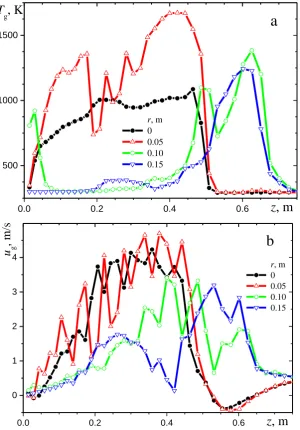
Let consider the axial profiles of a gas temperature, 𝑇g , and velocity, 𝑢g , on the axis of
[image:12.595.135.517.186.262.2]symmetry (𝑟 = 0) and also along the lines of 𝑟 = 0.05m, 10 m, and 15. 0. m for the flame shown in
Fig. 1b. The profiles plotted in Fig. 5 in a combination with temperature field presented in Fig. 1b
makes clear a strong non-uniformity of the developing flame. A very hot narrow circular region in a
in Figs. 5a and 5b) moves upward with a relatively high speed of about 4 m/s. At the same time,
there is a relatively thick region of a cold and slowly moving gas near the flame axis at 𝑧 > 0.5m
and 𝑟 < 0.08m. Moreover, a downward motion of a gas is observed in a part of this region. One
can see that both the gas temperature and velocity profiles at 𝑟 = 0.1m and 0.15m are quite
different from those at 𝑟 = 0 and 0.05m. The above described specific structure of the flame is a
motivation of subsequent attention to behaviour of water droplets moving in the flame along
different axial lines.
0.0 0.2 0.4 0.6
500 1000 1500
r, m
0 0.05 0.10 0.15 T
g, K
z
, m
a
0.0 0.2 0.4 0.6
0 1 2 3 4
r, m
0 0.05 0.10 0.15
u g
, m/s
z, m
[image:13.595.147.448.209.640.2]b
Fig. 5. The axial profiles of (a) temperature and (b) axial component of velocity
of gaseous combustion products in the model flame.
Before proceeding to the computational modeling of motion of water droplets in a gas flow, it is
interesting to estimate the so-called relaxation time, 𝑡𝑟𝑒𝑙, of the droplets. This can be done on the
𝑡rel = 29𝜌𝑎
2
𝜂 (21)
Equation (21) gives very small values of 𝑡rel < 0.25ms for water droplets of radius 𝑎 < 100μm. It
means that water droplets should be supplied at a small axial distance from the flame and the initial
velocity of droplets should be sufficient to reach a hot region inside the flame.
Obviously, the effect of initial conditions decreases along the droplet trajectory, and the
equilibrium position of a droplet is characterized by the same absolute values of two opposite
forces: the force of gravity and the drag force which supports the droplet. In the case of a relatively
small evaporating droplet, this condition can be written using the Stokes law. The resulting value of
the gas axial velocity is as follows:
𝑢g = 29𝜌w𝑔𝑎2
𝜂 (22)
Having substituted 𝜌𝜂
w= 1.8 × 10
−8 s
m2 and 𝑎 = 40 μm to Eq. (22), we obtain 𝑢g ≈ 0.2m/s. One
can see in Fig. 5b that this value of the axial velocity is observed near the flame axis at 𝑧𝑒q=
0.52m. It is interesting to compare this estimate with detailed numerical calculations.
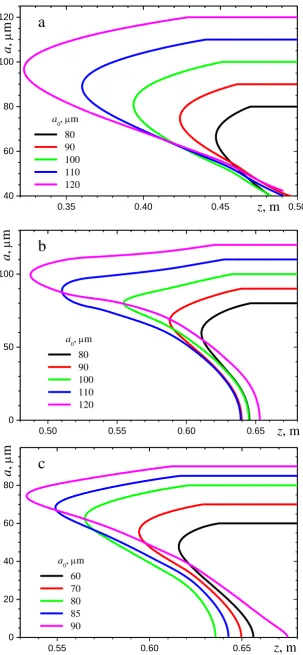
The numerical results for the current radius of evaporating water droplets along their trajectories
in the case of the droplet initial position of 𝑧0 = 0.75m and various distances, 𝑟0, from the flame
axis are presented at the in Fig. 6. The same effect is observed at different values of 𝑟0: one can
choose the value of 𝑢0 and the range of 𝑎0 to observe focusing of all the droplets in small local
regions where the equilibrium condition (22) is satisfied. It should be noted that the above estimate
of 𝑧eq for the droplets moving along the flame axis (𝑟0 = 0) is in good agreement with the
calculations shown in Fig. 6a. The calculations for droplets moving along the flame axis don’t show
their complete evaporation because of a cold gas area near the axis. This is a special case when the
thermal radiation of a hot flame should be taken into account in calculations of the droplet
evaporation. On the contrary, large water droplets supplied at 𝑟0 = 0.1m and 𝑟0 = 0.15m can
penetrate into the hot region and these droplets are totally evaporated during their backward motion
0.35 0.40 0.45 0.50 40 60 80 100 120
a0, m
80 90 100 110 120
a
,
m
z
, m
a
0.50 0.55 0.60 0.65
0 50 100
a0, m
80 90 100 110 120
a
,
m
z
, m
b
0.55 0.60 0.65
0 20 40 60 80 a
0, m
60 70 80 85 90
a
,
m
z
, m
[image:15.595.144.448.58.715.2]c
Fig. 6. Variation of radius of droplets along their trajectories at three initial positions of the droplets:
It is physically clear that the volume fraction of water droplets increases dramatically in the local
regions of their collection and total evaporation. Strictly speaking, the assumption of independent
motion of single droplets may be incorrect in the vicinity of these regions. However, following [20],
this effect is not considered in the present paper.
5. Optical properties of water droplets
The normalized coefficients of absorption and transport scattering (per unit volume fraction of
water) for independently absorbing and scattering droplets with radius 𝑎 can be determined as
follows:
𝐸a = 0.75𝑄a
𝑎 𝐸str = 0.75 Qstr
𝑎 (23)
According to Mie theory [49–51], the efficiency factors of absorption, 𝑄𝑎 , and transport scattering,
𝑄strdepend on both the complex index of refraction of water, 𝑚 = 𝑛 − 𝑖𝑘, and diffraction parameter
𝑥 = 2𝜋𝑎𝜆 . The following approximate relations suggested in [52] are used in the calculations instead
of the Mie theory:
𝑄a= (𝑛+1)4𝑛 2[1 − exp (−4𝑘𝑥)] 𝑄str = 𝐾 . {
𝜓
5 𝑤ℎ𝑒𝑛 𝜓 ≤ 5
(𝜓5)γ𝑤ℎ𝑒𝑛 𝜓 > 5 (24a)
𝐾 = 1.5𝑛(𝑛 − 1)exp (−15𝑘) 𝛾 = 1.4 − exp (−80k) 𝜓 = 2𝑥(𝑛 − 1)
(24b)
The spectral optical constants of water, 𝑛 and 𝑘, can be found in early papers [53, 54]. According to
[55, 56], we neglect a weak temperature dependence of the refractive index. It means that the most
important value of transport scattering coefficient in the range of water semi-transparency can be
calculated using the values of optical constants of water at room temperature. The calculated values
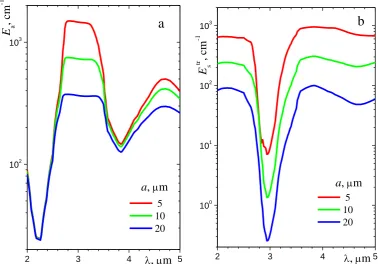
of 𝐸a and 𝐸str presented in Fig. 7 should be multiplied by the volume fraction of droplets to obtain
the local values of the spectral absorption and transport scattering coefficients: 𝛼d = 𝑓v𝐸a and
𝜎tr = 𝑓v𝐸str. One can see that radiation absorption by water droplets is significant in the main
near-infrared absorption band of water. It contributes to water evaporation and flame suppression. The
scattering by small droplets is large over the spectrum excluding the absorption band, where the
anomalous dispersion takes place [57, 58]. The hypothesis of independent scattering does not work
in the region of strong evaporation where the distance between the neighboring droplets may be
comparable with the wavelength. The dependent scattering may lead to significant changes in
optical properties of the medium [59–62]. However, this effect is a complex problem of physical
optics and it is beyond the scope of the present paper. Therefore, the ordinary relations of
2 3 4 5 102
103
5 10 20
, m
E a
, cm
-1
a, m
a
2 3 4 5
100 101 102 103
a, m
5 10 20
, m
E s
tr , cm
-1
[image:17.595.108.487.57.321.2]b
Fig. 7. Normalized (a) absorption and (b) transport scattering coefficients of water droplets.
It should be noted that there are two serious assumptions of the suggested theoretical model and
both of them are related with an expected high local volume fraction of small water droplets.
Strictly speaking, one cannot consider independent motion of these droplets and also independent
scattering of infrared radiation by water droplets in some local regions of the flame. The resulting
overall error of the simplified computational model depends strongly on water flow rate at the probe
stage of the flame suppression. One can decrease this error in the experiments using additional
probe-stage regimes with much lower flow rate of water.
6. Effect of radiation scattering by evaporating water droplets
The computational data presented in Fig 7 confirm that the above choice of the representative
CO2 absorption band at wavelength about 4.3μm will enable us to estimate the effect of scattering
of the flame radiation by evaporating water droplets at the probe stage of fire suppression. Note that
contributions of soot to both absorption and scattering of radiation are negligible in this spectral
range [63–66]. The absorption of thermal radiation by droplets is very small in this range whereas
the normalize transport scattering coefficient is very high: 𝐸str = 300cm−1 at 𝑎 = 10μm and
𝐸str ≈ 1000cm−1 at 𝑎 = 5μm (see Fig. 7b). Following [67], the emissivity of the liquid fuel
surface 𝜀w = 0.6 was used in the calculations. The latter does not mean that thermal radiation of
relatively cold liquid fuel is important. However, we take into account a partial reflection of the
It was shown in the previous section of the paper that relatively small evaporating droplets of
water are collected mainly at a small distance from the front of a developing flame. According to
Eq. (20) the volume fraction, 𝑓v, of slowly moving droplets in this thin region is very high and the
absolute value of is directly proportional to the flow rate of water in water spray. The maximum
value of 𝑓v,max = 10−3 and constant value of 𝐸str = 800cm−1 are assumed for the cloud of droplets
in subsequent calculations. To estimate the effect of infrared scattering by water droplets, the
following analytical relations were used for the spatial variation of volume fraction of droplets near
the flame with temperature field shown in Fig. 1b:
𝑓v = 𝑓v,max[1 − ( 𝑟
𝑟max−1) 2
2 ] 𝑒𝑥𝑝 [𝜉. (1 − 𝑧
𝑧cl)] 𝑧cl= 𝑧min𝜑(𝑟) (25a)
𝑟max = 0.1m 𝜉 = 10m−1 𝑧min = 0.5m (25b)
𝜑(𝑟) = {
1, 𝑟 < 0.05m 1 + 𝜁1𝑟, 0.05 ≤ 𝑟 < 0.1m 1.4 − 𝜁2𝑟, 0.1 ≤ 𝑟 < 0.2m
𝜁1 = 3m−1 𝜁2 = 1m−1 (25c)
It is assumed that scattering by water droplets in the region of 𝑧 < 𝑧cl and also at 𝑟 > 0.2m is
negligibly small.
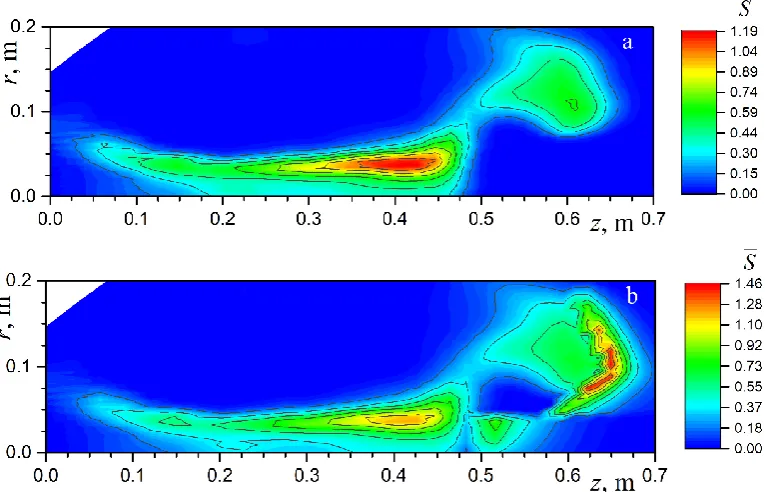
As discussed above, the observed radiation from the flame is determined by the radiative source
function. Therefore, the effect of infrared scattering by water droplets on the source function is
considered. Following the above normalization, the source function for the transport RTE calculated
using the P1 solution for irradiation is divided by the maximum value of the source function
calculated using the optically thin approximation. The finite-element triangulation of the
computational region shown in Fig. 5 was used in the calculations. The resulting field of
dimensionless value of S calculated using P1 approximation is presented in Fig. 8. One can see that
a cloud of small evaporating droplets leads to significant changes in the field of radiative source
function just in front of the developing flame. This effect is expected to be interesting for the infrared
diagnostics of transient flames at the probe stage of fire suppression. The latter can be used for partial
validation of CFD simulations. To the best of our knowledge, there is no appropriate data in the
literature on infrared measurements of thermal radiation of a flame suppressed by a jet of water
Fig. 8. The normalized radiative source function: a – without water droplets, b – with water droplets.
7. Conclusions
A procedure based on the earlier developed combined two-step method is suggested to simplify
time-consuming spectral radiative transfer calculations in transient pool fires during their
suppression using water sprays. A comparison with the reference numerical solution indicates that
the accuracy of the P1 approximation used at the first step of the method is sufficient for the
calculations of the radiative flux divergence. This will lead to a significant simplification of the
radiative module in the CFD code and much faster radiation calculations. This result can be
considered as an important stage in improving the fire radiation modeling.
The calculations of motion, heating, and evaporation of water droplets at the probe stage of fire
suppression indicated the local areas of focusing of moving droplets before their total evaporation in
the flame. The effect of infrared radiation scattering by these small droplets on the source function
responsible for the radiation from the flame is considerable. It is important that positions of the
local highly-scattering areas are very sensitive to the flame parameters. This can be used in probe
experiments for partial validation of transient CFD simulations.
Conflict of interests
None declared.
The authors gratefully acknowledge the financial support by the H2020-MSCA-IF-2016
Programme of the European Commission (RAD-FIRE project, no. 749220). We also wish to thank
Antoine Hubert and Okorie Ukairo for their kind assistance in processing the pool fire data and
formatting the paper.
References
[1] L.A. Dombrovsky and D. Baillis, Thermal Radiation in Disperse Systems: An Engineering Approach,
Begell House, New York, 2010.
[2] R. Viskanta, Radiative Transfer in Combustion Systems: Fundamentals and Applications, Begell House,
New York, 2005.
[3] J.R. Howell, R. Siegel, and M.P. Mengüç, Thermal Radiation Heat Transfer, CRC Press, New York,
2010.
[4] M.F. Modest, Radiative Heat Transfer, Third edition, Acad. Press, New York, 2013.
[5] L.A. Dombrovsky, Approximate methods for calculating radiation heat transfer in dispersed systems,
Thermal Engineering 43 (3) (1996) 235–243.
[6] V.M. Borisov and A.A. Ivankov, The P1 and P2 approximations of the spherical harmonic method as
applied to radiative heat transfer computations with allowance for strong blowing from the surface of a
vehicle moving in the Jovian atmosphere, Comput. Math. & Math. Phys. 46 (9) (2006) 1611–1622.
[7] L.A. Dombrovsky, W. Lipiński, and A. Steinfeld, A diffusion-based approximate model for radiation
heat transfer in a solar thermochemical reactor, J. Quant. Spectr. Radiat. Transfer 103 (3) (2007) 601–
610.
[8] D.A. Kontogeorgos, E.P. Keramida, and M.A. Founti, Assessment of simplified thermal radiation models
for engineering calculations in natural gas-fired furnace, Int. J. Heat Mass Transfer 50 (25-26) (2007)
5260–5268.
[9] T. Klason, X.S. Bai, M. Bahador, T.K. Nilsson, and B. Sundén, Investigation of radiative heat transfer in
fixed bed biomass furnaces, Fuel 87 (10–11) (2008) 2141–2153.
[10] L.A. Dombrovsky and W. Lipiński, A combined P1 and Monte Carlo model for multi-dimensional
radiative transfer problems in scattering media, Comput. Thermal Sci. 2 (6) (2010) 549–560.
[11] D.A. Andrienko and S.T. Surzhikov, P1 approximation applied to the radiative heating of descent
spacecraft, J. Spacecraft Rockets 49 (6) (2012) 1088–1098.
[12] L.A. Dombrovsky, The use of transport approximation and diffusion-based models in radiative transfer
calculations, Comput. Therm. Sci. 4 (4) (2012) 297–315.
[13] L.A. Dombrovsky, V. Timchenko, and M. Jackson, Indirect heating strategy of laser induced
hyperthermia: An advanced thermal model, Int. J. of Heat and Mass Transfer 55 (17-18) (2012) 4688–
4700.
[14] D.A. Andrienko, S.T. Surzhikov, and J.S. Shang, Spherical harmonics method applied to the
[15] J. Cai, C. Lei, A. Dasgupta, M.F. Modest, and D.C. Haworth, High fidelity radiative heat transfer
models for high-pressure laminar hydrogen-air diffusion flames, Combust. Theory Model. 18 (6) (2014)
607–626.
[16] J. Cai, R. Marques, and M.F. Modest, Comparisons of radiative heat transfer calculations in a jet
diffusion flame using spherical harmonics and k-distributions, ASME J. Heat Transfer, 136 (11) (2014)
112702-1 – 112702-9.
[17] L.A. Dombrovsky, D.L. Reviznikov, and A.V. Sposobin, Radiative heat transfer from supersonic flow
with suspended particles to a blunt body, Int. J. Heat Mass Transfer 93 (2016) 853–861.
[18] Y. Sun and X. Zhang, Contributions of gray gases in SLW for non-gray radiation heat transfer and
corresponding accuracies of FVM and P1 method, Int. J. Heat Mass Transfer 121 (2018) 819–831.
[19] L.A. Dombrovsky and L.G. Barkova, Solving the two-dimensional problem of thermal-radiation
transfer in an anisotropically scattering medium using the finite element method, High Temperature 24
(4) (1986) 585–592.
[20] A.V. Kolpakov, L.A. Dombrovsky, and S.T. Surzhikov, Transfer of directed radiation in an absorbing
and anisotropically scattering medium, High Temperature 28 (5) (1990) 753–757.
[21] L.A. Dombrovsky, Evaluation of the error of the P1 approximation in calculations of thermal radiation
transfer in optically inhomogeneous media, High Temperature 35 (4) (1997) 676–679.
[22] L.A. Dombrovsky, S. Dembele, and J.X. Wen, An infrared scattering by evaporating droplets at the
initial stage of a pool fire suppression by water sprays, Infrared Phys. Technol. 91 (2018) 55–62.
[23] I. Sikic, J.X. Wen, and S. Dembele, Evaluation of different schemes of the weighted-sum-of-grey-gases
model for fire simulations, Proc. 9th US Nat. Combust. Meeting, Combust. Inst., 2015.
[24] B.F. Magnussen and B.H. Hjertager, Development of the eddy-break-up model of turbulent combustion,
Proc. Combust. Inst. 16 (1976) 719–729.
[25] Z. Chen, J. Wen, B. Xu, and S. Dembele, Large eddy simulation of a medium-scale methanol pool fire
using the extended eddy dissipation concept, Int. J. Heat Mass Transfer 70 (2014) 389–408.
[26] D.K. Edwards, Molecular gas radiation, in “Advances in Heat Transfer”, 12, 115–193, Acad. Press,
New York, 1976.
[27] Z. Chen, The Finite Element Method: Its Fundamentals and Applications in Engineering, World Sci.
Publ., Singapore, 2011.
[28] O.C. Zienkiewicz, R.L. Taylor, and J.Z. Zhu, The Finite Element Method: Its Basis and Fundamentals,
Seventh edition, Elsevier, New York, 2013.
[29] L.A. Dombrovsky, J.H. Randrianalisoa, W. Lipiński, and V. Timchenko, Simplified approaches to
radiative transfer simulations in laser induced hyperthermia of superficial tumors, Comput. Thermal Sci.
5 (6) (2013) 521–530.
[30] L. Zhou, D. Zeng, D. Li, and M. Chaos, Total radiative heat loss and radiation distribution of liquid pool
fire flames, Fire Safety J. 89 (2017) 16–21.
[31] S. Dembele, V.H.Y. Tam, S. Ferrais, R.A.F. Rosario, and J.X. Wen, Effectiveness of water deluge in
[32] H.Z. Yu, Physical scaling of water mist suppression of pool fires in enclosures, Fire Safety J. 10 (2011)
145–158.
[33] M. Gupta, A. Pasi, A. Ray, and S.R. Kale, An experimental study of the effects of water mist
characteristics on pool fire suppression, Exper. Thermal Fluid Sci. 44 (2013) 768–778.
[34] A. Jenft, A. Collin, A. Boulet, G. Pianet, A. Breton, and B.A. Muller, Experimental and numerical study
of pool fire suppression using water mist, Fire Safety J. 67 (2014) 1–12.
[35] L.A. Dombrovsky, S. Dembele, and J.X. Wen, A simplified model for the shielding of fire thermal
radiation by water mists, Int. J. Heat Mass Transfer 96 (2016) 199–209.
[36] L.A. Dombrovsky, S. Dembele, and J.X. Wen, Shielding of fire radiation with the use of multi-layered
mist curtains: preliminary estimates, Comput. Thermal Sci. 8 (4) (2016) 371–380.
[37] L.A. Dombrovsky, D.L. Reviznikov, A.P. Kryukov, and V.Yu. Levashov, Self-generated clouds of
micron-sized particles as a promising way of a solar probe shielding from intense thermal radiation of
the Sun, J. Quant. Spectr. Radiat. Transfer 200 (2017) 234–243.
[38] R. Alpert, Numerical modelling of the interaction between automatic sprinkler sprays and fire plumes,
Fire Safety J. 9 (1985) 157–163.
[39] B. Downie, C. Polymeropoulos, and G. Godos, Interaction of a water mist buoyant methane diffusion
flame, Fire Safety J. 24 (1995) 359–381.
[40] K. Prasad, C. Liu, and K. Kailasanath, Simulation of water mist suppression of small scale methanol liquid
fires, Fire Safety J. 33 (1999) 185–212.
[41] J. Hua, K. Kumar, B.C. Khoo, and H. Xue, A numerical study of the interaction of water spray with fire
plume, Fire Safety J. 37 (2002) 631–657.
[42] M.-H. Feng, Q.-W. Li, and J. Qin, Extinguishment of hydrogen diffusion flames by ultrafine water mist in a
cup burner apparatus – A numerical study, Int. J. Hydrogen Energy 40 (2015) 13643–13652.
[43] T. Beji, S.E. Zadeh, G. Maragkos, and B. Merci, Influence of droplet size distribution and volume fraction
angular distribution on the results and computational time of water spray CFD simulations, Fire Safety J. 91
(2017) 586–595.
[44] J. Floid and R. McDermont, Development and evaluation of two new droplet evaporation schemes for fire
dynamics simulations, Fire Safety J. 91 (2017) 643–652.
[45] T. Beji, S. Ebrahimzadeh, G. Maragkos, and B. Merci, Numerical modelling of the interaction between
water sprays and hot air jets – Part II: Two-phase flow simulations, Fire Safety J. 96 (2018) 143–152.
[46] C.T. Crowe, J.D. Schwarzkopf, M. Sommerfeld, and Y. Tsuji, Multiphase Flows with Droplets and
Particles, Second edition, CRC Press, New York, 2011.
[47] A.P. Kryukov, V.Yu. Levashov, and I.N. Shishkova, Evaporation in mixture of vapour and gas mixture, Int.
J. Heat Mass Transfer 52 (23-24) (2009) 5585–5590.
[48] G. Falkovich, Fluid Mechanics (A short course for physicists), Cambridge Univ. Press, Cambridge (UK),
2011.
[50] C.F. Bohren and D.R. Huffman, Absorption and Scattering of Light by Small Particles, Wiley, New
York, 1983.
[51] W. Hergert and T. Wriedt, The Mie Theory: Basics and Applications, Springer, Berlin, 2012.
[52] L.A. Dombrovsky, Spectral model of absorption and scattering of thermal radiation by diesel fuel
droplets, High Temperature 40 (2) (2002) 242–248.
[53] G.M. Hale and M.P. Querry, Optical constants of water in the 200 nm to 200 m wavelength region,
Appl. Optics 12 (3) (1973) 555–563.
[54] V.M. Zolotarev and A.V. Dyomin, Optical constants of water in wide wavelength range 0.1Å÷1m,
Optics Spectr. 43 (2) (1977) 271–279.
[55] J.B. Hawkes and R.W. Astheimer, The temperature coefficient of the refractive index of water, J. Opt.
Soc. Amer. 38 (9) (1948) 804–806.
[56] A.N. Bashkatov and E.A. Genina, Water refractive index in dependence on temperature and
wavelength: A simple approximation, Proc. SPIE 5068 (2003) 393–395.
[57] M. Born and E. Wolf, Principles of Optics, Seventh (expanded) edition. Cambridge Univ. Press, New
York, 1999.
[58] M. Hancer, R.P. Sperline, and J.D. Miller, Anomalous dispersion effects in the IR-ATR spectroscopy of
water, Appl. Spectr. 54 (2000) 133–143.
[59] M.I. Mishchenko, L.D. Travis, and A.A. Lacis, Multiple Scattering of Light by Particles: Radiative
Transfer and Coherent Backscattering, Cambridge (UK), Cambridge Univ. Press, 2006.
[60] Y. Okada and A.A. Kokhanovsky, Light scattering and absorption by densely packed groups of spherical
particles, J. Quant. Spectr. Radiat. Transfer 110 (11) (2009) 902–917.
[61] M.I. Mishchenko, Electromagnetic Scattering by Particles and Particle Groups: An Introduction,
Cambridge Univ. Press, Cambridge (UK), 2014.
[62] L.X. Ma, J.Y. Tan, J.M. Zhao, F.Q. Wang, and C.A. Wang, Multiple and dependent scattering by densely
packed discrete spheres: Comparison of radiative transfer and Maxwell theory, J. Quant. Spectr. Radiat.
Transfer 187 (2017) 255–266.
[63] K.A. Jensen, J.M. Suo-Anttila, and L.G. Blevins, Measurement of soot morphology, chemistry, and
optical properties in the visible and near-infrared spectrum in the flame zone and overfire region of large
JP-8 pool fires, Combust. Sci. Technol. 179 (12) (2007) 2453–2487.
[64] L. Liu, M.I. Mishchenko, and W.P. Arnott, A study of radiative properties of fractal soot aggregates
using the superposition T-matrix method, J. Quant. Spectr. Radiat. Transfer 109 (15) (2008) 2656–2663.
[65] F. Liu, C. Wong, D. Snelling, and G.J. Smallwood, Investigation of absorption and scattering properties of
soot aggregates of different fractal dimension at 532 nm using RDG and GMM, Aerosol Sci. Technol. 47
(12) (2013) 1393–1405.
[66] N. Doner and F. Liu, Impact of morphology on the radiative properties of fractal soot aggregates, J. Quant.
Spectr. Radiat. Transfer 187 (2017) 10–19.
[67] A.Yu. Snegirev, Statistical modelling of thermal radiation transfer in buoyant turbulent diffusion flames,