R
RTI__
®
October
THE OMMUNICATION INTER
Series 9000 has a built-in off-line test panel.
No other tape transport has it.
Here's how
it
worl(s.
One big problem with synchronous tape transports is how to test them for various functions without tying up an expensive system. We have expensive systems at Kennedy Co.; we didn't want them tied up, so this was our solution.
All Series 9000 transports have an off-line test panel that allows complete functional checks with no interface connections. Any unit can be cycled both forward and backward, to check servo and direction commands. In addition, the basic read/ write electronics can be tested by selecting the write test mode. This programs the write amplifiers to write an all "ones"
tape. Data lamp lights verify that read electronics are processing the data.
We've kept it simple.
These tests allow the user to make a very simple test and determine whether the transport is functioning properly. It can be used in a receiving inspection test to eliminate expensive test equipment or in the field to allow fault isolation between tape transport and system.
Check that skew.
Another function of the test panel is a skew check on output read data. During the write test mode previously discussed, a skew check is made of all read data. If any channel reports back after a preset tolerance is
exhausted, the skew light illuminates signifying skew problems. In
conjunction with an IBM Skewmaster this light can be used to check mechanical and head alignment.
CIRCLE 1 ON READER CARD
F======:--Want some more?
I The total list of tests available on Series
i
9000 panel is: Test Mode pushbutton :1 and indicator· Write test pushbutton Iand indicator· Stop pushbutton. Forward run pushbutton· Reverse run pushbutton • Fast forward pushbutton • Fast reverse pushbutton • Load Point indicator (LED) • EOT indicator (LED) • Data indicator (LED) • and Skew indicator (LED) and Test point. Series 9000 is the finest engineered tape transport in the world.
To sum it up,
we're not simply trying to sell you our machines. We'd like you to understand the tape peripherals we build and then make up your own mind because the more you
~:::::::~~~ ___ lLlnderstand our product, the
-~~~="""'easier our selling job is. We have a no-magic brochure on tape
transports-write for it.
KENNEDY CO.
Undedicated
Up to now, most universities have had one computer to handle
administrative needs, another for academic needs, and still another
for research. These'single purpose computers were termed
"dedicated~'
Here at Xerox, we think dedication, though admirable in people,
is not so great in computers. More often than
not, separate computer systems waste time'
and money - on staff, space and overhead.
So we've come up with Xerox Multi-Use
Computing Systems, the remarkable
com-puting systems specially developed to serve
all
your university's needs. Concurrently.
Thanks to one of the most advanced
operating systems around, called Control
Program Five, Xerox can make your central
computer accessible to the broadest
num-ber of people with the greatest variety of
needs-administrative, academic or research.
What's more, Xerox will install from
scratch, or convert your present system on a
guaranteed cost basis. Even provide you
with a way to finance the job through
our Education Installment Plan (EIP).
Find out more.
Call
(800) 421-6882.
In California,
(213)
679-4511,
ext.
950.
Or write to 'Xerox
Corporation, Dept. I
5-08, 701
So. Aviation
Blvd., E1 Segundo, California
90245.
XEROXJt is a trademark of XEROX CORPORATION.
October,
1974 CIRCLE 4 ON READER CARDT Series: Has achieved worldwide reputation as the standard (ANSI and ECMA) against which the performance of all other cassettes is mea-sured. More in use than any other digital cassette.
R300
CertifiedData Cassette
R Series: Lower-cost certified cassette, also meeting
ANSI and ECMA standards.
H Series: Operates in extremely hostile
environments-65° to 160°F, where performance standards substantially exceed that of normal usage. Compatible with ANSI, ECMA and ISO standards.
WP Series: High quality cassette for word processor
or text editing systems using ten inches of clear leader and one-mil recording tape.
NLT Series: Leaderless design for use in Wang or
equiv-alent programmable calculators. Same high-performance features as T Series.
These five cassettes.
represent more than half
of all the certified digital
and word-processing
cassettes in use
throughout the
world today.
Just something to think
about when you buy
cassettes ... tomorrow.
Information Terminals Corporation
323 Soquel Way . Sunnyvale, California 94086 Call toll free (800) 538-7938 In California (408) 245-4400
CATAMATIElN®
~
OCTOBER, 1974
volume 20 number 10
This issue 119,234 copies
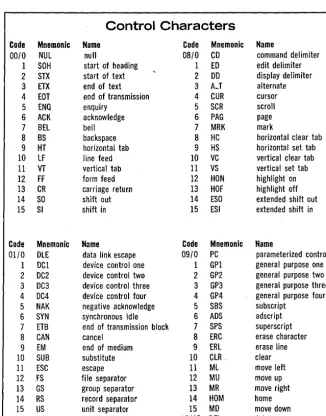
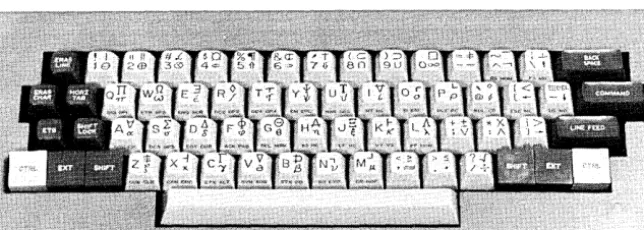
42 Characters in Dialogue
JOHN G. FLETCHER. Making the character set a bit
more complex lets it serve both for communications and processing.
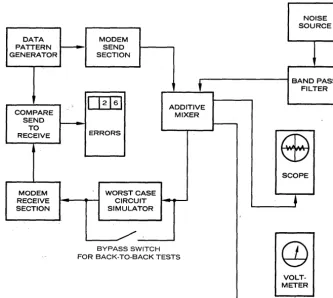
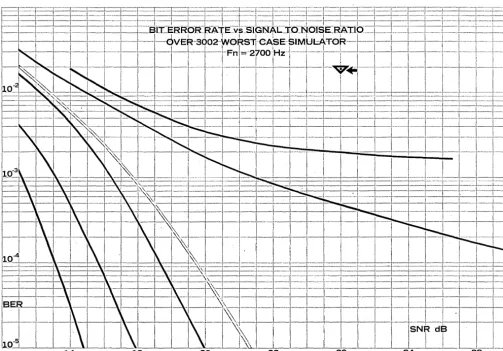
48 Evaluating Modems
ROBERT O. RITCHIE. Modems may look alike, but they ,
differ greatly. Price and brand name are not even clues to performance.
54 Simulating Communications
Systems
DONALD INGERMAN. Simulations need not be big and expensive, even for relatively complicated networks.
61 Unionism in Data Process'ing
BERNHARD SCHWAB and MARK THOMPSON. There are only two alternatives: plan for it now or plan against it now.
72 Archival Data Storage
SIDNEY B. GELLER. Putting an 800 bpi tape into a vault
so it won't be handled may be one of the poorer ways to save information.
Calendar 9
People 11
Letters 23
departments
Look Ahead 17
Source Data
27
News in Perspective
100Hardware 135
Software
&Services
149Advertisers' Index 156
Forum
160. October,
197485 Programming in Book Format
KNUT BULOW. A program can read like a book, though its plot may lack something.
90 DUMP*OLD*BITS*BIN
JACK L. LUDWIG. Wherein little macro saves the day
for lead coder.
95 The Breakup of IBM
ANGELINE PANTAGES. Some economists pooh-pooh the balance of trade argument and the natural mo-nopoly idea, hinting that six IBM's might be the right mix for the industry.
1 00 News in Perspective
CONFERENCES • . . . 100
ELECTRONICS .•••. 106
COMMUNICATIONS • 111 COMPANIES . . . • . • • 118
160 The Forum
SOFTWARE . • . . . • • 120
LABOR RELATIONS •• 125
INTERNATIONAL . • . 126 BENCHMARK • . . • . . 127
Parallel programming: if it's worth doing, it's worth doing twice.
about the cover
Multiple translations of
physical and conceptual representations
of data occur at the communications interface,
making it difficult to avoid distortion. Photographer
Andy Cominos brings it into focus in an
environment created by Clear White, Los Angeles .
Graphics to digits for under $2,000
THE NUMONICS DIGITIZER analyzes strip charts, templates, maps and Xrays.
4
We can tailor our digitizer into a data handling system that's just perfect for you; Or our Numonics digitizer interfaces to existing systems beautifully. And we build it small for desk-,top operation and portability. It has optional hard wired:area measurement and sinuous path-length programs with direct scaling as well as z-axis multipliers. You get all this for under $2.000 and we throw in Numonics' reliability:
does
it
again!
High-speecl20-inch plotters for $11.300
We've done a lot with our Matri'xelectro-static plotters in recent years. We made them quiet ... fast ... low cost ... and high in resolution.
Now we'r:e also making them WIDE~
The Matrix 2030 plotter offers a full
18.56-inch plotting width with an asynchronous paper speed of 3.0 ips. It also has a resolu-tion of 100 dots per inch. The new Dual Array writing head improves contrast 250%.
Plotting is easy and fast with our unique Versaplot™ plotting software. But best of all, the Matrix 2030 is priced at only
$12,300.
For information .on wide plotters with narrow prices, contact Versatec, Inc., 10100
Bubb Road, Cupertino, California 95014. (408) 257-9900, TWX 910-338-0243.
irVERSATEC
Specialists in
hard
copy
information display
CIRCLE 100 ON READER CARD
CRTRMRTICNQO
EDITORIAL STAFF Editor
Articles Editor International Editor Communications Editor Industry Editor Products Editor Source Data Editor Calendar Editor News Editor Bureau Managers
San Francisco . Los Angeles Washington, D.C. New York New England Correspondents Minneapolis Southwest Europe Australia Editorial Advisor Technical Advisor ContribUting Editors
EDITORIAL OFFICES
John L. Kirkley Richard A. McLaughlin
An~eline Pantages Phil Hirsch W. David Gardner Michael William Cashman Daniel P. Schlosky Carol A. Constantian
Tom McCusker
Edward K. Vasakl Edith D. Myers Phil Hirsch Angeline Pantages W. David Gardner
James K. Johnson Robert F. Alexander Pearce Wright Frederick A. Bland Robert L. Patrick Lowell Amdahl Paul Armer, Howard Bromberg, Philip H. Dorn, Louis B. Marienthal, Ray W. Sanders, Milton R. Wessel, F. G. Withington
Headquarters: 1801 S. la Clenega Blvd., los An-geles, CA 90035. Phone (213) 559-5111. Eastern: 35 Mason St., Greenwich, CT 06830, (203) 661-5400. lakeside Office Park, 599 North Avenue, Wakefield, Mass. 01880, (617) 246-2121, 9805 Singleton Dr., Bethesda, MD 20034, (301) 530-7271. Southwestern: 2711 Cedar Springs, Dallas, TX 75201, (214) 744-0161. Western: 2680 Bayshore Frontage Rd., Suite 401, Mountain View, CA 94043, (415) 965-8222. Foreign: 65, Hili Road, Chelms-ford, Essex, England, 64/90 Blues Point Rd., Mc-Mahons Point, NSW 2060, Australia.
GRAPHIC DESIGN & PRODUCTION Art & Production
Director Advertising Production Manager Production Assistant CIRCULATION
Cleve Marie Boutell
Marilee Pitman Alberta R. Martin
35 Mason Street, Greenwich, CT 06830 Circulation Director
Marketing Res.arch Director
Publisher Circulation audited
Suzanne A. Ryan
Douglas De Carlo James M. Morris
by Business Publications Audit
American Member
f:tABP
Business Press, Inc.DATAMATION Is
pub-\4-_\
IIshed monthly on orIIf!1
about the first day of every month by Tech-nical Publishing Company, 1301 South Grove Ave., Barrington, llilnols 60010; Arthur L. Rice, Jr., Chairman of the Board; James B. Tafel, President; Gardner F. landon, Executive Vice President. Executive, Circulation and Advertising offices, 35 Mason Street, Greenwich, CT 06830, (203) 661-5400. Editorial offices, 1801 S. la Cienega Blvd., los Angeles, CA 90035. Published at Chicago, III. DATAMATION Is circulated without charge by name and title to certain qualified individuals who are employed by companies Involved with automatic information handling equipment. Avail-able to others by subscription at the rate of $18 annually in the U.S. and Canada. Reduced rate for qualified students. Foreign subscriptions are available for £12.50 or for the equivalent of $30 U:S. in most West European currencies. Sole agent for all subscriptions outside the U.S.A. and Canada is J. B. Tratsart, Ltd. 154 A Greenford Road, Harrow, Middlesex HA13QT, England. No subscription agency is authorized by us to solicit or take orders for subscriptions. Controlled circu-lation paid at Columbus, OH and Form 3579 to be sent to TeChnical Publishing Company, P.O. Box 2000, Greenwich, CT 06830. Copyright 1974, Tech-nical Publishing Company. Microfilm copies of DATAMATION may be obtained from University Microfilms, A Xerox Company, 300 No. Zeeb Road, Ann Arbor, Michigan 48106. Printed by Beslow Associates, Inc.i
8
Now Documation has taken
away all
the reasons why you
couldn't get a low cost,
high-speed punch
High speed. Low cost. Until now those two phrases meant
compromise in a computer system. Settle for a slow punch.
Even then you had to worry about reliability factors.
No more.
Documation built the no-compromise punch you wanted.
This is an on-line punch. You load and unload the
1 ,OOO-card hoppers on the fly ... a true high-speed
punch ... punch all 80 columns at 100 cards
per minute. With fewer columns you can
get up to 285 cards per minute. And,
if you like, you can even get a 400 cpm
reader in the same configuration.
With our price your computer
representative can now give
you more punch for the price ...
a no-compromise punch for a
no-compromise computer
system.
I
I I
A
V
II
DOCUMATION
I
I N C O R P O R A T E D POST OFFICE BOX 1240 MELBOURNE, FLORIDA 32901 TELEPHONE (305) 724-1111 TWX 510-959-6286calendar
NOVEMBER
Fourth National Conference on Computers in. Clinical Medicine, Nov. 7-10, New Orleans. This year's meeting of
the Society for Computer Medicine (SCM) will focus on such topics as: the use of the computer in health screening, medical data confidentiality, educational programs, clinical algorithms, health records, state-of-the-art reviews, and cost benefits. Dr. John Vincent Atanasoff, whose work at Iowa State Univ. in the late 1930s led to the development of the electronic digital computer, will be made an honorary mem-ber of SCM at the meeting. Contact: Dr. Keith Sehnert,
3839 26th St. N:, Arlington, Va. 22207, (703) 525-1737.
29th Annual ACM Technical Conference, Nov. 11-13, San Diego. Approximately 2,000 people are expected to attend this year's work/ study conference of the Assn. for Comput-ing Machinery (ACM). The conference will include panel discussions on "Unpopular Ideas in Computing," a presenta-tion of 98 papers, several tutorials, and the fifth annual computer chess tournament. Tutorials and workshops will be on such topics as "Security and Privacy: Their Effects on Computer Management" and "Computers and Society: Pub-lic PoPub-licies and the ACM." There will be special interpreter services for deaf attendees. Fee: $55, members; $80, non-members. Contact: Lyn Swan, ACM '74, P.O. Box 9366, San Diego, Calif. 92109.
Fifth Annual Canadian Computer Show and Conference, Nov. 12-14, Montreal. An exhibition and a conference program emphasizing accomplishments in Canadian data processing are expected to attract 8,000-10,000 attendees. More than 80 ven.dors, including some from Japan, will display their products in a 30,000 sq. ft. exhibition. Six conference sessions, organized by the Canadian Information Processing Society (CIPS), with assistance from the Data
Processing Management Assn. (DPMA) and the Assn. for Systems Management (ASM), will treat the theme "Data Processing: A Canadian Industry." Fee: $45, advance regis-tration for all three days. Contact: Canadian Computer Show and Conference, 625 President Kennedy Ave., Mon-treal H3A 1K5, Canada.
DECEMBER
American Bankers Assn. Payments System Policy Confer-ence, Dec. 1-3, Chicago. About 500 top banking executives,
representing banks of all sizes, will direct their attention to the theme, "Electronic Funds Transfer Systems
(EFTS)-Decisions Needed NOW." Participants will discuss topics relating to the impact of EFTS, including the status and 'potential for Automated Clearing Houses (ACH), Point-of-Sale (pos), and Automated Teller Machines (ATM). Fee: $200. Contact: Francis P. Curran, Payments System Plan-ning Div., American Bankers Assn., 1120 Connecticut Ave., Washington, D.C. 20036.
National Microprocessor Conference, Dec. 2-3, Boston. A "major national conference" on microprocessors is being sponsored by Arthur D. Little, Inc., the Cambridge, Mass. research and consulting firm, in conjunction with the New York Management Center. The conference aims to
"com-October,
1974bine an objective overview of a wide range of micropro-cessor technologies with detailed analysis of economic implications." It is dir-ected toward product planners, senior engineers, .and R&D directors, and should also be of value to market and corporate planners and those in charge of analyzing new investment and venture opportunities. Fee: $425. Contact: Marjorie Maws, Arthur D. Little, Inc., Acorn Park, Cambridge, Mass. 02140, (617) 864-5770.
1974 National Telecommunications Conference, Dec. 2-4, San Diego. Sponsored by the Institute of Electrical and Electronics Engineers, this conference will examine the theme "New Trends in Communications." Trends discussed in the 36 technical sessions will include: the implementation of computer networks, social effects of telecommunications, privacy, the wired city, the impact of the microprocessor on communication implementations, the increasing utilization of communication satellite systems, and new contributions to switching, wire communioations, microwaves, and other technologies. In addition, about 50 exhibits will feature state-of-the-art communications and test equipment. Fee for full registration: $45, members; $55, nonmembers; after Nov. 15, add $10. (Limited registration, including admission to technical sessions and exhibits and a copy of the conference record-but no banquets-is $20 less.) Contact: Diane Huddleston, NTC '74, 10453 Roselle St., San Diego, Calif. 92121, (714) 453-7007.
Sixth National Transportation Data Systems Forum and Exhibit, Dec. 3-4, Washington, D.C. This forum and ex-hibit is sponsored by the Transportation Data Coordinating Committee (TDCC), a nonprofit 'Organization created by shippers and carriers to coordinate the development of electronic data interchange between shippers and carriers (rail, motor, ocean, air, forwarders). National and interna-tional officials from industry and government will meet to assess the latest electronic data systems and communications technology that will support shipper/ carrier data inter-change. They will discuss electronic documentation, tariffs, rating, billing, tracing, processing, and payments systems, as well as standards for data interchange and systems interface between shippers and carriers. Fee: $75. Contact: Edward A. Guilbert, TDCC, 1101 17th St. N.W., Washington, D.C. 20036, (202) 293-5514.
Second Annual Business Systems/Product World, Dec. 3-6, New York. The show, which last year attracted 18,000 users, will explore the theme "Sales Year '75" with exhibits of products and systems in word processing, calculating and data processing, micrographics and records management, copying and duplicating, systems design, environment and furniture, and telecommunications. In addition, a series of seminars titled "Managing f'Or Profit" will be presented by the Administrative Management Society, the International Word Processing Assn., and the Office Microfilm Manage-ment Assn., on the following subjects: office planning and layout, word processing,. records management/ micro-graphics, telecommunications control, and office security. Fees not yet determined. For conference information, con-tact: Frank Carberry, AMS, Maryland Rd., Willow Grove, Pa. 19090, (215) 659-4300. For exhibition information, contact: Rudy Lang, Prestige Expositions, Inc., 60 E. 42nd St., New York, N.Y. 10017, (212) 687-8877.
Conferences are generally listed only once. Please check recent issues of DATAMATION for addi-tional meetings scheduled during these months.
10
$51,238
per month
rental
$48,406
per month
lease
ITEL squeezes more out of your computer
dollar-than 18M.
Now you can get a whole computer
system from ITEL for less than what IBM charges for just a
central processing unit.
The numbers speak for themselves: For $51,238 a
month, IBM rents you a single 370/158
CPU
(includes two
ex-tra shifts). But for $48,406, ITEL leases you that same 370
CPU
with ITEL Monolithic Memory, 24 ITEL disk drives plus their
controllers, as well as 241TEL tape drives with their controllers.
To put it another way, if you were to rent a comparable
system from IBM, it would cost you $81,846 a month. Almost
double our price.
Furthermore, we'll lease any kind of 370 computer
package at proportional savings. And we'll make sure that all
terms and provisions are custom-tailored to meet your exact
financial objectives.
At ITEL, we COUldn't have acquired over half a billion
dollars in IBM computer leasing
experi-ence without doing more for your money.
ITEL
Your financial alternative.
~
One Embarcadero Center. San Francisco. California 94111. Phone: (415) 983-0000
people
THE TIME OF
HIS LIFE
"I'm 76 years old and I'm having the time of my life," says Paul M. Pair, senior education consultant for Con-trol Data Institute. And Pair has no plans for retirement. "I feel I have something to contribute."
His primary field is education. Since 1957 it has been edp education. He has been contributing to the fields for many years in many ways. A long-standing concern with professionalism, quality of performance, and standards
PAUL M. PAIR "How do you measure per-formance?"
. . . with "how do you measure the performance of people in our field?" ... has led him to many of his current activities. He is secretary of the Insti-tute for Certification of Computer Pro-fessionals (JccP), having served as the representative of the Assn. of Educa-tional Data Systems (AEDS) on the Computer Foundation Organizing Committee which organized JCCP. He
is part of an ongoing effort sponsored by the Institute for Computer Sciences and Technology and the Assn. for Computing Machinery (ACM) working with the National Bureau of Standards
October,
1974to codify, define, and describe the job skills and knowledge needed in com-puter-relatedoccupations and then to come up with some standard designa-tions. "The way it is now," said Pair, "a person can go from a job with one job title to another that is basically the same but carries a different title and a different rank."
Last spring, Pair learned that a Chi-cago chapter was being formed by the newly-national EDP Auditors Assn. "I'm not an edp auditor and I never will be one," he said, "but I looked into the organization, found that it was concenled with standards and mea-surement, and decided, this is me." He joined and very quickly was named chairman of the association's Commit-tee on Education and Training. At the auditing group's second national con-vention last June in Chicago, Pair de-livered a luncheon speech on "A Pro-gram for Testing and Certification of Knowledge of Computer Personnel." His committee polled those attendees in any way concerned with hiring peo-ple on the kind of training they look for. He· feels the results, when com-piled, will be a valuable guide for col-leges and universities on the kinds of courses they should offer.
Pair feels JCCP has come a long way
in "opening the doors and minds of people in higher education." As the institute's secretary he opens its mail. "We're hearing from all kinds of new people from all over the free world."
Last month was a key one for JCCP,
which had designated September "Pro-ject JCCP Month."
"It's the beginning of the school year," explained Pair, "and a good time to encourage people to prepare to sit for the Certificate in Data Process-ing (CDP) examination next Febru-ary." Constituent societies were en-couraged to help their members do this. Pair's group, AEDS, sent out 40-page packets to its 24 chapter presi-dents urging them to "go to work" and telling them how to do it.
Pair's career spans just about every aspect of education, starting as a high school teacher and subsequently a high school principal in Kansas. A native of Nebraska, he holds a B.A. degree from McPherson College, McPherson, Kan-sas, and an M.A. degree in education from the Univ. of Washington. From ~
Kansas, he moved to Washington, ~
where he was Superintendent of
::i
Schools first in Prosser and then· in ...jc
Kirkland.
c
He got into business education in ~ 1940 when he met John Robert Gregg, the father of Gregg shorthand. He was
director of Gregg's school in Chicago for 10 years, until it was acquired by McGraw Hill Publishing Co.
Pair's next effort was to found his own secretarial school, The Pair School of Business, in Chicago. "We began hearing and reading automa-tion. Here we were training secretaries. We wondered, were these machines go-ing to replace secretaries."
So he became the first franchisee for Dr. Vernon Patterson's Automation Institutes and founded Automation In-stitute of Chicago. This school was ac-quired by Control Data Corp. in 1968 and Pair became a senior staff consul-tant for Control Data Institute.
He's collected some firsts and some honors through the years. In 1961, he became the first private business school representative to become not only a member of but president of the N a-tional Business Education Assn. He served on its executive board the next nine years. In 1973 he was named Computer Science Man of the Year by the Chicago chapter of the Data Pro-cessing Management Assn. (DPMA)
and in the same year was named Voca-tional Education Man cif the Year by Goodwill Industries Rehabilitation Center. He has been listed in Who's Who in America since 1947 and in Who's Who in Education since 1954.
GOOD
THINKING
Jeffrey D. Stein is a college freshman dropout who's been a student of com-puting ever since. Also a savvy practi-tioner.
He's the 33-year-old president and founder, in 1969, of On-Line Business Systems, Inc. of San Francisco, a com-pany that began in an apartment with
JEFFREY D. STEIN The freshman who would work for nothing got $1.50 an hour.
people
a $2,000 investment and today has grown to a 60-person operation whose revenue approaches $2 million a year. The company develops and sells on-line services to businesses in the west-ern U.S., and soon will expand its of-ferings nationally with a 370/ 145-based system capable of supporting 100 ter-minals. The offerings to 55 clients range widely from such routine busi-ness systems as order entry, accounts receivable, and general ledger to reser-vations systems and project control-all offered on-line. Stein says his com-pany guarantees clients savings of a minimum of 30% not only in hard-ware and softhard-ware development costs, but because of the efficiencies in doing processing in real time. The prolifera-tion of desk and hand-held calculators has been getting people accustomed to doing their work in real time, says Stein of· his service, which often is called on-line facilities management.
Getting his business going' from a shoestring operation at a time when the venture capital market had dried up consumed a lot of Stein's time-but not enough for him to neglect profes-sional society and educational activity. Stein has a CDP and once taught the
CDP preparatory course in San Fran-cisco. He's been active in the Assn. for Computing Machinery CACM) and the
Assn. for Systems Management (ASM)
and recently was named chairman of the National Computer Conference Committee, a group that advises or-ganizers of the National Computer Conference. Shortly after his appoint-ment to the NCC post, Stein had a ]ist of a half dozen ideas to improve the annual conference. Among them is a proposal to attract good speakers to the conference without the speakers having to prepare a paper. Stein thinks the con-ference should be opened to persons who simply would like to talk for 15 or 20 minutes from notes. They would talk during a day-long forum.
Of computer professionalism, he thinks the CDP is a useful means of judging the kind of computer person you're confronting, but it's just a ginning and has a long way to go be-fore reaching the stature of a CPA or a law or medical license. The reason: "This industry is still in its infancy and the demand for computer people still is much bigger than the supply." He has great expectations for the work of the recently formed Institute for the Certi-fication of Computer Professionals
(JccP) .
12
Stein entered the computer business "without the faintest idea of what a computer was or what it was used for." While a freshman at Ohio State, he answered a newspaper advertisement for a part-time job in the computer center at Batelle Memorial Institute in Columbus, opened to junior or senior students with an A or B average major-ing in engineermajor-ing and statistics or math. Stein, a C-average freshman ma-joring in business accounting, talked his way into the job at $1.50 an hour "after offering "to work for nothing." He then forwent college to go into computing full-time, working as the
night supervisor at the IBM 650-based installation and spending days at the
IBM education center in Columbus
tak-ing "every course they offered," includ-ing one of the first 1401 courses. Later, in San Francisco, he was the first to write a COBOL program under IBSYS,
the IBM 7090 operating system. He was a consultant and, before forming his company, was the director of R&D at Greyhound Computer Corp., where he and his company's co-found-er Keith Davis began thinking of op-portunities in the field of on-line com-puting services. The record shows that it was good thinking.
"THE VOICE OF THE USER"
The Data Processing Management Assn. (DPMA) needs " . . . to become more visible ... and to let our voice be heard among manufacturers ... " says
DPMA'S new international president,
Edward J. Palmer.
Palmer, elected to the international presidency at DPMA'S annual INFO/ EXPO '74 conference in Minneapolis last June, is the assistant director of administrative data processing at Bos-ton Univ. As such, he designs and
EDWARD J. PALMER "A stance more re-sponsive to the public."
implements computer systems for ad-ministrative work of 16 of the univer-sity's colleges.
He believes strongly in the need for
DPMA to "take a stance more respon-sive to the public." He sees this as a two-pronged watchdog effort. "First
we must look out for legislation and trends which could hinder our employ-ers and, second, we should watch for opportunities to assist elected legisla-tors in areas concerning dp where they need our expertise and assistance."
Palmer's data processing career of 22 years began with Boston's Metro-politan Transit Authority, where he first learned tab equipment, and con-tinued with the Whiting Milk Com-pany of Boston, where he set up an automated producers' payroll system, a method of paying milk producers. Fol-lowing that he spent 14 years with
RCA'S Defense Products Div., during which he· was in charge of installation and implementation of the division's first computer, an RCA 301, and its upgrading to a Spectra 70/45. He has been with Boston Univ. for the past 31;2 years, having joined as a systems officer.
Palmer has been a DPMA member for
the past 13 years, having become ac-tive, first at the local level, 11 years ago. A native of Tucson, he became a New Englander when he went to Bos-ton Univ., from which he graduated in 1950, and where he met his wife. He likes New England although he admits, "It took some getting used to ... I had to trade hot weather for cold weather and learned how not to fight the snow ... but the change of seasons appealed tome ... "
His big hope for DPMA, under his presidency, is that it "act as the type of association it should be, working through our monitoring programs as far as the old budget will stand, becom-ing, as it should be, the voice of the
user." 0
..
"
. ,,:;-,t·
;8iabilitr
'.'
~ge
,
:j~.IBeautr
'f, , ."
r
.
::C"has pidfitably manufactured information display and >ntrol products for computer oriented industries since
)58-;-that's~ "stability." Since 1963 we've produce,d'
~ terminals called DATA-SCREENTM Terminals-that's Ige" in a .yc)l~ng industry. Ou( carefully styled terminals "
'e
comp~ible in any application, match a,ny dec?r~ M'~ "beltuty."" .
','
~" .~.
~ , ,
'"
,J
"White PQye'
'at
the Desert" • ; MiSslon..:Sa.~ Xavier del BacMINI-TEC™ MODEL 2400
MINI-TECTM DATA-SCREENTM Terminals include more feattJres in their standard price than any other low cost CRT. Check this list and compare:
Buffered and conversational mode 1920 (80 x 24) character screen display RS-232, TTL 20/60 mA current loop interface Separate, low profile "curved" style keyboard Full cursor control by operator and computer Load and read cursor address
Reads lower case. - displays upper case Tab feature and blink feature
Protect - display at reduced intensity
Space suppression by terminal logic Switch selectable roll-up through 9600 baud Externally selectable 11 0 through 9600 baud Full/half duplex - externally selectable
Page or line transmit - externally selectable
Composite video output for remote monitors
115/230 VAC, 50/60 Hz - switch selectable
Vinyl or painted finishes
STANDARD PRICE
Optional - split baud rate Optional - rack mount chassis
Optional - 16-key numeric pad on keyboard Optional - buffered hard copy adaptor for
popular printers
MINI-TEe
MODEL 2400
Standard Standard Standard Standard Standard Standard' Standard Standard Standard Standard Standard Standard Standard Standard Standard Standard Standard
$1495
$45 $60 $60
$100 to $175
Only 4 low cost options - everything else including simplified keyboard created for non-technical operators and compact design that occupies less desktop space is included.
For information about th is and 19 other DATA-SCREENTM Terminals offering par-allel, serial and teletypewriter replacement interfaces and priced from $995 contact TEC,
Incorporated, 9800 North Oracle Road,
Tucson, Az. USA 85704 (602) 297-1111
For Multi-Applicatio
Multi-Location Business Data Processin
~
ASCOT GENERAL INDUSTRIES, INC.
Route Salesman Order Sheet 'Omaha, Nebraska Date Q/?XJ/14
Account Number 676
Ship to ()t/tVE/?SAL IN£), MO{)(/c-T5
1010
tJ.
10TH C;[R££T OmflHl1 NEB.Bill to: SItME Ship Via: MTR, FREI&HT
Catalog No. Quantity
216 6
45" 10
23
1-Salesman: ttl1g£JS
Office: Oh1IfIfl'lt#ea.
ORDER ENTRY
Description
W!f££1- MOUNTS
B/J5HING-S
fLEe, MTR5,
~
ASCOT GENERAL INDUSTRIES, INC.
Price
39,40 IJ,7, ('0
33784
Date 5m30 1911- FiNl5tiIN6- Department Production Hours Diff Expected Red-Loss Total per BI.-Gain
00. No. Acc!. Actual Hour Expected Actual R B
M OTIS 1'1,/)20 50l 1'<"00 31~ 7 Cl
bl. JONES 11706;1., fiOZ. ),800 7
t.4 LEE IO/R.2(, (jOl 2800 6
{,7 D{/NN 1956),5' (iOl 400 100 1 1
691</DD I05{)Z/ fiOZ. ZOO 1
PRODUCTION REPORTS Order No. 1.068 ).068 ),0"'1 ;1.06'f
~
ASCOT GENERAL INDUSTRIES, INC.
Oper. No. 3/ 4-Z 37 15' Finishing Department Time and Production
Date
10/5#4-'
Time labor or No, Start Finish Elapsed Piece Rate Pieces Cost7:20 12.:00 4.~ 2. ?XJ 8fio 8,05
1:00 "1-:UJ 3.2 2,,3{) ;J,SO s: 15
T'O 12.:10 "1-.8 2.:;0 3~O 8·0S' /:00 S.oO 4-.0 2.30 ~50 5".15'
LABOR DISTRIBUTION
ASCOT GENERAL INDUSTRIES, INC.
Finishing D,v,s,on • Employee Time Sheet
~
ASCOT GENERAL INDUSTRIES, INC.
CHICAGO DIVISION WAREHOUSE
Inventory Status Report
For: SEPT
'74-Item Catalog # Onty. as of Onty. Shipped 9/30 During Month
P:BtRlN6-S 084-9 2740 /50
FLfIN&£ 9647 If) /8:3 2/40
AsroN 63/4- I 62.8 8S'
MIJFFI£R. '7218 6 1-23 176 fiL.rER. . {,2./6 804& IO;'S
INVENTORY COl'fTROL
Invoice ANlDVAFK ACCCS!)'(XW:S
116 N. Buchanan Street Albany, N.Y. 06478
Onty. Received During Month
'<CJO
-500 21000
-To Ascot General Ind. 31747 Van Alstyne Chicago. I l l . 60666
Date Shipped: 9/20/74
Shipped Via: Motor Freight P.O.# Inv.# Salesman Office Invoice Date A-545 86452 O'Brien Chicago 9/27/74 Items Catalog # Quantity Cost Wheel Bearings 674 100 $ 431.16 Bushing Seals 1040 500 101.13 Motor Covers 8241 200 1.624.18 SUb-Total 2.056.47 Sales Tax N/A Shipping Charge 105.24
$2.161.71
30 Days Net/2% 10 Days
ACCOUNTS PAYABLE
1017 10/8 10/9 10/10 10/11 10/12 10113 Totals EmployeelNumber RT lOT RT lOT RT lOT RT lOT RT lOT RT lOT RT lOT RT lOT 8E1JNETT 6117
{] a
(3 I 8 0 ~.~6 ()
- - . ~- ~~ ._- --1tL
OiRL'IL£ 82/4
8
0 8 / r5 0 80 8 0 10 ILANE 6743 8 0 8 0 60 {j 0 {j 0 i '/()o
PoWHL 0643 8 0 6 0 fj 0 fj 0 80
Ii
'to 0PAI?KER '1118 8 0 13 0 6 0 00 0 01 ~'f
a
I PAYROLL
~
ASCOT GENERAL INDUSTRIES, INC.
31747 Van Alstyne Chicago, illinois 60666 (312) 748-9200 Invoice
To Universal Auto Products 1010 lOth Street Omaha. Nebraska 45215 Salesman
Harris
Invoice # 10284
Catalog # Description Quanti ty Price 216
45 23
Wheel Mounts Bushings Elec. Motors
10 4 39.40 127.60 337.84 504.84 Sales Tax 25.24 Shipping Charge 63.14 TOTAL DUE 593.22
ACCOUNTS RECEIVABLE
~
ASCOT GENERAL INDUSTRIES, INC.
Transportation Division Overhead Analysis
Month '.3EPT.
Indirect Labor Budget Actual OverorUr Expense Budge
Supervision 77500 7~6,OO ( Ir,OI
Trk. Drivers Helpers Shipping
General Labor 1O(f,OO /71.21.. 2.33. 7t
Repair and Rework
Idle and Lost Time 1.77 (1.77.
Guaranteed Rate Cost ;/.41.00 :z.t3./4 2/5.86
Overtime Bonus 7£00 .32.'18 12,02
Maint, Mchy, Equip. /50.00 .38.2/, (f1/.74
Vacations %.00 16·00
Paid Holidays 1,61-7.00 /,07'1.37 574.6=
Total
COST ANALYSIS
OFF-LINE
TO OTHER COMPUTERS
~atashare
DA T AS HARE is the comprehensive answer provided by ltapoint Corporation to the problem of providing a
llti-apRlication business data processing and intelligent data try capability to multi-location organizations at a cost that's thin today's inflation-pinched budgets.
DA T ASHARE's big plus for users is that it permits the II computing power of a Datapoint 2200 Terminal Processor
be utilized at up to eight dispersed work stations. At those :ltions, operators using Datapoint 3300, 3360 or other :ltapoint terminals (with or without terminal printers) have II access via either local wire connection or telephone lines the 2200's powerful internal computer and 128K of virtual emory for conversion, entry, processing and storage of data )m sales orders, accounts payable and receivable, employee ne sheets, inventory receipts and other important source )cuments. Under DAT ASHARE control, operators using rminals at these work stations can utilize. programs stored
a central disk memory unit to aid in entering data for lrticular applications and other processing requirements, .dependent of and concurrent with, work going on at the other ations.
Physically DA T ASHARE is a master program stored in Ie central Datapoint 2200 processor which acts as controller )r data traffic between the work stations and the disk memory Ie unit associated with the 2200 where file and program data ; stored for each application and each work station. The IA T ASHARE program also allocates the internal processing ower of the 2200 among these work stations in a manner kin to time sharing, so that each station functions as though
had total command of the 2200.
The basic advantages of the DA T ASHARE approach for lulti-Iocation, multi-application data entry and processing equirements are flexibility - each operator can work upon
applications independently of what's going on at other stations (although stations can also share data files and programs if that's appropriate) - caRability - the full capacity of four
2200/2.4
megabyte disks is available to each work station for processing and storage of program and file data - and, of course, economy - each work station in effect enjoys the power and capability of a 2200 via a terminal that costs a fraction of the 2200.The DA T ASHARE program also provides each data station with automatic file maintenance, simplifying user creation of, access to, and storage of, data files stored in central memory. The program optimizes use of available memory space as well as makes it simple to create, combine or alter files. Further, with its communications interfaces and numerous emulation routines, the Datapoint 2200 /DAT ASHARE System can be readily integrated into most functioning
computer Icommunications networks. In some cases the Datapoint
22001
disk system will be used to edit andpre-process source data captured at the remote work stations before sending it on to a home office computer facility . However, the 2200 will most often be used as the central processor itself.
With DA T ASHARE, you can enjoy a proven business data processing and intelligent data entry capability in each of eight work stations at a cost well below a conventional upgrade. Scores of companies are'making use of this unique Datapoint package with outstanding results.
For further information
Da~o·po·lnt
on DA T ASHARE, contact~
the sales office nearest you or write or call Datapoint Corporation, San Antonio, Texas 78284, (512) 690-7151.
Ime Office: 9725 Datapoint Drivel San Antonio, Texas 78284/(512) 690-7173 • Sales Offices: Atlilnta/(404) 458-6423 • Austin (512) 452-9424. Baton Rouge/(504) 926-3700· Boston/(617) 890-0440
larlotte/(704) 527-3302. Chicago/(312) 298-1240. Cincinnati/(513) 421-6122. Cleveland/(216) 831-0550· Dallas/(214) 661-5536· Denver 1(303) 770-3921 • Des Moines/(515) 225-9070. Detroitl(31~~..::6~092
Irtford/(203) 677-4551 • Honolulu/(808) 524-3719· Houston/(713) 688-5791 • Los Angeles/(213),645-5400 • Minneapolis/(612) 854-4054 • Nashville/(615) 385-3014. Newark/(201) 376-1311 • New York/(212) 759-4656 'landO/(305) 896-1940 • Philadelphia/(215) 643-5767· Phoenix/(602) 265-3909 • Piltsburgh/(412) 931-3663 • Puerto Rico/(809) 783-5320 • Saint Louis/(314) 291-1430 • San Diego/(714) 460-2020
In Francisco/(415) 968-7020. Seattle/(206) 455-2044· Washington, D.C. 1(703) 790-0555. International: TRW I Datacom-lnternational/Los Angeles, California, TELEX 691286 (213) 475-6777 ,dney, Australia/922-31 00. Vienna, Austria/022Z/36 21 41 • Sao Paulo, Brazill 2467661 • Brussels!76 20 30 • Toronto/(416) 438-9800· Copenhagen/(01) 105366· Guayaquil, Ecuador 1350390 lOdon (01) 903 6261 • Helsinki/(90) 5671 • Paris/581 1270· Hanover, Germany/(0511) 634011 • Rotterdam/(010) 216244· Tel Aviv, Israel/(03) 417170. Milan/316 333· TokyO/263 3211 Jala Lumpur, Malaysia/21416 • Oslol 153490· Makati Rizal, The Philippines I 877 294 • Singapore 10/378165· Johannesburg!724 9301 • Stockholm/(08) 188295 • LysSI Berne/(032) 844240
· . .. IfYQutJtink
all .
System
3
disks
are alIke,
take
a closer look
attheBASF
130.
Because all single disk
car-tridges conform to certain industry
standards, you might think they're
all equal. They aren't. The
impor-tant difference is the extent to
which a manufacturer is willing to
go in order to
exceed
industry
standards. It's a matter of making
a disk cartridge better than you
really need, because there could
be times when you need it. Let's
look at a few superior points of the
BASF 130 System 3 disk cartridge:
The binder that won't quit
As you probably know,
mag-netic coating doesn't stick to the
aluminum disk all by itself. We use
a special binding agent to produce
an incredibly strong bond. The
disk is sealed to prevent oxidation,
so you can be sure the coating
won't peel or flake off.
Our own coating process
As the trend toward higher
packing densities continues, it
becomes increasingly important
to monitor the thickness of coating
deposited on the disk. The
prob-lem is compounded by the
neces-sity for progressively varying the .
coating thickness from the outside
toward the inside of the disk,
because packing density is
greater as the circumference
decreases. For those reasons,
we've discarded conventional
coating methods in favor of an
exclusive process using our own
BASF-designed equipment.
A polished performance
Following the coating
opera-tion, we use our own exclusive
polishing process to achieve
opti-mum surface regularity. We've
been able to achieve a surface so
flat, that the possibility of a head
crash being caused by an uneven
disk is completely eliminated. We
might mention that the coating
and binder formulation,
com-bined with coating and polishing
techniques, are all important
factors in achieving surface
hard-ness, which is the ability of the
coated surface to survive
exces-sive or extended head loading.
And to make sure •••
We test our 130 disk
car-tridges to standards much tighter
than those of the leading
equip-ment supplier. If anything
un-pleasant should happen, we'd
much prefer it happen here than
on your drive. As a regular
pro-cedure, we do scratch tests to
check coating thickness, impact
tests to determine head crash .
resistance, detergent tests to
check resistance to wear and tern
perature variations, and drop test:
to make sure balance and
align-ment don't shift during shipalign-ment.
We test to make sure our 130 disk
cartridges are error-free.
Finally
Our 130 costs no more than
other System 3 disk cartridges.
You're already paying for BASF
quality ... you might as well have
it. For more information on the
130, or BASF's line of
com-puter tape, disk packs and
flexible disks, write to
BASF Systems, Crosby Drive,
Bedford, Mass. 01730.
FI---:
You're already paying for BASF
quality,
you might aswell have
it.
L~~L
·
~lA
.~
LOOK ArEAD
COSTS DOWN, BUT PRICES ARE UP
"\.Jhile the
cos~of jus t about everything has risen
dramatically in recent years, the cost of doing
thing~.2..L._computer has been a noteworthy exception."
Thus reads an advertisement IBM published in the
~tlantjc ~~~~~lyand other general circulation publications in September--the month
it slapped price increases of 6 to 8% on equipment, services, and
maintenance.
The move, at a time when 1975 dp budgets seemed
likely to be kept at a standstill by cash-short managements, left
many installation managers distressed.
One, a banker who got wind
of the i.mpending increase and purchased a 370/168 two weeks before
the Sept. 18 announcement, said he saved his installation $300,000
by the timin8.
Nevertheless, his maintenance costs will rise by
nearly $1,000 a month.
Others talked of having to decimate
pro-gramming staffs just to keep within anticipated '75 budgets.
Even though the increase seemed to reopen opportunities for the
lower-priced offerings of independent peripheral manufacturers,
these suppliers were preparing to follow IBM's action with
in-creases of their own (see below), even as IBM followed Univac's 6%
increases by one day.
Earlier, Control Data had raised its prices 2-10%.
Shortly
after the Univac and IBM announcements, Honeywell, Burroughs, and
other leading suppliers weren't commenting on their plans.
FEW ESCAPE
TBMACTION
--~---IBM on Sept. 18 called up customers to present them with a price
schedule that upped purchase, maintenance, and rental prices on
smaller 370 equipment by 6% and on larger systems by 8%.
The
pur-chase price hikes went into effect immediately.
Users who sought
long-term lease plans to escape the new prices found they were out
of luck unless their contracts started before Sept. 18.
The lease
price increases were to go into effect next Jan. 1.
Only the 360, 1130, and 1800 lines (and the early 370/155 and
165 cpu's) escaped the wide-ranging adjustments on products IBM
had announced before this past summer.
Even the ancient 2311 disc
drive and the slow-moving 3650 retail store point-of-sale terminal
were jacked up by 6%.
In jts announcement--hand-delivered to the trade press by the
company's public relations men in the form of a terse
three-para-graph pr.ess release--the company said the increases applied to
prices in the U.S.
But there was speculation that it also
eventu-ally would apply, as in the past, to prices charged by subsidiaries
overseas.
MOVING UP \.JITH THE UMBRELLA
- - - - _
.. --_._-_
.._---Independent suppliers of peripheral equipment did well in the early
'70s when budgets were tight and 10% off sometimes was enough to
keep a project or a programming group intact.
As budgets loosened,
the independents, already simmering from IBM price reductions and
scarce lease financing, had to offer a lot more even to make a
presentation to a user.
LOOK ArE AD
increase on lease and maintenance contracts.
At Storage Technology,
6% price increases on rental equipment were announced after IBM's.
Despite these moves, Memorex vp George Dashiell figures he's
still 7-20% below IBM's prices, depending on product and
configu-ration, and STC's president Jesse Aweida estimates his Colorado
company's prices still are about 12% off of IBM's on average.
Calcomp raised prices 5-10% on products it sells to original
equip-ment manufacturers, but not to end users, "until further study."
A Calcomp spokesman said of the IBM action:
"It's IBM's first
price announcement in years that enhances our market position
because, for a change, it isn't a price reduction."
DIAL A BILL
An on-line service that enables a consumer to pay his bills, not
with checks but with a phone call to his savings institution, may
surface this month in the Minneapolis-St. Paul area.
It's an
out-growth of the In-Touch service originated in Seattle last year
that lasted less than a year.
Consumers will use push-button
phones for direct input, or talk from a rotary dial phone to an
operator.
This could be a boost to savings institutions that by
law can't offer checking accounts to their depositors.
INTERREGIONAL EFTS THIS YEAR
Eighteen charter members strong, the National Automated Clearing
House Assn. got down to business this month, holding its first
full board meeting Oct. 10, at which three committees were formed:
systems/operation, legal/legislative, and education/communications.
The group of regional Automated Clearing Houses, formed to
facil-itate interregional electronic funds transfer
(EFT~anticipates
the first interregional exchanges will take place before the end
of this year.
Charter members, 14 of which joined the four
found-ing members from California, Georgia, New England, and the upper
Midwest by an Aug. 31 deadline, represent virtually every section
of the country.
New ACH members are in New York City, Philadelphia,
Baltimore, Pittsburgh, Pa., Columbus and Dayton, Ohio, Detroit,
Memphis, Chicago, St. Louis, Kansas City, Mo., Dallas/Ft. Worth,
Houston, and Portland, Ore.
"The response was higher than we
expected," said Frank Curran, American Bankers Assn. staff director
of payment systems planning and NACHA secretary-treasurer.
"There
were a number of surprises, notably Memphis, St. Louis, Kansas
City, and Portland."
Curran said he feels announcement of NACHA's
formation acted as a catalyst to ACH activity in a number of
places.
He expects two or three other ACH's will join NACHA before
the end of the year.
DATASPEED 40:
A DECISION FOR IBM
Teletype has solved its production problems with the long-awaited
Dataspeed 40.
If these reports are true and volume production
starts before the end of the year, then IBM will soon be confronted
with a tough decision: what to do about providing signaling and
software maintenance for the Bell System product.
Many believe
the Mod 40 will become something of an industry standard, like
Teletype's Model 33 line (more than 500,000 shipped).
IBM provides software and signaling maintenance for the Mod 33
but, now that the Bell System and IBM are bumping up against each
other in more marketplaces, there are some who think IBM may not
go along this time.
This
$129,500*
timesharipg system
gives you better
BASIC
than
any
other minicomputer system.
With batch at the same time.
HP's 3000 Model 100 lets you do more with BASIC than ever before. You can intermix integer, real, long precision and complex numbers. Share resources with any kind of peripheral. Call subroutines compiled in FORTRAN, COBOL, and our Systems Programming Language. In batch you get complete multi-language capability concurrently. And a file system identical to the one used from terminals.
This innovation works for a living. You do. So call us.
HP minicomputers.
They work for a living.
HEWLETT
{Ii.,n;
, T
PACKARD
j
.. J
Sales and service from 172 offices in 65 countries.
1501 Page Mill Road, Palo Alto, California 94304 ·Domestic USA price only. 22416
WANGCO's low cost
Series-N
... the non-floppy disc!
The Series-N, with flying head and hard-disc reliability, gives you 25, 50 or 100megabit capacity, in a single, compact package ... at one-sixth the cost-per-bit of
floppy discs.
The Series-N, with one or two fixed discs, and with 100 or 200 tracks-per-inch
capability, lets you fit its capacity to your system requirements, without compromise.
For main memory extension, point-of-sales systems, software storage, process control programming ... any application calling for small size, fast access and iow cost, there is a Series-N model to fit your system.
In your system, the reliable Series-N costs little more than a floppy disc, because controller costs for the two are equal. But the far greater reliability of non-contact
rigid disc technology will pay its way many times over. And in addition, you get far greater capacity in only 6 inches of a standard 19-inch rack.
Transfer Capacity Rate Model (Megabits) (KB/Sec.)
N-1211
25
1562
N-1212
25
2500
N-1221
50
1562
N-1222
50
2500
N-2211
50
1562
N-2212
50
2500
N-2221
100
1562
N-2222
100
2500
For more information call the WANGCO office nearest you, or write to WANGCO Incorpo-rated, 5404 Jandy Place, Los Angeles, Calif. 90066. (213) 390-8081. TWX 910/343-6246.
Recording Track Rotation Density Density Speed (Bits/Inch) (TPI) (RPM)
2200
100
1500
2200
100
2400
2200
100
1500
2200
100
2400
2200
200
1500
2200
200
2400
2200
200
1500
2200
200
2400
\NANGCO
SETTING THE PACE IN PERIPHERALS
New York, N.Y. 516/294-8093. Boston, Mass. 617/444-9264· Washington, D.C. 301/937-2215· Cocoa Beach, Fla. 305/453-1144· Chicago, III. 312/298-6050 Houston, Tex. 713/785-0581 • Dallas, Tex. 214/620-1551· Denver, Colo. 303/355-3521 • San Francisco, Calif. 408/246-9241 • Seattle, Wash. 206/632-0710
IIi Europe: WANGCO Incorporated, The Lodge, 362 Cranford Lane, Harlington, Middlesex, England. Telephone: 897-0202. Cable: WANINC Offices in France, Germany, Sweden, Switzerland, Australia, Brazil, Canada, Israel, Japan and South Africa.
Comparison-shop the new KEY-EDIT®50
against all competition.
KEY-EDIT 50 is a low cost, high volume key-to-disk data entry system that is especially designed for small-to-medium users. Even if you have as few as five keypunch operators, KEY-EDIT 50 was designed with your needs in mind. The system can have as few as four visual display data terminals, and can be expanded up to a maximum of sixteen. There is also a central processor, a disk, a 7 -or 9-track magnetic tape unit, and a supervisor control console. Other optional hardware features include line printers, matrix printers, and up to four tape drives
per system.
Three things set KEY-EDIT 50 apart from other systems that compete with it:
The most powerful, sophisticated and flexible software in its price . category. The KEY-EDIT Input/Output Editor can give you increased
throughput, decreased turnaround time, and a significantly lower cost of data preparation and entry.
On-line communications concurrent with data entry. This growth-oriented option makes KEY-EDIT 50 more than just a data entry system. You may not need a communications capability today, but you will tomorrow. So meet tomorrow's needs at today's prices.
KEY-EDIT 50 is easy to learn and easy to use. Your present operators can learn to use KEY-EDIT 50 in a few hours. And because it's so easy to use, the productivity of your operators will increase almost immediately.
That's just three good reasons to look at KEY -EDIT 50 when you're shopping tor
a
replacement tor your punched cards. But there are many others. To learn about them, call or write today.//
.(iI(
CONSOUDATED
".,,~COMPUTER
INC.
In the United States: 275 Wyman Street, Waltham, Mass. 02154 (617) 890-7100 In Canada: 50 Gervais Drive, Doh Mills, Ontario M3C 1Z3 (416) 449-1120