Proceedings of the 2019 Conference on Empirical Methods in Natural Language Processing 5415
Capturing Argument Interaction in
Semantic Role Labeling with Capsule Networks
Xinchi Chen1 Chunchuan Lyu1 Ivan Titov1,2
[email protected] [email protected] [email protected] 1 ILCC, School of Informatics, University of Edinburgh
2ILLC, University of Amsterdam
Abstract
Semantic role labeling (SRL) involves extract-ing propositions (i.e. predicates and their typed arguments) from natural language sen-tences. State-of-the-art SRL models rely on powerful encoders (e.g., LSTMs) and do not model non-local interaction between argu-ments. We propose a new approach to mod-eling these interactions while maintaining ef-ficient inference. Specifically, we use Capsule Networks (Sabour et al.,2017): each propo-sition is encoded as a tuple ofcapsules, one capsule per argument type (i.e. role). These tuples serve as embeddings of entire proposi-tions. In every network layer, the capsules in-teract with each other and with representations of words in the sentence. Each iteration re-sults in updated proposition embeddings and updated predictions about the SRL structure. Our model substantially outperforms the non-refinement baseline model on all 7 CoNLL-2019 languages and achieves state-of-the-art results on 5 languages (including English) for dependency SRL. We analyze the types of mistakes corrected by the refinement proce-dure. For example, each role is typically (but not always) filled with at most one argument. Whereas enforcing this approximate constraint is not useful with the modern SRL system, it-erative procedure corrects the mistakes by cap-turing this intuition in a flexible and context-sensitive way.1
1 Introduction
The task of semantic role labeling (SRL) in-volves the prediction of predicate-argument struc-ture, i.e., both the identification of arguments and labeling them with underlying semantic roles. The shallow semantic structures have been shown beneficial in many natural language processing (NLP) applications, including information
extrac-1Code: https://github.com/DalstonChen/CapNetSRL.
signing the contract from
Hiti prevented injury
An x
Ini
tial
Refined Gold
signer (A0) signer (A0)
document (A1) sign.01
sign.01 signer (A0)
[image:1.595.310.526.223.271.2]document (A1)
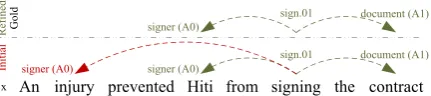
Figure 1: An example predicate-argument structure: green and red arcs denote correct and wrong predic-tions, respectively.
tion (Christensen et al., 2011), question answer-ing (Eckert and Neves,2018) and machine trans-lation (Marcheggiani et al.,2018).
In this work, we focus on the dependency ver-sion of the SRL task (Surdeanu et al.,2008). An example of a dependency semantic-role structure is shown in Figure 1. Edges in the graph are marked with semantic roles, whereas predicates (typically verbs or nominalized verbs) are anno-tated with their senses.
Intuitively, there are many restrictions on poten-tial predicate-argument structures. Consider the ‘role uniqueness’ constraint: each role is typically, but not always, realized at most once. For ex-ample, predicates have at most oneagent. Simi-larly, depending on a verb class, only certain sub-categorization patterns are licensed. Nevertheless, rather than modeling the interaction between ar-gument labeling decisions, state-of-the-art seman-tic role labeling models (Marcheggiani and Titov,
2017; Cai et al., 2018; Li et al., 2019b) rely on powerful sentence encoders (e.g., multi-layer Bi-LSTMs (Zhou and Xu, 2015; Qian et al., 2017;
Tan et al.,2018)). This contrasts with earlier work on SRL, which hinged on global declarative con-straints on the labeling decisions (FitzGerald et al.,
Instead of using hard constraints, we propose to use a simple iterative structure-refinement proce-dure. It starts with independent predictions and refines them in every subsequent iteration. When refining a role prediction for a given candidate ar-gument, information about the assignment of roles to other arguments gets integrated. Our intuition is that modeling interactions through the output spaces rather than hoping that the encoder some-how learns to capture them, provides a useful in-ductive bias to the model. In other words, captur-ing this interaction explicitly should mitigate over-fitting. This may be especially useful in a lower-resource setting but, as we will see in experiments, it appears beneficial even in a high-resource set-ting.
We think of semantic role labeling as ex-tracting propositions, i.e. predicates and argument-role tuples. In our example, the proposition issign.01(Arg0:signer= Hiti,
Arg1:document = contract). Across the
it-erations, we maintain and refine not only pre-dictions about propositions but also their em-beddings. Each ‘slot’ (e.g., correspond to role Arg0:signer) is represented with a vector, en-coding information about arguments assumed to be filling this slot. For example, if Hiti is pre-dicted to fill slot Arg0 in the first iteration then the slot representation will be computed based on the contextualized representation of that word and hence reflect this information. The combination of all slot embeddings (one per semantic role) con-stitutes the embedding of the proposition. The proposition embedding, along with the prediction about the semantic role structure, gets refined in every iteration of the algorithm.
Note that, in practice, the predictions in ev-ery iteration are soft, and hence proposition em-beddings will encode current beliefs about the predicate-argument structure. The distributed rep-resentation of propositions provides an alterna-tive (“dense-embedding”) view on the currently considered semantic structure, i.e. information extracted from the sentence. Intuitively, this representation can be readily tested to see how well current predictions satisfy selection restric-tions (e.g., contract is a very natural filler for
Arg1:document) and check if the arguments
are compatible.
To get an intuition how the refinement mecha-nism may work, imagine that bothHitiandinjury
are labeled asArg0forsign.01in the first iter-ation. Hence, the representation of the slotArg0 will encode information about both predicted ar-guments. At the second iteration, the wordinjury
will be aware that there is a much better candidate for filling thesignerrole, and the probability of assigninginjuryto this role will drop. As we will see in our experiments, whereas enforcing the hard uniqueness constraint is not useful, our iterative procedure corrects the mistakes of the base model by capturing interrelations between arguments in a flexible and context-sensitive way.
In order to operationalize the above idea, we take inspiration from the Capsule Net-works (CNs) (Sabour et al.,2017). Note that we are not simply replacing Bi-LSTMs with generic CNs. Instead, we use CN to encode the structure of the refinement procedure sketched above. Each slot embedding is now acapsuleand each proposi-tion embedding is a tuple of capsules, one capsule per role. In every iteration (i.e. CN network layer), the capsules interact with each other and with rep-resentations of words in the sentence.
We experiment with our model on stan-dard benchmarks for 7 languages from CoNLL-2019. Compared with the non-refinement baseline model, we observe substantial improvements from using the iterative procedure. The model achieves state-of-the-art performance in 5 languages, in-cluding English.
2 Base Dependency SRL Model
In dependency SRL, for each predicate p of a given sentence x = {x1, x2,· · · , xn} with n words, the model needs to predict roles y =
{y1, y2,· · ·, yn}for every word. The role can be
none, signifying that the corresponding word is not an argument of the predicate.
We start with describing the factorized baseline model which is similar to that of Marcheggiani et al.(2017). It consists of three components: (1) an embedding layer; (2) an encoding layer and (3) an inference layer.
2.1 Embedding Layer
The first step is to map symbolic sentencex and predicatepinto continuous embedded space:
ei= Lookup(xi), (1)
p= Lookup(p), (2)
2.2 Encoding Layer
The encoding layer extracts features from input sentence x and predicate p. We extract features from input sentencex using stacked bidirectional LSTMs (Hochreiter and Schmidhuber,1997):
xi= Bi-LSTMs(ei), (3)
wherexi ∈ Rdl. Then we represent each role logit
of each word by a bi-linear operation with the tar-get predicate:
bj|i=xiWp, (4)
whereW ∈ Rdl×de is a trainable parameter and bj|i ∈ Ris a scalar representing the logit of rolej
for wordxi.
2.3 Inference Layer
The probabilityP(y|x, p)is then computed as
P(y|x, p) =Y
i
P(yi|x, i, p), (5)
=Y
i
softmax(b·|i)yi, (6)
where b·|i = {b1|i, b2|i,· · ·, b|T ||i} and |T | de-notes the number of role types.
3 Dependency based Semantic Role Labeling using Capsule Networks
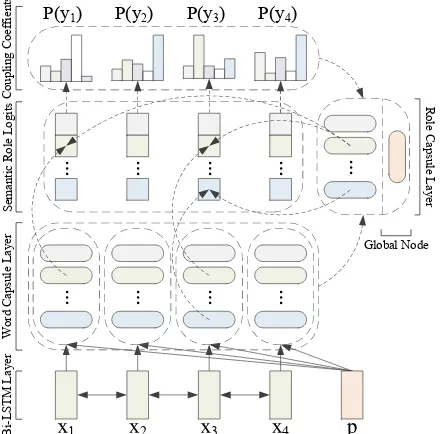
Inspired by capsule networks, we use capsule structure for each role state to maintain infor-mation across iterations and employ the dynamic routing mechanism to derive the role logitsbj|i it-eratively. Figure 2 illustrates the architecture of the proposed model.
3.1 Capsule Structure
We start by introducing two capsule layers: (1) the word capsule layer and (2) the role capsule layer.
3.1.1 Word Capsule Layer
The word capsule layer is comprised of capsules representing the roles of each word. Given sen-tence representation xi and predicate embedding p, the word capsule layer is derived as:
ukj|i =xiWjkp; k= 1,2,· · · , K, (7)
whereWk
j ∈ Rdl×de anduj|i ∈ RK is the cap-sule vector for rolej of word xi. K denotes the capsule size. Intuitively, the capsule encodes the argument-specific information relevant to decid-ing if role j is suitable for the word. These cap-sules do not get iteratively updated.
…
1 2 3 4
P(y1) P(y2) P(y3) P(y4)
Word Cap
sule
Layer
Semant
ic Role Logi
ts
Coupling Coe
ffien
ts
Role Capsule Layer
Bi-LSTM Layer
Global Node
… … … …
[image:3.595.307.527.65.282.2]… … … …
Figure 2: Architecture of the proposed CapsuleNet with the global capsule node. The dashed arcs are it-erable.
3.1.2 Role Capsule Layer
As discussed in the introduction, the role capsule layer could be viewed as an embedding of a propo-sition. The capsule network generates the capsules in the layer using “routing-by-agreement”. This process can be regarded as a pooling operation. Capsules in the role capsule layer att-th iteration are derived as:
v(jt)= Squash(s(jt)) = ||s
(t)
j ||2
1 +||s(jt)||2
s(jt)
||s(jt)||
, (8)
where intermediate capsules(jt) is generated with the linear combination of capsules in the word cap-sule layer with weightsc(ijt):
s(jt) =X
i
c(ijt)uj|i. (9)
Here,c(ijt)are coupling coefficients, calculated by “softmax” function over role logitsb(jt|i). The co-efficientsc(ijt)can be interpreted as the probability that wordxi is assigned rolej:
c(it)= softmax(b(·|ti)). (10)
The role logits b(jt|)i are decided by the iterative
Input:# of iterationsT, all capsules inlwuj|i
Result: semantic role logitsb(j|iT)
Initialization:b(0)j|i = 0;
fort∈[0,1,· · ·, T−1]do
for all capsules inlw:c(it)= softmax(b
(t)
·|i);
for all capsules inlr:s( t)
j =
P
ic
(t)
ijuj|i;
for all capsules inlr:v(jt)= Squash(s
(t)
j );
for all capsules inlwandlr:b( t+1)
j|i =b
(t)
j|i+v
(t)
jWuj|i;
end
Algorithm 1: Dynamic routing algorithm. lw and lr denote word capsule layer and role cap-sule layer, respectively.
3.2 Dynamic Routing
The dynamic routing process involves T itera-tions. The role logitsbj|i before first iteration are
all set to zeros:b(0)j|i = 0. Then, the dynamic rout-ing process updates the role logitsbj|iby modeling agreement between capsules in two layers:
bj(t|i+1)=bj(t|)i+v(jt)Wuj|i, (11)
whereW∈ RK×K.
The whole dynamic routing process is shown in Algorithm1. The dynamic routing process can be regarded as the role refinement procedure (see Section5for details).
4 Incorporating Global Information
When computing the j-th role capsule represen-tation (Eq9), the information originating from an
i-th word (i.e. uj|i) is weighted by the probabil-ity of assigning role j to wordxi (i.e. cij). In other words, the role capsule receives messages only from words assigned to its role. This im-plies that the only interaction the capsule network can model is competition between arguments for a role.2 Note though that this is different from im-posing the hard role-uniqueness constraint, as the network does this dynamically in a specific con-text. Still, this is a strong restriction.
In order to make the model more expressive, we further introduce a global nodeg(t)to incorporate global information about all arguments at the cur-rent iterations. The global node is a compressed representation of the entire proposition, and used in the prediction of all arguments, thus permitting arbitrary interaction across arguments. The global
2In principle, it can model the opposite, i.e. collaboration / attraction but it is unlikely to be useful in SRL.
nodeg(t)att-th iteration is derived as:
g(t)=Ws(t), (12)
where W ∈ RK×(K·|T |). Here, s(t) = s(t) 1 ⊕
s(2t)⊕ · · · ⊕s(|T |t) ∈ RK·|T |is the concatenation of
all capsules in the role capsule layer.
We append an additional term for the role logits update in Eq (11):
bj(t|+1)i =b(jt|i)+vj(t)Wuj|i+g(t)Wguj|i, (13)
whereW∈ RK×KandWg∈ RK×K.
5 Refinement
The dynamic routing process can be seen as it-erative role refinement. Concretely, the coupling coefficients c(it) in Eq (10) can be interpreted as the predicted distribution of the semantic roles for wordxiin Eq (5) att-th iteration:
c(it)=P(t)(·|x, i, p). (14)
Since dynamic routing is an iterative process, se-mantic role distributionc(it) in iterationtwill af-fect the semantic role distribution c(it+1) in next iterationt+ 1:
c(it+1)=f(c(it), x, i, p), (15)
where f(·) denotes the refinement function de-fined by the operations in each dynamic routing iteration.
6 Training
We minimize the following loss functionL(θ):
L(θ) =−1
n
n X
i
logP(T)(yi|x, i, p;θ)+λ||θ||22,
(16) whereλis a hyper-parameter for the regularization term andP(T)(yi|x, i, p;θ) = c(iT). Unlike stan-dard refinement methods (Belanger et al., 2017;
Lee et al.,2018) which sum losses across all re-finement iterations, our loss is only based on the prediction made at the last iteration. This encour-ages the model to rely on the refinement process rather than do it in one shot.
Uniqueness Constraint Assumption As we discussed earlier, for a given target predicate, each semantic role will typically appear at most once. To encode this intuition, we propose another loss termLu(θ):
Lu(θ) =
1
|T | X
j
log softmax(b(jT|·)), (17)
whereb(jT|·)are the semantic role logits inT-th it-eration. Thus, the final lossL∗(θ)is the combina-tion of the two losses:
L∗(θ) =L(θ) +ηLu(θ), (18)
whereηis a discount coefficient.
7 Experiments
7.1 Datasets & Configuration
we conduct experiments on CoNLL-2009 (Hajiˇc et al., 2009) for all languages, including Cata-lan (Ca), Chinese (Zh), Czech (Cz), English (En), German (De), Japanese (Jp) and Spanish (Es). As standard we do not consider predicate identifica-tion: the predicate position is provided as an input feature. We use the labeled ‘semantic’ F1 which jointly scores sense prediction and role labeling.
We use ELMo (Peters et al.,2018) (dimension
de as 1024) for English, and FastText embed-dings (Grave et al.,2018) (dimensionde as 300) for all other languages on both the baseline model and the proposed CapsuleNet. LSTM state dimen-sion dl is 500. Capsule sizeK is 16. Batch size is 32. The coefficient for the regularization term
λis0.0004. We employ Adam (Kingma and Ba,
2015) as the optimizer and the initial learning rate
α is set to 0.0001. Syntactic information is not utilized in our model.
7.2 Model Selection
Table 1 shows the performance of our model trained with lossL∗(θ)for different values of
dis-count coefficient η on the English development set. The model achieves the best performance whenηequals to 0. It implies that adding unique-ness constraint on loss actually hurts the perfor-mance. Thus, we use the lossL∗(θ)withηequals to 0 in the rest of the experiments, which is equiv-alent to the loss L(θ) in Eq (16). We also ob-serve that the model with 2 refinement iterations performs the best (89.92% F1).
η # of Iters P R F EM
1.0
1 89.31 88.31 88.80 63.21
2 88.34 88.92 88.63 62.80 3 88.92 88.97 88.94 63.51
0.1
1 89.16 87.99 88.57 62.94 2 88.70 88.89 88.80 63.00
3 89.75 89.40 89.57 66.01
0.0
1 89.59 90.06 89.82 66.74
2 89.88 89.97 89.92 66.93
[image:5.595.317.517.63.184.2]3 89.25 89.61 89.43 65.98
Table 1: The performance of our model (w/o global node) with different discount coefficients η of loss
L∗(θ)on the English development set. EM denotes the ratio of exact match on propositions.
Models Test Ood
Lei et al.(2015) 86.60 75.60
FitzGerald et al.(2015) 87.70 75.50
Foland and Martin(2015) 86.00 75.90
Roth and Lapata(2016) 87.90 76.50
Swayamdipta et al.(2016) 85.00
-Marcheggiani et al.(2017) 87.70 77.70
Marcheggiani and Titov(2017) 89.10 78.90
He et al.(2018) 89.50 79.30
Li et al.(2018) 89.80 79.80
Cai et al.(2018) 89.60 79.00
Mulcaire et al.(2018) 87.24
-Li et al.(2019b)† 90.40 81.50
Baseline† 90.49 81.95
[image:5.595.320.511.257.429.2]CapsuleNet†(This Work) 91.06 82.72
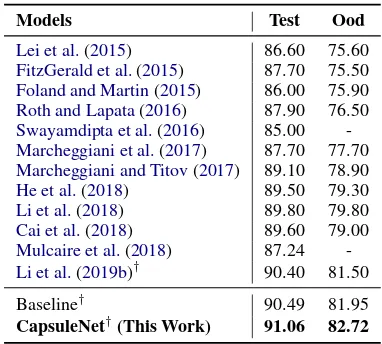
Table 2: The F1 scores of previous systems on the En-glish test set and out-of-domain (Ood) set. †denotes that the model uses Elmo.
7.3 Overall Results
Table2 compares our model with previous state-of-the-art SRL systems on English. Some of the systems (Lei et al., 2015; Li et al., 2018; Cai et al.,2018) only use local features, whereas oth-ers (Swayamdipta et al.,2016) incorporate global information at the expense of greedy decoding. Additionally, a number of systems exploit syntac-tic information (Roth and Lapata,2016; Marcheg-giani and Titov, 2017; He et al., 2018). Some of the results are obtained with ensemble systems (FitzGerald et al.,2015;Roth and Lapata,2016).
cap-Models Development Test Ood
P R F EM P R F EM P R F EM
CapsuleNet SRL 89.63 90.25 89.94 67.15 90.74 91.38 91.06 69.90 82.66 82.78 82.72 53.14
[image:6.595.76.522.65.131.2]w/o Global Node 89.88 89.97 89.92 66.93 90.95 91.15 91.05 69.65 82.45 82.27 82.36 51.95 w/o Role Capsule Layer 89.95 89.64 89.80 66.70 90.82 90.66 90.74 68.46 82.26 81.64 81.95 50.75 w/o Word Capsule Layer (Baseline) 89.47 89.61 89.54 66.17 90.31 90.68 90.49 68.27 82.16 81.74 81.95 50.75
Table 3: Ablation results in English development and test sets. EM denotes the ratio of the exact match on propositions.
sule network framework. The improvement on the out-of-domain set implies that our model is robust to domain variations.
7.4 Ablation
Table3gives the performance of models with ab-lation on some key components, which shows the contribution of each component in our model.
• The model without the global node is de-scribed in Section3.
• The model that furtherremoves the role cap-sule layertakes the mean of capsulesuj|i in Eq (7) of word capsule layer as the semantic role logitsbj|i:
bj|i = 1 K
K X
k
ukj|i, (19)
whereKdenotes the capsule size.
• The model that additionally removes the word capsule layer is exactly equivalent to the baseline model described in Section2.
As we observe, CapsuleNet with all compo-nents performs the best on both development and test sets on English. The model without using the global node performs well too. It obtains 91.05% F1 on the English test set, almost the same perfor-mance as full CapsuleNet. But on the English out-of-domain set, without the global node, the per-formance drops from 82.72% F1 to 82.36% F1. It implies that the global node helps in model gener-alization. Further, once the role capsule layer is re-moved, the performance drops sharply. Note that the model without the role capsule layer does not use refinements and hence does not model argu-ment interaction. It takes the mean of capsulesuj|i in the word capsule layer as the semantic role log-itsbj|i(see Eq (19)), and hence could be viewed as an enhanced (‘ensembled’) version of the baseline
Sent Len # of Props
0 - 9 181
10 - 19 1,806 20 - 29 3,514 30 - 39 3,102 40 - 49 1,383 50 - 59 391 60 - 69 121
# of Args # of Props
1 2,591
2 4,497
3 2,189
4 889
5 259
6 39
7 7
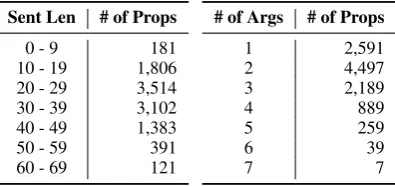
Table 4: Numbers of propositions with different sen-tence lengths and different numbers of arguments on the English test set.
model. Note that we only introduced a very lim-ited number of parameters for the dynamic routing mechanism (see Eq (11-13)). This suggests that the dynamic routing mechanism does genuinely captures interactions between argument labeling decisions and the performance benefits from the refinement process.
7.5 Error Analysis
The performance of our model while varying the sentence length and the number of arguments per proposition is shown in Figure 3. The statistics of the subsets are in Table4. Our model consis-tently outperforms the baseline model, except on sentences of between 50 and 59 words. Note that the subset is small (only 391 sentences), so the ef-fect may be random.
7.6 Effect of Refinement
7.6.1 Refinement Performance
[image:6.595.317.515.188.281.2]0-9 10-19 20-29 30-39 40-49 50-59 60-69
90 92
Sentences Length
1 2 3 4 5 6 7
85 90
[image:7.595.83.520.63.194.2]# of Arguments
Figure 3: The F1 scores of different models while varying sentence length and argument number on the English test set.
BASELINE CAPSULENET(W/OGLOBALNODE) CAPSULENET
2 4 6 8
85 90
# of Iterations
(a) Precision (P)
2 4 6 8
75 80 85 90
# of Iterations
(b) Recall (R)
2 4 6 8
84 86 88 90
# of Iterations
(c) F1
2 4 6 8
50 60
# of Iterations
[image:7.595.92.517.243.371.2](d) Exact Match Ratio (EM)
Figure 4: The performance of different models while varying the number of refinement iterations on the English development set.
2 4 6 8
500 1,000
# of Iterations
#
of
Propositions
with
Duplicate
Ar
guments
GOLD BASELINE
CAPSULENET CAPSULENET(W/OGLOBALNODE)
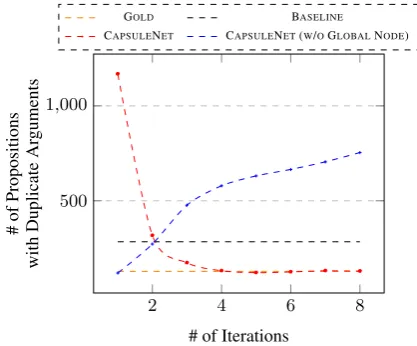
Figure 5: The number of propositions with duplicate arguments for various numbers of refinement iterations on the English development set.
node reduces the precision as the number of iter-ation grows. This model is less transparent, so it harder to see why it chooses this refinement strat-egy. As expected, the F1 scores for both models peak at the second iteration, the iteration number used in the training phase. The trend for the exact match score is consistent with the F1 score.
7.6.2 Duplicate Arguments
We measure the degree to which the role unique-ness constraint is violated by both models. We plot the number of violations as the function of the number of iterations (Figure 5). Recall that the violations do not imply errors in predictions as even the gold-standard data does not always sat-isfy the constraint (see the orange line in the fig-ure). As expected, CapsuleNet without the global node captures competition and focuses on enforc-ing this constraint. Interestenforc-ingly, it converges to keeping the same fraction of violations as the one observed in the gold standard data. In contrast, the full model increasingly ignores the constraint in later iterations. This is consistent with the over-generation trend evident from the precision and re-call plots discussed above.
[image:7.595.76.285.423.596.2](a) Capsule Network w/o Global Node (b) Capsule Network with Global Node
Figure 6: Changes in labeling between consecutive iterations on the English development set. Only argument types appearing more than 50 times are listed. “None” type denotes “NOT an argument”. Green and red nodes denote the numbers of correct and wrong role transitions have been made respectively. The numbers are transformed into log space.
Model Ja Es Ca De Cz Zh En Avg.
Previous Best Single Model 78.69 80.50 80.32 80.10 86.02 84.30 90.40 82.90 Baseline Model 80.12 81.00 81.39 76.01 87.79 81.05 90.49 82.55
CapsuleNet SRL (This Work) 81.26 81.32 81.65 76.44 88.08 81.65 91.06 83.07
Table 5: Labeled F1 score (including senses) for all languages on the CoNLL-2009 in-domain test sets. For previous best result, Japanese (Ja) is fromWatanabe et al.(2010), Catalan (Ca) is fromZhao et al.(2009), Spanish (Es) and German (De) are fromRoth and Lapata(2016), Czech (Cz) is fromHenderson et al.(2013), Chinese (Zh) is fromCai et al.(2018) and English (En) is fromLi et al.(2019b).
log spaceq˜= sign(q) log(|q|).
As we expected, for both models, the majority of changes are correct, leading to better overall performance. We can again see the same trends. CapsuleNet without the global node tends to filter our arguments by changing them to “None”. The reverse is true for the full model.
7.7 Multilingual Results
Table 5 gives the results of the proposed Capsu-leNet SRL (with global node) on the in-domain test sets of all languages from CoNLL-2009. As shown in Table5, the proposed model consistently outperforms the non-refinement baseline model and achieves state-of-the-art performance on Cata-lan (Ca), Czech (Cz), English (En), Japanese (Jp) and Spanish (Es). Interestingly, the effectiveness of the refinement method does not seem to be dependent on the dataset size: the improvements on the smallest (Japanese) and the largest datasets (English) are among the largest.
8 Additional Related Work
The capsule networks have been recently applied to a number of NLP tasks (Xiao et al.,2018;Gong et al.,2018). In particular,Yang et al.(2018) rep-resent text classification labels by a layer of cap-sules, and take the capsule actions as the classi-fication probability. Using a similar method, Xia et al.(2018) perform intent detection with the cap-sule networks. Wang et al. (2018) and Li et al.
(2019a) use capsule networks to capture rich fea-tures for machine translation. More closely to our work,Zhang et al.(2018) andZhang et al.(2019) adopt the capsule networks for relation extraction. The previous models apply the capsule networks to problems that have a fixed number of compo-nents in the output. Their approach cannot be di-rectly applied to our setting.
9 Conclusions & Future Work
SRL. In each iteration, we refine both predictions of the semantic structure (i.e. a discrete struc-ture) and also a distributed representation of the proposition (i.e. the predicate and its predicted arguments). The iterative refinement process lets the model capture interactions between the deci-sions. We relied on the capsule networks to opera-tionalize this intuition. We demonstrate that our model is effective, and results in improvements over a strong factorized baseline and state-of-the-art results on standard benchmarks for 5 languages (Catalan, Czech, English, Japanese and Spanish) from CoNLL-2019. In future work, we would like to extend the approach to modeling interaction be-tween multiple predicate-argument structures in a sentence as well as to other semantic formalisms (e.g., abstract meaning representations (Banarescu et al.,2013)).
Acknowledgments
We thank Diego Marcheggiani, Jonathan
Mallinson and Philip Williams for construc-tive feedback and suggestions, as well as anonymous reviewers for their comments. The project was supported by the European Research Council (ERC StG BroadSem 678254) and the Dutch National Science Foundation (NWO VIDI 639.022.518).
References
Laura Banarescu, Claire Bonial, Shu Cai, Madalina Georgescu, Kira Griffitt, Ulf Hermjakob, Kevin Knight, Philipp Koehn, Martha Palmer, and Nathan Schneider. 2013. Abstract meaning representation for sembanking. InProceedings of the 7th Linguis-tic Annotation Workshop and Interoperability with Discourse, pages 178–186.
David Belanger, Bishan Yang, and Andrew McCallum. 2017. End-to-end learning for structured prediction energy networks. InProceedings of the 34th Inter-national Conference on Machine Learning, ICML 2017, Sydney, NSW, Australia, 6-11 August 2017, pages 429–439.
Jiaxun Cai, Shexia He, Zuchao Li, and Hai Zhao. 2018. A full end-to-end semantic role labeler, syntax-agnostic over syntax-aware? arXiv preprint arXiv:1808.03815.
Janara Christensen, Mausam, Stephen Soderland, and Oren Etzioni. 2011. An analysis of open informa-tion extracinforma-tion based on semantic role labeling. In
Proceedings of the Sixth International Conference on Knowledge Capture, K-CAP ’11, pages 113–120, New York, NY, USA. ACM.
Dipanjan Das, Andr´e FT Martins, and Noah A Smith. 2012. An exact dual decomposition algorithm for shallow semantic parsing with constraints. In Pro-ceedings of the First Joint Conference on Lexical and Computational Semantics-Volume 1: Proceed-ings of the main conference and the shared task, and Volume 2: Proceedings of the Sixth International Workshop on Semantic Evaluation, pages 209–217. Association for Computational Linguistics.
Fabian Eckert and Mariana Neves. 2018. Semtic role labeling tools for biomedical question an-swering: a study of selected tools on the BioASQ datasets. InProceedings of the 6th BioASQ Work-shop A challenge on large-scale biomedical seman-tic indexing and question answering, pages 11–21, Brussels, Belgium. Association for Computational Linguistics.
Nicholas FitzGerald, Oscar T¨ackstr¨om, Kuzman Ganchev, and Dipanjan Das. 2015. Semantic role labeling with neural network factors. In Proceed-ings of the 2015 Conference on Empirical Methods in Natural Language Processing, pages 960–970.
William Foland and James Martin. 2015. Dependency-based semantic role labeling using convolutional neural networks. InProceedings of the Fourth Joint Conference on Lexical and Computational Seman-tics, pages 279–288.
Jingjing Gong, Xipeng Qiu, Shaojing Wang, and Xu-anjing Huang. 2018. Information aggregation via dynamic routing for sequence encoding. arXiv preprint arXiv:1806.01501.
Edouard Grave, Piotr Bojanowski, Prakhar Gupta, Ar-mand Joulin, and Tomas Mikolov. 2018. Learning word vectors for 157 languages. InProceedings of the 11th Language Resources and Evaluation Con-ference, Miyazaki, Japan. European Language Re-source Association.
Jan Hajiˇc, Massimiliano Ciaramita, Richard Johans-son, Daisuke Kawahara, Maria Ant`onia Mart´ı, Llu´ıs M`arquez, Adam Meyers, Joakim Nivre, Sebastian Pad´o, Jan ˇStˇep´anek, Pavel Straˇn´ak, Mihai Surdeanu, Nianwen Xue, and Yi Zhang. 2009. The conll-2009 shared task: Syntactic and semantic dependencies in multiple languages. InProceedings of the Thir-teenth Conference on Computational Natural Lan-guage Learning: Shared Task, CoNLL ’09, pages 1–18, Stroudsburg, PA, USA. Association for Com-putational Linguistics.
Shexia He, Zuchao Li, Hai Zhao, and Hongxiao Bai. 2018. Syntax for semantic role labeling, to be, or not to be. InProceedings of the 56th Annual Meet-ing of the Association for Computational LMeet-inguistics (Volume 1: Long Papers), pages 2061–2071.
Sepp Hochreiter and J¨urgen Schmidhuber. 1997. Long short-term memory. Neural Comput., 9(8):1735– 1780.
Diederik P. Kingma and Jimmy Ba. 2015. Adam: A method for stochastic optimization. CoRR, abs/1412.6980.
Jason Lee, Elman Mansimov, and Kyunghyun Cho. 2018. Deterministic non-autoregressive neural se-quence modeling by iterative refinement. In Pro-ceedings of the 2018 Conference on Empirical Meth-ods in Natural Language Processing, pages 1173– 1182, Brussels, Belgium. Association for Computa-tional Linguistics.
Tao Lei, Yuan Zhang, Lluis Marquez, Alessandro Mos-chitti, and Regina Barzilay. 2015. High-order low-rank tensors for semantic role labeling. In Proceed-ings of the 2015 Conference of the North Ameri-can Chapter of the Association for Computational Linguistics: Human Language Technologies, pages 1150–1160.
Jian Li, Baosong Yang, Zi-Yi Dou, Xing Wang, Michael R Lyu, and Zhaopeng Tu. 2019a. In-formation aggregation for multi-head attention with routing-by-agreement. arXiv preprint arXiv:1904.03100.
Zuchao Li, Shexia He, Jiaxun Cai, Zhuosheng Zhang, Hai Zhao, Gongshen Liu, Linlin Li, and Luo Si. 2018. A unified syntax-aware framework for seman-tic role labeling. In Proceedings of the 2018 Con-ference on Empirical Methods in Natural Language Processing, pages 2401–2411.
Zuchao Li, Shexia He, Hai Zhao, Yiqing Zhang, Zhu-osheng Zhang, Xi Zhou, and Xiang Zhou. 2019b. Dependency or span, end-to-end uniform semantic role labeling. arXiv preprint arXiv:1901.05280.
Diego Marcheggiani, Joost Bastings, and Ivan Titov. 2018.Exploiting semantics in neural machine trans-lation with graph convolutional networks. In Pro-ceedings of the 2018 Conference of the North Amer-ican Chapter of the Association for Computational Linguistics: Human Language Technologies, Vol-ume 2 (Short Papers), pages 486–492, New Orleans, Louisiana. Association for Computational Linguis-tics.
Diego Marcheggiani, Anton Frolov, and Ivan Titov. 2017. A simple and accurate syntax-agnostic neural model for dependency-based semantic role labeling.
arXiv preprint arXiv:1701.02593.
Diego Marcheggiani and Ivan Titov. 2017. En-coding sentences with graph convolutional net-works for semantic role labeling. arXiv preprint arXiv:1703.04826.
Phoebe Mulcaire, Swabha Swayamdipta, and Noah Smith. 2018. Polyglot semantic role labeling. arXiv preprint arXiv:1805.11598.
Matthew Peters, Mark Neumann, Mohit Iyyer, Matt Gardner, Christopher Clark, Kenton Lee, and Luke Zettlemoyer. 2018. Deep contextualized word rep-resentations. In Proceedings of the 2018 Confer-ence of the North American Chapter of the Associ-ation for ComputAssoci-ational Linguistics: Human Lan-guage Technologies, Volume 1 (Long Papers), pages 2227–2237, New Orleans, Louisiana. Association for Computational Linguistics.
Feng Qian, Lei Sha, Baobao Chang, LuChen Liu, and Ming Zhang. 2017. Syntax aware LSTM model for semantic role labeling. InProceedings of the 2nd Workshop on Structured Prediction for Natural Lan-guage Processing, pages 27–32, Copenhagen, Den-mark. Association for Computational Linguistics.
Michael Roth and Mirella Lapata. 2016. Neural se-mantic role labeling with dependency path embed-dings. arXiv preprint arXiv:1605.07515.
Sara Sabour, Nicholas Frosst, and Geoffrey E Hin-ton. 2017. Dynamic routing between capsules. In I. Guyon, U. V. Luxburg, S. Bengio, H. Wallach, R. Fergus, S. Vishwanathan, and R. Garnett, editors,
Advances in Neural Information Processing Systems 30, pages 3856–3866. Curran Associates, Inc.
Mihai Surdeanu, Richard Johansson, Adam Meyers, Llu´ıs M`arquez, and Joakim Nivre. 2008. The conll-2008 shared task on joint parsing of syntactic and se-mantic dependencies. InProceedings of the Twelfth Conference on Computational Natural Language Learning, CoNLL ’08, pages 159–177, Stroudsburg, PA, USA. Association for Computational Linguis-tics.
Swabha Swayamdipta, Miguel Ballesteros, Chris Dyer, and Noah A Smith. 2016. Greedy, joint syntactic-semantic parsing with stack lstms. arXiv preprint arXiv:1606.08954.
Oscar T¨ackstr¨om, Kuzman Ganchev, and Dipanjan Das. 2015. Efficient inference and structured learn-ing for semantic role labellearn-ing. Transactions of the Association for Computational Linguistics, 3:29–41.
Zhixing Tan, Mingxuan Wang, Jun Xie, Yidong Chen, and Xiaodong Shi. 2018. Deep semantic role label-ing with self-attention. InAAAI.
Mingxuan Wang, Jun Xie, Zhixing Tan, Jinsong Su, et al. 2018. Towards linear time neural machine translation with capsule networks. arXiv preprint arXiv:1811.00287.
Yotaro Watanabe, Masayuki Asahara, and Yuji Mat-sumoto. 2010. A structured model for joint learn-ing of argument roles and predicate senses. In Pro-ceedings of the ACL 2010 Conference Short Papers, pages 98–102, Uppsala, Sweden. Association for Computational Linguistics.
Proceedings of the 2018 Conference on Empirical Methods in Natural Language Processing, pages 3090–3099, Brussels, Belgium. Association for Computational Linguistics.
Liqiang Xiao, Honglun Zhang, Wenqing Chen, Yongkun Wang, and Yaohui Jin. 2018. MCapsNet: Capsule network for text with multi-task learning. In Proceedings of the 2018 Conference on Em-pirical Methods in Natural Language Processing, pages 4565–4574, Brussels, Belgium. Association for Computational Linguistics.
Min Yang, Wei Zhao, Jianbo Ye, Zeyang Lei, Zhou Zhao, and Soufei Zhang. 2018. Investigating cap-sule networks with dynamic routing for text classifi-cation. InProceedings of the 2018 Conference on Empirical Methods in Natural Language Process-ing, pages 3110–3119, Brussels, Belgium. Associ-ation for ComputAssoci-ational Linguistics.
Ningyu Zhang, Shumin Deng, Zhanling Sun, Xi Chen, Wei Zhang, and Huajun Chen. 2018. Attention-based capsule networks with dynamic routing for re-lation extraction. InProceedings of the 2018 Con-ference on Empirical Methods in Natural Language Processing, pages 986–992, Brussels, Belgium. As-sociation for Computational Linguistics.
Xinsong Zhang, Pengshuai Li, Weimin Jia, and Hai Zhao. 2019. Multi-labeled relation extraction with attentive capsule network.CoRR, abs/1811.04354.
Hai Zhao, Wenliang Chen, Jun’ichi Kazama, Kiyotaka Uchimoto, and Kentaro Torisawa. 2009. Multilin-gual dependency learning: Exploiting rich features for tagging syntactic and semantic dependencies. In Proceedings of the Thirteenth Conference on Computational Natural Language Learning: Shared Task, pages 61–66. Association for Computational Linguistics.