Exploring Representations from Unlabeled Data with Co-training
for Chinese Word Segmentation
Longkai Zhang Houfeng Wang∗ Xu Sun Mairgup Mansur
Key Laboratory of Computational Linguistics (Peking University) Ministry of Education, China
[email protected], [email protected], [email protected], [email protected],
Abstract
Nowadays supervised sequence labeling models can reach competitive performance on the task of Chinese word segmenta-tion. However, the ability of these mod-els is restricted by the availability of an-notated data and the design of features. We propose a scalable semi-supervised fea-ture engineering approach. In contrast to previous works using pre-defined task-specific features with fixed values, we dy-namically extract representations of label distributions from both an in-domain
cor-pus and an out-of-domain corcor-pus. We
update the representation values with a semi-supervised approach. Experiments on the benchmark datasets show that our approach achieve good results and reach an f-score of 0.961. The feature engineer-ing approach proposed here is a general iterative semi-supervised method and not limited to the word segmentation task.
1 Introduction
Chinese is a language without natural word delimiters. Therefore, Chinese Word Segmen-tation (CWS) is an essential task required by further language processing. Previous research shows that sequence labeling models trained on labeled data can reach competitive accuracy on the CWS task, and supervised models are more accurate than unsupervised models (Xue, 2003; Low et al., 2005). However, the resource of man-ually labeled training corpora is limited. There-fore, semi-supervised learning has become one
∗Corresponding author
of the most natural forms of training for CWS. Traditional semi-supervised methods focus on adding new unlabeled instances to the training set by a given criterion. The possible mislabeled instances, which are introduced from the auto-matically labeled raw data, can hurt the per-formance and not easy to exclude by setting a sound selecting criterion.
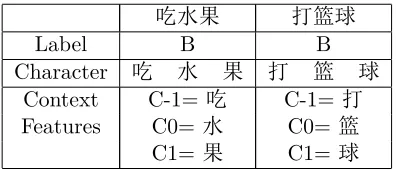
In this paper, we propose a simple and scal-able semi-supervised strategy that works by pro-viding semi-supervision at the level of represen-tation. Previous works mainly assume that con-text features are helpful to decide the potential label of a character. However, when some of the context features do not appear in the training corpus, this assumption may fail. An example is shown in table 1. Although the context of “水” and “篮” is totally different, they share a homo-geneous structure as “verb-noun”. Therefore. A much better way is to map the context informa-tion to a kind of representainforma-tion. More precisely, the mapping should let the similar contexts map to similar representations, while let the distinct contexts map to distinct representations.
吃水果 打篮球
Label B B
Character 吃 水 果 打 篮 球
Context C-1=吃 C-1= 打
Features C0= 水 C0= 篮
[image:1.612.327.525.558.643.2]C1= 果 C1= 球
Table 1: Example of the context of “水” in “吃水 果(Eat fruits)” and the context of “篮” in “打篮球
(Play basketball)”
We use the label distribution information that
is extracted from the unlabeled corpus as this representation to enhance the supervised model. We add “pseudo-labels” by tagging the unla-beled data with the trained model on the train-ing corpus. These “pseudo-labels” are not accu-rate enough. Therefore, we use the label distri-bution, which is much more accurate.
To accurately calculate the precise label dis-tribution, we use a framework similar to the co-training algorithm to adjust the feature values iteratively. Generally speaking, unlabeled data can be classified as in-domain data and out-of-domain data. In previous works these two kinds of unlabeled data are used separately for differ-ent purposes. In-domain data is mainly used to solve the problem of data sparseness (Sun and Xu, 2011). On the other hand, out-of domain data is used for domain adaptation (Chang and Han, 2010). In our work, we use in-domain and out-of-domain data together to adjust the labels of the unlabeled corpus.
We evaluate the performance of CWS on the benchmark dataset of Peking University in the second International Chinese Word Segmenta-tion Bakeoff. Experiment results show that our approach yields improvements compared with the state-of-art systems. Even when the la-beled data is insufficient, our methods can still work better than traditional methods. Com-pared to the baseline CWS model, which has already achieved an f-score above 0.95, we fur-ther reduce the error rate by 15%.
Our method is not limited to word segmen-tation. It is also applicable to other problems which can be solved by sequence labeling mod-els. We also applied our method to the Chi-nese Named Entity Recognition task, and also achieved better results compared to traditional methods.
The main contributions of our work are as fol-lows:
• We proposed a general method to utilize the label distribution given text contexts as representations in a semi-supervised frame-work. We let the co-training process ad-just the representation values from label distribution instead of using manually
pre-defined feature templates.
• Compared with previous work, our method achieved a new state-of-art accuracy on the CWS task as well as on the NER task.
The remaining part of this paper is organized as follows. Section 2 describes the details of the problem and our algorithm. Section 3 describes the experiment and presents the results. Section 4 reviews the related work. Section 5 concludes this paper.
2 System Architecture
2.1 Sequence Labeling
Nowadays the character-based sequence label-ing approach is widely used for the Chinese word segmentation problem. It was first proposed in Xue (2003), which assigns each character a label to indicate its position in the word. The most prevalent tag set is the BMES tag set, which uses 4 tags to carry word boundary information. This tag set uses B, M, E and S to represent the Beginning, the Middle, the End of a word and a Single character forming a word respectively. We use this tag set in our method. An example of the “BMES” representation is shown in table 2.
Character: 我 爱 北 京 天 安 门
Tag: S S B E B M E
Table 2: An example for the “BMES” representa-tion. The sentence is “我爱北京天安门” (I love Bei-jing Tian-an-men square), which consists of 4 Chi-nese words: “我” (I), “爱” (love), “北京” (Beijing), and “天安门” (Tian-an-men square).
2.2 Unlabeled Data
that by correctly designing features and algo-rithms, both in-domain unlabeled data and out-of-domain unlabeled data can work together to help enhancing the segmentation model. In our algorithm, the dynamic features learned from one corpus can be adjusted incrementally with the dynamic features learned from the other cor-pus.
As for the out-of-domain data, it will be even better if the corpus is not limited to a specific domain. We choose a Chinese encyclopedia cor-pus which meets exactly this requirement. We use the corpus to learn a large set of informative features. In our experiment, two different views of features on unlabeled data are considered:
Static Statistical Features (SSFs): These features capture statistical information of char-acters and character n-grams from the unlabeled corpus. The values of these features are fixed during the training process once the unlabeled corpus is given.
Dynamic Statistical Features (DSFs):
These features capture label distribution infor-mation from the unlabeled corpus given fixed text contexts. As the training process proceeds, the value of these features will change, since the trained tagger at each training iteration may as-sign different labels to the unlabeled data.
2.3 Framework
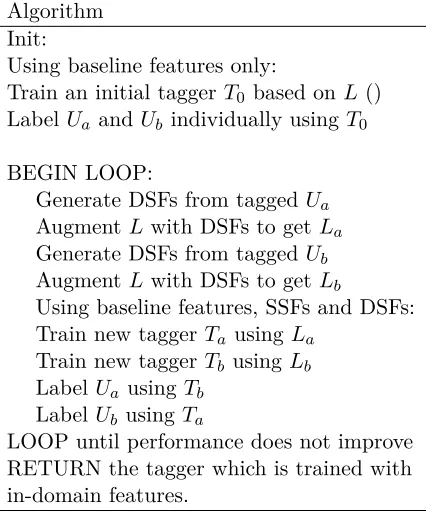
Suppose we have labeled data L, two unla-beled corpora Ua and Ub (one is an in-domain corpus and the other is an out-of-domain cor-pus). Our algorithm is shown in Table 3.
During each iteration, we tag the unlabeled corpus Ua using Tb to get pseudo-labels. Then
we extract features from the pseudo-labels. We use the label distribution information as dy-namic features. We add these features to the training data to train a new taggerTa. To adjust
the feature values, we extract features from one corpus and then apply the statistics to the other corpus. This is similar to the principle of co-training (Yarowsky, 1995; Blum and Mitchell, 1998; Dasgupta et al., 2002). The difference is that there are not different views of features, but different kinds of unlabeled data. Detailed de-scription of features is given in the next section.
Algorithm Init:
Using baseline features only:
Train an initial tagger T0 based onL () Label Ua andUb individually using T0
BEGIN LOOP:
Generate DSFs from taggedUa
AugmentL with DSFs to getLa
Generate DSFs from taggedUb
AugmentL with DSFs to getLb
Using baseline features, SSFs and DSFs: Train new taggerTa usingLa
Train new taggerTb using Lb
Label Uausing Tb
Label Ub using Ta
[image:3.612.320.533.68.326.2]LOOP until performance does not improve RETURN the tagger which is trained with in-domain features.
Table 3: Algorithm description
2.4 Features
2.4.1 Baseline Features
Our baseline feature templates include the features described in previous works (Sun and Xu, 2011; Sun et al., 2012). These features are widely used in the CWS task. To be convenient, for a characterci with context . . . ci−1cici+1. . ., its baseline features are listed below:
• Character uni-grams: ck (i−3< k < i+ 3)
• Character bi-grams: ckck+1 (i−3 < k < i+ 2)
• Whetherck and ck+1 are identical (i−2< k < i+ 2)
• Whetherck and ck+2 are identical (i−4< k < i+ 2)
2.4.2 Static statistical features
Statistical features are statistics that distilled from the large unlabeled corpus. They are proved useful in the Chinese word segmenta-tion task. We define Static Statistical Features (SSFs) as features whose value do not change during the training process. The SSFs in our approach includes Mutual information, Punctu-ation informPunctu-ation and Accessor variety. Previ-ous works have already explored the functions of the three static statistics in the Chinese word segmentation task, e.g. Feng et al. (2004); Sun and Xu (2011). We mainly follow their defini-tions while considering more details and giving some modification.
Mutual information
Mutual information (MI) is a quantity that measures the mutual dependence of two random variables. Previous works showed that larger MI of two strings claims higher probability that the two strings should be combined. Therefore, MI can show the tendency of two strings forming one word. However, previous works mainly fo-cused on the balanced case, i.e., the MI of strings with the same length. In our study we find that, in Chinese, there remains large amount of imbal-anced cases, like a string with length 1 followed by a string with length 2, and vice versa. We further considered the MI of these string pairs to capture more information.
Punctuation information
Punctuations can provide implicit labels for the characters before and after them. The acter after punctuations must be the first char-acter of a word. The charchar-acter before punctua-tions must be the last character of a word. When a string appears frequently after punctuations, it tends to be the beginning of a word. The situ-ation is similar when a string appears frequently preceding punctuations. Besides, the probabil-ity of a string appears in the corpus also affects this tendency. Considering all these factors, we propose “punctuation rate” (PR) to capture this information. For a string with length len
and probability p in the corpus, we define the left punctuation rate LP Rlen as the number of
times the string appears after punctuations,
di-vided by p. Similarly, the right punctuation rate RP Rlen is defines as the number of times it appears preceding punctuations divided by its probabilityp. The length of string we consider is from 1 to 4.
Accessor variety
Accessor variety (AV) is also known as letter successor variety (LSV) (Harris, 1955; Hafer and Weiss, 1974). If a string appears after or pre-ceding many different characters, this may pro-vide some information of the string itself. Pre-vious work of Feng et al. (2004), Sun and Xu (2011) used AV to represent this statistic. Sim-ilar to punctuation rate, we also consider both left AV and right AV. For a string s with length l, we define the left accessor variety (LAV) as the types of distinct characters preceding s in the corpus, and the right accessor variety (RAV) as the types of distinct characters after s in the corpus. The length of string we consider is also from 1 to 4.
2.4.3 Dynamic statistical features
The unlabeled corpus lacks precise labels. We can use the trained tagger to give the unla-beled data “pseudo-labels”. These labels can-not guarantee an acceptable precision. How-ever, the label distribution will not be largely affected by small mistakes. Using the label dis-tribution information is more accurate than us-ing the pseudo-labels directly.
Based on this assumption, we propose “dy-namic statistical features” (DSFs). The DSFs are intended to capture label distribution infor-mation given a text context. The word “Dy-namic” is in accordance with the fact that these feature values will change during the training process.
We give a formal description of DSFs. Sup-pose there areKlabels in our task. For example,
K = 4 if we take BMES labeling method. We define the whole character sequence with length
nasX = (x1, x2· · ·xj· · ·xn). Given a text
con-text Ci, where i is current character position,
the DSFs can be represented as a list,
Each element in the list represents the proba-bility of the corresponding label in the distribu-tion.
For convenience, we further define function ‘count(condition)’ as the total number of times a ‘condition’ is true in the unlabeled corpus. For example, count (current=‘a’) represents the times the current character equals ‘a’, which is exactly the number of times character ‘a’ ap-pears in the unlabeled corpus.
According to different types of text context
Ci, we can divide DSFs into 3 types:
1.Basic DSF
For Basic DSF ofCi, we define D(Ci):
D(Ci) = (D(Ci)1, . . . , D(Ci)K)
We define Basic DSF with current character po-sition i, text context Ci and label l(the lth di-mension in the list) as:
D(Ci)l=P(y=l|Ci=xi)
= count(Ci=xi∧y=l)
count(Ci =xi)
In this equation, the numerator counts the num-ber of times current character isxi with label l. The denominator counts the number of times current character is xi.
We use the term “Basic” because this kind of DSFs only considers the character of position i
as its context. The text context refers to the cur-rent character itself. This feature captures the label distribution information given the charac-ter itself.
2.BigramDSF
Basic DSF is simple and very easy to imple-ment. The weakness is that it is less power-ful to describe word-building features. Although characters convey context information, charac-ters themselves in Chinese is sometimes mean-ingless. Character bi-grams can carry more con-text information than uni-grams. We modify Basic DSFs to bi-gram level and propose Bigram DSFs.
For Bigram DSF of Ci, we define B(Ci):
B(Ci) = (B(Ci)1, . . . , B(Ci)K)
We define Bigram DSF with current character position i, text context Ci and label l (the lth
dimension in the list) as:
B(Ci)l=P(y=l|Ci =xi−jxi−j+1)
= count(Ci =xi−jxi−j+1∧y=l)
count(Ci=xi−jxi−j+1)
j can take value 0 and 1.
In this equation, the numerator counts the number of times current context is xi−jxi−j+1
with labell. The denominator counts the num-ber of times current context isxi−jxi−j+1.
3.WindowDSF
Considering Basic DSF and Bigram DSF only might cause the over-fitting problem, therefore we introduce another kind of DSF. We call it Window DSF, which considers the surrounding context of a character and omits the character itself.
For Window DSF, we defineW(Ci):
W(Ci) = (W(Ci)1, . . . , W(Ci)K)
We define Window DSF with current character position i, text context Ci and label l (the lth
dimension in the list) as:
W(Ci)l=P(y=l|Ci=xi−1xi+1)
= count(Ci =xi−1xi+1∧y=l)
count(Ci=xi−1xi+1)
In this equation, the numerator counts the number of times current context is xi−1xi+1 with labell. The denominator counts the num-ber of times current context isxi−1xi+1.
2.4.4 Discrete features VS. Continuous features
For static statistical value:
For mutual information, we round the real value to their nearest integer. For punctuation rate and accessor variety, as the values tend to be large, we first get the log value of the feature and then use the nearest integer as the corre-sponding discrete value.
For dynamic statistical value:
Dynamic statistical features are distributions of a label. The values of DSFs are all percentage values. We can solve this by multiply the proba-bility by an integer N and then take the integer part as the final feature value. We set the value of N by cross-validation..
2.5 Conditional Random Fields
Our algorithm is not necessarily limited to a specific baseline tagger. For simplicity and reliability, we use a simple Conditional Ran-dom Field (CRF) tagger, although other se-quence labeling models like Semi-Markov CRF Gao et al. (2007) and Latent-variable CRF Sun et al. (2009) may provide better results than a single CRF. Detailed definition of CRF can be found in Lafferty et al. (2001); McCallum (2002); Pinto et al. (2003).
3 Experiment
3.1 Data and metrics
We used the benchmark datasets provided by the second International Chinese Word Segmen-tation Bakeoff1 to test our approach. We chose the Peking University (PKU) data in our exper-iment. Although the benchmark provides an-other three data sets, two of them are data of traditional Chinese, which is quite different from simplified Chinese. Another is the data from Mi-crosoft Research (MSR). We experimented on this data and got 97.45% in f-score compared to the state-of-art 97.4% reported in Sun et al. (2012). However, this corpus is much larger than the PKU corpus. Using the labeled data alone can get a relatively good tagger and the unlabeled data contributes little to the perfor-mance. For simplicity and efficiency, our further
1http://www.sighan.org/bakeoff2005/
experiments are all conducted on the PKU data. Details of the PKU data are listed in table 4.
We also used two un-segmented corpora as unlabeled data. The first one is Chinese Giga-word2 corpus. It is a comprehensive archive of newswire data. The second one is articles from Baike3 of baidu.com. It is a Chinese encyclope-dia similar to Wikipeencyclope-dia but contains more Chi-nese items and their descriptions. In the exper-iment we used about 5 million characters from each corpus for efficiency. Details of unlabeled data can be found in table 5.
In our experiment, we did not use any ex-tra resources such as common surnames, part-of-speech or other dictionaries.
F-score is used as the accuracy measure. We define precision P as the percentage of words in the output that are segmented correctly. We define recall R as the percentage of the words in reference that are correctly segmented. Then F-score is as follows:
F = 2×P ×R
P +R
The recall of out-of-vocabulary is also taken into consideration, which measures the ability of the model to correctly segment out of vocabulary words.
3.2 Main Results
Table 6 summarizes the segmentation results on test data with different feature combinations. We performed incremental evaluation. In this table, we first present the results of the tagger only using baseline features. Then we show the results of adding SSF and DSF individually. In the end we compare the results of combining SSF and DSF with baseline features.
Because the baseline features is strong to reach a relative good result, it is not easy to largely enhance the performance. Neverthe-less, there are significant increases in f-score and OOV-Recall when adding these features. From table 6 we can see that by adding SSF and DSF individually, the F-score is improved by +1.1%
2http://www.ldc.upenn.edu/Catalog/
Identical words Total word Identical Character Total character 5.5×10⁴ 1.1×10⁶ 5×10³ 1.8×10⁶
Table 4: Details of the PKU data
Corpus Character used
Gigaword 5000193
Baike 5000147
Table 5: Details of the unlabeled data.
P R F OOV
Baseline 0.950 0.943 0.946 0.676
+SSF 0.961 0.953 0.957 0.728
+DSF 0.958 0.953 0.955 0.678
+SSF+DSF 0.965 0.958 0.961 0.731
Table 6: Segmentation results on test data with different feature combinations. The symbol “+”
means this feature configuration contains features set containing the baseline features and all features after
‘+’. The size of unlabeled data is fixed as 5 million characters.
and +0.9%. The OOV-Recall is also improved, especially after adding SSFs. When considering SSF and DSF together, the f-score is improved by +1.5% while the OOV-Recall is improved by +5.5%.
To compare the contribution of unlabeled data, we conduct experiments of using differ-ent sizes of unlabeled data. Note that the SSFs are still calculated using all the unlabeled data. However, each iteration in the algorithm uses unlabeled data with different sizes.
Table 7 shows the results when changing the size of unlabeled data. We experimented on three different sizes: 0.5 million, 1 million and 5 million characters.
P R F OOV
DSF(0.5M) 0.962 0.954 0.958 0.727
DSF(1M) 0.963 0.955 0.959 0.728
DSF(5M) 0.965 0.958 0.961 0.731
Table 7: Comparison of results when changing the size of unlabeled data. (0.5 million, 1 million and 5 million characters).
We further experimented on unlabeled corpus
with larger size (up to 100 million characters). However the performance did not change signif-icantly. Besides, because the number of features in our method is very large, using too large un-labeled corpus is intractable in real applications due to the limitation of memory.
Our method can keep working well even when the labeled data are insufficient. Table 8 shows the comparison of f-scores when changing the size of labeled data. We compared the results of using all labeled data with 3 different situa-tions: using 1/10, 1/2 and 1/4 of all the labeled data. In fact, the best system on the Second In-ternational Chinese Word Segmentation bakeoff reached 0.95 in f-score by using all labeled data. From table 8 we can see that our algorithm only needs 1/4 of all labeled data to achieve the same f-score.
Baseline +SSF+DSF Improve
1/10 0.934 0.943 +0.96%
1/4 0.946 0.951 +0.53%
1/2 0.952 0.956 +0.42%
All 0.957 0.961 +0.42%
Table 8: Comparison of f-scores when changing the size of labeled data. (1/10, 1/4, 1/2 and all labeled data. The size of unlabeled data is fixed as 5 million characters.)
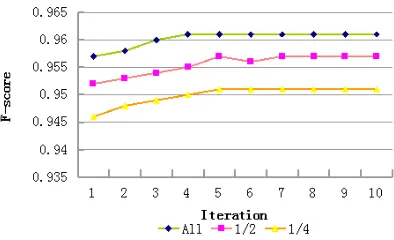
We also explored how the performance changes as iteration increases. Figure 1 shows the change of F-score during the first 10 itera-tions. From figure 1 we find that f-score has a fast improvement in the first few iterations, and then stables at a fixed point. Besides, as the size of labeled data increases, it converges faster.
Figure 1: Learning curve of using different size of labeled data
Table 9 shows the result. We can see that our method outperforms by +0.2% in f-score and +0.7% in OOV-Recall.
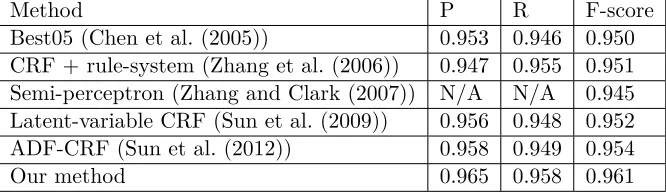
Finally, we compared our method with the state-of-art systems reported in the previous pa-pers. Table 10 listed the results. Best05 repre-sents the best system reported on the Second In-ternational Chinese Word Segmentation Bake-off. CRF + Rule system represents a combina-tion of CRF model and rule based model pre-sented in Zhang et al. (2006). Other three sys-tems all represent the methods using their cor-responding model in the corcor-responding papers. Note that these state-of-art systems are either using complicated models with semi-Markov re-laxations or latent variables, or modifying mod-els to fit special conditions. Our system uses a single CRF model. As we can see in table 10, our method achieved higher F-scores than the previous best systems.
3.3 Results on NER task
Our method is not limited to the CWS prob-lem. It is applicable to all sequence labeling problems. We applied our method on the Chi-nese NER task. We used the MSR corpus of the sixth SIGHAN Workshop on Chinese Lan-guage Processing. It is the only NER corpus using simplified Chinese in that workshop. We compared our method with the pure sequence la-beling approach in He and Wang (2008). We re-implemented their method to eliminate the dif-ference of various CRFs implementations. Ex-periment results are shown in table 11. We can see that our methods works better, especially
when handling the out-of-vocabulary named en-tities;
4 Related work
Recent studies show that character sequence labeling is an effective method of Chinese word segmentation for machine learning (Xue, 2003; Low et al., 2005; Zhao et al., 2006a,b). These su-pervised methods show good results. Unsuper-vised word segmentation (Maosong et al., 1998; Peng and Schuurmans, 2001; Feng et al., 2004; Goldwater et al., 2006; Jin and Tanaka-Ishii, 2006) takes advantage of the huge amount of raw text to solve Chinese word segmentation prob-lems. These methods need no annotated corpus, and most of them use statistics to help model the problem. However, they usually are less ac-curate than supervised ones.
Currently “feature-engineering” methods have been successfully applied into NLP ap-plications. Miller et al. (2004) applied this method to named entity recognition. Koo et al. (2008) applied this method to dependency pars-ing. Turian et al. (2010) applied this method to both named entity recognition and text chunk-ing. These papers shared the same concept of word clustering. However, we cannot simply equal Chinese character to English word because characters in Chinese carry much less informa-tion than words in English and the clustering results is less meaningful.
P R F OOV Using one corpus 0.963 0.955 0.959 0.724
Our method 0.965 0.958 0.961 0.731
Table 9: Comparison of our approach with using only the Gigaword corpus
Method P R F-score
Best05 (Chen et al. (2005)) 0.953 0.946 0.950
CRF + rule-system (Zhang et al. (2006)) 0.947 0.955 0.951 Semi-perceptron (Zhang and Clark (2007)) N/A N/A 0.945 Latent-variable CRF (Sun et al. (2009)) 0.956 0.948 0.952
ADF-CRF (Sun et al. (2012)) 0.958 0.949 0.954
[image:9.612.184.426.65.110.2]Our method 0.965 0.958 0.961
Table 10: Comparison of our approach with the state-of-art systems
P R F OOV
Traditional 0.925 0.872 0.898 0.712
Our method 0.916 0.887 0.902 0.737
Table 11: Comparison of our approach with tradi-tional NER systems
punctuation features.
There are previous works using features ex-tracted from label distribution of unlabeled cor-pus in NLP tasks. Schapire et al. (2002) use a set of features annotated with majority labels to boost a logistic regression model. We are different from their approach because there is no pseudo-example labeling process in our ap-proach. Qi et al. (2009) investigated on large set of distribution features and used these fea-tures in a self-training way. They applied the method on three tasks: named entity recogni-tion, POS tagging and gene name recognition and got relatively good results. Our approach is different from theirs. Although we all consider label distribution, the way we use features are different. Besides, our approach uses two unla-beled corpora which can mutually enhancing to get better result.
5 Conclusion and Perspectives
In this paper, we presented a semi-supervised method for Chinese word segmentation. Two kinds of new features are used for the itera-tive modeling: static statistical features and
dy-namic statistical features. The dydy-namic statis-tical features use label distribution information for text contexts, and can be adjusted automat-ically during the co-training process. Experi-mental results show that the new features can improve the performance on the Chinese word segmentation task. We further conducted exper-iments to show that the performance is largely improved, especially when the labeled data is insufficient.
The proposed iterative semi-supervised method is not limited to the Chinese word segmentation task. It can be easily extended to any sequence labeling task. For example, it works well on the NER task as well. As our future work, we plan to apply our method to other natural language processing tasks, such as text chunking.
Acknowledgments
[image:9.612.140.473.142.240.2]References
Blum, A. and Mitchell, T. (1998). Combining labeled and unlabeled data with co-training. In Proceedings of the eleventh annual confer-ence on Computational learning theory, pages 92–100. ACM.
Chang, B. and Han, D. (2010). Enhancing domain portability of chinese segmentation model using chi-square statistics and boot-strapping. In Proceedings of the 2010 Con-ference on Empirical Methods in Natural Lan-guage Processing, pages 789–798. Association for Computational Linguistics.
Chen, A., Zhou, Y., Zhang, A., and Sun, G. (2005). Unigram language model for chinese word segmentation. In Proceedings of the 4th SIGHAN Workshop on Chinese Language Processing, pages 138–141. Association for Computational Linguistics Jeju Island, Korea.
Dasgupta, S., Littman, M. L., and McAllester, D. (2002). Pac generalization bounds for co-training. Advances in neural information pro-cessing systems, 1:375–382.
Feng, H., Chen, K., Deng, X., and Zheng, W. (2004). Accessor variety criteria for chinese word extraction. Computational Linguistics, 30(1):75–93.
Gao, J., Andrew, G., Johnson, M., and Toutanova, K. (2007). A comparative study of parameter estimation methods for statisti-cal natural language processing. InANNUAL MEETING-ASSOCIATION FOR COMPU-TATIONAL LINGUISTICS, volume 45, page 824.
Goldwater, S., Griffiths, T., and Johnson, M. (2006). Contextual dependencies in unsuper-vised word segmentation. In Proceedings of the 21st International Conference on Compu-tational Linguistics and the 44th annual meet-ing of the Association for Computational Lin-guistics, pages 673–680. Association for Com-putational Linguistics.
Hafer, M. A. and Weiss, S. F. (1974). Word seg-mentation by letter successor varieties. Infor-mation storage and retrieval, 10(11):371–385.
Harris, Z. S. (1955). From phoneme to mor-pheme. Language, 31(2):190–222.
He, J. and Wang, H. (2008). Chinese named en-tity recognition and word segmentation based on character. In Sixth SIGHAN Workshop on Chinese Language Processing, page 128. Jin, Z. and Tanaka-Ishii, K. (2006).
Unsu-pervised segmentation of chinese text by use of branching entropy. In Proceedings of the COLING/ACL on Main conference poster sessions, pages 428–435. Association for Com-putational Linguistics.
Koo, T., Carreras, X., and Collins, M. (2008). Simple semi-supervised dependency parsing. Lafferty, J., McCallum, A., and Pereira, F.
(2001). Conditional random fields: Proba-bilistic models for segmenting and labeling se-quence data.
Li, Z. and Sun, M. (2009). Punctuation as implicit annotations for chinese word segmentation. Computational Linguistics, 35(4):505–512.
Low, J., Ng, H., and Guo, W. (2005). A maximum entropy approach to chinese word segmentation. In Proceedings of the Fourth SIGHAN Workshop on Chinese Language Processing, volume 164. Jeju Island, Korea. Maosong, S., Dayang, S., and Tsou, B. (1998).
Chinese word segmentation without using lex-icon and hand-crafted training data. In Pro-ceedings of the 17th international confer-ence on Computational linguistics-Volume 2, pages 1265–1271. Association for Computa-tional Linguistics.
McCallum, A. (2002). Efficiently inducing fea-tures of conditional random fields. In Proceed-ings of the Nineteenth Conference on Uncer-tainty in Artificial Intelligence, pages 403–410. Morgan Kaufmann Publishers Inc.
Miller, S., Guinness, J., and Zamanian, A. (2004). Name tagging with word clusters and discriminative training. InProceedings of HLT-NAACL, volume 4.
Ad-vances in Intelligent Data Analysis, pages 238–247.
Pinto, D., McCallum, A., Wei, X., and Croft, W. (2003). Table extraction using conditional random fields. In Proceedings of the 26th an-nual international ACM SIGIR conference on Research and development in informaion re-trieval, pages 235–242. ACM.
Qi, Y., Kuksa, P., Collobert, R., Sadamasa, K., Kavukcuoglu, K., and Weston, J. (2009). Semi-supervised sequence labeling with self-learned features. In Data Mining, 2009. ICDM’09. Ninth IEEE International Confer-ence on, pages 428–437. IEEE.
Schapire, R., Rochery, M., Rahim, M., and Gupta, N. (2002). Incorporating prior
knowledge into boosting. In MACHINE
LEARNING-INTERNATIONAL
WORK-SHOP THEN CONFERENCE-, pages
538–545.
Sun, W. and Xu, J. (2011). Enhancing chi-nese word segmentation using unlabeled data. In Proceedings of the Conference on Empiri-cal Methods in Natural Language Processing, pages 970–979. Association for Computational Linguistics.
Sun, X., Wang, H., and Li, W. (2012). Fast on-line training with frequency-adaptive learning rates for chinese word segmentation and new word detection. InProceedings of the 50th An-nual Meeting of the Association for Computa-tional Linguistics (Volume 1: Long Papers), pages 253–262, Jeju Island, Korea. Associa-tion for ComputaAssocia-tional Linguistics.
Sun, X., Zhang, Y., Matsuzaki, T., Tsuruoka, Y., and Tsujii, J. (2009). A discriminative latent variable chinese segmenter with hybrid word/character information. InProceedings of Human Language Technologies: The 2009 An-nual Conference of the North American Chap-ter of the Association for Computational Lin-guistics, pages 56–64. Association for Compu-tational Linguistics.
Turian, J., Ratinov, L., and Bengio, Y. (2010). Word representations: a simple and gen-eral method for semi-supervised learning. In
Proceedings of the 48th Annual Meeting of the Association for Computational Linguis-tics, pages 384–394. Association for Compu-tational Linguistics.
Xue, N. (2003). Chinese word segmentation as character tagging. Computational Linguistics and Chinese Language Processing, 8(1):29–48. Yarowsky, D. (1995). Unsupervised word sense disambiguation rivaling supervised methods.
In Proceedings of the 33rd annual meeting
on Association for Computational Linguistics, pages 189–196. Association for Computational Linguistics.
Zhang, R., Kikui, G., and Sumita, E. (2006). Subword-based tagging by conditional ran-dom fields for chinese word segmentation. In Proceedings of the Human Language Technol-ogy Conference of the NAACL, Companion Volume: Short Papers, pages 193–196. Asso-ciation for Computational Linguistics.
Zhang, Y. and Clark, S. (2007).
Chi-nese segmentation with a word-based
percep-tron algorithm. In ANNUAL
MEETING-ASSOCIATION FOR COMPUTATIONAL LINGUISTICS, volume 45, page 840.
Zhao, H., Huang, C., and Li, M. (2006a). An improved chinese word segmentation system with conditional random field. In Proceed-ings of the Fifth SIGHAN Workshop on Chi-nese Language Processing, volume 117. Syd-ney: July.