Deep Reinforcement Learning-based Text Anonymization against
Private-Attribute Inference
Ahmadreza Mosallanezhad Ghazaleh Beigi
Computer Science and Engineering Arizona State University
{amosalla, gbeigi, huanliu}@asu.edu
Huan Liu
Abstract
User-generated textual data is rich in con-tent and has been used in many user be-havioral modeling tasks. However, it could also leak user private-attribute information that they may not want to disclose such as age and location. User’s privacy concerns man-date data publishers to protect privacy. One effective way is to anonymize the textual data. In this paper, we study the problem of textual data anonymization and propose a novel Re-inforcement Learning-based Text Anonymi-zor, RLTA, which addresses the problem of private-attribute leakage while preserving the utility of textual data. Our approach first ex-tracts a latent representation of the original text w.r.t. a given task, then leverages deep rein-forcement learning to automatically learn an optimal strategy for manipulating text repre-sentations w.r.t. the received privacy and util-ity feedback. Experiments show the effective-ness of this approach in terms of preserving both privacy and utility.
1 Introduction
Social media users generate a tremendous amount of data such as profile information, network con-nections and online reviews and posts. Online vendors use this data to understand users prefer-ences and further predict their future needs. How-ever, user-generated data is rich in content and ma-licious attackers can infer users’ sensitive infor-mation. AOL search data leak in 2006 is an ex-ample of privacy breaches which results in users re-identification according to the published AOL search logs and queries (Pass et al.,2006). There-fore, these privacy concerns mandate that data be anonymized before publishing. Recent research has shown that textual data alone may contain suf-ficient information about users’ private-attributes that they do not want to disclose such as age, gen-der, location, political views and sexual
orienta-tion (Mukherjee and Liu, 2010; Volkova et al., 2015). Little attention has been paid to protect users textual information (Li et al., 2018; Zhang et al.,2018; Anandan et al., 2012;Saygin et al., 2006).
Anonymizing textual information comes at the cost of losing utility of data for future applications. Some existing work shows the degraded quality of textual information (Anandan et al.,2012;Zhang et al., 2018; Saygin et al., 2006). Another re-lated problem setting is when the latent represen-tation of the user generated texts is shared for different tasks. It is very common to use recur-rent neural networks to create a representation of user generated text to use for different machine learning tasks. Hitaj el al. show text represen-tations can leak users’ private information such as location (Hitaj et al., 2017). This work aims to anonymize users’ textual information against private-attribute inference attacks.
given task, and 2) a deep reinforcement learn-ing based privacy and utility preserver to convert the problem of text anonymization to a one-player game in which the agent’s goal is to learn the optimal strategy for text embedding manipulation to satisfy both privacy and utility. The Deep Q-Learning algorithm is then used to train the agent capable of changing the text embedding w.r.t. the received feedback from the privacy and utility sub-components.
We investigate the following challenges: 1) How could we extract the textual embedding w.r.t. a given task? 2) How could we perturb the ex-tracted text embedding to ensure that user private-attribute information is obscured? and 3) How could we preserve the utility of text embedding during anonymization? Our main contributions are: (1) we study the problem of text anonymiza-tion by learning a reinforced task-aware text anonymizer, (2) we corporate a data-utility task-aware checker to ensure that the utility of textual embeddings is preserved w.r.t. a given task, and (3) we conduct experiments on real-world data to demonstrate the effectiveness of RLTA in an im-portant natural language processing task.
2 Related Work
Reinforcement Learning (RL) has applications in natural language processing and recommendation systems. For example, a recent paper (Paulus et al., 2017) combines RL with a supervised method to get a readable and informative article summary. Another work uses RL to solve the problem of adversarial generative models for text generation (Shi et al.,2018). Sun et al. also uses RL in a recommendation system which recom-mends items according to the users’ feedbacks and preferences (Sun and Zhang,2018)
Textual data is rich in content and recent re-search has shown that users’ private-attributes can be easily inferred from the text (Beretta et al., 2015; Mukherjee and Liu, 2010; Volkova et al., 2015), however, few papers consider user privacy w.r.t. such data. Anandan et al.(2012) introduce
t-Plausibility which uses an information theoretic based approach to sanitize documents heuristi-cally. This method does not preserves the utility of data during anonymization process. Another work focuses on leveraging differential privacy (Dwork et al.,2017) to make the extracted Term Frequency Inverse Document (TF-IDF) textual vectors
pri-vate (Zhang et al., 2018). It has been shown that TF-IDF cannot accurately capture semantic mean-ing of the text which can hurt its usefulness for different tasks (Lan et al.,2005).
Two recent similar works Li et al. (2018); Coavoux et al. (2018) convert textual data anonymization into a minimax problem. These works use the idea of adversarial learning to create a text embedding which satisfies utility and protects users against private-attribute leak-age. Our scenario is similar to the work of (Li et al., 2018) as they have considered several attribute-inference attackers as adversaries to cre-ate a privacy-preserving text embedding. (Beigi et al.,2019b,a) propose a method for privacy pre-serving text representation. In this method, they try to add noise to an existing text representation in a way that it does not change the meaning of the text and it preserves the user’s private attributes.
Our work is different from the existing works. First, we consider the task that the textual infor-mation will be used for and protect users against leakage of private-attributes. Second, we incorpo-rate deep RL to anonymize the extracted text em-bedding by receiving privacy and utility feedbacks and automatically learning the optimal strategy for proper manipulation of text embeddings.
3 Problem Statement
LetX ={x1, x2, ..., xN}denotes a set ofN doc-uments and each document xi is composed of a sequence of words. We denotevi ∈ Rd×1 as the embedded representation of the original document
xi. Let P = {p1, p2, ..., pm}denotes a set of m private-attributes that users do not want to disclose such as age, gender, location, etc. The goal of re-inforced task-aware text anonymizer is to learn an embedding representation of each document and then anonymize it such that 1) users privacy is preserved by preventing any potential attacker to infer users’ private-attribute information from the textual embedding data, and 2) utility of the text embedding is maintained for a given taskT which incorporates such data, e.g., classification. In this paper, we study the following problem:
Problem 3.1. Given a set of documents X, set of private-attributes P, and given task T, learn an anonymizerf that can learn a private embed-ded representationvi from the original document
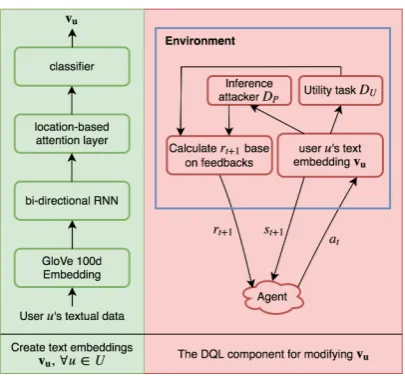
Figure 1: The architecture of RLTA method
text representationvi, and 2) the generated private representationviis good for the given taskT. The problem can be formally defined as:
vi=f(xi,P,T) (1)
Due to the success of Reinforcement Learn-ing (Shi et al., 2018; Paulus et al., 2017), we use RL to address the aforementioned problem. RL (Sutton and Barto,2018) formulates the prob-lem within the framework of Markov Decision Process (MDP), and learns an action-selection pol-icy based on past observations of transition data. An MDP is defined by state space S = {s}, ac-tion space A = {a}, transition probability func-tionP :S×A×S → [0,1]and reward function
r:S×A×S→R.
4 Proposed Method
We discuss the reinforced task-aware text anonymizer framework. The input of this private system is the user generated text, and the output is a privacy-preserving text representation. As in Figure. 1, this framework consists of two major components: 1) an attention based task-aware text representation learner, and 2) a deep RL based privacy and utility preserver. The text rep-resentation learner aims to extract the embedded representation of a document w.r.t. a given task by minimizing the task’s loss function. Then, the deep RL preserver manipulates the embedded text representation by learning the optimal strategy so that both privacy and utility of the embedded representation are preserved. It includes two sub-components: 1) private-attribute inference at-tackerDP, and 2) data-utility task-aware checker
DU. The former seeks to infer user private-attribute information based on their embedded text representation. The latter incorporates the given manipulated embedded text representation for a given taskT and investigates the usefulness of the latent representation forT.
The RL component then utilizes the feedback of the two sub-components to guide the data ma-nipulation process by ensuring that the new text embedding does not leak user private-attributes by confusing the adversary in DP and the changes made to the representation does not destroy the se-mantic meaning forT.
4.1 Extracting Textual Embedding
Let x = {w1, ..., wm} be a document with m words. Attention mechanism has shown to be ef-fective in capturing embedding of textual informa-tion w.r.t. a given task (Pennington et al.;Vaswani et al.,2017). It allows the model to attend to dif-ferent parts of the given original document at each step and then learns what to attend based on the in-put document and what it has produced as embed-ding representation so far, as shown in Figure.1.
We use a bi-directional recurrent neural net-work (RNN) to encode the given document into an initial embedding representation. RNN has been shown to be effective for summarizing and learning semantic of unstructured noisy short texts (Cho et al.,2014;Shang et al.,2015). We use GloVe 100d (Pennington et al.) to exchange each wordwi with its corresponding word vector, note that different dimensionality can be used. This process produces a matrix of textx0 ∈ Rm∗100.
We employ the gated recurrent unit (GRU) as the cell type to build the RNN, which is designed in a manner to have a more persisted memory (Cho et al.,2014). The bi-directional GRU will read the text forward and backwards, then outputs two hid-den states hfw
t ,hbwt and an output ot. We then
concatenate two hidden states as the initial en-coded embedding of the given original document:
Ht=Concat(hfwt ,hbwt ) (2)
After calculating the initial context vectorHt, we
seek to pinpoint specific information within the
Ht, which helps the classifier to predict the labels
element in theHt, showing the importance of that
element. The context vectorvtis calculated:
vt=
m X
i=1
at,iHi (3)
The vectorvtis then fed to a neural network
clas-sifier for the given utility task. Classification is one of the common tasks for textual data. Based on the output of the classifier and loss function, we update the three networks so that the output of the attention layer is an useful context that can be used for a utility task (Ranzato et al.,2015).
4.2 Reinforced Task-Aware Text Anonymizer
Here, we discuss the details of the second compo-nent which seeks to preserve privacy and utility.
4.2.1 Protecting Private-Attributes
Textual information is rich in content and pub-lishing textual embedding representation without proper anonymization leads to privacy breach and revealing the private-attributes of an individual such age, gender and location. It is thus essen-tial to protect the textual information before pub-lishing it. The goal of our model is to manipu-lated learned embedded representation such that any potential adversary cannot infer users’ private-attribute information. However, a challenge is that the text anonymizer does not know the ad-versary’s attack model. To address this challenge, we add a private-attribute inference attacker DP component to our text anonymizer. This sub-component learns a classifier that can accurately identify the private information of users from their embedded text representationsvu. We incorporate
this sub-component to understand how the textual embedded representation should be anonymized to obfuscate the private information.
Inspired by the success of RL (Kaelbling et al., 1996;Mnih et al.,2013;Van Hasselt et al.,2016), we model this problem using RL to automatically learn how to anonymize the text representations w.r.t. the private-attribute inference attacker. In our RL model, one agent is trained to change a randomly selected text embedding representation. Then, the agent keeps interacting with the environ-ment and changes the text embedding accordingly based on its current state and received rewards so that the private-attribute inference attacker cannot correctly identify user’s private-attribute informa-tion given his embedding. In this part, we define
the main four parts of RL environment in our prob-lem, i.e., environment, state, action and reward.
• Environment: Environment in our problem in-cludes the private-attribute inference attackers
DP and the text embeddingvu. Note thatDP is trained beforehand.
• State: State describes the current situation. Here, state is the current text embedding vector
vu,twhich reflects the results of the agents’
ac-tions onvuup to timet.
• Actions: Action is define as selecting one el-ement such as vu,k in text embedding vector
vu={vu,1, ..., vu,m}and changing it to a value near −1, 0 or 1. This results in 3.m actions wheremis the size of the embedding vector.
Changing value to near 1: In this action, the agent changes the value of vu,k to a value be-tween0.9to1.0. Asvu,k will be multiplied by a classifier’s weight, the output will be the weight as is. In another word, the value vu,k will be-come important to the classifier.
Changing value to near 0: In this action the
vu,k will be changed to a value between−0.01 to0.01. This action makesvu,kseem neutral and unimportant to a classifier as it will result in a0
when multiplied by a weight.
Changing value to near-1: In this action, the agent changesvu,k to a value between−1.0 to −0.9. This action will makevu,k important to a classifier, but, in a negative way.
• Reward: Reward in our problem is defined based on how successfully the agent obfuscated the private-attribute information against the at-tacker so far. In particular, we defined the reward function at state st+1 according to the
confi-dence of private-attribute inference attackerCpk
for private-attribute pk given the resultant text embedding at state st+1, i.e., vt+1.
Consider-ing the classifier’s input data asvu and its
cor-rect label as i, we define the confidence for a multi-class classifier as the difference between the probability of actual value of the private-attribute and the minimum probability of other values of the private-attribute:
Cpk =P r(l=i|vu)−max
j6=i P r(l=j|vu) (4)
within the range[−1,1]. Positive value demon-strates that the attacker has predicted private-attribute accurately, and negative value indicates that the attacker was not able to infer user’s private-attribute. According to this definition, the reward will be positive if action at has caused information hiding, and will be nega-tive if the actionat was not able to hide sensi-tive information. Having confidence of private-attribute inference attackers, reward function at statest+1is defined as:
rt+1(st+1) =−
X
pk∈DP
Cpk(st+1) (5)
The reward rt is calculated according to the state st+1 which associated with the transition
of agent from statest after applying actionat. Note that the goal of agent is to maximize the amount of received rewards so that the mean of rewardsrover timet∈[0, T](T is the terminal time) will be positive and above0.
4.2.2 Preserving Utility of Text Embedding
Thus far, we have discussed how to 1) learn tex-tual embeddings from the given original document w.r.t. the given task, and 2) prevent leakage of private-attribute information by developing a re-inforcement learning environment which incorpo-rates a private-attribute inference attacker and ma-nipulates the initial given text embedding accord-ingly to fool the attacker. However, data obfus-cation comes at the cost of data utility loss. Util-ity is defined as the qualUtil-ity of the given data for a given task. Neglecting the utility of the text em-bedding while manipulating it, may destroy the semantic meaning of the text data for the given task. Classification is one of the common tasks. In order to preserve the utility of data, we need to ensure that preserving privacy of data does not destroy the semantic meaning of the text embed-ding representation w.r.t. the given task. We ap-proach this challenge by changing the agent’s re-ward function w.r.t. the data utility. We add a util-ity sub-component, i.e., classifierDU, to the rein-forcement learning environment which its goal is to assess the quality of resultant embedding repre-sentation. We use the confidence of the classifier for the given task to measure the utility of embed-ding representation using the text embedembed-ding vec-torvuthe its correct labeli.
C =P r(l=i|vu)−min
j P r(l=j|vu) (6)
The agent can then use the feedback from the util-ity classifier to make decision when taking actions. We thus modify the reward function in order to in-corporate the confidence of utility sub-component. Reward function at statest+1can be defined as:
rt+1(st+1) =αCDU(st+1)− (7)
−(1−α) X
pk∈DP
Cpk(st+1)− B
where CDU andCpk represent the confidence of
utility sub-component and private-attribute infer-ence attacker, respectively. Moreover, B demon-strates a baseline reward which forces the agent to reach a minimum reward value. The coeffi-cient α also control the amount of contribution from both private-attribute inference and utility sub-components in the Eq.7.
4.3 Optimization Algorithm
Given the formulation of states and actions, we aim to learn the optimal strategy via manipulat-ing text representations w.r.t. the private-attribute attackers and utility sub-component feedbacks. We manipulate the text embeddings by repeatedly choosing an action at given current state st, and then applying actions on current state to transit to the new onest+1. The agent then receives reward rt+1 as a consequence of interacting with the
en-vironment. The goal of agent is to manipulate text embeddingvu,kin a way that maximizes its reward according to Eq.7. Moreover, the agent updates its action selection policyπ(s)so that it can achieve the maximum reward over time.
In RLTA we use Deep Q-Learning which is a variant of Q-Learning. In this algorithm the goal is to find the following function:
Q∗(st, at) = Est+1[rt+1+γmax a0 Q
∗(s
t+1, a0)] (8)
where Q(s, a) corresponds to the Q-function for extracting actions and it is defined as the expected return based on state s and action a. More-over,Q∗(s, a)denotes the optimal action-value Q-function which has the maximum expected return using the optimal policy π(s). Rewards are also discounted by a factor of γ per time step. The agent keeps interacting with the environment till it reaches the terminal timeT.
Since it is not feasible to estimate Q∗(s, a)
Algorithm 1The Learning Process of RLTA
Require: v,DP,DU,α,γ,B,T.
1: Initialize replay memoryMwith sizeN
2: whiletraining is not terminaldo 3: st←v
4: fort∈ {0,1, ..., T}do
5: Choose actionatusing-greedy
6: Performatonstand get(st+1, rt+1)
7: M ←M+ (st, at, rt+1, st+1)
8: st←st+1
9: Sample mini-batchbfrom memroyM
10: for(s, a, s0, r)∈bdo
11: Update DQN weights using Eq.11
12: end for 13: end for
14: end while
Q(s, a;θ). Given neural networks as excellent function approximators (Cybenko,1989), we lver-age a deep neural network function approximator with parameters θ, or a Deep Q-Network (DQN) (Mnih et al.,2013) by minimizing the following:
L(θ) = Est,at,rt+1,st+1[(y−Q(s, a;θ))
2] (9)
in whichyis the target for the current iteration:
y= Est+1[rt+1+γmax
a0 Q(st+1, a
0;θp)] (10)
θpis the parameters from the previous iteration. We update the DQN according to the derivation of Eq.9with respect to the parameterθ:
∇θL(θ) = Est,at,rt+1,st+1[(r (11)
+γmax
a0 Q(st+1, a 0;θp)
−Q(st, at;θ))∇θQ(st, at;θ)]
Algorithm1shows the optimization process.
5 Experiments
Experiments are designed to answer the fol-lowing questions: Q1(Privacy): How well RLTA can obscure users’ private-attribute information?
Q2(Utility): How well RLTA can preserve
util-ity of the textual data w.r.t. the given task?
Q3(Privacy-Utility Relation): How does
improv-ing user privacy affects loss of utility?
To answer the first question (Q1), we use inves-tigate the robustness of resultant text embedding against private-attribute inference attacks. We consider two private-attribute information, i.e., lo-cation and gender. To answer the second question
(Q2), we report experimental results w.r.t. a well-known task, sentiment analysis. Sentiment analy-sis has many applications in user-behavioral mod-eling and Web (Zafarani et al.,2014). In particular, we predict sentiment of the given textual embed-ding. To answer the final question (Q3), we exam-ine the privacy improvement against utility loss.
5.1 Data
We use a real-world dataset from Trustpilot (Hovy et al., 2015). This dataset includes user reviews along with users private-attribute information such as location and gender. We remove non-English reviews based on LANGID.py1 (Lui and Bald-win,2012) and only keep reviews classified as En-glish. Then, we consider English reviews associ-ated with location of US and UK and create a sub-set of data with10kusers. Each review is associ-ated with a rating score. We consider the review’s sentiment as positive if its rating score is {4,5} and consider it as negative if rating is{1,2,3}
5.2 Implementation Details
For extracting the initial textual embedding, we use a bi-directional RNNs which their hidden sizes are set to25. This makes the size of the final hid-den vector Ht as 50. We also use a logistic
re-gression with a linear network as the classifier in the attention mechanism. We use a 3-layer net-work for the Deep Q-netnet-work, i.e., input, hidden and output layers. Dimensions of the input and hidden layers are set to50 and700, respectively. Dimension of the last layer, i.e., output, is also set as150. This layer outputs the state-action values which we execute the action with the best value.
For each of the private-attribute attackers and utility sub-components, we use feed-forward net-work with a single hidden layer with dimension of
100which gets the textual embedding as input and uses aSof tmaxfunction as output.
We first train both private-attribute inference at-tackerDP and utility sub-component DU on the training set. These sub-components do not change after that. Then, we train an agent on each se-lected data for 5000 episodes. The reward dis-count for agents isγ = 0.99and batch sizeb= 32. We also set the terminal time T = 25. We run RLTA for5times and select the best agent based on the cumulative reward. We also vary α as
α = {0,0.25,0.5,0.75,1}. The higher values of
(a) Gender inference attack (b) Location inference attack (c) Sentiment prediction
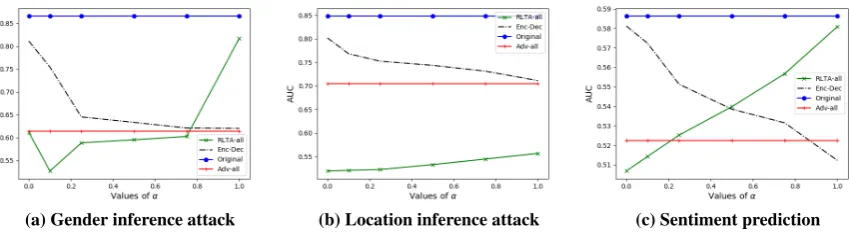
Figure 2: AUC scores for private-attribute and sentiment prediction tasks for different values ofα. Lower AUC for private-attribute inference attacks shows higher privacy, while higher AUC for the sentiment pre-diction task indicates higher utility.
αindicate more utility contribution in RLTA.
5.3 Experimental Design
We use10-fold cross validation of RLTA for eval-uating both private-attribute inference attacker and an utility task with the following baselines: • ORIGINAL: This baseline is a variant of
pro-posed RLTA which does not change the original user text embeddingsvuand publishes it as is.
• ADV-ALL: This adversarial method has two main components, i.e., generator and discrimi-nator, and creates a text representation that has high quality for a given task, but has poor quality for inferring private-attributes (Li et al.,2018).
• ENC-DEC: Using an auto-encoder is one of the effective methods to create a text embed-ding (Nallapati et al., 2016). We modify this simple method to create a privacy-preserving text embedding. This method gets the origi-nal text x and outputs a re-constructed text x¯. The following loss function is used to train the model. After training, we use the encoder’s out-put as the text representation vu (Cho et al.,
2014).
loss=−X x∈X
logP r(¯x|x)+ (12)
+α((X
pk
Cpk)−CDU)
In whichαis the privacy budget.
To examine the privacy of final text embed-ding, we apply the trained private-attribute at-tacker sub-component DP to the output of each method to evaluate the users’ privacy. We con-sider two private attributes, i.e., location and gen-der. We then compute the attacker’s AUC. Lower attacker’s AUC indicates that textual embeddings have higher privacy after anonymization against
the private-attribute inference attacker. We also report experimental results w.r.t. the utility. In particular, we predict sentiment (positive and neg-ative) of the given textual embedding by applying trained utility sub-componentDU to the resultant text embedding from test set for each method. We then compute AUC score for sentiment prediction task. Higher values of AUC demonstrate that the utility of textual embedding has been preserved.
5.4 Experimental Results
We answer the three questionQ1, Q2andQ3 to evaluate our proposed method RLTA.We use a natural language processing task, sentiment pre-diction, using a three layer neural network.
Privacy (Q1). Figure. 2 (a-b) demonstrates the results of private-attribute inference attack w.r.t. gender and location attributes. The lower the value of AUC is, the more privacy user has in terms of obscuring private attributes. We also report the performance of RLTA for different values ofα.
We observe that ORIGINALis not robust against private-attribute inference attack for both gender and location attributes. This confirms leakage of users private information from their textual data. Moreover, RLTA has significantly lower AUC score for both gender and location attributes in comparison to other methods. This demonstrates the effectiveness of RL for obfuscating private at-tributes. In RLTA, the AUC score for private-attribute inference attack increases for both at-tributes with the increase of α which shows the degradation in user privacy. The reason is because of the fact that agent pays less attention to privacy by increasing the value ofα.
does not lose its utility w.r.t. the given taskDU. The results show that asα increases, the AUC of inference attackers will decrease.
Utility (Q2). To answer the second question, we investigate the utility of embeddings w.r.t. senti-ment prediction. Results for different values ofα
are demonstrated in Figure. 2(c). The higher the value of the AUC is, the higher utility is preserved.
The ORIGINAL approach has the highest AUC
score which shows the utility of the text embed-dings before any anonymization. We observe that the results for RLTA is comparable to the ORIGI -NAL approach which shows that RLTA preserves the utility of text embedding. Moreover, RLTA outperforms ADV-ALL which confirms the
effec-tiveness of reinforced task-aware text anonymiza-tion approach in preserving utility of the textual embeddings. We also observe that the AUC of RLTA w.r.t. sentiment prediction task increases with the increase of value ofα. This is because with the increase ofα, the agent pays more atten-tion to the feedbacks of utility sub-component.
We also observe a small utility loss after apply-ing RLTA whenα = 1. This is because the agent keeps changing the text embedding until it reaches the terminal time. These changes result in loss of utility even when theα= 1.
Finally, in the ENC-DECmethod, as both utility and attackers have the same importance, trying to preserving privacy would result in huge utility loss as we increase the value ofα.
Privacy-Utility Relation (Q3).Results show that the ORIGINALachieves the highest AUC score for both utility task and private-attribute inference at-tack. This shows that ORIGINAL has the highest utility which comes at the cost of significant user privacy loss. However, comparing results of pri-vacy and utility for α = 0.5, we observe RLTA has achieved the lowest AUC score for attribute inference attacks in comparison to other baselines, thus has the highest privacy. It also reaches the higher utility level in comparison to the ADV-ALL. RLTA also has comparable utility results to the ORIGINAL approach. We also observe that in-creasing theαreduces the performance of RLTA in terms of privacy but increases its performance for utility. However, with α = 1, RLTA pre-serves both user privacy and utility in comparison to ORIGINAL, ENC-DEC, and ADV-ALL.
Method Location Gender Utility
ORIGINAL 84.77 86.54 58.57
[image:8.595.329.504.53.127.2]ENC-DEC 71.55 58.35 53.78 ADV-ALL 70.37 57.15 52.15 RLTA 53.34 56.41 54.83 RLTA-GEN 56.64 55.02 56.67 RLTA-LOC 52.04 56.64 54.13
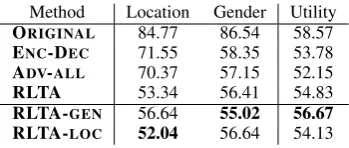
Table 1: Impact of different private-attribute in-ference attackers on RLTA when α = 0.5. With
α= 0.5, privacy and utility will contribute equally.
5.4.1 Impact of Different Components
Here, we investigate the impact of different private-attribute inference attackers. We define two variants of our proposed model, RLTA-GEN
and RLTA-LOC. In each of these variants, we train the agent in RLTA w.r.t. the one of private-attribute attackers, e.g., RLTA-GEN is trained to solely hidegender attribute. For this experiment we setα = 0.5 as in this case privacy and utility sub-components contribute equally during train-ing phase (Eq.7). Results are shown in Table1.
RLTA-LOCand RLTA-GENhave the best per-formance amongst all methods in obfuscating lo-cation and gender private-attributes, respectively. Results show that using RLTA-LOC could also help improve privacy on gender and likewise for (RLTA-GEN) in comparison to other approaches. RLTA-GENperforms better in terms of utility,
in comparison to RLTA which incorporates both gender and location attackers. Moreover, results show that both RLTA-GENand RLTA-LOChave
better utility than other baselines.
To sum-up, these results indicate that although using one private-attribute attacker in the training process can help in preserving more utility, it can compromise obscuring other private-attributes.
Parameter Analysis: Our proposed method
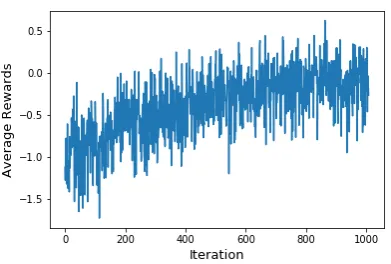
Figure 3: The average of agent’s rewards
On the other hand, if the users privacy is not top priority, this parameter can be set to a lower value than0.5which although it does not protect users’ private attribute as good as whenα >= 0.5, but it does protect users’ private attribute at a reasonable level.
5.4.2 Rewards Convergence
To evaluate the convergence of rewards, we con-sider agent’s reward during training phase for each episode, shown in Figure.3. The result indicates that agent’s average reward is low at the begin-ning and then it increases afterward. This is be-cause agent performs many random actions at the beginning to explore the action state space. We also observe that after several episodes, the reward converges to the baseline rewardB. This confirms that the agent has learned a proper action selection policyπ(s)to preserve both utility and privacy by satisfying the objectives of Eq.7.
6 Conclusion
In this paper, we propose a deep reinforcement learning based text anonymization, RLTA, which creates a text embedding such that does not leak user’s private-attribute information while preserv-ing its utility w.r.t. a given task. RLTA has two main components: (1) an attention based task-aware text representation learner, and (2) a deep RL based privacy and utility preserver. Our re-sults illustrate the effectiveness of RLTA in pre-serving privacy and utility. One future direction is to generate privacy preserving text rather than em-beddings. We also adopt deep Q-learning to train the agent. A future direction is to apply different RL algorithms and investigate how it impacts re-sults. It would be also interesting to adopt RLTA for other types of data.
7 Acknowledgements
The authors would like to thank Jundong Li for his help throughout the paper. This material is based upon the work supported, in part, by NSF 1614576, ARO W911NF-15-1-0328 and ONR N00014-17-1-2605.
References
Balamurugan Anandan, Chris Clifton, Wei Jiang, Mummoorthy Murugesan, Pedro Pastrana-Camacho, and Luo Si. 2012. t-plausibility: Generalizing words to desensitize text. Trans. Data Privacy, 5(3):505–534.
Ghazaleh Beigi, Kai Shu, Ruocheng Guo, Suhang Wang, and Huan Liu. 2019a. I am not what i write: Privacy preserving text representation learn-ing.arXiv preprint arXiv:1907.03189.
Ghazaleh Beigi, Kai Shu, Ruocheng Guo, Suhang Wang, and Huan Liu. 2019b. Privacy preserving text representation learning. Proceedings of the 30th on
Hypertext and Social Media (HT19). ACM.
Valentina Beretta, Daniele Maccagnola, Timothy Crib-bin, and Enza Messina. 2015. An interactive method for inferring demographic attributes in twitter. In
ACM Conference on Hypertext & Social Media.
Kyunghyun Cho, Bart Van Merri¨enboer, Caglar Gul-cehre, Dzmitry Bahdanau, Fethi Bougares, Holger Schwenk, and Yoshua Bengio. 2014. Learning phrase representations using rnn encoder-decoder for statistical machine translation. arXiv preprint arXiv:1406.1078.
Maximin Coavoux, Shashi Narayan, and Shay B Co-hen. 2018. Privacy-preserving neural representa-tions of text. arXiv preprint arXiv:1808.09408.
George Cybenko. 1989. Approximation by superposi-tions of a sigmoidal function. Mathematics of con-trol, signals and systems, 2(4):303–314.
Cynthia Dwork, Frank McSherry, Kobbi Nissim, and Adam Smith. 2017. Calibrating noise to sensitiv-ity in private data analysis. Journal of Privacy and Confidentiality, 7(3):17–51.
Briland Hitaj, Giuseppe Ateniese, and Fernando P´erez-Cruz. 2017. Deep models under the gan: informa-tion leakage from collaborative deep learning. In
Proceedings of the 2017 ACM SIGSAC Conference
on Computer and Communications Security, pages
603–618. ACM.
Dirk Hovy, Anders Johannsen, and Anders Søgaard. 2015. User review sites as a resource for large-scale sociolinguistic studies. InProceedings of the 24th
Leslie Pack Kaelbling, Michael L Littman, and An-drew W Moore. 1996. Reinforcement learning: A survey. Journal of artificial intelligence research.
Man Lan, Sam-Yuan Sung, Hwee-Boon Low, and Chew-Lim Tan. 2005. A comparative study on term weighting schemes for text categorization. InIEEE International Joint Conference on Neural Networks.
Yitong Li, Timothy Baldwin, and Trevor Cohn. 2018. Towards robust and privacy-preserving text repre-sentations. In The 56th Annual Meeting of the As-sociation for Computational Linguistics.
Marco Lui and Timothy Baldwin. 2012. langid. py: An off-the-shelf language identification tool. In
Pro-ceedings of the ACL 2012 system demonstrations.
Thang Luong, Hieu Pham, and Christopher D Man-ning. 2015. Effective approaches to attention-based neural machine translation. In Proceedings of the 2015 Conference on Empirical Methods in Natural
Language Processing, pages 1412–1421.
Volodymyr Mnih, Koray Kavukcuoglu, David Sil-ver, Alex Graves, Ioannis Antonoglou, Daan Wier-stra, and Martin Riedmiller. 2013. Playing atari with deep reinforcement learning. arXiv preprint arXiv:1312.5602.
Arjun Mukherjee and Bing Liu. 2010. Improving gen-der classification of blog authors. In Empirical
Methods in natural Language Processing (EMNLP).
Ramesh Nallapati, Bowen Zhou, Caglar Gulcehre, Bing Xiang, et al. 2016. Abstractive text summa-rization using sequence-to-sequence rnns and be-yond.arXiv preprint arXiv:1602.06023.
Greg Pass, Abdur Chowdhury, and Cayley Torgeson. 2006. A picture of search. In1st international con-ference on Scalable information systems (InfoScale).
Romain Paulus, Caiming Xiong, and Richard Socher. 2017. A deep reinforced model for abstractive sum-marization.arXiv preprint arXiv:1705.04304.
Jeffrey Pennington, Richard Socher, and Christopher Manning. Glove: Global vectors for word represen-tation. In Proceedings of conference on Empirical
Methods in natural Language Processing (EMNLP).
Marc’Aurelio Ranzato, Sumit Chopra, Michael Auli, and Wojciech Zaremba. 2015. Sequence level train-ing with recurrent neural networks. arXiv preprint
arXiv:1511.06732.
Y¨ucel Saygin, Dilek Hakkini-Tur, and G¨okhan Tur. 2006. Sanitization and anonymization of document repositories. InWeb and information security.
Lifeng Shang, Zhengdong Lu, and Hang Li. 2015. Neural responding machine for short-text conversa-tion. InProceedings of the 53rd Annual Meeting of the Association for Computational Linguistics.
Zhan Shi, Xinchi Chen, Xipeng Qiu, and Xuanjing Huang. 2018. Toward diverse text generation with inverse reinforcement learning. In 27th Interna-tional Joint Conference on Artificial Intelligence.
Yueming Sun and Yi Zhang. 2018. Conversational rec-ommender system. InACM SIGIR Conference on Research & Development in Information Retrieval.
Richard S Sutton and Andrew G Barto. 2018. Rein-forcement learning: An introduction. MIT press.
Hado Van Hasselt, Arthur Guez, and David Silver. 2016. Deep reinforcement learning with double q-learning. In30th AAAI Conference.
Ashish Vaswani, Noam Shazeer, Niki Parmar, Jakob Uszkoreit, Llion Jones, Aidan N Gomez, Łukasz Kaiser, and Illia Polosukhin. 2017. Attention is all you need. InAdvances in Neural Information Pro-cessing Systems, pages 5998–6008.
Svitlana Volkova, Yoram Bachrach, Michael Arm-strong, and Vijay Sharma. 2015. Inferring latent user properties from texts published in social media. In29th AAAI Conference on Artificial Intelligence.
Reza Zafarani, Mohammad Ali Abbasi, and Huan Liu. 2014. Social media mining: an introduction. Cam-bridge University Press.
Jinxue Zhang, Jingchao Sun, Rui Zhang, Yanchao Zhang, and Xia Hu. 2018. Privacy-preserving so-cial media data outsourcing. In IEEE INFOCOM