Abstract—In recent years, clustering is still a popular analysis tool for data statistics. The data structure identifying from the large-scale data has become a very important issue in the data mining problem. In this paper, an improved particle swarm optimization based on Gauss chaotic map for clustering is proposed. Gauss chaotic map adopts a random sequence with a random starting point as a parameter, and relies on this parameter to update the positions and velocities of the particles. It provides the significant chaos distribution to balance the exploration and exploitation capability for search process. This easy and fast function generates a random seed processes, and further improve the performance of PSO due to their unpredictability. In the experiments, the eight different clustering algorithms were extensively compared on six test data. The results indicate that the performance of our proposed method is significantly better than the performance of other algorithms for data clustering problem.
Index Terms—Data Clustering, Particle Swarm Optimization.
I. INTRODUCTION
lustering technique is the process of grouping from a set of objects. The objects within a cluster are similar to each other, but they are dissimilar to objects in other clusters. The property of clustering helps to identify some inherent structures that presents in the objects. Clustering reflects the statistical structure of the overall collection of input patterns in the data because the subset of patterns and its particular problem have certain meanings [1]. The pattern can be represented mathematically a vector in the multi-dimensional space.
K-means algorithm is a popular clustering technique and it was successfully applied to many of practical clustering problems [2]. However, the K-means is not convex and it may contain many local minima since it suffers from several drawbacks due to its choice of initializations. Recent advancements in clustering algorithm introduce the evolutionary computing such as genetic algorithms [3] and particle swarm optimization [4, 5]. Genetic algorithms typically start with some candidate solutions to the
L.Y. Chuang is with the Department of Chemical Engineering, I-Shou University , 84001 , Kaohsiung, Taiwan (E-mail: [email protected]) Y.D. Lin is with the Department of Electronic Engineering, National Kaohsiung University of Applied Sciences, 80778, Kaohsiung, Taiwan (E-mail: [email protected])
C.H. Yang is with the Department of Electronic Engineering, National Kaohsiung University of Applied Sciences, 80778, Kaohsiung Taiwan (phone: 886-7-3814526#5639; E-mail: [email protected]). He is also with the Network Systems Department, Toko University, 61363, Chiayi, Taiwan. (E-mail: [email protected]).
optimization problem and these candidates evolve towards a better solution through selection, crossover and mutation. The concept of PSO was designed to simulate social behavior which major property is information exchange and in practical applications. Many studies used PSO to cluster data within multi-dimensional space and obtained the outstanding results. However, the rate of convergence is insufficient when it searches global optima. Fan et al., [6] proposed to combine Nelder–Mead simplex search method with PSO, the rationale behind it being that such a hybrid approach will enjoy the merits of both PSO and Nelder–Mead simplex search method. Kao et al., explore the applicability of the hybrid K-means algorithm, Nelder-Mead simplex search method, and particle swarm optimization (K–NM–PSO) to clustering data vectors [7].
PSO adopts a random sequence with a random starting point as a parameter, and relies on this parameter to update the positions and velocities of the particles. However, PSO often leads to premature convergence, especially in complex multi-peak search problems such clustering of high-dimensional. We combined the Gauss chaotic Map and particle swarm optimization, named GaussPSO. Results of the conducted experimental trials on a variety of data sets taken from several real-life situations demonstrate that proposed GaussPSO is superior to the K-means, PSO, NM-PSO, K-PSO, and K-NM-PSO algorithms [7].
II. METHOD
A. Particle Swarm Optimization (PSO)
The original PSO method [8] is a population-based optimization technique, where a population is called a swarm. Every particle in swarm is analogous to an individual “fish” in a school, and it can be seemed a swarm consists of N particles moving around a D-dimensional search space. Every particle makes use of its own memory and knowledge gained by the swarm as a whole to find the best solution. The pbesti is introduced as the best previously visited position of
the ith particle; it is denoted as pi = (pi1, pi2, …, piD). The gbest
is the global best position of the all individual pbesti values; it
is denoted as the g = (g1, g2, …, gD). The position of the ith particle is represented by xi = (xi1, xi2, …, xiD), x∈ (Xmin, Xmax)D and its velocity is represented as vi = (vi1, vi2, …, viD) , v∈ [Vmin, Vmax]D. The position and velocity of the ith particle are updated by pbesti and gbest in the each generation. The
update equations can be formulated as:
(
)
(
old)
id d old
id id old
id new
id w v c r pbest x c r gbest x
v = × + 1×1× − + 2×2× − (1)
An Improved Particle Swarm Optimization
for Data Clustering
Li-Yeh Chuang, Yu-Da Lin, and Cheng-Hong Yang, Member, IAENG
new id old id new
id
x
v
x
=
+
(2)where r1 and r2are random numbers between (0, 1); c1 and c2 control how far a particle will move in once generation; new
id v
and old id
v denote respectively the velocities of the new and old
particle; old id
x is the current particle position; xidnew is a updated
particle position. Theinertia weight w controls the impact of the previous velocity of a particle on its current one; w is designed to replace Vmax and adjust the influence of previous particle velocities on the optimization process. For high-performance problem, a suitable tradeoff between exploration and exploitation is essential. One of the most important considerations in PSO is how to effectively balance the global and local search abilities of the swarm, because the proper balance of global and local search over the entire run is critical to the success of PSO [9]. In general, the inertia weight decreases linearly from 0.9 to 0.4 throughout the search process [10]. The respective equation can be written as:
(
)
minmax max min
max w
Iteration Iteration Iteration
w w
w i
LDW +
− ×
−
= (3)
where wmax is 0.9, wmin is 0.4 and Iterationmax is the maximum number of allowed iterations.
B. Gauss chaotic Map Particle Swarm Optimization (GaussPSO)
Gauss chaotic map is similar to the quadratic transformation in the sense that it allows a complete analysis of its qualitative and quantitative properties of chaos. It provides the continued fraction expansion of numbers, which is an analogy to the shift transformation corresponding to the quadratic iterator. This shift transformation can be satisfied the properties of chaos ─ dense periodic points, mixing and sensitivity [11]. We used these characteristics on Gauss chaotic map and adaptive action to avoid entrapment of the PSO in a local optimum.
In PSO, the parameters w, r1 and r2 are the key factors affecting the convergence behavior of the PSO. The r1 andr2 control the balance between the global exploration and the local search ability. An inertia weight w that linearly decrease from 0.9 to 0.4 throughout the search process is usually adopted [10]. Additionally, Gauss chaotic map is frequently used chaotic behavior maps and chaotic sequences can be quickly generated and easily stored, it is no need for storage of long sequences. In Gauss chaotic map PSO (GaussPSO), sequences generated by the Gauss chaotic map substitute the random parameters r1 and r2 in PSO. The parameters r1 and r2 are modified based on the following equation.
⎪⎩ ⎪ ⎨ ⎧
∈ =
= = 1mod1, ( ) (0,1)
) 1 (
0 ) ( , 0 ) (
x Gr x
x Frac
x Gr x
Gr (4)
The velocity update equation for GaussPSO can thus be formulated as:
(
)
(
old)
id d
old id id old
id new id
x gbest Gr
c
x pbest Gr
c v w v
− ×
× +
− ×
× + × =
2 2
1
1 (5)
where Gr is a function based on the results of the Gauss chaotic map with values between 0.0 and 1.0. The pseudo-code of the GaussPSO is shown below.
GaussPSO Pseudo-Code
01: Begin
02: Initial particle swarm
03: While (number of iterations, or the stopping criterion is not met)
04: Evaluate fitness of particle swarm 05: Forn = 1 to number of particles 06: Find pbest
07: Find gbest
08: Ford = 1 to number of dimension of particle 09: Update the position of particles by equations 5 and 2 10: Nextd
11: Nextn
12: Update the inertia weight value by equation 3 13: Update the value of Gr by equation 4 14: Next generation until stopping criterion
15: End
C. The application of the PSO algorithm a)Initial particle swarm
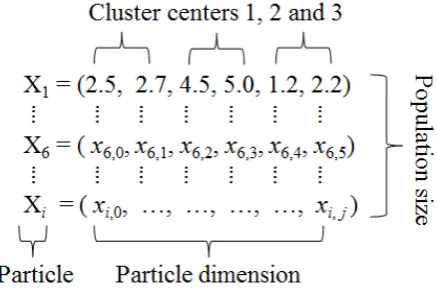
The 3×N particles are randomly generated with an individual position and velocity in the solution space. The generated position for the ith particle is defined as xi(xi∈{xi1, xi2, …, xin}) and the velocity is defined as vi(vi∈{vi1, vi2, …, vin}), where n is the number of particle. Every particle is
composed of K center positions for each cluster, where K is the anticipated number of clusters. N is computed as follow:
N =K×d (6)
[image:2.595.318.537.599.745.2]where d is the data set dimension. For example, a possible encoding of a particle for a two-dimensional problem with three clusters is illustrated in Fig. 1. The three cluster centers in this particle Xi are randomly generated as X1= (2.5, 2.7, 4.5, 5, 1.2, 2.2) and the particle dimension is N = 6, i.e., K=3, d=2 and the population size is 18.
b)Grouping the data vectors for every particle
The all data set are grouped into K clusters according to the data vectors on the basis of the Euclidean distance as the similar measurement. A matrix xi = (C1, C2, …, Cj, .., CK),
where Cjrepresents the jth cluster centroid vector and K is the
number of clusters, is calculated the distance as the length between the data vector and the centroid vector of the respective cluster in every particle, the calculation is described in equation 7. For each data vector, it is assigned to the cluster with the shortest distance.
∑
=
− =
⋅ d
i
ji pi j
p z x z
x
1
2
) ( )
D( (7)
∑
∈ ∀ 1 =
j p c
x p j
j x
n
z (8)
c)Fitness evaluation of each particle
The fitness value of each particle is computed by the following fitness function. The fitness value is the sum of the intra-cluster distances of all clusters. This sum of distance has a profound impact on the error rate.
n j
K i
Z X
fitness=
∑
j− i, =1,K, , =1,K, (9)where K and n are the numbers of clusters and data sets, respectively. Ziis the cluster center i and Xjis the data point j.
d)Update pbest and gbest
In each of the iteration, each particle will compare its current fitness value with the fitness value of its own pbest solution and the fitness value of the population’s gbest solution. The pbest and gbest values are updated if the new values are better than the old ones. If the fitness value of each particle Xi in the current generation is better than the previous
pbest fitness value, then both of the position and fitness value of pbest will be updated as Xi. Similarly, if the fitness value
of pbest in the current generation is better than previous gbest fitness value, then both of the position and fitness value of gbest will be updated as Xi.
III. RESULT AND DISCUSSION
A.Parameter settings
In an experiments, the iteration was set to 1000 and the population size was set to 50. The acceleration parameters were for PSO were set to c1=c2=2. Vmax was equal to (Xmax – Xmin) and Vmin was equal to – (Xmax – Xmin) [8]. The results are the averages of 50 simulation runs. For each run, 10 × N iterations were carried out for each of the six data sets in every algorithm when solving an N-dimensional problem. The criterion 10 × N was adopted in many previous experiments with a great success in terms of its effectiveness [7].
B. Data sets
Six experimental data sets, i.e., Vowel, Iris, Crude oil, CMC, Cancer, and Wine are used to test the qualities of the respective clustering methods. These data sets represent examples of data with low, medium and high dimensions. All
data sets are available at ftp://ftp.ics.uci.edu/pub/machine-learning-databases/.
Table I summarizes the characteristics of these data sets. Given is a data set with three features that are grouped into two clusters. The number of parameters are optimized in order to find the two optimal cluster center vectors that are equal to the product of the number of clusters and the number of features as N = k × d = 2 × 3 = 6. The six real-life data sets are described below:
(1) The Vowel data set (n = 871, d = 3, k = 6) consists of 871 Indian Telugu vowel sounds. It includes the three features corresponding to the first, second and third vowel frequencies, and six overlapping classes {d (72 objects), a (89 objects), i (172 objects), u (151 objects), e(207 objects), o (180 objects)}.
(2) Fisher’s iris data set (n = 150, d = 4, k = 3) consists of the three different species of iris flowers: iris setosa, iris virginica and iris versicolour. For each species, 50 samples were collected from the four features that are sepal length, sepal width, petal length and petal width. (3) The Crude oil data set (n = 56, d = 5, k = 3) consists of 56
objects are characterized by five features: vanadium, iron, beryllium, saturated hydrocarbons, and aromatic hydrocarbons. Three crude-oil samples were collected from the three zones of sandstone (Wilhelm has 7 objects, Sub-Mulnia has 11 objects, and Upper has 38 objects). (4) The Contraceptive Method Choice (denoted CMC with n
= 1473, d = 9, k = 3) consists of a subset of the 1987 National Indonesia Contraceptive Prevalence Survey. The samples consist of the married women who were either not pregnant or not sure of their pregnancy at the time the interviews were conducted. It predicts the choice of the current contraceptive method (no contraception has 629 objects, long-term methods have 334 objects, and short-term methods have 510 objects) of a woman based on her demographic and socioeconomic characteristics. (5) The Wisconsin breast cancer data set (n = 683, d = 9, k = 2)
consists of 683 objects characterized by nine features: clump thickness, cell size uniformity, cell shape uniformity, marginal adhesion, single epithelial cell size, bare nuclei, bland chromatin, normal nucleoli and mitoses. There are two categories in the data; malignant tumors (444 objects) and benign tumors (239 objects).
Table I
SUMMARY OF THE CHARACTERISTICS OF THE CONSIDERED DATA SETS
Name of data set
Number of classes
Number of features
Size of data set (size of classes in parentheses)
Vowel 6 3 871 (72, 89, 172,
151, 207, 180)
Iris 3 4 150 (50, 50, 50)
Crude Oil 3 5 56 (7, 11, 38)
CMC 3 9 1473 (629, 334,
510)
Cancer 2 9 683 (444, 239)
Wine 3 13 178 (59, 71, 48)
C.Test for statistical significance
Results from GaussPSO was compared with the other methods, i.e., K-means, GA, KGA, PSO, NM-PSO, K-PSO, and K-NM-PSO, to demonstrate the capability of data clustering. The quality of the respective clustering was measured by the following four criteria:
(1) The sum of the intra-cluster distances: The distances between data vectors within a cluster and the centroid of the cluster are defined in equation 7, and a higher quality of clustering represents that the sum is relatively small.
(2) Error rate: The numbers of misplaced points are divided by the total number of points, as shown in equation 10:
100 ,
0
≠
, 1
∑
1
× ⎟⎟ ⎠ ⎞ ⎜⎜
⎝ ⎛
⎭ ⎬ ⎫ ⎩
⎨ ⎧
= =
=
n
i i i
i i
B A
B A
error (10)
where n denotes the total number of points. Aiand Bidenote
the data sets of which the ith point is a member before and after of clustering. In Table II an example is shown by the two data points (2.5, 4.5) and (7.5, 5.5) are out of clusters, 1 and 2 are misplaced and the error rate is 2/5, i.e., 40%.
Table II ERROR RATE CALCULATIONS
i Data point Ai Bi Non-misplaced (0) /
misplaced (1) 1 (4.0, 5.0) 2 2 0
2 (2.5, 4.5) 1 2 1 3 (4.5, 3.5) 2 2 0 4 (7.5, 5.5) 1 2 1 5 (5.0, 6.0) 2 2 0
D.Experimental Results and Discussion
In this section, the performances of GaussPSO, and other proposed methods from 20 runs simulations are compared by means of the best fitness values and the standard deviation among six data sets. Table III summarizes the intra-cluster distances and error rates obtained from the eight clustering algorithms from the six data sets.
The test results are clearly shown that the PSO outperforms the GA method, independent of whether the average intra-cluster distance or best intra-cluster distance is
measured. For K-PSO compare with KGA, K-PSO still leads KGA, however, PSO offers better optimized solutions than GA with or without integration of the K-means method. For the all data sets, the averages and standard deviation of the GaussPSO is better than the ones for K-PSO and K-NM-PSO, in which K-PSO is a hybrid of the K-means and PSO algorithm, and K-NM-PSO is a hybrid of the K-means, Nelder–Mead simplex search [12] and PSO. Please note that in terms of the best distance, PSO, NM-PSO, K-PSO and K-NM-PSO all have a larger standard deviation than GaussPSO, even though they may achieve a global optimum. This means that PSO, NM-PSO, K-PSO, K-NM-PSO are weaker search tools for global optima than GaussPSO if all algorithms are executed just once. It follows that GaussPSO are more efficient in finding the global optimum solution than the other four PSO methods. For the error rates, standard deviations of the error rates and the best solution of the error rates from the 20 simulation runs. Table IV lists the number of objective function evaluations required by the seven methods after 10 × N iterations. K-means algorithm has fewest function evaluations on all data sets, but its results are less than satisfactory, as seen in Table III. GaussPSO is the same function evaluations, and they are fewer than PSO, NM-PSO, K-PSO and K-NM-PSO in terms of an average.
E.Advantage of the Gauss chaotic map algorithm
The Gauss chaotic map is a very powerful tool for avoiding entrapment in local optima, besides it does not increase the complexity. The computational complexity for GaussPSO and PSO can be derived as O(PG), where P is the population size and G is the number of generations. In equation 5, we can observe that the chaotic map is only used to amend the PSO updating equation.
The standard PSO, together with each individual and the whole population, evolves towards best fitness, in which the fitness function is evaluated with the objective function. Although this scheme has the property to increase the convergence capability, i.e., to evolve the population toward better fitness, but the convergence speed is too fast, the population may get stuck in a local optimum, since the swarms diversity rapidly decreases. On the other hand, it cannot be searched arbitrarily slowly if we want PSO to be effective.
Gauss chaotic map is a non-linear system with ergodicity, stochastic and regularity properties, and is very sensitive to its initial conditions and parameters. Consequently, the efficiency of GaussPSO is better than the standard PSO because of the chaotic property, i.e., small variation in an initial variable will result in huge difference in the solutions after some iteration. Since chaotic maps are frequently used chaotic behavior maps and the chaotic sequences can be quickly generated and easily stored, there is no need for storage of long sequences [11, 13].
IV. CONCLUSION
The novel method GaussPSO is introduced to solve the data clustering problems. This study used the six public recognizable UCI data sets to investigate the performance through our experiments. We uses minimum intra-cluster distances as a metric to search robustly data cluster centers in N-dimensional Euclidean space. The experimental results demonstrate that our proposed clustering algorithm reaches a minimal error rate and are possessed of the fastest convergence and the highest stabilities of results.
Acknowledgment
This work is partly supported by the National Science Council in Taiwan under grant NSC97-2622-E-151- 008-CC2.
REFERENCES
[1] A. K. Jain, M. N. Murty, and P. J. Flynn, "Data clustering: A review," Acm Computing Surveys, vol. 31, pp. 264-323, 1999.
[2] S. Z. Selim and M. A. Ismail, "K-Means-Type Algorithms: A Generalized Convergence Theorem and Characterization of Local Optimality," IEEE Transactions on Pattern Analysis and Machine Intelligence, vol. 6, pp. 81-87, 1984.
[3] K. J. Kim and H. Ahn, "A recommender system using GA K-means clustering in an online shopping market," Expert Systems with Applications, vol. 34, pp. 1200-1209, 2008.
[4] S. Paterlini and T. Krink, "Differential evolution and particle swarm optimisation in partitional clustering," Computational Statistics & Data Analysis, vol. 50, pp. 1220-1247, 2006.
[5] S. Rana, S. Jasola, and R. Kumar, "A review on particle swarm optimization algorithms and their
applications to data clustering," Artificial Intelligence Review, vol. 35, pp. 211-222, 2011. [6] S. K. S. Fan, Y. C. Liang, and E. Zahara, "Hybrid
simplex search and particle swarm optimization for the global optimization of multimodal functions," Engineering Optimization, vol. 36, pp. 401-418, 2004.
[7] Y. T. Kao, E. Zahara, and I. W. Kao, "A hybridized approach to data clustering," Expert Systems with Applications, vol. 34, pp. 1754-1762, 2008.
[8] J. Kennedy and R. Eberhart, "Particle swarm optimization," in IEEE International Joint Conference on Neural Network. vol. 4, pp. 1942-1948, 1995.
[9] Y. Shi and R. C. Eberhart, "Fuzzy adaptive particle swarm optimization," in In Proceedings of the 2001 congress on evolutionary computation, pp. 101-106, 2001.
[10] Y. Shi and R. C. Eberhart, "Empirical study of particle swarm optimization," in In Proceedings of Congress on Evolutionary Computation, Washington, D.C., pp. 1945-1949, 2002.
[11] Heinz-Otto Peitgen, Hartmut Jürgens, and D. Saupe, Chaos and fractals: new frontiers of science New York: Springer, 2004.
[12] J. A. Nelder and R. Mead, "simplex method for function minimization," Computer Journal, vol. 7, pp. 308-313, 1965.
TABLE III
COMPARISON OF INTRA-CLUSTER DISTANCES AND ERROR RATES FOR GAUSSPSO,K-MEANS,GA,KGA,PSO,NM-PSO,K-PSO, AND K-NM-PSO
Data set Criteria K-means GA KGA PSO NM-PSO Method K-PSO K-NM-PSO GaussPSO
Vowel Average Std Best 159242.87 916 149422.26 390088.24 N/A 383484.15 149368.45 N/A 149356.01 168477.00 3715.73 163882.00 151983.91 4386.43 149240.02 149375.70 155.56 149206.10 149141.40 120.38 149005.00 149015.50 120.67 148967.20 Error rates (%) Std Best 44.26 2.15 42.02 N/A N/A N/A N/A N/A N/A 44.65 2.55 41.45 41.96 0.98 40.07 42.24 0.95 40.64 41.94 0.95 40.64 42.10 1.59 39.84 Iris Average Std Best 106.05 14.11 97.33 135.40 N/A 124.13 97.10 N/A 97.10 103.51 9.69 96.66 100.72 5.82 96.66 96.76 0.07 96.66 96.67 0.008 96.66 96.66 6.551E-4 96.66 Error rates (%) Std Best 17.80 10.72 10.67 N/A N/A N/A N/A N/A N/A 12.53 5.38 10.00 11.13 3.02 8.00 10.20 0.32 10.00 10.07 0.21 10.00 10.00 0.00 10.00 Crude Oil Average Std Best 287.36 25.41 279.20 308.16 N/A 297.05 278.97 N/A 278.97 285.51 10.31 279.07 277.59 0.37 277.19 277.77 0.33 277.45 277.29 0.095 277.15 277.23 3.465E-2 277.21 Error rates (%) Std Best 24.46 1.21 23.21 N/A N/A N/A N/A N/A N/A 24.64 1.73 23.21 24.29 0.75 23.21 24.29 0.92 23.21 23.93 0.72 23.21 26.43 0.71 25 CMC Average Std Best 5693.60 473.14 5542.20 N/A N/A N/A N/A N/A N/A 5734.20 289.00 5538.50 5563.40 30.27 5537.30 5532.90 0.09 5532.88 5532.70 0.23 5532.40 5532.18 4.055E-5 5532.18 Error rates (%) Std Best 54.49 0.04 54.45 N/A N/A N/A N/A N/A N/A 54.41 0.13 54.24 54.47 0.06 54.38 54.38 0.00 54.38 54.38 0.054 54.31 54.38 0.00 54.38 Cancer Average Std Best 2988.30 0.46 2987 N/A N/A N/A N/A N/A N/A 3334.60 357.66 2976.30 2977.70 13.73 2965.59 2965.80 1.63 2964.50 2964.70 0.15 2964.50 2964.39 8.21E-6 2964.39 Error rates (%) Std Best 4.08 0.46 3.95 N/A N/A N/A N/A N/A N/A 5.11 1.32 3.66 4.28 1.10 3.66 3.66 0.00 3.66 3.66 0.00 3.66 3.51 0.00 3.51 Wine Average Std Best 18061.00 793.21 16555.68 N/A N/A N/A N/A N/A N/A 16311.00 22.98 16294.00 16303.00 4.28 16292.00 16294.00 1.70 16292.00 16293.00 0.46 16292.00 16292.68 0.66 16292.18 Error rates (%) Std Best 31.12 0.71 29.78 N/A N/A N/A N/A N/A N/A 28.71 0.27 28.09 28.48 0.27 28.09 28.48 0.40 28.09 28.37 0.27 28.09 28.31 0.28 28.09 The results of K-means, GA, KGA, PSO, NM-PSO, K-PSO, K-NM-PSO can be found in [7].
TABLE IV
NUMBER OF FUNCTION EVALUATIONS OF EACH CLUSTERING ALGORITHM
Data set K-means PSO NM-PSO Method K-PSO K-NM-PSO GaussPSO
Vowel 180 16,290 10,501 15,133 9,291 9,774
Iris 120 7,260 4,836 6,906 4,556 4,356
Crude Oil 150 11,325 7,394 10,807 7,057 6,795
CMC 270 36,585 23,027 34,843 21,597 21,951
Cancer 180 16,290 10,485 15,756 10,149 9,774
Wine 390 73,245 47,309 74,305 46,459 45,747
Average 215 26,833 17,259 26,292 16,519 16,400