KU-CST at CoNLL–SIGMORPHON 2018 Shared Task: a
Tridirectional
Model
Manex Agirrezabal
Centre for Language Technology (CST) Department of Nordic Studies and Linguistics (NorS)
University of Copenhagen (KU) [email protected]
Abstract
In this paper we describe our sequence-to-sequence model for morphological inflection. We have constructed a common Encoder-Decoder network that encodes the input lemma into a dense vector to translate it to an inflected form, based on input morpholog-ical tags. The main novelty of the model is that the input lemma is encoded in three dif-ferent directions: left-to-right, right-to-left and boundaries-to-center. In this paper we report the accuracies of the model compared to the same bidirectional approach.
1 Introduction
In this work we present the neural network ar-chitecture prepared for the task of morphological inflection in the CoNLL–SIGMORPHON 2018 Shared Task (Cotterell et al.,2018). Both morpho-logical analysis and morphomorpho-logical inflection are crucial in end-to-end Natural Language Process-ing pipelines, as they are one of the initial steps performed before solving more high-level prob-lems such as Named-Entity Recognition, Senti-ment Analysis, or others.
2 Task
In the CoNLL–SIGMORPHON 2018 Shared Task there were two tasks to solve. In this work we present a possible solution for the first task, in which word-forms have to be built without consid-ering the context. The input in the task is a lemma and a list morphological tags. The system should be then able to produce the corresponding word form. The following is an example from the Span-ish dataset
jaquear V;CON D; 1;P L
↓
jaquearamos
in which the input lemma isjaquearand its mor-phological tags state that the word form should be a verb (V) in conditional tense (COND), first per-son (1) in plural (PL). The output word form is
jaquearamos.
The models can be trained and tested in over 100 languages and in three different settings, low-, medium- and high-resource scenarios (100, 1,000 or 10,000 training instances, respectively).
2.1 Dataset
As mentioned above we trained and tested our models in the provided dataset, which contains morphological inflections for over 100 languages. The information is encoded using Unicode and morphological tags follow the UniMorph tagging schema (Kirov et al.,2018).
3 Method
Following previous successful attempts to mor-phological inflection (Kann and Sch¨utze, 2016), we built a model based on Neural Networks, specifically an Encoder-Decoder network (Cho et al., 2014) with an attention mechanism ( Bah-danau et al.,2014). Furthermore, instead of con-structing a linguistically inspired model, we have shortly explored an engineering approach. The main novelty of our model is in the way the input is encoded.
InLample et al.(2016) it is stated that recurrent architectures such as Recurrent Neural Networks are capable of encoding very long sequences, but the representation is biased towards the last ex-plored items. Because of that, a bidirectional RNN could be expected to represent well the structure of a word, as it models both the ending (suffix) and the beginning (prefix) by the use of a forward en-coder and a backward enen-coder, respectively.
Our model explores whether this architecture can be improved adding another encoder that
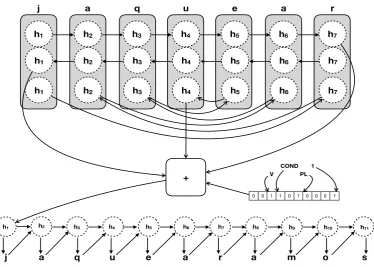
codes the word starting at the boundaries and end-ing in the center, capturend-ing in that way the central structure of the word. The architecture is shown in Figure1.
Each input is encoded with three different en-coders, left-to-right, right-to-left and boundaries-to-center, and those encoded representations are concatenated. Then, a many-hot encoding rep-resentation of the morphological tags is concate-nated at the end. In this way, we generate the rep-resentation of our source lemma with its morpho-logical information. This representation goes to the decoder so that the output word is generated character by character.
4 Model configuration
The implementation is based on a Machine Trans-lation model created using the Pytorch framework. It encodes sentences using three Recurrent Neural Networks with 128 GRU cells in each encoder. In order to train the decoder, we use a teacher forcing ratio of 0.5. We started training all the models for 10 epochs, but we could observe that the models from the low-resource scenario did not converge and the ones in the high-resource scenario did not improve results after the fifth epoch. Because of that, we train our models for 20, 15 and 5 epochs in the low-, medium- and high-resource scenarios, respectively.
5 Results
We tested a bidirectional and a tridirectional
model and our expectations were that the tridirec-tional one would show a better performance in the development set. As you can see in Table1, the mean accuracy is slightly better than in the bidirec-tional model with the same exact configuration,1
although these differences are not significant ac-cording to a bootstrap test.
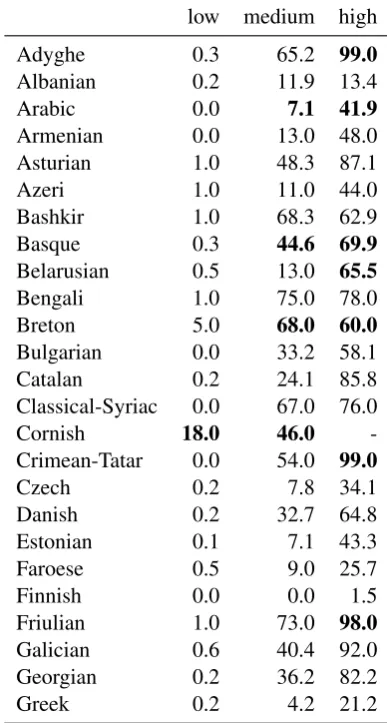
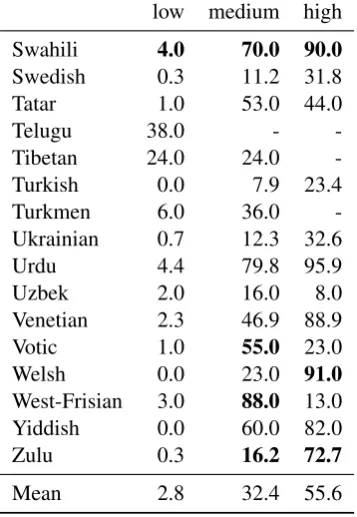
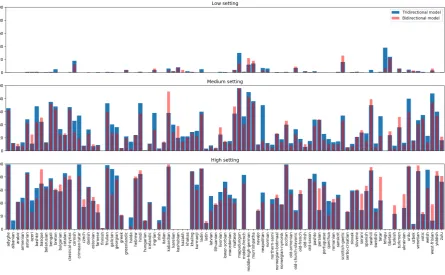
In Table 2you can see the accuracies for each language in each setting with the tridirectional ap-proach2. In Figure2 we plotted these accuracies
together with the accuracies of the bidirectional model. In some cases, our tridirectional approach is sufficiently more accurate than the bidirectional
1Same number of epochs, same cell types, and same size
of hidden memory size. We are aware, although, that the tridirectional approach has more parameters because it has three encoders instead of two.
2In order to make it more interpretable, we marked in bold
results that are better than the current baseline presented for the shared task.
Mean accuracies
low medium high Bidirectional model 2.3 28.4 54.8 Tridirectional model 2.8 32.4 55.6
Mean Levenshtein distances
low medium high Bidirectional model 5.25 2.30 1.28
[image:2.595.308.520.63.203.2]Tridirectional model 5.21 2.11 1.41
Table 1: Average results for the bidirectional and tridi-rectional approaches in three different settings.
one, such as inCrimean-Tatar,Galician,Quechua
andwelshin the high setting, orBashkir, Crimean-Tatar, Ingrian, Napolitan, Tatar andUrdu in the medium setting. There are other cases, although, that the bidirectional approach shows a higher ac-curacy. Check, for instance,PersianandTatar in the high setting orKabardianin the medium set-ting.
low medium high
Adyghe 0.3 65.2 99.0
Albanian 0.2 11.9 13.4
Arabic 0.0 7.1 41.9
Armenian 0.0 13.0 48.0
Asturian 1.0 48.3 87.1
Azeri 1.0 11.0 44.0
Bashkir 1.0 68.3 62.9
Basque 0.3 44.6 69.9
Belarusian 0.5 13.0 65.5
Bengali 1.0 75.0 78.0
Breton 5.0 68.0 60.0
Bulgarian 0.0 33.2 58.1
Catalan 0.2 24.1 85.8
Classical-Syriac 0.0 67.0 76.0
Cornish 18.0 46.0
-Crimean-Tatar 0.0 54.0 99.0
Czech 0.2 7.8 34.1
Danish 0.2 32.7 64.8
Estonian 0.1 7.1 43.3
Faroese 0.5 9.0 25.7
Finnish 0.0 0.0 1.5
Friulian 1.0 73.0 98.0
Galician 0.6 40.4 92.0
Georgian 0.2 36.2 82.2
[image:2.595.316.510.403.765.2]/
j a q u e a r
h1 h2 h3 h4 h5 h6 h7
h1 h2 h3 h4 h5 h6 h7
h1 h2 h3 h4 h5 h6 h7
+
0 0 1 1 0 1 0 0 0 1
V
COND 1 PL
h1 h2 h3 h4 h5 h6 h7 h/8 h/9 h/10 h/11
[image:3.595.110.485.62.329.2]j a q u e a r a m o s
Figure 1: Architecture of our Tridirectional Encoder-Decoder model.
low medium high
Greenlandic 4.0 22.0
-Haida 0.0 14.0 18.0
Hebrew 0.4 24.3 77.9
Hindi 1.1 73.2 84.6
Hungarian 0.1 1.0 12.9
Icelandic 0.4 11.1 41.4
Ingrian 4.0 58.0
-Irish 0.2 3.6 13.8
Italian 0.0 12.8 34.9
Kabardian 6.0 58.0 96.0
Karelian 2.0 40.0
-Kashubian 8.0 20.0
-Kazakh 0.0 22.0
-Khakas 2.0 22.0
-Khaling 1.0 28.8 88.7
Kurmanji 0.0 30.6 68.1
Ladin 5.0 60.0 93.0
Latin 0.0 3.5 9.6
Latvian 0.2 8.3 50.9
Lithuanian 0.2 3.9 37.3
Livonian 1.0 25.0 57.0
Lower-Sorbian 0.8 13.7 72.6
Macedonian 0.0 14.8 52.8
Maltese 4.0 57.0 47.0
Mapudungun 30.0 96.0
-Middle-French 1.1 52.8 83.1
low medium high
Middle-High-German 12.0 90.0
-Murrinhpatha 14.0 76.0
-Navajo 0.4 9.7 28.1
Neapolitan 7.0 70.0 56.0
Norman 6.0 12.0
-Northern-Sami 0.1 9.4 46.0
Norwegian-Bokmaal 0.8 26.2 47.8
Norwegian-Bynorsk 0.4 17.6 37.7
Occitan 1.0 40.0 99.0
Old-Armenian 0.0 11.8 60.7
Old-Church-Slavonic 7.0 33.0 29.0
Old-French 0.0 18.2 53.9
Old-Irish 2.0 6.0
-Old-Saxon 0.6 15.1 77.1
Pashto 2.0 48.0 85.0
Persian 0.2 47.3 29.3
Portuguese 0.2 25.9 72.6
Quechua 0.2 18.0 43.0
Romanian 0.2 13.2 41.1
Sanskrit 0.9 14.4 52.7
Scottish-Gaelic 16.0 54.0
-Serbo-Croatian 0.1 5.4 26.3
Slovak 0.7 10.6 59.3
Slovene 1.2 21.2 59.3
Sorani 0.3 28.0 29.3
low medium high
Swahili 4.0 70.0 90.0
Swedish 0.3 11.2 31.8
Tatar 1.0 53.0 44.0
Telugu 38.0 -
-Tibetan 24.0 24.0
-Turkish 0.0 7.9 23.4
Turkmen 6.0 36.0
-Ukrainian 0.7 12.3 32.6
Urdu 4.4 79.8 95.9
Uzbek 2.0 16.0 8.0
Venetian 2.3 46.9 88.9
Votic 1.0 55.0 23.0
Welsh 0.0 23.0 91.0
West-Frisian 3.0 88.0 13.0
Yiddish 0.0 60.0 82.0
Zulu 0.3 16.2 72.7
Mean 2.8 32.4 55.6
Table 2: Accuracies for all languages in the low-, medium- and high-resource scenario using the tridirec-tioalEncoder-Decoder model. The last row shows the average accuracy for each resource scenario.
6 Conclusion and Future work
In this experiment we tried to approach morpho-logical inflection using a slightly more complex Encoder-Decoder architecture, by encoding the lemmas in three different directions (left-to-right, right-to-left and boundaries-to-center).
Although the model works quite well in some cases, there is plenty room for improvement. The main improvement that must be done is to continue experimenting with more parameters to check whether the addition of parameters im-proves results. Both in the medium- and high-resource settings, there are some languages that show very bad performance, especially Finnish,
HungarianandLatin. We feel that there is a need of carefully analyzing their outputs so that to bet-ter understand the motivation for these low results. Data augmentation techniques were success-fully used in the last CoNLL–SIGMORPHON 2018 Shared Task (Bergmanis et al.,2017;Kann and Sch¨utze, 2017; Nicolai et al., 2017; Silfver-berg et al.,2017) and thus, we think that our model could see its results improved in the low- and the medium-resource setting by adding artificially generated data.
We expect that using external resources, such
as Wikipedia, would have a positive effect. We could even analyze how much effect does a spe-cific amount of text have in this task pretraining character embeddings with, for instance, 10,000, 50,000 or 100,000 characters.
Acknowledgments
I acknowledge the anonymous reviewers for their informative comments and possible extra future directions, and also the organizers of the CoNLL– SIGMORPHON 2018 Shared Task for giving us the opportunity of participating in such an excit-ing task.
References
Dzmitry Bahdanau, Kyunghyun Cho, and Yoshua Ben-gio. 2014. Neural machine translation by jointly learning to align and translate. arXiv preprint arXiv:1409.0473.
Toms Bergmanis, Katharina Kann, Hinrich Sch¨utze, and Sharon Goldwater. 2017. Training data aug-mentation for low-resource morphological inflec-tion. Proceedings of the CoNLL SIGMORPHON 2017 Shared Task: Universal Morphological Rein-flection, pages 31–39.
Kyunghyun Cho, Bart Van Merri¨enboer, Caglar Gul-cehre, Dzmitry Bahdanau, Fethi Bougares, Holger Schwenk, and Yoshua Bengio. 2014. Learning phrase representations using rnn encoder-decoder for statistical machine translation. arXiv preprint arXiv:1406.1078.
Ryan Cotterell, Christo Kirov, John Sylak-Glassman, G´eraldine Walther, Ekaterina Vylomova, Arya D. McCarthy, Katharina Kann, Sebastian Mielke, Gar-rett Nicolai, Miikka Silfverberg, David Yarowsky, Jason Eisner, and Mans Hulden. 2018. The CoNLL– SIGMORPHON 2018 shared task: Universal mor-phological reinflection. In Proceedings of the CoNLL–SIGMORPHON 2018 Shared Task: Univer-sal Morphological Reinflection, Brussels, Belgium. Association for Computational Linguistics.
Katharina Kann and Hinrich Sch¨utze. 2016. Med: The lmu system for the sigmorphon 2016 shared task on morphological reinflection. In Proceedings of the 14th SIGMORPHON Workshop on Computational Research in Phonetics, Phonology, and Morphol-ogy, pages 62–70.
[image:4.595.72.251.67.326.2]Figure 2: Accuracies of both the bidirectional and tridirectional models. As it can be seen in the figure, results from the two models are not very different as it was initially expected.
Christo Kirov, Ryan Cotterell, John Sylak-Glassman, Graldine Walther, Ekaterina Vylomova, Patrick Xia, Manaal Faruqui, Sebastian Mielke, Arya D. Mc-Carthy, Sandra Kbler, David Yarowsky, Jason Eis-ner, and Mans Hulden. 2018. UniMorph 2.0: Uni-versal Morphology. InProceedings of the Eleventh International Conference on Language Resources and Evaluation (LREC 2018), Miyazaki, Japan. Eu-ropean Language Resources Association (ELRA).
Guillaume Lample, Miguel Ballesteros, Sandeep Sub-ramanian, Kazuya Kawakami, and Chris Dyer. 2016. Neural architectures for named entity recognition.
arXiv preprint arXiv:1603.01360.
Garrett Nicolai, Bradley Hauer, Mohammad Motallebi, Saeed Najafi, and Grzegorz Kondrak. 2017. If you can’t beat them, join them: the university of alberta system description. Proceedings of the CoNLL SIG-MORPHON 2017 Shared Task: Universal Morpho-logical Reinflection, pages 79–84.