A Linear-Time Transition System for Crossing Interval Trees
Emily Pitler Ryan McDonald
Google, Inc.
{epitler,ryanmcd}@google.com
Abstract
We define a restricted class of non-projective trees that 1) covers many natural language sentences; and 2) can be parsed exactly with a generalization of the popular arc-eager sys-tem for projective trees (Nivre, 2003). Cru-cially, this generalization only adds constant overhead in run-time and space keeping the parser’s total run-time linear in the worst case. In empirical experiments, our proposed transition-based parser is more accurate on average than both the arc-eager system or the swap-based system, an unconstrained non-projective transition system with a worst-case quadratic runtime (Nivre, 2009).
1 Introduction
Linear-time transition-based parsers that use either greedy inference or beam search are widely used to-day due to their speed and accuracy (Nivre, 2008; Zhang and Clark, 2008; Zhang and Nivre, 2011). Of the many proposed transition systems (Nivre, 2008), the arc-eager transition system of Nivre (2003) is one of the most popular for a variety of reasons. The arc-eager system has a well-defined output space: it can produceall projective trees and only projec-tive trees. For an input sentence with n words, the arc-eager system always performs2noperations and each operation takes constant time. Another attractive property of the arc-eager system is the close connection between the parameterization of the parsing problem and the final predicted output structure. In the arc-eager model, each operation has a clear interpretation in terms of constraints on the
final output tree (Goldberg and Nivre, 2012), which allows for more robust learning procedures (Gold-berg and Nivre, 2012).
The arc-eager system, however, cannot produce trees with crossing arcs. Alternative systems can produce crossing dependencies, but at the cost of taking O(n2) transitions in the worst case (Nivre,
2008; Nivre, 2009; Choi and McCallum, 2013), re-quiring more transitions than arc-eager to produce projective trees (Nivre, 2008; G´omez-Rodr´ıguez and Nivre, 2010), or producing trees in an unknown out-put class1(Attardi, 2006).
Graph-based non-projective parsing algorithms, on the other hand, have been able to preserve many of the attractive properties of their corresponding projective parsing algorithms by restricting search to classes ofmildly non-projective trees(Kuhlmann and Nivre, 2006). Mildly non-projective classes of trees are characterizable subsets of directed trees. Classes of particular interest are those that both have high empirical coverage and that can be parsed efficiently. With appropriate definitions of fea-ture functions and output spaces, exact higher-order graph-based non-projective parsers can match the asymptotic time and space of higher-order projec-tive parsers (Pitler, 2014).
In this paper, we propose a class of mildly non-projective trees (§3) and a transition system (§4) that is sound and complete with respect to this class (§5) while preserving desirable properties of arc-eager: it runs inO(n)time in the worst case (§6), and each operation can be interpreted as a prediction about
1A characterization independent of the transition system is
unknown.
the final tree structure. At the same time, it can produce trees with crossing dependencies. Across ten languages, on average 96.7% of sentences have dependency trees in the proposed class (Table 1), compared with 79.4% for projective trees. The implemented mildly non-projective transition-based parser is more accurate than a fully projective parser (arc-eager, (Nivre, 2003)) and a fully non-projective parser (swap-based, (Nivre, 2009)) (§7.1).
2 Preliminaries
Given an input sentencew1w2. . . wn, a dependency
tree for that sentence is a set of vertices V = {0,1, . . . , n} and arcs A ⊂ V ×V. Each vertex
icorresponds to a word in the sentence and vertex0
corresponds to an artificialrootword, which is stan-dard in the literature. An arc(i, j) ∈ A represents a dependency between a modifierwjand a headwi.
Critically, the arc setAis constrained to form a valid dependency tree: its root is at the leftmost vertex0; each vertexihas exactly one incoming arc (except
0, which has no incoming arcs); and there are no cy-cles. A common extension is to add labels of syntac-tic relations to each arc. For ease of exposition, we will focus on the unlabeled variant during the discus-sion but use a labeled variant during experiments.
A dependency tree isprojectiveif and only if the nodes in the yield of each subtree form a contigu-ous interval with respect to the words and their order in the sentence. For instance, the tree in Figure 1a is non-projectivesince the subtrees rooted at came andparadedo not cover a contiguous set of words. Equivalently, a dependency tree is non-projective if and only if the tree cannot be drawn in the plane above the sentence without crossing arcs. As we will see, these crossing arcs are a useful measure when defining sub-classes of non-projectivity. We will often reason about the set of verticesincidentto a particular arc. The incident vertices of an arc are its endpoints: for an arc(u, v),uandvare the two vertices incident to it.
3 k-Crossing Interval Trees
We begin by defining a class of trees based on re-strictions on crossing dependencies. The class def-inition is independent of any transition system; it is easy to check whether a particular tree is within the
rootWho do youthink cameto DC where aparadewasheldfor Sam (a) A dependency tree with two disjoint sets (blue and dashed/red and dotted) of crossing arcs (bold).
(root, think) (came, Who)
(DC, held) (held, where)
(parade, for)
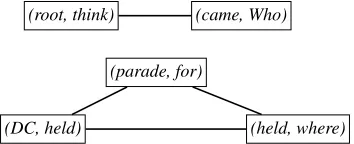
[image:2.612.331.508.131.203.2](b) The auxiliary graph for the sentence above. There are two connected components of crossed arcs, one of which corresponds to the crossing interval
[root, came]and the other[DC, for].
Figure 1: A sentence with two crossing intervals.
class or not. We compare the coverage of this class on various natural language datasets with the cover-age of the class of projective trees.
Definition 1. LetAbe a set of unlabeled arcs. The Interval of A, Interval(A), is the interval from the leftmost vertex inAto the rightmost vertex inA, i.e., Interval(A) = [min(VA), max(VA)], where VA = {v:∃u[(u, v)∈A∨(v, u)∈A]}.
Definition 2. For any dependency tree T, the below procedure partitions the crossed arcs in
T into disjoint sets A1, A2, . . . ., Al such that Interval(A1), Interval(A2), . . . , Interval(Al) are all vertex-disjoint. These intervals are thecrossing in-tervalsof the treeT.
Procedure: Construct an auxiliary graph with a vertex for each crossed arc in the original tree. Two such vertices are connected by an arc if the inter-vals defined by the arcs they correspond to have a non-empty intersection. Figure 1b shows the aux-iliary graph for the sentence in Figure 1a. The connected components of this graph form a parti-tion of the graph’s vertices, and so also partiparti-tion the crossed arcs in the original sentence. The intervals defined by these groups cannot overlap, since then the crossed arcs that span the overlapping portion would have been connected by an arc in the aux-iliary graph and hence been part of the same con-nected component.
ver-2-Crossing 1
-Endpoint-Language Interval Crossing Projective
Basque 93.5 94.7 74.8
Czech 97.4 98.9 77.9
Dutch 91.4 95.8 63.6
English 99.2 99.3 93.4
German 94.7 96.4 72.3
Greek 99.1 99.7 84.4
Hungarian 95.3 96.3 74.7
Portuguese 99.0 99.6 83.3
Slovene 98.2 99.5 79.6
Turkish 99.1 99.3 89.9
[image:3.612.81.290.59.203.2]Average 96.7 98.0 79.4
Table 1: Proportion of trees (excluding punctuation) in each tree class for the CoNLL shared tasks training sets: Dutch, German, Portuguese, and Slovene are from Buch-holz and Marsi (2006); Basque, Czech, English, Greek, Hungarian, and Turkish data are from Nivre et al. (2007).
tices such that a) all crossed arcs within the interval are incident to at least one of these vertices and b) any vertex in the interval that has a child on the far side of its parent is one of thesekvertices.
Figure 1a shows a 2-Crossing Interval tree. For the first crossing interval, think and came satisfy the conditions; for the second, parade and held do. The coverage of 2-Crossing Interval trees is shown in Table 1. Across datasets from ten lan-guages with a non-negligible proportion of cross-ing dependencies, on average 96.7% of dependency trees are 2-Crossing Interval, within 1.3% of the larger 1-Endpoint-Crossing class (Pitler et al., 2013) and substantially larger than the 79.4% coverage of projective trees. Coverage increases askincreases; for 3-Crossing Interval trees, the average coverage reaches 98.6%. Punctuation tokens are excluded when computing coverage to better reflect language specific properties rather than treebank artifacts; for example, the Turkish CoNLL data attaches punctua-tion tokens to the artificial root, causing a 15% abso-lute drop in coverage for projective trees when punc-tuation tokens are included (89.9% vs. 74.7%).
3.1 Connections to Other Tree Classes
k = 0 ork = 1 gives exactly the class of projec-tive trees (even a single crossing implies two vertex-disjoint crossed edges).2-Crossing Interval trees are a subset of the linguistically motivated 1-Endpoint-Crossing trees (Pitler et al., 2013) (each crossed edge is incident to one of the two vertices for the
root b a1 b1 a2 b2 . . . an−1 bn−1 an bn a Figure 2: A 2-Crossing Interval tree that is not well-nested and has unbounded block degree.
interval, so all edges that cross it are incident to the other vertex for the interval); all of the exam-ples from the linguistics literature provided in Pitler (2013, p.132-136) for 1-Endpoint-Crossing trees are 2-Crossing Interval trees as well. 2-Crossing In-terval trees arenot necessarilywell-nestedand can have unbounded block degree (Kuhlmann, 2013). Figure 2 shows an example of a 2-Crossing Inter-val tree (all crossed edges are incident to eitheraor
b; no children are on the far side of their parent) in which the subtrees rooted ata andb are ill-nested and each has a block degree ofn+ 1.
4 Two-Registers Transition System
A transition system for dependency parsing com-prises: 1) an initial configuration for an input sen-tence; 2) a set of final configurations after which the parsing derivation terminates; and 3) a set of deter-ministictransitionsfor transitioning from one con-figuration to another (Nivre, 2008).
Our transition system builds on one of the most commonly used transition systems for parsing pro-jective trees, the arc-eager system (Nivre, 2003). An arc-eager configuration, c, is a tuple,(σ, β, A), where 1)σ is astack consisting of a subset of pro-cessed tokens; 2)β is abuffer consisting of unpro-cessed tokens; and 3)Ais the set of dependency arcs already added to the tree.
We define a new transition system called two-registers. Configurations are updated to include two registersR1andR2, i.e.,c = (σ, β, R1, R2, A). A register contains one vertex or is empty: R1, R2 ∈
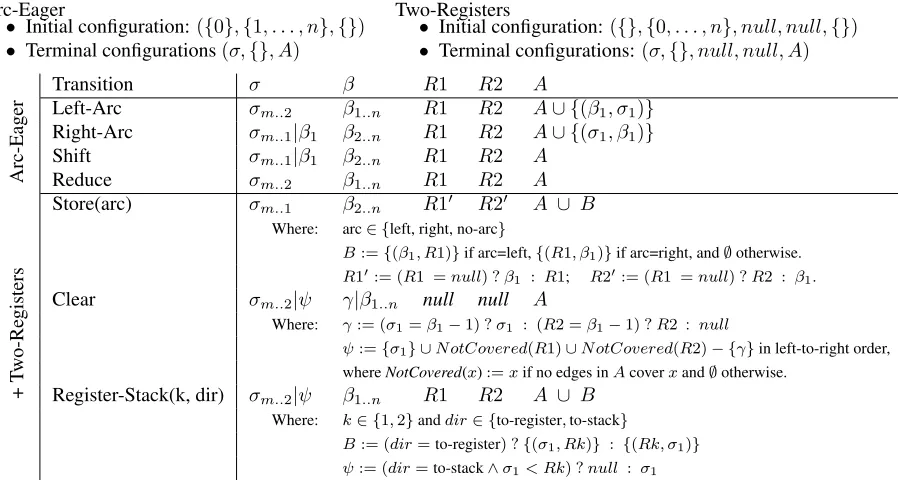
V ∪ {null}. Table 2 defines both the arc-eager and two-registers transition systems. The two-registers system includes the arc-eager transitions (top half of Table 2) and three new transitions that make use of the registers (bottom half of Table 2):
[image:3.612.328.524.65.128.2]Arc-Eager
• Initial configuration:({0},{1, . . . , n},{})
• Terminal configurations(σ,{}, A)
Two-Registers
• Initial configuration:({},{0, . . . , n}, null, null,{})
• Terminal configurations:(σ,{}, null, null, A)
Transition σ β R1 R2 A
Arc-Eager
Left-Arc σm..2 β1..n R1 R2 A∪ {(β1, σ1)}
Right-Arc σm..1|β1 β2..n R1 R2 A∪ {(σ1, β1)}
Shift σm..1|β1 β2..n R1 R2 A
Reduce σm..2 β1..n R1 R2 A
+
Tw
o-Re
gisters
Store(arc) σm..1 β2..n R10 R20 A ∪ B
Where: arc∈ {left, right, no-arc}
B:={(β1, R1)}if arc=left,{(R1, β1)}if arc=right, and∅otherwise.
R10:= (R1 =null) ?β1 : R1; R20:= (R1 =null) ?R2 : β1.
Clear σm..2|ψ γ|β1..n null null A
Where: γ:= (σ1=β1−1) ?σ1 : (R2 =β1−1) ?R2 : null
ψ:={σ1} ∪NotCovered(R1)∪NotCovered(R2)− {γ}in left-to-right order,
whereNotCovered(x):=xif no edges inAcoverxand∅otherwise. Register-Stack(k, dir) σm..2|ψ β1..n R1 R2 A ∪ B
Where: k∈ {1,2}anddir∈ {to-register,to-stack}
B:= (dir=to-register) ?{(σ1, Rk)} : {(Rk, σ1)}
[image:4.612.81.530.70.310.2]ψ:= (dir=to-stack∧σ1< Rk) ?null : σ1
Table 2: Transitions and the resulting state after each is applied to the configuration(σm..2|σ1, β1|β2..n, R1, R2, A).
Transition σ β R1 R2 A
. . . [that we Hans house] [helped paint] null null {(house,the)} Store(no-arc) [that we Hans house] [paint] helped null
Store(right) [that we Hans house] [] helped paint ∪ {(helped, paint)} Register-Stack(2, to-stack) [that we Hans] [] helped paint ∪ {(paint, house)} Register-Stack(1, to-stack) [that we] [] helped paint ∪ {(helped, Hans)} Register-Stack(1, to-stack) [that] [] helped paint ∪ {(helped, we)} Register-Stack(1, to-register) [that] [] helped paint ∪ {(that, helped)}
[image:4.612.72.525.359.470.2]Clear [that] [paint] null null
Table 3: An excerpt from a gold standard derivation of the sentence in Figure 3. The two wordspaintandhouseare added to the registers and then crossed arcs are added between them and the top of the stack.
Transition Precondition Type
Left-Arc, Right-Arc R1∈/(σ1, β1)∧R2∈/ (σ1, β1) (2)
Store(·) (R1 =null∨R2 =null)∧(β1> last) (1)
Clear (R16=null)∧(R26=null∨β1=null)∧(σ2< R1)∧(σ1∈/ (R1, R2)) (1)
Register-Stack(k,·) (σ1> last)∨(k= 1∧ ¬IsCovered(R1)) (1)
σ2< Rright (2)
Register-Stack(k, to-register) (Rclose, σ1)∈/A (3)
Register-Stack(k, to-stack) (σ1, Rfar)∈/A (3)
Table 4: Preconditions that ensure the 2-Crossing Interval property for trees output by the two-registers transition system, applied to a configuration(σm..1, β1..n, R1, R2, A). Ifσ1 < R1,Rclose :=R1andRfar:=R2; otherwise,
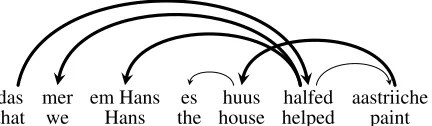
[image:4.612.73.545.533.630.2]das mer em Hans es huus halfed aastriiche that we Hans the house helped paint Figure 3: A clause with crossing edges (Shieber, 1985).
adding an arc between this token and the token in the first register.
• Clear: Removes tokens from the registers, re-ducing them completely if they are covered by an edge inAor otherwise placing them back on the stack in order. If eitherR2or the top of the stack is the token immediately to the left of the front of the buffer, that token is placed back on the buffer instead.
• Register-Stack: Adds an arc between the top of the stack and one of the registers.
A derivation excerpt for the clause in Figure 3 is shown in Table 3. The two tokens incident to all crossed arcshelpedandpaintare stored in the reg-isters. The crossed arcs are then added through Register-Stack transitions, working outward from the registers through the previous words in the sen-tence:(paint, house), then(helped, Hans), etc. After all the crossed arcs incident to these two tokens have been added, the registers are cleared.
Preconditions related to rootedness, single-headedness, and acyclicity follow the arc-eager sys-tem straightforwardly: each transition that adds an arc(h, m)checks thatmis not the root,mdoes not already have a head, and thathis not a descendant of
m. Preconditions used to guarantee that trees output by the system are within the desired class are listed in Table 4. In particular, they ensure that all crossed arcs are incident to registers, and that each pair of registers entails an interval corresponding to a self-contained set of crossed edges. To avoid travers-ingAwhile checking preconditions, two helper con-stants are used:IsCovered(Rk)2andlast3.
2IsCovered(R1) is true if there exists an arc inAwith
endpoints on either side ofR1. Rather than enumerating arcs, this boolean can be updated in constant time by setting it to true only after a Register-Stack(2, dir) transition withσ1 < R1;
likewise R2 can only be covered with a Register-Stack(1, dir) transition withσ1> R2.
3last is used to indicate the rightmost partially processed
unreduced vertex after the last pair of registers were cleared (set to the rightmost inγ,ψafter each Clear transition).
Lemma 1. In the two-registers system, all crossed arcs are added through register-stack operations. Proof. Suppose for the sake of contradiction that a right arc (s, b) added whenσ1 = sandβ1 = bis
crossed in the final output tree (the argument for left-arcs is identical). Let(l, r)withl < rbe an arc that crosses(s, b). One of{l, r}must be within the open interval(s, b) and one of{l, r} ∈/ [s, b]. When the arc (s, b) is added, no tokens in the open interval
(s, b)remain. They cannot be in the stack or buffer since the stack and buffer always remain in order; they cannot be in registers by the preconditionR1∈/ (σ1, β1)∧R2 ∈/ (σ1, β1)for Right-Arc transitions.
Thus,(l, r)must already have been added. It cannot be thatl ∈ (s, b) and r > b, since the rest of the buffer has never been accessible to tokens left ofb. The ordering must then bel < s < r < b. Figure 4 shows that for each way(l, r)could have been added (Right-Arc, 4a; Store(right), 4b; Register-Stack(k, to-stack), 4c; Register-Stack(k, to-register), 4d), it is impossible to keepsunreduced without violating one of the preconditions.
The only other type of arc-adding operation is Store. Similar logic holds: arcs added through Left-Arc and Right-Left-Arc transitions cannot cross these arcs, since they would violate the preconditions
R1 ∈/ (σ1, β1)∧R2 ∈/ (σ1, β1); later arcs
involv-ing other registers would imply Clear operations that violateσ2< R1∧σ1 ∈/ (R1, R2).
5 Parsing2-Crossing Interval Trees with the Two-Registers Transition System
In this section we show the correspondence between the two-registers transition system and 2-Crossing Interval trees: each forest output by the transition system is a 2-Crossing Interval tree (soundness) and every 2-Crossing Interval tree can be produced by the two-registers system (completeness).
5.1 Soundness: Two-Registers System→ 2-Crossing Interval trees
s
r . . . b . . . . . . l
(a)Right-Arc:swould have been in a register, and the Right-Arc would have violatedR1∈/(σ1, β1)∧R2∈/(σ1, β1).
l r
. . . b . . . . . . s . . .
(b)Store(right):swould be on the stack when the registers were cleared, so Clear would have violatedσ2< R1∧σ1∈/(R1, R2). l
. . . b . . . . . . s . . . r
(c)Register-Stack(k, to-stack): Ifswas on the stack, then ifs > R2, Register-Stack(k, t-stack) would have violatedσ2 < R2; if
s < R2, thens ∈ (R1, R2), and Clear would have violated σ2< R1∧σ1∈/(R1, R2). Ifsinstead was inR2(not shown),
then it would get covered by(l, r)and reduced by Clear.
s r
. . . b . . . . . . l
(d) Register-Stack(k, to-register): smust have been inR2. s would get covered by(l, r)and reduced by Clear.
Figure 4: If a stack-buffer arc(s, b)is added in the two-registers system, there cannot have been an earlier arc(l, r)
withl < s < r < b, since it would then be impossible to keepsunreduced without violating the preconditions.
the registers being cleared, and subsequent actions cannot introduce crossed arcs to the last token or to its left (by the β1 > last and σ1 > last
pconditions on storing and register-stack arcs, re-spectively). Thus, each set of tokens that were in registers simultaneously defines a crossing interval. Condition (a) of Definition 3 is satisfied, since all crossed arcs are incident to registers and at most two vertices are in registers at the same time.
Assume that a vertex h, h /∈ {R1, R2}, has a child m on the far side of its parent g (i.e., ei-ther h < g < m or m < g < h). The edge
(h, m)is guaranteed to be crossed and so was added through a register-stack arc (Lemma 1). The order-ingh < g < m is not possible, since if(g, h) had been added through a left-arc, then h would have been reduced, and if (g, h) and (h, m) were both added through register-stack arcs, then one of them would have violated the (Rclose, σ1) ∈/ A or the (σ1, Rfar)∈/ Aprecondition. Similar reasoning can
rule outm < g < h. Thus Condition (b) of Defini-tion 3 is also satisfied.
5.2 Completeness: 2-Crossing Interval trees→ Two-Registers System
Proof. The portions of a 2-Crossing Interval tree in-between the crossing intervals can be constructed using the transitions from arc-eager. For a partic-ular crossing interval[l, r]and a particular choice of two verticesaandbincident to all all crossed arcs in the interval (l ≤a < b ≤r),aandbdivide the in-terval into: L= [l, a),a,M = (a, b),b,R= (b, r].
All arcs incident to neitheranorbmust lie entirely withinL,M, orR.4
The parser begins by adding all arcs with both endpoints in L, using the standard arc-eager Shift/Reduce/Left-Arc/Right-Arc. It then shifts until
ais at the front of the buffer and storesa. It then re-peats the same process to add the arcs lying entirely inM untilb reaches the front of the buffer, adding the parent ofawith a Register-Stack(1, to-register) transition if the parent is in M and the arc is un-crossed. bis then stored, adding the arc betweena
andbif necessary. Throughout this process, the pre-conditionR1 ∈/ (σ1, β1)∧R2 ∈/ (σ1, β1) for left and right arcs is satisfied.
Next, the parser will repeatedly take Register-Stack transitions, interspersed with Reduce transi-tions, to add all the arcs with one endpoint in{a, b}
and the other inLorM, working right-to-left from
b (i.e., from the top of the stack downwards). No shifts are done at this stage, so theσ2 < R2
pre-condition on Register-Stack arcs is always satisfied. Theσ1 > lastprecondition is also always satisfied since all vertices in the crossing interval will be to the right of the previous crossing interval boundary point. After all these arcs are done, if there are any uncrossed arcs incident toato the left that go outside of the crossing interval, they are added now with a Register-Stack transition.5
4E.g., if there were an arc not incident toaorbwith one
endpoint left ofa and one endpoint right ofa, then this arc must be crossed or lie outside of the crossing interval.
5Only possible in the case l = a, in which case
Finally, the arcs with at least one endpoint in R
are added, using Register-Stack arcs for those with the other endpoint in{a, b}and Left-Arc/Right-Arc for those with both endpoints inR. Before any ver-tex incident to a or b is shifted onto the stack, all tokens on the stack to the right ofbare reduced.
After all these arcs are added, the crossing interval is complete. The boundary points of the interval that can still participate in uncrossed arcs with the exte-rior are left on the stack and buffer after the clear operation, so the rest of the tree is still parsable.
6 Worst-case Runtime
The two-registers system runs inO(n)time: it com-pletes after at mostO(n)transitions and each tran-sition takes constant time.
The total number of arc-adding actions (Left-Arc, Right-Arc, Register-Stack, or a Store that includes an arc) is bounded byn, as there are at mostnarcs in the final output. The net result of{Store, Store, Clear} triples of transitions decreases the number of tokens on the buffer by at least one, so these triples, plus the number of Shifts and Right-Arcs, are bounded byn. Finally, each token can be removed completely at most once, so the number of Left-Arcs and Reduces is bounded byn. Every transition fell into one of these categories, so the total number of transitions is bounded by5n=O(n).
Each operation can be performed in constant time, as all operations involve moving vertices and/or adding arcs, and at most three vertices are ever moved (Clear) and at most one arc is ever added. Most preconditions can be trivially checked in con-stant time, such as checking whether a vertex al-ready has a parent or not. The non-trivial pre-condition to check is acyclicity, and this can also be checked by adding some book-keeping variables that can be updated in constant time (full proof omitted due to space constraints). For example, in the derivation in Table 3, prior to the Register-Stack(2, to-stack) transition, R1 →A R2 (helped →A paint). After the arc (R2, σ1) (paint, house)
is added,R2→Aσ
1and by transitivity,R1→Aσ1.
The top of the stack is then reduced, and since σ2
does not have a parent to its right, it is not a descen-dant ofσ1, and so afterHansbecomes the new σ1,
the system makes the update thatR1,R29Aσ1.
7 Experiments
The experiments compare the two-registers transi-tion system for mildly non-projective trees proposed here with two other transition systems: the arc-eager system for projective trees (Nivre, 2003) and the swap-based system for all non-projective trees (Nivre, 2009). We choose the swap-based system as our non-projective baseline as it currently repre-sents the state-of-the-art in transition-based parsing (Bohnet et al., 2013), with higher empirical perfor-mance than the Attardi system or pseudo-projective parsing (Kuhlmann and Nivre, 2010).
The arc-eager system is a reimplementation of Zhang and Nivre (2011), using their rich feature set and beam search. The features for the two other tran-sition systems are based on the same set, but with slight modifications to account for the different rel-evant domains of locality. In particular, for the swap transition system, we updated the features to account for the fact that this transition system is based on the arc-standard model and so the most relevant posi-tions are the top two tokens on the stack. For the two-register system, we added features over proper-ties of the tokens stored in each of the registers. All experiments use beam search with a beam of size 32 and are trained with ten iterations of averaged structured perceptron training. Training set trees that are outside of the reachable class (projective for arc-eager, 2-Crossing Intervals for two-registers) are transformed by lifting arcs (Nivre and Nilsson, 2005) until the tree is within the class. The test sets are left unchanged. We use the standard technique of parameterizing arc creating actions with depen-dency labels to produce labeled dependepen-dency trees.
LAS (UAS)
Language eager swap two-registers
[image:8.612.73.545.60.205.2]Basque 70.50 (78.06) 69.66 (77.44) 71.10(78.57) Czech 79.60 (85.55) 80.74(86.82) 79.75 (85.93) Dutch 78.69 (81.41) 79.65 (82.69) 80.77(83.91) English 90.00 (91.18) 90.16 (91.29) 90.36 (91.54) German 88.34 (91.01) 86.76 (89.56) 89.08(91.95) Greek 77.34 (84.79) 76.90 (84.72) 77.59(84.77) Hungarian 80.00 (84.20) 79.93 (84.40) 80.21 (84.91) Portuguese 88.30 (91.64) 87.92 (91.79) 87.40 (91.20) Slovene 75.68 (83.97) 76.34 (84.47) 76.08 (84.33) Turkish 68.83 (77.34) 70.71 (79.74) 70.94(80.39) Average 79.73 (84.92) 79.88 (85.29) 80.33 (85.75) Table 5: Labeled and Unlabeled Attachment Scores (LAS and UAS) on the CoNLL 2006/2007 Shared Task datasets (gold part-of-speech tags and morphology).
LAS (UAS)
Language eager swap two-registers
Basque 64.36(73.03) 63.23 (72.10) 64.27 (72.32) Czech 75.92 (83.79) 76.92(84.54) 76.37 (83.79) Dutch 78.59 (81.07) 79.69 (83.03) 80.77(83.71) English 88.19 (89.77) 88.68 (90.32) 88.93(90.50) German 87.74(90.62) 85.66 (88.40) 87.60 (90.48) Greek 77.46(85.14) 76.29 (84.65) 77.22 (84.82) Hungarian 75.88(81.61) 75.83 (81.89) 75.71 (82.43) Portuguese 86.07(90.16) 85.65 (89.86) 85.91 (90.16) Slovene 71.72(81.69) 71.36 (81.63) 71.58 (81.43) Turkish 62.18 (74.22) 63.12 (75.26) 64.06(76.82) Average 76.81 (83.11) 76.64 (83.17) 77.24(83.65) Table 6: Labeled and Unlabeled Attachment Scores (LAS and UAS) on the CoNLL 2006/2007 Shared Task datasets (predicted part-of-speech tags and morphology).
7.1 Results
Table 5 shows the results using gold tags as fea-tures, which is the most common set-up in the lit-erature. The two-registers transition system has on average 0.8% absolute higher unlabeled attachment accuracy than arc-eager across the ten datasets in-vestigated. Its UAS is higher than arc-eager for eight out of the ten languages and is up to 2.5% (Dutch) or 3.0% (Turkish) absolute higher, while never more than 0.4% worse (Portuguese). The two-registers transition system is also more accurate than the al-ternate non-projective swap system on seven out of the ten languages, with more than 1% absolute im-provements in UAS for Basque, Dutch, and German. The two-registers transition-system is still on aver-age more accurate than either the arc-eaver-ager or swap systems using predicted tags as features (Table 6).
Crossed / Uncrossed
Language eager swap two-registers
Basque 33.10 / 83.32 39.37/ 82.52 34.49 /83.58 Czech 43.98 / 87.37 68.76/87.63 55.42 / 87.24 Dutch 40.08 /87.66 71.08/ 85.70 69.19 / 87.08 English 27.66 / 91.98 42.55/ 92.00 42.55/92.09 German 55.29 / 91.60 72.35 / 89.46 75.29/91.85 Greek 29.94 / 84.79 33.12/ 84.76 30.57 /84.94 Hungarian 44.40 /84.98 55.40 / 84.07 55.60/ 84.77 Portuguese 48.17 /90.98 58.64/ 90.79 57.07 / 89.96 Slovene 41.83 / 83.60 47.91/84.05 44.11 / 83.65 Turkish 45.07 / 86.20 70.39/ 86.15 56.25 /87.31 Average 32.51 /87.25 55.96/ 86.72 52.05 /87.25 Table 7: UAS from Table 5 for tokens in which the in-coming arc in the gold tree is crossed or uncrossed (recall of both crossed and uncrossed arcs).
Finally, we analyzed the performance of each of these parsers on both crossed and uncrossed arcs. Even on languages with many non-projective sen-tences, the majority of arcs are not crossed. Ta-ble 7 partitions all scoring tokens into those whose incoming arc in the gold tree is crossed and those whose incoming arc is not crossed, and presents the UAS scores from Table 5 for each of these groups. On the crossed arcs, the swap system does the best, followed by the two-registers system, with the arc-eager system about 20% absolute less accurate. On the uncrossed arcs, the arc-eager and two-registers systems are tied, with the swap system less accurate.
8 Discussion and Related Work
There has been a significant amount of recent work on non-projective dependency parsing. In the transition-based parsing paradigm, the pseudo-projective parser of Nivre and Nilsson (2005) was an early attempt and modeled the problem by trans-forming non-projective trees into projective trees via transformations encoded in arc labels. While im-proving parsing accuracies for many languages, this method was both approximate and inefficient as the increase in the cardinality of the label set affected run time.
[image:8.612.73.301.266.408.2]covers. Nivre (2009) introduced a transition system that covered all non-projective trees via a newswap transition that locally re-ordered words in the sen-tence. The downside of the swap transition is that it made worst-case run time quadratic. Also, as shown in Table 7, the attachment scores ofuncrossedarcs decreases compared with arc-eager.
Two other transition systems that can be seen as generalizations of arc-eager are the 2-Planar tran-sition system (G´omez-Rodr´ıguez and Nivre, 2010; G´omez-Rodr´ıguez and Nivre, 2013), which adds a second stack, and the transition system of Choi (Choi and McCallum, 2013), which adds a deque. The arc-eager, 2-registers, 2-planar, and the Choi transition systems can be seen as along a continuum for trading off various properties. In terms of cover-age, projective trees (arc-eager)⊂2-Crossing Inter-val trees (this paper)⊂2-planar trees⊂all directed trees (Choi). The Choi system uses a quadratic num-ber of transitions in the worst case, while arc-eager, 2-registers, and 2-planar all use at mostO(n) transi-tions. Checking for cycles does not need to be done at all in the arc-eager system, can be with a few con-stant operations in the 2-registers system, and can be done in amortized constant time for the other sys-tems (G´omez-Rodr´ıguez and Nivre, 2013).
In the graph-based parsing literature, there has also been a plethora of work on non-projective pars-ing (McDonald et al., 2005; Martins et al., 2009; Koo et al., 2010). Recent work by Pitler and col-leagues is the most relevant to the work described here (Pitler et al., 2012, 2013, 2014). Like this work, Pitler et al. define a restricted class of non-projective trees and then a graph-based parsing algorithm that parses exactly that set.
The register mechanism in two-registers transi-tion parsing bears a resemblance to registers in Aug-mented Transition Networks (ATNs) (Woods, 1970). In ATNs, global registers are introduced to account for a wide range of natural language phenomena. This includes long-distance dependencies, which is a common source of non-projective trees. While transition-based parsing and ATNs use quite differ-ent control and data structures, this observation does raise an interesting question about the relationship between these two parsing paradigms.
There are many additional points of interest to explore based on this study. A first step would
be to generalize the two-registers transition system to a k-registers system that can parse exactly k -Crossing Interval trees. This will necessarily lead to an asymptotic increase in run-time askapproaches
n. With larger values ofk, the system would need additional transitions to add arcs between the reg-isters (extending the Store transition to consider all subsets of arcs with the existing registers would be-come exponential ink). Ifkwere to increase all the way ton, such a system would probably look very similar to list-based systems that consider all pairs of arcs (Covington, 2001; Nivre, 2008).
Another direction would be to define dynamic oracles around the two-registers transition system (Goldberg and Nivre, 2012; Goldberg and Nivre, 2013). The additional transitions here have inter-pretations in terms of which trees are still reachable (Register-Stack(·) adds an arc; Store and Clear in-dicate that particular vertices should be incident to crossed arcs or are finished with crossed arcs, re-spectively). The two-registers system is not quite arc-decomposable (Goldberg and Nivre, 2013): if the wrong vertex is stored in a register then a later pair of crossed arcs might both be individu-ally reachable but not jointly reachable. However, there may be a “crossing-sensitive” variant of arc-decomposability that takes into account the vertices crossed arcs are incident to that would apply here.
9 Conclusion
In this paper we presentedk-Crossing Interval trees, a class of mildly non-projective trees with high em-pirical coverage. For the case of k = 2, we also presented a transition system that is sound and com-plete with respect to this class that is a generaliza-tion of the arc-eager transigeneraliza-tion system and main-tains many of its desirable properties, most notably a linear worst-case run-time. Empirically, this tran-sition system outperforms its projective counterpart as well as a quadratic swap-based transition system with larger coverage.
Acknowledgments
References
G. Attardi. 2006. Experiments with a multilanguage non-projective dependency parser. In Proceedings of CoNLL, pages 166–170.
B. Bohnet, J. Nivre, I. Boguslavsky, R. Farkas, F. Ginter, and J. Hajic. 2013. Joint morphological and syntactic analysis for richly inflected languages. TACL, 1:415– 428.
S. Buchholz and E. Marsi. 2006. CoNLL-X shared task on multilingual dependency parsing. InProceedings of CoNLL, pages 149–164.
J. D. Choi and A. McCallum. 2013. Transition-based de-pendency parsing with selectional branching. InACL, pages 1052–1062.
M. A. Covington. 2001. A fundamental algorithm for dependency parsing. Proceedings of the 39th Annual ACM Southeast Conference, pages 95–102.
Y. Goldberg and J. Nivre. 2012. A dynamic oracle for arc-eager dependency parsing. InCOLING.
Y. Goldberg and J. Nivre. 2013. Training deterministic parsers with non-deterministic oracles. TACL, 1:403– 414.
C. G´omez-Rodr´ıguez and J. Nivre. 2010. A transition-based parser for 2-planar dependency structures. In
Proceedings of ACL, pages 1492–1501.
C. G´omez-Rodr´ıguez and J. Nivre. 2013. Divisible tran-sition systems and multiplanar dependency parsing.
Computational Linguistics, 39(4):799–845.
T. Koo, A. M. Rush, M. Collins, T. Jaakkola, and D. Son-tag. 2010. Dual decomposition for parsing with non-projective head automata. InProceedings of EMNLP, pages 1288–1298.
M. Kuhlmann and J. Nivre. 2006. Mildly non-projective dependency structures. In Proceedings of COLING/ACL, pages 507–514.
M. Kuhlmann and J. Nivre. 2010. Transition-based techniques for non-projective dependency parsing.
Northern European Journal of Language Technology, 2(1):1–19.
M. Kuhlmann. 2013. Mildly non-projective dependency grammar. Computational Linguistics, 39(2).
A. F. T. Martins, N. A. Smith, and E. P. Xing. 2009. Concise integer linear programming formulations for dependency parsing. In Proceedings of ACL, pages 342–350.
R. McDonald, F. Pereira, K. Ribarov, and J. Hajiˇc. 2005. Non-projective dependency parsing using span-ning tree algorithms. InProceedings of HLT/EMNLP, pages 523–530.
J. Nivre and J. Nilsson. 2005. Pseudo-projective depen-dency parsing. InProceedings of ACL, pages 99–106.
J. Nivre, J. Hall, S. K¨ubler, R. McDonald, J. Nilsson, S. Riedel, and D. Yuret. 2007. The CoNLL 2007 shared task on dependency parsing. In Proceedings of the CoNLL Shared Task Session of EMNLP-CoNLL, pages 915–932.
J. Nivre. 2003. An efficient algorithm for projective de-pendency parsing. InProceedings of the 8th Interna-tional Workshop on Parsing Technologies, pages 149– 160.
J. Nivre. 2008. Algorithms for deterministic incremen-tal dependency parsing. Computational Linguistics, 34(4):513–553.
J. Nivre. 2009. Non-projective dependency parsing in expected linear time. InProceedings of ACL, pages 351–359.
E. Pitler, S. Kannan, and M. Marcus. 2012. Dynamic programming for higher order parsing of gap-minding trees. InProceedings of EMNLP, pages 478–488. E. Pitler, S. Kannan, and M. Marcus. 2013. Finding
opti-mal 1-Endpoint-Crossing trees. TACL, 1(Mar):13–24. E. Pitler. 2013. Models for improved tractability and accuracy in dependency parsing. University of Penn-sylvania.
E. Pitler. 2014. A crossing-sensitive third-order factor-ization for dependency parsing. TACL, 2(Feb):41–54. S. M. Shieber. 1985. Evidence against the
context-freeness of natural language. Linguistics and Philoso-phy, 8(3):333–343.
W. A. Woods. 1970. Transition network grammars for natural language analysis. Communications of the ACM, 13(10):591–606.
Y. Zhang and S. Clark. 2008. A tale of two parsers: in-vestigating and combining graph-based and transition-based dependency parsing using beam-search. In Pro-ceedings of EMNLP, pages 562–571.