http://wrap.warwick.ac.uk
Original citation:
Reeve, Joanne L., Blakeman, Tom, Freeman, George K., Green, Larry A., James, Paul
A., Lucassen, Peter, Martin, Carmel M., Sturmberg, Joachim P. and van Weel, Chris.
(2013) Generalist solutions to complex problems : generating practice-based evidence -
the example of managing multi-morbidity. BMC Family Practice, Volume 14 (Number 1).
Article number 112. ISSN 1471-2296
Permanent WRAP url:
http://wrap.warwick.ac.uk/67026
Copyright and reuse:
The Warwick Research Archive Portal (WRAP) makes this work of researchers of the
University of Warwick available open access under the following conditions.
This article is made available under the Creative Commons Attribution 2.0 Generic (CC
BY 2.0) license and may be reused according to the conditions of the license. For more
details see:
http://creativecommons.org/licenses/by/2.0/
A note on versions:
The version presented in WRAP is the published version, or, version of record, and may
be cited as it appears here.
D E B A T E
Open Access
Generalist solutions to complex problems:
generating practice-based evidence - the
example of managing multi-morbidity
Joanne Reeve
1*, Tom Blakeman
2, George K Freeman
3, Larry A Green
4, Paul A James
5, Peter Lucassen
6,
Carmel M Martin
7, Joachim P Sturmberg
8and Chris van Weel
9Abstract
Background:A growing proportion of people are living with long term conditions. The majority have more than one. Dealing with multi-morbidity is a complex problem for health systems: for those designing and implementing healthcare as well as for those providing the evidence informing practice. Yet the concept of multi-morbidity (the presence of >2 diseases) is a product of the design of health care systems which define health care need on the basis of disease status. So does the solution lie in an alternative model of healthcare?
Discussion:Strengthening generalist practice has been proposed as part of the solution to tackling multi-morbidity. Generalism is a professional philosophy of practice, deeply known to many practitioners, and described as expertise in whole person medicine. But generalism lacks the evidence base needed by policy makers and planners to support service redesign. The challenge is to fill this practice-research gap in order to critically explore if and when generalist care offers a robust alternative to management of this complex problem.
We need practice-based evidence to fill this gap. By recognising generalist practice as a‘complex intervention’ (intervening in a complex system), we outline an approach to evaluate impact using action-research principles. We highlight the implications for those who both commission and undertake research in order to tackle this problem. Summary:Answers to the complex problem of multi-morbidity won’t come from doing more of the same. We need to change systems of care, and so the systems for generating evidence to support that care. This paper contributes to that work through outlining a process for generating practice-based evidence of generalist solutions to the complex problem of person-centred care for people with multi-morbidity.
Keywords:Generalism, Primary care, Action research, Multimorbidity
Background
Strengthening generalist practice has been mooted as part of the solution to emerging problems facing health systems [1-3]. Generalism refers to a professional phil-osophy of practice deeply known to practising physicians but which is less well understood (and valued) by other stakeholders in the wider health care community. Two ap-proaches to strengthening generalism can be envisaged. Firstly, a professional development approach would see leadership from professional bodies in advocating for
change to support and enhance generalist practice. A number of international Colleges have started this work [2,4]. We may complement and extend that work using a research-based approach: to develop evidence of if and when whole-person generalist care offers something dif-ferent and better to other models of care (for example, condition-focused specialist care). The aim of this paper is to develop a framework to support this second route. We use a key challenge for health systems–managing multi-morbidity–as a critical case within which to describe our ideas. And finish by considering how the work might be used more widely to strengthen generalist practice and so contribute to improving the effectiveness of health care.
* Correspondence:[email protected]
1
University of Liverpool, B122 Waterhouse Buildings, 1-5 Brownlow St, Liverpool L693GL, UK
Full list of author information is available at the end of the article
“The current care systems cannot do the job. Trying harder will not work, changing systems of care will”[5].
The need to ‘Think Differently’about care for people with multi-morbidity is an identified priority for health systems across the world [6-9]. Around, one in four people live with a long-term condition; the majority with more than one [9,10]. 70% of health service spending in the UK, for example, is on dealing with long term condi-tions [6,7]. Multi-morbidity is more common amongst deprived populations [10]. We face an ‘epidemic of multi-morbidity and rising complexity of health needs’ [6,11] resulting from changing demographics and global circumstances. Tackling this problem is a major and ur-gent strategic priority.
There is a growing mismatch between the needs of pop-ulations of people living with complex, chronic illness [10]; and the resources offered by a health system that is focused on condition defined carea[12]. Current strategies for managing long term conditions emphasise two ele-ments: delivering interventions defined by evidence-based condition-specific protocols of best practice; and develop-ing teams of multiple professionals to manage the level and complexity of demand thus created [13]. The goal is integrated, effective care [14]. Yet critical review of the current evidence of the impact of integrated care high-lights demonstrable improvements in clinical governance (e.g. adherence to protocols), but little impact on patient outcomes or costs to health services [15]. The focus on or-ganisational integration has produced limited benefit for individual patients [15]. However policy makers lack evi-dence defining high quality alternatives that achieve better patient outcomes.
The Word Health Organisation has called for work to refocus health care to recognise and address the health goals of individuals [16]; changing clinical practice from condition focused care to “individually tailored decision making”[17]. The challenge for health systems is how to develop a model of integrated care that is centred on the needs of the person, rather than the needs of the health system itself [6,18,19]). Medical generalism, or‘expertise in whole person medicine’, has been proposed as a profes-sional practice-based solution to the problem [2]. However generalism is a professional philosophy of practice [20], ra-ther than the evidence-based model of care needed by pol-icy makers and planners to support service re-design.
Roland & Paddison argued that if health systems are to tackle the challenge of multi-morbidity, clinicians need to be free to exercise professional judgement in their management of patients [21] –to go ‘beyond the protocol’. Recognising that professionals bring their own ‘evidence’ to the decision making process [22], which they integrate with evidence from scientific study to make an informed judgement. This role is core to the expertise of the generalist [1,2,20,23].
Whilst authors have recognised the limitations of protocol-defined care [21,24], as yet there is a lack of evi-dence to demonstrate that the professional judgement of generalist expertise delivers better outcomes (see Figure 1). Developing generalist solutions to complex problems such as multi-morbidity is an example of a ‘ practice-to-evi-dence gap’[25]. To date, work has focused on how to get evidence into practice–to address a perceived evidence-to-practice gap and encourage practitioners to use evi-dence. Our discussions recognise an alternative problem– a gap between the practice and the science, with a need to develop practice-based evidence [25] of the impact of generalist care.
Discussion
To tackle this practice-evidence gap, we consider how to develop evidence of the impact of generalist practice. We view ‘doing generalism’ as an intervention and so use the Medical Research Council Complex Interven-tions framework as a guide to evaluating the approach [28]. We must therefore start with a definition.
Defining the intervention: the practice of generalist expertise
To date, definitions of generalist expertise takes the form of professional expert accounts [1,29] or consensus state-ments derived from review of professional writing [2,29]. They describe the breadth of the work of the generalist. But lack a focus on thedistinctexpertise of the generalist: that which is unique to and distinguishes generalist care from other approaches to practice.
The recent UK Royal College of General Practitioners report, for example, describes five elements of generalist practice in the primary care context: whole-istic care (seeing the person as a whole and in context; using this perspective as part of one’s therapeutic approach); being able to deal with the widest range of patients and condi-tions, including undifferentiated problems; taking continu-ity of responsibilcontinu-ity; and coordinating care across health and social care organisations [2]. The importance of the consultation and consultation skills are a recognised com-ponent in this and other accounts.
However a specialist (offering condition focused care) may take continuity of responsibility, coordinate care across organisations, and have excellent consultation skills. Gener-alist expertise can be employed in the first consultation with a patient. These factors may be seen as ‘enablers’of generalist care, but they do not define generalist expertise. It is the whole-person focus that is defining. But we need to go further in defining the distinct expertise that translates this whole-istic‘view’into a‘therapeutic approach’.
Based on analysis of patients’accounts of health care experience, Reeve et al. argue that it is not enough to offer personal care (care which is empathic, ongoing and
Reeveet al. BMC Family Practice2013,14:112 Page 2 of 8
coordinates care beyond disease management) but must go further to offering personalised care [30]. In their study, patients described receiving excellent personal care from helpful, concerned and compassionate profes-sionals; who recognised needs beyond disease manage-ment, coordinating support for the psychological and practical impact of their illness. However patients also described that their care was not personalised. Profes-sionals did not use this whole-person view to influence decisions that were made about their medical care. As a result patients described feeling “trapped on a conveyor belt” with health care becoming an additional burden on, rather than a resource for, living [30].
We therefore propose that the distinct and defining component of the generalist, whole-person focused thera-peutic approach, is defined by the principle of person-centred decision making which recognises health as a resource for living and not an end in itself [23]. Which is in turn underpinned by thepracticeof interpretive medi-cine: integrating multiple sources of knowledge (including biomedical, biographical and professional) in a dynamic exploration and interpretation of individual illness experi-ence [31]. Practice leads to decisions about what is wrong, and what is needed to intervene, which support an out-come of health as a resource for living [23,31].
We summarise this understanding of expert generalist practice in Figure 1.
Evaluating the intervention
With a definition of the intervention that is generalist expertise, it is now possible to consider how we might evaluate the impact of care.
Developing the expertise of generalist practice is part of the core training of Family Physicians and General Practitioners. It is already being delivered to some pa-tients with multi-morbdity, some of the time [32]. We therefore propose to use action research principles to evaluate the impact of care: to identify opportunities to
enhance the practice of generalist expertise; to assess the impact of change; and so to generate our practice-based evidence. We start by considering how we would assess capacity for delivering care underpinned by the Expertise of Generalist Practice (EGP).
What is needed to deliver care underpinned by generalist expertise
Expert generalist practice needs practitioners trained in both the principles (values) and practice (skills) of interpret-ive practice. Expert generalist practice takes place in the interaction between a patient and a practitioner. However, trained practitioners are not enough to deliver generalist care. External factors also influence practice (Figure 1). We need a whole system approach to recognising, and subsequently evaluating, the care that results from inter-vening in these complex processes. To help us with this, we draw on the work of May and colleagues and their ac-count of Normalisation Process Theory [33].
Normalisation Process Theory (NPT) draws on exten-sive research into understanding how interventions into complex systems become part of everyday care. It offers a structure for understanding the processes underpin-ning care, which enable or constrain the embedding and integration of a set of practices into routine care [34]. Here, we use NPT to understand factors which may sup-port or undermine the continuation of the practice of generalist expertise within the primary care context. When applied to the intervention that is delivery of the expertise of generalist practice, NPT tells us that contin-ued integration needs sustained effort by all parties to ensure that EGP is understood by all (patients, practi-tioners and the wider health system) and is reinforced through ongoing feedback. Successful integration also needs all parties to both engage with EGP, and to deliver it. This can be summarised as sustained effort in four domains of work: sense making, engagement, action and monitoring [33].
*PDM = Person-centred Decision Making; *IM = Interpretive Medicine
Variable componentsa
Consultation skills
Continuity of care
Doctor-patient relationship
Delivering care for...
Undifferentiated problems
First contact care
Complex problems
Widest range of problems
Protocol dictated care: a ‘technical bypass’?b Constant componentsa
Principle of PDM*
[image:4.595.61.539.89.243.2]Practice of IM*
Outlining Normalisation Process Theory (NPT)
NPT [33] proposes that a complex intervention only be-comes a part of everyday practice as a result of significant work and continuous investment by all parties involved.
Integration of a complex intervention into everyday practice depends on successful action within each of four domains of work: namely, sense making, engagement, action and monitoring. We can understand capacity for expert generalist encounters through a consideration of whole system enablers and constraints within each of these four domains.
SENSE-MAKING WORK (also referred to as
Coherence): refers to the work that people do individually and collectively to understand and make sense of the complex intervention (CI). The CI must be distinguishable from other approaches to care.
Individuals and the collective group need a (shared) understanding of the aims, objectives and intended benefits of the CI. The value and benefits of the CI must be internalised–people need a sense of why it matters. ENGAGEMENT (also referred to asCognitive Participation): looks at the relationship work that people do to start up and enrol in a CI. And also considers how people sustain engagement through legitimating the work and collectively defining the actions needed to sustain practice.
ACTION (also referred to asCollective Action): looks at the‘operational work’people do to make a set of practices happen. This looks at issues such as managing skill sets, resource allocation, building accountability and trust, and the interactional work with other actors in the health care setting.
MONITORING (orReflexive Monitoring): refers to the appraisal work that people do to understand and assess the CI. It includes the practices used to collect data on effectiveness, the individual and collective work to interpret the data and thus appraise impact and effectiveness; along with the work to modify the CI in light of reflections.
CONTINUOUS INVESTMENT is a fifth dimension which cuts across all 4 domains.
We can use this model to help us develop a whole-system understanding of what is needed to support the practice of generalist expertise in the care of people with multi-morbidity: assessing patient, practitioner and system-level factors which enhance or limit capacity.
Assessing capacity for the practice of generalist expertise in the management of multi-morbidity
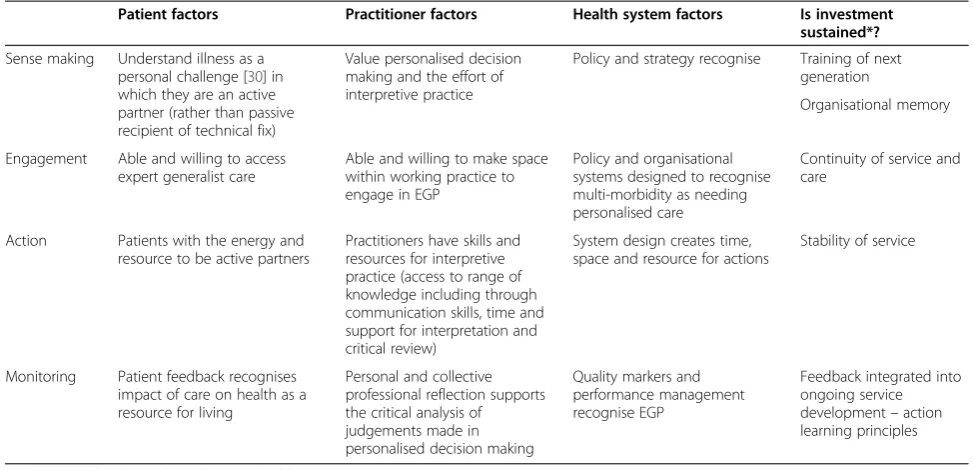
The table offers a whole-system consideration of what would be needed to support EGP for people with multi-morbidity (Table 1).
It is clear that we will need to draw on multiple sources of data including policy/strategy review, audit of care, and stakeholder interviews with patients and practitioners if we are to assess capacity for EGP in the management of multi-morbidity. We have published [32] and (as yet) un-published data from the UK which suggests enablers for expert generalist care include: patient and professional de-sire for personalised care for people with multi-morbidity (sense making), supported by strong interpersonal rela-tionships between patients and their health professionals (action). But constraints include a shortage of skills and confidence in interpretive practice along with a lack of time for a comprehensive personal assessment of need (engagement and action). Also a lack of feedback on why it matters (monitoring) supporting the ongoing effort needed to deliver personalised expert generalist care.
What is the impact of expert generalist care: evaluating generalism in action
A structured assessment of capacity for expert generalist practice allows us to identify what is needed to strengthen the consistent delivery of quality generalist care to people with multi-morbidity. By intervening to address those needs and evaluating the impact of the changes, we start to generate practice-based evidence of EGP. This is the process of action research.
Action research
Action research is a process whereby people work to-gether, and learn toto-gether, whilst tackling a real problem. People acquire new knowledge through actual practice, underpinned by critical reflection on the process and outcomes of practice [35]. Action learning makes explicit the tacit knowledge of practice [35]. It is a dynamic model by which practice evolves based on critical reflec-tion and continual learning. It thus offers an approach whereby we can develop evidence out of everyday prac-tice–practice-based evidence [25].
Drawing on these principles of action research, we present the Generalism in Action (GIA) framework as a change model to describe, deliver and evaluate expert generalist practice. The framework focuses on develop-ing and evaluatdevelop-ing generalist solutions to health care problems within a given context. It supports the user in asking‘(how) can an expert generalist approach enhance person-centred primary care within the context of par-ticular area or problem?’It can therefore be used to crit-ically enhance and evaluate EGP for the care of people with multi-morbidity (Figure 2).
To use the GIA framework, we start with a description of the problem. In this case, we are considering the care of people with multi-morbidity. Next we assess capacity for expert generalist encounters, systematically identify-ing areas of potential need for change. We can then pilot
Reeveet al. BMC Family Practice2013,14:112 Page 4 of 8
changes: implementing and evaluating the impact of change using action learning principles. We make the tacit knowledge [22] used by generalist practitioners to guide person-centred decision making transparent, and thus open to critical review. We generate evidence of if and when expert generalist care makes a difference. We therefore build an evidence-base of practice, practice-based evidence [25], supporting future practice and pol-icy development through describing if and when gener-alist care‘matters’.
An example of developing action research for multi-morbidity
[image:6.595.54.541.100.335.2]Reeve & Bancroft describe an early example of the appli-cation of the GIA idea in the form of a service develop-ment project in a UK practice [32,36]. The Practice team identified a problem: a spiralling burden of workload for patients and practitioners in dealing with the needs of housebound patients with multi-morbidity. The team felt that patients were not accessing expert generalist care, largely because systems of care were organised around the technical delivery of specialist-defined proto-cols of care. Changes were made to offer protected time for expert generalist care of a sample of patients identi-fied as being at greatest risk. Evaluation of impact re-vealed that the new care model resulted in changes to care planning for around two thirds of patients. How-ever care for the remaining third was no different to that delivered by standard protocol-based chronic disease management. Findings from this initial practice based study have informed stakeholder discussions leading to development of a formal research proposal to critically
Table 1 Assessing capacity for expert generalist practice in the management of multi-morbidity
Patient factors Practitioner factors Health system factors Is investment
sustained*?
Sense making Understand illness as a personal challenge [30] in which they are an active partner (rather than passive recipient of technical fix)
Value personalised decision making and the effort of interpretive practice
Policy and strategy recognise Training of next generation
Organisational memory
Engagement Able and willing to access expert generalist care
Able and willing to make space within working practice to engage in EGP
Policy and organisational systems designed to recognise multi-morbidity as needing personalised care
Continuity of service and care
Action Patients with the energy and resource to be active partners
Practitioners have skills and resources for interpretive practice (access to range of knowledge including through communication skills, time and support for interpretation and critical review)
System design creates time, space and resource for actions
Stability of service
Monitoring Patient feedback recognises impact of care on health as a resource for living
Personal and collective professional reflection supports the critical analysis of judgements made in personalised decision making
Quality markers and performance management recognise EGP
Feedback integrated into ongoing service development–action learning principles
* robust enough to last within a changing healthcare context.
•
•
[image:6.595.304.539.352.717.2]develop and evaluate the learning–to develop practice-based evidence of the impact of changes to care.
The Complex Needs Project at Vauxhall Primary Health Centre
Delivering EGP.The Complex Needs project at Vauxhall Primary Health Centre (VPHC).
VPHC is a medium sized General Practice in a deprived area of Liverpool. The team were concerned that house-bound patients with complex illness (multimorbidity) had limited exposure to expert generalist care. Patients re-ceived high quality chronic disease management care delivered at home visits by nursing staff with excellent consultation skills (as assessed by the performance frame-work that is QOF and patient surveys). However, GP care was predominantly reactive in the face of acute illness.
The clinical team asked, what would be the impact of changing from usual protocol-defined chronic disease management care to expert generalist care for house-bound patients with multimorbidity?
They established a register of housebound patients with more than 2 long term conditions and on 5 or more medicines a day. Changes to care involved introdu-cing dedicated time for a GP home visit. GPs with ex-pertise in generalist practice undertook an assessment of the impact of health, illness, and healthcare on individ-ual daily living. Visits took about an hour; and were repeated as many times as needed for health needs to stabilise (where continued visiting made no further changes to care). The most common changes to care were to reduce the burden of health care: reduced pre-scribing, surveillance, exempting the patient from protocol defined care pathways.
Review of care articulated a number of core compo-nents in the delivery of generalist expertise:
– Justification of medicalisation of health and illness experience for this individual at this time. (Ashift from a specialist view of health need asking, does this patient meet the diagnostic criteria for a given disease, and if so is it appropriate (safe) to treat? The onus is on justifying exempting an individual from disease-defined care. To an expert generalist
approach: asking (how) does a disease-model help us understand and address the health and illness needs of this individual and at this time? The onus is on justifying a decision to instigate medical intervention for an illness problem[32])
– A principle of Minimally Disruptive Medicine [37]: minimising the burden of health care, as well as illness, on daily living
– Continuity of episode to support interpretive practice: having the same named practitioner responsible for the interpretive care of an individual
for at least the current episode of care (until care needs had stabilised). Including the use of good clinical notekeeping/summaries to support continuity.
The team recognised the need for further work in other settings to refine these identified core components
Summary
In western communities, health needs increasingly re-flect the rise in prevalence of chronic complex illness. We need to adapt health systems to meet this need; through providing a balance of generalist and specialist care [1,16]. We have an increasingly detailed understand-ing of the pathology of the common chronic diseases fa-cing our communities, and so of ways to intervene in the pathological process. Guidelines for care derived from‘ ro-bust synthesis of clinical and economic evidence’support optimisation of disease-focused care [24]. However, we lack an equivalent framework supporting generalist care. We lack practice-based evidence to demonstrate the utility and trustworthiness of generalist care alongside the better described specialist approach. We have discussed an ex-ample of improving care for people with multi-morbidity, but suggest that the approach may be of utility for a range of ‘complex problems’and areas of diagnostic uncertainty for example, medically unexplained symptoms.
We have outlined an approach to address this practice-evidence gap based on action research principles. Action research for quality improvement is not a new concept in health care [35]; but evidence for practice is still tradition-ally dominated by experimental designs. Yet a number of sources are challenging a ‘drainpipe’ model of knowledge translation, which sees research evidence as a way to in-form practitioners and policy makers what they‘should’be doing [25,38,39]. There has been a call for more critical examination of practice, based on the principles of partici-patory research and action learning, in order to support the translation of practice into an evidence base which contributes to the critical development, delivery and evalu-ation of quality care [25]. This is particularly appropriate when the expertise lies within the clinical community.
If this approach is to be successful, we need also to recognise and address the barriers to undertaking this sort of research - including issues related to funding, career progression for action researchers and support for dissemination. Critical implementation and evaluation of the GIA framework may also provide us with evidence of the value and limitations of action research for im-proving health care.
We thus describe a new framework to support the generation of practice-based evidence of the impact of individually tailored generalist care. We have evidence supporting the development of the component parts,
Reeveet al. BMC Family Practice2013,14:112 Page 6 of 8
but now seek to evaluate whether the framework can support change towards more person-centred care. Test-ing the framework is one goal for a new Special Interest Group (SIG) within NAPRCG (the North American Pri-mary Care Research Group). The Generalism SIG was formed in 2011 to support the critical development, de-livery and evaluation of generalist care within a modern managed health care context. It is an international col-laboration with representatives from North America, Australia and Europe. Developing and implementing the GIA is one area of our work. We welcome com-ments, feedback and expressions of interest in joining us in this work.
Endnote a
We refer to ‘condition’ rather than ‘disease’ defined care since: health policy refers predominantly to long term conditions, rather than diseases; dealing with the management of a ‘condition’ that ‘warrants attention’ – for example hypertension–rather than a disease per se.
Abbreviations
EGP:Expert Generalist Practice–the practice of generalist expertise; NPT: Normalisation Process Theory; GIA: Generalism in Action; NAPCRG: North American Primary Care Research Group.
Competing interests
The authors declare that they have no competing interests.
Authors’contributions
This paper arises from discussions at the inaugural NAPCRG Generalism Special Interest Group meeting held in Banff in 2011. JR conceived the paper and led the writing of the manuscript. TB, GF, LG, PJ, JM, CM, JS & CvW contributed substantially to the intellectual content of the paper through providing critical commentary, interpretation and revisions. All authors read and approved the final manuscript.
Authors’information
All are members of the NAPRCG Generalism Special Interest Group. JR holds a National Institute of Health Research Clinician Scientist Award supporting a body of work on Generalist Solutions for Complex Problems. GF was a member of the Royal College of General Practitioners (UK) Commission on Generalism.
Acknowledgements
The authors would like to thank the three peer reviewers for helpful comments contributing to the final manuscript
Author details
1
University of Liverpool, B122 Waterhouse Buildings, 1-5 Brownlow St, Liverpool L693GL, UK.2University of Manchester, Williamson Building, Oxford
Road, Manchester M13 9PL, UK.3Imperial College London, 25 St James Close, Pangbourne Reading RG8 7AP, UK.4University of Colorado, Denver, USA. 5
University of Iowa, 200 Hawkins Drive, Des Moines, Iowa, USA.6Nijmegen Medical Centre, Radboud University, Po Box 9010, Nijmegen, The Netherlands.7Trinity College Dublin, Rathbourne Road, Dublin 15, Ireland.
8The Newcastle University, University Drive, Callaghan, NSW 2308, Australia. 9
Radboud University Nijmegen Medical Centre, The Netherlands; Australian Primary Health Care Research Institute, Australian National University, Po Box 9010, Nijmegen, Canberra, Australia.
Received: 6 January 2013 Accepted: 2 August 2013 Published: 7 August 2013
References
1. Stange K:The generalist approach.Ann Fam Med2009,7:198–203. 2. Royal College of General Practitioners:Medical Generalism. Why expertise in
whole person medicine matters.London: College of General Practitioners; 2012. 3. Glanville J, Kendrick T, McNally R, Campbell J, Hobbs R:Research output
on primary care in Australia, Canada, Germany, the Netherlands, the United Kingdom, and the United States: bibliometric analysis.BMJ2011, 342:d1028.
4. Royal College of Physicians and Surgeons of Canada:Generalism: achieving a balance with specialization.www.royalcollege.ca/portal/page/portal/rc/ common/documents/educational_initiatives/generalism.pdf. 5. Committee of Quality in Health Care in America, Institute of Medicine:
Crossing the quality chasm: a new health system for the twenty first century. Washington DC: National Academies Press; 2001.
6. Kings fund:Long Term Conditions and multimorbidity; 2012. http://www. kingsfund.org.uk/time-to-think-differently/trends/disease-and-disability/long-term-conditions-multi-morbidity.
7. Department of Health:Long Term Conditions: 3rd edition; 2012. https:// www.gov.uk/government/publications/long-term-conditions-compendium-of-information-third-edition.
8. Boyd CM, Darer J, Boult C, Fried LP, Boult L, Wu AW:Clinical practice guidelines and quality of care for older patients with multiple comorbid diseases: implications for pay for performance.JAMA2005,294:716–724. 9. Van Weel C, Schellevis FG:Comorbidity and guidelines: conflicting
interests.The Lancet2006,367:550–551.
10. Barnett K, Mercer SW, Norbury M, Watt G, Wyke S, Guthrie B: Epidemiology of multi-morbidity and implications for health care, research and medical education: a cross-sectional study.The Lancet 2012,380:37-43.
11. Mercer S:Multimorbidity and the inverse care law in primary care. BMJ2012,344:e4152.
12. Tinetti ME, Fried T:The end of the disease era.Am J Med2004,116:179–185. 13. Ouwens M:Integrated care programmes for chronically ill patients.Int J
Qual Health Care2005,17:141–146.
14. Lewis R, Rosen R, Dixon J:Where next for integrated care organisations in the English NHS.London: Nuffield Trust; 2010. http://www.nuffieldtrust.org.uk/ publications/where-next-integrated-care-organisations-english-nhs. 15. Fulop N:Integrated care: what can the evidence tell us.http://www.
nuffieldtrust.org.uk/talks/slideshows/naomi-fulop-integrated-care-what-can-evidence-tell-us.
16. World Health Organization:Primary Care. Now more than ever.Geneva: WHO; 2008. http://www.who.int/whr/2008/whr08_en.pdf.
17. Tinetti ME, Fried TR, Boyd CM:Designing health care for the most common chronic condition–multimorbidity.JAMA2012,307:2493–94. 18. NHS Future Forum:Summary report.https://www.gov.uk/government/
uploads/system/uploads/attachment_data/file/213748/dh_127540.pdf. 19. Sturmberg JP, O’Halloran DM, Martin CM:Healthcare reform: the need for
a complex adaptive systems approach.InHandbook of Systems and Complexity in Health.Edited by Sturmberg P, Martin CM. New York: Springer; 2013:827–853.
20. Gunn J, Naccarella L, Palmer V, Kokanovic R, Pope C, Lathlean J:What is the place of generalism in the 2020 primary care team?.Melbourne: Australian Primary Health Care Institute; 2007. http://aphcri.anu.edu.au/content/stream-six-workforce/what-place-generalism-2020-primary-care-team.
21. Roland M, Paddison C:Better management of patients with multimorbidity.BMJ2013. doi:10.1136/bmj.f2510.
22. Hilton S:Education and the changing face of medical generalism: from priest to mountain guide.Br J Gen Prac2008,58:252–261.
23. Reeve J, Irving G, Dowrick C:Can generalism help revive the primary healthcare vision?J R Soc Med2011,104:395–400.
24. Guthrie B, Payne K, Alderson P, McMurdo MET, Mercer SW:Adapting clinical guidelines to take account of multimorbidity.BMJ2012, 345:e6341.
25. Green LW:Making research relevant: if it is an evidence-based practice, where’s the practice-based evidence?Fam Pract2008,25:i20–i24. 26. McPherson H, Schroer S:Acupuncture as a complex intervention for
depression: a consensus method to develop a standardised treatment protocol for a randomised controlled trial.Complement Ther Med2007, 15:92–100.
28. Medical Research Council:Complex Interventions guidance.London: Medical Research Council; 2008. http://www.mrc.ac.uk/Utilities/Documentrecord/ index.htm?d=MRC004871.
29. McWhinney IR, Freeman T:Textbook of Family Medicine.Oxford: Oxford University Press; 2009.
30. Reeve J, Lynch T, Lloyd-Williams M, Payne S:From personal challenge to technical fix: the risks of depersonalised care.Health Soc Care Community 2012,20:145–154.
31. Reeve J:Interpretive Medicine: supporting generalism in a changing primary care world, Occasional Paper Series 88. London: Royal College of General Practitioners; 2010.
32. Reeve J, Bancroft R:Generalist solutions to overprescribing: a joint challenge for clinical and academic primary care.Prim Health Care Res Dev2013. FirstView article: http://dx.doi.org/10.1017/S1463423612000576. 33. May C, Murray E, Finch T, Mair F, Treweek S, Ballini L, Macfarlane A, Rapley T:
Normalisation Process Theory on-line users manual and toolkit; 2010. http:// www.normalizationprocess.org.
34. Blakeman T, Protheroe J, Chew-Graham C, Rogers A, Kennedy A: Understanding the management of early stage kidney disease in primary care: a qualitative study.Br J Gen Pract2012,62:233–242. 35. Edmonstone J:Action learning in health care–a practical handbook.
London: Radcliffe; 2011.
36. NHS Improvement:Managing multimorbidity in practice; 2013. http://www. improvement.nhs.uk/documents/COPD_MultiMorbidities.pdf.
37. May C, Montori VM, Mair FS:We need minimally disruptive medicine. BMJ2009,339:b2803.
38. Gabbay J, Le May A:Practice-based evidence for health care. Clinical Mindlines.Oxon: Routledge; 2010.
39. Montgomery K:How doctors think. Clinical judgement and the practice of medicine.New York: Oxford University Press; 2006.
doi:10.1186/1471-2296-14-112
Cite this article as:Reeveet al.:Generalist solutions to complex problems: generating practice-based evidence - the example of managing multi-morbidity.BMC Family Practice201314:112.
Submit your next manuscript to BioMed Central and take full advantage of:
• Convenient online submission
• Thorough peer review
• No space constraints or color figure charges
• Immediate publication on acceptance
• Inclusion in PubMed, CAS, Scopus and Google Scholar
• Research which is freely available for redistribution
Submit your manuscript at www.biomedcentral.com/submit
Reeveet al. BMC Family Practice2013,14:112 Page 8 of 8
![Figure 1 Defining expert generalist practice [26,27].](https://thumb-us.123doks.com/thumbv2/123dok_us/9588093.462471/4.595.61.539.89.243/figure-defining-expert-generalist-practice.webp)