Semantic Frame Identification with Distributed Word Representations
Karl Moritz Hermann‡∗ Dipanjan Das† Jason Weston† Kuzman Ganchev† ‡Department of Computer Science, University of Oxford, Oxford OX1 3QD, United Kingdom
†Google Inc., 76 9th Avenue, New York, NY 10011, United States
{dipanjand,kuzman}@google.com [email protected]
Abstract
We present a novel technique for semantic frame identification using distributed rep-resentations of predicates and their syntac-tic context; this technique leverages auto-matic syntactic parses and a generic set of word embeddings. Given labeled data annotated with frame-semantic parses, we learn a model that projects the set of word representations for the syntactic context around a predicate to a low dimensional representation. The latter is used for se-mantic frame identification; with a stan-dard argument identification method in-spired by prior work, we achieve state-of-the-art results on FrameNet-style frame-semantic analysis. Additionally, we report strong results on PropBank-style semantic role labeling in comparison to prior work.
1 Introduction
Distributed representations of words have proved useful for a number of tasks. By providing richer representations of meaning than what can be en-compassed in a discrete representation, such ap-proaches have successfully been applied to tasks such as sentiment analysis (Socher et al., 2011), topic classification (Klementiev et al., 2012) or word-word similarity (Mitchell and Lapata, 2008). We present a new technique for semanticframe identification that leverages distributed word rep-resentations. According to the theory of frame se-mantics (Fillmore, 1982), a semantic frame rep-resents an event or scenario, and possesses frame elements (or semanticroles) that participate in the
∗
The majority of this research was carried out during an internship at Google.
event. Most work on frame-semantic parsing has usually divided the task into two major subtasks: frame identification, namely the disambiguation of a given predicate to a frame, andargument iden-tification(or semantic role labeling), the analysis of words and phrases in the sentential context that satisfy the frame’s semantic roles (Das et al., 2010; Das et al., 2014).1 Here, we focus on the first sub-task of frame identification for given predicates; we use our novel method (§3) in conjunction with a standard argument identification model (§4) to perform full frame-semantic parsing.
We present experiments on two tasks. First, we show that for frame identification on the FrameNet corpus (Baker et al., 1998; Fillmore et al., 2003), we outperform the prior state of the art (Das et al., 2014). Moreover, for full frame-semantic parsing, with the presented frame identification technique followed by our argument identification method, we report the best results on this task to date. Sec-ond, we present results on PropBank-style seman-tic role labeling (Palmer et al., 2005; Meyers et al., 2004; M`arquez et al., 2008), that approach strong baselines, and are on par with prior state of the art (Punyakanok et al., 2008).
2 Overview
Early work in frame-semantic analysis was pio-neered by Gildea and Jurafsky (2002). Subsequent work in this area focused on either the FrameNet or PropBank frameworks, and research on the lat-ter has been more popular. Since the CoNLL 2004-2005 shared tasks (Carreras and M`arquez,
1
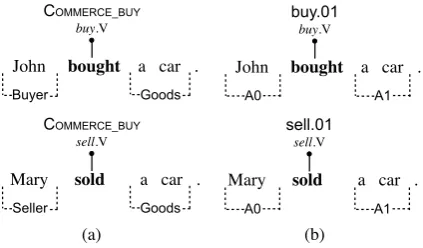
John bought a car .
COMMERCE_BUY buy.V
Buyer Goods
John bought a car .
buy.01
buy.V
A0 A1
Mary sold a car .
COMMERCE_BUY sell.V
Seller Goods
Mary sold a car .
sell.01
sell.V
A0 A1
[image:2.595.76.288.67.191.2](a) (b)
Figure 1: Example sentences with frame-semantic analyses. FrameNet annotation conventions are used in (a) while (b) denotes PropBank conventions.
2004; Carreras and M`arquez, 2005) on PropBank semantic role labeling (SRL), it has been treated as an important NLP problem. However, research has mostly focused on argument analysis, skipping the frame disambiguation step, and its interaction with argument identification.
2.1 Frame-Semantic Parsing
Closely related to SRL, frame-semantic parsing consists of the resolution of predicate sense into a frame, and the analysis of the frame’s argu-ments. Work in this area exclusively uses the FrameNet full text annotations. Johansson and Nugues (2007) presented the best performing sys-tem at SemEval 2007 (Baker et al., 2007), and Das et al. (2010) improved performance, and later set the current state of the art on this task (Das et al., 2014). We briefly discuss FrameNet, and subse-quently PropBank annotation conventions here.
FrameNet The FrameNet project (Baker et al., 1998) is a lexical database that contains informa-tion about words and phrases (represented as lem-mas conjoined with a coarse part-of-speech tag) termed as lexical units, with a set of semantic frames that they could evoke. For each frame, there is a list of associated frame elements (or roles, henceforth), that are also distinguished as core or non-core.2 Sentences are annotated us-ing this universal frame inventory. For exam-ple, consider the pair of sentences in Figure 1(a).
COMMERCE BUY is a frame that can be evoked by
morphological variants of the two example lexical unitsbuy.V andsell.V.Buyer,SellerandGoodsare some example roles for this frame.
2Additional information such as finer distinction of the
coreness properties of roles, the relationship between frames, and that of roles are also present, but we do not leverage that information in this work.
PropBank The PropBank project (Palmer et al., 2005) is another popular resource related to se-mantic role labeling. The PropBank corpus has verbs annotated with sense frames and their ar-guments. Like FrameNet, it also has a lexi-cal database that stores type information about verbs, in the form of sense frames and the possi-ble semantic roles each frame could take. There are modifier roles that are shared across verb frames, somewhat similar to the non-core roles in FrameNet. Figure 1(b) shows annotations for two verbs “bought” and “sold”, with their lemmas (akin to the lexical units in FrameNet) and their verb framesbuy.01 andsell.01. Generic core role labels (of which there are seven, namelyA0-A5and
AA) for the verb frames are marked in the figure.3 A key difference between the two annotation sys-tems is that PropBank uses a local frame inven-tory, where frames are predicate-specific. More-over, role labels, although few in number, take spe-cific meaning for each verb frame. Figure 1 high-lights this difference: while bothsell.V andbuy.V
are members of the same frame in FrameNet, they evoke different frames in PropBank. In spite of this difference, nearly identical statistical models could be employed for both frameworks.
Modeling In this paper, we model the frame-semantic parsing problem in two stages: frame identification and argument identification. As mentioned in§1, these correspond to a frame dis-ambiguation stage,4and a stage that finds the var-ious arguments that fulfill the frame’s semantic roles within the sentence, respectively. This re-sembles the framework of Das et al. (2014), who solely focus on FrameNet corpora, unlike this pa-per. The novelty of this paper lies in the frame identification stage (§3). Note that this two-stage approach is unusual for the PropBank corpora when compared to prior work, where the vast ma-jority of published papers have not focused on the verb frame disambiguation problem at all, only fo-cusing on the role labeling stage (see the overview paper of M`arquez et al. (2008) for example).
3NomBank (Meyers et al., 2004) is a similar resource for
nominal predicates, but we do not consider it in our experi-ments.
4
2.2 Distributed Frame Identification
We present a model that takes word embeddings as input and learns to identify semantic frames. A word embedding is a distributed representa-tion of meaning where each word is represented as a vector in Rn. Such representations allow a
model to share meaning between similar words, and have been used to capture semantic, syntac-tic and morphological content (Collobert and We-ston, 2008; Turian et al., 2010,inter alia). We use word embeddings to represent the syntactic con-text of a particular predicate instance as a vector. For example, consider the sentence “He runs the company.” The predicate runs has two syntac-tic dependents – a subject and direct object (but no prepositional phrases or clausal complements). We could represent the syntactic context ofrunsas a vector with blocks for all the possible dependents warranted by a syntactic parser; for example, we could assume that positions 0. . . n in the vector correspond to the subject dependent, n+1. . .2n
correspond to the clausal complement dependent, and so forth. Thus, the context is a vector inRnk
with the embedding ofHeat the subject position, the embedding ofcompany in direct object posi-tion and zeros everywhere else. Given input vec-tors of this form for our training data, we learn a matrix that maps this high dimensional and sparse representation into a lower dimensional space. Si-multaneously, the model learns an embedding for all the possible labels (i.e. the frames in a given lexicon). At inference time, the predicate-context is mapped to the low dimensional space, and we choose the nearest frame label as our classifica-tion. We next describe this model in detail.
3 Frame Identification with Embeddings
We continue using the example sentence from
§2.2: “He runs the company.” where we want to disambiguate the frame ofruns in context. First, we extract the words in the syntactic context of runs; next, we concatenate their word embeddings as described in§2.2 to create an initial vector space representation. Subsequently, we learn a map-ping from this initial representation into a low-dimensional space; we also learn an embedding for each possible frame label in the same low-dimensional space. The goal of learning is to make sure that the correct frame label is as close as possible to the mapped context, while competing frame labels are farther away.
Formally, let x represent the actual sentence with a marked predicate, along with the associated syntactic parse tree; let our initial representation of the predicate context beg(x). Suppose that the word embeddings we start with are of dimension
n. Then g is a function from a parsed sentence
xtoRnk, wherekis the number of possible
syn-tactic context types. For exampleg selects some important positions relative to the predicate, and reserves a block in its output space for the embed-ding of words found at that position. Suppose g
considers clausal complements and direct objects. Theng :X → R2nand for the example sentence
it has zeros in positions0. . . nand the embedding of the wordcompanyin positionsn+1. . .2n.
g(x) = [0, . . . ,0,embedding ofcompany].
Section 3.1 describes the context positions we use in our experiments. Let the low dimensional space we map to beRmand the learned mapping beM : Rnk → Rm. The mapping M is a linear
trans-formation, and we learn it using theWSABIE
algo-rithm (Weston et al., 2011).WSABIEalso learns an
embedding for each frame label (y, henceforth). In our setting, this means that each frame corre-sponds to a point in Rm. If we have F
possi-ble frames we can store those parameters in an
F ×mmatrix, onem-dimensional point for each frame, which we will refer to as the linear map-pingY. Let the lexical unit (the lemma conjoined with a coarse POS tag) for the marked predicate be `. We denote the frames that associate with
` in the frame lexicon5 and our training corpus as F`. WSABIE performs gradient-based updates
on an objective that tries to minimize the distance betweenM(g(x))and the embedding of the cor-rect labelY(y), while maintaining a large distance between M(g(x)) and the other possible labels
Y(¯y) in the confusion setF`. At disambiguation
time, we use a simple dot product similarity as our distance metric, meaning that the model chooses a label by computing the argmaxys(x, y) where
s(x, y) =M(g(x))·Y(y), where the argmax iter-ates over the possible framesy ∈F`if`was seen
in the lexicon or the training data, ory ∈ F, if it was unseen.6 Model learning is performed using the margin ranking loss function as described in
5The frame lexicon stores the frames, corresponding
se-mantic roles and the lexical units associated with the frame. 6This disambiguation scheme is similar to the one adopted
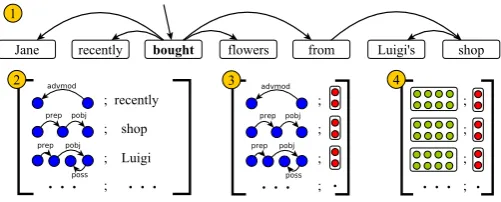
Figure 2: Context representation extraction for the embedding model. Given a dependency parse (1) the model extracts all words matching a set of paths from the frame evoking predicate and its direct de-pendents (2). The model computes a composed rep-resentation of the predicate instance by using dis-tributed vector representations for words (3) – the (red) vertical embedding vectors for each word are concatenated into a long vector. Finally, we learn a linear transformation function parametrized by the context blocks (4).
Weston et al. (2011), and in more detail in section 3.2.
SinceWSABIElearns a single mapping fromg(x)
to Rm, parameters are shared between different
words and different frames. So for example “He runs the company” could help the model disam-biguate “Heownsthe company.” Moreover, since
g(x)relies on word embeddings rather than word identities, information is shared between words. For example “He runs the company” could help us to learn about “Sherunsa corporation”.
3.1 Context Representation Extraction
In principleg(x)could be any feature function, but we performed an initial investigation of two partic-ular variants. In both variants, our representation is a block vector where each block corresponds to a syntactic position relative to the predicate, and each block’s values correspond to the embedding of the word at that position.
Direct Dependents The first context function we considered corresponds to the examples in§3. To elaborate, the positions of interest are the labels of the direct dependents of the predicate, sokis the number of labels that the dependency parser can produce. For example, if the label on the edge be-tweenrunsandHeisnsubj, we would put the em-bedding ofHein the block corresponding tonsubj. If a label occurs multiple times, then the embed-dings of the words below this label are averaged.
Unfortunately, using only the direct dependents can miss a lot of useful information. For exam-ple, topicalization can place discriminating infor-mation farther from the predicate. Consider “He runsthecompany.” vs. “It was thecompanythat he runs.” In the second sentence, the discrim-inating word, company dominates the predicate runs. Similarly, predicates in embedded clauses may have a distant agent which cannot be captured using direct dependents. Consider “The athlete ranthe marathon.” vs. “The athleteprepared him-self for three months torunthe marathon.” In the
second example, for the predicate run, the agent The athleteis not a direct dependent, but is con-nected via a longer dependency path.
Dependency Paths To capture more relevant context, we developed a second context function as follows. We scanned the training data for a given task (either the PropBank or the FrameNet domains) for the dependency paths that connected the gold predicates to the gold semantic argu-ments. This set of dependency paths were deemed as possible positions in the initial vector space rep-resentation. In addition, akin to the first context function, we also added all dependency labels to the context set. Thus for this context function, the block cardinalitykwas the sum of the number of scanned gold dependency path types and the num-ber of dependency labels. Given a predicate in its sentential context, we therefore extract only those context words that appear in positions warranted by the above set. See Figure 2 for an illustration of this process.
We performed initial experiments using con-text extracted from 1) direct dependents, 2) de-pendency paths, and 3) both. For all our experi-ments, setting 3) which concatenates the direct de-pendents and dependency path always dominated the other two, so we only report results for this setting.
3.2 Learning
We model our objective function following We-ston et al. (2011), using a weighted approximate-rank pairwise loss, learned with stochastic gradi-ent descgradi-ent. The mapping from g(x) to the low dimensional spaceRm is a linear transformation,
so the model parameters to be learnt are the matrix
M ∈ Rnk×m as well as the embedding of each
possible frame label, represented as another ma-trixY ∈RF×mwhere there areF frames in total.
The training objective function minimizes:
X
x
X
¯
y
L ranky(x)
where x, y are the training inputs and their cor-responding correct frames, and y¯ are negative frames, γ is the margin. Here, ranky(x) is the
rank of the positive frameyrelative to all the neg-ative frames:
ranky(x) =
X
¯
y
I(s(x, y)≤γ+s(x,y¯)),
and L(η) converts the rank to a weight. Choos-ingL(η) = Cηfor any positive constant C opti-mizes the mean rank, whereas a weighting such as
L(η) = Pη
i=11/i (adopted here) optimizes the
top of the ranked list, as described in (Usunier et al., 2009). To train with such an objective, stochastic gradient is employed. For speed the computation ofranky(x) is then replaced with a
sampled approximation: sample N items y¯until a violation is found, i.e. max(0, γ + s(x,y¯) − s(x, y)))>0and then approximate the rank with
(F −1)/N, see Weston et al. (2011) for more details on this procedure. For the choices of the stochastic gradient learning rate, margin (γ) and dimensionality (m), please refer to§5.4-§5.5.
Note that an alternative approach could learn only the matrixM, and then use ak-nearest neigh-bor classifier in Rm, as in Weinberger and Saul
(2009). The advantage of learning an embedding for the frame labels is that at inference time we need to consider only the set of labels for classi-fication rather than all training examples. Addi-tionally, since we use a frame lexicon that gives us the possible frames for a given predicate, we usually only consider a handful of candidate la-bels. If we used all training examples for a given predicate for finding a nearest-neighbor match at inference time, we would have to consider many more candidates, making the process very slow.
4 Argument Identification
Here, we briefly describe the argument identifi-cation model used in our frame-semantic parsing experiments, post frame identification. Given x, the sentence with a marked predicate, the argu-ment identification model assumes that the pred-icate frame y has been disambiguated. From a frame lexicon, we look up the set of semantic roles
Rythat associate withy. This set also contains the null roler∅. Fromx, a rule-based candidate argu-ment extraction algorithm extracts a set of spans
Athat could potentially serve as the overt7
argu-7By overtness, we mean the non-null instantiation of a
semantic role in a frame-semantic parse.
•starting word ofa •POS of the starting word ofa
•ending word ofa •POS of the ending word ofa
•head word ofa •POS of the head word ofa
•bag of words ina •bag of POS tags ina
•a bias feature •voice of the predicate use
•word cluster ofa’s head
•word cluster ofa’s head conjoined with word cluster of the predicate∗
•dependency path betweena’s head and the predicate
•the set of dependency labels of the predicate’s children
•dependency path conjoined with the POS tag ofa’s head
•dependency path conjoined with the word cluster of
a’s head
•position ofawith respect to the predicate (before, after, overlap or identical)
•whether the subject of the predicate is missing (miss-ingsubj)
•missingsubj, conjoined with the dependency path
[image:5.595.315.520.61.276.2]•missingsubj, conjoined with the dependency path from the verb dominating the predicate toa’s head
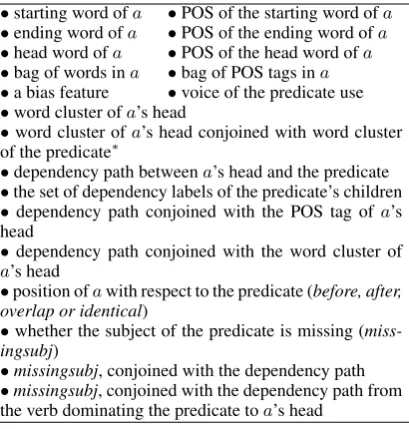
Table 1: Argument identification features. The span in con-sideration is termeda. Every feature in this list has two ver-sions, one conjoined with the given rolerand the other con-joined with bothrand the framey. The feature with a∗ su-perscript is only conjoined with the role to reduce its sparsity.
mentsAyfory(see§5.4-§5.5 for the details of the candidate argument extraction algorithms). Learning Given training data of the form
hhx(i), y(i),M(i)iiN
i=1, where,
M={(r, a}:r ∈ Ry, a∈ A ∪ Ay}, (1)
a set of tuples that associates each role r in Ry
with a spanaaccording to the gold data. Note that this mapping associates spans with the null roler∅ as well. We optimize the following log-likelihood to train our model:
max θ
N
X
i=1
|M(i)|
X
j=1
logpθ (r, a)j|x, y,Ry
−Ckθk2 2
wherepθis a log-linear model normalized over the
set Ry, with features described in Table 1. We
setC = 1.0 and use L-BFGS (Liu and Nocedal, 1989) for training.
5 Experiments
In this section, we present our experiments and the results achieved. We evaluate our novel frame identification approach in isolation and also con-joined with argument identification resulting in full frame-semantic structures; before presenting our model’s performance we first focus on the datasets, baselines and the experimental setup.
5.1 Data
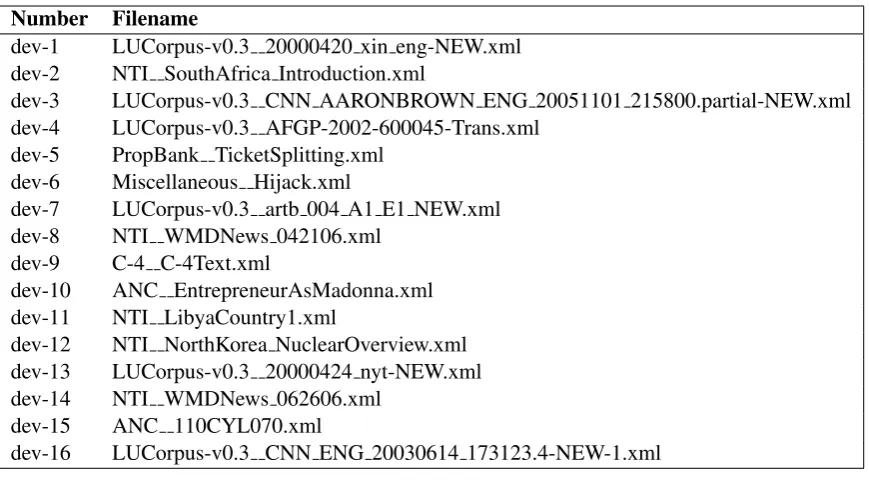
We evaluate our models on both FrameNet- and PropBank-style structures. For FrameNet, we use the full-text annotations in the FrameNet 1.5 re-lease8which was used by Das et al. (2014,§3.2). We used the same test set as Das et al. contain-ing 23 documents with 4,458 predicates. Of the remaining 55 documents, 16 documents were ran-domly chosen for development.9
For experiments with PropBank, we used the Ontonotes corpus (Hovy et al., 2006), version 4.0, and only made use of the Wall Street Journal doc-uments; we used sections 2-21 for training, sec-tion 24 for development and secsec-tion 23 for testing. This resembles the setup used by Punyakanok et al. (2008). All the verb frame files in Ontonotes were used for creating our frame lexicon.
5.2 Frame Identification Baselines
For comparison, we implemented a set of baseline models, with varying feature configurations. The baselines use a log-linear model that models the following probability at training time:
p(y|x, `) = e
ψ·f(y,x,`) P
¯
y∈F`e
ψ·f(¯y,x,`) (2)
At test time, this model chooses the best frame as argmaxyψ ·f(y, x, `)where argmax iterates over the possible frames y ∈ F` if ` was seen in the
lexicon or the training data, ory ∈F, if it was un-seen, like the disambiguation scheme of§3. We train this model by maximizing L2 regularized
log-likelihood, using L-BFGS; the regularization constant was set to 0.1 in all experiments.
For comparison with our model from§3, which we call WSABIEEMBEDDING, we implemented two
baselines with the log-linear model. Both the baselines use features very similar to the input rep-resentations described in§3.1. The first one com-putes the direct dependents and dependency paths
8
Seehttps://framenet.icsi.berkeley.edu. 9These documents are listed in appendix A.
as described in §3.1 but conjoins them with the word identity rather than a word embedding. Ad-ditionally, this model uses the un-conjoined words as backoff features. This would be a standard NLP approach for the frame identification problem, but is surprisingly competitive with the state of the art. We call this baselineLOG-LINEARWORDS. The
sec-ond baseline, tries to decouple theWSABIEtraining
from the embedding input, and trains a log linear model using the embeddings. So the second base-line has the same input representation as WSABIE
EMBEDDINGbut uses a log-linear model instead of
WSABIE. We call this model LOG-LINEAR EMBED
-DING.
5.3 Common Experimental Setup
We process our PropBank and FrameNet training, development and test corpora with a shift-reduce dependency parser that uses the Stanford conven-tions (de Marneffe and Manning, 2013) and uses an arc-eager transition system with beam size of 8; the parser and its features are described by Zhang and Nivre (2011). Before parsing the data, it is tagged with a POS tagger trained with a condi-tional random field (Lafferty et al., 2001) with the following emission features: word, the word clus-ter, word suffixes of length 1, 2 and 3, capitaliza-tion, whether it has a hyphen, digit and punctua-tion. Beyond the bias transition feature, we have two cluster features for the left and right words in the transition. We use Brown clusters learned us-ing the algorithm of Uszkoreit and Brants (2008) on a large English newswire corpus for cluster fea-tures. We use the same word clusters for the argu-ment identification features in Table 1.
We learn the initial embedding representations for our frame identification model (§3) using a deep neural language model similar to the one pro-posed by Bengio et al. (2003). We use 3 hidden layers each with 1024 neurons and learn a 128-dimensional embedding from a large corpus con-taining over 100 billion tokens. In order to speed up learning, we use an unnormalized output layer and a hinge-loss objective. The objective tries to ensure that the correct word scores higher than a random incorrect word, and we train with mini-batch stochastic gradient descent.
5.4 Experimental Setup for FrameNet
Hyperparameters For our frame identification model with embeddings, we search for the WSA
SEMAFORLEXICON FULLLEXICON
Development Data
Model All Ambiguous Rare All Ambiguous Rare
LOG-LINEARWORDS 89.21 72.33 88.22 89.28 72.33 88.37 LOG-LINEAREMBEDDING 88.66 72.41 87.53 88.74 72.41 87.68 WSABIEEMBEDDING(§3) 90.78 76.43 90.18 90.90 76.83 90.18
SEMAFORLEXICON FULLLEXICON
Model All Ambiguous Rare Unseen All Ambiguous Rare
Test Data
Das et al. supervised 82.97 69.27 80.97 23.08
Das et al. best 83.60 69.19 82.31 42.67
[image:7.595.78.520.64.184.2]LOG-LINEARWORDS 84.53 70.55 81.65 27.27 87.33 70.55 87.19 LOG-LINEAREMBEDDING 83.94 70.26 81.03 27.97 86.74 70.26 86.56 WSABIEEMBEDDING(§3) 86.49 73.39 85.22 46.15 88.41 73.10 88.93
Table 2: Frame identification results for FrameNet. See§5.6.
SEMAFORLEXICON FULLLEXICON
Model Precision Recall F1 Precision Recall F1
Development Data
LOG-LINEARWORDS 76.97 63.37 69.51 77.02 63.55 69.64 WSABIEEMBEDDING(§3) 78.33 64.51 70.75 78.33 64.53 70.76
Test Data
Das et al. supervised 67.81 60.68 64.05
Das et al. best 68.33 61.14 64.54
LOG-LINEARWORDS 71.21 63.37 67.06 73.31 65.20 69.01 WSABIEEMBEDDING(§3) 73.00 64.87 68.69 74.29 66.02 69.91
Table 3: Full structure prediction results for FrameNet; this reports frame and argument identification performance jointly. We skip LOG-LINEAREMBEDDINGbecause it underperforms all other models by a large margin.
We search for the stochastic gradient learning rate in {0.0001,0.001,0.01}, the margin γ ∈ {0.001,0.01,0.1,1}and the dimensionality of the final vector space m ∈ {256,512}, to maximize the frame identification accuracy of ambiguous lexical units; by ambiguous, we imply lexical units that appear in the training data or the lexicon with more than one semantic frame. The underlined values are the chosen hyperparameters used to an-alyze the test data.
Argument Candidates The candidate argument extraction method used for the FrameNet data, (as mentioned in§4) was adapted from the algorithm of Xue and Palmer (2004) applied to dependency trees. Since the original algorithm was designed for verbs, we added a few extra rules to handle non-verbal predicates: we added 1) the predicate itself as a candidate argument, 2) the span ranging from the sentence position to the right of the pred-icate to the rightmost index of the subtree headed by the predicate’s head; this helped capture cases like “afewmonths” (wherefewis the predicate and months is the argument), and 3) the span ranging from the leftmost index of the subtree headed by the predicate’s head to the position immediately before the predicate, for cases like “your gift to Goodwill” (wheretois the predicate and your gift is the argument).10
10Note that Das et al. (2014) describe the state of the art
in FrameNet-based analysis, but their argument identifica-tion strategy considered all possible dependency subtrees in
Frame Lexicon In our experimental setup, we scanned the XML files in the “frames” directory of the FrameNet 1.5 release, which lists all the frames, the corresponding roles and the associ-ated lexical units, and creassoci-ated a frame lexicon to be used in our frame and argument identification models. We noted that this renders every lexical unit asseen; in other words, at frame disambigua-tion time on our test set, for all instances, we only had to score the frames inF` for a predicate with
lexical unit`(see§3 and§5.2). We call this setup
FULL LEXICON. While comparing with prior state
of the art on the same corpus, we noted that Das et al. (2014) found several unseen predicates at test time.11 For fair comparison, we took the lexical units for the predicates that Das et al. considered as seen, and constructed a lexicon with only those; training instances, if any, for the unseen predicates under Das et al.’s setup were thrown out as well. We call this setup SEMAFOR LEXICON.12 We also
experimented on the set of unseen instances used by Das et al.
ILP constraints For FrameNet, we used three ILP constraints during argument identification (§4). 1) each span could have only one role, 2) each core role could be present only once, and 3) all overt arguments had to be non-overlapping.
a parse, resulting in a much larger search space. 11
Instead of using the frame files, Das et al. built a frame lexicon from FrameNet’s exemplars and the training corpus.
[image:7.595.87.513.217.297.2]Model All Ambiguous Rare LOG-LINEARWORDS 94.21 90.54 93.33 LOG-LINEAREMBEDDING 93.81 89.86 93.73 WSABIEEMBEDDING(§3) 94.79 91.52 92.55
Dev data↑ ↓Test data
Model All Ambiguous Rare
[image:8.595.72.527.61.160.2]LOG-LINEARWORDS 94.74 92.07 91.32 LOG-LINEAREMBEDDING 94.04 90.95 90.97 WSABIEEMBEDDING(§3) 94.56 91.82 90.62
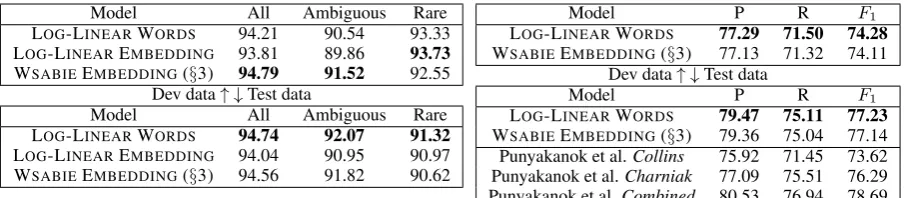
Table 4: Frame identification accuracy results for PropBank. The model and the column names have the same semantics as Table 2.
Model P R F1
LOG-LINEARWORDS 80.02 75.58 77.74 WSABIEEMBEDDING(§3) 80.06 75.74 77.84
Dev data↑ ↓Test data
Model P R F1
LOG-LINEARWORDS 81.55 77.83 79.65 WSABIEEMBEDDING(§3) 81.32 77.97 79.61
Table 5: Full frame-structure prediction results for Propbank. This is a metric that takes into account frames and arguments together. See§5.7 for more details.
5.5 Experimental Setup for PropBank
Hyperparameters As in§5.4, we made a hyper-parameter sweep in the same space. The chosen learning rate was0.01, while the other values were
γ = 0.01andm = 512. Ambiguous lexical units were used for this selection process.
Argument Candidates For PropBank we use the algorithm of Xue and Palmer (2004) applied to dependency trees.
Frame Lexicon For the PropBank experiments we scanned the frame files for propositions in Ontonotes 4.0, and stored possible core roles for each verb frame. The lexical units were simply the verb associating with the verb frames. There were no unseen verbs at test time.
ILP constraints We used the constraints of Pun-yakanok et al. (2008).
5.6 FrameNet Results
Table 2 presents accuracy results on frame iden-tification.13 We present results on all predicates, ambiguous predicates seen in the lexicon or the training data, and rare ambiguous predicates that appear≤ 11times in the training data. The WS
-ABIE EMBEDDING model from §3 performs
signif-icantly better than the LOG-LINEAR WORDS
base-line, whileLOG-LINEAREMBEDDINGunderperforms
in every metric. For the SEMAFORLEXICON setup,
we also compare with the state of the art from Das
13We do not report partial frame accuracy that has been
reported by prior work.
Model P R F1
LOG-LINEARWORDS 77.29 71.50 74.28 WSABIEEMBEDDING(§3) 77.13 71.32 74.11
Dev data↑ ↓Test data
Model P R F1
[image:8.595.74.289.205.278.2]LOG-LINEARWORDS 79.47 75.11 77.23 WSABIEEMBEDDING(§3) 79.36 75.04 77.14 Punyakanok et al.Collins 75.92 71.45 73.62 Punyakanok et al.Charniak 77.09 75.51 76.29 Punyakanok et al.Combined 80.53 76.94 78.69
Table 6: Argument only evaluation (semantic role labeling metrics) using the CoNLL 2005 shared task evaluation script (Carreras and M`arquez, 2005). Results from Punyakanok et al. (2008) are taken from Table 11 of that paper.
et al. (2014), who used a semi-supervised learn-ing method to improve upon a supervised latent-variable log-linear model. For unseen predicates from the Das et al. system, we perform better as well. Finally, for theFULLLEXICONsetting, the
ab-solute accuracy numbers are even better for our best model. Table 3 presents results on the full frame-semantic parsing task (measured by a reim-plementation of the SemEval 2007 shared task evaluation script) when our argument identifica-tion model (§4) is used after frame identification. We notice similar trends as in Table 2, and our sults outperform the previously published best re-sults, setting a new state of the art.
5.7 PropBank Results
Table 4 shows frame identification results on the PropBank data. On the development set, our best model performs with the highest accuracy on all and ambiguous predicates, but performs worse on rare ambiguous predicates. On the test set, the
LOG-LINEAR WORDS baseline performs best by a
very narrow margin. See§6 for a discussion. Table 5 presents results where we measure pre-cision, recall andF1for frames and arguments
to-gether; this strict metric penalizes arguments for mismatched frames, like in Table 3. We see the same trend as in Table 4. Finally, Table 6 presents SRL results that measures argument performance only, irrespective of the frame; we use the eval-uation script from CoNLL 2005 (Carreras and M`arquez, 2005). We note that with a better frame identification model, our performance on SRL im-proves in general. Here, too, the embedding model barely misses the performance of the best baseline, but we are at par and sometimes better than the sin-gle parser setting of a state-of-the-art SRL system (Punyakanok et al., 2008).14
6 Discussion
For FrameNet, the WSABIE EMBEDDING model we
propose strongly outperforms the baselines on all metrics, and sets a new state of the art. We be-lieve that theWSABIEEMBEDDINGmodel performs
better than the LOG-LINEAR EMBEDDING baseline
(that uses the same input representation) because the former setting allows examples with differ-ent labels and confusion sets to share informa-tion; this is due to the fact that all labels live in the same label space, and a single projection ma-trix is shared across the examples to map the input features to this space. Consequently, the WSABIE
EMBEDDINGmodel can share more information
be-tween different examples in the training data than theLOG-LINEAREMBEDDINGmodel. Since theLOG -LINEARWORDSmodel always performs better than
the LOG-LINEAR EMBEDDING model, we conclude
that the primary benefit does not come from the input embedding representation.15
On the PropBank data, we see that the LOG -LINEARWORDSbaseline has roughly the same
per-formance as our model on most metrics: slightly better on the test data and slightly worse on the development data. This can be partially explained with the significantly larger training set size for PropBank, making features based on words more useful. Another important distinction between PropBank and FrameNet is that the latter shares frames between multiple lexical units. The ef-fect of this is clearly observable from the “Rare” column in Table 4. WSABIE EMBEDDINGperforms
poorly in this setting whileLOG-LINEAREMBEDDING
performs well. Part of the explanation has to do with the specifics ofWSABIE training. Recall that
the WSABIE EMBEDDING model needs to estimate
the label location inRm for each frame. In other
words, it must estimate 512 parameters based on at most 10 training examples. However, since the input representation is shared across all frames, every other training example from all the lexical units affects the optimal estimate, since they all modify the joint parameter matrixM. By contrast, in the log-linear models each label has its own set of parameters, and they interact only via the normalization constant. The LOG-LINEAR WORDS
model does not have this entanglement, but cannot share information between words. For PropBank,
combination of two syntactic parsers as input. 15One could imagine training a W
SABIEmodel with word features, but we did not perform this experiment.
these drawbacks and benefits balance out and we see similar performance for LOG-LINEAR WORDS
andLOG-LINEAREMBEDDING. For FrameNet,
esti-mating the label embedding is not as much of a problem because even if a lexical unit is rare, the potential frames can be frequent. For example, we might have seen the SENDING frame many times,
even thoughtelex.V is a rare lexical unit.
In comparison to prior work on FrameNet, even our baseline models outperform the previous state of the art. A particularly interesting comparison is between our LOG-LINEARWORDS baseline and the
supervised model of Das et al. (2014). They also use a log-linear model, but they incorporate a la-tent variable that uses WordNet (Fellbaum, 1998) to get lexical-semantic relationships and smooths over frames for ambiguous lexical units. It is possible that this reduces the model’s power and causes it to over-generalize. Another difference is that when training the log-linear model, they nor-malize over all frames, while we nornor-malize over the allowed frames for the current lexical unit. This would tend to encourage their model to ex-pend more of its modeling power to rule out pos-sibilities that will be pruned out at test time.
7 Conclusion
We have presented a simple model that outper-forms the prior state of the art on FrameNet-style frame-semantic parsing, and performs at par with one of the previous-best single-parser sys-tems on PropBank SRL. Unlike Das et al. (2014), our model does not rely on heuristics to con-struct a similarity graph and leverage WordNet; hence, in principle it is generalizable to varying domains, and to other languages. Finally, we pre-sented results on PropBank-style semantic role la-beling with a system that included the task of au-tomatic verb frame identification, in tune with the FrameNet literature; we believe that such a sys-tem produces more interpretable output, both from the perspective of human understanding as well as downstream applications, than pipelines that are oblivious to the verb frame, only focusing on ar-gument analysis.
Acknowledgments
References
C. F. Baker, C. J. Fillmore, and J. B. Lowe. 1998. The berkeley framenet project. In Proceedings of COLING-ACL.
C. Baker, M. Ellsworth, and K. Erk. 2007. SemEval-2007 Task 19: Frame semantic structure extraction. InProceedings of SemEval.
Y. Bengio, R. Ducharme, P. Vincent, and C. Jauvin. 2003. A neural probabilistic language model. Jour-nal of Machine Learning Research, 3:1137–1155.
X. Carreras and L. M`arquez. 2004. Introduction to the CoNLL-2004 shared task: Semantic role labeling. InProceedings of CoNLL.
X. Carreras and L. M`arquez. 2005. Introduction to the CoNLL-2005 shared task: semantic role labeling. In Proceedings of CoNLL.
R. Collobert and J. Weston. 2008. A unified architec-ture for natural language processing: Deep neural networks with multitask learning. InProceedings of ICML.
D. Das, N. Schneider, D. Chen, and N. A. Smith. 2010. Probabilistic frame-semantic parsing. In Proceed-ings of NAACL-HLT.
D. Das, D. Chen, A. F. T. Martins, N. Schneider, and N. A. Smith. 2014. Frame-semantic parsing. Com-putational Linguistics, 40(1):9–56.
M.-C. de Marneffe and C. D. Manning, 2013.Stanford typed dependencies manual.
C. Fellbaum, editor. 1998. WordNet: an electronic lexical database.
C. J. Fillmore, C. R. Johnson, and M. R. Petruck. 2003. Background to FrameNet. International Journal of Lexicography, 16(3):235–250.
C. J. Fillmore. 1982. Frame Semantics. In Linguis-tics in the Morning Calm, pages 111–137. Hanshin Publishing Co., Seoul, South Korea.
D. Gildea and D. Jurafsky. 2002. Automatic label-ing of semantic roles. Computational Linguistics, 28(3):245–288.
E. Hovy, M. Marcus, M. Palmer, L. Ramshaw, and R. Weischedel. 2006. Ontonotes: The 90 In Pro-ceedings of NAACL-HLT.
R. Johansson and P. Nugues. 2007. LTH: semantic structure extraction using nonprojective dependency trees. InProceedings of SemEval.
A. Klementiev, I. Titov, and B. Bhattarai. 2012. In-ducing crosslingual distributed representations of words. InProceedings of COLING.
J. Lafferty, A. McCallum, and F. Pereira. 2001. Con-ditional random fields: Probabilistic models for seg-menting and labeling sequence data. InProceedings of ICML.
D. C. Liu and J. Nocedal. 1989. On the limited memory BFGS method for large scale optimization. Mathematical Programming, 45(3):503 – 528.
L. M`arquez, X. Carreras, K. C. Litkowski, and S. Stevenson. 2008. Semantic role labeling: an in-troduction to the special issue. Computational Lin-guistics, 34(2):145–159.
A. Meyers, R. Reeves, C. Macleod, R. Szekely, V. Zielinska, B. Young, and R. Grishman. 2004. The NomBank project: An interim report. In Pro-ceedings of NAACL/HLT Workshop on Frontiers in Corpus Annotation.
J. Mitchell and M. Lapata. 2008. Vector-based models of semantic composition. In Proceedings of ACL-HLT.
M. Palmer, D. Gildea, and P. Kingsbury. 2005. The Proposition bank: An annotated corpus of semantic roles.Computational Linguistics, 31(1):71–106.
V. Punyakanok, D. Roth, and W. Yih. 2008. The im-portance of syntactic parsing and inference in se-mantic role labeling. Computational Linguistics, 34(2):257–287.
R. Socher, J. Pennington, E. H. Huang, A. Y. Ng, and C. D. Manning. 2011. Semi-supervised recursive autoencoders for predicting sentiment distributions. InProceedings of EMNLP.
J. Turian, L. Ratinov, and Y. Bengio. 2010. Word representations: A simple and general method for semi-supervised learning. In Proceedings of ACL, Stroudsburg, PA, USA.
N. Usunier, D. Buffoni, and P. Gallinari. 2009. Rank-ing with ordered weighted pairwise classification. In ICML.
J. Uszkoreit and T. Brants. 2008. Distributed word clustering for large scale class-based language mod-eling in machine translation. In Proceedings of ACL-HLT.
K. Q. Weinberger and L. K. Saul. 2009. Distance met-ric learning for large margin nearest neighbor clas-sification. Journal of Machine Learning Research, 10:207–244.
J. Weston, S. Bengio, and N. Usunier. 2011. Wsabie: Scaling up to large vocabulary image annotation. In Proceedings of IJCAI.
N. Xue and M. Palmer. 2004. Calibrating features for semantic role labeling. InProceedings of EMNLP 2004.
Number Filename
dev-1 LUCorpus-v0.3 20000420 xin eng-NEW.xml dev-2 NTI SouthAfrica Introduction.xml
dev-3 LUCorpus-v0.3 CNN AARONBROWN ENG 20051101 215800.partial-NEW.xml dev-4 LUCorpus-v0.3 AFGP-2002-600045-Trans.xml
dev-5 PropBank TicketSplitting.xml dev-6 Miscellaneous Hijack.xml
dev-7 LUCorpus-v0.3 artb 004 A1 E1 NEW.xml dev-8 NTI WMDNews 042106.xml
dev-9 C-4 C-4Text.xml
dev-10 ANC EntrepreneurAsMadonna.xml dev-11 NTI LibyaCountry1.xml
dev-12 NTI NorthKorea NuclearOverview.xml dev-13 LUCorpus-v0.3 20000424 nyt-NEW.xml dev-14 NTI WMDNews 062606.xml
dev-15 ANC 110CYL070.xml
[image:11.595.73.508.60.300.2]dev-16 LUCorpus-v0.3 CNN ENG 20030614 173123.4-NEW-1.xml
Table 7: List of files used as development set for the FrameNet 1.5 corpus.
A Development Data