Scalable Modified Kneser-Ney Language Model Estimation
Kenneth Heafield∗,† Ivan Pouzyrevsky‡ Jonathan H. Clark† Philipp Koehn∗ ∗University of Edinburgh
10 Crichton Street Edinburgh EH8 9AB, UK
†Carnegie Mellon University 5000 Forbes Avenue Pittsburgh, PA 15213, USA
‡Yandex
Zelenograd, bld. 455 fl. 128 Moscow 124498, Russia [email protected] [email protected] [email protected] [email protected]
Abstract
We present an efficient algorithm to es-timate large modified Kneser-Ney mod-els including interpolation. Streaming and sorting enables the algorithm to scale to much larger models by using a fixed amount of RAM and variable amount of disk. Using one machine with 140 GB RAM for 2.8 days, we built an unpruned model on 126 billion tokens. Machine translation experiments with this model show improvement of 0.8 BLEU point over constrained systems for the 2013 Workshop on Machine Translation task in three language pairs. Our algorithm is also faster for small models: we estimated a model on 302 million tokens using 7.7% of the RAM and 14.0% of the wall time taken by SRILM. The code is open source as part of KenLM.
1 Introduction
Relatively low perplexity has made modified Kneser-Ney smoothing (Kneser and Ney, 1995; Chen and Goodman, 1998) a popular choice for language modeling. However, existing estima-tion methods require either large amounts of RAM (Stolcke, 2002) or machines (Brants et al., 2007). As a result, practitioners have chosen to use less data (Callison-Burch et al., 2012) or simpler smoothing methods (Brants et al., 2007).
Backoff-smoothed n-gram language models (Katz, 1987) assign probability to a word wn in
contextwn1−1according to the recursive equation
p(wn|wn1−1) =
(
p(wn|wn1−1), ifwn1 was seen b(wn1−1)p(wn|w2n), otherwise
The task is to estimate probabilityp and backoff b from text for each seen entry wn
1. This paper
Filesystem Map Reduce 1 Filesystem Identity Map Reduce 2 Filesystem
...
MapReduce Steps
Filesystem Map Reduce 1
Reduce 2 ...
[image:1.595.312.524.207.352.2]Optimized
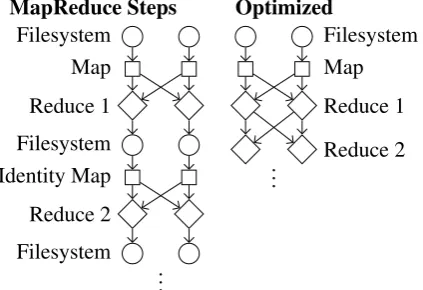
Figure 1: Each MapReduce performs three copies over the network when only one is required. Ar-rows denote copies over the network (i.e. to and from a distributed filesystem). Both options use local disk within each reducer for merge sort.
contributes an efficient multi-pass streaming algo-rithm using disk and a user-specified amount of RAM.
2 Related Work
Brants et al. (2007) showed how to estimate Kneser-Ney models with a series of five MapRe-duces (Dean and Ghemawat, 2004). On 31 billion words, estimation took 400 machines for two days. Recently, Google estimated a pruned Kneser-Ney model on 230 billion words (Chelba and Schalk-wyk, 2013), though no cost was provided.
Each MapReduce consists of one layer of map-pers and an optional layer of reducers. Mapmap-pers read from a network filesystem, perform optional processing, and route data to reducers. Reducers process input and write to a network filesystem. Ideally, reducers would send data directly to an-other layer of reducers, but this is not supported. Their workaround, a series of MapReduces, per-forms unnecessary copies over the network (Fig-ure 1). In both cases, reducers use local disk.
Writing and reading from the distributed filesys-tem improves fault tolerance. However, the same level of fault tolerance could be achieved by checkpointing to the network filesystem then only reading in the case of failures. Doing so would en-able reducers to start processing without waiting for the network filesystem to write all the data.
Our code currently runs on a single machine while MapReduce targets clusters. Appuswamy et al. (2013) identify several problems with the scale-out approach of distributed computation and put forward several scenarios in which a single ma-chine scale-up approach is more cost effective in terms of both raw performance and performance per dollar.
Brants et al. (2007) contributed Stupid Backoff, a simpler form of smoothing calculated at runtime from counts. With Stupid Backoff, they scaled to 1.8 trillion tokens. We agree that Stupid Backoff is cheaper to estimate, but contend that this work makes Kneser-Ney smoothing cheap enough.
Another advantage of Stupid Backoff has been that it stores one value, a count, per n-gram in-stead of probability and backoff. In previous work (Heafield et al., 2012), we showed how to collapse probability and backoff into a single value without changing sentence-level probabilities. However, local scores do change and, like Stupid Backoff, are no longer probabilities.
MSRLM (Nguyen et al., 2007) aims to scal-ably estimate language models on a single ma-chine. Counting is performed with streaming algo-rithms similarly to this work. Their parallel merge sort also has the potential to be faster than ours. The biggest difference is that their pipeline de-lays some computation (part of normalization and all of interpolation) until query time. This means that it cannot produce a standard ARPA file and that more time and memory are required at query time. Moreover, they use memory mapping on en-tire files and these files may be larger than physi-cal RAM. We have found that, even with mostly-sequential access, memory mapping is slower be-cause the kernel does not explicitly know where to read ahead or write behind. In contrast, we use dedicated threads for reading and writing. Perfor-mance comparisons are omitted because we were unable to compile and run MSRLM on recent ver-sions of Linux.
SRILM (Stolcke, 2002) estimates modified Kneser-Ney models by storingn-grams in RAM.
Corpus Counting
Adjusting Counts
Division Summing
[image:2.595.333.499.63.186.2]Interpolation Model
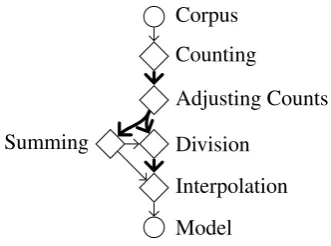
Figure 2: Data flow in the estimation pipeline. Normalization has two threads per order: sum-ming and division. Thick arrows indicate sorting.
It also offers a disk-based pipeline for initial steps (i.e. counting). However, the later steps store alln-grams that survived count pruning in RAM. Without pruning, both options use the same RAM. IRSTLM (Federico et al., 2008) does not imple-ment modified Kneser-Ney but rather an approxi-mation dubbed “improved Kneser-Ney” (or “mod-ified shift-beta” depending on the version). Esti-mation is done in RAM. It can also split the corpus into pieces and separately build each piece, intro-ducing further approximation.
3 Estimation Pipeline
Estimation has four streaming passes: counting, adjusting counts, normalization, and interpolation. Data is sorted between passes, three times in total. Figure 2 shows the flow of data.
3.1 Counting
For a language model of orderN, this step counts allN-grams (with length exactlyN) by streaming through the corpus. Words near the beginning of sentence also formN-grams padded by the marker <s>(possibly repeated multiple times). The end of sentence marker</s>is appended to each sen-tence and acts like a normal token.
Unpruned N-gram counts are sufficient, so lower-order n-grams (n < N) are not counted. Even pruned models require unpruned N-gram counts to compute smoothing statistics.
Vocabulary mapping is done with a hash table.1 Token strings are written to disk and a 64-bit
Suffix
3 2 1
Z B A Z A B B B B
Context
2 1 3
[image:3.595.111.253.66.133.2]Z A B B B B Z B A
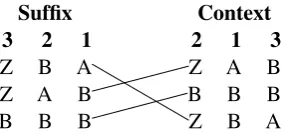
Figure 3: In suffix order, the last word is primary. In context order, the penultimate word is primary.
murHash2token identifier is retained in RAM. Counts are combined in a hash table and spilled to disk when a fixed amount of memory is full. Merge sort also combines identicalN-grams (Bit-ton and DeWitt, 1983).
3.2 Adjusting Counts
The countscare replaced with adjusted countsa.
a(w1n) =
(
c(wn
1), ifn=N orw1 =<s>
|v:c(vwn1)>0|, otherwise
Adjusted counts are computed by streaming throughN-grams sorted in suffix order (Figure 3). The algorithm keeps a running total a(wN
i ) for
eachiand compares consecutiveN-grams to de-cide which adjusted counts to output or increment. Smoothing statistics are also collected. For each length n, it collects the number tn,k of n-grams
with adjusted countk∈[1,4].
tn,k=|{w1n:a(w1n) =k}|
These are used to compute closed-form estimates (Chen and Goodman, 1998) of discountsDn(k)
Dn(k) =k−
(k+ 1)tn,1tn,k+1 (tn,1+ 2tn,2)tn,k
for k ∈ [1,3]. Other cases are Dn(0) = 0 and
Dn(k) =Dn(3)fork≥3. Less formally, counts
0 (unknown) through 2 have special discounts.
3.3 Normalization
Normalization computes pseudo probabilityu
u(wn|wn1−1) = a(w
n
1)−Dn(a(w1n))
P
xa(w1n−1x) and backoffb
b(w1n−1) =
P3
i=1Dn(i)P|{x:a(w1n−1x) =i}|
xa(wn1−1x)
2https://code.google.com/p/smhasher/
The difficulty lies in computing denominator
P
xa(wn1−1x) for all w1n−1. For this, we sort in context order (Figure 3) so that, for everyw1n−1, the entrieswn1−1xare consecutive. One pass col-lects both the denominator and backoff3 terms
|{x:a(w1n−1x) =i}|fori∈[1,3].
A problem arises in that denominator
P
xa(wn1−1x) is known only after streaming through all w1n−1x, but is needed immediately to compute each u(wn|w1n−1). One option is to buffer in memory, takingO(N|vocabulary|)space since each order is run independently in parallel. Instead, we use two threads for each order. The sum thread reads ahead to computePxa(w1n−1x) and b(wn1−1) then places these in a secondary stream. The divide thread reads the input and the secondary stream then writes records of the form
(w1n, u(wn|w1n−1), b(wn1−1)) (1) The secondary stream is short so that data read by the sum thread will likely be cached when read by the divide thread. This sort of optimization is not possible with most MapReduce implementations.
Because normalization streams throughwn1−1x in context order, the backoffs b(w1n−1) are com-puted in suffix order. This will be useful later (§3.5), so backoffs are written to secondary files
(one for each order) as bare values without keys.
3.4 Interpolation
Chen and Goodman (1998) found that perplex-ity improves when the various orders within the same model are interpolated. The interpolation step computes final probabilitypaccording to the recursive equation
p(wn|wn1−1) =u(wn|w1n−1)+b(wn1−1)p(wn|w2n−1) (2) Recursion terminates when unigrams are interpo-lated with the uniform distribution
p(wn) =u(wn) +b()
1
|vocabulary|
where denotes the empty string. The unknown word counts as part of the vocabulary and has count zero,4so its probability isb()/|vocabulary|. 3Sums and counts are done with exact integer arithmetic. Thus, every floating-point value generated by our toolkit is the result ofO(N)floating-point operations. SRILM has nu-merical precision issues because it usesO(N|vocabulary|) floating-point operations to compute backoff.
4SRILM implements “another hack” that computes
Probabilities are computed by streaming in suf-fix lexicographic order: wnappears beforewnn−1, which in turn appears before wnn−2. In this way, p(wn)is computed before it is needed to compute
p(wn|wn−1), and so on. This is implemented by jointly iterating throughN streams, one for each length ofn-gram. The relevant pseudo probability u(wn|w1n−1) and backoff b(wn1−1) appear in the input records (Equation 1).
3.5 Joining
The last task is to unite b(w1n) computed in §3.3 withp(wn|wn1−1)computed in§3.4 for storage in the model. We note that interpolation (Equation 2) used the different backoffb(wn1−1)and so b(w1n) is not immediately available. However, the back-off values were saved in suffix order (§3.3) and in-terpolation produces probabilities in suffix order. During the same streaming pass as interpolation, we merge the two streams.5 Suffix order is also convenient because the popular reverse trie data structure can be built in the same pass.6
4 Sorting
Much work has been done on efficient disk-based merge sort. Particularly important is arity, the number of blocks that are merged at once. Low arity leads to more passes while high arity in-curs more disk seeks. Abello and Vitter (1999) modeled these costs and derived an optimal strat-egy: use fixed-size read buffers (one for each block being merged) and set arity to the number of buffers that fit in RAM. The optimal buffer size is hardware-dependent; we use 64 MB by default. To overcome the operating system limit on file han-dles, multiple blocks are stored in the same file.
To further reduce the costs of merge sort, we implemented pipelining (Dementiev et al., 2008). If there is enough RAM, input is lazily merged and streamed to the algorithm. Output is cut into blocks, sorted in the next step’s desired order, and then written to disk. These optimizations elim-inate up to two copies to disk if enough RAM is available. Input, the algorithm, block sorting, and output are all threads on a chain of producer-consumer queues. Therefore, computation and disk operations happen simultaneously.
5Backoffs only exist if then-gram is the context of some
n+ 1-gram, so merging skipsn-grams that are not contexts. 6With quantization (Whittaker and Raj, 2001), the quan-tizer is trained in a first pass and applied in a second pass.
0 10 20 30 40 50
0 200 400 600 800 1000
RAM
(GB)
[image:4.595.310.510.73.293.2]Tokens (millions) SRI SRI compact IRST This work
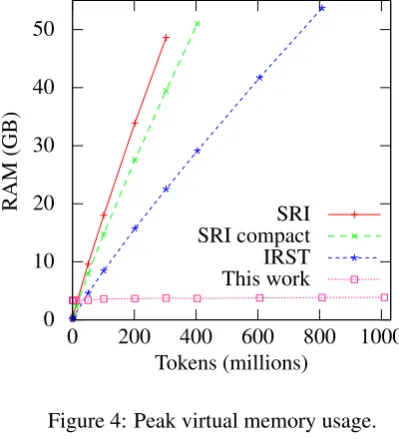
Figure 4: Peak virtual memory usage.
0 2 4 6 8 10 12 14
0 200 400 600 800 1000
CPU
time
(hours)
Tokens (millions) SRI
SRI compact IRST This work
Figure 5: CPU usage (system plus user).
Each n-gram record is an array of n vocabu-lary identifiers (4 bytes each) and an8-byte count or probability and backoff. At peak, records are stored twice on disk because lazy merge sort is not easily amenable to overwriting the input file. Additional costs are the secondary backoff file (4 bytes per backoff) and the vocabulary in plaintext.
5 Experiments
Experiments use ClueWeb09.7 After spam filter-ing (Cormack et al., 2011), removfilter-ing markup, se-lecting English, splitting sentences (Koehn, 2005), deduplicating, tokenizing (Koehn et al., 2007), and truecasing, 126 billion tokens remained.
[image:4.595.310.511.303.500.2]1 2 3 4 5
[image:5.595.352.480.63.117.2]393 3,775 17,629 39,919 59,794
Table 1: Counts of unique n-grams (in millions) for the 5 orders in the large LM.
5.1 Estimation Comparison
We estimated unpruned language models in bi-nary format on sentences randomly sampled from ClueWeb09. SRILM and IRSTLM were run un-til the test machine ran out of RAM (64 GB). For our code, the memory limit was set to 3.5 GB because larger limits did not improve perfor-mance on this small data. Results are in Figures 4 and 5. Our code used an average of 1.34–1.87 CPUs, so wall time is better than suggested in Fig-ure 5 despite using disk. Other toolkits are single-threaded. SRILM’s partial disk pipeline is not shown; it used the same RAM and took more time. IRSTLM’s splitting approximation took 2.5 times as much CPU and about one-third the memory (for a 3-way split) compared with normal IRSTLM.
For 302 million tokens, our toolkit used 25.4% of SRILM’s CPU time, 14.0% of the wall time, and 7.7% of the RAM. Compared with IRSTLM, our toolkit used 16.4% of the CPU time, 9.0% of the wall time, and 16.6% of the RAM.
5.2 Scaling
We built an unpruned model (Table 1) on 126 bil-lion tokens. Estimation used a machine with 140 GB RAM and six hard drives in a RAID5 configu-ration (sustained read: 405 MB/s). It took 123 GB RAM, 2.8 days wall time, and 5.4 CPU days. A summary of Google’s results from 2007 on differ-ent data and hardware appears in§2.
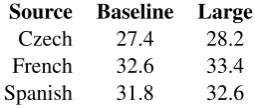
We then used this language model as an ad-ditional feature in unconstrained Czech-English, French-English, and Spanish-English submissions to the 2013 Workshop on Machine Translation.8 Our baseline is the University of Edinburgh’s phrase-based Moses (Koehn et al., 2007) submis-sion (Durrani et al., 2013), which used all con-strained data specified by the evaluation (7 billion tokens of English). It placed first by BLEU (Pap-ineni et al., 2002) among constrained submissions in each language pair we consider.
In order to translate, the large model was quan-tized (Whittaker and Raj, 2001) to 10 bits and compressed to 643 GB with KenLM (Heafield,
8http://statmt.org/wmt13/
Source Baseline Large
Czech 27.4 28.2 French 32.6 33.4 Spanish 31.8 32.6
Table 2: Uncased BLEU results from the 2013 Workshop on Machine Translation.
2011) then copied to a machine with 1 TB RAM. Better compression methods (Guthrie and Hepple, 2010; Talbot and Osborne, 2007) and distributed language models (Brants et al., 2007) could reduce hardware requirements. Feature weights were re-tuned with PRO (Hopkins and May, 2011) for Czech-English and batch MIRA (Cherry and Fos-ter, 2012) for French-English and Spanish-English because these worked best for the baseline. Un-cased BLEU scores on the 2013 test set are shown in Table 2. The improvement is remarkably con-sistent at 0.8 BLEU point in each language pair.
6 Conclusion
Our open-source (LGPL) estimation code is avail-able from kheafield.com/code/kenlm/
and should prove useful to the community. Sort-ing makes it scalable; efficient merge sort makes it fast. In future work, we plan to extend to the Common Crawl corpus and improve parallelism.
Acknowledgements
References
James M. Abello and Jeffrey Scott Vitter, editors. 1999. External memory algorithms. American Mathematical Society, Boston, MA, USA.
Raja Appuswamy, Christos Gkantsidis, Dushyanth Narayanan, Orion Hodson, and Antony Rowstron. 2013. Nobody ever got fired for buying a cluster. Technical Report MSR-TR-2013-2, Microsoft Re-search.
Dina Bitton and David J DeWitt. 1983. Duplicate record elimination in large data files. ACM Trans-actions on database systems (TODS), 8(2):255–265.
Thorsten Brants, Ashok C. Popat, Peng Xu, Franz J. Och, and Jeffrey Dean. 2007. Large language models in machine translation. In Proceedings of the 2007 Joint Conference on Empirical Methods in Natural Language Processing and Computational Language Learning, pages 858–867, June.
Chris Callison-Burch, Philipp Koehn, Christof Monz, Matt Post, Radu Soricut, and Lucia Specia. 2012. Findings of the 2012 workshop on statistical ma-chine translation. In Proceedings of the Seventh Workshop on Statistical Machine Translation, pages 10–51, Montr´eal, Canada, June. Association for Computational Linguistics.
Ciprian Chelba and Johan Schalkwyk, 2013. Em-pirical Exploration of Language Modeling for the google.com Query Stream as Applied to Mobile Voice Search, pages 197–229. Springer, New York.
Stanley Chen and Joshua Goodman. 1998. An em-pirical study of smoothing techniques for language modeling. Technical Report TR-10-98, Harvard University, August.
Colin Cherry and George Foster. 2012. Batch tun-ing strategies for statistical machine translation. In Proceedings of the 2012 Conference of the North American Chapter of the Association for Computa-tional Linguistics: Human Language Technologies, pages 427–436. Association for Computational Lin-guistics.
Gordon V Cormack, Mark D Smucker, and Charles LA Clarke. 2011. Efficient and effective spam filtering and re-ranking for large web datasets. Information retrieval, 14(5):441–465.
Jeffrey Dean and Sanjay Ghemawat. 2004. MapRe-duce: Simplified data processing on large clusters. In OSDI’04: Sixth Symposium on Operating Sys-tem Design and Implementation, San Francisco, CA, USA, 12.
Roman Dementiev, Lutz Kettner, and Peter Sanders. 2008. STXXL: standard template library for XXL data sets. Software: Practice and Experience, 38(6):589–637.
Nadir Durrani, Barry Haddow, Kenneth Heafield, and Philipp Koehn. 2013. Edinburgh’s machine trans-lation systems for European language pairs. In Pro-ceedings of the ACL 2013 Eighth Workshop on Sta-tistical Machine Translation, Sofia, Bulgaria, Au-gust.
Marcello Federico, Nicola Bertoldi, and Mauro Cet-tolo. 2008. IRSTLM: an open source toolkit for handling large scale language models. In Proceed-ings of Interspeech, Brisbane, Australia.
David Guthrie and Mark Hepple. 2010. Storing the web in memory: Space efficient language mod-els with constant time retrieval. In Proceedings of EMNLP 2010, Los Angeles, CA.
Kenneth Heafield, Philipp Koehn, and Alon Lavie. 2012. Language model rest costs and space-efficient storage. InProceedings of the 2012 Joint Confer-ence on Empirical Methods in Natural Language Processing and Computational Natural Language Learning, Jeju Island, Korea.
Kenneth Heafield. 2011. KenLM: Faster and smaller language model queries. InProceedings of the Sixth Workshop on Statistical Machine Translation, Edin-burgh, UK, July. Association for Computational Lin-guistics.
Mark Hopkins and Jonathan May. 2011. Tuning as ranking. InProceedings of the 2011 Conference on Empirical Methods in Natural Language Process-ing, pages 1352–1362, Edinburgh, Scotland, July.
Slava Katz. 1987. Estimation of probabilities from sparse data for the language model component of a speech recognizer. IEEE Transactions on Acoustics, Speech, and Signal Processing, ASSP-35(3):400– 401, March.
Reinhard Kneser and Hermann Ney. 1995. Improved backing-off for m-gram language modeling. In Proceedings of the IEEE International Conference on Acoustics, Speech and Signal Processing, pages 181–184.
Philipp Koehn, Hieu Hoang, Alexandra Birch, Chris Callison-Burch, Marcello Federico, Nicola Bertoldi, Brooke Cowan, Wade Shen, Christine Moran, Richard Zens, Chris Dyer, Ondˇrej Bojar, Alexan-dra Constantin, and Evan Herbst. 2007. Moses: Open source toolkit for statistical machine transla-tion. InAnnual Meeting of the Association for Com-putational Linguistics (ACL), Prague, Czech Repub-lic, June.
Philipp Koehn. 2005. Europarl: A parallel corpus for statistical machine translation. In Proceedings of MT Summit.
Kishore Papineni, Salim Roukos, Todd Ward, and Wei-Jing Zhu. 2002. BLEU: A method for automatic evalution of machine translation. In Proceedings 40th Annual Meeting of the Association for Com-putational Linguistics, pages 311–318, Philadelphia, PA, July.
Andreas Stolcke. 2002. SRILM - an extensible lan-guage modeling toolkit. InProceedings of the Sev-enth International Conference on Spoken Language Processing, pages 901–904.
David Talbot and Miles Osborne. 2007. Randomised language modelling for statistical machine trans-lation. In Proceedings of ACL, pages 512–519, Prague, Czech Republic.