EUR 7250 EN
Multiannual Programme
of the Joint Research Centre
1980-1983
1980
Annual Status Report
Plutonium fuels and actinide
research
Published by the
COMMISSION OF THE EUROPEAN COMMUNITIES Directorate-General
Scientific and Technical Information and Information Management Bâtiment Jean Monnet
LUXEMBOURG
Reproduction In whole or in part of the contents of this publication is free, provided the source is acknowledged
© ECSC-EAEC, Brussels-Luxembourg, 1981 Printed in the Federal Republic of Germany
ISBN 92-825-2339-X
1
-Plutonium Fuels and Actinide Research
1980
Research staff: Budget:
Projects:
117
Commitments 13,526,604. - ECU
1 1.1 1.2 1.3
2 2.1 2.2 2.3
3 3.1 3.2 3.3
Operation Limits of Plutonium Fuels Swelling of Advanced Fuels Oxide Fuel Transients
Equation of State of Nuclear Materials
Actinide Cycle Safety
Formation of Actinides (FACT)
Safe Handling of Plutonium Fuel (SHAPE)
Aspects of the Head-End Processing of Carbide Fuel (REC ARB)
Actinide Research Crystal Chemistry Solid State Studies Applied Actinide Research
Programme Manager: R. Lindner
European Institute for Transuranium Elements Postfach 2266, D-7500 Karlsruhe
1. Introduction
Nuclear energy is released by fission of heavy nuclei. In parallel with the fission process in a nuclear reactor, neu-tron capture produces elements heavier than the initial uranium. These so-called transuranium elements such as plutonium and americium have important consequences for the nuclear fuel cycle and, because of their high spe-cific radioactivity, particularly the biologically important alpha particles which they release, must always be handled with care.
Technological aspects of the handling and behaviour of these substances during all stages of the fuel cycle, fabri-cation, irradiation, reprocessing and waste disposal, are thus of importance for the continued development of nuclear energy. All information should be available on the physical and chemical properties, not only of uranium compounds but also of those of plutonium and higher actinides.
Generally nuclear safety considerations focus on the potential malfunctioning of large nuclear installations. They calculate risks and establish multiple and redundant devices to minimize the probabilities of accidents. But the source of the danger is the nuclear fuel which has to be prevented from reaching uncontrolled criticality or releas-ing fission products and Heavy Atoms.
Thus basic research on the technology of nuclear fuels and especially those containing plutonium will always have a place in nuclear energy. Eventually the field will expand beyond plutonium because breeding and recycl-ing will need a better knowledge also of higher elements and their compounds as to their nuclear, chemical and mechanical characteristics.
The European Institute for Transuranium Elements was established with all of the necessary facilities for this work and it serves as the focal point for a Community Research Programme,
- meeting demands not satisfied in national laboratories - giving all Member States immediate access to this area
of research
- extending research on nuclear fuels beyond the imme-diate needs in preparation for the future development of the cycle
- coordinating dispersed efforts in the field of basic research on actinide elements beyond the immediate interests of the nuclear industry.
2
-Although the general concern for reactor safety has changed the primary orientation of the programme (for-merly directed towards the economy of the nuclear fuel cycle) work on the so-called "advanced" fuels continues to be a part of the Institute's activity, exercising thereby a "flywheel action" maintaining long-term research lines alive independent of the sometimes short-term fluctua-tions of national priorities.
2. Results
1. Operation Limits of Plutonium Fuels
Safe operation of nuclear fuel requires knowledge of the operation limits within which the specified behaviour is maintained. If these limits are for any reason exceeded it must be possible to evaluate the consequences. The swel-ling behaviour of advanced fuels, i. e. fuels of uranium plutonium mixed carbide or nitride (MX type) has been studied for the past 8 years and this is now nearing com-pletion.
Oxide Fuel Transients is a new sub-project Equation of state investigations provide the data required to evaluate the behaviour of the fuel in the hypothetical case of an uncontrolled power excursion.
1.1. Swelling of Advanced Fuels
The objective of this sub-project is to provide an experi-mentally substantiated model to describe the behaviour of fast reactor advanced fuels under the full range of nor-mal operating conditions.
During the reporting period:
- experimental results measured in numerous irradiated fuels have been collated into a coherent picture. Two areas where information is still insufficient are a compa-rative study of the mechanical properties of carbide
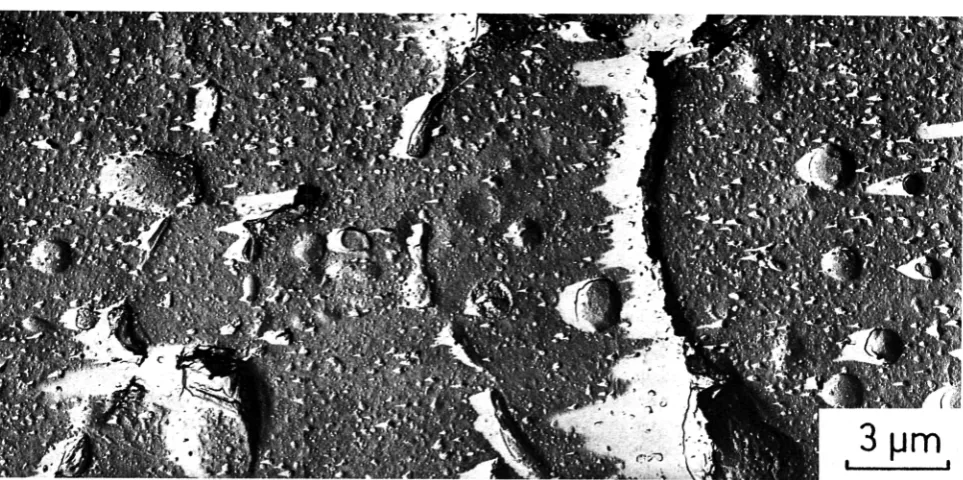
and nitride fuels based on nitride of high purity and the local fission gas analyses by transmission electron microscopy of MX-fuels in a burn-up range as large as possible in order to establish a detailed model of the fission gas kinetics, especially for temperatures below 1000 °C (Fig. 1).
- the post irradiation examination of carbide fuels from He-bonded and Na-bonded fast breeder pins of high burn-up (7 to 12 a/o) has been terminated. An empirical quantitative description of the in-pile performance of carbide fuel has been given. On this basis also carbo-nitride and carbo-nitride fuels may be treated for which extensive fast flux irradiation data do not exist. - the in-pile performance of advanced fuels depends
largely on their mechanical properties. Hence the fracture stress, flow stress using acoustic emission, fracture surface energy measurements and the cal-culation of residual stresses in pellet fragments were investigated.
1.2. Oxide Fuel Transients
[image:6.595.59.541.516.756.2]Transient conditions arise from operational events such as fuel changing, load changing or maintenance require-ments, all of which may be classified as normal operation. Additionally unplanned transients will inevitably occur. Examples of such transients are equipment faults or ope-rator errors which could give rise to mismatch between coolant flow and power generation leading to excursions which are limited by the reactor safety equipment. It is necessary to evaluate the consequence of any such tran-sient on the fuel behaviour and its subsequent life. It is the objective of sub-project "Oxide Fuel Transients" to develop on a theoretical and experimental basis a phy-sical model of the fuel response during power and tempe-rature transients from normal operation tempetempe-rature to the melting point.
During the reporting period,
an irradiation programme for transient testing of fuels has been prepared.
analysis methods have been developed to assist in interpretation of irradiation conditions.
the post irradiation examination of transient test samples has been prepared.
Samples, which had been irradiated during 1979 in the fra mework of the previous subproject "Corrosion", have been examined. Interesting results have been obtained using a micro galvanic cell to measure the oxygen poten tial in irradiated fuel samples. The radial gradient of oxy gen potential and hence oxygen to metal ratio existing during the final days of the irradiation have been deter mined. This is an important result of relevance to the tran sient programme because physical properties of the fuel such as thermal conductivity depend on the local oxygen/ metal ratio (Fig. 2).
2.00 1.98 % 1.96 1.94
-- centre
• / / I 1 I 1 1 1 i hole—H
ç, ~ ~"
UPuO burn
'
1.94 initial up 3A0/.
composition
outer surface—«j
0 0.2 0.4 0.6 0.« 1.0
Fig. 2 Radial variation of OI M in an irradiated mixed oxide fuel pellet.
1.3. Equation of State of Nuclear Materials
The objective of this work is to determine the vapour pres sure generated by an irradiated nuclear fuel between 3000 K and the critical point. Initial work with U 02 at sev
eral research laboratories has given results which vary sig nificantly from calculations by classical thermodynamic methods (Fig. 3).
During the reporting period,
the necessity to explain almost one order of magnitude difference in the total pressure of U 02 at 5000 K, the
experimental data being higher than the calculated pressures, involved the main effort on both the theoreti cal and experimental side. The theoretical activity of the project was concentrated on the study of the vapo rization mechanism at extreme rates of evaporation and the gas dynamics of the Mach disk technique.
the final objective of the studies on the mechanism of the evaporation of nuclear fuels is the determination of the ratio of the molecular species and their partial rates of evaporation under extreme conditions, which
10000 3 2 1 σ α. Σ σ>0 o -1 -2 I / ■■ ' 6000 1
5000 4000 T(K)
1 I
^ ^ . c r i t i c a l point d a t a
V\
\ . \
\
t h e o r y ^
<
^ e x p e r i m e n t a l results
^ \
\ \
\ \
\ \
\ \
\ \ mp
\ \ i
Τ
I
1 1 I I
1.0 1.5 2.0 , 2.5 3.0
Fig. 3 - Total vapour pressure over uranium dioxide up to the critical point
leads to a departure from equilibrium rates. Above the operational limit of the HertzKnudsen equation, the evaporation mechanism is determined by the popu lation density of the different energy levels. A surface model, starting from the welldefined structure of solid materials, had to be developed to determine the binding and activation energies. The suppression of the slowest rate determining reaction step in a multistep vaporiza tion process may in principle lead to an increase in the overall evaporation rate beyond the calculated equili brium relationship.
mach disk measurements from 3700 Κ to 4200 Κ on U02, evaluated on the basis of gas dynamic relation
ships, confirmed the previous results from laser induced evaporation into a vacuum.
2. Actinide Cycle Safety
The safety of a nuclear fuel cycle depends among other things on the content and isotopie composition of heavy nuclides and fission products in the fuel, and on their che mical and physical form during the different stages of the cycle.
4
-2.1. Formation of Actinides (FACT)
The objectives of this activity are
to determine experimentally the nuclear properties of actinides irradiated in thermal and fast reactors in order to check the reliability of reactor physics calculations, to assess the irradiation behaviour of significant quanti
ties of mixed uranium minor actinide oxides consi dering the buildup of transplutonides by Pu recycling (Fig. 4).
During the reporting period,
the isotope correlation technique was applied to calcul ate the formation of actinides,
the preparation of irradiation experiments with americ ium containing fuel was started,
mixed uraniumamericium oxide fuel was prepared and characterized,
fission yield systematics were investigated.
During the reporting period,
an aerosol laboratory was installed,
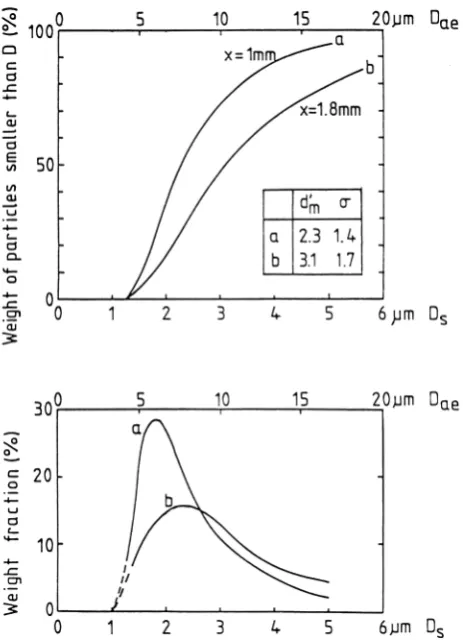
methods of characterization of nuclear aerosols were developed (Fig. 5),
characterization of aerosols formed during fuel fabrica tion was started.
¿ 1 0 0 °
Q c tí α E tí CL O l 'αϊ 50
10 15 20um Dae
α b
dm σ
2.3 1.4 3.1 1.7
6 um Ds
\
"10 20 30
[image:8.595.315.547.161.482.2]nvt ( n / c m ^ ] c=
Fig. 4 - Accumulated energy (GWd/T) obtained from recycling Pu or Pu together with self-generated Minor Actinides MA
(= Pu + Np + Am + Cm) in a fast reactor. (1023 n/cm2 correspond
to one fuel cycle. Out of pile time 3 years.)
30< >o £ c 20 o J -u α c_
*■ 10
en Ol s. 0 ( ) -; il ;
) 1
5 ■ α / h 2 10 1 3
15 2(
_
-Κ 5 6
20jjm Da e
6um Ds
Fig. 5 - Size distribution of aerosol particles produced by vibrating (UPU)02 pellets together at 50 cycles per second and
two different amplitudes, X. As would be expected, the larger amplitude of vibration produces a slightly greater mean particle size.
Dae: Aerodynamic diameter
Ds: Stokes diameter
2.2. Safe Handling of Plutonium Fuel (SHAPE)
As Pu will be used as ceramic (oxide, carbide, nitride ...) fuel, its handling problems are increased by the formation of aerosols. The acceptability of Pu fuels in nuclear energy depends, therefore, also on the knowledge of aerosol for mation, stability and distribution as a function of fuel form, and on the availability of fabrication procedures yielding reproducible and uniform products which meet safety standards. The objective of this activity is to study these aspects in realistic laboratory conditions.
2.3. Aspects of the Head-End Processing of Carbide Fuel (RECARB)
Future reactor fuel, irrespective of the reactor type (LWR, HTGR,FBR) or the fuel type (oxide, carbide) is expected to be reprocessed by TBP extraction after preparation of a nitric acid feed solution in a corresponding headend process.
The objectives of this activity are the planned headend process studies for advanced fuel comprising:
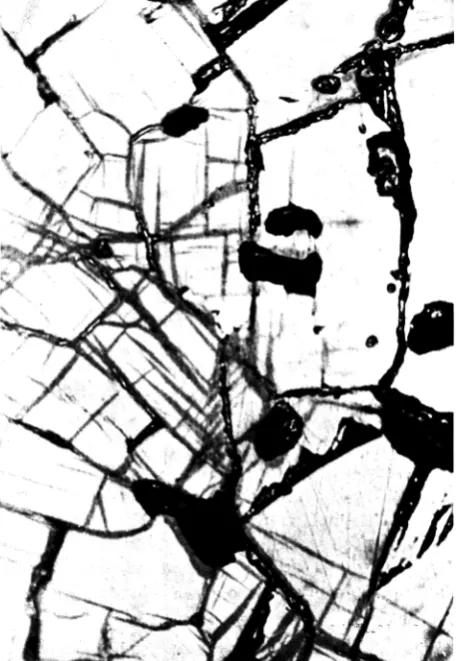
basic aspects of carbide fuel (unirradiated and irra diated) oxidation and dissolution (Fig. 6),
a comparison of different headend reprocessing methods for advanced fuels,
[image:8.595.58.283.328.495.2]5
-During the reporting period,
- the direct dissolution of (unirradiated) MX fuel with nitric acid was studied with special emphasis on the rate of dissolution, the composition of the off-gas and of the dissolver solution,
- the main organic compounds formed during the direct dissolution of (unirradiated) carbide fuel in nitric acid were identified and their elimination by oxidation was studied.
Fig. 6 - Oxidation in C02 of irradiated (UPu) C for 3 hours at
700 °C. Oxide growth occurs in pores, cracks and along specific crystallographic planes within the fuel.
3. Actinide Research
The project emphasises the study of actinide metals, of intermetallics and of simple binary compounds (oxides, chalcogenides, pnictides, hydrides). The aim is to obtain information on the influence of 5f electrons and other outer electrons on different types of bonds (ionic, coval-ent, metallic) and to permit understanding and/or predic-tion of bonding-related properties. This informapredic-tion is obtained by well selected solid state investigations which require well characterized samples in a suitable form (e. g. single crystals, films etc.). Interpretation of the results depends on the development of bonding models on the basis of thermodynamics and solid state quantum physics in close cooperation between experimentalists and theo-reticians.
The project is structured in the following activities.
3.1. Crystal Chemistry
This activity involves the preparation and characterisation of metals or compounds of known purity and structure, in a form suitable for the investigation of solid state proper-ties. It is performed almost exclusively at the Karlsruhe Establishment.
During the reporting period,
- Pa metal was prepared for the determination of thermo-dynamic properties (Fig. 7),
- methods for the preparation and characterisation of (single) crystals of actinide compounds were improved, - high pressure and low temperature X-ray diffraction
techniques were applied to actinide solids.
Fig. 7 - Crystals of pure Protactinium metal
3.2. Solid State Studies
Solid state properties are studied partially in collaboration with specialised laboratories within the Community. During the reporting period, at the Karlsruhe Establish-ment,
- the vapour pressure of Pa metal was determined (Fig. 8),
- a thermodynamic theory developed to describe defect equilibria and transitions in oxides ("spacing statistics") was applied to specific mixed actinide oxides. - photoelectron spectra of uranium intermetallics and
uranium hydride were determined,
[image:9.595.313.545.189.559.2] [image:9.595.57.288.195.526.2]2900 2700 2500
σ o en α ο_
Q- 0
σι ο
-1
3.4 3.6 3.8 4.0
Fig. 8 - Vapour pressure of protactinium metal measured by mass effusion and mass spectrometry
3.3. Applied Actinide Research
This activity offers support to other parts of the pro gramme, when special developments - scientific or tech nological - in actinide-related research are requested on a short-term-basis. It includes preparation of encapsulated actinide samples for scientific research or as radiation sources, and problems of actinide recovery and waste fixation.
Surface and catalytic properties of actinide (intermetallic) compounds will also be studied.
During the reporting period,
- the preparation of mixed actinide oxides by gel sup ported precipitation was attempted,
- the properties of glass and ceramics as possible matrix for solidified actinide waste were investigated.
4. Conclusions
The programme maintains, albeit at a somewhat reduced level, its involvement with the problems of advanced fast breeder fuel materials. It is a matter for speculation when these results will be needed, there is agreement that they
will one day be required. At the present time problems of light water reactor safety dominate the scene, we may foresee a time when even the public media will be con vinced of the safety of fast reactors and then questions of energy conservation will loom large again. The full utilisa tion of all fuels will be demanded and the advanced fast reactor fuels will be the subject of further development.
We are convinced that our present research is thus well justified. It has all the aspects of a Community pro gramme, the aims are of considerable value and there is no competition with industrial interests, the joint pro gramme has a unifying function and collaborates well with national laboratories.
Our project on safety of the nuclear fuel cycle is still only beginning. Accumulated experience in the handling of radioactive materials is being put to work and new equip ment is being built up for the investigation of aerosol pro duction and behaviour. Significant results are expected in the next few years.
Studies of the highly radioactive components of the nuc lear fuel cycle have turned attention to americium and its isotopes 241 and 243. They gain increasing importance as actinide energy sources and a significant demonstration of an actinide fuel cycle seems to be possible on the basis of work done during 1980.
A closed fuel cycle involves problems of reprocessing and refabrication operations in the field of chemical engineer ing and ceramic process technology, which are far from being optimised. Considerable work was done in the early years of nuclear development but much less attention has been paid to them in the last decade. Our research into head end studies on carbide reprocessing technology and refabrication aspects of the higher actinides have formed a basis for further development of value to the national laboratories.
In the field of actinide research two significant advances have been made. The first is in the production of very pure materials, essentially single crystals of high quality. This is a science in itself and an absolute prerequisite of any solid state research in the field.
The second is the advanced spectroscopy in which secon dary electrons are used to investigate the surface of these very pure actinide materials and, if the surface can be kept clean, the bonding properties of the bulk materials. The year 1980 saw a breakthrough in the experimental technique and we expect a number of significant results in the near future.
Salgs- og abonnementskontorer Bureaux de vente ■ Uffici di
Vertriebsbüros ■ Sales Offices vendita · Verkoopkantoren
Belgique - België
Moniteur belge — Belgisch Staatsblad Rue de Louvain 40-42 —
Leuvensestraat 40-42
1000 Bruxelles - 1000 Brussel Tél. 512 00 26
CCP 000-2005502-27 Postrekening 000-2005502-27
Sousdèpôts — Agentschappen: Librairie européenne — Europese Boekhandel
Rue de la Loi 244 - Wetstraat 244 1040 Bruxelles - 1040 Brussel
France
Service de vente en France des publica tions des Communautés européennes Journal officiel
26, rue Desaix 75732 Paris Cedex 15
Tél. (1) 578 61 39 - CCP Paris 23-96 Sousdépôt
D.E.P.P.
Maison de l'Europe
37, rue des Francs-Bourgeois 75004 Paris
Tél. 887 96 5 0
Nederland
Staatsdrukkerij en uitgeversbedrijf Christoffel Plantijnstraat, 's-Gravenhage Tel. (070) 62 45 51
Postgiro 42 53 00
United Kingdom
H.M. Stationery Office
P.O. Box 569
London SE1 9NH
Tel. (01) 9 2 8 69 7 7 . ext. 3 6 5
National Giro Account 582-1002
CREDOC
Rue de la Montagne 34 - Bte 1 1 Bergstraat 34 - Bus 11
1000 Bruxelles 1000 Brussel
Danmark
J.H. Schultz Boghandel Møntergade 19 1116 København K Tlf. (01) 14 1 1 95 Girokonto 200 1 195
Underagentur: Europa Bøger Gammel Torv 6 Postbox 137 1004 København K Tlf. (01) 14 54 32
BR Deutschland
Verlag Bundesanzeiger
Breite Straße - Postfach 10 80 06 5000 Köln 1
Tel. (0221) 21 03 48 (Fernsc reiber: Anzeiger Bonn
8 8 8 2 595)
Postscheckkonto 834 00 Köln
Ireland
Government Publications Sales Office
G.P.O. Arcade Dublin 1 or by post from Stationery Office Dublin 4
Tel. 78 96 44
Italia
Libreria dello Stato Piazza G. Verdi 10
00198 Roma Tel. (6) 8508 Telex 62008
CCP 387001 Agenzia
Via XX Settembre
(Palazzo Ministero del tesoro) 00187 Roma
Grand-Duché de Luxembourg
Office des publications officie/les des Communautés européennes 5, rue du Commerce
Boîte postale 1003 — Luxembourg Tél. 49 00 81 - CCP 19190-81 Compte courant bancaire: BIL 8-109/6003/300
United States of America
European Community Information Service
2100 M.Street. N.W. Suite 707
Washington, D.C. 20 037 Tel. (202) 862 95 00
Schweiz - Suisse - Svizzera
Librairie Payot 6, rue Grenus 1211 Genève Tél. 31 89 50 CCP 12-236 Genève
Sverige
Librairie CE. Fritze 2. Fredsgatan Stockholm 16
Postgiro 193, Bankgiro 73/4015
España
Libreria MundiPrensa Castellò 37 Madrid 1 Tel. 275 46 55
Andre lande · Andere Länder · Other countries · Autres pays · Altri paesi ■ Andere landen
Kontoret for De europæiske Fællesskabers officielle Publikationer ■ Amt für amtliche Veröffentlichungen der Europäischen Gemeinschaften ■ Office for Official Publications of the European Communities ■ Office des publications officielles des Communautés européennes ■ Ufficio delle pubblicazioni
ufficiali delle Comunità europee · Bureau voor officiële publikaties der Europese Gemeenschappen