I I ;
CONTROLLER
CONCEPTS
VOLUME
2
Multibus .
Multibus "
VMEbus
Qbus/Unibus
DG Nova/Eclipse'
Perkin-Elmer /T I.
(
1985 CORTROLLER CORCEPTS
VOLUME 2 •
Peripheral Concepts, Inc. 18003-G2 Sky park Circle Irvine, California 92714 (714)250-9510
c 1985 Peripheral Concepts, Incorporated. All Rights Reserved. Reproduction by any means, electronic or mechanical, is strictly prohibited. Disclosure to other
parties, in whole or in part, other than Peripheral Concepts original subscriber or client requires prior written permission. All information is believed to be reliable but no guarantee is expressed or implied as to its accuracy and/or completeness.
---'wrll"wti(§ iAb··'_~i"~·"1l· ""' . . s
tin
ft. z" ~#'*Ct1' 'rb' "00'6' - ' " r i b e' e'ef .... , d ' " tt $ • S'FOREWORD
The 1985 peripheral controller market has expanded into new areas, and
so has this year's edition of Controller Concepts. Several new
sections have been added this year, including Host Adapters and
Inbedded controllers in Volume 1 and VMEbus controllers in this
volume.
The VMEbus is a leading contender for the rapidly growing 32 bit
microcomputer market. With solid roots in Europe, VME has already made
impressive gains in the U.S. workstation and CAD/CAM markets. While
there is excitement about VME's future, its success is by no means
guaranteed. The VMEbus section examines some of the factors that can
profoundly affect the VME controller business over the next few years.
In other areas as well, this year's edition has been greatly expanded.
We have presented an in-depth technical discussion of new host
interfaces. We have also provided a much more detailed product matrix.
Some new forecasting categories have been added. The Multibus and
VMEbus statistics have been broken down by drive interfaces (i.e.
ST506, ESDI, SMD, QIC, Pertec). For' the DEC-compatible controllers,
C
.. '
additional breakdowns by bus type (Q-bus/Unibus) and by business type
(OEM/Captive) have been included. It is therefore not surprising that
we ended up splitting the report in two separate volomes. The first
volume contains SASI/SCSI, IBM-PC/XT/AT, Host Adapters, and Imbedded
(
Controllers.
The accuracy of our work depends upon the the level of support we
receive from the industry. We are indeed grateful for the overwhelming
support we received during our field research earlier this year. We
are also thankful for the many suggestions regarding our 1984.report.
Most of those have been
incorporate~in this year's edition.
Please give us a call if you have any suggestions, questions, or need
additional information. We can. also provide "custom" reports or do
further investigation into a particular niche market.
Vipul Mehta
(\
,
( }
Peripheral Concepts'
r
TABLE OF CONTEITS
INTRODUCTION
How the Report is Organized •••••••••••••••••••••••••••••••
A Guide to Interpreting the Numbers •••••••••••••••••••••••
Market Trends •••••••••••••••••••••••••••••••••••••••••••••Total Revenue Forecasts •••••••••••••••••••••••••••••••••••
Total Shipment Forecasts ••••••••••••••••••••••••••••••••••
Revenue Share ••••••••••••••••••••••••••••••••••••••••••••••INTRO-I
INTRO-3
INTRO-4
INTRO-8
INTRO-9
INTRO-IO
THE DEC COMPATIBLE HOST INTERFACES
Introduction •.••••••••••••••••••••••••.•••••••••••••••••••••
A New
Br~edOf Computers ••••••••••••••••••••••••••••••••••••
DEC Mass Storage Configurations •••••••••••••••••••••••••••••
.Compatibility Issues ••••••••••••••••••••••••••••••••••••••••
Product Definition ••••••••••••••••••••••••••••••••••••••••••
Market Trends •••••••••••••••••••••••••••••••••••••••••••••••Revenue Breakdown
Q-bus Vs Unibus •••••••••••••••••••••••••
Revenue Breakdown - OEM Vs. Captive •••••••••••••••••••••••••
Technology Trends •••••••••••••••••••••••••••••••••••••••••••Competing Technologies ••••••••••••••••••••••••••••••••••••••
(.2Y
Assumptions •••••••••••••••••••••••••••••••••••••••••••••
'Market Share Analysis •••••••••••••••••••••••••••••••••••••••
Revenue Forecasts •••••••••••••••••••••••••••••••••••••••••••
Shipment Forecasts ••••••••••••••••••••••••••••••••••••••••••
MINICOMPUTER COMPATIBLE INTERFACES
DEC-I
DEC-4
DEC-6
DEC-7
DEC-9
DEC-IO
DEC-IS
DEC-16
DEC-17
DEC-20
DEC-22
DEC-23
DEC-24
DEC-2S
Introduction ••••••••••••••••••••••••••••••••••••••••••••••• MINI-I
Revenue Forecasts ••••••••••••••••••••••••••••••••••••••••••• MINI-3
Shipment Forecasts •••••••••••••••••••••••••••••••••••••••••• MINI-4
Data General Compatible Interfafes
Introduction ••••••••••••••••••••••••••••••••••••••••••••••••
Market Overview/ Trends ••••••••••••••••••••••••••••••••••••••
Product Definition •••••••••
~•••••••••••••••••••••••••••••••••
Market Share Analysis ••••••••••••••••••••••••••••••••••••••••
Perkin-Elmer Compatible Interfaces
Introduction ••...••.•••••..••••••••••••••.•.•••••••••••••••••
Market Trends/ Forecasts
• • • • • • • • • • •• •
• • • • • • ••
• • • • • • • • • • • • • • • •Market Shares
• • • • • • • • • ••
• • • • • • • • • • • • • • • • • • • • • • • • • • • • • • • • • • • • •Texas Instruments Compatible Interfaces
• • • • • • • • • • • • • ••
• • • • • • •DG-I
DG-2
DG-4
DG-4
PE-I
PE-2
PE-3
TI-I
[image:4.612.52.551.267.703.2]c
THE MULTIBUS HOST INTERFACE
Introduction ••••••••••••••••••••••••••••••••••••••••••• MULTIBUS-l
Bus Characteristics
Multibus I ••••••••••••••••••••••• MULTIBUS-4
Bus Characteristics - Multibus II •••••••••••••••••••••• MULTIBUS-5
Product Definition ••••••••••••••••••••••••••••••••••••• MULTIBUS-7
Market Trends •••••••••••••••••••••••••••••••••••••••••• MULTIBUS-8
Technology Trends •••••••••••••••••••••••••••••••••••••• MULTIBUS-12
Competing Technologies ••••••••••••••••••••••••••••••••• MULTIBUS-15
Key Assumptions •••••••••••••••••••••••••••••••••••••••• MULTIBUS-17
Market Share Analysis •••••••••••••••••••••••••••••••••• MULTIBUS-18
Revenue Forecasts •••••••••••••••••••••••••••••••••••••• MULTIBUS-19
Shipment Forecasts ••••••••••••••••••••••••••••••••••••• MULTIBUS-20
Revenue Breakdown By Drive Interface ••••••••••••••••••• MULTIBUS-21
THE VMEBUS HOST INTERFACE
Introdu.ction •••••••••••••••••••••••.••••••••••••••••••••••••
Technical Characteristics •••••••••••••••••••••••••••••••••••
Product Definition ••••••••••••••••••••••••••••••••••••••••••
Market Trends ••••••••••••••••••••••••••••••••••••••••••••••• Technology Trends •••••••••••••••••••••••••••••••••••••••••••
Competing Technologies ••••••••••••••••••••••••••••••••••••••
Key Assumptions •••••••••••••••••••••••••••••••••••••••••••••
Market Share Analysis •••••••••••••••••••••••••••••••••••••••
Revenue Forecasts •••••••••••••••••••••••••••••••••••••••••••
Shipment Forecasts ••••••••••••••••••••••••••••••••••••••••••
Revenue Breakdown By Drive Interface ••••••••••••••••••••••••
PRODUCT MATRIX
VME-l
VME-3
VME-l1
VME-12
VME-17
VME-20
VME-22
VME-23
VME-24
VME-25
VME-26
Introduction
• • • • • • • • • • • • • • • • • • • • • • • • • • • • • • • • • • • • • • • • • • •DEC
• • • • • • • • • • • • • • • • • • • • • • • • • • • • • • • • • • • • • • • • • • • • • • • • • • • •• • • • • • • • • • • • • • • • • • • • • • • • • • • • • • • • • • • • • • • • • • • • • • • • • • •
MINI
MULTIBUS
• • • • • • • • • • • • • • • • • • • • • • • • • • • • • ••
• • • • • • • • • • • • • • • • •• • • • • • • • • • • • • • • • • • • • • • • • • • • • • • • • • • • • • • • • • • • • • • • • • • • •
VME
Manufacturers' Index
• • • • • • • • • • • • • • • • • • • • • • • • • • • • • • • • • • •PRODUCTS-l
PRODUCTS-3
PRODUCTS-42
PRODUCTS-56
PRODUCTS-71
PRODUCTS-81
MANUFACTURERS' PROFILES
• • • • • • • • • • • • • • • • • • • • • • • • • • • • • • • • • • •MAN-l
IBM, IBM-PC, PC/XT, and PC AT are trademarks of International Business Machines
Corporation.
DEC, PDP, LSI, VAX, Q-bus, Unibus, Massbus and CMI are trademarks of Digital
Equipment
Corporatio~.NOVA, ECLIPSE and ECLIPSE/MY are trademarks of Data General Corporation.
Multibus. Multibus II and iRMX are trademarks of Intel Corporation.
(
I RHODUCTI OR
How the Report is Organized
Controller Concepts is partitioned by host interface. All controllers, regardless of the type of peripherals they control (i.e., Winchester, Floppy,. Tape, etc.) are grouped within a section by the type of
computer or host interface they support. Each chapter also presents its data independently, so you can skip around or start at any chapter without missing any pertinent information on the interface of
interest. The Total Forecast section contains a numerical and
analytical summary of all the chapters. Also included in this section are the total market numbers from Controller Concepts Volume 1, which contains SASI/SCSI, IBM-PC/XT/AT, Host Adapters and Imbedded
Controllers. In this way, the reader can get an idea of the total
controll~r market as well as the impact of the individual markets listed in this volume.
The host interfaces covered in Controller Concepts (Vol 2) are:
DEC Busses- These peripheral controllers are board-level products which support the Q-bus, Unibus or any other interfaces used on Digital Equipment computers. Controllers
purchased by DEC from third party suppliers for
incorporation into subsystems or for resale, are also included. Controllers used internally by manufacturers to build subsystems have been reported under the
"captive" category.
Minicomputer- These peripheral controllers are board-level products which support host interfaces for Data General,
Perkin-Elmer and Te~as Instruments minicomputers. Controllers purchased by these computer manufacturers from third party suppliers are also included.
Multibus- These peripheral controllers are board level products which support the Multibus-I (IEEE- 796) or Multibus-II
interfaces. Controller shipments from Intel have been included. Controllers that are "private labeled" by Intel from outside vendors have been credited to the source supplier.
INTRO-I
(
VMEbus- These peripheral controllers are board level products which
support the VMEbus or its extensions approved by the
VMEbus International Trade Association.
Most sections are then further divided into the types of peripherals
that the controller supports:
Winchester-
Floppy-
Tape-Controller products supporting one or more winchester
or. rigid disk drives of various form factors.
Controller products which support only floppy disk
interfaces of various capacities and form factors.
Controller products which support
1/4 inch, 1/2 inch,
data cassette, or any other sequential access streaming
or start/stop tape drive.
Multifunction- Controller products which support more than one type of
peripheral such as Floppy/Winchester, Winchester/ Tape,
and Winchester/Floppy/Tape controllers.
Some sections have further breakdowns unique to that interface. These
breakdowns are described in the associated chapters.
There are also two other sections:
Product Matrix- A detailed list of all controller products in
production or scheduled for production by the first
quarter of 1986. T4e
produ~ts ar~again grouped by
host interface.
Manufacturers' Profiles- A brief description of each supplier and the
product
lines~anufactured.INTRO-2
(9
Peripheral Conceptsr
A Guide to Interpreting the Numbers
To save time in analyzing revenue and shipment numbers, keep the following points in mind:
Constant Dollars- All revenues are listed in 1985 Dollars with no discount rates applied.
Calendar Years- All revenues/shipments are reported in calendar years, not fiscal years. Make appropriate adjustments to your situation.
Manufacturers- All revenues/shipments represent products manufactured by U.S. companies for world-wide consumption, regardless of the physical location of the manufacturing facility. Included are imports by overseas manufacturers intended for U.S. consumption. In other words, the destination of product is always the U.S.
Market Shares- All market share data is listed in revenues for calendar year 1984.
Captive Products- Captive products ~isted are those controllers used in other products manufactured by the same supplier for internal consumption. For example, a board-level
controller supplier who also manufactures subsystems, will ship some of their-board-Ievel production "buried" in the subsystems.
INTRO-3
Market Trends
Peripheral Concepts estimates the total controller market/all
categories to be:
REVENUES
($)SHIPMENTS
1984
512.4M
12.1M
1985
581.9M
15.2M
1986
693.1M
18.6M
1987
826.3M
22.0M
1988
979.2M
26.1M
Revenues of the peripheral controller market are expected to produce a
compound annual growth of 17.6% from 1984 to 1988. From 1984 to 1985,
revenue growth was 13.6%, down significantly from the 1983-84 period.
The sluggish growth experienced in the computer industry certainly
affected the overall controller market growth, but their was also a
C.
lag of 6-9 months before most suppliers experienced a downturn in new
and existing orders. With few exceptions, the second quarter of 1985
revealed the strongest decline. Flat growth ·is now occuringduring the
third quarter, so it is likely that the worst is over.
i
A moderate recovery is expected during the second and third quarters
of 1986, with an estimated 19.1% annual growth rate from 1985 levels.
Year-to-year revenue growth is expected to stabilize within the 19.0%
to 19.5% range through
1987~Unit shipments are a different story. An
impressive 22.8% increase over 1984 levels are projected for 1985,
increasing to 36.4% annually by 1988. The main driving factor is the
introduction of many new semiconductor controller products, both in
OEM and imbedded controller segments. Compound unit growth rate for
INTRO-4
the forecast period is estimated at 19.4% for chips, 29.6% for
board-level products. By 1989, total revenues for all controller
products will break the Billion Dollar mark.
The DEC compatible controller segment accounted for 48.5% of all
revenues. generated in 1984, or roughly $73.85 Million. The second
strongest market was the Multibus at 30.6%, with revenues of $46.48
Million. In third place was the Minicomputer controller market, with
17.3%. The emerging VMEbus market accounted for a tiny 3.6%, or $5.53
Million in revenues.
By 1988, revenues from DEC-compatible controllers will reach $132.1
Million, but its market share will drop slightly to 45.1%. The
Multibus-I/II market will maintain in its number two position, but
C'ith a smaller 26.7% share of the market. VMEbus controllers will
exhibit a dramatic growth, capturing 17.8% of the total market, or
$52.03 Million. The Non-DEC minicomputer market share will decline to
10.4% in 1988. It is important to note that every single category will
register a .net growth in revenues for the 1984-88 period.
I
The VMEbus controller market is clearly the fastest growing category,
with a compound annual growth i . revenues of 75.1%. Explosive growth
projections for super microcomputers, fueled by the workstation and
CAD/CAM markets, will contribute most to this dramatic upswing in
VMEbus controller revenues. A shift towards smaller Q-bus based DEC
computers will result in lower average selling prices for compatible
controllers. Consequently, revenue share for DEC controllers will
INTRO-5
decline slightly, but the growth in shipments will remain strong. A
severe decline in revenues for Texas Instruments controllers and a
greater move towards captive controllers, will shrink the market share
of Non-DEC minicomputer compatible controllers. Competing busses,
particularly the VME, will slow the growth rate of the Multibus
controller market in the future.
There were 17 manufacturers offering 153 DEC-compatible products in
1984, or nine products per company. In the minicomputer market, 8
suppliers offered 56 products, or seven products per company.
Corresponding numbers for the Multibus market were 13 suppliers and 58
products, or 4.46 products per company. Lastly, 19 companies offered
40 VMEbus compatible controllers in 1984, or 2.1 products per company.
The total number of products, and particularly, the number of products
( per company is an indicator of the maturity level of a category. As
the market becomes more stable, only a limited number of suppliers
(
remain, and each supplier offers a broader range of products. Applying
that rule, DEC was the most mature market, followed by other
minicomputers, Multibus, and VMEbus.
\
Finally, the markets covered in this volume (DEC Compatible,
"
Minicomputer, Multibus and VMEbus) will account for 28.2% of the
controller market in 1985, Qr $164.08 Million. the remaining 71.8%
($417.84 Million) is shared among the SASI/SCSI, IBM-PC/XT/AT, Host
Adapters, semiconductors, and Imbedded Controllers. Market segments
covered in each of the two volumes will continue to maintain their
respective shares. In 1988, controllers covered in this volume will
INTRO-6
..
.-J
, 1
,
generate $292.71 Million, or 29.9%. The total market will reach
$979.17 Million in that year. Interestingly, the compound annual
I
growth rates for the two markets will be nearly equal, 17.8%
for-~
controllers covered in this volume and 17.5% for controllers covered
by
Volume 1.
(
INTRO-7
I
"'
..lee
CONTROLL!I TYPE:
D~(JIpATIBL!
0'l'IIEII HINI<D!PllT!I
MULTIBUS IIII
YHBbua
TOTAL REVENUES ($000)
AHJfUAL GROWTH RAT!
0'l'IIEII !IARDTS:
TOTAL REYENUBS ($000)
0'l'IIEII [1)
TOTAL HAllET ($000)
AHJfUAL GROImf RAT!
mID OTHER "INI Il!i'il!iI "ULTIBUS
_ V"EBUS ...
;.;.-.=..,.
'-iiiiiiiiiiiioo _ _ _ ... _ _ . .
...
...
.,.--...(
AcnJAL
TOTAL CONTROLLERS -AU. CATIlXlIUES
IEVEl'IU! SUIItARY
REVENUES BT PRODUCT 'rrp! ($000)
( FORECAST
1984 1985 1986 1987 1988
R!V($&:) (%) REV($&:) (%) R!V($I) (%) 1l"V($&:) (%) R!V($() (%) 73,850 48.5 83,686 51.0 101,728 51.5 116,711 48.7 132,108 45.1 26,272 17.3 24,~1 14.9 25,980 13.1 28,535 11.9 30,510 10.4 46,481 30.6 47,550 29.0 55,880 28.3 66,900 27.9 78,060 26.7 5,538 3.6 8,449 5.1 13,981 7.1 27,694 11.5 52,038 17.8
$152,141 100% $164,086 100% $197,569 100% $239,840 100% $292,716 100%
7.9% 20.4% 21.4% 22.0%
•
-REV($() (%) REV($() (%) REV($() (%) REV($&:) (%) REV($() (%)
152,141 29.7 164,086 28.2 197,569 28.5 239,840 29.0 292,716 29.9 360,264 70.1 417,846 71.8 495,488 71.5 586,508 71.0 686,461 70.1
$512,405 100% $581,932 100% $693,057 100% $826,348 100% $979,177 100%
13.6% 19.1% 19.2% 18.5%
> >
1984~
CAGR:
15.6%
3.8%
13.8%
75.1%
17.8%
CAGR:
17.8%
17.5%
17.6%
[1) Iuclud .. SASI/SCSI, IIIt-PC, Host SOURCE: PEltIPRllW. COIIC!P\'S, INC.
Adaptara, I.bedded, alld NOIl-eapti.a
O
Semc:ollductor Sh1~lIta (Vol I).J
1
,
,
,
(
I
00
38e
OTHER I1INI
MULTI BUS UI1EBUS
...
".--...,.
2ee ...
~-..,.lee
<
...
---
...
lC'roAL
TOTAL CXlH'l'ROI.UIS -ALL CATfliOKIP.S
SRIPMPJtl' SUIttARl'
SRIPH!N'I'S 8Y PRODUCT TYPE (000)
< FORPJ:AST
1984 1985 1986 1987 1988
COItTROLL!I TYPE
UNITS(I) (%) UNITS (I) (%) UNITS(I) e%) UlfITS([) (%) UlfITS(I) (%)
DI!C-«MPATIBLE 49.1 46.7 59.9 SO.l 76.7 SO.3 95.3 47.7 115.5 44.6 0'11IER IWfI<XIIPIlT!I 11.4 10.8 10.7 8.9 11.9 7.8 13.9 7.0 15.3 5.9
I1IJLTIBUS IIII 39.2 37.3 41.1 34.4 SO.8 33.3 64.8 32.5 78.9 30.5
YHEhu8 5.5 5.2 7.9 6.6 13.0 8.5 25.6 12.8 49.3 19.0 TOTAL SHIPH!N'I'S (000) 105.2 100% 119.6 100% 152.4 100% 199.6 100% 259.0 100%
ANNUAL GROWTH RAT! 13.7% 27.4% 31.0% 29.8%
OTHBI HAlDTS I #
UNITS(I) e%) UNITS(I) e%) UlfITS(I) el) UlfITS([) (%) UlfITS([) (%) TOTAL SRIPH!N'I'S (000) 105.2 .9 119.6
.
.8 152.4 .8 199.6 .9 259.0 1.0anma [1] 12,025.4 99.1 15.oes.S 99.2 18,366.8 99.2 21,779.2 99.1 25,812.3 99.0
TOTAL HAH!T (000) 12,130.6 100% 15,205.1 100% 18,519.2 100% 21,978.8 100% 26.071.3 100%
AHlIUAL GROImI RAT! 25.3% 21.8% 18.7% 18.6%
>
>
1984-88
CAGR:
23.8%
7.6%
19.1%
73.0%
25.3%
CAGR:
25.3%
21.0%
21.1%
[1] Include. SASI/SCSI, IBN-PC, Roet SOUICI: PERIPIIElAL CONC!PTS. INC.
Adapter8, Iabedded, and Noa-capt1ye
s.1eoaductor Sh1/IMGU (Vol I).
(
7~
( )
Peripheral Concepts
mx=~tible
(48.5\)
~
1984 Mu:Icet Share
'lbtal Revenues: $1S2.lM
0
1988 Market Share
'lbtal Revenues: $292. 1M
INTRO-IO
----"-"~"-~-"'-- - ""~""-,,~~"~~---" 10
](1
25
1984-88 C!GR: 17.8\
i
J
i
,1
~I
{4
~ ,
•
1 ..
~ J
i
~----, ~.
'"
r.
THE DEC-COMPATIBLE HOST IRTERFACES
Introduction
In 1963, Digital Equipment Corporation brought the forerunner of
today's minicomputer to the market. Called the PDP-S, this computer
retailed for $27,000. This was indeed a breakthrough in an industry
where the average base price of most machines were over $100,000.
Within two years after the PDP-S, DEC introduced a mass producible
version, the PDP-8, with a price tag of $18,000. The machine was an
instant success. Further price re~~ctions over the next several years
made the popular PDP-8 the first computer to break the under $10,000
price tag.
But it was not until 1970 that the minicomputer market was born.
Digital introduced a new machine in the series, called the PDP-II.
This model offered a much greater speed/performance than its
predecesors, along with a 16-bit word size. The PDP-II was equipped
with a .new backplane bus called the Unibus. Since that time, the
Unibus has remained the standard-bus on many new additions to the PDP
family. Even today, it remains one of the most successful line of
computers in the world.
j
Another mass storage interface that quickly gained popularity was theQ-bus. First introduced on the LSI-II series of microcomputers, the
Q-bus beca~e the standard for the smaller, economical DEC systems. The
Q-bus computers typically support lower capacity peripherals and
slower networking speeds than the Unibus.
DEC-1
(
The majority of all new microcomputers coming from DEC are now Q-bus
based. Nearly half of today's 16 bit microcomputer systems use the
Q-bus.
Standardization of the Unibus and the Q-bus on DEC computers created a
lucrative market for add-on products. Independent suppliers rallied
behind the two busses and offered many products such as memory boards,
controllers, and subsystems. These products often delivered a higher
performance at a lower price tag than those offered by DEC. Users who
could not afford to wait for long delivery times also turned to the
after market suppliers. Some of the initial products however, had some
drawbacks.
Earlier controllers were difficult to use and were not truly
"DEC-compatible". Controller operation was not transparent to the
computer's operating system, i.e., they required the users to add
special "patches" or modifications to the software. With the
introduction of "emulating" controllers in the late seventies, all of
that changed. The emulating controllers mimicked DEC's proprietary
,
subsystem products requiring no software changes. Users could attach
the less expensive, industry standard Storage Module Disk (SMD) drives
-to these controllers instead of the single-sourced, higher-priced DEC
drives.
The DEC-compatible controller market is a mature market. Compatibility
is rarely an issue anymore, since almost all products offer emulation.
Clear leaders have also emerged for each segment. An industry shakeout
DEC-2
occured in the early eighties and since then, there have been no more
casualties.
However, things are far from dull. Many new systems and storage
architectures have been introduced by Digital over the past two years.
And many more are coming which will profoundly alter the size and
structure of the future DEC controller market.
(
DEC-3
o
Peripheral Concepts
c
A New Breed of Computers
Products introduced by DEC within the last two years have set the tone
for the next generation of systems. The VAX series has emerged as the
flagship product. The VAX, which was DEC's first product for the 32
bit computer market, has become the yardstick for performance at the
high end. Today, the VAX computer line covers an entire spectrum of
applications.
All of the VAXs use a 32 bit architecture as well as DEC's own
propri~tary
operating system
call~~VMS. The most popular VAX products
include the 11/730 at the low end, and the 11/750 and 11/780 at the
high end. All of these machines support the Unibus, although the
11/750 and the 11/780 use 32 bit local busses for memory transfers. A
newer member, the VAX 11/785 was introduced in mid 1984. This was
followed by the machine popularly rumored as "Venus" which was finally
announced in November 1984 as the VAX-8600. The 8600 is by far the
most powerful VAX addition with a 4.6 Mega-Instructions-Per-Second
(MIPS) performance level versus 1.0 MIPS found on the 11/780. The
VAX-8600 also supports Unibus and'will work with the existing storage
products.
The "MicroVAX" series made its debut in 1983 with the MicroVAX-I. This
was the first of the VAX line to use the Q-bus interface. The
MicroVAX-I suffered from some significant bottlenecks, especially from
the poor performance of its RQDXl disk controller. The MicroVAX-II,
announced in May of this year, had resolved many of the shortcomings
DEC-4
-of the MicroVAX-I. This machine brings the performance -of the
.&X-l1/780 and the powei of VMS software to the workstation market,
its main application. The MicroVAX-II uses a private 32 bit bus for
high speed memory transfers, while retaining the Q-bus for I/O
operations. The disk controller used (RQDX2) provides a much higher
performance level than the original RQDX1. Many independent suppliers
have introduced disk and tape controllers for the MicroVAX line.
It is important to note that there are significant differences between
the VAXs and the MicroVAXs. Operating system software for the MicroVAX
is MicroVMS, which is incompatible-with standard VMS. The VAX-II
series supports clustering, larger than 100 Mbyte disk drives, and 64
or more users, none of which are supported by the MicroVAXs. These
features are aimed to keep the larger VAXs "in business", thereby
( otecting the Unibus-compatible market.
Several new computers in the PDP series were also introduced within
the past year. The top of the line, the Unibus~based PDP-l1/84,
started shipping in the first quarter of 1985. Delivering the
performance of a PDP-l1/70 at one-thi,rd the price, the 11/84 will
quickly replace the aging 11/70.
The MicroPDP-ll series introduced in mid-84, also made the switch to
the Q-bus. The three MicroPDPi (in order of performance) are the
11/SV, the 11/23, and the 11/73. In June of 1985 the MicroPDP-11/83
was announced, using an 18 MHz version of the J-l1 processor. The
11/83 delivers 50% more performance than the 11/73.
DEC-5
(
(
... .,
DEC Mass Storage Configurations
The captive DEC controllers (those supplied by DEC with peripherals)
connect the Unibus, Q-bus, or other busses with DEC disk drives. The
Massbus is the only exception, since subsystems with built-in
controllers can only be connected to it. On the other hand,
controllers from the independent vendors connect the Unibus or the
Q-bus with an industry standard disk drive such as an SMD or a 9-track
Pertec-compatible tape drive.
Unibus based computers include
mo~~of the members of the PDP-II
series and the VAX 11/730. DEC captive controllers for the PDP-II
include the RPIIE (for older RP02/03 type drives), the RK611 (for
RK06/07 drives), and the RLII (for RLOI/02 drives). The VAX 11/730
uses both the RK611 and the RLll, plus the UDA50 controller for the RA
series disk drives. The PDP-lIs can also be adapted to the Massbus
using the RHII adapter.
Q-bus based computers include all of the LSI-II series, the new
MicroPDP-lls, and the MicroVAXs. These computers use the same
•
peripherals (RP, RK and RL series) as the Unibus systems with
corresponding Q-bus
controll~rs.The Micro series can also use the RD
family of disk drives with RQDX controllers.
Computers like the VAX 11/750 and the 11/780 that do not have a
"backplane" Unibus or Q-bus, require the RH750/780 adapters to the
Massbus. Alternatively, the HSC50 controller can be used between the
local VAX bus (CMI) and a DSA-compliant drive. The independent
DEC-6
~---
-i
f
iC
"'
-supplier normally bypasses the local VAX busses and instead, offer
Unibus controllers for use with a Unibus adapter.
Compatibility Issues
In the. DEC world, the controller is much more than a serial to
parallel conversion between the host computer and the peripheral
device. Like all other peripheral controllers, DEC-compatible
controllers must comply with the physical and electrical requirements
of the bus they support. In addition, these controllers must also
support one or more DEC operating-systems. The DEC systems'
diagnostics software must also work' with the controller.
Software drivers from DEC are designed for specific characteristics of
their own captive controllers and subsystems. The compatible
controller must fully emulate these hardware characteristics while
remaining completely transparent to the computer. Often times,
controllers from independent suppliers suppbrt drives with higher
speeds and/or capacities than DEC drives. Once again, for true
compatibility, no hardware or
soft~arechanges should be required.
Newer storage architectures have made these compatibility issues even
•
more
~mportant.DEC's Digital Storage Architecture CDSA) is a
framework that covers mass' storage devices and controllers under the
Mass Storage Control Protocol (MSCP). Within this framework, all DSA
drives are compatible with DSA controllers. Any drive can be connected
to any controller and drives can be mixed on the same controller. All
DEC-7
(
,
drives are dual-ported and can be connected to two different
controllers.
Under the MSCP protocol, the controller plays a very key role. The
operating system disk server treats the peripheral simply as a class
of device. It has no knowledge of the drive's physical
characteristics. The peripheral itself only performs simple data
recording and playback. Thus, the controller not only transfers data
to/from the peripheral device, but i t is also responsible for the
handling of drive characteristics, managing the flow of data to/from
the host, and validating data integrity.
Examples of MSCP controllers include the UDA50, the HSC50, and the
RQDX2 for the Unibus, VAX bus (CMI), and Q-bus, respectively. The
captive RA80/8! and RA60 disk drives are DSA compatible. Many MSCP
compatible controllers have now been introduced by independent
suppliers. These controllers support MSCP on one end, and work with
industry standard disk and tape drives on the other.
DEC-8
:
$
'g!"'lA'"f
Product Definition
I
tProducts and forecasts within this category refer to controller
~
"
board-level products that have a DEC-compatible port on the host side,
and various drive interfaces on the drive side. Examples of products
and manufacturers in this category include:
(
Advanced Electronic Design Winc-OS/OS, Flex-02
Andromeda Systems
RDC, SDC, UDC, WDC-ll Series
Aviv Corporation
DFC/TFC 800
&
900 Series
Computer Storage Technology CS-300, TC-200
Distributed Logic Corp
Emulex Corporation
General Robotics
MDB Systems
Micro Technology, Inc.
Mini Computer Technology
Plessey Peripherals
Qualogy
Scientific Micro System,
Sigma Information Systems
Spectra Logic Corp.
Webster Computer
Wespercorp
DEC-9
DQ/DU 100, 200, 400
&
600
MV 100
&
200 Series
SC 02/03, SC 12/21/31, TC
SC700
&
SC7000 Series, QDOl, QT12
RXV21, SMVll/22, MWVll/22, STVII
MLSI
&
MDB Series
MS, MX,
M~V,&
MXV Series
EDC24, MCT1300, SMVIS
FCV, XC/XCV, DC/DCV Series
,
D41XX, D8120, D82XX
FWD 0101/0106, FWD 1101/1106
RSV31, TSVll, RQD11 A/B
12, IS, 21, 2S, Ill, 121
PCLV11J, SMDQ11A, SRDQ11B
DC, TC, TD, TDQ Series
(-Market Trends
Peripheral Concepts estimates the total market to be:
1984
REVENUES $ 73,850K
SHIPMENTS 49.1K
1985
83,686K
59.9K
1986
101,728K
76.7K
1987
116,711K
95.3K
1988
132,108K
115.5K
Despite the sluggish computer market, revenues from DEC-compatible
controllers grew almost 25% during ~he 1983-1984 period. This year,
revenue growth will slow to 13.3%. Shipments will grow at a healthy
22.0% rate during 1985, reflecting lower overall prices for DEC
controllers. Lower prices will not result from drastic erosions, but
from a change in product mix in favor of Q-bus. The introduction of
several new systems by Digital in 1985 will fuel market growth at a
faster rate over the next two years. Revenue growth for the 1985-1986
period will be 21.6% with a corresponding unit growth of 28.0%. Unit
shipments will grow 24.3% in 1987, followed by a 21.2% growth in the
following year.
For the 1984-1988 forecast pepiod, compound annual growth is expected
to be 15.6% in revenues, 23.8% in shipments. Our projections for
revenues have been lowered slightly from last year's predictions, but
the shipment forcast essentially remains the same. The variation has
been caused by a faster growth in Q-bus controllers than anticipated,
which command lower Average Selling Prices (ASP). As indicated in
DEC-I0
j
j
j
i
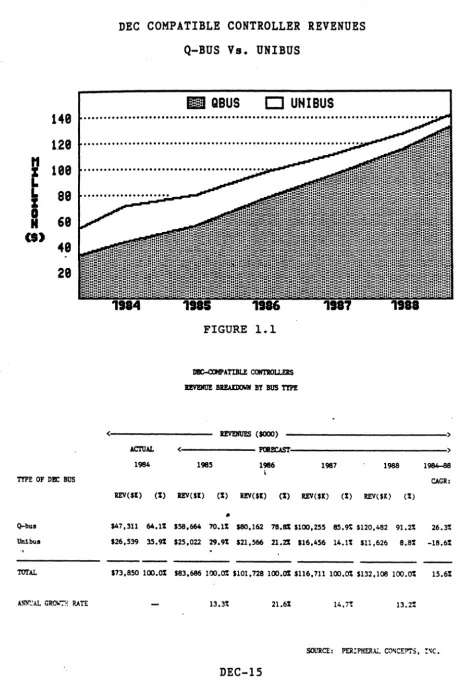
Figure 1.1, Q-bus controllers will account for 78.8% and 85.9% of alli
_~C controllers in 1986 and 1987, respectively. In the following year, Unibus controllers will dwindle to a mere 8.8% of the total market.Winchester controllers remain the revenue leaders in this segment with
57.4% sha~e of 1984 revenues. Over the next four years, winchester
controllers will continue at slightly under 60% share. Tape
controllers, which accounted for 23.6% share in 1984, will also remain
stable at 23-24% share through 1988. Multifunction controllers will
exhibit growth beginning in 1987, as the Micro series systems ship in
high volume. The 11.2% multifunction share this year will account for
a'14.1% share by 1988. Revenues from multifunction controllers will
double during this period.
Floppy controllers will turn heavily captive, causing a steady decline
£:
the floppy-only controller market over the next four years. In1984, floppy-only controllers accounted for 7.7% of revenues and 13.8%
of shipments. By 1988, these numbers are expected to decline to 2.9%
and 4.8%, respectively. The integration of floppy control functions on
multifunction products will also contribute to this decline.
There is a moderate level of capti¥e activity in the DEC-compatible
controller market. Companies that use their controllers in captive
.
subsystems include Scientific Micro Systems, Plessey Peripherals,
Qua10gy, and Aviv Corporation. The two leading controller
manufacturers, Emulex Corporation and Distributed Logic, do not have a
DEC-II
(.
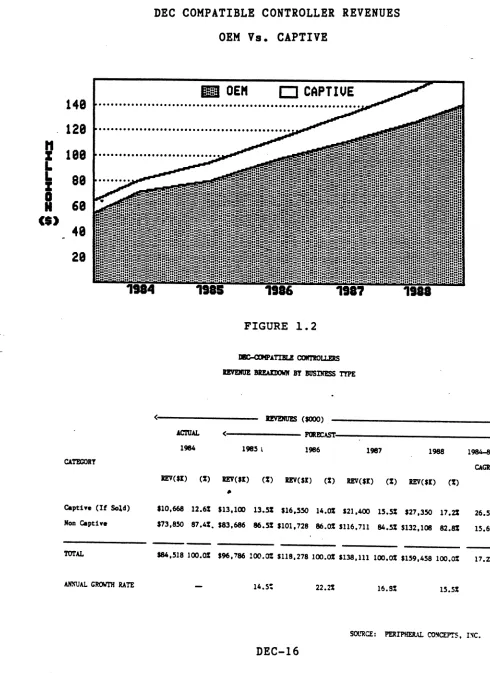
significant subsystems business. Figure 1.2 shows the projections for
captive and non-captive controller markets.
For all manufacturers, captive consumption of controllers in 1984 was
6.8K units. On an "if sold" basis, this represents $10.66 million, or
12.6~
of the total revenues for 1984. The captive segment will exhibit
a gradual growth through 1988, reaching 17.2% of the total revenues in
1988. This represents a compound annual growth of 26.5% for the
1984-1988 period. Compound growth for shipments will be higher at
34.2% for the same period. The growing subsystems market for the Micro
series will account for most of this growth.
The ASP for DEC controllers will decline through 1988. The overall ASP
will actually decline faster than the selling prices of individual
functional categories, primarily as a result of the shift towards
Q-bus. Tape-only controllers will experience the most price erosion. a
negative compound growth of -10.3% during the 1984-1988 period. This
will be followed by the winchester-only category at -7.3% with
multifunction controllers at -4% for the same period. Product maturity
i
and declining volumes will keep the pricing of floppy-only controllers
relatively stable.
Distribution channels for DEC-compatible controllers are primarily a
"direct" sale. The business is weighted more towards the OEM than the
end-user. Digital Equipment is one of the biggest OEM customers. The
company is buying disk controller boards for the MicroVAX computer
from an after-market supplier. Subsystems manufacturers. such as
DEC-12
o
Peripheral Concepts
--~---.---t
I
•System Industries and U.S. Design Corporation, also make volume
p~rchases of controllers from third party vendors. Many large users of
DEC computers in the scientific and defense communities buy storage hardware from independent suppliers and integrate these systems
in-house. Sales of DEC-compatible controllers through traditional
distributors was a small portion of the total market and will remain
so for the next several years.
Gross margins have been quite comfortable in the past, but will come
under pressure as the market moves more towards Q-bus. However,
relatively lower volumes and higher performance requirements will keep
this segment from experiencing the severe price erosions of the SCSI
and IBM-PC markets. Increasing complexities of DEC's storage
architectures have resulted in longer development times and higher
~ ts. Consequently, some private label activities have already begun
and this is likely to increase.
The Proprietary nature of DEC's new storage architecture (and the
companys' recent legal actions) have created some uncertainty in the
future of the compatible controller industry. After distributing
documentation for MSCP to several controller manufacturers last year,
•
the company abruptly withdrew further access to these specifications.
As a result, the development o( new MSCP-compatible controllers became
extremely difficult. In July of this year, Digital Equipment filed a
suit to protect the MSCP patent. Controller companies with MSCP
controllers are now facing an uncertain product line. However, i t
seems unlikely that this "stalemate" situation will continue for very
DEC-13
(
long. We expect DEC to offer some type of licensing arrangement for
MSCP products within the next six months.
We also expect the company to move more aggressively in an effort to
capture a larger share of the peripherals market, controllers and
subsystems included. This effort will be particularly intense at the
high end. It will take a great deal of technical expertise and clever
market timing to compete effectively with DEC. Those companies that
are simply riding under DEC's "price and delivery umbrella" may face
difficult times in the near-term.
Overall, things are looking much brighter for the DEC-compatible
business than last year. A flurry of new computer introductions has
provided a significant growth potential. As these new systems begin to
ship in volume, the need for after market storage controllers will
grow proportionally.
Despite failures in the personal computer market, DEC has managed to
gain further momentum in the mini- and high-performance microcomputer
markets. This will fuel additional growth in the controller market
over the next few years.
DEC-14
,
C
i'
~
i
•
f
148
1.28
I
188
88
68
(1)
48
28
(
'I'TP! OF D!I: BUS
Unibus
TOTAL
DEC COMPATIBLE CONTROLLER REVENUES
Q-BUS Vs. UNIBUS
III
QBUS
D
UNIBUS
...•...•..•.•.•...•...•.•.•..•••..•...•....•.••...•....•..•..
..•....••.•.••••••..•...•....••..••...•.•.•...••.••••••••...
FIGURE 1.1
<:---
I!V!ItUFS (SOOO)---)
AC'n1AL
1984
<:---
mtI!CAST~---)1985 1986
I
1987 1988 1984-438
CAGR:
REV($I) (%) REV('I) e%) REVe$l) (%) REV($I) (%) REV($l) (%)
-$47,311 64.1% $58.664 70.1% $80,162 78.81 $100,255 85.9: $120,482 91.2% 26.3% $26,539 35.9% ,25,022 29.9% $21.566 21.21 $16,456 14.1% $11,626 8.8% -18.6%
$73,850 100.0% $83.686 100.0% $101,728 100.0% $116,711 100.0% $132,108 100.0% 15.6%
13.3% 21.6% 14.7~ 13.2%
SOURCE: PER:::P!lERAL COliC!:!"!'S, ::'>C.
DEC-1S
[image:30.620.54.521.45.741.2]c
I
c.)
* t • 'W.. * 'C ok
DEC COMPATIBLE CONTROLLER REVENUES
OEM Vs. CAPTIVE
Cl
CAPTIUE
, . " " ) "
.
.,.148 ... .
128
188
88
68
48
28
CATEGORY
CapU.,. (If Sold)
HoD c.ptiYe TOTAL
ID'UAL CROWTH RATE
FIGURE 1.2
<:---
DYiIWIS e$OOO)--->
AC'l'UAL
1984 <---~~---:> 1985 I 1986 1987 1988 1984-88
CAG!:
lEVe,l) e%) lEVe,l) e%) IEV(SI) (%) RIV(sl) (%) IEV(SI) el)
'10,668 12.6% $13,100 13.5% $16,550 14.0% 121,400 15.5% S27,35O 17.21 26.5% '73,850 87.4%. $83,686 86.5% $101,728 86.0% 1116,711 84.5% $132,108 82.8% 15.6% $84,518 100.0% $96,186 100.0: S118,278 100.0% 1138,111 100.0% '159,458 100.0% 11.21
14.S~ 22.21 16.8% 15.5%
SOURCE: PERIPHERAL CO!ICEPTS, I:fC.
DEC-16
[image:31.612.55.545.61.734.2]~~chnology Trends I
\.
There has been little change in the basic architecture for DEC
controllers in the last four years. Most DEC-compatible controllers
are based on a "micro-engine" concept, whereas the core of the
controller is designed with a microprocessor and firmware in read-only
memories. Using this basic architecture, a family of products can be
designed with only firmware changes. This flexibility is particularly
important where emulation of a variety of storage products is key to
success. For this reason, microprocessor based designs will remain the
backbone of future DEC controller hardware.
Storage Module Disk (SMD) drives in the 8 and 14 inch form factors
have dominated the DEC-compatible market in the past. New high speed
C"n
drives will help extend this dominance for the next three to four years. Most SMD controllers introduced during 1985 support the faster2.4 Megabytes/second speed. The development of drives utilizing IPI-2
interface has been slower than expected. We expect the impact of IPI-2
drives in this market will not occur until late 1987 or early 1988.
For the smaller DEC systems, high capacity 5-1/4 inch disk drives with
the ST506/412 interface are becoming popular. DEC has recently become
a consumer of 85 Megabyte ST506 drives from an OEM peripheral
supplier. This will result in a healthy growth for high performance
ST506/412 controllers, both in stand-alone and multifunction
configurations. Controllers supporting small winchesters with the ESDI
interface were introduced earlier this year. This market is not
DEC-17
(9
Peripheral Concepts
-" . _ ' • • -0 •• _ _ _ ~_ ~_'_ ... ....:..~ _ _ ,...,.-._~" _ _ _ • _ _ " - . . . " _ ... _ . . . ~ . . _ . . . " " • • , . . - . . . - . . . _ .... ",,,,,
expected to be significant prior to the end of 1986, when volume
l
\
production and second-sourcing of these products begin to occur.
The 9-track Pertec tape drives remain the leading secondary storage
medium for DEC systems. This situation will not change during the next
three to four years. The TK50 tape cartridge (introduced along with
the MicroVAX-II) has had very little response. This cartridge may be
used by DEC for software distribution purposes in the future, but its
widespread usage seems unlikely.
Another promising candidate for t~pes may be the cartridge developed
by Electronic Processors (and second sourced by Fujitsu). But this
too, cannot succeed without direct support from Digital. A lower cost
implementation of IBM's 3480 cartridge drive has the potential to
( become a standard in this market, but we don't expect this to
materialize before 1987-1988.
The Quarter-inch cartridge products are finding niche applications in
the Q-bus microcomputer market. Streaming drives with the QIC type
interfaces have been used with s~me Micro series computers, but they
have failed to capture any significant market share. In this
marketplace, cartridge drives with start/stop capabilities (such as
CDC's Sentinel and Kenned~'s 6455) are more suitable. Both controller
and subsystems products are now available for use with these tape
drives.
Standard mass storage busses and architectures are key to the
compatible controller market. With the introduction of DSA, the next
DEC-18
.>
I
~.
1
i
i
,
t
8~"eration architecture has become quite clear. To support DSA and the
HSCP protocols, more sophisticated controllers will be needed.
Future controllers will perform many more tasks than they have in the
past. At the same time, emulation requirements have become less
stringent and more predictable.
The future of the next generation "BI" bus is a bit questionable, but
it is rumored to be slated for introduction on the MicroVAX-III. The
BI may be too complex and too expensive to implement. The available
technical data on the BI indicate~ that several LSI devices, including
s6me propietary DEC chips, will be needed to interface with the new
bus. To receive widespread after-market support, the BI must overcome
many hurdles.
(
DEC-19
Competing Technologies
In the past, entering the computer business was a major venture that
only a few could afford. Traditionally, a computer company had to
develop and manufacture computer hardware, add-ons, software and
accessories. This required enormous resources. Today, many companies
develop only the key system components and integrate the rest using
standard hardware and software. By doing so, these companies can offer
added value for targeted markets without requiring elaborate
resources. Sun Microsystems and Apollo Computer are doing just that in
the engineering workstation and CAD/CAM market. This is the market
where the new MicroVAX computers are positioned. DEC faces a
formidable challenge from these "supermicro" makers who will
effectively compete against the Q-bus with their Multibus I/II and
( VMEbus-based machines.
IBM is expected to enter the workstation market in 1986. AT&T has also
become a contender with their 3B series computers. The more
traditional DEC rivals, such as Data General and Prime Computer, will
,
certainly try to capture a share of this growing business with
competitive products. The ability of the Q-bus systems to penetrate
-this market before the competition gains momentum is key to the future
success. DEC has the advantage of early market entry and will be
leveraged to win some key accounts.
Competition at the high end has not changed much. DEC has a
substantial share of the scientific market, primarily with the high
DEC-20
o
Peripheral Concepts
.--p.
I'~· ~_____
§~M_-w'1e~=-·---> • •:11
,~
d VAlse IBM is the main competitor, followed by Data General. For
the niche markets, companies like Hewlett Packard, Perkin Elmer, and
Gould SEL offer competing products. A number of new
"Super-minicomputer" companies have been formed in the past couple of
years, but their future impact on the market remains unknown until
products are announced.
Many DEC-compatible controller manufacturers are looking at the
competing products and formulating strategies. So far, none of the
controller suppliers have made a strong committment to non-DEC
products. The VMEbus controller market has attracted the most serious
attention, but no products have yet materialized. Most suppliers are
busy concentrating their efforts to meet the challenge of supporting
DEC's new mass storage architectures.
(
DEC-21
(
i l l
Assumptions
o
The Introduction of several new DEC systems during 1985 will help
fuel market growth for the next four years, primarily,.from the
Q-bus based systems.
o
The Unibus controller market will continue to decline. The shift
towards the Q-bus will reduce overall selling prices.
o
The introduction of the MicroVAX line will boost the growth of
multifunction controllers, and lower projections for the tape-only
segment during 1986 and 1987.
o
DEC's patent claims for the MSCP will not adversely impact the
controller market.
CALENDAR
1984
MARIET SHARE
REVENUES BY MANUFACTURER
MANUFACTURER
MARKET SHARE
(%)
Emulex
Distributed Logic
Corp~Scientific Micro Systems
Plessey Peripherals
Micro Technology, Inc.
Andromeda Systems
Sigma Informations Systems
Wespercorp
Spectra Logic Corp.
MDB Systems
Qualogy
OTHER
TOTALS
DEC-22
o
Peripheral Concepts
38.6
23.9
5.1
4.9
3.3
3.3
3.2
3.1
2.7
2.4
2.4
7.1
.Ii
(ok"
Share Analysist
In calendar year 1984, Emulex and Dilog once again captured over 60~j
A
1
of the DEC-compatible controller market. Emulex is by far the most
dominant force in this market, with 38.6% share. Dilog generated more
tban four times the revenues from DEC-compatible controllers than the
next contender, Scientific Micro Systems. The rest of the market
remained quite fragmented as another nine suppliers captured between
2% and 5% of the market. Five other vendors had less than 2% market
share each.
i
At
least three companies, Computer Storage Technology/E.F. Industries, £, Minicomputer Technology, and Wespercorp are passive participants in
the DEC-compatible controllers. These companies have no plans to offer
~~ products into the DEC market, they are simply sustaining their
mature products. After shifting the emphasis to DEC subsys~ems in
1983, Plessey Peripherals has become active in board-level controllers
once again.
If the captive consumption were factored in, Qualogy' would rank number i
five with its significant subsystems business. During 1985, no
significant shifts in market posi~ions are expected. Revenues for 1985
will be higher at Micro Technology and Andromeda, whereas Dilog will
experience some decline.
DEC-23
(
-- _ _ _ _ ... , .. _"'"".,_~"-.. "~6~·' , ... <",. • • _ . . . ~ ; _ _ :..;.~ •• , . " ' " " " ' .
mimi
WINCHESTER
0
FLOPPY
IDIil
TAPE
mn
MULTIFUNCTION
148 ... . 128 ... '.,0 ~"'"~
~
100
L
L
80
Z
B
60(S)
40
29
<
• • • • • • • • • • • • • • • • • • • • • • • • • • • • • • • • • • • • • .II"I'I!'I't'I't'ft'!1"ftIo
DEC-COHPATIBLE CONTROLLERS REVENUE StMfARy
REVENUPS BY PRODUC'l' TYPE ($000)
AcroAL < FOm:AsT
> >
1984 1985 1986 1987 1988 1984-88
CONTROLLER TYP! CAGR:
m($I) (%) m($I) (zt) REV($I) (%) REV($I) (%) REV(SK) (%)
Winchester 42,429 57.5 48,554 58.0 61,230 60.2 69,802 59.8 n,481 58.6 16.2%
Floppy 5,670 7.7 5,':8 6.5 5,186 5.1 4,584 3.9 3,897 2.9 -8.9%
Tape 17 ,401 23.6 20,324 24.3 24,267 23.9 27,834 23.8 32,037 24.3 16.5%
Hu1 tifunction 8,350 11.3
° 9,360 11.2 11,045 10.9 14,491 12.4 18,693 14.1 22.3%
TOTAL REVENUES ($000) $73,850 100% $83,686 100% $101,728 100% $116,711 100% $132,108 100% 15.6%
ANNUAL GROW"rH RAT! 13.3% 21.6% 14.7% 13.2%
SOURCE: PERIPHERAL CONCEPl'S, INC.
o
Peripheral Concepts DEC-24.,£Iit.26X sa i.!i QJ •• &
r:c
W~
F1 Tl
M1
~
"J J
'·'f
~
i
~
II
f
•
C.
,
S
(J()
CONTROLl.ER TYPE
W!.nchester
Floppy Tape
Multifunction
m
WINCHESTER
0
FLOPPY ID]JTAPE
IIID
MULTIFUNCTION
148 ... .
129 ... .
lee
sa ... .
6
e ...
't.Q@'~~'4e
28
<
AC!'UAL
DEC-COHP ArIBLE CONTROlLERS SHIPMENT SUHHARY
SHIPMENTS BY PRODUcr TYPE (000)
< FORECAST
> >
1984