Design and Implementation of an
Ahead-of-Time Compiler for PHP
by
Paul Biggar
Dissertation
Presented in fulfillment
of the requirements
for the Degree of
Doctor of Philosophy
T
RINITYC
OLLEGED
UBLINDeclaration
I, the undersigned, declare that this work has not previously been submitted as an exercise for a degree at this, or any other University, and that unless otherwise stated, is my own work.
Paul Biggar 14th April, 2010
Permission to Lend and
/
or Copy
I, the undersigned, agree that Trinity College Library may lend or copy this disserta-tion upon request.
Paul Biggar 14th April, 2010
Abstract
In recent years the importance of dynamic scripting languages — such as PHP, Python, Ruby and Javascript — has grown as they are used for an increasing amount of software development. Scripting languages provide high-level language features, a fast compile-modify-test environment for rapid prototyping, strong integration with database and web development systems, and extensive standard libraries. PHP powers many of the most popular web applications such as Facebook, Wikipedia and Yahoo. In general, there is a trend towards writing an increasing amount of an application in a scripting language rather than in a traditional programming language, not least to avoid the complexity of crossing between languages.
Despite their increasing popularity, most scripting language implementations remain interpreted. Typically, these implementations are slow, between one and two orders of magnitude slower than C. Improving the performance of scripting language imple-mentations would be of significant benefit, however many of the features of scripting languages make them difficult to compile ahead of time. In this dissertation we argue that ahead-of-time compilation of scripting languages is both possible and valuable. We presentphc, an ahead-of-time compiler for the PHP language. We describe the
design and implementation of the compiler, and identify specific challenges in the design of a compiler for a dynamic scripting language.
We determine that there are three important features of scripting languages that are difficult to compile or reimplement. Since scripting languages are defined primarily through the semantics of their original implementations, they often change semantics between releases. They provide C APIs, used both for foreign-function interfaces and to write third-party extensions. These APIs typically have tight integration with the original implementation, and are used to provide large standard libraries, which are difficult to re-use, and costly to reimplement. Finally, they support run-time code generation. These features make the important goal of correctness difficult to achieve for compilers and reimplementations.
We present a technique to support these features in our ahead-of-time compiler for PHP. Our technique uses the original PHP implementation through the provided PHP C API, both in our compiler, and in our generated code. We support all of
these important scripting language features, particularly focusing on the correctness of compiled programs. Additionally, our approach allows us to automatically support limitedfuturelanguage changes. We present a discussion and performance evaluation of this technique, which we show increases the execution speed of PHP programs by 1.55x in our benchmarks. In order to improve this performance, static analysis and
optimization are required.
Acknowledgements
More than anyone, I’d like to thank David Gregg for his supervision, help and advice throughout the last six and a half years. He guided me through my undergraduate research, through my PhD applications, and throughout my PhD. I think it is fair to say that nearly everything I know about research comes from David.
Many supervisors are hands-off, David is certainly not. He has read everything I produced, he met me frequently to guide my research and his door is always open. His expertise on all manner of topics related to compilers and research has been invaluable.
It is the rare problem that David could not help me on. David made it his business to understand everything I did. I’m not sure he knew anything about scripting languages when I met him, but he spent a considerable amount of time and effort to understand my research thoroughly.
From the moment I started this PhD, David has been there for me. Any time there was a problem, he had time to help with it. In particular, at the start of 2007 I went through a particularly bad time. My then-current research wasn’t going anywhere, and a change was needed. At the time, neither of us was really sure I’d make it to finish my PhD. During that time in particular, his help and guidance was very much appreciated.
Many of my colleagues merit thanks, in particular our research group: Kevin Williams, Nicholas Nash, Robert (Bobb) Crosbie, Jason McCandless and (Raymond) Scott Manley. They listened to my ideas and critiqued my work. Kevin also worked on scripting languages, and I learned a lot from chatting to him. Nick did an amazing job in our first paper, and I’m very proud of the result.
John Gilbert and Edsko de Vries were collaborators onphc. I sat in their office for the
first year of my research, and I think I learned more about compilers from them than from any other source. Of course, they also startedphc, and invited me to work on it,
to which I owe them a great debt. I don’t think the compiler I would have otherwise worked on would have been anything as successful.
I want to thank Edsko in particular. Working with Edsko is a lesson in how to code
well, and I learned a great deal from working onphcwith him. He read a lot of my
code, my commit logs, and all my papers. Arguing with Edsko helped me flesh out a great many ideas; no unclear idea gets past him. He also took on the herculean effort of reading my whole PhD in one night.
I also want to thank Kevin, Nick, Bobb, Jason, Scott, John and Edsko for their friendship. It would have been a long four years without it.
Jimmy Cleary interned with me during the summer of 2009. He worked on many aspects ofphc, writing features, fixing bugs, and running a massive amount of
exper-iments. His output far outstripped the time it took to train him in, and I honestly believe I would not have this PhD finished without his help.
Many people took the time to read my papers and dissertation, and offer comments, including David, Kevin, Nick, Bobb, Jason, Scott, Edsko, John and Jimmy. Thanks also to Nuno Lopes, Graham Kelly, Christopher Jones, Alex Gaynor, James Stanier, Cornelius Riemenschneider, and Etienne Kneuss, who all provided valuable feedback. Peter Hayes taught me the trick of reading my papers out loud. I believe this made a considerable difference to the quality of my writing.
I travelled considerably throughout my PhD. I learned a great deal from travelling to PLDI, ASPLOS and HOPL, from speaking to too many people to list here. Seminars and summer schools also taught me a great deal. Thanks to Markus Schordan, Sebas-tian Hack and Fabrice Rastello, and Koen de Bosschere for accepting me to Dagstuhl, the SSA seminar and the ACACES summer school, respectively. I learned a great deal, and met a lot of interesting people. Lectures from Mike Hind, Kathryn McKinley and Barbara Ryder were particularly interesting and inspiring.
I had many opportunities thanks to the kind help of others. I want to thank Dan Quinlan for his invitation to Livermore, to Ian Taylor for arranging the Google Tech Talk, to Brian Shire for having me to Facebook, and to Daniel Berlin for mentoring me ongccduring the Google Summer of Code. These seemingly small opportunities
have benefited me much more than you might know.
ix
My family and friends have been very supportive throughout this PhD. No amount of thanks can express how much I value their friendship and love.
I could never have gotten to where I am without my fiancée, Orla McHenry. The last two years have been a lot of work and stress, and without her to welcome me home, I would have struggled to make it through. She brought me cookies when I worked late, cheered me up when I was down, and told me it would be fine when I worried. She was always there when I needed her. Knowing how proud she is of me always makes me smile. Of all of the things I’ve gained in the last four years, nothing makes me happier than Orla. I’ve never felt luckier than I am to have her.
Contents
Abstract . . . vi
Acknowledgements . . . ix
Contents . . . xviii
List of Figures . . . xix
List of Tables . . . xxi
List of Listings . . . xxiii
1 Introduction 1 1.1 My thesis . . . 1
1.2 A Compiler for a Scripting Language . . . 2
1.3 Terminology . . . 3
1.4 Attribution . . . 3
1.5 Published Research . . . 5
1.6 Structure of this Dissertation . . . 6
2 Scripting Languages 7 2.1 Background . . . 7
2.1.1 Uses of Scripting Languages . . . 8
2.1.2 Scripting Language Feature Overview . . . 9
2.1.3 Scripting Language Type Systems . . . 10
2.1.4 PHP . . . 13
2.2 Run-time Type Feedback . . . 13
2.2.1 Research on the Self Programming Language . . . 14
2.2.2 Comparison with Type Analysis . . . 15
2.2.3 Application to Scripting Languages . . . 16
2.3 Summary . . . 18
3 Program Analysis 19 3.1 Dataflow Analysis . . . 19
3.2 Alias Analysis . . . 20
3.2.1 Pre-history . . . 21
3.2.2 Ascendency . . . 22
3.2.3 Divergence . . . 26
3.2.4 Scalability . . . 28
3.2.5 Shape Analysis . . . 29
3.3 Static Single Assignment Form . . . 30
3.3.1 SSA Form and Alias Analysis . . . 31
3.4 Type Analysis . . . 34
3.4.1 Devirtualization Support . . . 35
3.4.2 Type-inference . . . 36
3.5 Combined Analysis . . . 37
3.5.1 Combined Constant-propagation and Alias Analysis . . . 39
xiii
3.6.1 Type Analysis . . . 40
3.6.2 Alias Analysis . . . 42
3.6.3 Other Analysis . . . 43
3.7 Summary . . . 44
4 Design of thephcCompiler 45 4.1 Overview . . . 45
4.2 Intermediate Representations . . . 47
4.2.1 Abstract Syntax Tree . . . 47
4.2.2 High-level Intermediate Representation . . . 48
4.2.3 Medium-level Intermediate Representation . . . 48
4.2.4 Challenges in Intermediate Representation Design . . . 48
4.3 Compiled and Interpreted Models . . . 53
4.4 Passes . . . 54
4.5 Embed System . . . 55
4.5.1 Language Flags . . . 56
4.5.2 Evaluating Expressions . . . 57
4.5.3 Querying PHP Implementation Information . . . 57
4.6 Optimization . . . 57
4.6.1 Early Optimization . . . 58
4.6.2 Cleanup Optimizations . . . 58
4.6.3 Whole-program Analysis . . . 60
4.7 Conclusion . . . 66
5 A Practical Solution for Scripting Language Compilers 67 5.1 Motivation . . . 67
5.2 Challenges to Compilation . . . 69
5.2.1 Motivating Example . . . 70
5.2.2 Undefined Language Semantics . . . 70
5.2.3 C API . . . 73
5.2.4 Run-time Code Generation . . . 74
5.3 Related Work . . . 75
5.3.1 Undefined Language Semantics . . . 75
5.3.2 C API . . . 77
5.3.3 Run-time Code Generation . . . 77
5.3.4 Other Approaches . . . 78
5.4 Our Approach . . . 78
5.4.1 Undefined Language Semantics . . . 79
5.4.2 C API . . . 80
5.4.3 Run-time Code Generation . . . 81
5.4.4 Compiling withphc . . . 81
5.4.5 Optimizations . . . 82
5.4.6 Caveats . . . 84
5.5 Interactions with the PHP Memory Model . . . 85
xv
5.5.2 Pitfalls with the Memory System . . . 86
5.6 Just-in-time Compilers . . . 88
5.7 Evaluation . . . 89
5.7.1 PHP Performance Profile . . . 89
5.7.2 Performance . . . 91
5.7.3 Performance Examination . . . 93
5.7.4 Feedback-directed Optimization . . . 97
5.7.5 Run-time Code Generation in PHP Programs . . . 98
5.8 Conclusion . . . 100
6 Static Analysis of Dynamic Scripting Languages 103 6.1 Motivation . . . 103
6.2 PHP Language Behaviour . . . 106
6.2.1 PHP Overview . . . 106
6.2.2 Dynamic Typing . . . 107
6.2.3 Arrays . . . 107
6.2.4 Symbol-tables . . . 107
6.2.5 Objects . . . 108
6.2.6 Operators . . . 110
6.2.7 Scalar Values . . . 111
6.2.8 Implicit Type Conversions . . . 112
6.2.9 Type-coercion . . . 112
6.2.11 References . . . 113
6.2.12 Implicit Value Creation . . . 116
6.2.13 Dynamic Code Generation . . . 116
6.3 Existing PHP Static Analyses . . . 117
6.3.1 WebSSARI . . . 117
6.3.2 Web Vulnerabilities . . . 117
6.3.3 Pixy . . . 118
6.3.4 SQL Injection Attacks . . . 119
6.4 Unsuitability of Alias Analysis Models for Static Languages . . . 119
6.5 Analysis . . . 121
6.5.1 Analysis Overview . . . 122
6.5.2 Alias Analysis . . . 125
6.5.3 Literal and Type Analysis . . . 133
6.5.4 Constant Analysis . . . 133
6.5.5 Definitions, Uses and SSA Form . . . 134
6.5.6 Modelling Library Functions and Operators . . . 136
6.5.7 Termination . . . 137
6.5.8 Deployment-time Analysis . . . 137
6.5.9 Future Work . . . 138
6.6 Experimental Evaluation . . . 140
6.7 Related Work . . . 146
xvii
7 Closing Thoughts 149
7.1 The Future of PHP Research . . . 149
7.1.1 High-level Optimizations . . . 149
7.1.2 Foundations . . . 150
7.1.3 Future Work . . . 150
7.1.4 Experience of Working with PHP . . . 151
7.2 Perhaps We’re Going the Wrong Way . . . 154
7.2.1 Are JIT Compilers the Future? . . . 156
7.3 A Better Place . . . 157
7.4 Contribution . . . 159
7.4.1 Scripting Language Compilation . . . 159
7.4.2 Static Analysis . . . 160
7.4.3 Scripting Language Behaviour . . . 161
7.4.4 ThephcCompiler . . . 161
7.5 Conclusion . . . 161
A Intermediate Representation Definitions 163 A.1 Abstract Syntax Tree . . . 163
A.2 High-level Intermediate Representation . . . 167
A.3 Medium-level Intermediate Representation . . . 170
B Whole Program Optimization Interface 175
List of Figures
4.1 Overview of the structure ofphc. . . 46
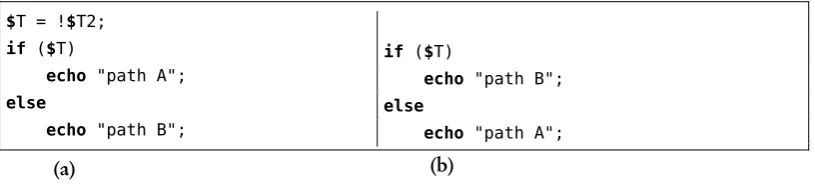
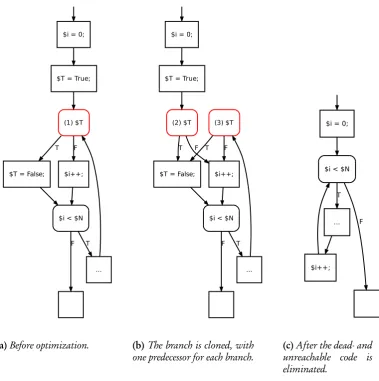
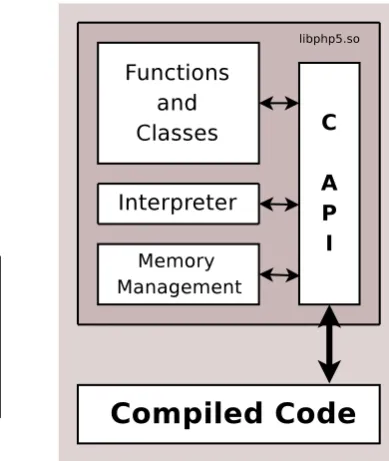
4.2 Removal of conditional statements in theremove loop booleanspass . 60 5.1 Interaction ofphcand the PHP C API . . . 80
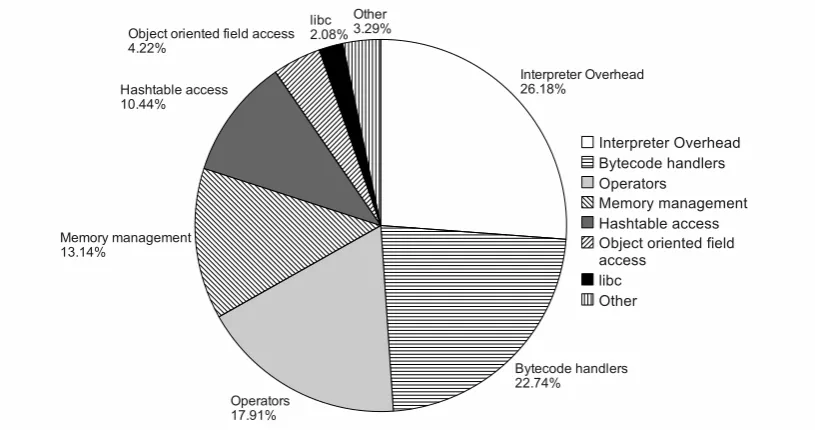
5.2 Profiling results of the PHP interpreter . . . 89
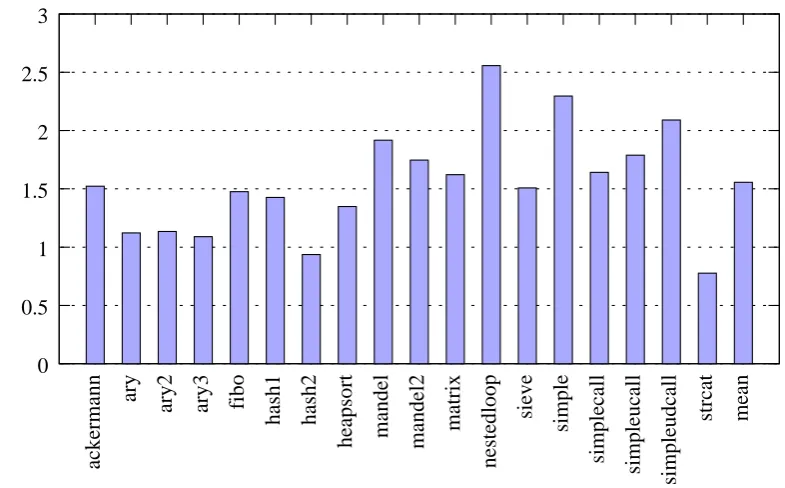
5.3 Speedups ofphccompiled code vs the PHP interpreter . . . 92
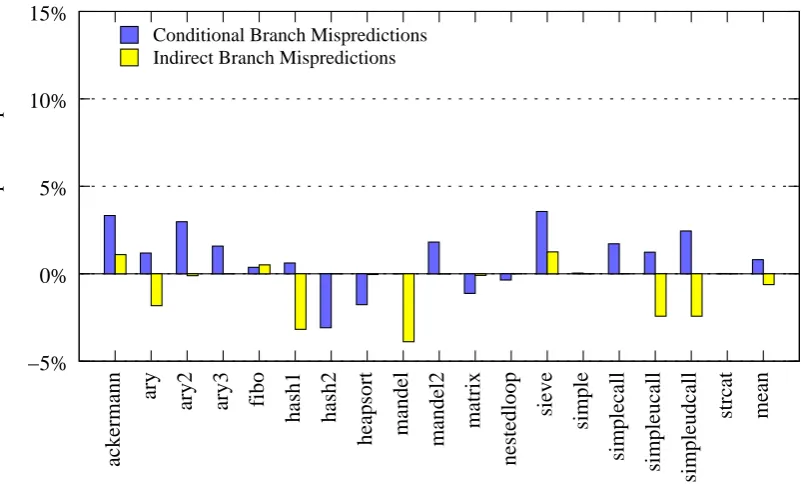
5.4 Relative memory usage ofphccompiled code vs the PHP interpreter . 92 5.5 Branch misprediction results . . . 94
5.6 Executed instructions and memory accesses results . . . 96
5.7 Speedups ofphccompiled code using FDO . . . 97
6.1 Selection of magic methods and object handlers . . . 110
6.2 PHP assignment memory representation . . . 114
6.3 Points-to graphs for Figure 6.2 . . . 126
6.4 Points-to graph . . . 128
6.5 PHP assignment memory representation . . . 130
6.6 Points-to graphs for Figure 6.5 . . . 130
6.7 Memory layouts for Listing 6.10 . . . 131
6.8 Literal propagation semi-lattice . . . 133
6.9 Peak references per variable in the analysed benchmarks . . . 142
6.10 Peak types per variable in the analysed benchmarks . . . 143
6.11 Branches removed in the analysed benchmarks . . . 144
6.12 Dead code eliminated in the analysed benchmarks . . . 145
List of Tables
2.1 Popular scripting languages and their uses . . . 8
2.2 Popular scripting language features . . . 9
4.1 AST passes . . . 55
4.2 Passes to lower the AST into HIR . . . 55
4.3 Passes to lower the HIR into MIR . . . 56
4.4 MIR passes . . . 56
4.5 Optimization passes . . . 56
4.6 Code generation passes . . . 57
5.1 Package statistics for 581 PHP code packages . . . 99
5.2 Dynamic features in PHP code . . . 99
6.1 Characteristics of analysed benchmarks . . . 141
List of Listings
3.1 Example of HSSA form . . . 32 3.2 Program which can be better optimized using a combined analysis
than iterating over separate analyses . . . 38 4.1 Dynamic class declaration at run-time . . . 49 4.2 Array assignment by reference . . . 49 4.3 Method invocation by reference . . . 50
4.4 Aforeach-loop in the AST and MIR . . . 51
4.5 for-loop in the AST and HIR . . . 53
4.6 A demonstration of theif-simplification pass. . . 59 5.1 PHP code demonstrating dynamic, changing or unspecified language
features . . . 71 5.2 phcgenerated code is called via the PHP system . . . 81
5.3 phcgenerated code for$i = 0 . . . 82 5.4 phcgenerated code forfile_get_contents($f) . . . 82 5.5 phcgenerated code forinclude ($TLE0) . . . 83 5.6 String concatenation benchmark . . . 87 6.1 Example of the use of variable-variables . . . 108 6.2 Example of field use without declaration . . . 109 6.3 Example of intransitive equality operations . . . 111 6.4 Example of implicit type conversions . . . 112 6.5 Assignment by copy . . . 113 6.6 Assignment by reference . . . 113 6.7 Example of dynamic aliasing in PHP . . . 114 6.8 Examples of implicitly created values . . . 116 6.9 Example of C++references . . . 120 6.10 A short program with reference assignments and an array . . . 131
CHAPTER1
Introduction
1.1 My thesis
My thesis:Compiling scripting languages using an ahead-of-time compiler is possible and valuable.
The world of programming is currently undergoing a language renaissance. In partic-ular, dynamic scripting languages are becoming incredibly poppartic-ular, providing many features above those provided by large incumbents such as Java, C and C++. Perl is the language of system administration; PHP the server-side language of the internet; Javascript the client-side language the internet. Lua is currently the titleholder of embedded languages for scripting C and C++applications, enjoying a particular niche in the gaming industry. Python and (to a lesser extent) Ruby are perhaps the future of scripting languages — powerful, elegant, generalist languages with staunch and devout followers, which are slowly replacing Perl and encroaching on PHP.
Despite this massive surge in interest, the research community has been somewhat silent on the issue. In personal conversations, I find many researchers do not see the point of scripting languages. As experts in many programming languages, nearly all of them statically typed, the dynamic typing which seems so freeing to the average programmer instead seems unappealing to the programming language researcher.
At the same time, the scripting language community cares little for 60 years of compiler research. Modern scripting languages are closer to two decades old than one, yet they are mostly implemented using interpreters (and often not-very-good interpreters). Although most enthusiasts yearn for speed in their applications, most of the scripting language communities solve speed issues by rewriting their performance sensitive code in C. Two steps forward, one step back.
My aim is to bridge the gap between these two worlds. This dissertation describes the design and implementation ofphc, an ahead-of-time compiler for PHP. It aims to
provide the basis for scripting language research, and show to the scripting language community that compilers are useful.
1.2 A Compiler for a Scripting Language
Most dynamic scripting languages are interpreted. This offers great flexibility and speed of development by removing thecompilestep. However, compilers are valuable tools for programmers.
The most important benefit which can be provided by a compiler is execution speed. Dynamic scripting languages have dynamic type systems, which require a lot of run-time type checks. PHP also has run-time reference behaviour, which must be checked on the majority of run-time value accesses. By providing static analyses at compile-time, a compiler can avoid many of these slowdowns.
Many important compiler optimizations make it easier for programmers to write pro-grams. Optimizations such as constant propagation and loop-invariant code motion allow programmers to think about their programs at a slightly higher level, to avoid manual program optimization, and can reduce the cost of meta-programming facilities. Interpreted scripting language implementations force the user to be responsible for their own optimizations, which can decrease programmer productivity.
PHP is a language used mostly on the internet. One of the most important aspects of a web site’s usability is its response time[Schurman and Brutlag, 2009]. However, a site’s response time is affected by many systems: the server must be contacted over the internet, the web application run, the database consulted, the answer returned over the internet, and the web page must be rendered in the user’s browser. This does not leave a large amount of time for the web application code to run.
Even in cases where PHP is not the bottleneck[Lerdorf, 2008], PHP programs are still limited in their ability to process data by the constraints of operating in a web environment. By providing a faster implementation, web applications are freed to do more in the same amount of time.
For other components of a web application, it is possible to improve performance. Databases access time may be decreased through faster hard drives, more memory and through caches such asmemcached.1 Network latency can be reduced by adding
redundant servers and more bandwidth. Currently, the PHP execution time can only be decreased by increasing the speed of the processor, itself a challenge of late. Compilation provides another compelling means to do this.
1.3. Terminology 3
Large web companies use arrays of thousands of computers to host their websites. An increase in the speed of PHP of just 20-30% could free thousands of machines to be used for other purposes, to expand services to more users, or which could just be turned off. Compiler optimization can even help save the environment.
Finally, compilers can be used in a vast range of tools to support programmers. Type-analysis, call-graphs and pointer information can aid code viewers, program understanding, integrated development environments (IDEs), program verification, and bug-finding tools. These have long been available for popular languages such as Java, but have been lacking for scripting languages because the frameworks for analysis have been unavailable.
1.3 Terminology
Terminology related to scripting languages can be confusing, as thecanonical imple-mentation of a language often has the same name as the language. The problems of canonical languages are discussed in great detail in Section 5. The Python commu-nity often refers to the canonical Python implementation asCPythonto avoid this ambiguity.
In PHP, there are no existing conventions along these lines. In this dissertation I have used ‘PHP’ to refer to the PHP language. The PHP language is defined by a canonical implementation which can be downloaded from php.net. This implementation I refer to as the ‘PHP system’. Thephccompiler is another implementation of the PHP
language.
1.4 Attribution
Most research is built upon the foundation laid by others, and this dissertation is no exception.
Thephcfront-end, which includes the scanner, parser, and the design of the AST, was
written by de Vries and Gilbert[2007]. They are also the authors ofmaketea[de Vries
and Gilbert, 2008], which generates code to supportphc’s intermediate representations
De Vries was also a co-author of Biggar et al.[2009], a journal version of which is in preparation. This version is an earlier version of Chapter 5 in this dissertation. De Vries also wrote the original code generation inphc. The HIR and MIRs (see
Section 4.2) were designed based partially on lowering passes which De Vries wrote.
Jimmy Cleary, a computer science undergraduate student at Trinity, worked as an intern in our research group during the summer of 2009. During this time, he:
• reengineered the HSSA form (see Section 6.5.5), fixing a large number of bugs, especially related to the dead-code elimination pass,
• fixed bugs in theif-simplificationandremove-loop-booleansoptimization passes, discussed in Section 4.6.2,
• wrote a pass to gather statistics from the optimizer, and scripts to convert those statistics into the graphs shown in Section 6.6.
The remaining work in this dissertation is mine. I:
• greatly expanded the lowering passes to handle a much larger portion of the PHP language,
• designed and implemented the HIR and MIR, described in Section 4.2,
• meticulously detailed the eccentricities of the PHP language, described in Sec-tions 4, 5.2 and 6.2,
• came up with the idea to link the interpreter intophcand the generated code,
described in Section 5,
• integrated the PHP system into the compiler, as detailed in Sections 4.5 and 5.4,
• rewrote the generated code to support more of the PHP language, and in a manner which could be optimized,
• wrote all of the optimizations described in Section 5.4.5,
• performed the experiments and evaluation in Sections 5.7 and 6.6,
• wrote the static analysis and optimization framework described in Chapter 6,
1.5. Published Research 5
1.5 Published Research
Parts of the research which appears in this dissertation have been published, are in submission, or in preparation in the following venues:
Published in peer reviewed publications:
• P. BIGGAR and D. GREGG, One Representation to Rule Them All,PLDI ’09 FIT Session
• P. BIGGAR, E. DE VRIES and D. GREGG, A Practical Solution for Scripting Language Compilers,SAC ’09: ACM Symposium on Applied Computing (2009)
In submission or preparation:
• P. BIGGAR, E. DE VRIES and D. GREGG, A Practical Solution for Script-ing Language Compilers ( Journal Version),Submitted to Science of Computer Programming, July 2009
• P. BIGGAR and D. GREGG, Static Analysis for Dynamic Scripting Languages,
In preparation for submission to ACM SIGPLAN 2010 conference on Programming language design and implementation
• P. BIGGAR and D. GREGG, PHP Experience Report (working title), In preparation as a chapter in Static Single Assignment Book (working title)
Research talks:
• P. BIGGAR and D. GREGG, On the use of SSA with scripting languages,
Static Single-Assignment Form Seminar, Autrans, France (April 2009).
• P. BIGGAR and D. GREGG, Compiling and Optimizing Scripting Languages,2
Google, Mountain View, CA andLawrence Livermore National Labs, Livermore,
CA (March 2009).
1.6 Structure of this Dissertation
This dissertation has the following structure:
• Chapter 2 introduces scripting languages, their characteristics, and existing research on their implementation.
• Chapter 3 introduces program analysis, and discusses existing research on alias analysis, type analysis, SSA, combined analyses, analysis of scripting languages.
• Chapter 4 describes the structure of phc, design decisions made during its
development, and provides an experience report of creating a scripting language compiler. This chapter includes work presented in “Compiling and Optimizing Scripting Languages”, “One Representation to Rule Them All”, and “On the use of SSA with scripting languages”, and to be published in “PHP Experience Report”.
• Chapter 5 deals with compilingcanonical languages—languages defined by a single implementation. Scripting languages generally fall into this category. This chapter describes the first compelling means to combine ahead-of-time compilation with interpreted scripting languages. This chapter is based on “A Practical Solution for Scripting Language Compilers”.
• Chapter 6 deals with static analysis of PHP, particularly for optimization, and its implementation in phc. This builds on and corrects previous research on
PHP static analysis, and is the most complete static analysis to date for the PHP language. This chapter is based on “Static Analysis for Dynamic Scripting Languages”.
CHAPTER2
Scripting Languages
This dissertation discusses creating a compiler for PHP, a popular scripting language. A great deal of the information presented in this dissertation is applicable to other scripting languages, such as Perl, Python, Ruby, Javascript and Lua. This chapter provides background information on scripting languages, in particular discussing their features, type systems and programming styles. It also discusses the research into scripting language implementation, particularly run-time type-based optimizations for dynamic languages.
2.1 Background
This dissertation discusses analysis and implementation techniques for a set ofscripting
languages. In this section, I discuss the important features of languages in this subset.
The exact definition of a scripting language is somewhat unclear, as is the full set of languages which fall into this category. An early use of the termscripting[Ousterhout, 1997] names some scripting languages, and explains their use and advantages, but omits an attempt at a definition.
The simplest definition of a scripting language is a language designed or used princi-pally toscript, or drive the actions of a larger application. However, this definition is flawed, because popular scripting languages are used for application development, and many other languages have support for scripting.
The term ‘scripting language’ is commonly used to describe languages with a common features set, discussed in this section. This is how the term is commonly used, and so we too use this ‘definition’. In this dissertation, the termscripting languagerefers to Javascript, Lua, Perl, PHP, Python, and Ruby, which are probably the most important languages for large-scale scripting today. Other common scripting languages which we do not discuss in this dissertation include Bash, Visual Basic, Tcl and ASP.
The termscriptingimplies a program which directs the actions of a larger program; a common term for a scripting language is a gluelanguage. There are many ways
to script applications. For example, Javascript is most commonly used as a way to manipulate HTML pages in a browser. The HTML pages are exposed to a Javascript program via the Document Object Model[Keith, 2005]. A simple Javascript program might check that all the fields of a web form are filled in before submission to the server. More complex Javascript programs include email clients such as Gmail, or word processors and spreadsheet packages provided by Google Docs.
2.1.1 Uses of Scripting Languages
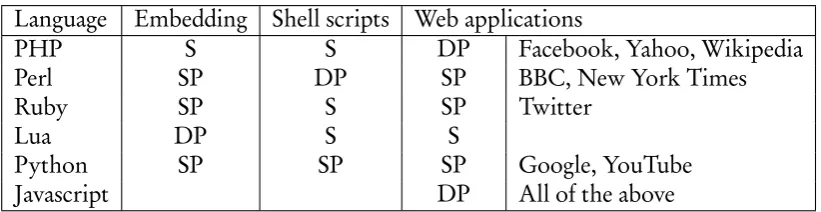
The scripting languages discussed in this dissertation have much in common. In particular, they are all designed and used for similar purposes, for scripting larger C/C++applications, for shell scripting in the Unix environment, and for writing web applications. Table 2.1 shows the major uses of scripting languages, which languages support the uses, and which ones were designed for it.
Language Embedding Shell scripts Web applications
PHP S S DP Facebook, Yahoo, Wikipedia
Perl SP DP SP BBC, New York Times
Ruby SP S SP Twitter
Lua DP S S
Python SP SP SP Google, YouTube
[image:32.595.86.497.360.466.2]Javascript DP All of the above
Table 2.1: Popular scripting languages and how they are used; ‘Web applications’ indicates
a language is used for scripting web application, ‘Embedding’ indicates the language can be
embedded into C/C++applications, ‘Shell scripts’ indicates it is used for shell scripting.Dmeans
the language is designed for the indicated purpose,Smeans the indicated purpose is supported,P
means the language is popularly used for the indicated purpose.
Scripting language implementations can often be embedded into C or C++programs, to provide a scripting interface to an end-user. Lua is designed expressly for this purpose, and it is estimated that over 50% of video games shipped with a scripting environment use Lua.1Muhammad and Ierusalimschy[2007]provide a comparative
analysis of these interfaces. Visual Basic is also used for scripting components of the Windows operating system.
Scripting languages are often used forshell scripting: to manipulate the output of Unix programs. Unix shells, such asbash,kshandzshare simple languages designed for
this purpose. Perl was also designed for this purpose, in particular to replace the
1Mark de Loura surveyed approximately 100 ‘game executives’, published online at
2.1. Background 9
lower-level toolsawkandsed. It offers very powerful facilities for manipulating the
output of external programs. Tcl also once filled this niche.
The largest and fastest growing area in which scripting languages dominate is in the design of web sites and web applications. PHP is currently available on more than 20 million web servers. Itscripts the output of databases based on user input from HTTP forms. Ruby is also important in the area, using the Ruby on Rails framework. Python and Perl are also often used for programming web sites. Table 2.1 shows popular web applications built using each scripting language.
Finally, scripting languages are being used more and more for writing whole appli-cations. Python in particular is being used for large applications, such as Mercurial, SCons, BitTorrent and Bazaar.
2.1.2 Scripting Language Feature Overview
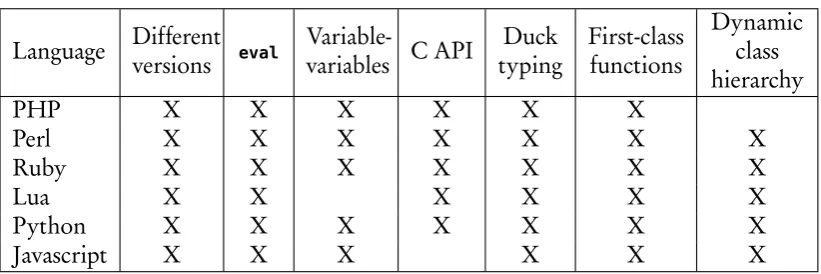
Most scripting languages have a single canonical implementation, which is interpreted. The design of the languages and programs written in them often reflect this inter-preted history; important language features include run-time code generation, a C API, variable-variables, dynamic class hierarchies, and other features which are straight-forward to implement in an interpreter. Table 2.2 shows exactly which features are available in which scripting language.
Language Different versions eval
Variable-variables C API
Duck typing
First-class functions
Dynamic class hierarchy
PHP X X X X X X
Perl X X X X X X X
Ruby X X X X X X X
Lua X X X X X X
Python X X X X X X X
[image:33.595.100.511.498.635.2]Javascript X X X X X X
Table 2.2: Popular scripting language features;Xindicates the feature is present in a language.
The scripting languages we discuss in this dissertation are all imperative, dynamically typed languages. No language we discuss requires or supports type declarations.2Only
Perl even supports variable declarations.
Scripting languages all have facilities for manipulating the symbol-table, and for using strings as program code, at run-time. This provides support for accessing variables by name at run-time (variable-variables), as well as supporting theevalstatement.
Scripting languages commonly include C APIs, which are part of the language. These C APIs are used as foreign function interfaces, and to write the languages’ standard li-braries. C APIs are discussed in more detail in Section 5, and compared by Muhammad and Ierusalimschy[2007].
An idiomatic scripting language feature is table support: all scripting languages have syntactic support for hashtables and use them as the principal data structuring unit. In fact, Python is the only scripting language to differentiate between lists and tables. The object models of Javascript, Lua, PHP, Python, Ruby are based on implementing objects using tables. As a result, most scripting languages are duck-typed (duck-typing), as discussed in Section 2.1.3.
From a language point of view, scripting languages store functions, method, modules, and classes in tables (dynamic class hierarchy). The tables allow these features to be replaced on the fly at run-time. Scripting languages also support first-class functions, but their use is not nearly as common as in higher-order or functional languages such as Scheme, Lisp, Haskell or OCaml. As such, scripting languages strongly resemble older dynamic languages: Ruby, Python and Javascript are very similar to Smalltalk and Self. However, PHP does not support dynamic class hierarchies, so we do not discuss them further.
Finally, most scripting languages have strong support for string operations, important for web application and shell scripting. Perl and Ruby both include syntactic support for regular expressions.
2.1.3 Scripting Language Type Systems
Many of the features which make scripting languages different from other program-ming languages relate to how they aretyped. Informally, a language’s type system is a
2Although PHP allows optional type annotations on function parameters, which are used for run-time
2.1. Background 11
means of specifying the values which are allowed in a language, and the operations allowed on those values. The facets of a scripting language’s type system can be used to classify the language, and a scripting language’s feature set is often affected by it’s type system. Table 2.2 shows that the scripting languages we discuss are all dynamically typed, duck-typed languages.
Dynamic Typing
Informally, dynamic typing means that types are associated with run-time values. This is in contrast to static typing where types are associated with compile-time names such as variables or class fields. Commonly this means that a variable in a statically typed language may only hold values of a specified type, while a variable in a dynamically typed language may hold a value of any type. Dynamic typing is also known aslatent
typing.
The important difference between statically and dynamically typed languages is in type checking. Statically typed languages perform type checking statically, attempting to prevent errors before the program is run. Dynamically typed languages instead perform type checks at run-time. Arguably, as dynamic typing is used to mean dynamic checking, ‘dynamic typing’ is a misnomer, but the term is in common use[Pierce, 2002].
Duck Typing
Dynamic typing in scripting language is also used to supportduck typing. Duck typing is better described as a programming style than a type system, but it relies on dynamic language features commonly found in scripting languages’ type systems.
Duck typing, as a term, comes from the Python community, although the concept is older. It is attributed to Alex Martelli, in a post to comp.lang.python:
“In other words, don’t check whether it IS-a duck: check whether it QUACKS-like-a duck, WALKS-like-a duck, etc, etc, depending on exactly what subset of duck-like behaviour you need to play your language-games with.”
the same manner as a nominal type system[Pierce, 2002, Section 19.3]—a better programming style is to instead rely on the object’s run-time behaviour. Thetypeof the object therefore depends on itscurrentfields and methods, at the time that the object is used. As a result, the type system may support changing an object’s fields and/or methods at run-time, including adding and removing them on a per-object basis.
Weak Typing
Weak typing is ostensibly the opposite of strong typing, though it has no formal
definition. Both these terms are heavily overloaded, and it is not clear what they mean[Cardelli, 2004].
Weak typing is often considered to mean that values may be implicitly converted between scalar types, a definition commonly used in the scripting language commu-nity. However, other people use it to mean the same as dynamic typing, that unsafe conversions are allowed[Cardelli, 2004], that type conversions with an undefined meaning are possible, or that type checks are omitted. It is also used to mean that it is possible to evade the type system, for example, using C casts. Occasionally, it is used to imply that one language is inferior to another.
The popular meaning in the dynamic language community (implicit conversions) is perhaps a poor definition. Casts in most dynamic languages create new values from existing values, and are therefore safe. It is not possible to view the bits of a value of one type as another, as it is in C, where there are loopholes in the type system. Similarly, implicit conversions are well defined at run-time (though they are rarely specified in prose, a separate problem).3
Chris Smith’s definitions4ring true with how I’ve most often seen the terms used:
“Strong typing:A type system that I like and feel comfortable with.”
“Weak typing:A type system that worries me, or makes me feel uncom-fortable.”
Overall, because the term is not defined unambiguously, it is best not to use it. In this
2.2. Run-time Type Feedback 13
dissertation, I omit the term ‘weak typing’, and instead refer to ‘dynamic typing’ or
‘implicit type conversions’ as necessary.
2.1.4 PHP
PHP was originally created as a domain specific language for templating HTML pages. PHP is a short form of its original name ‘Personal Home Page/Forms Interpreter’. It was since renamed to ‘PHP Hypertext Preprocessor’.
PHP has gone through several versions since its release in 1995. In this dissertation, we discuss PHP 5, the most recent version. The PHP language is described in detail in Section 6.2. Its canonical implementation is described in Sections 5.2 and 5.5.
The first versions of PHP were implemented in Perl. PHP’s major influence is Perl, and it has similar syntax and semantics, including a dynamic type system with implicit type conversions, powerful support for hashtables, and garbage collection. PHP programs are typically web applications, and PHP is tightly integrated with the web environment, including extensive support for databases, web-servers, and HTTP and string operations.
PHP has a dynamic type system, with symbol-tables based on hashtables. PHP is not a fully duck-typed language. In particular, its classes are closed, and an object may not change its class once it is instantiated. While its fields are malleable, its class hierarchy is static, and an object’s methods may not be changed at any time.
PHP is a hybrid object-orientation/procedural language, due to its history. Early versions of PHP did not support object-orientation, which was grafted into PHP 3. PHP 5 changed the object model so that objects were not copied by default. This legacy is still visible in the current language; in particular PHP references, discussed in detail in Section 6.2.11.
2.2 Run-time Type Feedback
instead on virtual machine research for dynamic languages, particularly in the area of feedback-based type analysis.
Run-time type feedback is used by just-in-time ( JIT) compilers[Aycock, 2003]to optimize generated code based on type information collected at run-time. JIT compil-ers compile source or bytecode to native executable code at run-time. That is, their
run-timeandcompile-timephases are intermingled. As a result, they can collect type
information during execution, which can be used for optimization at compile-time. There are a number of run-time type feedback (hereaftertype feedback) techniques available.
2.2.1 Research on the Self Programming Language
The Self research project[Ungar and Smith, 1987]produced three generations of run-time compilers, all of which used type-based optimizations. Many of Self’s features are dynamic, and the Self JIT compilers were designed to execute these features quickly.
The first generation compiler[Chambers and Ungar, 1989]JIT compiled a method at a time. It optimized a significant amount of Self’s dynamic features using compile-time type-inference. The type inference algorithm used was iterative type analysis[Palsberg and Schwartzbach, 1991], discussed in Section 3.4.2.
As a method’s dynamic dispatch is expensive, it used inline caching to speed up the invocation. In this scheme, a call-site was backpatched with the address of the compiled method after compilation. The compiled method first performed type checks to ensure that it had the correct receiver—if not, the call was redirected towards the general dispatch mechanism. Agesen and Hölzle[1995]report this optimization to be successful 95% of the time. The first compiler could also inline small methods, and replace field accesses (which would typically involve a method invocation) with simple dereferences.
A number of other techniques were developed to support compilation based on types. If a variable could have multiple types after a control-flow join,message splitting is used to duplicate statements after the join. This allows variables to have single types in each statement, instead of merging the type information.
Type predictioncompiles based on the idea that some methods are nearly always called
2.2. Run-time Type Feedback 15
of the time, according to benchmarks[Chambers and Ungar, 1989].
Finally,maps[Chambers et al., 1989]allow efficient implementation of duck-typing. As object fields are not declared, but added and removed at run-time, it is impossible to have a static object layout. To rectify this, objects are implemented usingmaps. Maps have a known number of fields, and the fields can be accessed with a single dereference. If a field is added to an object, its map (and therefore its type) changes. As a result, maps allow duck-typed languages to be compiled efficiently, in a similar fashion to class-based languages such as Smalltalk.
The second generation Self compiler[Chambers and Ungar, 1990]added a number of extra optimizations, includingextended splitting. This was an extension of message splitting which allowed whole paths to be split. In particular, this had large advantages for the quality of type information available to the compiler in loops.
The third generation Self compiler[Hölzle and Ungar, 1994]used significantly more type feedback than before. Run-time types are recorded using aPolymorphic Inline
Cache(PIC)[Hölzle et al., 1991]. This is an extension of aninline cachewhich can
store more than one type.
Based on these run-time types, the compiler can optimistically inline a called method. Techniques from previous Self compilers are also improved with better type infor-mation. The compiler also recompiles code over time, based on improved type information, a technique also used in mixed-mode interpreters [Suganuma et al., 2002].
2.2.2 Comparison with Type Analysis
Type analysis, discussed in Section 3.4, is a complementary technique to run-time type feedback. Type analysis is typically performed ahead-of-time, and can lead to the removal of type checks and dynamic dispatch. In a perfect world, compile-time type analysis would lead to perfectly efficient code. In practice, because type analysis is a static technique, it must be conservative, and often cannot compete with the accuracy of run-time type feedback. However, run-time type feedback has a run-time overhead, when compared to type analysis.
method dispatches. However, type-feedback was determined to be significantly more powerful for integer programs. In Self, arithmetic operations between two integers can lead to overflow, in which case the type of the result of the operation would be a
BigInteger. As such, pure type analysis cannot infer that the result of the operation is an integer. However, run-time type feedback can discern this. As a result, in Agesen and Hölzle’s experiments, programs compiled with type-inference ran 70% slower than those compiled using type feedback.
2.2.3 Application to Scripting Languages
Compilation techniques designed for Self were mostly aimed at eliminating dynamic dispatch and efficiently compiling objects in a language where all types are objects. These optimizations are also important for dynamic scripting languages. Recent dynamic language implementations have reused the optimizations. V85 uses
hid-den classes, a run-time analysis equivalent to Self’s maps, to efficiently JIT compile
Javascript programs. Polymorphic Inline Caches are used by SquirrelFish Extreme6
for the same purpose.
Scripting languages also use type analysis to generate efficient code for numeric computation.Specializationis a technique for efficient compilation of numeric values,
andtracesextend the granularity over which specialization can be performed.
Specialization
Psyco[Rigo, 2004] is a JIT compiler for Python which usesspecialization.
Special-ization means compiling methods specially based on the types or values of their
arguments. For example, a function called with two integer arguments would be compiled differently to the same function called with two floating point arguments.
The Psyco specializer differs from previous work, in that it does not use profiling or statistics. Instead, it runs completely lazily, compiling a function any time it is called with a new set of types. In addition, it also compiles a function lazily, stopping half-way, waiting until more run-time information information about a value is available by executing the function, and then continuing compilation. It then specializes based on this progressively more specific information about run-time types.
2.2. Run-time Type Feedback 17
Traces
Atrace-basedJIT compiler profiles a program, gathering type information at run-time.
It uses this type information to optimize the generated code according to the actual types of the program. As such, it is very similar to the type-based feedback found in Self compilers, as well as Psyco’s specialization. The important distinction of a trace-based JIT compiler is that it does not necessarily use functions or methods as its compilation unit.
TraceMonkey[Gal et al., 2009]is a trace-based compiler for Javascript, which is part of Mozilla Firefox. It records frequently executed (hot) sequences of instructions and compiles them to native code. This sequence of instructions—thetrace—forms a loop, which may cross method boundaries. A trace has a single type associated with each variable in the program. The compiler speculates that this set of types will be static for future iterations, but it cannot be certain. As such, it must add guards at various points to exit the trace. Theseside-exitsmay themselves become hot, and be combined into an existing trace to form a trace-tree. A single tree may have many branches, depending on how mutable variables types are in the program. TraceMonkey reports speedups of 2–20x over the existing bytecode interpreter.
Type-based Interpreters
Although these techniques are typically applied to JIT compilers, type specialization can also be performed in interpreters.Dynamic interpretation[Williams, 2009]is a technique to record type information in aDynamic Intermediate Form(DIR). It was implemented for the Lua scripting language.
The DIR is a combined control-flow and type-flow graph. Its nodes are bytecode instructions, and its edges are either control-flow or type-flow edges. Type-flow edges allow the interpreter to build complete program paths on which all the types of all variables are known. Each of these paths is built at run-time based on the concrete types in the program.
After a statement is executed, the type of its result is used to determine its successor. If its successor node is not known, then a node with the correct instruction and set of types is sought. If such as node is not found, a new node is created. Each node stores the full set of types at that program point, so that it may be searched for, and so that it will know the types to search for in its successor. As long as there are no type changes in the program, no new nodes will be built.
Based on this type feedback, the dynamic interpreter uses type-specialized bytecode. The types of an operand are known when the node is built. The next time the node is executed, the operands are guaranteed to have the same types, and so type-checks are avoided. This technique is particularly effective on arithmetic statements, which have traditionally been slow to interpret. In his experiments, Williams reports a speedup of 2.6x in the best case. In the average case, their speedup is 1.45x. They achieve particular speedups on benchmarks implementing numeric algorithms and loops, but not on those that use method dispatch.
2.3 Summary
This chapter provides background information on scripting languages. It describes their feature set, how they are used, and their type systems. It discusses important literature on the implementation of dynamic languages, particularly related to run-time, type-based feedback. It compares it to type-analysis, and discusses how it is used in modern scripting languages.
CHAPTER3
Program Analysis
Program analysis is a technique for determining properties of a program. In this chapter, we discuss static program analyses. A static program analysis attempts to determine program properties ahead-of-time. In Chapter 2 we discussed some techniques which use run-time, or dynamic, analysis.
This chapter begins by introducing dataflow analysis. Alias analysis is discussed in great detail, and type analysis, combined analysis, and the SSA form are all discussed, These analyses form the basis for the static analyses we develop in Chapter 6.
3.1 Dataflow Analysis
The static analyses in this chapter can typically be considered to bedataflowanalyses. A dataflow analysis is one which statically models the flow of values in a program at run-time.
A dataflow analysis is formulated over acontrol-flow graph. A control flow graph (CFG) is built for each function in a program, and is a graph in which the nodes arebasic
blocks, and the edges represent the function’s control-flow. Abasic blockis a maximal
list of consecutive statements with one entry point and one exit point. The CFG has
entryandexitblocks for the entry and return points of the function.
Analyses are oftenset-based, that is, they propagate sets of information. A dataflow analysis is classified by how the sets are propagated. An analysis is eitherforwardsor
backwards. A forwards analysis propagates program information from a block to its
successor. A backwards analysis propagates program information from a block to its predecessor. From here on, we shall discuss forwards analyses.
At each block, an analysis combines its predecessors’ sets, adds and removes elements from the set, and passes the sets to its successors. The predecessors sets are merged by either set union or set intersection. For each block,genandkillsets are created, which add and remove information from the set. This process is typically organized using
transfer functions, which specify which additional items should be killed and which
additional items should be added to the sets.
Thegenandkillsets are used to statically approximate the run-time behaviour of a statement. The components of a statement which are mapped into those sets are called
lvaluesandrvalues. Anlvalueis value which may be written to during a statement,
and anrvalueis a value which may be read from during a statement.
As a concrete example, consider areaching definitionanalysis[Aho et al., 2007, Section 9.2.4]. Reaching definitions at a point in the program are definitions whose values reach that program point. It is a forwards analysis, propagating sets of definitions from blocks to their successors.
To begin the analysis, all blocks are initialized to the empty set. Blocks have both input (IN) and output (OUT) sets. A block’s IN set is the set union of all of its predecessors’ OUT sets. A block’s OUT set is determined with the following transfer function:
OU T =GEN∪(I N\K I LL)
GEN are the solutions generated in a block. In this example, they are the set of definitions created in the block. The KILL set contains the definitions invalidated by this block.
The transfer functions are iteratively applied to all blocks. When no solutions have changed, the algorithm is said to have reached afix-point, that is, no solutions changed. This is often implemented using aworklist algorithm, in which the successors of changed blocks are added to a list to be processed again. Most static analyses can be expressed using variations on this framework, even if they do not use sets.
In the next section, we look at alias analysis, an application of dataflow analysis which is central to this dissertation.
3.2 Alias Analysis
Alias analysisis a program analysis aimed at discovering program properties related to
aliasing, defined by Landi and Ryder[1991]:
3.2. Alias Analysis 21
A great deal of research over the last 20 years has been dedicated to the research of pro-gram analyses to detect aliasing. Alias analysis is related topoints-to analysis[Emami et al., 1994], pointer analysis [Hind and Pioli, 2000], mod-ref1 or side effect
analy-sis[Landi et al., 1993]andmay-aliasinformation[Cytron and Gershbein, 1993]. In this dissertation, we shall refer to all of these asalias analysis, as the overlap between them is so great that it is not worth distinguishing between them for our purpose. Alias analysis also has close ties toescape analysis(see Section 3.2.3) andshape analysis
(see Section 3.2.5).
Powerful alias analysis techniques became important due to the interest in analysing C and C++programs. As a result, the study of alias analysis can be roughly split into four eras:
1. Prehistory
2. Ascendency: The formulation of important techniques, during the 1990s.
3. Diversion: A short time with a lot of research into escape analysis
4. Scalability: Recent research has focussed on scaling alias analysis to millions of lines of code
3.2.1 Pre-history
Pre-historyrefers to early research which shaped the development of alias analysis. A
number of the important techniques described in Section 3.2.2 were developed during this time.
Work on alias analysis evolved from earlier work on Fortran. Fortran’s memory model is significantly less powerful than that of C and C++, and it restricts the ability of the programmer to create aliases. As a result, Fortran did not require powerful alias analysis techniques. As research into C programs became more important, existing techniques of analysis were used as building blocks.
analyses operated on a graph of dynamically allocated objects, building the graph as the program was analysed.
The major contribution of this era was creating the building blocks that were used later on. The major focus of the research from this era was developing techniques for naming different objects created at the same allocation site, which is similar to the goals of modern alias analyses. Among a number of important developments was the ability to identify recursive structures such as linked-lists[Jones and Muchnick, 1982]. Larus and Hilfinger[1988]showed how to model strong updates when an analysis could prove that a variable is killed, which is the basis for modern flow-sensitive
algorithms. Interprocedural analysis[Chase et al., 1990, Cooper and Kennedy, 1988,
1989] andk-limited[Horwitz et al., 1989, Jones and Muchnick, 1979, Larus, 1989,
Ruggieri and Murtagh, 1988] naming schemes, were both investigated, which are closely related tocontext-sensitivityandobject-sensitivity, discussed in the next section.
This early work also provides a foundation forshape analysis, which attempts to identify recursive data structures such as trees and linked-lists[Jones and Muchnick, 1982]. Escape analysis—statically identifying the scope of heap-allocated memory— descends from work to detect the lifetime of objects in a program [Ruggieri and Murtagh, 1988].
3.2.2 Ascendency
The second era of alias analysis research began with attempts to model the aliasing behaviour of C. It can be considered to start approximately with Landi and Ry-der’s[1991]classification research, in particular noting the complexity of analysing C as compared to Fortran. The era characterized largely by the systematic exploration of the parameters of powerful alias analyses.
A number of important alias analysis algorithms were developed in this time, with similar approaches. For example, we describe Andersen’s[1994]analysis:
3.2. Alias Analysis 23
• Given all the aliases, solve the solution, creating a single set of aliases for the whole program. The result is a graph with edges between names which are aliases.
Burke et al.’s[1994]and Choi et al.’s[1993]algorithms are superficially different, using dataflow-style algorithms to iterate through the statements of the program, updating a solution set of aliases as they proceed. However, their net result is very similar: one or more graphs with names for nodes, and edges indicating possible aliases between the names, at particular points in the program.
The major analyses of the era differ in a number of important parameters, which affect their performance (this is, the speed of the analysis) and precision:2
naming-schemes: Many alias analysis algorithms differ in how they name memory locations. Different naming techniques strongly affect the speed and precision of an analysis. If a single name can refer to more than one piece of memory, that memory isabstract; otherwise it isconcrete.
Two important components which affect how naming schemes are used are
context-sensitivityandobject-sensitivity.
context-sensitivity: Interprocedural analysis algorithms typically use either a
call-stringor afunctionalapproach[Sharir and Pnueli, 1981]. A functional
approach attempts to create a model of a function which takes inputs and generates outputs. A call-string approach names objects based in some way upon the callgraph at the point of allocation.
For example, if memory is allocated in functionfoo, on line 12, a context-insensitive approach might name the memory ‘foo:12’. Iffoowas called from two different functions, two pieces of memory would have the same name. In a context-sensitive approach, the two callersbar1andbar2would lend their names to the memory. The result would be two pieces of memory which do not alias, namely ‘bar1:foo:12’ and ‘bar2:foo:12’.
Context-sensitive algorithms use calling context in their analyses, typically using the call-string approach. This allows it considers two pieces of mem-ory from the same allocation site to be different for two different callers. Fully context-sensitive algorithms can take exponential time[Landi and 2Different analyses use different names for the same ideas; we try to use accepted terminology from
Ryder, 1992], but context-insensitive algorithms can be much less precise, especially in the presence of factory methods (including C ‘constructors’). In general, the solution is to use a compromise, using only a small part of the call-stack in the name.
object-sensitivity: One important algorithm [Emami et al., 1994] chooses a single name to represent the entire heap, analysing only a function’s local variables. Others use the object’s static class—or concrete class if known—combining every object of the same type. Compared to the common technique of choosing a separate name for each allocation site, these techniques offers some performance benefits. With only one name per class, the total number of names may be significantly lower than using one name per allocation site.
flow-sensitivity: A flow-sensitive algorithm considers program flow, with new def-initions overriding old—these new defdef-initions are strong-updates or
killing-definitions. Flow-sensitive algorithms must iterate until reaching a fix-point,
reducing performance, especially when combined with context-sensitivity. A flow-insensitive algorithm removes any ordering between statements in a func-tion, and can only useweak-updates, sacrificing precision for performance.
field-sensitivity: Objects with fields can be analysed by representing each field indi-vidually for precision, or by limiting the number of fields represented (possibly to just one) for speed.
directionality: Given an assignment statement, an analysis usingunification[ Steens-gaard, 1996] will consider the lvalue to alias the rvalue, thereby sharing alias sets. An analysis which usesinclusion[Andersen, 1994]will only consider that the rvalue’s alias set must be a subset of the lvalue’s set. Therefore inclusion is more precise, but unification has greater performance, due to its symmetry.
representation: The size of the result set of an alias analysis can depend on its repre-sentation. Alias pairs[Landi and Ryder, 1991]consist of tuples with a list of names which can alias. They represent the tuple〈p,q〉separately from〈*p,*q〉.
Thecompact representation[Choi et al., 1993]instead represents edges between
names, in a similar fashion to apoints-to[Emami et al., 1994]representation.
3.2. Alias Analysis 25
The major analyses of the era vary in these parameters.
Both Andersen’s[1994]and Steensgaard’s[1996]algorithms are context- and flow-insensitive, modelling only stack variables. They both use only one solution for the whole program, but differ in their directionality: Andersen’s algorithm is inclusion-based; Steensgaard’s is unification-based. The result is that Steensgaard’s algorithm runs in linear time compared toO(n3)complexity for Andersen’s. Both algorithms’
run-times are very short for programs less than 3000 lines, but Andersen’s can be 10-100 times slower for large programs (6000-25000 lines)[Shapiro and Horwitz, 1997, Section 3.2]. The precision of the algorithms is also very different, with Andersen’s being significantly more precise[Hind and Pioli, 2000, Section 5].
Burke et al.’s [1994] algorithm is flow- and context-insensitive, and requires one analysis set per function. Its major difference from Andersen’s algorithm is that it is interprocedural. This makes the analysis more accurate because it does not consider unreachable functions, and uses a variable’s scope in its analysis. However, this appears to make little difference to the precision in practice, nor does it greatly affect the algorithm’s run-time[Hind and Pioli, 2000, Sections 5.1 and 5.6].
Choi et al.’s[1993]algorithm is flow- and context-sensitive and requires two solution sets per program point (control-flow graph node). However, it is only slightly more precise than Burke et al.’s algorithm, but an average of 2.5 times slower[Hind and Pioli, 2000, Section 5]. Its representation iscompact pairs, which are more compact
thanalias pairs. Compact pairs only represent basic aliases, deriving further alias
relationships through transitivity and commutitivity. For example, the pairs〈*a,b〉 (*aaliases b) indicates thatapoints-tob. Combined with the pair〈*b,c〉, we could derive the set〈**a, c〉. This is represented explicitly using alias pairs, but compact pairs omits this set, instead representing it implicitly.
Points-to analysis[Emami et al., 1994]differs from these algorithms in that it is fully
Simpler Forms of Alias Analysis
Address-takenalias analysis keeps all stack-locations which have their address taken (in
the sense of the C code:p = &x;) in a single set. The set also contains all heap names and global variables. This form of analysis is simple, easy to implement, and very fast, being linear to the size of the program. However, it is significantly less precise than Steensgaard’s[1996]analysis.
Type-based alias analysis[Diwan et al., 1998]uses a language’s strong typing rules to
restrict analyses. It relies on the fact that two memory locations cannot alias if their types are not compatible. Furthermore, two fields of the same object are not the same, even if they have the same type. These rules can be combined with a simple analysis such as Steensgaard’s, but the improvement is not significant[Diwan et al., 1998, Section 3.3].
3.2.3 Divergence
In the late 1990s, the interest in pointer analysis coincided with the explosion of interest in Java. The success of Java from its launch in 1995 led to a huge interest in in-dustry, undergraduate teaching and research material. In the field of program analysis, it kick-started a resurgence of JIT compiler technology, and led to the development of advanced garbage collectors. It also led to the development of escape analysis.
Escape Analysis
Escape analysis algorithms attempt to statically detect the lifetime of objects. The simplest use of escape analysis is to allow objects to be allocated on the stack instead of the heap, but common optimizations include synchronization removal andscalar
replacement of aggregates[Muchnick, 1997].
Escape analysis was first designed to analyse LISP[Park and Goldberg, 1991, 1992, Ruggieri and Murtagh, 1988]. The research was extended to allow optimizations on Java[Blanchet, 1999, Bogda and Hölzle, 1999, Choi et al., 1999, Gay and Steensgaard, 2000, Whaley and Rinard, 1999]. The techniques used for these optimizations were very similar to existing algorithms for alias analysis.
3.2. Alias Analysis 27
graph[Emami et al., 1994]. Each object in the graph is marked according to how far it escapes from the function in which it is defined:
NoEscape: The object does not escape the function in which it was allocated. This means it is not reachable from an object returned from the function, any pa-rameter to the function, any object in global scope, or any object in a separate thread. However, it may be reachable from callees of its allocation function.
A NoEscape object may be allocated on the stack. This is designed to avoid
memory allocation and deallocation, by allocating it on the stack usingalloca, which is automatically freed upon popping the function’s stack frame. Objects allocated on the stack in this manner will also see improvements in their cache locality. Stack allocation is a prerequisite forexplodingan object’s fields into scalar registers, known asscalar replacement of aggregatesorobject explosion.
ArgEscape: An object whichArgEscapes may escape its allocating function, but it never escapes the thread in which it was allocated. This allows synchronization optimizations to be performed on the object. The simplest optimization is to remove the synchronization header from the allocated object, reducing the run-time memory usage. However, in Java it is also possible to remove calls to synchronization primitives, and to replace standard strings and collections with lock-free versions.
In research which performed both stack allocation and synchronization op-timizations, the synchronization optimizations were typically much more successful[Whaley and Rinard, 1999, Sections 8.3 and 8.4]and useful[Choi et al., 1999, Section 8.3].
GlobalEscape: Objects which escape globally are the most conservative case, and are not suitable for optimization.
Although the main optimizations allowed by escape analysis are stack allocation and synchronization removal, it can also be used forpre-tenuringin a generational garbage collector[Jump and Hardekopf, 2003]. This allocates objects with long-lifetimes in the older generations of the garbage collector, as it is expected that the objects will otherwise need to be moved there from a younger generation.
which is made extremely difficult by Java’s dynamic class loading3[Liang and Bracha,
1998]. In addition, the analyses are typically expensive—Choi et al.’s intraprocedural analysis isO(N6), though they are e