(
(
[
(
[
I'
[
(
I
(
I
··1
[
[
[
[
PROCEEDINGS OF 'fHE FIRST
SPACEBORNE COMPUTER SOFTWARE WORKSHOP
Sponsored by the
Air Force Space Systems Division
and
The Aerospace Corporation
Held at the
Aerospace Corporation
El Segundo, California
on
20-22 September 1966
Proceedings published by the
System Development Corporation
The views, conclusions, and recommendations expressed in this document do not necessarily reflect the official views or policies of agencies of the United States Government.
This document was produced by System Development Corporation in performance
of Contract Number AF 19(628)-5166. Permission to quote from this document
or to reproduce. it, wholly or in part, sho~ld be obtained in advance from
The Deputy For Technology, Space Systems Division,Air Force Systems Command.
(
[
r;
I
r
(,
r
I'
('.
I;
[
r
I~
[
I
[
(
I
I'
:~ ,.,
THEME
The United States Space Program is investing an increasing proportion of its funds and reliance
on the digital computer~ both on the ground and on
board the spacecraft. In the on-board case, this
has been made possible by the rapid advances in miniaturization which have led to the achievement of the computing power of a medium-sized general purpose ground computer within the physical
dimen-sions of
a.
desk calculator. But what is the.situation in the programming of these computers? Has the software technology made a corresponding advance to exploit the new hardware? What has it done to minimize errors, effort, time and cost? Is it helping to narrow the gap between the application problem and the computer? What potential has it acquired to influence the course of future hardware development?
The objectives of this workshop are: first,
to encourage the exchange of experiences and ideas among spaceborne software specialists; second, to assess the state of spaceborne software in the context of software technology as a whole; and third, to initiate a search for definitions and guidelines for application in future spaceborne software development.
··Jr'
[
[
[
I'
I
r
' ,I;
[
[
(,
[
I:
(1
[
[
[
r
r
-,{CONTENTS
PREFACE
SESSION I - OPENING SESSION
Session Summary
Major M. A. Ikezawa
Air Force Space Systems Division
Aerospace Software in Perspective
L. J. Andrews
Aerospace Corporation
Software State of Art
T. B. Steel, Jr.
System Development Corporation
Current Trends in Aerospace Computation
Dr. B. W. Boehm RAND Corporation
SESSION 2 - THE.STATE OF SPACEBORNE SOFTWARE
Session Summary
Dr.
Walter A. SturmAerospace Corporation
The Gemini Computer Software System
P.
P.
MooneyFederal Systems Division
Spac,e Sys tCUIS D1 vis ion
*Software Aspects of the Maneuvering Ballistic Re-Entry Vehicle
P. L. Phipps
UNIVAC'Defense System Division
,*This document was not available at the time of publication of the
proceedings. See note on referenced page.
v
iv
3
5
9
13
29
31
I.
I
SESSION 4 - LANGUAGE AND PROCESSOR CONSIDERATIONS FOR SPACE BORNE SOFTWARE('
r:
r
I'
I
[
[
.•
("
, ,(
[
[
(
Session Summary
Ralph B. Conn
Aerospace Corporation San Bernardino Operations
*Language Features of the Apollo Guidance Computer
T. J. Lawton and C. Muntz MIT Instrumentation Laboratory
Application of NELIAC to Aerospace Programming
Dr. G. Graham Murray General Precision, Inc.
Considerations in Selecting a Space borne Programming Language
T. C. Spillman
IBM Federal Systems Division
Standardize the System, Not the Language!
M. I. Halpern
Lockheed Miss"ile and Space Company
Phoenix Compiler Language and Software System
A. J. Stone
Hughes Aircraft Company
Effeciency Considerations of Problem-Oriented Processor Design
Vilas D. Henderson and E. L. Smith Logicon, Inc.
Preliminary SDC Recommendations for a Common Space borne Programming Language
L. J. Carey and W. E. Meyer System Development Corporation
*This document was not available at the time of publication of the
proceedings. See note on referenced page.
vii
187
191
193
205
211
223
235
[
[
[
SUMMARY OF SESS10N 1by
Major M. A. Ikezawa
Air Force Space Systems Division
This session was intended to keynote the workshop with a set of
observations by computer personalities from three institutionR which
r
have worked closely with Air Force problems. It was also intentionalthat the three speakers represent different subsets of the comput,er world.
The first speaker, Ladimer J. Andrews of the Aerospace Corporation,
provided the original stimulus from which the idea of the workshop evolved.
[
The comments he made were meant to be a re-creation of that original stimuluswhich he provided about two years ago.
The second speaker, Thomas B. Steel, Jr., of the System'Development
(:
Corporation, provided a provocative critique of space borne programmingfrom a broader software viewpoint. His well articulated observations eli.cited
r
much comment during the workshop.The last speaker, Dr. Barry W. Boehm of the RAND Corporation, brought
out some implications of aerospace computation in general.
('
The session was opened by Col. D. V. Miller, Vice-Commander of theAir Force Space Systems Division.
(
(
(
I
3I
[
I
I'
I
,)
I:
(
r
r
[
[
['
INTRODUCTION
AERO/SPACE SOFTWARE IN PERSPECTIVE
by
L. J. ANDREWS
Aerospace Corporation
Several years ago it became apparent that the software costs associated with
aerospace equipment would soon approach the hardware costs. Order of magnitude
decreases in component costs coupled with more demanding and sophisticated
functional tasks has accelerated this tendency. What we would like to foresee
as an output from this workshop is an exposition of current software problems,
a dissemination of current practices, and inter-agency discussions leading to
the means and steps required to either effect a common usage of aerospace
soft-ware, or provide techniques for the expeditious generation and validation of
aerospace software. Whichever of these two approaches is favored certain
criteria of success are evident. Specifically, the actual cost of the generated
and validated program should be lower than present methods allow, the time to produce
the program and effect changes should be reduced, our confidence in the validity
of the flight program should be increased, the procedures or techniques used should
contribute to a growing body of knowledge, and the methods advocated should provide
a framework for orderly progress in keeping with state-of-the-art advances.
APPROACH
While it is not my intention to presuppose an outcome from this workshop, an
intriguing concept that satisfies the success criteria is that of an interservice
library of programs oriented toward the specialized needs of flight computers for
aircraft and space vehicles.
I
I
J
I'
1
r
I
l
I
~ ..I
(
machine, with some difficulty, in a higher language that is very nearly machine
independent. This latter feature represents a formidable task especially when
the present specialization of aerospace computers is considered. But as in
vehicle and mission independence so also is progress being made toward machine
independence. Because of the tremendous strides being made in semiconductor
technology, the austere functional capability and the sparsity of parts formerly
required for reliability have been relaxed and near future flight machines are of
a much more general purpose nature. But beyond extending the sophistication of
airborne computers there are two trends in newer machine organizations that
considerably aid the cause. Paradoxically these trends are in opposite directions.
The first is a trend to effect airborne and commercial instruction set compatibility
and the second is a trend to provide a problem-oriented machine instructions.
Both of these trends closely couple to the business of this workshop; the former
for the near term and the latter trend becoming of importance as the software goals,
the possibilities, and the detailed paths of progress become better defined. For
this reason we would like to anticipate that the results of this workshop, and
others to follow, can have a profound influence on machine organizations of the
future. To view this influence more pragmatically, a constant problem of the
machine manufacturer is to define a spectrum of requirements upon which to base
his next generation of airborne computers. Because the requirements for military
systems are usually not well known to industry far in advance, are subject to
redirection, (and is some cases vanish) the computer supplier has ample opportunity
to make very costly mistakes.
The concept of a modular library of programs tends to desensitize the mission
requirements from the machine organization to the benefit of both the supplier
and the customer. The notion is that the excellent measure of machine
I
r
I
I
I
I
[
r
I-i
I'
r
r
[
[
l
SOFTWARE STATE-OF-THE-ART
(A Summary of Mr. T. B. Steel's paper by Mr. H. I1ger of the
System Development Corporation)
Software is more than just the computer program. It is the interfacing function
between hardware and skinware -- the latter, of course, being the man referred
to in man-machine relations. Software, then, means the programs, the procedures,
and the arrangement and format of input data.
The principal object of most software work is the object program. In this
respect, it is interesting to note a familiar comment that 85% of all NELIAC
code produced consists of the MELIAC compilers.
The language of software is the language used to communicate with the machine.
At first though, it would seem that our natural language would be ideal for
this. We are a long way from this stage at present.
The early languages used in programming were symbolic assembly languages with
a single, one-for-one representation of the binary machine code. This
permitted the user to defer or ignore details of assignment of locations.
As more automated techniques developed more clerical and bookkeeping tasks
were performed for the programmer.
Next, languages became more like mathematical notation, such as FORTRAN.
By 1958, compilers were available which produced somewhat poor code. Then
came ALGOL and its derivatives -- MAD, JOVIAL, NELIAC and others.
There have been many developments in the past ten years in procedure languages.
These are languages in which one describes the processing steps needed to solve
problems. That is, you solve the problem logically. That may change, and is
in the process of changing now, in a direction I will refer to a little later.
I would like to make some comments on language standardization. ALGOL has
generated many dialects, as have all the languages. There has not been
[
r
r
(
I
r
J
I
[
I
f
I
I
[
r
[
[
(
[
and guidance. Space will come to look more like ground-based systems.
In 5-10 years, we will have the equivalent of ground-based computers
in space.
In conclusion:
The main differences between ground and space are
reliability and validation.
The Information Processing community tolerates a wide
amount of unreliability.
The costs of getting all the errors out is so high,
we can and do risk it.
We need to get ways to check out systems.
We need to be able to describe what we want to do.
Automated checkout is needed.
We need to be aware of the implications of failure.
11
(
I
I
J
I
I
I'
:r
r
(
r
CURRENT TRENDS IN AEROSPACE COMPUTATION
AND SOME IMPLICATIONS
*
Barry Boehm
The RAND Corporation, Santa Monica, California
INTRODUCTION
In this talk, I will point out what appear to me to
be some salient trends in aerospace computation, and
indicate some possible windfalls or pitfalls which may
await the alert or unwary spaceborne software practitioner.
One trend which I wish I could guarantee is that
expressed·in a recent Los Angeles Times article [1],
citing salaries of $10,000 a year for beginning
program-mers and $25,000 a year for experienced ones, and quoting
the president of Digitek:
"The richest man on the earth
t
in the year 2000 will be a programmer."
Although the
figures appear to be somewhat inflated, there's a trend
we'd all like to participate in!
*
Any views expressed in this Paper are those of the
author. They should not be interpreted as reflecting the
views of The RAND Corporation or the official opinion or
policy of any of its governmental or private research
sponsors.
Papers are reproduced by The RAND Corporation
as a courtesy to members of its staff.
This Paper was presented at ,the SSD/Aerospace
Work-shop on Spaceborne Computer Software at Aerospace
Corpora-tion, El Segundo, California, 20 September 1966.
t
In one sense, this quote may be true because almost
everyone, rich or poor, may be "programmers" by that time.
Even in its more straightforward interpretation, though,
the statement is worth a minute's thought:
programmers are
often very close to fresh, critical information--a proximity
which has been the key to the development of many famous
fortunes.
~
...
\J'I
~ ~ ~ ~ ~ ~
lOe
Ie
-~---+--" i .le
i
.Ole J+ ,
-I
I
~
.OOI6~'----~---~
1955 60 65 10 7S
COlT
~
CPU/Stor . . . coot tn dollaro per .llltoo addition.
Figure 1
1,000,000 • J
100.000
'.
10.0001.000 100
10~'---~
1955 60 6S 70 75
SPEED
aU/Storage speed in tho,,.&nds of additions
Figure 3
r--_
~--IJ
~...
~....
KUllo ...
of
Addtt loa.
'U
s.coatl
1.000.000 r, - - - ,
lOO.oooJ ~
10,000 I ; 1,0001 I yJl"
100 ~'-J/'~---~
10 I io!'
.1 ~'--~----~---~
1955 60 65 10 75
COICI'tlTlIlG rovn 111 TIll URIT&D STATIIS
Figure
.21.000 ~~~~---,
I
100 I t
-1
,oojJ
-- I
i
.1 --i
.01 ~'---~---~
1955 6~ 65 70 75 SIZE
CPU/Storage size in cubic feet
Figure 4
-I
f
I
[
I
I
1_,
"[
Ii
I'
, !, "
[
r
[
[
[:
[
[,
i[
[
of these devices with each other and with CPU memories.
New terminal devices employing electronic and
photo-optical methods are being developed, providing an
input-output capability which is not only faster and more
reliable than electromechanical devices, but often also,
as in the case of graphic input devices such as the light
pen and RAND Tablet, a more natural way to communicate.
Also, new methods of organizing CPUs are maturing,
particularly associative memories and multiprocessors.
The Westinghouse "Solomon" computer will be capable of
performing approximately 1000 operations Simultaneously;
Boeing's proposed Information Systems Simulator (ISS),
possibly 100,000 simultaneous operations.
RANGE OF APPLICATIONS
A fundamental law of human nature is that people
are insatiable: no matter how much they have, they
al-ways need a little more.
This law has many forms (e.g.,
Parkinson's Second Law:
"Expenditure rises to meet
income"; Second law of Communications Economics:
"Demand
eventually exceeds channel capacity") and is at least as
old as Eve and the Garden of Eden.
It is certainly true so far for computing power.
Every increase in computer capability is matched by an
increase in the number, size, and complexity of problems
people need to have solved. Today's computer is being
used to optimize processes, such as boost trajectories
and chemical reactions, which its predecessor of a few
years ago could barely simulate. And more complex
pro-cesses in biology and meteorology which were .infeasible
I
I
r
I'
I
r
I
I
I
·'1·
)
[
I
I
I
I
r
('
[
[:
software remains essentially a handicraft industry.
Programs are produced, one at a time and with great
personal care, like Harris tweeds or fine musical
instru-*
ments; some indeed have considerable aesthetic appeal.
The concept of interchangeable parts is little used;
indeed, there are very few programming standards upon
which to base interchangeability. Some significant
progress has been made on assemblers and compilers, but
even here provisions for the inevitable debugging phase
are primitive.
Conversion of programs from one machine
to another can be extremely dreary and time-consuming
work.
Programming documentation is spotty: many programs
are useless if their author isn't around to explain them,
and most operating systems operate at a fraction of their
power because people can't penetrate the murky
documenta-t~on
that surrounds them.
Is it any wonder that software
is scrambling to keep up?
IMPLICATIONS:
PROGRAMMING STANDARDS
In the current software situation, then, it is
evident that the individual, firm, or country which finds
more efficient ways of producing software will be in a
position of considerable advantage.
Thus, there is a
strong need for more natural problem-oriented languages,
programming languages and operating systems with more
helpful debugging features, acceptable programming
stan-dards, and more understandable documentation.
*
Save your old hand-coded computer programs.
Some
connoisseur in the year 2066 will pay a fortune for them.
I
I-I
1
I
J
I:
I
I'
1
I
r
I:
('
(
and leave the earth at a distance of exactly one
astro-nomical unit from the sun.
Some Guidelines
Here are some guidelines which I have found most
useful in the programming process [8J:
1) Wherever possible, use machine-independent
programming languages;
2)
Encourage logical simplicity over slight gains
in program efficiency;
3) Develop programs in modular form;
4) Document with frequent examples;
5) Anticipate the direction of extensions to
programs, and provide a clean, well-defined
interface for incorporating them into a program.
Reference 9 contains a number of further useful
guide-lines.
Documentation
Some automated aids to documentation are becoming
available, such as Raytheon's program analyzer and the
NOTS flowchart producer, but people are still the key
to good documentation.
Anyone who has attempted to plow
through IBM's five-foot shelf of System 360 documentation
is aware that quantity is no substitute for quality.
I
would like to suggest a rule which I have found fairly
successful. This is the
Golden Rule of Documentation: Document
unto others as you would have others
document unto you.
Think about it. How often do you use a double standard
for documentation?
[
[
I
·r
I
I
I
I
I
[
r
I
I
1-r
r
[
[
('
decided to make the computer less accessible to engineers.
The management found a marked tendency for engineers to
use old designs and their extrapolations because computer
programs were available to analyze them, rather than
inventing new designs.
The computer software system,
often in very subtle ways, can stimulate mediocrity rather
than creativity.
What Can We Do About It?
There are no panaceas, but there is one discipline
being developed which can shed light on such problems.
This is systems analysis, best described in Ref. 10, but
difficult to summarize because it is less a body of
stan-dard techniques than a state of mind.
The systems analysis
approach commits the analyst to a careful definition and
continuous re-examination of his project's goals, to
en-sure that the problem he solves is the appropriate one.
It also involves him in a continuous confirmation of the
relevance of his efforts to the achievement of his goals,
to guarantee that his solutions solve the problems he wants
them to solve.
The key words are continuous and relevance.
It is all
too easy to abrogate one's responsibility for maintaining
relevance, somewhere along the line, and to find brilliant
solutions to the wrong problems.
It is especially easy
for computer software specialists to do so, and especially
dangerous, as the software system's limitations quickly
become project limitations--often in a way that the user,
who is taking a lot on faith, doesn't fully recognize.
[
I
I
I
1
:1
I
I'
r
I'
I
l
[
REFERENCES
1. Sederberg, Arelo, "Software:
Hard Knock for Computer
Industry," Los Angeles Times, Sec. 1, pp. 1-3,
September 18, 1966.
2.
Armer, Paul, "Computer Aspects of Technological Change,
Automation, a nd Economic Progress," in Techno logy
and the American Economy, Appendix Vol. I, The
Outlook for Technological Change and Employment,
U.S. Government Printing Office, February 1966,
pp. 1-205 through 1-232; also, The RAND Corporation,
P-3478, November 1966.
3. Ware, W. H., Future Computer Technology and Its Impact,
The RAND Corporation, P-3279, March 1966.
4.
Raj chman, J. A., "New Trends in Computer Memor ies , "
Electronic Design, Vol. 12, No.1, January 6, 1964,
pp. 53-59.
5.
Adams Associates, Inc., Computer Characteristics
Quarterly, July 1966.
6.
Hobbs, L. C., "Impact of Hardware in the 1970's,"
Datamation, Vol. 12, No.3, March 1966, pp. 36-44.
7.
Baker, R.M.L., and M. W. Makemson, An Introduction to
Astrodynamics, Academic Press, New York, 1960.
8.
Boehm, B. W., "Development and Usage of the ROCKET
Trajectory Program," Proceedings, ICRPG Working
Group on Design Automation, Chemical Propulsion
Information Agency Publication No. 92, September
1965; also, The RAND Corporation, P-3l87, August
1965.
9.
Berner, R. W., "Economics of Programming Production,"
Datamation, Vol. 12, No.9, September 1966,
pp. 32-39.
10. Quade, E. S. (ed.), Analysis for Military Decisions,
Rand McNally, Chicago, 1964.
25
I
I
I
l
I
'I
1
SESSION 2
The State of Spaceborne Software
Chairman: Dr. Walter A. Sturm
Aerospace Corporation
27
r
[
I
r
I
[
[
I
[
r
[
[
[
[
[
SUMMARY OF SESSION 2
by
Dr. Walter A. Sturm Aerospace Corporation
The three case studies presented in this session included three basically
different types of digital computers, and different time periods as well.
All of the presentations were based on a general discussion of the systems'
organizations from the viewpoint of software development. The first paper
emphasized the development of the software itself, and the simulation tools;
the second paper stressed the application of the management tools which were
used to control the software development; the third paper described the
problems associated with validating the flight software.
The fourth paper summarized the data collected by SDC in the course of their
industry-wide survey. The main point was that spaceborne software
develop-ment encompasses a striking assemblage of individual problems, each of which
is familiar to the experienced programmer in one application or another.
29
I
I
[
I
r
I
I
I
I
I
[
I
(
(-
I-I'
[
[
[
INTRODUCTION
THE GEMINI COMPUTER SOFTWARE SYSTEM
by
P. P. MOONEY
IBM Federal Systems Division
In March of 1962, IBM was awarded a contract for development of the Gemini digital
computer and system integration of the Inertial Guidance System (IGS) which included
the computer, an inertial platform, a keyboard and display unit, and an incremental
velocity indicator. Sometime later in the program, an Auxiliary Tape Memory was
added to the system.
The computer developed by IBM performs guidance and navigation calculations, based
upon sensor inputs, for Ascent Guidance, Rendezvous, Orbit Navigation, Orbit
Determination, Orbit Prediction, Touchdown Predict and Re-entry. It also performs
calculations for astronaut display, receives telemetry commands from the ground
and sends IGS telemetry information to the ground.
All of these computations are done in real time and therefore, the programming of
the computer is a task which is complicated by the attendent problems associated
with a real-time system. The following sections in this paper will discuss the
Gemini computer briefly and the programming considerations emanating from the
resultant design. Then, some of the programming problems which were encountered
will be presented along with the solutions implemented to overcome them. Next,
will be a discussion of the Gemini software tools which were developed and used
very successfully in the course of developing the flight programs for 12 Gemini
flights.
THE GEMINI COMPUTER
The Gemini Computer is a general purpose,binary, fixed-point computer, designed
for missile or space vehicles. The memory is random access.
(
I
r
I
I
I
I~
[
(
[
[
There are basically two types of words in the computer. Namely, an instruction
word and a data word. Instructions are 13 bits in length as shown in the figure
below:
Instruction Word
4 bits 9 bits
I
OP Code Operand AddressA data word is 26 bits long, occupying Syllables 0 and 1 of a word. All data is in
two's compliment so there is no real-sign bit.
Data Word
H L
26 bits
Since all 4 of the operation code bits of the instruction are used there are
16
operation codes in the computer. They are:
ARITHMETIC LOGICAL BRANCH I/O
CLA SHF (SHIFT) ROP CLD (CLEAR
DIS-CRETE)
ADD AND TRA PRO (PROCESS I/O)
SUB TMI
RSU (REVERSE TNZ
SUBTRACT)
MPY
DIV
SPQ (STORE PRODUCT/ QUOTIENT)
STO
r
[
[
(
r
(
I
f
(
(
r
I
[
I'
[
[
(
(
[
In order to solve this problem, the ATM was developed. It is a magnetic tape with
the following characteristics:
length
speed
capacity
525 feet
1~ inches/second
approximately 100,000 13-bit words
Since the ATM was incorporated in the middle of the project, the basic ground rule
for interfacing with the computer was minimum hardware changes to the computer.
This placed the burden of reading from the tape upon the program. The tape and
computer run asynchronously so that the critical timing was accomplished within
the program. It was required to sense the information coming from the tape, and
perform the necessary logic to store the data and return to look for more data
be-fore it passes under the read heads.
Since there are no record markers on the tape, programs on the tape are identified
by a program word which proceeds each program. Again, it is up to the tape read
subroutine to recognize the proper program number in order to begin reading
in-formation from the tape into memory.
The design of the ATM has significant influence on the programming of the Gemini
Computer. Since Syllable 2 of the memory is Read Only, and cannot be written into
with data from the tape, it was necessary to make the best use of this part of
mem-ory by putting a Hardcore program in this area. That is, it is necessary to define
a set of fixed subroutines which do not change for the remainder of the project.
The reason for this will be shown later. Therefore, all subroutines such as
trigon-ometric, log, tape read, telemetry, and keyboard were judiciously chosen to be
placed in the Hardcore. These are all subroutines which are non-mission dependent
and will never change.
r
r
These instructions will be in various subroutines which will naturally be in severaldifferent sectors. Therefore, the Residual sector becomes full quite fast. In the
f
following section, is a discussion on how the Assembly Program greatly helps toI
overcome the problem of sectorized memory, and how to effectively use the feature of the Residual sector. But, it also requires work on the programmer to makemaxi-mum use of the Residual memory. This is done by time sharing many of the
loca-tions in that sector. That is, by use of the Psuedo Operation, SYN, a core location
I
in Residual sector can be used by several different modes or subroutines. It is upI
to the programmer to know which variables to time share. choices and thorough testing of the program, this concept has been successfully But, by very judiciousJ
employed and helped to maximize the use of available memory.Also, relative to data access is a consideration of how to allot data and instructions
in each sector. A typical sector layout is shown in the figure below:
~
~
Inst Inst
Inst
Data
Sector
I
I
1
Syl 0 Syl I Syl 2r
Since Syllable 2 is a Read Only portion of memory, it almost always containsin-I
structions. Only through use of a special mode (Halfword Mode) data can be read[
. By observing this typical layout, one can see that there are two considerations that from Syllable 2. Syllable 0 and 1 can be either instructions or data as can be seen.[
the programmer must be concerned with. First, how many locations to allow fordata. Unfortunately, this process could not be automated in the assembler because
the sequential execution of instructions is within a syllable until a HOP instruction is
encountered (otherwise the instruction address register will count up to 256 and reset
[
37
I
I
I
[
I
I
I
I
I
[)
I
J
I
I
I
('
I
I;
r
but allows absolute coding when desired by the programmer. In addition, it also
pro-vides the capability for several psuedo operations which significantly ease the task
for the programmer.
It is designed such that the programmer give minimum attention to the problems
in-herent in a sectorized memory. In addition, extensive post-processor and
pre-proces-sor information is provided on the printout to aid in optimizing the source program
as well as preventing unnecessary delays in searching through the listing during
critical test and simulation periods. Another of the very useful features of the
assembler is an Edit pass, which precedes each assembly. This allows the programmer
to make changes to the source program through correction cards, and makes effective
use of tape operation.
The unique feature of the Gemini assembly program that is the key to optimum
mem-ory usage, is the Automatic Storage Allocator which is accomplished between pass
one and pass two of the assembly process. The design of this concept relieves the
programmer from specifying which variables and constants must be put in the
Resi-dual sector, and which ones should be in the other sectors. It operates on a
priority scheme which arrives at the most optimum use of the Residual memory.
CAPABILITIES OF THE ASSEMBLER
In order to give a deeper appreciation of the Gemini Assembler, it is well to present
a more detailed discussion of the various capabilities which the assembler provides
to the programmer. The capabilities which are in the resultant assembler were
arrived at by implementing, where possible, as many of the useful features found in
FMS, by creative thinking on the part of the assembler designers, and by requests
and suggestions from the application programmers. Several of the ideas have been
carried over into the design of the assembly programs for the IBM Saturn V computer.
Similarly, it lacks some useful features such as MACRO's which would be very useful,
[
(
I
I
I
J
!I
f
r
I
r
I
I,
I'
I
I'
I:
[
I"
A bit table by sector showing the locations in memory used by
the program.
PSUEDO OPERATIONS
The Gemini Assembler provides several psuedo operations for the programmer.
•
•
ID Card Printed on each page of the printout
Comments Cards - Information to be printed out at the place
in the listing indicated by the sequence number. For instance:
ARC TANGENT SUBROUTINE
Origin (ORG) - This code causes the succeeding instructions to
begin at the sector, syllable and word coded in the location field
of the card. (Similar to FMS.)
Reserve (RES) - By use of this psuedo operation, the assembler
is told how many locations within a syllable it may use for
in-structions before starting in the next syllable.
Block Started by Symbol (BSS) - This specifies a block of storage
which has the left-hand symbol of the BSS card as the symbolic
name of the first word in the block. The location fielj of the
BSS card tells how many locations to be reserved (similar to FMS).
Equate (EQU) - This psuedo operation specifies the sector syllable
and word to which the left-hand symbol of the psuedo operation is
to be assigned. (Similar to FMS.)
Decimal (DEC) and Octal (OCT) - These psuedo operations
define the value to assigned to left-hand symbol. (Similar to
FMS.",)
Synonomous (SYN) - The card specifies the names of variables
and constants in the location field which are to be assigned the same memory location as the left-hand symbol of the card.
(Similar to FMS.,)
Pointer (PTR) - This psuedo operation generates a 13-bit word
containing the Gemini memory address of the variable given in the location field. This is very useful in setting up modified
address instructions symbolically.
r
I
I
I
I
I
I
f
f
I
r
I
[
I
I
[
r
I
[
The next items to be assigned locations are those HOP constants which the
program-mer has defined. (Normally the assembler generates HOP constants. But the
pro-grammer can define his own for performing address modification.)
Then, the constant and literal lists are searched to assess their usage as
deter-mined during pass one. If they are used in more than one sector, they must be
duplicated and assigned locations for the appropriate sectors. If a sector
over-flows an attempt is made to place the remaining constants or literals in Residual.
Otherwise, the symbol becomes undefined. The variables that are time shared (SYN)
are also processed in the ASA phase. It should be noted here, that this phase of
the assembly process is done while tapes are being rewound from pass one, and
therefore, adds no time to the assembly process.
Pass two of the assembly follows immediately behind the ASA phase. It performs
the following tasks:
Generates the necessary HOP instruction and HOP constants
from program continuity. (These were identified in pass one.)
Completes the core map for each instruction
Encodes and writes out listing with error conditions
Computes values for constants, HOP constants, literals,
and places them in core map
writes out on tape the core map, the variable, left-hand symbol
and constant names, and assigned address for use by the simulator.
SYSTEM DESCRIPTION AND OPERATION
The Gemini assembler system is a tape-oriented system, requiring two channels
on the 7094 II. A self-loading system tape containing the assembler and punch
program is the heart of the system. The output of the assembler is an eight-file
tape, which is used as input to the simulator and punch programs.
(
I
I
I
I
I
1
I
f
I
I
I
I
I
I
I
1-[
I'
resulting from that operation. It also checks for any violations of programming
ground rules and overflow conditions. This gives the programmer
diagnostic-type information not available if the program were to be debugged on the Gemini
computer. The Simulator Program provides an accurate simulation of the functional
operation of the Gemini computer and associated I/O equipment.
To greatly enhance the debugging and analysis task, the Gemini Simulator will
also output any or all the following information for a given simulation run made
on the 7090:
Full trace - provides a printout of every executed instruction,
the contents of the accumulator resulting from that operation,
and any diagnostic-type information.
Flow trace - prints out every executed TRA type instruction,
thereby providing a program flow debugging feature with
mini-mum printout.
Store trace - prints out every executed STO instruction.
Spot trace - gives a full trace over selected areas of the program
thereby providing a selective debugging feature with minimum
printout.
Core dump - this gives an octal dump of all core locations at
any given instant of execution selected by control cards.
Symbolic dump - this prints out all memory locations which
have been assigned a symbolic name together with the decimal
value of the contents of that location.
The simulator is used in one of two ways. Either as a static simulator or as a
dynamic simulator. As a static simulator it receives inputs on cards and computes
the outputs for a test case. these results are then printed out for analysis.
I
I
I
I
I
I
I
I
f
I-f
I-I
r
I
r
[
[
r
REFERENCES
A flexible system capable of providing good turn around time
from mission planning to program validation.
Timely and effective documentation.
1. Description of Gemini Digital Computer, IBM Technical Report No.
65-554-0089, 22 November 1965.
2. IBM 7090 DPS Gemini Assembler and Punch Program Reference Manual,
IBM Technical Report No. 66-538-01, 4 January 1966.
3. The Gemini Simulator Reference Manual, IBM Technical Report No.
64-542-0llB, 15 March 1965.
47
I
1
1
1
J
J
I
1
I
I
I
Maneuvering Ballistic
Re-Entry Vehicle
by
P. L. Phipps
UNIVAC Corporation
(This paper was not available at the time of publication of the proceedings.)
49
(page 50 blank)
if
:1
'I
11
SOFTWARE ASPECTS OF THE TITAN III PROGRAM
by
FRANK R. TROEGER
Logicon, Inc.
A number of related launch vehicles go under the general
designation of Titan-III. The particular program to which this paper
refers is the inertially guided version of Titan-III, the Titan-lIIC. This
vehicle consists of a two stage core adapted from the Titan-II ICBM, to
which are strapped two large solid rocket motors, each capable of 1.2
million pounds of thrust. Atop the core is the third stage body, the
50-called transtage, whose special features include two restartable
l1lain engines and a separate attitude control system for use during
coasting periods.
Development of the Titan-IIlC was begun approximately four years
ago. The objective of the program. was to develop quickly and at reasonable
cost a capability to inject into earth orbit a variety of military payloads.
The key words of the program were to be versatility and quick reaction
capability.
Early studies of likely T-III missions had determined that a
sel£-cqntained inertial system was better suited to the guidance problem
than a ground-based radio system. As key components of such a system
and to be compatible with the broad objectives of the program, an all
attitude inertial measurement unit and an easily programmed random-access
computer were indicated. However, when it was shown that the already
existing Titan-II guidance system could be adapted to be technically adequate
for the Titan-III nlissions, its lower developmental costs and smaller
schedule risks prevailed.
Exc ept for the incorporation of an environmental control system
and for some minor modifications to the logic of the computer, the Titan-III
guidance system is es sentially the same as that used in Titan-II. Its
principal subsystems are a three-gimbal inertial measurement unit (IMU)
built by the AC Electronic s Division of General Motor s, and a digital
computer built by the Federal Systen1S Division of IBM.
r
I
r
(
l
I
1
I
I
,I
r
I
I
[
1
I
(
[
11
analog or bilevel data. This implies that the programmer must ensure
that words required to be telemetered appear in the accumulator at
specified word times. The problem is aggravated in certain missions
because of the need to compress bandwidth at altitudes in excess of
3000 miles, bringing with it a further 4 to 1 data reduction and telemetering
of only 8 words of every 64 appearing in the accumulator.
4) In multiplication, the least bit of both operands is truncated off
prior to initiation, thereby introducing a small bias in the product.
Furthermore, because of the algorithm used, there is the characteristic
that a multiplicand of zero may either form a product of zero or a LSB =1
depending upon the presence of a one in a particular bit of the multiplier.
There are a number of other hardware-imposed restrictions, that
together with those that have been listed place a premium upon the
programmer having had prior experience with this machine. As a rough
estimate, it probably takes six m.onths to break in a new programmer for
this machine -- and it might be said that prior programming experience
on large general purpose machines does not significantly alter this
estimate.
It might be suggested that such an environment forms the ideal
justification for a compiler. This possibility 'was looked into more than
five year s ago on the Titan-II program by both IBM and TRW. While it
was difficult to prove, at that time it was estimated that the efficiency
of compiled code would be less than 80% that of good hand coding. This
factor plus the uncertain costs of developing such a compiler caused the
idea to be dropped. On Titan-III the idea has from time to time been
renewed, but the conclusion has been the same. The fact that much of
the time even with hand coding there has been a shortage of storage has
not added to the attractiveness of a compiler development.
There are a number of other hardware features which when coupled
with operational requirements tend to make the programmer's job a little
I
I"
l
I
1
J
f
1
I
I"
I
r
I~
I
I
r
I
[
[
•
•
•
•
SERIAL, BINARY, COMPLETE-VALUE, FIXED POINT
6000 RPM DRUM MEMORY
51 tracks - 9792 instructions
12 tracks - 768 fixed constants
3 tracks - 192 target constants
3 tracks - 192 words data storage
1 track - 8 word A revolver
1 track - 3 word F revolver
1 track - 2 word revolver - accumulator
3 tracks - M, P, Q revolvers
1 track - Accelerometer processor
CONCURRENT ARITHMETIC - 25 BIT DATA WORD
add, subtract, transfer
multiply (24 bit accuracy)
divide
INSTRUCTION REPERTOIRE
6400 per second
533 1/3 per sec ond
128 per second
5 arithmetic:
+, -,
x, .;-, A17 airborne output: 14 discr.etes, 3 dc analogs
3 conditional branch
7 transfer
1 attitude data processor
3 miscellaneous
1 instruction modify
TABLE I
TITAN-III MGC CAPABILITIES
I
I$SP £)(HlfJlT 62-1~1
I
PHlM! pAYLOAfJPIiOGRMf 6<¥A 5TI' I?E~/REM[NTS
1 ".
~ ~ ~ T-/~ A 2WKS 62- 127 mlflt:A INfOlMlllfIf fl'llELIM fLT I'LAN r
I
1
I .I.;;><. ::>< A :.;x;. T-14.5IMMC 2W~ ">< A - - AC5'I'IMMCIACC IJ~
1/60& IDMTS DOC (TOE!iJrt- ( VEH PATA BOOK ( f PIIWM 1KAJECTOKY 't j ;/~t/,.!7:':io'i~:rtL---.fPflA1"P fIR TfST PLA--!I
• f
I
-..
I
>< Ell? >< '-14 A
ZWTIr
.-.f PfTAII(f) MISSION 3IfC.
\I'IIOG. ftIfI'OKT PlAN(
. T-"
M~C ~1lI:l
T-Ia A14m
_I~ lIEf TfWEC!OI1'I I'RW/.I PiSCKErEl" If3'
-
~T-12 A 3fjIllYS
lVAlIIJATION·K£f. TA'AJEer-,
.,
T-If' ACSI' 3QPA'IS
I
I
I
I
(PETAllED E/I/IOK ANAL.I
J.
T-I/ A I5PAYS~
flllVI.l'EP /.Ins ION
3nd--I '-fO A
"
18A3f lfNE PfXllflYlfU
( '-9
A([ff.Jll.lIl C5!'(FI.lIlI../l)"
I
8A~E LINE GIJIPANCE Et;IJATIONS" .I.-1-8.8 AUI' I WK ~. I. M~ "_AM$P£e" M08. MCfnCATJO/V ~I
T-8.5 MMe 60PA'IS ' . ,I!.1tRfF{/lIfOFIUIFl.f.EWATI!Wi .$r.OfIJilKfAl!f1ICl'/l~#lHf.f
f -.,nvcrUKAL ~IWA(
1-6.5 MMe 8WK3
( :k~/GA,,~~/r'
~ 1 VEHICLE_I I,YEN PftuLIAIt
'-55 MMC 5WA:lj PA1A tJOOI( ~~l Cf)NT"A('~ (JArA FtPOM
I
I ~A:':'':'':fs~= I
'-5
ItJM 3.tJ1
r~:~::'~J'1!" 1
~
T-4 A~CSI' 5
'-4
A 2Wft$,[
fiNAL GIIIP EQUATIONS rVEH PISI'f~ION PArA 1
•
'-3.B ACSp I Wf(
---,
fiNAl PIIOGIIAM.,
SI'f~I
'-3 MMC9WKS T-~.O "Mesp I. 0 I
I All' fAM/CATION ( fiNAL CONsTANTs I
I
~ I
'-2.8 MMe IJllf( I
IIIICKI Will' All' TO HI? 1 I
J.
T-E.S A EWf(S
1
T-2.2 "MC$P 1.8 VE;{pJjlME£r' fiNAL f'AKAMET[I?S"
.I.
I
r
T-2.0 IBM / WK T-Z.O A,S,. .Z T-eo A I r'-2~ MMC I6!lPAYSL
P£lIVEK pKOG. TAP! lf~i~~/;:~~;rr fm'TlM Tm OliJlCTIVES] 1/6 ~AfETY TKNEe.
~
[1-Z.OJMMCT
2
1liANG! 1AfETY II[POIITI T-/.$ MMC IPAY T-I.5 ACSP JWKS
I
I
( fmTAIL M' (fTK)j fLIGHT 31M TAl'f
1
I
I
1
1
T-I.O MMe 3PAYS T-I.O MMC 2WKS
I I'6NCIIN.FCS' USTS'
1
2H"13 ZC~/3 PIINEST TIIAJECTOfIr
T-.~ ACSl'/11J.II2~ T-. 3IAI,,,,_ 1.7 T-.8 ACSf' !.7
~OAO /.IGC PIIIIM, VElilfY] fPllO<>fAM VAIiPATIOm PIIOGIiAM YAI//JATION
I
J.
~
T-./ A (V30JI G /JAYS
f {VAl • flECOMMENPA7tON.
.l
T-./ SSP
IPA/::;,£~~o;;;;~r/!·I/""c
T-O MMC:4CP COIINTPOWN TESTS"
(
'-0 ETR FliGHT
I
.,
1
, •. 5 ErR I5/JAYS
(WI.CK lOOf( ANAiY$SI T.2.5 AC$PIA 60g,rs (fiNE GIIAIN ANALYSIS l
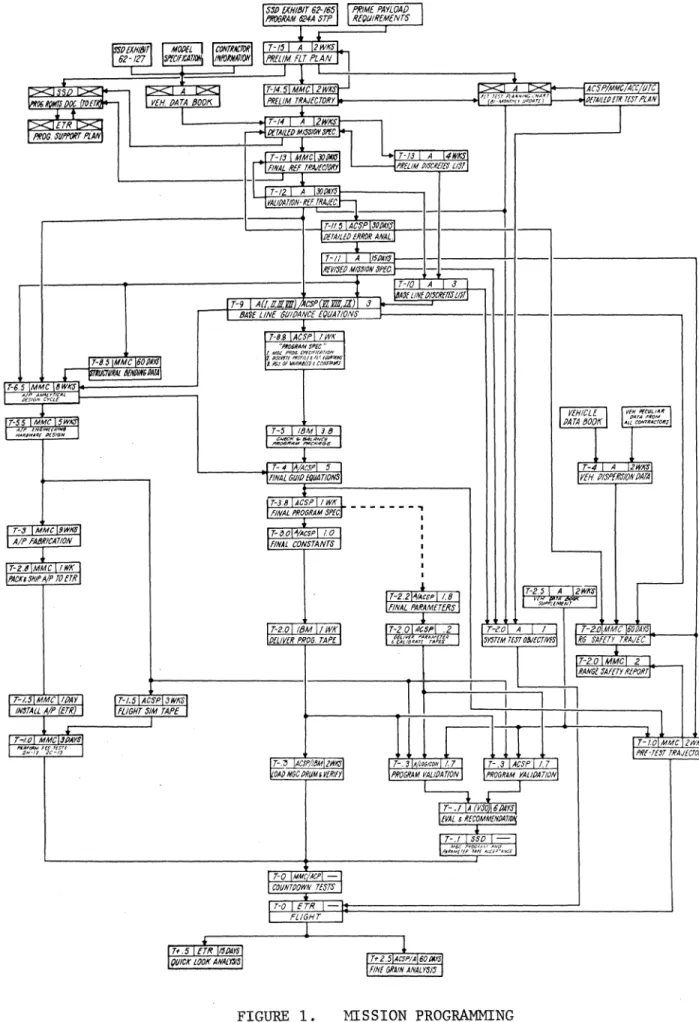
(
FIGURE 1. MISSION PROGRAMMING
I
I
I
I
f
I
I
r
I"
]
[
I
r
I
I
I
(
[
I'
In an attempt to minimize the impact of such changes the plan calls for
the delivery of a "check and balance" program package, thereby permitting
the equation-writer to assess the alternatives himself. This package also
permits a check on the general progress of programming and is an
oppor-tunity to call out misunder standings if any exist.
1-r
I
I
r
I
I
I
J
I
r
il
I_
I
(
I'
I
I'
(
Validation
Validation is really the answer to the question: is the MGC
software ready to fly? This prime question can be broken down into
three distinct criteria which can then be tested separately:
1) Are all mission and systems requirements accurately reflected
in the programming specification?
2) Are the requirements of the programming specification met
by the MGC coding?
3) Are all mission and systems requirements satisfied by the
MGC coding?
It should be noted that only the third criterion c·onstitut~s a completely
necessary and sufficient basis upon which to fly. While unlikely, there
may be subtle effects of MGC program mechanization which prevent criteria
1) and 2) from implying 3). The question might then be asked. why test to
anything but criterion 3)? This is the "black box" approach to validation.
In certain applications it may have merit; on T-III we have not use.d it.
There are several rea sons:
1) In its pure state nothing is known about the innards of the
program. Consequently it is necessary to devise tests to
uncover all possible failure modes. For missions of the
duration and complexity of T-III, this would be a horrendous
task.
2) A lesson learned by our hardware brothers years ago is that
you can learn much more about how something will work - and
how it will fail - by opening it up than you can by probing it
from the outside. Double,..whiskered diodes, solder balls,
gl'aphite particles are all good examples.
On T-III a two pronged approach is taken to validation. Both AC
Electronics and Aerospace/Logicon have independent votes. Thus far there
has not been disagreement in their final recommendation to SSD. The methods
I
I
I
(
I-I
I
I
I'
r
I
r
I
I'
Ii
[:
l:
[
(:
of the equation is checked automatically. These programs are valuable
tools in that they can handle relatively coarse coding. They are also relatively
inexpensive to run.
Both approaches are valuable, and it is intere sting to note that they
tend to complement, not comp,ete with one another. At any given point in a
validation,about the same number of errors have been found by each. It is as
though they were starting at opposite ends of the program, both working
toward the middle.
At both AC Electronics and Aerospace/Logicon, closed-loop
interpretive simulations form the test of criterion 3). By the time these
tests are run, the progralll is well shaken down, and these runs constitute
merely final confidence tests.
The ground programs are handled in a somewhat different manner.
Simulations of the green-light countdown procedures are run by Aerospace/
Logicon to test the accuracy of the conlpensation for accelerometer and
gyro terms and to test the proper use of these values after the transition
into the flight program. AC Electronics relies primarily on lab te sts of
the programs on an MGC and its related ground equipment. Again, it has
been found that the methods tend to complement each other.
I
I
l
I
I
I
:I
I
I'
:I
I
I
r
I
I'
I
('
[
[
If the flight be unsuccessful, the cause mayor may not be tracked
down. Regardless, the chances are that the failure will have software
impact. There may be the attem.pt to build in a capability to detect and
correct the failure. Or there may be the attempt to have the software
better adapt to the particular failure condition so that for a given mission
even if the prime objectives cannot be completely satisfied, there is the
opportunity to accomplish certain secondary objectives.
I cannot stress too strongly this particular facet of spacecraft
software design. In es sence, this ability to apply some intelligence in
adapting to the conditions encountered is something relatively new to
unmanned systems. Credit for its incorporation into the T-III program
goes largely to R. V. Erilane of Aerospace. Certainly there was little
such capability applied to missile systems, derived rate for radar systems
having both range and range-rate is one of the few instances of adaption
in the face of malfunction.
Some people will argue that a set of guidance equations need only
perform adequately in the presence of parameter deviations less than
+
3 crfrom nominal. Academically and statistically, this is a reasonable position.
But, talk to a propulsion engineer about the standard deviation in differential
thrust buildup of two engines, fired after some" time in orbit. He may describe
what he hopes will happen, but he may also interject that once in a while one
engine may burp in coming on - but that really isn It a propulsion malfunction.
After a couple of thousand in-orbit firings of at least a couple of hundred
engines, he will have better data or maybe a better engine. Meanwhile though,
it sure would help if guidance could tolerate engine burps. And yes, it would
be nice if the engines do fail to come on, that we go through say, one more
cycle; if that is unsucces sful, then try something else.
Note that here I am speaking of an adaptive ability that is quite
different from that which has been more generally studied in the computer
field, viz.
I
I
r
1
If
'I
1
Case History
In the Titan-III program thus far there have been a number of flights
for which software development and software validation have been the major
elements in the critical path. Flight Plan II-1 was one such instance.
Pre-paring for an early February launch, a series of short-multiply errors was
found in the minor loop just a few days before Christlllas. The balance of
the airborne coding pivots on the coding of the lllinor loop. Thus a relatively
minor error resulted in more than 900 instruction changes. These changes
were coded within 10 days, and by resorting to validation running concurrent
with debugging, the flight date was met.
A somewhat different problem arose in the case of Flight Plan VII A.
Because of
a) the plane change (s) involved,
b) the high ternrlnal accuracy required
c) the presence of IMU gimbal stops and
d) the need to point the telemetry antenna back at earth
this flight plan had always been considered quite complex. Difficulty in
yeezin~ mission and payload requirements plus the desire to minimize
storage requirements led to late definition of the equations. Table III lists
the dates on which equation changes were incorporated into the program
specification. These dates are to be compared against the milestone dates
listed in the mission programllling. For a1l intents and purposes, change 3
formed the baseline equations; this at T-6 months compared to the T-9 date
in the missi~n programming, chart. The addition of a requirement to toast
the solar cells of the payload (to keep them from being too cold to operate
when the payload was released into orbit) was the largest single change from
that point. Gwen a normal-sized program, even that change would not have
been large, but IBM was already approaching 90% of total instruction capacity.
Past this point coding efficiency generally drops off so badly that this last 10%
is considered unusable space. Nonetheless IBM did manage to squeeze in the
I
I
I
[
DATEI
15Feb6524Mar65
I
5Apr659Apr65
I
11May658Jun65
I
16Jun6521Jun65
I:
12Ju16520Ju165
:I
5Aug65II
17Aug65
27Aug65
II
2Sep65 7Sep65I
4Nov65 290ct65r
16Nov657Dec65
[:
9Dec65 14Dec65[
21Dec65[
[I
[
CHANGE NUMBER
PRELIMINARY ISSUE OF BLK 1-4,20
BL -·INCOMPLETE
1 - MINOR ADDITIONS
2 - MODIFIED FIXED POINT NA VIGA TION
3 - COMPLETE ISSUE OF BASE LINE
4 - NEW DRIFT MATRIX
5 - MODIFIED B LK 16, 7, 9, 1 8
.
6 - REISSUE OF FIG. 1
7 - CORRECTED BLK 7, ADDED INITIALIZATIONS
8 - REVISED TOASTING LOGIC
9 - REVISED FIG. 1, BLK 5, 6, 8, 19
10 - REISSUE OF COMPLETE DOCUMENT
11 - IBM LOGIC CHANGES
12 - IBM SCALING CHANGES
13 - REVISED BLOCK 9
14 - FINAL CONSTANTS, PARAMETERS
15 - CHANGED 13 PARAMETERS, 1 CONSTANT
16 - CHANGED 34 PARAMETERS
17 - CHANGED 35 PARAMETERS, 4 CONSTANTS
18 - MODIFY BLK 9, FIG. 1, 4 PARAMETERS
19 - CHANGED 9 PARAMETERS
LAUNCH
TABLE III
FLIGHT PLAN VI I
I
(
r
I
I
I
r
I