Context-Oriented Component-based Software Development
Basel Magableh
A Thesis submitted to the University of Dublin, Trinity College
in fulfillment of the requirements for the degree of
Doctor of Philosophy (Computer Science)
Declaration
I, the undersigned, declare that this work has not previously been submitted to this or any
other University, and that unless otherwise stated, it is entirely my own work.
Basel Magableh
Acknowledgements
First and foremost, I thank my supervisor Stephen Barrett for his guidance, and support
over the years. I very much appreciate his motivation, feedback, and endless patience during
my Ph.D. studies. I would like to thank Dr. Stefan Weber for his continuous support and
guidance. A very special thank you to Professor Khalid Al- Begain, for his decent advices
and guidance.
I express my gratitude to the women who supports me through the past four years, who
gave me love and great company to produce this volume of work. To Hebah my lovely wife,
the one who su↵ers the most from being very far away from home. This thesis would not
have been possible unless your hard support my dear Hebah. This work is totally yours.
I will dedicate this work to you my dear son Sanad. Because of you my lovely lad this
work was started and finished. I lift my family and home land to improve my career to assure
you will have a better future. To the man who always motivates me and provides me with
decent advices to keep fighting and to add very small footprint in this world. To my father
Ismail, who was always advising me to be creative and do my best. To the women who always
keep filling my heart with forgiveness and faith to be a better human in this world. To my
mother, to that hard worker that spent her life minding my needs worrying about my wishes.
To all past and present members in the Distributed Systems Group, thank you for making
it such a great and lively research environment to be in. A big thank you goes especially to
my room mates of Lloyd 008 for lively discussions (not only) about work, and for being great
0 ACKNOWLEDGEMENTS
A very special thank you to all my friends for encouraging me, each in their own way.
Each one of you deserves a big thank you. My regards should go especially to my journey
fellows: Dr. Nearchos Paspallis, Dr. Melanie Bouroche, Dr. Serena Fritsch, Dr. Mazeiar
Salehie, Dr. Mark gleeson, Dr. Asad Salkham and Dr. Pierpaolo Dondio. A big thank
you also to my dear friends: Mr. Khaled Smadi, Mr. Nidal AL-Buriuite and Mr. Azez
Al-Rawashdeh.
Finally, I would like to thank my father-in-law Omar. Thank you to all my dear brothers,
Dr. Amer, Dr. Mohammad, Mr. Ala’a, Eng. Mo’ad, Mr. Bashar, Mr. Ahmad and Mr.
Ibrahim for your support and encouragements.
Basel Magableh
University of Dublin, Trinity College
Abstract
Software in distributed and mobile computing environments needs to cope with variability,
diversity of computing platforms and operates in di↵erent execution environments.
Mo-bile computing environments are heterogeneous and dynamic. Everything from the devices
used and resources available to network bandwidth and user context can change at runtime.
This presents the software developers with the challenge of tailoring behavioural variations
of the software to specific user needs and adapt to context changes. The design and the
development of context-dependent and self-adaptable applications in mobile computing
en-vironments cannot rely on classical software-development methodologies, which assume that
the software execution environment is known a priori at design time, and the application
environment can be anticipated. Supporting the development and execution of self-adaptive
software systems raises numerous challenges, from development processes, design space and
development tools, to the adaptation mechanism that ensures adaptability and dependability
of the self-adaptive software that is targeted. This thesis explores how far we can support
the engineering of self-adaptive applications using generic development paradigm provided by
non-specialized language frameworks, and not being limited to a specific platform or
mecha-nism. This gives the software developers the flexibility to construct a self-adaptive application
using an object-oriented programming language and deploy it on several platforms.
The thesis is that the software developers must considered the context information and
context-dependent behaviour in the analysis, design and implementation of self-adaptive
con-0 ACKNOWLEDGEMENTS
junction with the contextual changes. In order to overcome the problem and the challenges
of engineering self-adaptive software, this thesis contributes to the knowledge by
present-ing Context-Oriented Software Development (COSD), a generic development paradigm for
the construction of self-adaptive software from context-oriented components, which enables
dynamic composition of the context-dependent behaviours and provides the software with
capabilities of self-adaptability and dependability in mobile computing environments. Our
model is based on a decomposition strategy of self-adaptive software based on context, which
provides a flexible mechanism for modularising the software into several composable units of
behaviour and decouples the context-dependent from context-free parts. The context-oriented
component model encapsulates the implementation of the context-dependent parts in distinct
architecture units, which enables the software to adjust its functionality and/or behaviour
dynamically. This di↵ers from the majority of existing works, which seek to embed awareness
of context in the functional implementation of applications. The Context-Oriented Software
is developed using a Context-Oriented Component-based Application Model Driven
Archi-tecture (COCA-MDA). Afterwards, the context-oriented software is manipulated at runtime
by COCA-middleware, which performs a runtime behavioural composition of the
context-dependent functionality based on the operational context. The evaluation of context-oriented
software in comparison to existing work shows that context-oriented software development is
better suited for implementing context-dependent and self-adaptive applications. In addition,
the evaluation of COCA-middleware in terms of the modifiability and performance quality
attributes, shows better performance in performing the adaptation with less impact on the
allocated resources. This thesis shows that COCA-MDA has reduced the development e↵ort
in modelling the Platform Independent Model (PIM) and Platform Specific Model (PSM), as
it reduces the amount of configurations and maintenance needed to transform the PIM into
PSM. In addition, COCA-MDA produced a component-based architecture described by an
Architecture Description language (ADL), which reduces the e↵ort needed to implement the
0
Publications Related to this Ph.D.
1. Magableh, B. and Barrett, S. (2011). Context Oriented Software Development. Journal
of Emerging Technologies in Web Intelligence (JETWI), 3(4), pages 206–216.
2. Magableh, B. and Barrett, S. (2011). Adaptive Context Oriented Component-Based
Application Middleware (COCA-Middleware). In Proceedings of the 8th International
Conference of Ubiquitous Intelligence and Computing, (UIC 2011), pages 137–151,
Ban↵, Canada.
3. Magableh, B. and Barrett, S. (2011). Model-Driven Productivity Evaluation for
Self-adaptive Context-Oriented Software Development. In Proceedings of the 5th
Interna-tional Conference and Exhibition on Next Generation Mobile Applications, Services,
and Technologies, (NGMAST 11), pages 158–167, Cardi↵, Wales, United Kingdom.
4. Magableh, B. and Barrett, S. (2011). Self-adaptive application for indoor wayfinding for
individuals with cognitive impairments. In Proceedings of the 24th International
Sym-posium on Computer-Based Medical Systems, (CBMS 11), pages 1–6, Bristol, United
Kingdom.
5. Magableh, B. and Barrett, S. (2011). Objective-COP: Objective Context Oriented
Programming. In Proceedings of the first International Conference on Information and
Communication Systems, (ICICS 2011), pages 45–49, Irbid, Jordan.
6. Magableh, B. and Barrett, S. (2010). PrimitiveC-ADL: Primitive Component
Archi-tecture Description Language. In Proceedings of the 7th International Conference on
Informatics and Systems, (INFOS 2010), pages 103–118, Cairo. Egypt.
7. Magableh, B. and Barrett, S. (2009). PCOMs: A Component Model for Building
Context-Dependent Applications. In Proceedings of the First International Conference
on Adaptive and Self-adaptive Systems and Applications, (Adaptive 09), pages 44–48,
Contents
Acknowledgements iii
Abstract iv
Publications Related to this Ph.D. vii
List of Tables xiii
List of Figures xv
Listings xviii
Glossary xix
Acronyms xxiii
Chapter 1 Introduction 1
1.1 Background . . . 2
1.2 Runtime Context-Dependent Behaviour Variability Management . . . 4
1.2.1 Upfront autonomic design. . . 5
1.2.2 Runtime variability management. . . 5
1.2.3 Unanticipated adaptation. . . 6
0
1.2.5 Behavioural composition. . . 8
1.2.6 Platform- or framework-specific adaptation. . . 9
1.3 Objectives and Research Questions . . . 10
1.3.1 Research questions . . . 10
1.4 Contributions . . . 11
1.5 Scope . . . 13
1.6 Road Map . . . 14
1.7 Summary . . . 15
Chapter 2 Engineering Self-adaptive Software 16 2.1 Self-adaptive Software . . . 17
2.2 Variability Management with Context-oriented Programming and Aspects . 19 2.3 Modelling Self-adaptive Applications . . . 23
2.3.1 Model Driven Development and AOP . . . 25
2.3.2 A-MUSE . . . 26
2.3.3 CAMEL . . . 27
2.3.4 MUSIC MDD . . . 28
2.3.5 Paspallis MDD . . . 29
2.3.6 U-Music MDD . . . 29
2.3.7 CAUCE . . . 30
2.3.8 ContextUML . . . 31
2.4 Feature Analysis and Comparative Study of MDA-based Approaches . . . 32
2.4.1 Existence of MDA-related Features . . . 34
2.4.2 Tool-related feature analysis . . . 34
2.4.3 Quality of the MDA-based Approaches . . . 36
2.4.4 Evaluation Results . . . 39
2.5 Component-based Software Development . . . 41
0 CONTENTS
2.5.2 FRACTAL . . . 42
2.5.3 One.world . . . 43
2.5.4 PCOM . . . 44
2.5.5 A Comparative Analysis of Component-based Frameworks . . . 44
2.6 Middleware-centric Development . . . 49
2.6.1 DySCAS . . . 50
2.6.2 CASA . . . 51
2.6.3 Kinesthetics eXtreme (KX) . . . 52
2.6.4 MADAM . . . 53
2.6.5 CARISMA . . . 54
2.6.6 Middleware Comparative Study . . . 55
2.7 Self-adaptability Assurance and Verification . . . 60
2.8 Summary . . . 62
Chapter 3 Context-Oriented Software Development 64 3.1 Rationale . . . 65
3.2 Context-oriented Component Model (COCA-component) . . . 68
3.3 COCA-ADL: A Context-oriented Component-based Application ADL . . . . 71
3.4 Overview of the COCA-middleware . . . 72
3.4.1 Context Manager . . . 73
3.4.2 Component Manager . . . 74
3.4.3 Policy Manager . . . 75
3.4.4 Adaptation Manager . . . 75
3.4.5 Verification Manager . . . 77
3.5 COCA-MDA Development Approach . . . 78
3.6 Context-Oriented Component-based Application Example . . . 81
3.6.1 Analysis: Capturing Context and User Requirements . . . 83
0
3.6.3 Modelling the Platform Specific Model . . . 94
3.6.4 Code Generation . . . 96
3.7 Summary . . . 96
Chapter 4 Implementation 98 4.1 The COCA-platform Implementation . . . 98
4.1.1 The COCA Runtime Platform . . . 100
4.1.2 Adaptation Manager Runtime Functions . . . 100
4.1.3 Context Manager . . . 105
4.1.4 COCA-components Framework . . . 106
4.1.5 Policy Manager . . . 108
4.1.6 Verification Manager . . . 110
4.2 I-TrinityTour Case Study Implementation . . . 112
4.3 Summary . . . 120
Chapter 5 COCA-Middleware Architecture Evaluation 121 5.1 COCA-middleware Evaluation Objectives . . . 122
5.2 Self-adaptive Application Quality Attribute Characterization . . . 124
5.2.1 Relating Quality Attributes with Self-adaptive Properties . . . 125
5.3 Evaluation of COCA-middleware with ATAM . . . 127
5.3.1 ATAM Evaluation Steps . . . 127
5.3.2 ATAM Evaluation Results . . . 132
5.4 Lessons Learned from ATAM Evaluation . . . 140
5.5 Context-oriented Software Evaluation . . . 142
5.5.1 Metrics . . . 142
5.5.2 Hardware and Software Configuration . . . 144
5.6 COSD Vs. AOSD Experiments . . . 146
5.6.1 Experiment 1: Context Monitoring and Sensing . . . 147
0 CONTENTS
5.6.3 Experiment 3: Collaborated Aspect Activation . . . 150
5.7 COCA-middleware Evaluation . . . 154
5.7.1 Experiment 4: Self-tuning Evaluation . . . 155
5.7.2 Experiment 5: Self-reconfiguring Evaluation . . . 158
5.8 Summary . . . 160
Chapter 6 Development Methodology Evaluation 162 6.1 Evaluation Objectives . . . 163
6.2 Self-adaptive Indoor Wayfinding Application for Individuals with Cognitive Impairments . . . 164
6.2.1 Modelling the I-WayFinder Application with COCA-MDA . . . 167
6.3 IWayFinder Implementation and Evaluation . . . 175
6.4 Evaluating COCA-MDA with COCOMO II . . . 176
6.4.1 COCOMO II Evaluation Results . . . 183
6.5 Lessons Learned . . . 189
6.6 Summary . . . 190
Chapter 7 Conclusions 191 7.1 Achievements . . . 192
7.2 Future work . . . 195
7.3 Summary . . . 196
List of Tables
2.1 MDA-related criteria evaluation . . . 35
2.2 MDA tool-related criteria . . . 36
2.3 Supporting context-dependent behaviour variations on the analysis, design and implementation . . . 37
2.4 Anticipation of context change-related criteria and evaluation results . . . 38
2.5 Context model-related criteria and evaluation results . . . 39
2.6 Modelling context-dependent behaviour variations and evaluation results . . . 40
2.7 Component model comparative analysis . . . 45
2.8 Middleware comparative study . . . 56
5.1 Relating quality attributes with self-* properties . . . 125
5.2 Architecture approach/quality attribute . . . 128
5.3 Scenario ratings and number of votes . . . 131
5.4 Evaluation results of scenario 1. ADL transparency . . . 133
5.5 Evaluation results of scenario 5. Components composition . . . 134
5.6 Evaluation results of scenario 8. User tasks . . . 135
5.7 Evaluation results of scenario 13. Adaptation assurance and verification . . . 136
5.8 Evaluation results of scenario 14. Unforeseen changes . . . 137
5.9 Evaluation results of scenario 15. Unanticipated adaptation . . . 138
0 LIST OF TABLES
5.11 Evaluation results of scenario 21. Conflict resolution . . . 139
List of Figures
2.1 Self-adaptive software challenges and approaches . . . 17
3.1 Behavioural Decomposition Model . . . 67
3.2 COCA-component Conceptual Diagram . . . 69
3.3 COCA-ADL Elements . . . 71
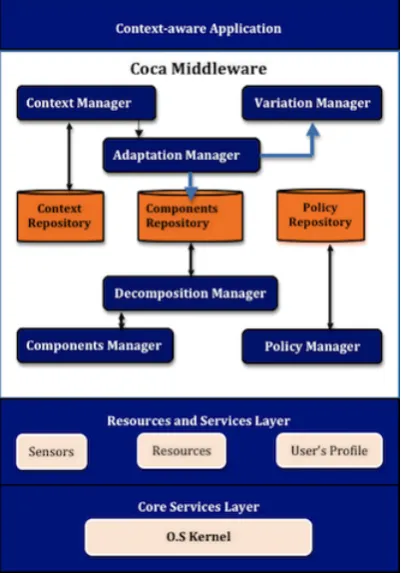
3.4 COCA-platform Architecture. . . 72
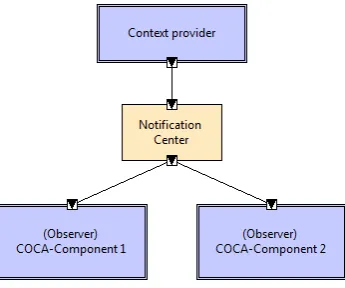
3.5 Observer Design Pattern . . . 73
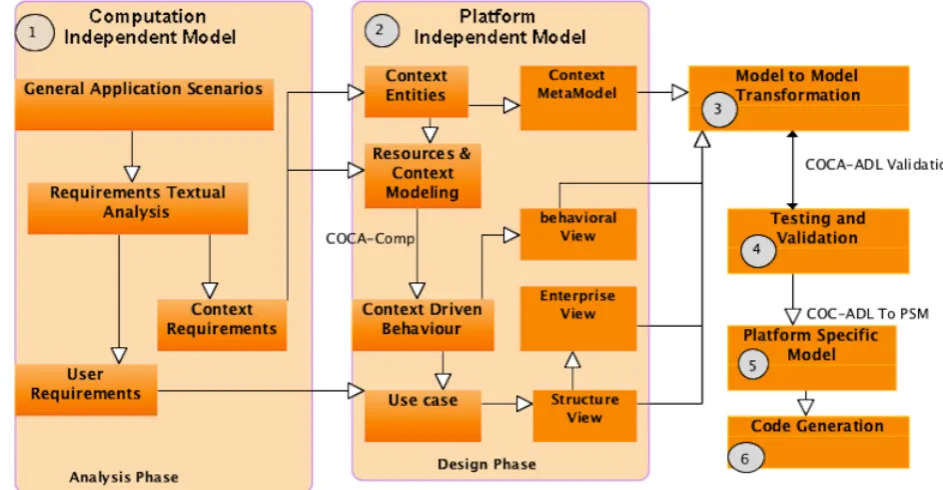
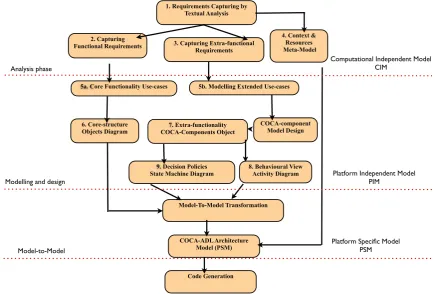
3.6 Context-oriented component-based application model-driven architecture (COCA-MDA) . . . 78
3.7 Modelling tasks . . . 83
3.8 Requirements UML profile . . . 84
3.9 Functional and extra-functional partial requirements diagram . . . 85
3.10 Resources and context entities model . . . 88
3.11 Context meta-model . . . 89
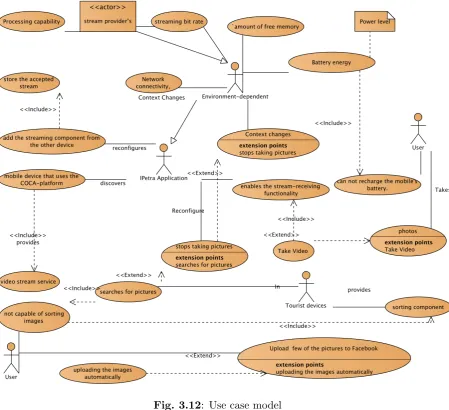
3.12 Use case model . . . 90
3.13 I-TrinityTour Core-Classes structure . . . 91
3.14 Extra-functionality Object Diagram of the Context Oriented Components . . 92
3.15 Decision policies . . . 94
3.16 Overall model . . . 95
0 LIST OF FIGURES
4.1 COCA-middleware . . . 99
4.2 Application Adaptation Runtime Model . . . 101
4.3 COCA-component conceptual diagram . . . 107
4.4 Components life-cycle . . . 109
4.5 Adaptation self-assurance verification . . . 111
4.6 I-Trinity application running on IPhone device . . . 113
4.7 COCA-component Location-update sublayer activation . . . 114
4.8 Sequence Diagram for Streaming Component Adaptations . . . 115
4.9 Streaming component invoked in the execution . . . 117
4.10 Adapting Sorting Component and Camera flashes using external and internal adaptations . . . 118
4.11 Two devices communicating using the Bonjour service . . . 119
5.1 Quality attribute utility tree . . . 130
5.2 Simulator Control User Interface . . . 145
5.3 Context Monitoring battery usage . . . 148
5.4 Context Monitoring CPU Activity . . . 149
5.5 Real Memory Allocation (MB) . . . 149
5.6 Context Detection Battery Usage . . . 150
5.7 Context Detection CPU Activity . . . 150
5.8 Context Detection Real Memory Allocation (MB) . . . 151
5.9 Activating Collaborated Aspects/COCA-components Battery Usage . . . 152
5.10 Activating Collaborated Aspects/COCA-components CPU Activity . . . 152
5.11 Activating Collaborated Aspects/COCA-components Real Memory Allocation (MB) . . . 152
5.12 Aspects/COCA-components Composition . . . 153
5.13 Autonomic Properties Support . . . 154
0
5.15 Energy Usage for I-TrinityTour Application . . . 157
5.16 Using the Allocated Resources in Sleep/Wake Mode . . . 157
5.17 Adaptation/Reconfiguration Time (ms) . . . 159
5.18 Memory Allocation for I-TrinityTour . . . 159
6.1 Case study requirements diagram . . . 168
6.2 Use case diagram . . . 169
6.3 Core structure object diagram . . . 170
6.4 Behavioural Model . . . 171
6.5 Activity diagram . . . 172
6.6 I-WayFinder application architecture . . . 177
6.7 Direction Output Context Oriented Component . . . 178
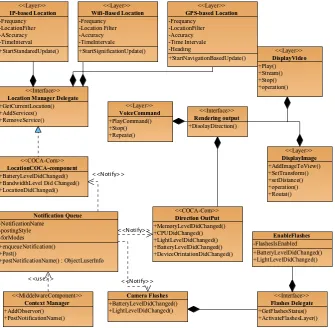
6.8 Energy usage for IWayFinder application. . . 178
6.9 Adaptation time (ms) . . . 178
6.10 Rating Scale for Programmer Unfamiliarity (UNFM) . . . 182
6.11 Total E↵ort for each MDA approach . . . 184
6.12 Cumulative E↵ort per model/MDA in person-months . . . 185
6.13 MUSIC-MDA and U-MUSIC-MDA estimated e↵orts . . . 186
6.14 COCA-MDA and Paspallis’s MDA estimated e↵orts . . . 187
Listings
3.1 Decision Policy Example . . . 95
4.1 Forward invocation to other objects . . . 104
4.2 Forward invocation to other objects . . . 105
4.3 COCA-component registers itself as observer for a specific context condition . 105 4.4 Context manager notification sent to COCA-component . . . 106
4.5 Component framework methods . . . 108
4.6 Retreving bundle information . . . 112
4.7 Loading COCA-component from remote url . . . 116
4.8 Verifying COCA-component for a specific class . . . 116
6.1 Decision policy1 . . . 173
6.2 Decision policy 2 . . . 174
6.3 Decision policy 3 . . . 175
Glossary
Notation Description
advice Describes a class of functions which modify other
functions when the latter are run; it is a certain
function, method or procedure that is to be applied
at a given join point of a program.
aspect An aspect of a program is a feature linked to many
other parts of the program, but which is not related
to the program’s primary function. An aspect
crosscuts the program’s core concerns, therefore
violating its separation of concerns that tries to
encapsulate unrelated functions.
context Any information that is computationally accessible
and upon which behavioural variations depend.
context-aware application refer to a class of software systems that are able to
monitor and detect context changes in the
environment where they operate.
context-awareness The software system is aware of its context, which is
0 Glossary
Notation Description
context-dependent A context-dependent application adjusts its
behaviour according to context conditions arising
during execution.
crosscutting Properties or areas of interest such as quality of
service, energy consumption, location awareness,
users’ preferences, and security.
desmet A methodology for evaluating software engineering
methods and tools.
heterogeneous A set of collaborated aspects (code fragments), that
extend the application behaviour in several parts of
the program and have an impact across the whole
software system.
homogeneous Applying the same code, that extend the application
behaviour in several parts of the program.
joinpoint A point in the control flow of a program. In
aspect-oriented programming a set of join points is
described as a pointcut. A join point is a
specification of when, in the corresponding main
0
Notation Description
pointcut Is a set of join points. Whenever the program
execution reaches one of the join points described in
the pointcut, a piece of code associated with the
pointcut (called advice) is executed. This allows a
programmer to describe where and when additional
code should be executed in addition to an already
defined behavior..
self-* properties The autonomic properties of a software, which
includes (self-organising, self-healing, self-optimising
and self- protecting).
self-adaptive A self-adaptive application modifies its own
structure and behaviour in response to changes in
its operating environment.
self-healing The capability of discovering, diagnosing and
reacting to disruptions. It can also anticipate
potential problems, and accordingly take proper
actions to prevent a failure.
self-optimising The capability of managing performance and
resource allocation in order to satisfy the
requirements of di↵erent users. End-to-end response
time, throughput, utilisation and workload are
examples of important concerns related to this
0 Glossary
Notation Description
self-organising The capability of reconfiguring automatically and
dynamically in response to changes by installing,
updating, integrating, and composing/decomposing
software entities.
self-protecting The capability of detecting security breaches,
anticipating problems and recovering from their
e↵ects. It has two aspects, namely defending the
system against malicious attacks, and anticipating
problems and taking actions to avoid them or
mitigate their e↵ects.
separation of concerns Is the process of separating a computer program
into distinct features that overlap in functionality as
Acronyms
Notation Description
A-MUSE Architectural Modeling for Service Enabling in
Freeband.
ADL Architecture Description language.
AOP Aspect-Oriented Programming.
AOSD Aspect Oriented Software Development.
ASLOC Adapted source lines of code.
AspectJ Aspect-oriented Java extension.
ATAM Architecture Trade-o↵Analysis Method.
ATL Atlas Transformation Language.
CAMEL Context Awareness ModEling Language.
CASA Contract-based Adaptive Software Architecture.
CAUCE Context-aware Applications for Ubiquitous
Computing Environments.
CBSD Component-based Software Development.
CCA Component Collaboration Architecture.
CCTV Closed-Circuit TeleVision.
CIM Computation Independent Model.
0 Acronyms
Notation Description
COCA-ADL Context-Oriented Component-based Applications
Architecture Description Language.
COCA-component Context-Oriented Component model.
COCA-MDA Context-Oriented Component-based Applications
Model-Driven Architecture.
COCA-middleware Context-Oriented Component-based Applications
Middleware.
COCOMO II Constructive Cost Model II.
COP Context-Oriented Programming.
COSD Context Oriented Software Development.
DAOP Dynamic Aspect Oriented Programming.
DP Decision Point.
DPL Decision PoLicy.
DSL Domain Specific Language.
ECA Enterprise Collaboration Architecture.
ECORE Eclipse CORE meta-model.
EDOC Enterprise Distributed Object Computing.
EMF Eclipse Modelling Framework.
JCOOL Java COntext Oriented Language.
JCOP Java Context-Oriented Programming.
MADAM Mobility and ADaptation enAbling Middleware.
MDA Model Driven Architecture.
0
Notation Description
MOF Meta Object Facility.
MOSEL MOdeling Specification and Evaluation Language.
MUSIC Mobile USers In Ubiquitous Computing.
OMG Object Management Group.
OOP Object Oriented Programming.
OSGI Open Services Gateway initiative framework.
PIM Platform Independent Model.
PIV Platform Independent View.
PM Person-Months.
POI Places Of Interest.
PSM Platform Specific Model.
PSV Platform Specific View.
QoS Quality of Services.
QR-code Quick Response Code.
RFID Radio Frequency IDentification.
SLOC Source Lines Of Code.
TDEV Time to Develop.
U-MUSIC Unanticipated dynamic-adaptation for Mobile USers
In Ubiquitous Computing.
0 Acronyms
Notation Description
UML Unified Modelling Language.
Chapter 1
Introduction
Context-dependent applications refer to a class of software systems that are able to monitor
and detect context changes in an environment where they operate. They can autonomously
modify their own structure and behaviour in response to context changes [Oreizy et al., 1999].
Software in distributed and mobile computing environments needs to cope with variability as
software systems are deployed on an increasingly large diversity of computing platforms and
operate in di↵erent execution environments. Mobility induces context changes to the
compu-tational environment and therefore, changes to the availability of resources, and continuously
evolving requirements require software systems to be able to adapt to context changes
[In-verardi and Tivoli, 2009]. Moreover, because of the software pervasiveness, and in order to
make adaptation e↵ective and successful, adaptation processes must be considered in
con-junction with dependability and reliability by providing dynamic verification and validation
mechanism, which validates the adaptation output with the adaptation goals, objectives, and
architecture quality attributes [Cheng et al., 2008, de Lemos et al., 2011].
This thesis contributes to the knowledge by presenting Context Oriented Software
De-velopment (COSD), a generic deDe-velopment paradigm for the construction of self-adaptive
software from oriented components, which enables a runtime composition of
context-dependent behaviours and provides the software with capabilities of self-adaptability and
The thesis is that the software developers must considered the context information and
context-dependent behaviour in the analysis, design and implementation of self-adaptive
software. In particular, software needs to consider the composition of its components in
conjunction with the contextual changes, which provides context-driven adaptation and
self-adaptability.
This chapter is organized as follows: Section 1.1 highlight the needs for dynamic
adapta-tion of context-aware applicaadapta-tions. Secadapta-tion 1.2 provides an overview of the research problems
and motivations of engineering self-adaptive software. The research objectives are discussed
in Section 1.3. The outline of the solution is presented in Section 1.4. The scope of this
research is demonstrated in Section 1.5. Finally, the thesis structure is shown in Section 1.6.
1.1
Background
A self-adaptive and context-dependent software system operating in a highly dynamic world
must adjust its behaviour automatically in response to changing environments or
require-ments, while shifting the human role from operational to strategic. Humans define
adapta-tion goals and new applicaadapta-tions or domain requirements, and the system performs all
nec-essary adaptations autonomously at runtime. Throughout the system’s life-cycle, including
adaptation periods, the system needs to be available and provides functionality to users or
other systems, while keeping acceptable levels of Quality of Services (QoS) [Al-Begain, 2004].
However, several researchers have emphasized the need for a new development paradigm that
overcomes the complexity, mobility, and variability of this class of applications [Inverardi,
2007, Inverardi and Tivoli, 2009, Baresi and Ghezzi, 2010, Blair et al., 2009, Amoui et al.,
2011, de Lemos et al., 2011]. The authors argue that we have to reconceptualize the whole
software engineering process for modern software systems, and particularly for the case of
self-adaptive systems [de Lemos et al., 2011]. This is only achieved if software is designed to
be dynamic and o↵ers adaptability and variability in conjunction with mobility and
In the last few years, Model Driven Development (MDD), Component-based Software
Development (CBSD), and context-oriented software have become interesting alternatives for
the design and construction of self-adaptive software systems. In general, the ultimate goal
of these technologies is to be able to reduce development costs and e↵ort, while improving the
modularity, flexibility, adaptability, and reliability of software systems [Clemente et al., 2011].
An analysis of these technologies shows them all to include the principle of the separation
of concerns, and their further integration is a key factor to obtaining high-quality and
self-adaptable software systems. Each technology identifies di↵erent concerns and deals with
them separately in order to specify the design and build applications, and, at the same time,
provides dynamic behavioural variations autonomously.
The Object Management Group (OMG) [Kleppe et al., 2003] proposes the Model Driven
Architecture (MDA), a set of standards that provides a practical implementation of MDD
approach. MDA provides a set of guidelines that focus on the explicit separation of
platform-independent from platform-specific concerns. In MDA, there are three di↵erent views for the
software: the computation-independent view (CIV), the Platform Independent View (PIV),
and the Platform Specific View (PSV). The Computation Independent View (CIV) focuses
on both the environment and the requirements of the system and hides the details of the
software structure and processing. The PIV focuses on the operation of the system and hides
details that are dependent on the deployment platform. The PSV combines the CIV and
PIV, with an additional focus on the details of a specific platform [Kleppe et al., 2003].
CBSD targets the construction of large, high-quality, evolvable software systems in a
timely and a↵ordable manner by assembling independent and reusable software modules
known as components [Clemente et al., 2011]. A software component is a unit of composition
with contractually specified interfaces and explicit context dependences [Szyperski, 2002].
CBSD emphasizes on the separation of concerns among the software modules that
encap-sulate a set of related functionalities, or, in the case of Service-oriented Architecture
[Papa-zoglou et al., 2007], a component is converted into a service and subsequently inherits further
Context-Oriented Programming (COP) has emerged as a dynamic fine-grained behavioural
adaptation, which uses a programming-level techniques for performing the context
han-dling [Gassanenko, 1998, Keays and Rakotonirainy, 2003]. COP has dedicated support for
defining and composing variations to basic program behaviour. A variation, which is defined
within a layer, can be deactivated/activated for the dynamic extent of a code block. For
a more complex context-aware system, the same context information would be triggered in
di↵erent parts of an application and would trigger the invocation of additional behaviours.
In this way, context handling becomes a concern that spans several application units,
essen-tially crosscutting into the main application execution. A programming paradigm aiming at
handling such crosscutting concerns (referred to as aspects) is Aspect-Oriented Programming
(AOP) [Kiczales et al., 1997]. Dynamic Aspect Oriented Programming (DAOP) has emerged
to enforce separation of concerns and support runtime adaptations through weaving code
blocks in the application execution [Popovici et al., 2002].
1.2
Runtime Context-Dependent Behaviour Variability
Man-agement
Mobile computing environments are heterogeneous and dynamic. Everything from the devices
used and resources available to network bandwidths and user context can change drastically
at runtime [Belaramani et al., 2003]. This presents the software developers with the challenge
of tailoring behavioural variations both to specific user needs and to the context information.
The design and development of context-dependent and self-adaptable software applications in
mobile computing environments cannot rely on classical software-development methodologies,
which assume that the software execution environment is known a priori at design time and
that the application environment can be anticipated at the development time [Inverardi and
Tivoli, 2009]. Supporting the development and execution of software systems raises numerous
challenges, from development processes, design space, and tools for the system’s thorough
the targeted self-adaptive systems [de Lemos et al., 2011]. However, these challenges, taken
in isolation, are not new in the software domain. Several approaches attack this domain by
providing a model-centric, middleware-centric, or programming-level technique that enables
the software to be more context-aware and self-adaptive [Kapitsaki et al., 2009]. This research
observes the following challenges in engineering self-adaptive software systems.
1.2.1 Upfront autonomic design.
Engineering a self-adaptive system from scratch requires the support of dynamic and
be-havioural views of the software design; the software developers should focus on 1) the parts
of the application that need to adapt accordingly as a response to a specific context change;
and 2) each component must be able to perform the adaptation autonomously. This presents
a challenge for the software developers because self-adaptive applications, by their nature, can
be seen as the collaboration of individual context-dependent behaviour variations.
Context-dependent variations can be seen as a collaboration of individual features spanning the
soft-ware modules in several places [Hirschfeld et al., 2008], and they are sufficient to qualify as
heterogeneous crosscutting in the sense that di↵erent code fragments are applied to di↵erent
program parts [Apel et al., 2006]. Before encapsulating crosscutting context-dependent
be-haviours into a software module, the developers must first identify the bebe-haviours in the
soft-ware requirements. This is difficult to achieve because, by their nature, context-dependent
behaviours are entangled with other behaviours, and are likely to be included in multiple
parts (scattered) of the software modules [Lincke et al., 2011]. Using intuition or even
do-main knowledge is not necessarily sufficient for identifying their volatile behaviour; instead,
a formal analysis procedure is needed for the software requirements and a separation of their
individual concerns [Carton et al., 2007].
1.2.2 Runtime variability management.
Mobile computing infrastructures make it possible for mobile users to run software services
create a challenge for the development and deployment of mobile services that are able to
adapt to context changes and are able to ensure that users experience the ‘best’ quality of
services possible, according to their needs and specific contexts of use. Thus, it is
desir-able that self-adaptive software is desir-able to reconfigure and reoptimize itself by recomposing
components or services dynamically, according to the operational context [Salehie and
Tahvil-dari, 2009,Salvaneschi et al., 2011]. The assumptions made by the COP approaches proposed
in [Gassanenko, 1998,Costanza, 2005,Costanza et al., 2006,Hirschfeld et al., 2008,Salvaneschi
et al., 2011], i.e. that the developer knows all the possible software adaptations in advance
and designs the application accordingly, is not sufficient to fulfil this need. In addition, in
COP and context-aware aspects [Tanter et al., 2006], the context model and the adaptation
logic are explicitly hard-coded in the application’s business code [Lincke et al., 2011]; this
often leads to poor scalability and maintainability [Kapitsaki et al., 2009].
1.2.3 Unanticipated adaptation.
Mobility induces changes in the computational environment and therefore changes in the
availability of the allocated resources and services; this often requires the adaptation engine
to decide which behaviour must be deactivated/activated in the presence of unforeseen
con-text changes. Unforeseen refers to concon-text changes that cannot be predicted at the design
time. Adaptation must be considered in conjunction with dependability, i.e. no matter what
adaptation is performed, the software system must continue to guarantee a certain level of
quality of services and meet the user’s performance needs. Anticipated adaptation is defined
by Keeney [Keeney, 2004] as an adaptation behaviour that is foreseen by the developers
at development time. On the other hand, semi-anticipated is defined as an adaptation
be-haviour that can be partially foreseen by the developers during the development process, then
a middleware is used for executing an adaptation plan, which specifies application variability
models [Rouvoy et al., 2008b]. The assumption is that the developers can provide a
prelim-inary adaptation plan which is able to reason about a certain environmental condition. An
incorporates components, possibly from a number of di↵erent developers to adjust the
appli-cation behaviour at runtime [Keeney, 2004, Khan, 2010, Ding et al., 2009]. An unanticipated
adaptation requires the software to consider a trade-o↵ between the adaptation goal and
the quality attributes of the architecture. To increase the anticipatory capability of a
self-adaptive system, code units need to be loaded dynamically i.e. a late binding of a particular
component implementation or services. However, the capability of software to perform late
binding requires a clear modularization of the self-adaptive software system; this leads us to
the next challenge in engineering self-adaptive software using modularity techniques [Cheng
et al., 2008, de Lemos et al., 2011].
1.2.4 Modularization.
In the classical view of object-oriented software development, the modular structure for
soft-ware systems has rested on several assumptions. These assumptions may no longer
charac-terize the challenge of constructing self-adaptive software systems that are to be executed
in mobile computing environments [Harrison, 2011]. The most important assumptions in
object-oriented development methodologies are that the decision to use or reuse a particular
component/object is made at the time the software is developed.
However, the development of a variety of modern self-adaptive software architectures such
as mobile/ubiquitous computing, and component-based and context-oriented software has
emphasized on deferring these decisions about component selection until runtime. This might
increase the software capabilities in terms of variability, adaptability, and maintainability, and
increase the anticipatory level of the software by loading a particular component/service that
can handle unforeseen context changes dynamically. In addition, modularity can reduce the
development e↵ort and increase software comprehensibility [Munnelly et al., 2007]. However,
this is not always the case. DAOP supports dynamic weaving of aspects to modify the
software behaviour based on the modularity mechanism, supported by the AOP paradigm.
Using the AOP paradigm, context information can be handled through aspects that interrupt
The idea behind AOP is to implement crosscutting concerns as aspects whereas the core
features are implemented as components. Using pointcuts and advice, an aspect weaver
glues aspects and components together. Pointcuts specify the join points of aspects and
components, whereas advice define which code is applied to these points. However,
design-ing context-dependent behaviour usdesign-ing aspect oriented programmdesign-ing paradigm requires a
platform support for activating aspects driven by the context states. Such implementation
requires the AOP platform to evaluate each joinpoint in conjunction with the associated
con-text state and the passive concon-text values. This means that the AOP framework needs to keep
track of past context conditions and their associated states [Tanter et al., 2006]. Evaluating
each joinpoint with the passive and active context many times leads to poor performance and
consumes the allocated resources. Unfortunately, the existing AOP languages tend to add
a substantial overhead in both execution time and code size, because all pointcuts must be
registered by the aspect framework and parsed each time the advice methods are executed.
This restricts their practicality for small devices with limited resources [Hundt et al., 2010].
In addition, it is infeasible for an AOP-based framework to support dynamic de-/activation
of collaborative context-dependent behaviours that entangle with each other, as stated by
Mezini et al. [Mezini and Ostermann, 2004], Salvaneschi et al. [Salvaneschi et al., 2011], and
Lincke et al. [Lincke et al., 2011].
1.2.5 Behavioural composition.
The selection of a particular component at runtime by context-dependent and self-adaptive
applications is presumably made based on the active or passive context in addition to the
context state and its dependency [Tanter et al., 2006, Lincke et al., 2011], and the possible
composition of a context-dependent functionality [Salvaneschi et al., 2011, Hirschfeld et al.,
2008], which will exhibit volatile behaviour in the face of context changes. One could ask
whether the current software domain techniques have sufficient support or the mechanism
for performing such dynamic selection and composition of a software component based on its
the software modules to be loosely coupled, and their behaviour variations can be combined
and activated autonomously, according to the context changes. Such a challenge has been
tackled by a composition strategy that was performed through the development process and
depended totally on a static view of the self-adaptive software design. Such a view implies that
the developers have to explicitly predict the final composition of the software and possible
variations of the application using a programming-level technique such as COP [Schuster
et al., 2011] or AOP [Tanter et al., 2006]. In model-based approaches, the composition is
produced by proposing application variability models at the design time, then at runtime the
middleware uses a utility function to select the best variant to be executed [Geihs et al., 2011].
Alternatively, the composition is shifted one step further to be performed through
model-to-model transformation, assuming that a workflow script can provide multiple variations of the
application design [Carton et al., 2007].
1.2.6 Platform- or framework-specific adaptation.
The generation of multiple self-adaptive software systems to be implemented on heterogeneous
software platforms raises the need for a generic development process that enables the software
developer to build a self-adaptive application without being limited to a specific programming
framework and/or particular middleware technology. Instead, software developers can use
a standard development process and implement the application using an object-oriented
programming language that requires a lower level of programmer familiarity and results in
less of a gap between the middleware designer and the software developers. Our work, which
investigates MDA approaches that target self-adaptive component-based software systems,
has found that the real potential behind MDA is not being fully employed either by current
MDA-based tools or by the proposed MDA approaches. In addition, MDA-based approaches
generate an architecture that is tightly coupled to the middleware or platform technology
1.3
Objectives and Research Questions
In this thesis, we wish to explore how far we can support the engineering of self-adaptive
applications using generic development paradigms provided by non-specialized programming
language such as COP, and AOP, and not limited to a specific platform or mechanism. This
gives the software developers the flexibility to construct a self-adaptive application using an
object-oriented programming language and deploy it on several platforms. Additionally, from
the software developer’s perspective, it is vital to know the productivity of the development
paradigm that might be used in constructing the self-adaptive application.
In addition, it is important to explore the best practices in designing and implementing
the adaptation engine (middleware), which is expected to provide adaptability and
depend-ability. Productivity evaluation of the development methodology and the middleware can
assist developers in selecting a methodology from those proposed in the literature to achieve
adaptability and dependability of the software system. Finally, modularity properties are
key determinants of quality in software, so we wish to explore the best decomposition
strat-egy that can facilitate dynamic behavioural composition of the context-dependent variations.
Our research has shown that MDD, CBSD, and COP may be appropriately combined to
com-plement each other, improving the development of self-adaptive software systems. However,
such combination in the form of COSD is a subject for further investigation and evaluation
in terms of software adaptability, variability, and dependability, in conjunction with their
expected improvements with respect to software performance and modifiability.
1.3.1 Research questions
To attain these objectives, this thesis addresses the following research question:
Does engineering self-adaptive applications using a decomposition strategy based on the
context-dependent functionality support adaptability and variability in several levels of
gran-ularity and reduce the development e↵ort from the software developers’ point of views? If
used to develop this class of applications targeting the mobile computing environments and
considering the mobility constraints without being limited to a language framework? Which
decomposition strategy can facilitate the development of context-aware applications? It is
unknown if a better and significant advance in modularity based on context information can
break through the complexity of constructing self-adaptive software, and its costs and
bene-fits remain uncovered. What is the efficacy of using the proposed MDA on the development
e↵orts and the developer productivity? Does any model-driven methodologies reduce the
development cost and the e↵ort to maintain the application code, or in some cases they will
increased the development e↵ort ? What are the pros and cons of implementing the proposed
platform in resource constrained environment like mobile devices? What are the optimisation
gains from implementing the Context-Oriented Component-based Applications Middleware
(COCA-middleware) on comparison to other adaptive middleware architectures?
1.4
Contributions
In order to overcome the problem and the challenges of engineering self-adaptive software,
this thesis contributes to the knowledge by presenting COSD methodology. The result of
COSD methodology is a component-based architecture described by a Context-Oriented
Component-based Applications Architecture Description Language (ADL).
COCA-ADL is a independent model transformed by a tool support into the desired
platform-specific model. This provides code mobility for the same application into various deployment
platforms.
The oriented component model encapsulates the implementation of the
context-dependent parts in distinct architectural units, which enables the software to adjust its
func-tionality and/or behaviour dynamically. This di↵ers from the majority of existing work, which
seek to embed awareness of context in the functional implementation of applications. The
context-oriented software is developed using a Context-Oriented Component-based
is manipulated at runtime by a COCA-middleware that performs a runtime behavioural
composition of the context-dependent functionality based on the operational context. The
self-adaptive software dependability is achieved through the COCA-middleware capability
in considering its own functionality and the adaptation impact/costs. A dynamic
decision-making based on a policy framework is used to evaluate the architecture evolution and verifies
the fitness of the adaptation output with the application’s objectives, goals and the
architec-ture quality attributes. A case study application is implemented and deployed in an IPhone
device as proof of concept. The implementation demonstrates the application’s ability to
modify its behaviour based on the execution context. The implementation demonstrates how
the platform maintains the quality attributes by adapting a self-tuning and self-configuring
mechanisms in response to multiple context changes.
The self-adaptive context-oriented component-based software has been evaluated in two
distinct phases. The first phase includes pre-implementation evaluation using the
Architec-ture Trade-o↵Analysis Method (ATAM) [Kazman et al., 2002]. The objective of this
evalu-ation is to consider the COCA-middleware architecture’s sensitivity points and the trade-o↵
among the quality attributes, which the COCA-middleware design must maintain. This
provides evidence that the proposed middleware architecture does maintain the quality
at-tributes by trade-o↵s among the quality atat-tributes while achieving the adaptation goals.
The second phase evaluates the Context-Oriented Software Development paradigm and the
COCA-middleware and the case study in terms of the architecture performance and
mod-ifiability. The evaluation compared the performance gain from implementing a case study
application using the COSD paradigm and COCA-middleware with several approaches
pro-posed in the literature like Aspect Oriented Software Development (AOSD) [Filman et al.,
2004] and Context-Oriented Programming [Appeltauer et al., 2008, Schuster et al., 2011]. In
addition, the performance of COCA-middleware implementation was evaluated with other
middleware architectures proposed in the literature.
Finally, a state-of-the-art case study was selected to demonstrate the COCA-MDA
applica-tion. The development of the case study demonstrates how the methodology adapts a policy
framework for achieving and assuring the adaptation results among unforeseen changes. In
addition, it demonstrates how the modularization technique can reduce the complexity of
the self-adaptive application design. The Constructive Cost Model II (COCOMO II) [Boehm
et al., 2000] is used to evaluate the impact on the development cost of using the
COCA-MDA methodology. It shows how COCA-COCA-MDA does reduce the required development e↵ort
compared to other MDAs. It also demonstrates how COCA-MDA has reduced the software
maintenance ratio through the architecture deployment and transformation.
1.5
Scope
This thesis focuses on studying dynamic software composition using model-driven
develop-ment, component-based software and a dedicate adaptive middleware. On another hand,
there are several approaches in the literature that target self-adaptability and dependability
of software systems. The model-free adaptation is one of them. In this approach the
mech-anism does not have a predefined model for the environment and the system itself. In fact,
by knowing the requirements, goals, and alternatives, the adaptation mechanism adjusts the
system. Such an approach is out of the scope of this thesis, because it focuses more on
col-laborative reinforcement learning mechanism, which enables groups of reinforcement learning
agents to solve system optimisation problems in dynamic and decentralized networks.
In addition to that, context-awareness can be achieved via ontology model and rule-based
engine. The ontologies usage exploits the principles of the semantic web to produce ontologies
that describe context information and its associations and provide means for reasoning and
inference. We have also omitted this category from our study, because ontologies usually
model context information specific to a chosen application domain.
Regarding rule-based reasoning approaches, a rule-based system is a combination of a
number of rules and a set of activation conditions for these rules. This category has not
respective approaches specific to context management for services adaptation [Daniele et al.,
2007].
1.6
Road Map
The reminder of this thesis is structured as follows:
Chapter 2 summarises and discusses the current state-of-the-art approaches for
self-adaptive software and their limitations, and also identifies critical challenges that arise when
engineering self-adaptive systems. Context adaptation approaches and techniques are
dis-cussed in this chapter in terms of the modelling approach, self-adaptability requirements,
and run time infrastructure.
Chapter 3 proposes a development methodology, that applies to the Model-driven
Ar-chitecture style. The COCA-MDA methodologys phases and tasks are described in detail
and show the process of constructing a case study application.
Chapter 4 describes the implementation of the COCA-middleware and the case study
applications.
Chapter 5 provides results of architecture evaluation. The proposed architecture is
evaluated using the ATAM method, which has been adapted and used to evaluate the
middleware capability in terms of several quality attributes. In addition, the
COCA-middleware is evaluated with other architectures proposed in the literature in terms of its
adaptability and modifiability.
Chapter 6demonstrates the capabilities of COCA-MDA in supporting the development
of context-aware applications by describing a state-of-the-art case study and evaluating the
development e↵ort involved in adapting the COCA-MDA in constructing the application.
1.7
Summary
This chapter highlights several challenges in building self-adaptive software from a conceptual
view to the level of runtime infrastructure middleware components. In order to support
context-binding mechanisms, a platform solution is needed to legitimately deal with the
heterogeneity of context-dependent behaviours. The results of the decomposition mechanism
are a clear, modularised, component model, which separates the context-dependent from
Chapter 2
Engineering Self-adaptive Software
Supporting the development and execution of self-adaptive software systems raises numerous
challenges. These challenges include the development processes for building them, the design
space, which describes the design patterns and the best practices of designing their building
blocks, i.e. component model or code fragments. The adaptation mechanism, which describes
the best adaptation action that can be used under the limited resources of the execution
environment.
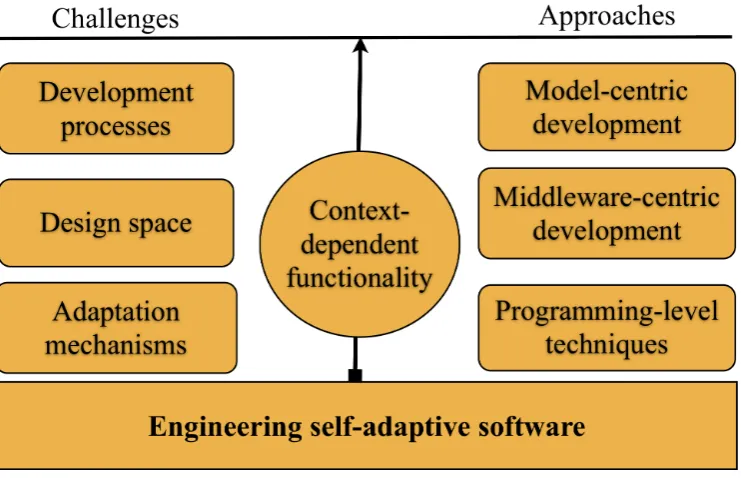
The proposed approaches in the literature can be classified into model-centric,
middleware-centric, and programming-level techniques, as shown in Figure 2.1. The ultimate goal of these
approaches was to support adaptability, variability and increase the software quality by
man-aging the context-dependent functionality at the programming level, middleware layer, or
architecture model. In addition to that, they were trying to provide an adaptation
mecha-nism, that have less impact on the allocated resources under the mobility constrains of the
execution environments.
This chapter summarises and discusses the current state-of-the-art approaches for
engi-neering self-adaptive software systems. Specifically, we intend to focus on the management of
the context-dependent concerns, the model-driven development methodologies,
component-based software development, and middleware centric-development that support dynamic
discussed, as they tend to support runtime verification and validation mechanisms of the
[image:43.595.137.508.181.420.2]adaptation output.
Fig. 2.1: Self-adaptive software challenges and approaches
However, self-adaptive software and their self-* properties are defined in Section 2.1.
Section 2.2 discusses behavioural variability support in the programming level. Section 2.3
addresses the challenges of modelling self-adaptive software. A comparison of the related work
on model-based adaptation is presented in Section 2.4. Section 2.5 focuses on
component-based adaptive applications. Section 2.6 addresses the middleware support for self-adaptive
software. Self-adaptability assurance and runtime verification is discussed in Section 2.7.
2.1
Self-adaptive Software
There is a growing demand for developing applications with aspects such as context awareness
and self-adaptive behaviours. Context awareness [Parashar and Hariri, 2005] means that
[Hirschfeld et al., 2008] considered context to be any information that is computationally
accessible and upon which behavioural variations depend. A context-dependent application
adjusts its behaviour according to context conditions arising during execution. A self-adaptive
application modifies its own structure and behaviour in response to changes in its operating
environment [Oreizy et al., 1999].
Self-adaptive software has certain characteristics, known as the autonomic properties
or the * properties which include organising, healing, optimising and
self-protecting [Horn, 2001].
Self-organising is the capability of reconfiguring automatically and dynamically in
re-sponse to changes by installing, updating, integrating, and composing/decomposing software
entities [Salehie and Tahvildari, 2009].
Self-healing is the capability of discovering, diagnosing and reacting to disruptions. It
can also anticipate potential problems, and accordingly take suitable actions to prevent a
failure [Robertson and Laddaga, 2005, Kuwadekar et al., 2010].
Self-optimising, which is also called self-tuning or self-adjusting [Hinchey and Sterritt,
2005], is the capability of managing performance and resource allocation in order to satisfy
the requirements of di↵erent users. End-to-end response time, throughput, utilisation and
workload are examples of important concerns related to this property. Self-protecting is the
capability of detecting security breaches, anticipating problems and recovering from their
e↵ects. It has two aspects, namely defending the system against malicious attacks, and
an-ticipating security problems by taking actions to avoid them or mitigate their e↵ects [Salehie
and Tahvildari, 2009]. Self-awareness, self-monitoring, self-situated and context-awareness
are the underlying primitive properties of the self-autonomic properties based on the
auto-nomic computing paradigm specified by Horn [Horn, 2001].
Some other properties were also mentioned at this level, such as openness and anticipatory
[Parashar and Hariri, 2005], which are optional. Self-awareness [Hinchey and Sterritt, 2005]
means that the system is aware of its self states and behaviours. This property is based on
Implementing a self-adaptive software system in a resource-poor environment faces a
wide rang of variance in platforms’ specifications and Quality of Services (QoS) [Kuwadekar
et al., 2010]. Mobile devices have di↵erent capabilities in terms of CPU, memory, and network
bandwidth [Kuwadekar et al., 2008]. Everything from the devices used and resources available
to network bandwidths and user context can change drastically at runtime [Belaramani et al.,
2003].
In general, architecture-driven dynamic system adaptation has several challenges such as
maintaining the correspondence between architectural models and system implementation in
order to ensure that architecture-based adaptation is appropriately executed. The second
issue is providing the necessary evolution facilities in the implementation infrastructure. An
appropriate way to study the challenges is to classify them on the basis of adaptation features
that they support and how they manage software variability in the architecture level [Salehie
and Tahvildari, 2009]. In the following sections, several approaches that target engineering
self-adaptive software system are discussed.
2.2
Variability Management with Context-oriented
Program-ming and Aspects
Compositional adaptation enables an application to adapt its structure or behaviour for
anticipating concerns that were unforeseen during its original design and implementation.
Normally, compositional adaptation can be achieved using the separation of concerns
tech-nique, computational reflection, component-based design, and adaptive middleware
[McKin-ley et al., 2004]. The separation of concerns enables the software developers to separate
the functional behaviour and the crosscutting concerns of self-adaptive applications. The
functional behaviour refers to the business logic of an application [McKinley et al., 2004].
Context-driven behavioural variations are heterogeneous crosscutting concerns and a set of
collaborating aspects that extend the application behaviour in several parts of the program
Crosscutting concerns are properties or areas of interest such as quality of service, energy
consumption, location awareness, users’ preferences, and security. This work considers the
functional behaviour of an application as the base-component that provides the user with
context-free functionality. On the other hand, context-dependent behaviour variations are
considered as crosscutting concerns that span the software modules in several places.
Context-Oriented Programming (COP) is an emerging technique that enables
context-dependent adaptation and dynamic behaviour variations [Gassanenko, 1998,Keays and
Rako-tonirainy, 2003]. In COP, context can be handled directly at the code level by enriching the
business logic of an application with code fragments responsible for performing context
ma-nipulation, thus providing the application code with the required adaptive behaviour [Salehie
and Tahvildari, 2009].
Costanza et al. [Costanza et al., 2006] proposed the design of context-aware systems
following a layered approach. The term ” layer ” refers to a specific context-dependent
functionality, which might include a partial implementation of a class or a set of methods
[Costanza et al., 2006], or the whole class is encapsulated inside a layer [Hirschfeld et al., 2008].
Hirschfeld et al. argued that the class-in-layer approach is more e↵ective than the
layer-in-class approach for encapsulating the context-dependent functionality, starting from the claim
that context-dependent behavioural variations occur separately or in any combination, and in
most cases they are collaborating and entangled with each other. A layer can be dynamically
activated and composed with other layers, allowing fine-grained control of an application’s
runtime behaviour [Hirschfeld et al., 2008]. An example for using COP for implementing
context-aware applications was proposed by Schuster et al. [Schuster et al., 2011]. Schuster
et al. proposed Java Context-Oriented Programming (JCOP), which uses a layered approach
for achieving behavioural de-/activation for a prototype mobile application. The application
was implemented based on a simple context model, which was implicitly encoded with the
application code. Such approach, shows the feasibility to use COP for implementing
self-tuning context-aware application for mobile computing environments.
variations using the layered approach mentioned above. The assumption made by the COP
prototype is the context information is processed and delivered by the infrastructure and
the focus was on providing an add-hoc mechanism of the context-dependent behaviour at
the programming level. However, supporting the self-* autonomic properties requires the
software systems to support the MAPE-K autonomic computing loop, which includes
moni-toring, analysing, planning and executing [Salvaneschi et al., 2011]. This requires the
context-oriented software to have a runtime infrastructure that supports context monitoring,
detec-tion, deciding, and acting processes.
In the JCOP approach proposed by Schuster et al. [Schuster et al., 2011], the developers
have to predict all possible behaviour inside the source code. As an outcome, the anticipated
adjustment is restricted to the amount of code stubs on hand o↵ered by the creators [Kapitsaki
et al., 2009]. In this case, the amount of behavioural variations introduced in the application is
limited by the developer’s ability to predict the piece of code that might extend the application
behaviour [Salvaneschi et al., 2011]. On the other hand, it is impractical to forecast all
likely behaviours and program them at the source code. In addition, this method does not
separate the adaptation mechanism from the application’s business logic, which provides
poor scalability and maintainability [Kapitsaki et al., 2009]. Furthermore, the context model
is implicitly coupled inside the source code, which requires rewriting and recompiling the
code whenever a new context-dependent behaviour or context provider is introduced to the
application’s platform. To a certain degree, it is very difficult for the developers to decide
when and where the context-dependent behavioural variations are needed, particularly in the
presence of unanticipated contextual changes that were unforeseen during the original design
and construction of the COP software.
For more complex context-aware systems, the same context information would be
trig-gered in di↵erent parts of an application and would trigger the invocation of additional
behaviour. In this way, context handling becomes a concern that spans several application
units, essentially crosscutting into the main application execution. A programming paradigm
Pro-gramming (AOP) [Kiczales et al., 1997]. Using the AOP paradigm, context information can
be handled through aspects that interrupt the main application execution.
In order to achieve self-adaptation to context in a manner similar to COP [Gassanenko,
1998, Keays and Rakotonirainy, 2003], the context-dependent behavioural variations and the
context monitoring and handling must be addressed in separate aspects. Unfortunately, the
aspect-oriented development methodology can be used to handle homogeneous behavioural
variations where the same piece of code can be invoked in several software modules [Apel
et al., 2006, Mezini and Ostermann, 2004], and it does not support adaptation of aspects to
context in what is called context-driven adaptation [Kapitsaki et al., 2009].
Context-aware aspects proposed by Tanter et al. [Tanter et al., 2006], which provides
these functionality by designing pointcuts which depend on di↵erent contexts, so that advices
would only be executed in specific context conditions. Current AOP languages are limited
regarding to context condition expression. First, they are not able to consider past context.
Second, they are not able to express context-dependencies in aspects. Designing aspects
that become active when particular contexts are verified, require the possibility to refer to a
context definition in a pointcut construction. This means that the AOP framework should
allow the programmers to specify the context condition in the syntax of joinpoint definitions.
For example, BeInContext(Context LocationCtx) would allow the programmer to react to
context changes based on the user’s location.
Another important ability of a framework should be giving an overview about all actual
and past activated contexts, so that pointcuts can be designed on the base of this information.
This means that the AOP framework needs to keep track of past context conditions and their
associated states. This is called context snapshotting [Tanter et al., 2006], and the saved
state of one context condition at a given point of time is called context snapshot. A global
context snapshot is therefore a snapshot of all context conditions at a given point in time.
Context snapshots are only made at a special point of time, because otherwise it would
lead to high memory problem. So the main problem is to define the right points of time