Effects of structural relaxation on calculations of the interface and transport properties
of Fe/MgO(001) tunnel junctions
Xiaobing Feng, O. Bengone, and M. Alouani
Institut de Physique et Chemie des Matériaux de Strasbourg, UMR 7504 CNRS-UdS, 23 rue du Loess, Strasbourg 67034, France
S. Lebègue
Laboratoire de Cristallographie, Résonance Magnétique et Modélisations (CRM2, UMR CNRS 7036), Institut Jean Barriol, Nancy Université, BP 239, BD des Aiguillettes, 54506 Vandoeuvre-lès-Nancy, France
I. Rungger and S. Sanvito
School of Physics and CRANN, Trinity College, Dublin 2, Ireland 共Received 30 March 2009; published 12 May 2009兲
The relaxation of the interface structure of Fe/MgO共100兲magnetic tunnel junctions predicted by density-functional theory depends significantly on the choice of exchange and correlation density-functional. Bader analysis reveals that structures obtained by relaxing the cell with the local spin-density approximation共LSDA兲display a different charge transfer than those relaxed with the generalized gradient approximation共GGA兲. As a con-sequence, the electronic transport is found to be extremely sensitive to the interface structure. In particular, the conductance for the LSDA-relaxed geometry is about 1 order of magnitude smaller than that of the GGA-relaxed one. Surprisingly, the effect of the exchange and correlation potential within both the LSDA and the GGA has a little effect on the calculated transmission coefficient when applied to the same Fe/MgO/Fe共001兲 geometry. The high sensitivity of the electronic current to the details of the relaxed interface might explain the discrepancy between the experimental and calculated values of magnetoresistance.
DOI:10.1103/PhysRevB.79.174414 PACS number共s兲: 75.70.Cn, 73.40.Gk, 71.15.Ap, 71.20.Eh
I. INTRODUCTION
Tunnel magnetoresistance 共TMR兲 is the change in the electric resistance of a magnetic trilayer made of two ferro-magnetic metallic electrodes separated by an insulating spacer when the mutual orientation of the magnetizations of the electrodes changes from parallel alignment 共PA兲to anti-parallel alignment共AA兲. The figure of merit for the effect is the TMR ratio, defined as
TMR =GPA−GAA
GAA
,
whereGPA 共GAA兲 is the conductance for the PA共AA兲
con-figuration. Among the possible material combinations Fe/ MgO共100兲 magnetic tunnel junctions 共MTJs兲have attracted much attention, since extremely large TMR ratios were theo-retically predicted on the basis of symmetry-driven spin fil-tering from the tunnel barrier.1 These have been now
dem-onstrated experimentally2–4and the symmetry filtering effect
is now widely accepted. However, the measured TMR ratios are usually significantly lower than those predicted by ab initiomethods.
The origin of such a discrepancy is currently a matter of debate. On the theory side, interface resonance states共IRSs兲 located around the Fermi energy共EF兲 are important for the zero-bias transport5 and are usually difficult to describe
ac-curately. Moreover the MgO bandgap is significantly under-estimated by local spin-density approximation 共LSDA兲 and generalized gradient approximation共GGA兲so that the barrier height might not be accurately predicted. On the experimen-tal side, the quality of Fe/MgO MTJs depends on the prepa-ration methods. The 4% lattice mismatch between Fe and
MgO produces dislocations and significant relaxation at the interface. In addition, in typical growth conditions the Fe layers close to the interface might be partially oxidized.6–8
Many theoretical results have been published concerning the influence of interfacial structure on the electronic transport properties,9–12but little effort was devoted to the effect of the
atomic relaxation and electron-electron correlation on the tunneling magnetoresistance. Notice, however, that in the lit-erature whether or not the Fe/MgO interface is oxidized is controversial. Several papers claimed that the interface is not oxidized,13–17 others claimed that the amount of oxidation at
the interface can be tuned by the growth condition and that it might indeed be possible to grow nonoxidized ideal interfaces.6,18,19 Theoretical calculations claimed that the
transport properties can change drastically if such an FeO layer is present at the Fe/MgO interface.11,20,21
Several different geometries for the Fe/MgO interface have been proposed theoretically, based on relaxing
关Fe兴n/关MgO兴m supercells, consisting of n Fe and m MgO monolayers 共MLs兲 subject to various constraints. In Ref. 1
LSDA relaxation for a 关Fe兴5/关MgO兴5 superlattice, in which
the in-plane lattice constant is held at the LSDA value for bulk Fe, yields a Fe-O distance of 2.17 Å. In contrast an early LSDA calculation for one Fe ML on MgO substrate predicted an Fe-O distance of 2.3 Å.22 Likewise a GGA
study for one MgO ML on a Fe slab returns a Fe-O distance of 2.21 Å and a separation between the first and the second Fe MLs, 6% smaller than that of bulk Fe.10 How relevant
calculations for single MLs on surfaces are for Fe/MgO MTJ is however not clear and there is still disagreement between experiments23and theory.22These controversies over the
differ-ent interface geometries affect the electronic and transport properties. Our work aims at answering this question.
II. COMPUTATIONAL DETAILS
We perform structural relaxations for a关Fe兴10/关MgO兴6 su-perlattice with both the LSDA and GGA共Ref. 24兲 function-als by means of the projector augmented wave 共PAW兲 method25as implemented in theVASPcode.26Charge transfer
and magnetic moments are calculated for the differently re-laxed structures with Bader analysis27 using the LSDA
den-sities. A 12⫻12 in-planek-point grid and an energy cutoff of 400 eV are employed to converge the charge density. As benchmark we find for bulk Fe a lattice constant of 2.75 Å and a bulk modulus of 2.68 Mbar, both in good agreement with other all-electron LSDA calculations.28Then the trans-port properties are computed with the SMEAGOL 共Ref. 29兲
code, which combines the nonequilibrium Green’s functions
共NEGF兲 formalism with density-functional theory 共DFT兲.30
The GGA of Perdew, Burke, and Ernzerhof共PBE兲 共Ref.31兲
functional and a 400⫻400 k-point grid are used for calcu-lating the transmission coefficient.
III. ELECTRONIC STRUCTURE OF THE INTERFACE
The layer spacings at the Fe/MgO interfaces obtained af-ter structural relaxation are summarized in Table I. These have been obtained by keeping fixed the in-plane lattice con-stant, set equal to the experimental value for Fe, and the atomic position of the two most internal Fe MLs. In the table we report the obtained layer spacings along the stack direc-tiondn, whered0represents the Fe-O distance at the Fe/MgO
interface andn⬎0共n⬍0兲refers to separation between MgO
共Fe兲MLs. In the table we also report the unrelaxed structural parameters taken from Ref. 1.
LSDA relaxation gives a Fe-O distance of 2.0 Å. This is significantly different from 2.16 Å of the GGA-unrelaxed structure. The only available experimental results are for MgO on top of the Fe surface and Fe/MgO/Fe共001兲with the presence of FeO at the interface,7,8where the FeO/MgO
dis-tance at the interface is about 2.20 Å. The LSDA relaxation also predicts that the spacing,d−1, between the first two Fe
layers next to the Fe/MgO interface is drastically reduced to 19% of that of bulk Fe. The changes in layer spacing of the MgO barrier, on the other hand, are relatively small. Inter-estingly, the GGA results are significantly different from the LSDA ones. In particular, GGA returns a Fe-O distance of
2.22 Å in agreement with experiment7,8and the reduction in d−1 is less pronounced than that for the LSDA. Our
GGA-relaxed structure is in good agreement with other GGA studies10,32and rather close to the reference unrelaxed
inter-face structure.
Figure1demonstrates that the charge transfer between Fe and MgO is very sensitive to the interface structure. The Bader analysis for the LSDA-relaxed geometry predicts that the first two Fe MLs at the Fe/MgO interface acquire a simi-lar amount of electron charge, ⌬Q, while for the GGA-relaxed and unGGA-relaxed structures it indicates that the interface Fe ML loses electrons and the second Fe ML gains a signifi-cant amount of charge. In all cases MgO loses electrons to Fe. Similar charge transfer from MgO to neighboring metal-lic layers was predicted before for Rh/MgO interfaces.33For
the LSDA-relaxed structure we predict a net electron transfer from MgO to Fe of up to about 0.06 electrons per atom. This is larger than the one for the other two geometries. The Bader charges for O atoms at the interface and in the middle of the MgO barrier are, respectively, 7.64 and 7.71. This indicates that charge is transferred to Fe mainly from O. Finally, since the GGA-relaxed structure is close to the un-relaxed one, the charge transfer is also similar.
The local magnetic moments of the Fe atoms关Fig.2共a兲兴
[image:2.609.106.504.128.196.2]are calculated by integrating the spin densities in the do-mains determined by charge densities resulting from the Bader analysis. These are similar for the GGA-relaxed and unrelaxed structures, both presenting a significant enhance-ment of the Fe magnetic moenhance-ment at the MgO interface. For TABLE I. The interface structure of a关Fe兴10/关MgO兴6superlattice obtained by LSDA and GGA relaxation.
The structural parameters for the unrelaxed structure are taken from Ref.1. The middle two Fe layers are frozen at a separation of 1.43 Å and the experimental lattice constant for bulk Fe is used for the in-plane lattice constant.dnindicates the separation共in Å兲between layers from Fe/MgO the surface共n= 0兲, with the indexn⬎0共n⬍0兲label MgO共Fe兲layers.
DFT d−4 d−3 d−2 d−1 d0 d1 d2 d3
Unrelaxed 1.433 1.433 1.433 1.433 2.160 2.026 2.026 2.026
LSDA 1.297 1.313 1.343 1.120 2.002 2.130 2.119 2.119
GGA 1.380 1.414 1.427 1.350 2.219 2.199 2.177 2.185
0 4 8 12
Z (Å) -0.06
-0.04 -0.02 0 0.02 0.04 0.06 0.08
∆
Q
(
e
/
layer)
Unrelaxed LDA relaxed GGA relaxed MgO Fe
FIG. 1. 共Color online兲 Charge transfer, ⌬Q, for a
[image:2.609.353.520.551.685.2]the LSDA-relaxed structure however such interfacial mag-netic moment is dramatically suppressed. This is only 1.10B, to be compared with 2.65B and 2.68B, respec-tively, for the GGA-relaxed and unrelaxed geometries. Since
⌬Q is much smaller than the change in the magnetic mo-ment, the dramatic decrease in interface magnetic moment in the LSDA calculations is caused by an internal electron re-distribution between the majority- and minority-spin sub-bands. This is demonstrated by the spin-decomposed electron occupation关Fig. 2共b兲兴. Since in the LSDA relaxationd−1 is
significantly shorter than that for GGA relaxation, the sup-pression of the magnetic moment is expected, based on the fact that many magnetic materials undergo magnetic collapse under pressure.34
IV. TRANSPORT PROPERTIES
The effects of the interface structure on the electronic transport are studied withSMEAGOL.29At zero bias the con-ductance,G, is simplyG=e2/hT共EF兲, whereeis the electron charge,hthe Planck’s constant, andT共EF兲is the transmission coefficient calculated at EF. The transmission coefficient
T共EF兲calculated within the GGA for the unrelaxed structure and for the LSDA and GGA-relaxed structures is presented in Fig.3. The transmission for majority spins in the PA de-pends weakly on the energy but it is reduced by about 1 order of magnitude for the LSDA-relaxed structure when compared to both the GGA and the unrelaxed ones. In con-trast the minority-spin channel for PA is dominated by a peak at around EF. This originates from IRSs at the Fe/MgO interface.35 For the LSDA-relaxed structure these peaks are
shifted by about 0.2 eV towards lower energies with respect to the GGA-relaxed case. A similar shift is found for both spins in the AA configuration. This shift leads to a large change in the low bias conductance. As is shown in TableII, the total conductance of the LSDA-relaxed structure is about 30 times smaller than that of the GGA-relaxed structure for the PA. Although the magnetic moment and charge transfer are similar for the GGA-relaxed structure and the unrelaxed structure, the transmission coefficients for the two structures are significantly different. The GGA-relaxed structure shows
less pronounced and wider peaks in the transmission coeffi-cient than those of the unrelaxed structure. This results in the conductance of GGA-relaxed structure being five times smaller than that of the unrelaxed one.
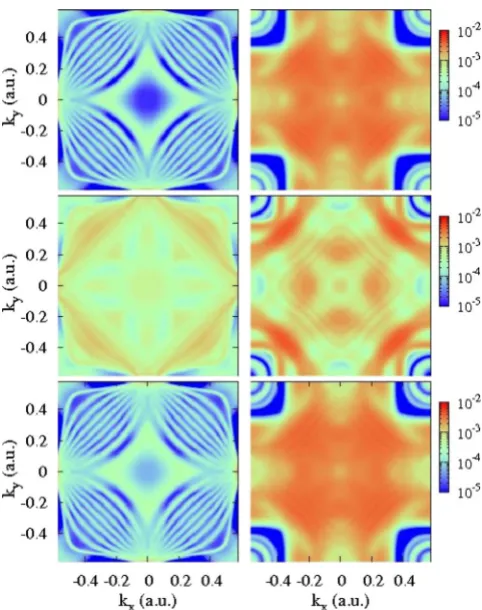
Since the peak in transmission at around EF originates from the IRSs at the Fe/MgO interface, the shift in energy of the transmission coefficient for the LSDA-relaxed structure relative to that of the GGA-relaxed one is the result of a high sensitivity of IRSs to the interface geometry. In Fig. 4 the density of states 共DOS兲, projected on the interface Fe layer, is shown for both spins. For the LSDA-relaxed structure this is shifted by about 0.2 eV with respect to that of the GGA-relaxed structure, which causes the corresponding energy shift of T共E兲. Since the unrelaxed and GGA-relaxed struc-tures are close to each other, the general feastruc-tures of the pro-jected DOS for the two are also similar. In order to get a better insight into the role of relaxation, in Fig. 5 we show the k-resolved projected DOS at EF for the interfacial Fe layer. The results for the GGA-unrelaxed and GGA-relaxed structures are rather similar, but they differ remarkably from that for the relaxed case. In general the LSDA-TABLE II. The TMR and zero-bias conductance for PA and AA Fe/MgO/Fe MTJ. GGA PBE is used for the unrelaxed and relaxed structures. The results are shown for the unrelaxed, the LSDA-relaxed, and for the GGA-relaxed structures. The experimental TMR is for a Fe/MgO/Fe MTJ with a 2.3-nm-thick MgO barrier and a temperature of 20 K共Ref.3兲.
GPA GAA
TMR 共%兲
GGA unrelaxed 1.21⫻10−3 7.18⫻10−6 17300
LSDA relaxed 7.32⫻10−6 6.74⫻10−7 986
GGA relaxed 2.38⫻10−4 3.23⫻10−6 7270
Expt. 247
0 1 2 3
Moment
(
µB
)
unrelaxed LSDA relax. GGA relax.
0 4 8 12
Z (Å)
3 4 5
Occupation
(
e
)
unrelaxed LSDA relax.
Fe MgO
Majority
Minority
(a)
[image:3.609.353.519.67.269.2](b)
FIG. 2. 共Color online兲 共a兲The magnetic moment and共b兲 spin-decomposed electron occupation for a关Fe兴10/关MgO兴6superlattice. These are calculated using Bader analysis for the valence electrons. The vertical dashed line in the top panel denotes the Fe/MgO interface.
10-7
10-6
10-5
10-4
10-3
-0.4 -0.2 0 0.2 0.4
E(eV)
10-7
10-6
10-5
10-4
10-3
T(E)
10-7
10-6
10-5
10-4
10-3
Unrelaxed LDA Relaxed GGA Relaxed
a)
b)
[image:3.609.88.256.70.201.2]c)
[image:3.609.312.559.656.746.2]relaxed geometry shows a substantial reduction in the spin-polarization, demonstrated by the fact that the k-resolved DOS is similar for the majority and minority spins. This is expected to produce a reduction in spin filtering and as a consequence a reduction in TMR. It is also important to note that the main differences between LSDA-relaxed and GGA-relaxed 共and GGA-unrelaxed兲 geometries are more evident around Brillouin zone center, i.e., for electrons with a large
linear momentum perpendicular to the MgO barrier and therefore with a larger transmission probability.
The changes in conductance lead to very different values for the TMR. Our calculated values for the TMR are shown in TableII. The LSDA-relaxed structure has a TMR of about 103, which is much smaller than the TMRs of the other two structures and in much closer agreement to experiments.3
The dramatic reduction in TMR for the LSDA-relaxed struc-ture originates from two feastruc-tures: the shift to lower energies of the IRSs transmission peak and the large reduction in the majority-spin transmission for PA. These can be both asso-ciated with a loss of spin polarization of the first Fe layer at the Fe/MgO interface in the LSDA-relaxed case. To show whether the huge effect on the TMR is due to the atomic relaxation alone or to the combined effect of the different functionals and relaxation, we have calculated the transmis-sion coefficient of 关Fe兴8/关MgO兴4/关Fe兴8 for the unrelaxed
atomic positions both within the GGA and the LSDA as shown in Fig.6. It is clear from this figure that the transmis-sion coefficient remains almost unchanged at the vicinity of the Fermi level. The change in the TMR is less than 1%. The small difference in the peak positions of the LSDA and GGA results is due to the small differences in the electronic struc-ture calculated using the two functionals. We are therefore confident that most of the change in the transmission coeffi-cients is due to atomic relaxation effects on the interface electronic structure as can be seen in Figs.2and4where the magnetic properties at the interface and Fermi surface are altered due to atomic relaxations.
V. CONCLUSION
Motivated by the significant difference between theory and experiments on the reported TMR values in Fe/MgO/ Fe共100兲MTJs, we studied the interface structure and its ef-fects on the electronic and transport properties by means of DFT and the NEGF formalism. In general LSDA- and GGA-relaxed interfacial geometries are rather different, yielding different charge transfer and interfacial magnetism. In par-ticular the local magnetic moment of the interfacial Fe ML is severely suppressed for the LSDA-relaxed structure and en--3 -2 -1 0 1 2 3
E(eV)
-3 -2 -1 0 1 2 3
PDOS
(arb.
units)
[image:4.609.351.520.67.195.2]Unrelaxed LDA-relaxed GGA-relaxed
FIG. 4.共Color online兲The projected density of states共PDOS兲of the interface Fe 3dorbitals in a关Fe兴10/关MgO兴6junction. Positive-and negative-projected DOSs represent the majority Positive-and minority components, respectively. The PDOS for the unrelaxed structure is calculated within the GGA.
FIG. 5.共Color online兲Thek-resolved projected density of states for the interface Fe ML in a Fe/MgO/Fe junction. GGA-unrelaxed, LSDA-relaxed, and GGA-relaxed structures are shown in the top, middle, and bottom panels, respectively. The left and right panels are for majority and minority spins, respectively.
10-4 10-2
T(
E)
-1 0 1
E-EF(eV)
10-4 10-2
T(
E)
P majority P minority AP majority
(a)
[image:4.609.88.256.68.199.2](b)
[image:4.609.52.293.379.684.2]hanced for GGA-relaxed ones. These differences are re-flected in the transport properties. In particular the differ-ences at the interface determine the energy position of resonances in the transmission for the minority spins. These resonances are caused by IRSs and largely determine the zero-bias conductance. As a consequence the TMR is rather sensitive to the interfacial structure. These features can par-tially explain the disagreement between theory and experi-ments and are expected to apply to many other systems rel-evant for spintronics. As a by-product, we have shown that
for the same structure of the interface, the GGA and the LDA functionals produce very similar transmission coefficients and TMR.
ACKNOWLEDGMENTS
X.F., O.B., M.A., and S.L. acknowledge an ANR grant under Contract No. ANR-06-NANO-053, and I.R. and S.S. thank Science Foundation of Ireland for financial support
共Grants No. 07/IN.1/I945 and No. 07/RFP/PHYF235兲.
1W. H. Butler, X.-G. Zhang, T. C. Schulthess, and J. M.
Ma-cLaren, Phys. Rev. B 63, 054416共2001兲.
2M. Bowen, V. Cros, F. Petroff, J.-M. de Teresa, L. Morellón, M.
R. Ibarra, F. Güell, F. Peiró, A. Cornet, and A. Fert, Appl. Phys. Lett. 79, 1655共2001兲.
3S. Yuasa, T. Nagahama, A. Fukushima, R. Suzuki, and K. Ando,
Nature Mater. 3, 868共2004兲.
4F. Greullet, C. Tiusan, F. Montaigne, M. Hehn, D. Halley, O.
Bengone, M. Bowen, and W. Weber, Phys. Rev. Lett. 99,
187202共2007兲.
5I. Rungger, O. N. Mryasov, and S. Sanvito, Phys. Rev. B 79,
094414共2009兲.
6M. Müller, F. Matthes, and C. M. Schneider, Europhys. Lett. 80,
17007共2007兲.
7H. L. Meyerheim, R. Popescu, J. Kirschner, N. Jedrecy, M.
Sauvage-Simkin, B. Heinrich, and R. Pinchaux, Phys. Rev. Lett. 87, 076102共2001兲.
8C. Tusche, H. L. Meyerheim, N. Jedrecy, G. Renaud, A. Ernst, J.
Henk, P. Bruno, and J. Kirschner, Phys. Rev. Lett. 95, 176101 共2005兲.
9J. P. Velev, K. D. Belashchenko, and E. Y. Tsymbal, Phys. Rev.
Lett. 96, 119601共2006兲.
10B. D. Yu and J.-S. Kim, Phys. Rev. B 73, 125408共2006兲. 11C. Heiliger, P. Zahn, B. Y. Yavorsky, and I. Mertig, Phys. Rev. B
72, 180406共R兲 共2005兲.
12J. Velev and W. H. Butler, Phys. Rev. B 69, 024404共2004兲. 13S. Yuasa and D. D. Djayaprawira, J. Phys. D: Appl. Phys. 40,
R337共2007兲.
14M. Sicot, S. Andrieu, C. Tiusan, F. Montaigne, and F. Bertran, J.
Appl. Phys. 99, 08D301共2006兲; M. Sicot, S. Andrieu, P. Tur-ban, Y. Fagot-Revurat, H. Cercellier, A. Tagliaferri, C. De Na-dai, N. B. Brookes, F. Bertran, and F. Fortuna, Phys. Rev. B 68, 184406共2003兲; M. Sicot, S. Andrieu, F. Bertran, and F. Fortuna, ibid. 72, 144414共2005兲.
15P. Luches, P. Torelli, S. Benedetti, E. Ferramola, R. Gotter, and
S. Valeri, Surf. Sci. 601, 3902共2007兲.
16M. Zajac, K. Freindl, K. Matlak, M. Slezak, T. T. Slezak, N.
Spiridis, and J. Korecki, Surf. Sci. 601, 4305共2007兲.
17L. Plucinski, Y. Zhao, B. Sinkovic, and E. Vescovo, Phys. Rev. B
75, 214411共2007兲.
18F. J. Palomares, C. Munuera, C. Martinez Boubeta, and A.
Ce-bollada, J. Appl. Phys. 97, 036104共2005兲.
19C. Tusche, H. L. Meyerheim, N. Jedrecy, G. Renaud, and J.
Kirschner, Phys. Rev. B 74, 195422共2006兲.
20X. G. Zhang, W. H. Butler, and A. Bandyopadhyay, Phys. Rev. B
68, 092402共2003兲.
21P. Bose, A. Ernst, I. Mertig, and J. Henk, Phys. Rev. B 78,
092403共2008兲.
22C. Li and A. J. Freeman, Phys. Rev. B 43, 780共1991兲. 23T. Urano, J. Phys. Soc. Jpn. 57, 3403共1988兲.
24J. P. Perdew, in Electronic Structure of Solids 91, edited by P.
Ziesche and H. Eschrig共Akademie Verlag, Berlin, 1991兲, p. 11. 25P. E. Blöchl, Phys. Rev. B 50, 17953共1994兲.
26G. Kresse and J. Hafner, Phys. Rev. B 47, 558共1993兲. 27R. Bader,Atoms in Molecules: A Quantum Theory共Oxford
Uni-versity Press, New York, 1990兲.
28E. G. Moroni, G. Kresse, J. Hafner, and J. Furthmuller, Phys.
Rev. B 56, 15629共1997兲.
29A. R. Rocha, V. M. Garcia-Suarez, S. Bailey, C. Lambert, J.
Ferrer, and S. Sanvito, Phys. Rev. B 73, 085414共2006兲. 30J. M. Soler, E. Artacho, J. D. Gale, A. Garcia, J. Junquera, P.
Ordejon, and D. Sanchez-Portal, J. Phys.: Condens. Matter 14, 2745共2002兲.
31J. P. Perdew, K. Burke, and M. Ernzerhof, Phys. Rev. Lett. 77,
3865共1996兲.
32D. Wortmann, G. Bihlmayer, and S. Blügel, J. Phys.: Condens.
Matter 16, S5819共2004兲.
33C. W. M. Castleton, S. Nokbin, and K. Hermansson, J. Phys.:
Conf. Ser. 100, 082027共2008兲; http://stacks.iop.org/1742-6596/ 100/082027
34J. Kunes, A. V. Lukoyanov, V. I. Anisimov, R. T. Scalettar, and
W. E. Pickett, Nature Mater. 7, 198共2008兲.
35I. Rungger, A. R. Rocha, O. Mryasov, O. Heinonen, and S.