Field Manual Headquarters
100-5 Department of the Army
Washington, DC, 14 June 1993
OPERATIONS
TABLE OF CONTENTS
Page
PREFACE . . . iv INTRODUCTION . . . v CHAPTER 1 CHALLENGES FOR THE US ARMY . . . .1-1 THE ROLE OF DOCTRINE . . . .1-1 THE AMERICAN VIEW OF WAR . . . . . . 1-2 THE STRATEGIC CONTEXT . . . . . . 1-3 THE TRAINING AND READINESS CHALLENGE . . . 1-5 CHAPTER 2 FUNDAMENTALS OF ARMY OPERATIONS . . . 2-0 THE RANGE OF MILITARY OPERATIONS . . . . . . . 2-0 JOINT, COMBINED, AND INTERAGENCY
OPERATIONS . . . . . . 2-2 INTEGRATION OF ARMY CAPABILITIES . . . . . . 2-2 DISCIPLINED OPERATIONS . . . . . . 2-3 THE FOUNDATION OF ARMY OPERATION . . . . 2-4 COMBAT POWER . . . .. . . 2-9 CHAPTER 3 FORCE PROJECTION . . . 3-1 FORCE-PROJECTION CONSIDERATIONS . . . 3-3 FORCE-PROJECTION OPERATIONS . . . 3-7 CHAPTER 4 JOINT OPERATIONS . . . . 4-1 JOINT RELATIONSHIPS . . . 4-1 THEATER STRUCTURE . . . . . . 4-5 CHAPTER 5 COMBINED OPERATIONS . . . 5-1 CONSIDERATIONS. . . 5-1 PLANNING AND CONDUCT . . . 5-3 CHAPTER 6 PLANNING AND EXECUTING OPERATIONS . . . . . . .6-0 THE STRATEGIC LINK . . . .6-0 PLANNING CONSIDERATIONS . . . .6-3 THE BATTLEFIELD FRAMEWORK . . . 6-11 OFFENSE AND DEFENSE AT THE TACTICAL AND OPERATIONAL LEVELS . . . 6-15 CONFLICT TERMINATION . . . 6-23
PREFACE
The mission of the United States Army is to protect and defend the Constitution of the United States of America. The Army does this by deterring war and, when deterrence fails, by achieving quick, decisive victory on and off the battlefield anywhere in the world and under virtually any conditions as part of a joint team. How the Army thinks about accomplishing its mission is the subject of this manual.
The US Army is doctrine-based doctrinally capable of handling large campaigns as well as combat in a variety of scenarios. FM 100-5 is the Army’s keystone warfighting doctrine. It is a guide for Army commanders. It describes how to think about the conduct of campaigns, major operations, battles, engagements, and operations other than war. It addresses fundamentals of a force-projection army with forward-deployed forces. It applies to the Total Army, active and reserve components as well as Army civilians. Finally, FM 100-5 furnishes the authoritative foundation for subordinate doctrine, force design, materiel acquisition, professional education, and individual and unit training.
Army operations doctrine builds on the collective knowledge and wisdom gained through recent conduct of operations combat as well as operations other than war numerous exercises, and the deliberate process of informed reasoning throughout the Army. It is rooted in time-tested principles and fundamentals, while accommodating new technologies and diverse threats to national security.
This keystone manual links Army roles and missions to the National Military Strategy, of which power projection is a fundamental principle. Thus, force projection the military’s ability to respond quickly and decisively to global requirements is fundamental to Army operations doctrine. The Army recognizes that it will normally operate in combination with air, naval, and space assets to achieve the overall strategic aim of decisive land combat. It also recognizes that operations outside the United States will usually be in conjunction with allies.
The proponent of this manual is HQ TRADOC. Send comments and recommendations on DA Form 2028 directly to Commander, US Army Training and Doctrine Command, ATTN: ATDO-A, Fort Monroe, VA 23651-5000.
INTRODUCTION
The Army’s doctrine lies at the heart of its professional competence. It is the authoritative guide to how Army forces fight wars and conduct operations other than war. As the Army’s keystone doctrine, FM 100-5 describes how the Army thinks about the conduct of operations. FM 100-5 undergirds all of the Army’s doctrine, organization, training, materiel, leader development, and soldier concerns.
Never static, always dynamic, the Army’s doctrine is firmly rooted in the realities of current capabilities. At the same time, it reaches out with a measure of confidence to the future. Doctrine captures the lessons of past wars, reflects the nature of war and conflict in its own time, and anticipates the intellectual and techno-logical developments that will bring victory now and in the future.
Winning wars is the primary purpose of the doctrine in this manual. Since wars are fought for strategic purposes, the doctrine addresses the strategic context of the application of force. Since battle is translated into strategic objectives by operational art, a major portion of the manual addresses the operational level of war. And, since all operations must be based on sound tactics, a major portion of the text covers tactics. The manual also addresses the related fields of joint and combined operations, logistics, the environment of combat, and operations other than war. But, its primary focus is warfighting and how commanders put all the elements together to achieve victory at least cost to American soldiers.
Doctrine derives from a variety of sources that profoundly affect its development: strategy, history, technology, the nature of the threats the nation and its armed forces face, interservice relationships, and political decisions that allocate resources and designate roles and missions. The advent of Active Defense in 1976 was preceded by the emergence of a new order of weapon lethality that was dramatically revealed in the Arab-Israeli War of 1973. The doctrine of that era also reflected a decreased role for the US Army in the evolving national strategy that followed the country’s decade-long experience in Southeast Asia. The 1976 doctrine set as its priority the defense of NATO Europe against a quantitatively superior Warsaw Pact. It accepted force ratios as a primary determinant of battle outcomes and argued the virtues of armored warfare and the combined arms team.
The Army’s ideas about warfighting were evolving in a number of key areas: from service independence (an unequivocal claim in the 1954 FM 100-5) to service interdependence; from defense to offense and then to a more proper balance between the two; from battlefield linearity to greater fluidity; from set-piece battle to simultaneous operations throughout the depth of the battlefield. Throughout, doctrine reflects the adaptation of technology to new weapons systems and capabilities, organizations, missions, training, leader development, and soldier support. In this way, doctrine continues to be the Army’s engine of change.
The 1993 doctrine reflects Army thinking in a new, strategic era. This doctrine recognizes that the Cold War has ended and the nature of the threat, hence the strategy of the United States as well, has changed. This doctrine reflects the shift to stronger joint operations, prompted by the Goldwater-Nichols Act of 1986. This doctrine considers the high quality of Army leaders and soldiers. It causes AirLand Battle to evolve into a variety of choices for a battlefield framework and a wider interservice arena, allows for the increasing incidence of combined operations, recognizes that Army forces operate across the range of military operations. It is truly doctrine for the full dimensions of the battlefield in a force-projection environment.
This doctrine retains the best of all the doctrine that has gone before and expands upon it as appropriate. The battlefield framework has been revised to allow practitioners of Army operations a wider range of options in which to organize their forces on the terrain. It also recognizes that the Army is the only national contingency force capable of achieving land dominance.
This manual offers a doctrine for full-dimension operations. And, despite the removal of the Army’s tactical nuclear weapons from its inventories, this doctrine recognizes that the primary purpose of the Army is deterrence; but, should deterrence fail, the Army’s purpose is to win the nation’s wars by fighting as part of a joint force of the United States. The doctrine provides for a force-projection army that can build and sustain substantial combat power in remote regions of the globe.
As with all previous Army keystone doctrine, this doctrine provides direction for the Army and reflects its progress through the years. Baron von Steuben’s 1779 Regulations for the Order and Discipline of the Troops of the United States (the antecedent of our modern-day FM 100-5) was not penned in a setting of well-ordered formations and well-disciplined troops; but it allowed for their creation and led to a highly professional Army that generations later stands foremost in the world. It reflects the collective wisdom of our Army against the background of history. It reflects the lessons learned from recent experiences and the setting of today’s strategic and technological realities. It considers the nature of today’s threats. It is a doctrine for the entire Army, one that seeks nothing less than victory for the United States—now and in the future. vi CHAPTER 1
CHALLENGES FOR THE US ARMY
The Army’s ideas about warfighting were evolving in a number of key areas: from service independence (an unequivocal claim in the 1954 FM 100-5) to service interdependence; from defense to offense and then to a more proper balance between the two; from battlefield linearity to greater fluidity; from set-piece battle to simultaneous operations throughout the depth of the battle-field. Throughout, doctrine reflects the adaptation of technology to new weapons systems and capabilities, organizations, missions, training, leader development, and soldier support. In this way, doctrine continues to be the Army’s engine of change.
The 1993 doctrine reflects Army thinking in a new, strategic era. This doctrine recognizes that the Cold War has ended and the nature of the threat, hence the strategy of the United States as well, has changed. This doctrine reflects the shift to stronger joint operations, prompted by the Goldwater-Nichols Act of 1986. This doctrine considers the high quality of Army leaders and soldiers. It causes AirLand Battle to evolve into a variety of choices for a battlefield framework and a wider interservice arena, allows for the increasing incidence of combined operations, recognizes that Army forces operate across the range of military operations. It is truly doctrine for the full dimen-sions of the battlefield in a force-projection environment.
This doctrine retains the best of all the doctrine that has gone before and expands upon it as appropriate. The battlefield framework has been revised to allow practitioners of Army operations a wider range of options in which to organize their forces on the terrain. It also recognizes that the Army is the only national contingency force capable of achieving land dominance.
This manual offers a doctrine for full-dimension operations. And, despite the removal of the Army’s tactical nuclear weapons from its inventories, this doctrine recognizes that the primary purpose of the Army is deterrence; but, should deterrence fail, the Army’s purpose is to win the nation’s wars by fighting as part of a joint force of the United States. The doctrine provides for a force-projection army that can build and sustain substantial combat power in remote regions of the globe.
Regional challenges will confront Army forces with an adversary whose system of beliefs interprets differently such fundamental ideas as right and wrong, the value of human life, and the concepts of victory and defeat. What appears to be fanatical to Army forces may be completely rational to their opponent. Under-standing cultural differences is important if friendly forces are to establish the military conditions neces-sary to achieve strategic goals. Unlike the Cold War era when threats were measurable and, to some de-gree, predictable Army forces today are likely to en-counter conditions of greater ambiguity and uncer-tainty. Doctrine must be able to accommodate this wider variety of threats. In so doing, the Army is pre-pared to respond to these worldwide strategic chal-lenges across the full range of possible operations as part of a joint and combined team.
Given the global range of US national strategy, Army forces may be committed on short notice to action anywhere in the world to confront and overcome a variety of difficult challenges. Doctrine describes how these forces think about applying the basic principles of war and operations other than war and the conditions, circumstances, and influences in which they may
The United States Army exists to
support and defend the Constitution of
the United States. It does that by
deterring war and, if deterrnece fails, by
providing Army forces capable of
achieving decisive victory as part of a
joint team on the battlefield--anywhere in
the world and under virtually any
conditions.
THE ROLE OF DOCTRINE
Doctrine is the statement of how America’s Army, as part of a joint team, intends to conduct war and operations other than war. It is the condensed expres-sion of the Army’s fundamental approach to fighting, influencing events in operations other than war, and deterring actions detrimental to national interests. As an authoritative statement, doctrine must be definitive enough to guide specific operations, yet remain adapt-able enough to address diverse and varied situations worldwide.Doctrine touches all aspects of the Army. It facili-tates communications between Army personnel no matter where they serve, establishes a shared profes-sional culture and approach to operations, and serves as the basis for curriculum in the Army school sys-tem. Doctrine permeates the entire organizational struc-ture of the Army and sets the direction for moderniza-tion and the standard for leadership development and soldier training.
Conditions or events that would cause forces to be employed will challenge Army forces. Such con-ditions include drug trafficking, natural or man-made disasters, regional conflicts, civil wars, insurgencies, and intimidation by irrational and often ruthless ex-tremists who have available for their use all manner of weapons and systems, including weapons of mass destruction.
CONTENTS
THE ROLE OF DOCTRINE ... 1-1
THE AMERICAN VIEW OF WAR ... 1-2
THE STRATEGIC CONTEXT ... 1-3 The Levels of War ... 1-3 National Security Strategy and Policies1-3 Mational Military Strategy ... 1-3 Strategic Goals and the Use of Force . 1-4 The Strategic End State ... 1-4 The Strategic Army ... 1-4 Theater Strategy ... 1-5
THE TRAINING AND
READINESS CHALLANGE ... 1-5
CHAPTER 1
be called upon to operate. The global realities of to-day are in a period of significant change. Army forces may find themselves called upon to fight under condi-tions of rapid force projection that can build to major sustained operations in war and peace or that can ter-minate quickly only to lead to other commitments else-where. Doctrine must be relevant to these conditions to be effective. It must be solid enough to weather the winds of turmoil and, at the same time, sufficiently dynamic to capture the relevant aspects of change.
Doctrine should reflect new technology and its potential for the future, as well as its effects on Army operations. The US has a major strength in technol-ogy. When fielded and incorporated into doctrine, technology affords a significant advantage to soldiers one that enables the employment of overwhelming and decisive combat power while minimizing risk to the force. Doctrine seeks to be sufficiently broad and for-ward looking so that it rapidly accommodates major technological opportunities to give soldiers a battle-field advantage. It sets the conditions to exploit tech-nologies that afford a significant increase in lethality, offers major improvement for protection of forces, exploits key vulnerabilities of potential adversaries, and offers a capability that presents an adversary with multiple threats simultaneously. Advances in technol-ogy are continually changing the way warfare is con-ducted at a pace now greater than ever before. Microprocessing, miniaturization, communications, and space technologies have combined to permit al-most real-time intelligence and information sharing, distributed decision making, and rapid execution of orders from a wide variety of forces and systems for concentrated effect. At the same time, however, war-fare remains a test of the soldier’s will, courage, en-durance, and skill. Freezing rain, muddied foxholes, blistering heat, physical exertion, and imminent dan-ger will remain the domain of the soldier.
Resources and force dispositions—themselves re-flective of national strategy—contribute to the devel-opment of doctrine. Decreases in forward-deployed Army forces necessitate an Army that is prepared to deploy forces anywhere in the world on short notice from the continental United States (CONUS) and from forward-deployed locations. The Army is likely at any time to be involved in contingency operations at home and abroad. Force projection replaces forward defense as a more likely employment of Army ele-ments. Doctrine has to accommodate that reality.
Army forces will have to deploy rapidly to operational areas. Doctrine cannot assume that Army forces are in place when the conflict begins. Doctrine must pro-vide an understanding of and prepare Army forces for the difficulty of getting to the region of conflict with the appropriate force to accomplish the mission.
Doctrine seeks to meet the challenges facing the Army by providing the guidance to deal with the range of threats to which its elements may be exposed. It reflects the strategic context in which Army forces will operate, sets a marker for the incorporation of devel-oping technologies, and optimizes the use of all avail-able resources. It also incorporates the lessons of war-fare and the wisdom of the Army’s collective leader-ship in establishing a guide to action in war and op-erations other than war.
THE AMERICAN VIEW OF WAR
The Army reflects the highest ideals of the nation it represents—a nation built on a unique set of values and aspirations expressed in the Declaration of Inde-pendence and the Constitution. These enduring val-ues influence virtually every facet of American soci-ety, its laws, domestic programs, and foreign rela-tions. A special relationship exists within any nation among the government, the people, and the military; national values address this relationship.
The Constitution of the United States establishes the fundamental parameters of the national defense structure, while national attitudes affect the nature and employment of US armed forces. Members of the Army swear to support and defend the Constitution against all enemies, foreign and domestic. The Army serves as a repository of its national values and em-beds them into its professional ethos. Proper subordi-nation to political authority, loyalty, duty, selfless ser-vice, courage, integrity, respect for human dignity, and a sense of justice are all part of the Army’s identity. These values directly influence the Army’s behavior in peace and war.
expect the military to accomplish its missions in com-pliance with national values. The American people expect decisive victory and abhor unnecessary casu-alties. They prefer quick resolution of conflicts and reserve the right to reconsider their support should any of these conditions not be met. They demand timely and accurate information on the conduct of military operations.
The responsibility for the conduct and use of mili-tary forces is derived from the people and the govern-ment. The Army commits forces only after appropri-ate direction from the National Command Authorities (NCA). In the end, the people will pass judgment on the appropriateness of the conduct and use of military operations. Their values and expectations must be met.
In an age of instant communication, capabilities available to the media have had increasingly impor-tant impacts on military operations. They serve as a conduit of information not only to the American pub-lic but also to the rest of the world. Dramatic visual presentations can rapidly influence public—and there-fore political—opinion so that the political underpin-nings of and operations other than war may suddenly change with no prior to the commander in the field. The higher the echelon of command, the more likely the impact of media coverage. Strategic direction and, therefore, the range of operations and their duration, may be dramatically affected.
THE STRATEGIC CONTEXT
The detailed formulation of national strategic di-rection is beyond the scope of this manual. Neverthe-less, national military strategy, derived from national security policy, provides the basis for all operations.
THE LEVELS OF WAR
Fundamental to the Army’s doctrine is an appre-ciation of the levels of war tactical, operational, and strategic—that define the entire range of military op-erations and the links between tactical actions and stra-tegic objectives. The levels of war are defined more by the consequences of their outcome than they are by the echelon of involvement, although, as a general rule, the higher the echelon, the higher the level of war.
The levels of war apply not only to war but also to operations other than war. The strategic perspectives
are worldwide and long-range. Strategy is concerned with national or, in specific cases, alliance or coali-tion objectives. The operacoali-tional level provides the vital link between strategic objectives and tactical employ-ment of forces. At the operational level, military forces attain strategic objectives through the design, organi-zation, and conduct of campaigns and major opera-tions. Tactical battles and engagements are fought to achieve operational results.
The tactical level of war is concerned with the ex-ecution of battles and engagements. On the battle-field, the primary focus of the tactical commander is winning battles and engagements in which he executes maneuvers and fires to achieve a specific objective. Tactical-level commanders are moved in and out of battles and engagements by higher commanders. Suc-cesses and failures at the tactical level, as viewed by the operational-level commander, set the conditions for operational maneuver. The interrelationships of the different levels of war are discussed in greater detail in Chapter 6.
NATIONAL SECURITY STRATEGY AND POLICIES
The United States approaches its global commit-ments with a national security strategy founded on de-terrence and the capability to project power to safe-guard its national security interests and objectives. Successful military operations may not, by themselves, achieve the desired strategic goals, but their failure will ensure eventual defeat. Operations across the full range of military activities must complement the other elements of national power directed to accomplish political aims. National security policies establish the strategic goals and objectives for specific situations.
NATIONAL MILITARY STRATEGY
The foundations of the national military strategy de-rive from the national security strategy. The US mili-tary fulfills four fundamental demands of the national security strategy:
- Ensuring strategic deterrence and defense. - Exercising forward presence in vital areas. - Responding effectively to crises.
- Retaining the national capacity to reconstitute forces.
signed to support a strategic end state that ensures a lasting victory. Military forces must be prepared to support strategic objectives after the termination of hostilities. In both war and operations other than war, military and specifically Army—units must integrate their efforts to support the overall policy scheme.
THE STRATEGIC ARMY
In peace or in war, the Army is the nation’s his-torically proven decisive military force. A key mem-ber of the joint team, the Army serves alongside the Air Force, Navy, and Marine Corps to protect the nation’s vital security interests. The Army’s primary mission is to organize, train, and equip forces to con-duct prompt and sustained land combat operations. It is the Army’s ability to react promptly and to conduct sustained land operations that make it decisive. The Army is competent in many areas, such as nation as-sistance, counterdrug operations, security asas-sistance, deterrence, and stability operations, that can combine with other elements of national power to achieve stra-tegic effects favorable to US interests around the world. The Army’s capabilities provide the nation a diverse, deployable, and sustainable set of options that include strategic and operational logistics and communications capabilities. Most of all, the Army represents the nation’s only military force capable of prolonged land combat. Simply stated, the Army has strategic stay-ing power.
The Army must be capable of full-dimensional
operations. This means employing all means
avail-able to accomplish any given mission decisively and at the least cost—across the full range of possible op-erations in war and in opop-erations other than war.
The Army must train to fight as part of a joint,
com-bined, United Nations, or interagency force.
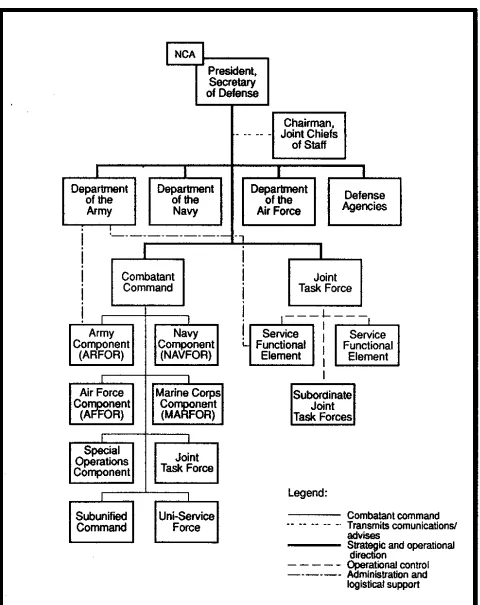
Com-batant commanders seek the power inherent in joint operations by synchronizing the complementary warfighting capabilities of all the services and sup-porting commands into a unified effort. Participation in joint training exercises and joint doctrine develop-ment is a prerequisite to joint capability. The Army develops and trains leaders to operate as part of joint and multinational staffs. Forward-presence forces sup-port collective security arrangements and operate as part of multinational formations. Additionally, the Army enhances relationships with regional partners through
The national military strategy provides the follow-ing strategic principles to guide the employment of military forces:
- Readiness.
- Collective security. - Arms control.
- Maritime and aerospace superiority. - Strategic agility.
- Power projection. - Technological superiority. - Decisive force.
These principles reflect America’s strengths and ex-ploit the weaknesses of its opponents.
STRATEGIC GOALS AND THE USE OF FORCE
The military component of the national security strategy focuses on the use of military force in dem-onstration or operation as an element of national power. Its combination with other elements of national power seeks to preserve, to protect, and to advance the vital interests of the United States. Military operations in war or operations other than war influence, and are influenced by, other elements of policy. The objec-tive of the military in war is victory over the opposing military force at the least cost to American soldiers. How that victory contributes to the overall policy ob-jectives is determined before the war is joined. War makes the most manifest use of military force. How-ever, successful military operations in any form re-quire that military commanders have a clear sense of strategic policy goals and objectives, how the use of military force fits into the overall national security strategy, and the desired military end state.
THE STRATEGIC END STATE
Military force is only one component of national security strategy. When applied either to deter aggres-sion or prosecute military operations, military force seeks to end conflict on terms favorable to US inter-ests. The objective of military forces in war is victory over the opposing military forces at the least cost to US forces. Integrating that victory with other (eco-nomic, political, diplomatic) policy components is an important consideration for policymakers before the war is joined.
de-combined exercises, continual contacts, and nation assistance.
Army forces must be deployable. Commanders tai-lor force packages to accommodate land combat re-quirements of theater commanders in a variety of stra-tegic contingency plans. Deployability is a product of strategic lift coupled with Army force readiness. To ease the burden on strategic lift, the Army pre-posi-tions equipment on land and sea, improves military-related infrastructures in less stable regions, designs forces and equipment that are easily transportable, and trains forces to deploy quickly.
The Army must be expansible. The Army gener-ates forces to respond rapidly to crises with a mix of trained and ready, active and reserve component forces representing the Total Army. How rapidly those forces can be generated depends on a number of variables, since time and training resources needed to hone a fighting edge and prepare combat teams for war are severely limited. Timely mobilization of reserve forces provides the means for sustaining conflict. Deployed forces require reserve component participation for combat arms, combat support (CS) and combat ser-vice support (CSS) across Army activities ranging from nation assistance to global war.
The Army must be capable of achieving decisive victory. The Army must maintain the capability to put
overwhelming combat power on the battlefield to de-feat all enemies through a total force effort. It pro-duces forces of the highest quality, able to deploy rap-idly, to fight, to sustain themselves, and to win quickly with minimum casualties. That is decisive victory.
THEATER STRATEGY
Theater commanders translate national, alliance, or coalition direction into theater strategies based on planning requirements for war or operations other than war. Theater strategies are reinforced as required by supporting combatant commanders. Theater strate-gies provide the basis for all operations plans (OPLANs) and are designed to achieve strategic end states.
THE TRAINING AND
READINESS CHALLENGE
On the day of battle, soldiers and units will fight as well or as poorly as they are trained. Training to high standards is essential in both peace and war; never can Army forces afford not to train and maintain the high-est levels of readiness. Every commander, every sol-dier, every unit in a force-projection army must be trained and ready to deploy. Leaders have the respon-sibility to train subordinates. This may be their most solemn responsibility.
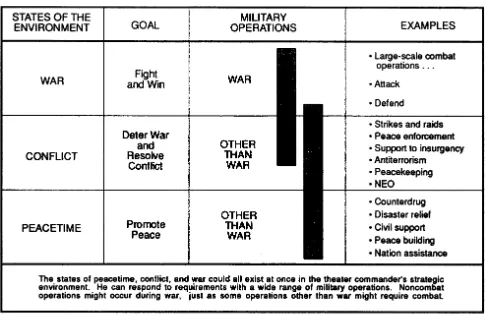
Often the Army will operate in all three environments at once. When-ever operations in these environments occur simultaneously, the Army inte-grates and coordinates their effects so they mutually support the attain-ment of strategic objectives.
OPERATIONS OTHER THAN WAR
Nations use all the resources at their disposal to pursue national objectives. The US promotes the self-development of nations through the measured use of national resources and assistance. The prime focus of the Army is warfighting, yet the Army’s frequent role in operations other than war is critical. Use of Army forces in peacetime helps keep the day-to-day tensions between nations below the threshold of conflict. The US Army’s warfighting doctrine reflects the
nature of modern warfare. It applies the principles of war and combat power dynamics to contemporary and anticipated future battlefields within the strategic policy direction of our government. It is inherently a joint doctrine that recognizes the teamwork required of all the services and the extension of the battlefield in time, space, and purpose through all available re-sources and campaign design. US Army doctrine is compatible with joint doctrine. It recognizes that a joint force commander (JFC) has a variety of ground, sea, air, special operations, and space options available to accomplish strategic objectives. Nonethe-less, actions by ground-force units, in coordination with members of the joint team, will be the decisive means to the strategic ends.
While the conditions of warfare change with time and circumstance, the qualities of skill, tenacity, bold-ness, and courage have always marked successful armies and commanders and will continue to do so. Army doctrine exploits those qualities, together with technology, self-reliance, and the spirit of the offense that characterizes the American soldier. While reflect-ing the increased complexity and lethality of the mod-ern battlefield, Army doctrine recognizes that advanced weapons and technologies are no better than the skill with which leaders and soldiers employ them against the enemy.
THE RANGE OF
MILITARY OPERATIONS
The US seeks to achieve its strategic objectives in three diverse environments, using all elements of na-tional power. The Army classifies its activities during peacetime and conflict as operations other than war. During peacetime, the US attempts to influence world events through those actions that routinely occur be-tween nations. Conflict is characterized by hostilities to secure strategic objectives. The last environment that of war involves the use of force in combat opera-tions against an armed enemy.
CHAPTER 2
FUNDAMENTALS OF ARMY OPERATIONS
CONTENTS
THE RANGE OF
MILITARY OPERATIONS ... 2-0 Operations Other Than War ... .2-0 War ... 2-1 JOINT, COMBINED, AND INTERAGENCY
OPERATIONS ... 2-2
INTEGRATION OF ARMY
CAPABILITIES ... 2-2 The Total Force ... 2-2 Types of Forces ... 2-2 Balance ... 2-2 Combined Arms ... 2-3 Technology ... 2-3
DISCIPLINED OPERATIONS ... 2-3
THE FOUNDATIONS OF
ARMY OPERATIONS ... 2-4 The Principles of War ... 2-4 The Tenets of Army Operations ... 2-6
assistance, counterdrug operations, arms control, treaty verification, support to domestic civil authorities, and peacekeeping.
Americans prefer peace. Hostile forces, however, may seek to provoke a crisis or otherwise defeat our purpose by creating a conflict. At the point where diplomatic influence alone fails to resolve the conflict, persuasion may be required. However, at the point the military may be used to resolve the conflict, the US could enter a more intense environment in which it uses the military to pursue its aims.
US forces are used to deter enemy action. Their physical presence, coupled with their potential use, can serve as a deterrent and facilitate the achievement of strategic objectives. Should this deterrence fail, the US can use force to compel compliance. Regardless of the specific type of operation, a return to the envi-ronment of peacetime is part of the desired strategic goal.
WAR
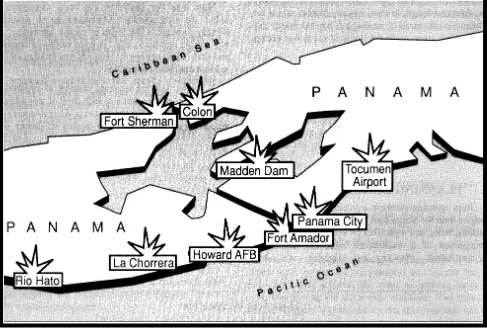
Congress and the NCA may decide to protect our national interests with force or the threat of force. War may be of a limited or general nature. Limited war is armed conflict short of general war as was conducted during Operation Just Cause in December 1989. Gen-eral war, such as World Wars I and II, involves armed conflict among major powers in which the total re-sources of the belligerents are employed and survival is at stake. In either instance, the Army, as part of a joint team, applies decisive force to fight and win with minimum casualties.
[image:15.612.72.557.369.684.2]In concert with the other services, and at times with our allies, fighting and winning our nation’s wars is the traditional role of the Army the one on which it principally focuses and trains. Even in war, the de-sired strategic goal remains directed at concluding hostilities on terms favorable to the US and its allies and returning to peacetime as quickly as possible.
2-1 JOINT, COMBINED, AND
INTERAGENCY OPERATIONS
The Army will not operate alone. The Army con-tributes a full range of unique capabilities for combat, CS, and CSS functions for sustained land combat op-erations as part of a joint, combined, or interagency team. This poses a dilemma for the enemy. As he attempts to avoid the efforts of one service, he opens himself to attack by another. Also, the nature of con-flict in regional crises may involve coalitions that could be different from familiar, longstanding alliance struc-tures. Cooperation with allies is the norm. This im-plies a need for interoperability, accommodation of allied objectives and capabilities, and some policy limi-tations.
In an environment of joint and combined operations, the Army will also operate with other agencies of the US Government. This is true not only when the mili-tary is the prime strategic option -- as it is in war -- but when other agencies are the preferred option and the military provides forces. Army forces must be pre-pared to conduct a number of operations that integrate warfighting and operations other than war with a vari-ety of government and nongovernment agencies, other services, forces from other nations, and international agencies. Robust liaison will facilitate understanding, coordination, and mission accomplishment. Chapters 4 and 5 discuss joint and combined operations in de-tail.
INTEGRATION OF
ARMY CAPABILITIES
The capabilities of the US Army are best realized through the integration of its many components work-ing in concert with joint and combined forces.
THE TOTAL FORCE
To meet future missions with a smaller force, the US Army conducts operations as a total force of the active component, reserve components, and civilians acting in concert with other services and allies. The total force policy engenders public support in any op-eration requiring force projection from opop-erations other than war, through war, to postconflict activities.
TYPES OF FORCES
The Army recognizes three general types of com-bat forces armored forces, light forces, and special op-erations forces (SOF). With their appropriate CS and CSS units, these forces provide a balanced and versa-tile force mix, increasing the options available to the
field commander. Each type of force is unique and possesses varying degrees of deployability, sustainability, lethality, and survivability. A mix of these forces can provide the overwhelming combat power necessary to meet the unique strategic, opera-tional, and tactical requirements of any contingency. For example, airborne and air assault forces may be inserted to force a lodgment, which will support the later deployment of armored and sustainment elements. To protect the lodgment in depth, SOF provide sur-veillance and target acquisition until armored forces are available. Each type of Army force complements the others as it contributes to the joint force.
BALANCE
The components of battle can be joined in a limitless array of complex combinations. Often, elements of a defense are within every offense; within every defense, an offense. Army forces maneuver to bring firepower on the enemy, and bring firepower on the enemy in order to maneuver. Army forces tend to focus on the enemy, but will use terrain for positional advantages when warranted. The commander, determined to de-feat enemy forces on one day, may find himself re-sponsible for feeding them the next. Unconventional and conventional warfare can exist side by side, the one flowing to the other and back again. Balance and a rich choice of options are key to success.
Army forces seek to increase their options while limiting those of their opponents. Successful com-manders do not run out of options; they limit the enemy’s options instead. Risks and gambles are part of option decisions. Field Marshal Erwin Rommel defined a risk as a chance you take; if it fails, you can recover. A gamble is a chance taken; if it fails, recov-ery is impossible. Only with the capability to parry and strike in any direction with sudden and overwhelm-ing combat power can Army forces attain the ideal of quick, decisive victory.
allow the commander to strike the enemy while pre-pared to adjust as conditions change. The commander strives never to be without options.
COMBINED ARMS
Army forces prefer to fight as a combined arms team. Combined arms warfare is the simultaneous ap-plication of combat, CS, and CSS toward a common goal. These arms and services are integrated horizon-tally at each command echelon, normally battalion through corps, and vertically between these command echelons. Combined arms warfare produces effects that are greater than the sum of the individual parts. The combined arms team strives to conduct fully inte-grated operations in the dimensions of time, space, purpose, and resources. Combined arms forces oper-ate over increasingly large areas of the battlefield with less force density than in the past.
Modern combined arms warfare puts added stress on maintaining dispersed and noncontiguous forma-tions. Army forces overwhelm the enemy’s ability to react by synchronizing indirect and direct fires from ground and air-based platforms; assaulting with armor, mechanized, air assault, and dismounted units; jam-ming the enemy’s communications; concealing friendly operations with obscurants; and attacking from several directions at once. The goal is to confuse, de-moralize, and destroy the enemy with the coordinated impact of combat power. The enemy cannot compre-hend what is happening; the enemy commander can-not communicate his intent nor can he coordinate his actions. The sudden and devastating impact of com-bined arms paralyzes the enemy’s response, leaving him ripe for defeat.
The application of combined arms in this manner is complex and demanding. It requires detailed plan-ning and violent execution by highly trained soldiers and units who have been thoroughly rehearsed.
TECHNOLOGY
The strength of the US is manifested in part by the breadth and diversity of its technology base. Advances in electronics, communications, automation, reconnais-sance and surveillance, contamination avoidance, and precision-guided smart weapons and the exploitation of space-based capabilities have increased the lethal-ity, range, accuracy, and reliability of our weaponry. The Army can best use technology in future conflicts only if it is integrated with doctrine. Understanding the relationship between doctrine and technology
be-gins with the premise that doctrine must be the engine that drives the exploitation of technology.
The Army recognizes how warfare changes with the emergence of newer, advanced, and more sophis-ticated technologies. This affects its soldiers and the doctrine that governs how it fights. The Army also maximizes its combat power through the horizontal integration of new weapons or components, especially when they can be applied across a family of systems.
DISCIPLINED OPERATIONS
War is tough, uncompromising, and unforgiving. For soldiers, the rigors of battle demand mental and physical toughness and close-knit teamwork. Between the anxiety of battle, soldiers spend long hours doing routine but necessary tasks in the cold, wet weather and mud, moving from position to position, often with-out hot meals, clean clothes, or sleep. In war, the po-tential for breakdown in discipline is always present. The Army operates with applicable rules of engage-ment (ROE), conducting warfare in compliance with international laws and within the conditions specified by the higher commander. Army forces apply the com-bat power necessary to ensure victory through appro-priate and disciplined use of force.
Discipline begins with trained leaders whose per-sonal example, standard of conduct, concern for sol-diers, and loyalty to subordinates create well-disci-plined units and proper conduct of operations on the battlefield. The Army develops disciplined noncom-missioned and officer leaders who teach their soldiers to do the right thing even during the absence of their leaders.
Exercising discipline in operations includes limit-ing collateral damage -- the inadvertent or secondary damage occurring as a result of actions by friendly or enemy forces. FM 27-10 provides guidance on spe-cial categories of objects that international law and the Geneva and Hague Conventions protect. It also governs appropriate soldier conduct in war. FM 41-10 provides guidance on control and treatment of dis-placed civilians.
effective in reducing casualties and enhancing fair treatment of combatants and noncombatants alike so long as trained leaders ensure those laws are obeyed. The commander ensures the proper treatment of pris-oners, noncombatants, and civilians by building good training programs that reinforce the practice of respect-ing those laws and ROE.
Commanders build good training programs that force the practice of law-of-land warfare and ROE. ROE specify the circumstances and limitations in which forces may engage the enemy. Many factors influence ROE, including national command policy, mission, operational environment, commander’s intent, and law-of-land warfare. ROE always recognize the soldier’s right of self-defense. Properly written ROE are clear and tailored to the situation. ROE may change over the duration of a campaign. A force-projection army tends to face a wide array of ROE. For example, ROE during Operations Just Cause, Desert Shield, Desert Storm, and Provide Comfort were widely di-verse; within each operation, the ROE were different and changed over time.
The commander’s understanding of his mission and his higher com-mander’s intent will help protect the force and decrease the chance of unnecessary ca-sualties. Every soldier is responsible for preventing violations of the law-of-land warfare. Success results from leadership, discipline, esprit, and professional training.
THE FOUNDATIONS
OF ARMY OPERATIONS
Fundamental to operating successfully across the full range of military operations is an understanding of the Army’s doctrinal foundations—the principles of war and the tenets of Army operations.
THE PRINCIPLES OF WAR
The nine principles of war provide general guid-ance for the conduct of war at the strategic, opera-tional, and tactical levels. They are the enduring bed-rock of Army doctrine. The US Army published its first discussion of the principles of war in a 1921 Army training regulation. The original principles adopted by the Army, although slightly revised, have withstood the test of time. Today’s force-projection Army rec-ognizes the following nine principles of war.
Objective
Direct every military operation toward a clearly defined, decisive, and attainable objective.
The ultimate military purpose of war is the de-struction of the enemy’s armed forces and will to fight. The ultimate objectives of operations other than war might be more difficult to define; nonetheless, they too must be clear from the beginning. The linkage, therefore, between objectives at all levels of war is crucial; each operation must contribute to the ultimate strategic aim.
The attainment of intermediate objectives must di-rectly, quickly, and economically contribute to the op-eration. Using the analytical framework of mission, enemy, troops, terrain, and time available (METT-T), commanders designate physical objectives such as an enemy force, decisive or dominating terrain, a junc-ture of lines of communication (LOCs), or other vital areas essential to accomplishing the mission. These become the basis for all subordinate plans. Actions that do not contribute to achieving the objective must be avoided.
Offensive
Seize, retain, and exploit the initiative.
Offensive action is the most effective and deci-sive way to attain a clearly defined common objec-tive. Offensive operations are the means by which a military force seizes and holds the initiative while maintaining freedom of action and achieving decisive results. This is fundamentally true across all levels of war.
Commanders adopt the defensive only as a tem-porary expedient and must seek every opportunity to seize the initiative. An offensive spirit must therefore be inherent in the conduct of all defensive operations. The side that retains the initiative through offensive action forces the enemy to react rather than act.
Mass
Mass the effects of overwhelming combat power at the decisive place and time.
Massing effects, rather than concentrating forces, can enable numerically inferior forces to achieve decisive results, while limiting exposure to enemy fire.
Economy of Force
Employ all combat power available in the most effective way possible; allocate minimum essential combat power to secondary efforts.
Economy of force is the judicious employment and distribution of forces. No part of the force should ever be left without purpose. When the time comes for action, all parts must act. The allocation of available combat power to such tasks as limited attacks, defense, delays, deception, or even retrograde operations is measured in order to achieve mass elsewhere at the decisive point and time on the battlefield.
Maneuver
Place the enemy in a position of disadvantage through the flexible application of combat power.
Maneuver is the movement of forces in relation to the enemy to gain positional advantage. Effective ma-neuver keeps the enemy off balance and protects the force. It is used to exploit successes, to preserve free-dom of action, and to reduce vulnerability. It continu-ally poses new problems for the enemy by rendering his actions ineffective, eventually leading to defeat.
At all levels of war, successful application of ma-neuver requires agility of thought, plans, operations, and organizations. It requires designating and then shifting points of main effort and the considered ap-plication of the principles of mass and economy of force. At the operational level, maneuver is the means by which the commander determines where and when to fight by setting the terms of battle, declining battle, or acting to take advantage of tactical actions. Ma-neuver is dynamic warfare that rejects predictable patterns of operations.
Unity of Command
For every objective, seek unity of command and unity of effort.
At all levels of war, employment of military forces in a manner that masses combat power toward a com-mon objective requires unity of command and unity of effort. Unity of command means that all the forces are under one responsible commander. It requires a single commander with the requisite authority to di-rect all forces in pursuit of a unified purpose.
Unity of effort, on the other hand, requires coor-dination and cooperation among all forces even though they may not necessarily be part of the same com-mand structure toward a commonly recognized objec-tive. Collateral and main force operations might go on simultaneously, united by intent and purpose, if not command. The means to achieve unity of purpose is a nested concept whereby each succeeding echelon’s concept is nested in the other. In combined and inter-agency operations, unity of command may not be pos-sible, but the requirement for unity of effort becomes paramount. Unity of effort coordination through co-operation and common interests is an essential comple-ment to unity of command.
Security
Never permit the enemy to acquire unexpected ad-vantage.
Security enhances freedom of action by reducing vulnerability to hostile acts, influence, or surprise. Se-curity results from the measures taken by a commander to protect his forces. Knowledge and understanding of enemy strategy, tactics, doctrine, and staff planning improve the detailed planning of adequate security measures. Risk is inherent in war; however, command-ers must not be overly cautious. To be successful, commanders must take necessary, calculated risks to preserve the force and defeat the enemy. Protecting the force increases friendly combat power.
Surprise
Strike the enemy at a time or place or in a manner for which he is unprepared.
Simplicity
Prepare clear, uncomplicated plans and concise orders to ensure thorough understanding.
Everything in war is very simple, but the simple thing is difficult. To the uninitiated, military opera-tions are not difficult. Simplicity contributes to suc-cessful operations. Simple plans and clear, concise orders minimize misunderstanding and confusion. Other factors being equal, the simplest plan is prefer-able. Simplicity is especially valuable when soldiers and leaders are tired. Simplicity in plans allows better understanding and troop leading at all echelons and permits branches and sequels to be more easily under-stood and executed.
THE TENETS OF ARMY OPERATIONS
Whenever Army forces are called upon to fight, they fight to win. Army forces in combat seek to im-pose their will on the enemy; in operations other than war, they seek to alter conditions to achieve their pur-pose. Victory is the objective, no matter the mission. Nothing short of victory is acceptable. The Army’s doctrine describes its approach to generating and ap-plying forces and force at the strategic, operational, and tactical levels.
The Army’s success on and off the battlefield de-pends on its ability to operate in accordance with five basic tenets: initiative, agility, depth, synchronization, and versatility. A tenet is a basic truth held by an or-ganization. The fundamental tenets of Army opera-tions doctrine describe the characteristics of success-ful operations. All training and leadership doctrine and all combat, combat support, and combat service support doctrine derive directly from, and must sup-port, the fundamental tenets. The US Army believes that its five basic tenets are essential to victory. In and of themselves they do not guarantee victory, but their absence makes it difficult and costly to achieve.
Initiative
Initiative sets or changes the terms of battle by action and implies an offensive spirit in the conduct of all operations. Applied to the force as a whole, initia-tive requires a constant effort to force the enemy to conform to commanders’ operational purposes and tempos, while retaining freedom of action. It means depleting the enemy’s options, while still having op-tions of their own. This requires leaders to anticipate events on the battlefield so that they and their units
can act and react faster than the enemy. Applied to individual soldiers and leaders, initiative requires a willingness and ability to act independently within the framework of the higher commander’s intent.
In the attack, initiative implies never allowing the enemy to recover from the initial shock of the attack. Attacking commanders gain and maintain the initia-tive by surprise in their selection of the time and place of attack and the violence with which they execute it. They concentrate forces and execute with speed, au-dacity, and violence, continually seeking soft spots and shifting their main effort when required. They are prompt in transitioning from the attack to exploitation and back, if necessary. Commanders press the fight tenaciously and aggressively, accepting risks and push-ing soldiers and systems to the limits of their endur-ance for as long as necessary. The goal is to create a fluid situation where the enemy loses the coherence of the defense. Retaining the initiative over time re-quires thinking ahead, planning beyond the initial op-eration, and anticipating key events on the battlefield hours, days, and weeks in advance.
In the defense, initiative implies quickly turning the tables on the attacker. Defending commanders act rapidly to negate the attacker’s initial advantages. They gather intelligence to gain advance warning and an-ticipate likely enemy courses of action. They set the tempo and restrict, as much as possible, enemy op-tions. Once the attacker commits to a particular course of action, defenders frustrate it and then preempt any adjustments by the attacker, thereupon seizing the ini-tiative.
In battle, initiative requires the decentralization of decision authority to the lowest practical level. At the same time, decentralization risks some loss of synchro-nization. Commanders constantly balance these com-peting risks, recognizing that loss of immediate con-trol is preferable to inaction. Decentralization demands well-trained subordinates and superiors who are will-ing to take risks.
combination with other elements of national and coa-lition power to restore stability.
Agility
Agility is the ability of friendly forces to react faster than the enemy and is a prerequisite for seizing and holding the initiative. It is as much a mental as a physical quality. Greater quickness permits the rapid concentration of friendly strength against enemy vul-nerabilities. Forces may need to concentrate repeat-edly so that by the time the enemy reacts to one ac-tion, another has taken its place, disrupting the enemy’s plans and leading to late, uncoordinated, and piece-meal responses. This process of successive concen-tration against locally weaker or unprepared enemy forces enables smaller forces to disorient, fragment, and eventually defeat much larger opposing forma-tions. To achieve such a defeat, leaders and units must be agile.
Friction is the accumulation of chance errors, un-expected difficulties, and confusion of battle that im-pede both sides. It can never be completely elimi-nated, but left unchecked, it can have a devastating effect on unit agility. To reduce friction, leaders must continually read the battlefield, know when to decide, and act without hesitation.
In operations other than war, as commanders per-ceive changes to their environment, they devise imagi-native methods of applying their resources to those changes and act quickly to gain or maintain control of the environ-ment. For example, Army forces in di-saster relief operations can use tactical vehicles and communication systems to reach isolated locations, to direct efforts, and to restore services to supplement the efforts of local governments whose normal re-sources are overwhelmed.
In peacekeeping operations, Army forces might defuse conditions that would otherwise lead to a re-sumption of fighting by recognizing the inherent dan-gers and by resolving grievances before they ignite into open combat. A situational awareness that per-ceives and anticipates changes in the environment, combined with the ability to act quickly within the intent of higher commanders, leads to an agility in operations other than war that is vital to successful outcomes.
Depth
Depth is the extension of operations in time, space, resources, and purpose. These factors vary by ech-elon and by constraints given to commanders. What
is most important, however, is the fact that in any op-eration the Army must have the ability to gain infor-mation and influence operations throughout the depth of the battlefield. This ability highlights the joint na-ture of deep operations, which means participation by the other services.
To think in depth is to forecast and to anticipate so that the enemy can be attacked simultaneously through-out the depth of the battlefield. Commanders consider the effects of distance on operations. They determine how far operations must extend and how long their LOCs and those of the enemy will be. They consider the effect of depth on force densities throughout the length and breadth of their area of operations (AO). They calculate the effective range of supporting func-tions such as intelligence, fire support, logistics, air defense, and aviation.
Depth allows commanders to sustain momentum and take advantage of all available resources to press the fight, attacking enemy forces and capabilities si-multaneously throughout the battlefield. Momentum in the attack and elasticity in defense derive from depth. Successful commanders are always concerned with the outcome of current operations and the anticipation of future operations; they think in depth, understanding that war is the province of uncertainty and chance. They look beyond the requirements of the moment and forecast the actions needed in the future.
In pursuit of operational objectives, commanders employ joint assets with Army forces to extend their ability to attack the enemy throughout the battlefield. Key are multiple modes of attacks on different targets in some reasonable sequence to achieve a common objective. By extending the depth of the fight, com-manders force the enemy to fight on their terms. With joint resources, commanders observe enemy move-ments and activities and protect their forces through-out the theater. In conjunction with air and naval op-erations, they employ maneuver, fires, space assets, and SOF to attack the enemy.
coordination. Most importantly, these operations pre-vent the enemy from impacting on friendly actions. Commanders retain reserves and adjust their main ef-forts to exploit tactical opportunities and carry the fight into the depths of the enemy’s formations or defenses. At the same time, commanders guard their own free-dom of action by protecting their forces and the means needed to sustain combat operations.
In operations other than war, depth extends ac-tivities in time, space, resources, and purpose to affect the environment and the conditions that are to be re-solved. Seldom are short-term situations conclusive. Commanders envision simultaneous activities and se-quential stages that lead to a long-term outcome. For example, to solve the problem of feeding the local population, commanders may set up kitchens and dis-tribute food in the first stage, assist in the reestablish-ment of commercial food distribution points in the second stage, and finally assist in improving road net-works as the local government regains the ability to provide a steady supply of food. Similarly, peacekeep-ing operations may begin with an initial objective of observing a cease-fire, then move to support of an eco-nomic recovery program, and finally conclude in sup-port of an international agency program that results in cultural assimilation and the resolution of the un-derlying conflict. Just as in war, commanders antici-pate future situations and decide how to coordinate activities in depth that will achieve the desired end state.
Synchronization
Synchronization is arranging activities in time and space to mass at the decisive point. For example, in-tegrating the activities of intelligence, logistics, and fire support with maneuver leads to synchronized op-erations. It means that the desired effect is achieved by arranging activities in time and space to gain that effect.
Synchronization includes, but is not limited to, the massed effects of combat power at the point of deci-sion. Some of the activities that commanders synchro-nize in an operation, such as jamming enemy commu-nications, suppressing enemy air defenses, and shift-ing reserves, might occur before the decisive moment. They may take place at locations distant from one an-other. Though separated in time and space, these ac-tivities must be well synchronized if their combined effects are to be felt at the decisive time and place. Synchronization seeks to gain overwhelming combat power.
Attacking commanders have synchronized their supporting fires with maneuver when they have shifted an artillery strike to a target series of enemy direct fire systems while maneuvering forces rapidly to the enemy’s flanks and rear. Or, on a larger scale, com-manders have synchronized their main and support-ing attacks when the supportsupport-ing attack takes place at precisely the right time and place to divert enemy forces and fires from the main effort as they strike the enemy. An operational commander has synchronized two major operations if one diverts the attention of the bulk of enemy forces, thus uncovering a key ob-jective for decisive attack by the other.
Synchronization usually requires explicit coordi-nation among the various units and activities partici-pating in any operation. By itself, however, such co-ordination is no guarantee of synchronization unless commanders first visualize the consequences to be pro-duced and how they sequence activities to produce them. Staffs must understand their commander’s in-tent since they make a large part of the synchroniza-tion plan happen. Synchronizasynchroniza-tion thus takes place first in the minds of commanders and then in the actual planning and coordination of movements, fires, and supporting activities. Rehearsals are key to success-ful execution of synchronized operations.
In a force-projection army, the ability to synchro-nize operations becomes paramount. When forces are not already forward deployed in the AO, the follow-ing considerations of early—and, if necessary, forced— entry become highly complex: protection, intelligence preparation, logistics, force buildup, in-frastructure access, and the attainment of overwhelm-ing combat power. Joint and combined operations demand careful synchronization of operations to ef-fect intertheater and intratheater logistics flow, mu-tual support, efficient use of all available resources, and the ultimate application of force to achieve the strategic purpose.
In the end, the product of effective synchroniza-tion is maximum use of every resource to make the greatest contribution to success. This is true in opera-tions other than war as well as in war. Synchroniza-tion implies judgment in choosing among simultaneous and sequential activities. Commanders make this dis-tinction clear to their staffs and subordinate command-ers when effects of one activity are a precondition for subsequent action. To achieve this requires the antici-pation that comes with thinking in depth, mastery of time-space-purpose relationships, and a complete un-derstanding of the ways in which friendly and enemy capabilities interact. Most of all, synchronization re-quires a clear statement of the commander’s intent.
Versatility
Versatility is the ability of units to meet diverse mission requirements. Commanders must be able to shift focus, tailor forces, and move from one role or mission to another rapidly and efficiently. Versatility implies a capacity to be multifunctional, to operate across the full range of military operations, and to per-form at the tactical, operational, and strategic levels.
Versatility is to the decathlete as agility is to the boxer. The decathlete trains for and competes in ten separate events; the boxer, one. Army units are ca-pable of rapidly realigning forces and refocusing on widely divergent missions. Disciplined units, highly trained and competent throughout the range of mili-tary operations, are the wellspring of versatility.
Versatility is the ability of tactical units to adapt to different missions and tasks, some of which may not be on unit mission-essential task lists (METL). Army forces have always been versatile; in World War II, Korea, and Vietnam, they adapted quickly to the environment and the tactics of the enemy. In a force-projection army, however, the demands for versatility increase. Operations Just Cause, Desert Shield, Desert Storm, and Provide Comfort introduced Army forces to dynamic environments that called for quick, suc-cessful action across a wide range of war and opera-tions other than war. Forces must be prepared to move rapidly from one geographical region to another and from one type of warfare to another in quick succes-sion.
The same is true for operations other than war. Military police (MP), for example, can provide a mo-bile, lethal show of force, restore civil order, process prisoners of war, and assist peacekeeping operations. Engineer units, with some reorganization and
retrain-ing, can transfer their skills from combat missions to other tasks such as rebuilding infrastructures or restor-ing water and power supplies. Field artillery or infan-try units can be committed to fighting forest fires on short notice with minimal training.
Versatility denotes the ability to perform in many roles and environments during war and operations other than war. It allows for the smooth transition from one mission to another. Versatility requires compe-tence in a variety of missions and skills. It suggests that all military organizations must have the ability to organize in different combinations of units and the capacity to redeploy from one area or region to an-other without the loss of focus. Versatility is the result of well-led, well-trained, and well-equipped forces; high standards; and detailed planning. Versatility en-sures that units can conduct many different kinds of operations, either sequentially or simultaneously, with the same degree of success.
COMBAT POWER
Combat power is created by combining the ele-ments of maneuver, firepower, protection, and leader-ship. Overwhelming combat power is the ability to focus sufficient force to ensure success and deny the enemy any chance of escape or effective retaliation. The enemy is killed, wounded, captured, or not ca-pable of influencing future battlefield events; he is fro-zen by fear and uncertainty, confused, and isolated. Overwhelming combat power is achieved when all combat elements are violently brought to bear quickly, giving the enemy no opportunity to respond with co-ordinated or effective opposition.
Unlimited resources are seldom, if ever, available to the commander. He fights with what he has against whatever force he is committed. But in so doing, he seeks to attain overwhelming combat power as best he can at the decisive point and time. Battle should not be a fight between two relatively equal foes. When tactics are successful, commanders gain a combat power advantage over the enemy and are able to de-feat him quickly with minimal losses to their own troops. Army forces seek to overwhelm the enemy with a combination of factors, key among which are superior equipment, training, leadership, doctrine, and the qualities and courage of the American soldier. Combat is the traditional role of the Army, and the one on which it principally focuses and trains. Win-ning in battle depends on an understanding of the dy-namics of combat power and putting them together to ensure defeat of the enemy.
THE DYNAMICS OF COMBAT POWER
Four primary elements—maneuver, firepower,
pro-tection, and leadership—combine to create combat
power—the ability to fight. Their effective applica-tion and sustainment, in concert with one another, will decide the outcome of campaigns, major operations, battles, and engagements. Leaders integrate maneu-ver, firepower, and protection capabilities in a variety of combinations appropriate to the situation.
Maneuver
Maneuver is the movement of combat forces to gain positional advantage, usually in order to deliver— or threaten delivery of—direct and indirect fires. Ma-neuver is the means of positioning forces at decisive points to achieve surprise, psychological shock, physi-cal momentum, massed effects, and moral dominance. Successful maneuver requires anticipation and men-tal agility.
Commanders may achieve the effects of maneuver without movement by allowing the enemy to move into a disadvantageous position. Moving and posi-tioning units during deployment to a theater and within a theater prior to operations are forms of maneuver if this movement gains a positional advantage and can influence the outcomes of battles and campaigns. Maneuver is rarely effective without firepower and protection. Maneuver keeps the enemy off balance, protecting the force. Maneuver continually poses new problems for the enemy, rendering his reactions inef-fective, and eventually leading to his defeat.
The positional advantages and staying power gained by ground maneuver forces are unique and can-not be replaced by other means. Army combat avia-tion assets can also offer the ground commander greater flexibility and unique advantages in reconnaissance, protection, and lethality; however, the temporary na-ture of these platforms cannot replace the permanence of ground forces. Maneuver and firepower are insepa-rable and complementary dynamics of combat. Al-though one might dominate a phase of the battle, the synchronized effects of both characterize all opera-tions. Their joint use makes the destruction of larger enemy forces feasible and enhances the protection of a friendly force. Maneuver may also exploit the ef-fects of nuclear weapons.
Firepower
Firepower provides destructive force; it is essen-tial in defeating the enemy’s ability and will to fight. It is the amount of fire that may be delivered by a position, unit, or weapon system. Firepower may be either direct or indirect. Integrated as part of the commander’s concept, firepower includes the fire sup-port functions that may be used separately from or in combination with maneuver to destroy the enemy. The extended range and precision of direct and indirect fire weapon systems, using laser-guided munitions and integrated target acquisition systems, make firepower more lethal than ever before. Firepower can be inte-grated with smoke or electronic warfare systems to disrupt or disorganize the enemy, producing specific physical and psychological effects.
Firepower effects occur at the strategic, opera-tional, and tactical levels and must be synchronized with other attack systems against the enemy. Maxi-mum firepower effects require the full integration of Army and joint-service systems and procedures for determining priorities; locating, identifying, and track-ing targets; allocattrack-ing firepower assets; and assesstrack-ing fire effects. Finally, firepower is most effective when combined with the maneuver force.
Protection
Protection conserves the fighting potential of a force so that commanders can apply it at the decisive time and place. Protection has four components.
force protection. Reconnaissance precedes all successful operations. Proper dispersion helps reduce losses from enemy fires as does the use of camouflage, discipline, counterreconnaissance, security operations, and fortified fighting positions. These mea-sures help commanders protect their force from enemy observation and are used through-out the conduct of operations. These are mostly passive measures, but they should also be combined with such active measures as cun-ning, guile, and craftiness. At the operational level, air and missile defense, protection of air bases, and friendly force lodgment areas are all important activities associated with force protection.
•
The second component of protection keeps soldiers healthy and maintains their fighting morale. It includes guarding their equipment and supplies from loss or damage. Tactical commanders take care of their s