http://www.scirp.org/journal/ijcns ISSN Online: 1913-3723
ISSN Print: 1913-3715
An Improved AOMDV Routing Protocol for
Airspace Communication Network
Xi Zhang, Tao Zhang
School of Electronic and Information Engineer, Beihang University, Beijing, China
Abstract
The airspace communication network based on spacecraft has a wide range of applications in regional information enhancement and emergency communi-cation. In this paper, a routing algorithm for congestion degree detection of multipath routing (CD_AOMDV) is proposed. The method of combining the whole congestion degree detection and local congestion degree detection be-fore service initiation is adopted. Timely and accurate judgment of the con-gestion degree reduced the loss rate of the hot nodes, so the average packet loss rate reduced. Simulation results show that compared with the traditional AOMDV protocol, the CD_AOMDV proposed in this paper has reduced the packet loss and improved delay performance, which is more suitable for the airspace communication network.
Keywords
Airspace Communication Network, AOMDV Routing Protocol, Nodes Mobility, SNS Simulation Platform
1. Introduction
The spacecraft has the advantages of long stay time, high precision and high coverage area. Therefore, airspace communication network which is based on spacecraft supports fast access of mobile nodes such as UAVs and ground mo-bile nodes in the coverage area of the airspace. Airspace communication net-work has a wide range of applications in the area of information enhancement, emergency communications.
At present, there are few research achievements about the technology of air-space communication network both at home and abroad. International research on airspace communication is mainly focused on air traffic control [1], airspace communication network architecture [2], security problems in air transport sys-tems [3], multi-frequency data communication [4], navigation signal detection How to cite this paper: Zhang, X. and
Zhang, T. (2017) An Improved AOMDV Routing Protocol for Airspace Communi-cation Network. Int. J. Communications, Network and System Sciences, 10, 157-166.
https://doi.org/10.4236/ijcns.2017.108B017
[5], etc. Less attention has been paid to the routing of the airspace communica-tion network. In fact, due to the constantly movement of UAVs and ground mo-bile nodes, the network topology keeps changing. Because of the dynamic to-pology and limited transmission bandwidth, the airspace communication net-work has Ad hoc netnet-work characteristics.
In the existing routing protocols, according to the generation time of the routing table, the Ad hoc network routing protocols are divided into table-dri- ven routing protocol and on-demand routing protocol [6]. Because the on-demand routing protocols (such as DSR [7], TORA [8], AODV [9]) just dis-covery and maintenance the required routing, the on-demand routing protocols are faster than the table-driven routing protocols, and the memory footprint of the on-demand routing protocols is smaller and when topology changes they use less time to response [10] [11]. So the on-demand routing protocols are more suitable for airspace communication network.
However, for the airspace communication network, because the aerostat nodes often have better ability (greater throughput, routing capacity, etc.) so they are in a special hub position in the airspace communication network. It usually makes the aircraft nodes to become hot nodes in the network. When the frequency of session-initiated or the volume of session increases, it is usual to see link congestion of the links between UAVs with aerostats. In this case, if the aerostats can’t be selected repeatedly when select multipath, the success rate of the session will reduce greatly. If the aerostats can be selected repeatedly, when the aerostats become hot nodes, it is difficult to deal with problems such as large number of packet loss and rapid increase in delay.
The AOMDV protocol is mainly applied to the network of equal nodes [12]. The AOMDV protocol is difficult to apply directly to the space network which node has different capability and nodes are easy to become hot nodes. In this paper, an improved AOMDV protocol (CD_AOMDV protocol) is proposed to reduce the packet loss rate of the aerostats when they become hot nodes. The al-gorithm improves the efficiency of network transmission by detecting the link congestion degree and selecting the path with the lowest congestion degree.
2. Ease of Use
The Problem to Apply AOMDV in the Airspace Communication
Network
Simulation results show that when using the AOMDV protocol (shown in Fig-ure 1) with the increase of the traffic volume, the packet loss rate and the end- to-end delay increases rapidly in the air traffic network. After analysis, the rea-son is that in many cases AOMDV can only find one available path (which con-tains the aerostats) in the airspace communication network. What is more se-rious is that the aerostats are easy to become hot nodes.
Figure 1. Packet loss rate of aerostats.
session, UAVs also began to lost packets, the percentage of the loss rate of the aerostats slowly decline. However, in general, the aerostats still caused 80% of the packet loss rate. Therefore, reducing packet loss rate of the aerostats has be-come an important problem of the airspace communication network.
In the airspace communication network, aerostats are bound to become hot nodes due to the particularity of the network. This feature challenges the AOMDV protocol. The AOMDV protocol are suitable for networks with equal nodes, it should be improved to apply in the airspace communication network. Before initial every session, the nodes need to detect the congestion degree to avoid hot nodes. For middle nodes to transmit packets, next hop and link with less congestion degree will be chosen.
The improved protocol can take advantage of the big bandwidth of the aero-stats and maintain the superiority of the AOMDV algorithm when there is no congestion. When the performance of the aerostats is getting worse, other path with less congestion will be selected to transmit data. The problem of packets loss and delay is solved.
3. CD_AOMDV Routing Protocol
In order to solve the problem of network congestion caused by hot nodes in the airspace communication network, the CD_AOMDV protocol is proposed in this paper to improve the AOMDV protocol. The protocol records the congestion degree of each path in the route path during the route discovery, and sorts con-gestion degree of the discovered paths. When the HELLO messages are ex-changed between neighbors, the link congestion degree will be passed as one of the parameters.
3.1. Improved Route Discovery and Maintenance
During the route discovery, the intermediate node adds the current link
conges-160 170 180 190 200 210 220 230 240
0.5 1 1.5 2 2.5 3 3.5 4 4.5 5x 10
5
Packet delivery Rate(packets/s)
P a c k e ts d ro p p e d a t ae ro st a t
Simulation Results of Dropped Packets
tion degree to RREP. The source node can calculate the congestion degree of each path after receiving RREP. The congestion degree of each path is equal to the highest congestion degree of the path.
In this paper, the source node calculates the congestion degree for each path
and determines which path to use. Suppose that there are k paths, and the
con-gestion degree of each path is p(i). The congestion degree for each segment of the i path is x x0, 1,,xn (in this scenario, n≤8).
That is:
( )
arg max( )
t , 0,1, 2, , 7p i = x t= (1)
(
)
= l max t length
x ∗Bw (2)
l is the length of the queue when the route is discovered, maxlength is the
maximum length of the queue buffer, Bw is link bandwidth. This formula
comprehensively reflects the current congestion and processing ability of each link.
After calculating the congestion degree for each path, the source node will se-lect the path with the lowest congestion degree to transmit packets, that is:
( )
(
)
path=arg min p i ,i=0,1, 2,,k (3)
[image:4.595.223.526.377.716.2]As shown in Figure 2, in dealing with RREQ packets, the difference between
CD_AOMDV and AOMDV protocol is that the intermediate node or destina-tion node will add the link congesdestina-tion degree when creating RREP.
As shown in Figure 3, in dealing with RREP, the difference between CD_ AOMDV and AOMDV protocol is that the source node will compare, determine and record link congestion degree, the intermediate node will record the link congestion degree.
After the route discovery, assume that there are k neighbors in the process of forwarding packets from the source node or the intermediate node. The calcula-tion formula of congescalcula-tion degree of the neighbors is the same as the calculacalcula-tion formula of discovery route. According to the result of the link detection x i
( )
, we select the next hop path as the formula below: [image:5.595.252.496.246.698.2]( )
( )
path=min arg x i ,i=0,1, 2,,k (4)
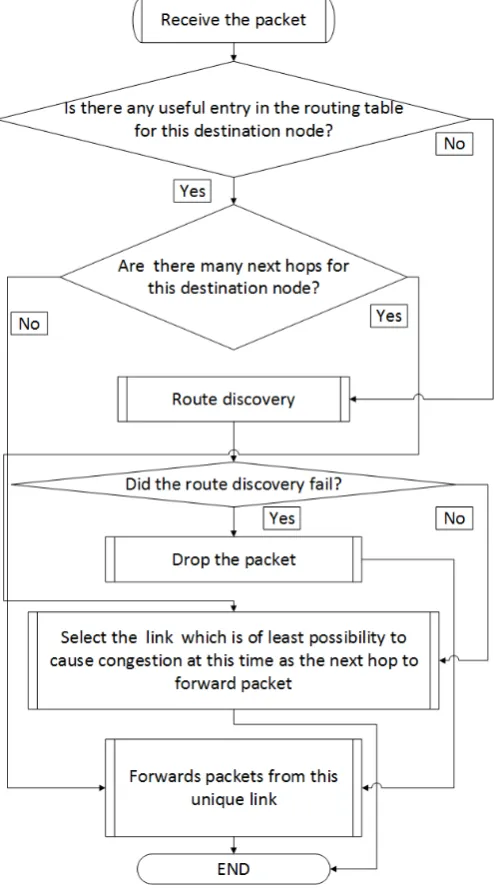
As shown in Figure 4, before the source nodes send the packets and the in-termediate nodes forward packets, they will check the link congestion degree and select the path whose congestion is lowest.
During the routing maintenance, CD_AOMDV uses the HELLO messages to interact with the “congestion degree” between the neighbor nodes.
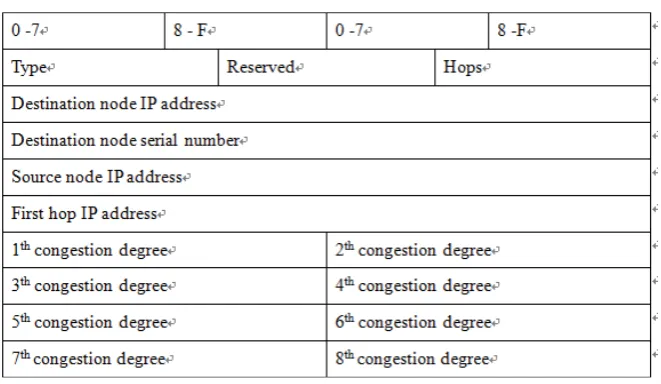
As in the airspace communication network, the number of hops between the source and destination nodes does not exceed eight hops, and more than eight hops are considered invalid routes. The CD_AOMDV protocol adds eight records of the link congestion degree at the end of the RREP. The new format of RREP is shown in Figure 5.
[image:6.595.251.500.260.706.2]Figure 5. RREP message format.
3.2. Improved Routing Table
In a mobile Ad hoc network, the AOMDV protocol sets “valid time period” for each path to ensure that the paths in the routing table are available at the time of forwarding, and when the idle time is too long some paths will be discarded.
In the airspace communication network, the CD_AOMDV protocol will no longer periodically initiate the routing request. In order to reduce the frequency of route initiation, only when the destination is needed and there is no routing entry the node starts route discovery.
In order to record the congestion degree, the routing table is changed; the routing information list of the improved routing table is shown in Figure 6.
3.3. Experiment Simulation
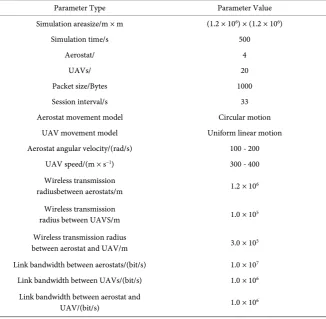
The scenario parameters are shown in Table 1. The simulation scene size is (1.2 × 10⁶ m) × (1.2 × 10⁶ m) and it is evenly divided into four areas in both vertical
and horizontal direction. In each area, one aerostat is cruising around the center of the area with a radius of 1/4 of the area length. The angular velocity of the aerostat is between 100 rad/s and 200 rad/s. So in total, there are 4 aerostats, two to six UAVs are randomly distributed near the aerostat. At the beginning of the simulation, the destination addresses are randomly generated within the scene, and the UAVs continue to fly to a new destination with a flight speed between 300 m/s and 400 m/s. UAVs will connect to a new aerostat will they fly from one area into another. Packets are sent from UAVs to UAVs, the aerostats just for-ward packets instead of sending or receiving them. The simulation last 1,000,000 seconds, every 100 seconds as a new cycle, three new sessions are evenly pro-duced in every cycle. Session duration is random, packet length are 1000 bytes. The packet time interval is decided by the session duration and session load.
Figure 6. Routing information list.
Table 1. Simulation parameters.
Parameter Type Parameter Value
Simulation areasize/m × m (1.2 × 106) × (1.2 × 106)
Simulation time/s 500
Aerostat/ 4
UAVs/ 20
Packet size/Bytes 1000
Session interval/s 33
Aerostat movement model Circular motion
UAV movement model Uniform linear motion
Aerostat angular velocity/(rad/s) 100 - 200
UAV speed/(m × s−1) 300 - 400
Wireless transmission
radiusbetween aerostats/m 1.2 × 10⁶
Wireless transmission
radius between UAVS/m 1.0 × 10⁵
Wireless transmission radius
between aerostat and UAV/m 3.0 × 10⁵
Link bandwidth between aerostats/(bit/s) 1.0 × 10⁷
Link bandwidth between UAVs/(bit/s) 1.0 × 10⁶
Link bandwidth between aerostat and
UAV/(bit/s) 1.0 × 10⁶
hot nodes will drop lots of packets and the network packet loss rate increases dramatically. As the CD_AOMDV choose the path with bigger bandwidth, the traffic is balanced and the packet loss rate will increase much more slowly.
Figure 7. Packet loss rate comparison at different packet transmission rates.
Figure 8. End-to-end delay comparison at different packet transmission rates.
In summary, in the process of increasing the link load, in the airspace com-munication network, some nodes especially the aerostats can easily become hot
160 170 180 190 200 210 220 230 240 0.05
0.1 0.15 0.2 0.25 0.3
Packet delivery Rate(packets/s)
P
a
c
k
e
t d
ro
p
R
at
e
Simulation Results of Drop Rate
AOMDV CD_AOMDV
160 170 180 190 200 210 220 230 240
50 55 60 65 70 75 80 85 90 95 100
Packet delivery Rate(packets/s)
De
la
y
(s)
Simulation Results of Delay
nodes. By making full use of the information of multiple routing discovery and neighbor interaction, CD_AOMDV protocol selects the path of the lowest con-gestion degree. Thus the packet loss rate and delay are both increasing slowly.
Acknowledgements
This work was supported by the National Key Research and Development Pro-gram of China (No. 2016YFB1200102), the National Nature Science Foundation of China (No. 91638301).
References
[1] Kampichler, W. and Eier, D. (2016) Location Based Communication Services for UAS in the NAS. 2016 IEEE/AIAA 35th Digital Avionics Systems Conference
(DASC), Sacramento, CA, 25-29 September 2016, 1-7.
https://doi.org/10.1109/dasc.2016.7778036
[2] Monticone, L.C., Snow, R.E. and Ribeiro, L.Z. (2014) Load-Balancing Algorithms for Multifrequency Data Communications. 2014 Integrated Communications, Navi- gation and Surveillance Conference (ICNS), Herndon, VA, 8-10 April 2014, Q4-1- Q4-13. https://doi.org/10.1109/icnsurv.2014.6820013
[3] Strohmeier, M., Lenders, V. and Martinovic, I. (2015) On the Security of the Auto-matic Dependent Surveillance-Broadcast Protocol. IEEE Communications Surveys
& Tutorials, 17, 1066-1087. https://doi.org/10.1109/COMST.2014.2365951
[4] Liu, Y. and Zhu, Y. (2013) A Collaborative Integrity Monitor Algorithm for Low Space Aviation under Limited Number of Navigation Satellites. 2013 International Conference on Connected Vehicles and Expo (ICCVE), Las Vegas, NV, 2-6 Decem-ber 2013, 910-915. https://doi.org/10.1109/ICCVE.2013.6799925
[5] Zhang, P. and Cui, Y. (2010) Research Progress of Routing Algorithm for Mobile Ad Hoc Networks. Computer Science, No. 1, 10-22+38.
[6] Royer, E.M. and Toh, C.-K. (1999) A Review of Current Routing Protocols for Ad Hoc Mobile Wireless Networks. IEEE Personal Communications, 6, 46-55.
https://doi.org/10.1109/98.760423
[7] Johnson, D.B. (2003) The Dynamic Source Routing Protocol for Mobile ad Hoc Networks. Draft-ietf-manet-dsr-09.txt.
[8] Park, V. and Corson, M.S. (1997) Temporally-Ordered Routing Algorithm (TORA) Version 1 Function Specification. Internet-Draft, draft-ietf-manet-tora-spec-00.txt. [9] Perkins, C.E. and Royer, E.M. (1999) Ad-Hoc on-Demand Distance Vector Routing.
Proceedings of Mobile Computing System and Applications (WMCSA99), 25-26
February 1999, 90-100. https://doi.org/10.1109/MCSA.1999.749281
[10]Marina, M.K. and Das, S.R. (2006) Ad Hoc on Demand Multipath Distance Vector Routing. Wireless Communication and Mobile Computing, 6, 969-988.
https://doi.org/10.1002/wcm.432
[11]Yu, B.-G., Yu, C.-F. and Liu, G. (2014) Communication Analysis of Multiple Mobile Nodes Based on AODV and AOMDV Routing Protocol. Value Engineering, 15, 194-195.
[12]Li, J., Huang, T.H., Cui, G.S. and Yang, M. (2015) Research on Link Expiration Time-Based AOMDV Routing Protocol. Computer Applications and Software, 32, 132-135.
Submit or recommend next manuscript to SCIRP and we will provide best service for you:
Accepting pre-submission inquiries through Email, Facebook, LinkedIn, Twitter, etc. A wide selection of journals (inclusive of 9 subjects, more than 200 journals)
Providing 24-hour high-quality service User-friendly online submission system Fair and swift peer-review system
Efficient typesetting and proofreading procedure
Display of the result of downloads and visits, as well as the number of cited articles Maximum dissemination of your research work
Submit your manuscript at: http://papersubmission.scirp.org/