on an
OPEN
TWO
LAYER FLUID
by
P.J. BRYANT
No. l
November 1976
PERMANENT WAVE STRUCTURES ON AN
OPEN TWO LAYER FLUID
By P.J'. Bryant
There is a significant nonlinear interaction between fast free
surface waves and slow interface waves when the group velocity of the free
surface waves is the same as the phase velocity of the interface waves.
This interaction leads to permanent wave structures consisting of a wave
group of permanent envelope on the free surface and a wave· of perma,nent
shape on the interface. A theory is developed for periodic permanent
wave structures of this type, from which solutions are found numerically.
'l'he theory includes all significant quadratic nonlinear interactions
between free surface harmonics and interface harmonics, as well as between
the interface harmonics themselves. It is found that there is a sequence
1. Introduction.
Two w1iform layers of fluid with densities of similar magnitude and a
free upper surface have two modes of gravity wave propagation, a fast free
surface wave mode and a slow interface wave mode. When both wave modes
are present, a nonlinear interaction occurs between them. Benney [l] has
shown that the nonlinear interaction is resonant when the group velocity
of the fast free surface wave mode equals the phase velocity of the slow
interface wave mode, This property leads to permanent wave structures in
which a wave group of permanent envelope on the free surface is coupled
with and moves with the same velocity as a permanent wave on the interface.
The interaction between surface waves and internal waves has been
studied previously in terms of the response of the surface waves to the
velocity field caused at the surface by the internal waves [2, 3,
4J.
Theconcept of radiation stress was used to determine the behaviour of a surface
wave under the influence of a prescribed internal wave. This method is
unsatisfactory for the present problem because the shape of the internal
wave, as well as the shape of the surface wave, are unknown quantities. It
was found in these investigations that maximum interaction occurs when the
phase velocity of the internal wave and the group velocity of the surface
wave are matched.
The approach used here is to assume that the wave propagation is
unidirectional and is spatially periodic. The surface and interface waves
may then be represented by Fourier series whose coefficients have a slow
time dependence. Equations are foW1d for the time rate of change of each
Fourier amplitude in terms of all significant quadratic interactions between
all Fourier amplitudes. Solutions describing permanent wave structures are
found from these equations. In the limit as the fundamental wavelength
becomes large compared with the depth, the Fourier series tend towards
The properties of long waves on a shallow uniform
singZe
layer fluidare dominated by the near-resonant nature of the interactions between wave
harmonics
[5, 6],
If k and l denote the wavenumbers of two long waveharmonics propagating in the same direction with frequencies u)k, wl, then
wk + w l - wk+ l
=
O ( µ 2 ) ' ( 1. 1)where µ is a measure of the ratio of fluid depth to wavelength. For waves
long compared with the depth, this near-resonant interaction causes the k+l
harmonic to grow to an amplitude comparable with the amplitudes of the k and
l harmonics separately. A long periodic wave therefore contains a large
number of harmonics, whose amplitudes decrease with increasing wavenumber
because their interactions move further from resonance. The long periodic
waveB of permanent form are approximated by cnoidal waves, tending towards
solitary waves as the separation between consecutive crests increases.
The same general properties are valid for single mode pennanerrt waves
in a two layer fluid. Peters & Stoker [ 7] have shown that there exist fast
free surface permanent waves and slow interface permanent waves. The near~
resonant condition (equation 1.1) then applies respectively either to the
frequencies of the fast free surface wave harmonics alone, or to the
frequencies of the slow interface wave harmonics alone.
When both wave modes are present, significant near-resonant interactions
occur between free surface and interface wave harmonics in the neighbourhood
of wa.venumbers L'ik, k, k +L\k (tik ~ k) for which
(wk+L'ik)free surface -
(~)free
surface - (wl\k)interface= o.
(1.2)This near~resonant interaction takes two forms. It may describe an interface
wave harmonic of small wavenumber interacting with a free surface wave
harmonic of large wavenumber to modify another free surface wave harmonic
of large wavenumber. This is the nonlinear interaction that generates
free surface wavenumbers over a broad waveband to form a wave group. It
interacting to modify an interface wave harmonic of small wavenumber.
This is the nonlinear interaction that generates interface waves in the
presence of a group of free surface waves. It will be seen later (§§
5, 6)
that equation (1.2) is modified by the horizontal velocity caused at the
free surface by the wave on the interface, but that this modification does
not alter the validity of the above arguments.
2. Governing__equation~,
The two layer fluid consists of a lower layer of mean depth h1 and
density pi on a horizontal bottom, and an upper layer of mean depth h2
and density P2 with a free upper su-rface. Attention is confined to fluids
for which the density difference P1 - P2 is small compared with P1 and P2·
The fundamental wavelength is denoted by 2TI.l, and a,b are measure of free
surface and interface wave amplitudes respectively, to be defined more
precisely later. The horizontal and vertical coordinates x,y are
non-dimensional, being measured in uni ts of hi + h2, and the origin of y is on
:),;;
the mean interface, The time t is non-dimensional in uni ts of ( (hi + h2) / g) ",
where g is gravity. Interface displacement, n, and free surface displacement
E;,, are measured in units of b, and both velocity potentials
c/i1,cl>2
in units 3 1:of ( g( hi + h2) ) 2• The principal small parameter is c
=
b/ ( h 1 + h2) <{ 1, andother non-dimensional parameters are £'
=
a/ (hi + h2) ~ 1, µ=
(hi + h2)I
l bThe governing equations are then
¢ + ¢ "' 0 h < y
<
0 (2.la)lxx lyy
¢ + <P2yy :: 0 o < y < 1 h (2.lb)
2xx
<Ply
·-
0 on y ::: -h, (2.lc)<Ply nt
s(n<P )
lx x ::::: O(t:2) on y= o,
(2.ld)¢2y n, i:; E:(n¢2 ) x x :::::: 0( £2) on y
= o,
(2,le)+ ~£P ( ¢ 2 + ¢ 2 ) - ~£ ( ¢ 2 + ¢ 2 )
= .
0 ( E 2 ) on y=
0 'lx ly 2x 2y
¢ - t;, - £ ( t;,¢ )
=
O( £2) on y=
1 - h,'2y t 2x x
¢2t + t;, + st;,¢2yt + ~£(¢22x + ¢2~)
=
0(£2) on y=
1-h.Spatially periodic solutions are sought of the form
00
t;, ::;; ~
l
~(t) exp i(k]Jx - wkt) + k=l00
n
=
~l
Bk ( t) exp i ( k]Jx - wk t) + k=l00
*
*
¢1 =~
l
c
1k(t) cosh kµ(y + h) exp i(kJJx -wkt) +
*
k=l00 ¢2 =~
l
(c2k(t) cosh k]Jy + D2k(t) sinh kµy) exp :i.(:kµx- wkt) +
k=l
*
(2.lf) (2.lg) (2.lh) (2.2a) (2.2b) (2.2c) (2.2d)
Where 11- denotes complex conjugate, and k, ~ are non-dimensional wavenumber
~ (in units of
1/f)
and frequency (in units of (g/h1+h 2 )) 2•
Substitution of these Fourier series in equations (2.1) followed by
neglect of the 0(£) terms yields the linear approximation, whose solution
is (with T 1 = tanh k]Jh T2
=
tanh kµ (1-h))( P +Ti T2) ( wk2/kµ) 2 - p(T1 +T2) wk2/kµ + (p-1) T1 T2
=
O, ( 2. 3)Bk
=
(l -T2kµ/wk2) co sh {kp( 1-h)} ~= (
ikµ/wk) sinh {kµh} elk(2.4)
·- ( ikµ/wk )D2k
=
( ikµ/~) (wk 2 /kµ - T2)I (
1 - T2(u/ /kµ)c
2k.Equation
(2.3)
is the dispersion relation, with the solution(JJ 2
k
kµ
(2.5)
where the larger root will be denoted wAk, and the smaller root wBk. When
p
=
1 + /Jp, /Jp <{ 1, as in the present application, the two roots reduce tow
2 = kµ tanh k]J ( 1 + 0 (lip) ) ' Akll]3~
= lip '1'1 T2 /(T1 +T2)(l + O(L:ip)).The fast wave mode with frequency wAk is the free surface wave mode with
propertj.es almost independent of the presence of the interface. The slow
wave mode with frequency ~k is dependent on the reduced gravity gl\p at the
interface displacement.
The linear solution in equations ( 2. 3) and ( 2. 4) may now be used in
the calculation of the next approximation, that is, in the subs ti tut ion of
equations (2.2) in equations (2.1) including the evaluation of the 0(€)
terms. When the velocity potential amplitudes elk'
c
2k, D2k are eliminated,
two differential equations emerge from lengthy calculation, namely
(with D = d/ dt) ,
D(D-2iU},.)(~+(p-l)(l-Tzkµ/w
1
/) cosh {kµ(l-h)} Bk)k-1
--
~
£.f.~l
Pk,-lB,e.
Bk-l exp - i(w,e_ +wk-l-wk)tco
k""l,2, ....• ,
( D - i ( ~ - w Ak wBk
IL\) ) (
D - i (wk + w Ak wBkI
wk) ) (Bk -(l-'r2kµ/wk2) cosh {kµ(l-h)} Ak)k-1
-
~
£ )~
-l B,e, Bk-f exp - i(w.e. + uJk-l - (J.lk)t.c=l '
k = l , 2 , ...
(2.6a)
(2.6b)
The freq_uencies w_e, defined for positive wavenumbers by equation (2.5)
are continued to negative wavenumbers by
w_.e.
=-w.e.
(l>
0). The coefficientsPk,l , Qk,l are stated in the Appendix. Note that Pk,-l
=
Pk,-(k-l)'~.-..e.
=
~,-(k-l)'
0<
..e.<
k.Equation ( 2. 6a) has a complementary ftmction which when substituted
into equations (2.2a) or (2.2b) yields wave harmonics with exponents
kµx ± wk t . F'or a given initial displacement, this equation describes
waves of one mode (either fast or slow) propagating in the positive a,nd
negative x-directions, modified as they propagate by the nonlinea.r right
into equations (2.2a) or (2.2b), yields wave modes with exponents
kllx ± wAk wBk/wk t . The frequency wk is equal either to wAk for a fast mode
or wBk for a slow mode. Hence, for a given initial displacement, equation
(2.6b) describes waves of the mode other than that in equation (2.6a)
propagating in the positive and negative x-directions.
If equation (2.6a) is integrated as it stands, the right hand side of
the resulting equation would contain the denominators - i ( W,e + wk-l - wk)
and - i (wk+£. -wt -wk). When all three frequencies in either of these
denominators are of the slow mode, the expressions are 0(µ2) as µ -> 0 interface
(equation 1.1). Since the equations will be applied to long/waves for which
s/µ2
=
0(1), this integration is not permissible. When equation (2.6a) ismultiplied by exp(-2iwk t) , no such difficulty occurs and the equation
integrates to
D(Ak + (p-1)(1 - Tz kµfw/) cosh {kµ(l-h)} Bk)
k-1
-- ~ iE
l
l=l00
+ i E
l
l=l+ 0(£2) , k
=
1, 2, ...When equation (2.6b) is multiplied by the integrating factor
exp - i (wk+ wAk wm/l\.)t and integrated, i t becomes
(D-i(wk-WAk WBk/wk))(Bk-(l-T2 kµ/wk2) cosh {kµ(l-h)} ~)
k-1
= ~ iE
l
l=l
co
+ i E
l
L=l+ O(t:2) , k
=
1, 2,If this equation is now multiplied by the integrating factor
(2.7a)
( 2. '7b)
exp ~ i (wk~ wAk luBk/wk) and integrated, the right hand side of the resulting
equation contains the denominators - i ( W,e + wk-l - wAk ~k/wk) and
magnitude small compared with 1 when k and l are such that the triad
describes the near-resonant interaction of equation (1.2). If attention
is restricted to those k and l for which these denominators have a magnitude
comparable with 1, equation ( 2. 7b) may be multiplied by the integrating
factor and integrated to leave
k-1 =-~E:
l
:t=1
00
-€
l
l=l
Benney [ 8] derived equations for the time evolution of long nonlinear
waves, that is, waves for which µ2 "'E: ~ 1. His analysis, applied to the
( 2. 8)
present problem, predicts that for a long nonlinear wave on the free surface
£;, satisfies a Korteweg and de Vries equation, while for a long nonlinear
wave on the interface
n
satisfies a Korteweg and de Vries equation. '.rhelatter equation is now derived by taking the long wave limits of equations
(2.7a) and
(2.8)
withwk, W,e_,
U\t-.t
andwk+i
all referring to the slowinterface wave mode.
The linear long wave velocity on the interface is
Co
=
limwBk/kµ,
µ->O
and, from equation (2.3), is the smaller positive root of
Co4 -Co2 +h(l-h)(p-1)/p =
o.
The coefficients
Pk,l/(wk+i-W.e. +wk)
in equation (2.7a) reduce toCo4 +(3h-2)C0 2
+ l-2h
(1+0(µ2)) Co2 - (1-h)
and the coefficients Q.k,.t in equation (2.8) are 0(µ2) •. On substitution
k-1
= -
~ iErl
kµ B,e Bk-l exp - i (w.e. + wk-l-U\)
t.e.
=l00
+ O(E2) , k
=
1, 2, ...3Co Co4 +(3h-2)Co2 + l-2h
where r
=
-4h (2Co2 -l)(Co2 - (1-h))
(1+0(µ2
) ) .
(2.10)
Equation (2.10) may be summed over
.e.
and k, using equation (2.2b), to givewhere, from equation (2.3),
wk/kµ
=
C0 - k2µ2s + 0(µ4),c
0 ( 1 + ( 3/ p - 2) h ( 1 - h) )c
0 2 - h ( 1 - h)and s ""
-6
22Co -1
(2.11)
Equation (2.11) is a Korteweg and de Vries equation, as predicted by Benney
[ 8] .
3, Permanent waves on the interface
Permanent periodic waves of (nondimensional) velocity c on the
inter-face have the Fourier expansion
00
n(x,t)::::
l
bk cos kµ(x-ct)k=l
where from equation (2.2b)
(3.1)
( 3, 2)
When
l\
is eliminated between equations (2.7a) and (2.8), and Bk is replacedfrom equation (3.2), then
If the wave height, trough to crest, is denoted by 2b, where
E:
=
b/(h1 +h2), then00
l
b2k-l=
-1 k=lwhere the origin in x - ct is taken at the trough of the wave.
The properties and method of solution of equations (3.3) have been
described previously
[6]
for permanent waves on a single layer fluid, and ( 3. 4)apply again here. For waves of length small or comparable with the lesser
of the layer depths, the permanent waves are Stokes' waves on the interface
for which bi
=
-1, bz=
0( E:). For longer waves, as µ decreases, the nonlinearinteractions between the wave harmonics lie closer to resonance, and the
permanent waves therefore contain more harmonics. Starting from large values
ofµ, equations ( 3.3) may be solved numerically for successively smaller values
of µ to any required numerical accuracy, with the neglect of the 0( E:2)
remainder. One wavelength of the solution for p
=
1.05, h=
0.9, E:=
0.05,and µ = 2 is sketched in figure 1. This periodic permanent wave is closely
approximated by the cnoidal wave solutions of the Kortewel:S and de Vries
equation (2.11), since for a small upper layer (h
=
0.9), the coefficientsrands in equation (2.11) are of comparable magnitude when (l-h)2µ 2 ~ £,
As equations (3.3) are solved for smaller values ofµ at constant p, h~ and£,
the solutions tend towards periodically spaced solitary waves, and the number
of harmonics increases. The solution in figure 1 for µ
=
2 contains 11harmonics exceeding 10-3 in magnitude, while that forµ=
o.
2 contains '71harmonics exceeding l0-3 in magnitude.
The present calculations have been checked analytically against two
previous investigations of the long wave limit. Long permanent waves at
the interface of a two layer fluid were investigated by Peters & Stoke:c [
71
~who developed perturbation expansions for the streamline displacements in the
corresponding steady flow problem. Their solutions agree exactly with the
cnoidal and solitary wave solutions of equation (2.11). Benjamin [9] showed
density and velocity are arbitrary functions of height. When his method is
applied to the particular case of a two layer open fluid, agreement is obtained
again with the cnoidal and solitary wave solutions of equation (2.11).
The coefficient r in equation (2.11) is negative when the interface is
high, positive when the interface is low, and r = O for /J.p ~ 1 when
( 3. 5)
When r
<
0, the cnoidal wave solutions of equation (2.11) are peaked towardsthe troughs, as in figure 1. As the upper layer is increased in depth and r
approaches zero, the periodic solutions tend towards the sinusoidal solution
of equation (2.11) for r
= o.
When r>
O, the cnoidal wave solutions ofequation (2.11) are peaked towards the crests, as in figure 1 inverted. The
same properties are true of the solitary wave solutions of equation ( 2, 11),
although as was noticed 'by Peters and Stoker, there is no solitary wave
solution for which µ 2
=
0( E:) when r
=
o.
In this case, following Benney [ 8] ,equation ( 2 .11) may be rewritten
n +Con + 3E2An2
n
+ µ2sn=
o(s
3, sµ2, µ4) ,
t x x xxx ( 3. 6)
where )1 - O(s) and A is an 0(1) coefficient, and this equation does have
solitary wave solutions.
4.
Permanent wave structuresPeriodic permanent wave structures containing both the fast free surface
wave mode and the slow interface wave mode are now investigated. Solutions
to the governing equations are sought of the form
n
n
=
l
bk cos kµ(x-ct) k=lm2
~
=
l
~ cos {kµ( x-ct) - at}k=m1
(4.la)
where bk ( 1
<
k<
n), ~ (m1<
k<
m2 ) , c and a are to be determinecL Theform of these solutions is such that the interface wave and the envelope
with a constant frequency a relative to the group envelope. The corresponding
complex amplitudes, from equations (2.2)1 are
Bk(t) = bk exp i( wk - kµc)t 1 <k < n,
~(t)
=
ak exp i( wk - kµc - a)t m1<k <m2.The significant nonlinear interactions are divided into three types:
( 4.
2a)(4.2b)
I. Two interface wave modes interacting to modify a third interface wave mode,
1 < ltl, k-t, k <n.
Equation (2.8) is valid for this interaction, since ~,k-l + ~l - u)Ak is
comparable with 1.
( 4.
3a)II. Two free surface wave modes interacting to modify an interface wave mode,
w - w :!!: w
A,l._+,e
Ai
Bk( 4.
3b)Equation (2.8) is valid for this interaction also since wA,k+l -
wAl -
WAkis comparable with 1.
III. An interface wave mode and a free surface wave mode interacting to
modify a free surface wave mode,
U) o+Wo~WAk
A,k--t.. B{, ( 4. 3c)
Equation (2.8) is valid here also because wA,k-l +
wBl -
wBk is comparablewith 1.
These three types of quadratic interaction dominate all other nonlinear
interactions because of their nearness to resonance. For this reason, they
are the only nonlinear interactions included in the calculations.
The governing equations are formulated in terms of the Fourier amplitudes
defined in equations (
4.
2), for otherwise exponentially large coefficientsare multiplied by exponentially small amplitudes. The free surface amplitudes
Ak (m1 ~ k ~ m2) have associated with them exponentially small interface
amplitudes Bk (m1
<
k<
m2), so it is possible in principle to use equations( 2. ~(a), ( 2. 8) throughout the calculations. This is not desfrable in practice
because of the errors caused in the numerical calculations. When equations
equations (4.2), the governing equations become
k-1 n-k
(wBk -kµc)bk
=
~
E .e.I1 (R1)k,-l blbk-l + E .e.I1 (R1)k,l blbk+lm2-k
+ E
l
(R2)k,l at8k+t l=m1Min(n,k-mi) ( wAk - kµc - a) ak
=
El
l=l
The coefficients RI, R2, R 3 associated with the three types of nonlinear
interaction are defined in the Appendix.
(4.4a)
(4.4b)
Equation (3.4) measuring the height of the interface wave is still valid,
namely
l
bk=
-1k odd
(4.5a)
Since the height of the wave group on the free surface is independent of the
height of the interface wave, then
k
~dd
8k= ;\
1*1ere A is a prescribed constant. The maximum height of the envelope of the
wave group above the mean free surface is denoted by a, where a/(h1 +h2 ) = £1•
It is to be noted that if ~ (m1 .;;;;; k.;;;;; m2) is one solution for the free surface
harmonics, then -ak (m 1 .;;;;; k .;;;;; m2) is another solution with the same envelope.
The n+m2-m1+3 equations (4.4), (4.5) are now solved for the n+m2-~m1+3
variables bk (l .;;;;;k .;;;;;n), 8k (m1 .;;;;;k .;;;;;m2), c and a.
_5_. __ R_ermanent wave structures of short wavelength.
The simpler solutions of equations (4.4) and
(4.5)
include those of shortwavelength, when the wave on the interface is almost sinusoidal because the
first type of interaction is far from resonance. For a free surface wave
group of sufficiently small amplitude, equations (4.4a), (lt.5a) are then
(5.1)
This set of m2 - m1 + 1 linear algebraic equations has in general m2 - m1 + 1 sets
of solutions, each set containing an eigenvalue a and the corresponding
eigenvector~ (m1 < k <m2) of the matrix of coefficients. Each eigenvector
may be scaled to satisfy equation (4.5b).
It is a straightforward numerical calculation [10] to find the eigenvalues
and eigenvectors of the set of equations (5.1) for any given external parameters.
These parameters were taken to be p
=
1.05, h=
0.9, µ=
20, £=
£1=
0.005,for which the equality ~l
=
dwAk/dk occurs at about k=
l0.5. The intervalm1 ~k <m2 was chosen to be sufficiently large that sets of solutions were
reproducible to within the desired numerical accuracy (10-4) when the size o:f
the interval was increased further. Each set of solutions was then used as
the starting estimate for a Newton-Raphson solution of equations (4.4) and
( 4. 5) to the same numerical accuracy. The first five sets of solutions are
drawn in figure 2( a), and the corresponding free surface wave groups (equation
4.1b) a.re drawn in figure 2(b).
In order to understand the sets of solutions in figure 2(a), equations
(5.1) are written as the set of difference equations
where (R3\,-l ~ (R3)k',1 , and f(k) is approximately a quadratic form in
A comparison of these difference equations with the differential equation
d2
~
+ f(x)y=
0 ,-~ k.
(5.2)
shows that solutions for ak are oscillatory in k when f(k)
>
O, and areconvergent or divergent in k when f(k)
<
O. The only stationary value of f( k)k · t · d ( k ) th t · ,,,.
I
1ma es 1 a maximum near dk wAk - wBl - a = 0, a is, near wBl "' Ul.!lAk
a
L Hence acceptable solutions for ak (m1 < k < m2) consist of' a range in theneighbourhood of resonance where ak is an oscillatory function of k 9 enclosed
by ranges at each end where ak decreases monotonically in magnitude towards
of the range of oscillation and the number of oscillations of ak as a function
of k both increase when a decreases. These properties are all present in the
five solutions sketched in figure 2(a).
The structures of the free surface wave groups in figure 2(b) may be
interpreted in terms of their interaction with the horizontal velocity field
caused at the free surface by the wave on the interface. Since the wave on
the interface is sinusoidal, the horizontal velocity u at the free surface is
also sinusoidal with a positive maximum at the centre of the group and a
negative minimum at the two ends of the group. The resonance equation (1.2)
is modified now to
( 5. 3)
where c
=
0.035 and -0.001::;;; u e;;;; 0.001 (from equations 2.2d, 2.4) for the wavegroups in figure 2(b). Hence the wavenumber of the free surface wave within
the group varies from 10.8 at the centre of the group to
9.6
where the groupextends to the ends of the fundamental wavelength. Measurements in figure 2(b)
confirm the accuracy of this interpretation.
6.
Permanent wave structures of long wavelength.When the fundamental wavelength increases, the first type of interaction,
namely that 'between harmonics on the interface, moves closer to resonance.
The number of interface harmonics therefore increases, and since each interface
harmonic interacts near resonance with a range of pairs of free surface
harmonics, the number of free surface harmonics also increases. 'l~e latter
effect may be seen alternatively as a consequence of a longer interface wave
causing a stronger horizontal velocity gradient at the free surface.
Two methods have been developed for calculating numerically the solutions
of equations
(4.4), (4.5)
for long wavelengths. The harmonics of a permanentinterface wave of given wavelength in the absence of a free surface wave group,
bk ( 1
<
k e;;;; n) , may be calculated as in § 3 and then substituted into eque,tions(tr.4b). 'l~e resulting linear algebraic equations for ak (m1 ~k ~m2) and a
and the solution used as a starting estimate for a Newton-Raphson solution
of equations (4.4), (4.5) at the given wavelength. Alternatively, the
solutions in
§5
at short wavelengths may be continued step by step inµ tolong wavelengths, using the Newton-Raphson method of solution at each step.
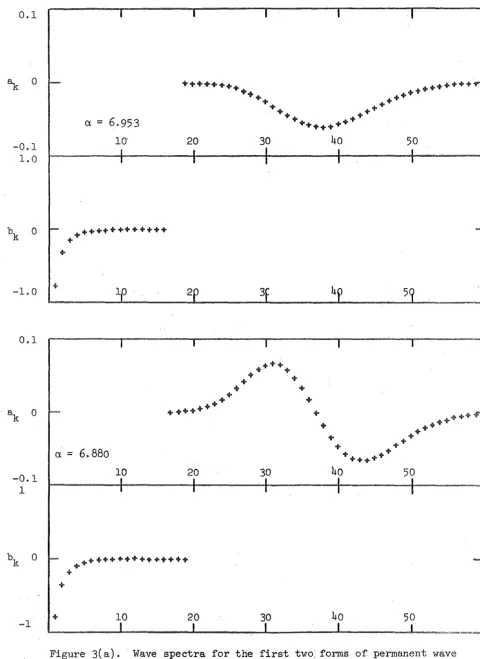
The first two sets of solutions for the harmonics at p
=
1.05, h =0.9,µ
=
2, £=
£1=
0.01 are shown in figure 3(a), and the correspondingpermanent wave structures are sketched in figure 3(b). It can be seen that
the shape of the spectra of the free surface harmonics in figure 3(a) is the
same as that of the first two fo:i;-ms in figure 2( a). This similarity of shape
was found for all five forms in figure 2(a) as µ decreased from 20 to 2. The
free surface wave groups in all five forms of permanent wave structure also
retained similarity of shape as µ decreased.
The horizontal velocity at the centre of the free surface wave group is
0.008, 0.009 respectively in the two examples in figure 3(b), and the phase
velocity is 0.066, 0.067 respectively. Equation (5.3) therefore predicts that
the wavenumber at the centre of the free surface group should be about 37
in both examples. The validity of this interpretation is confirmed by figure
3( a), where k
=
37 lies near the centre of the spectrum in both examples, andby figure 3(b), where measurement of the wavelength within the free surface
wave group agrees with this estimate.
The interface wave spectrum is broader in the presence of a wave group
than in its absence. The interface spectrum for the first form of permanent
wave structure in figure 3 contains 15 harmonics exceeding 10-3 in magnitude,
while the interface permanent wave spectrum in the absence of a surface wave
group contains only
6
harmonics exceeding 10-3 in magnitude. The free surfacewave group, through the second type of nonlinear interaction identified in §4,
broadens the interface wave spectrum and hence sharpens the interface wave,
The amplitude of the free surface wave group (measured by £ 1) may be
increased step by step so that the second type of nonlinear interaction causes
a greater change to the shape of the wave on the interface. One such example
structure at p
=
l.05, h=
0.9, µ=
2, e: = 0.01, e:'=
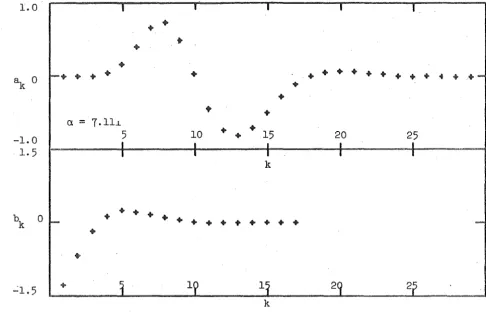
0.05.The spectrum of the free surface harmonics in figure 4(a) displays the
characteristic shape of the second form of permanent wave structure, but the
spectrum of the interface harmonics, instead of decreasing monotonically in
magnitude as previously, now displays a small overshoot. It can be seen in
figure 4(b) that the shape of the envelope of the free surface wave group has
been impressed onto the interface wave, which is a property that also occurs
for the other forms of permanent wave structure in this limit. The phase
velocity of the structure has increased from 0.067 at e:
=
e:'=
0.01 to0.124 at e:
=
0.01, e:'=
0.05 because the structure is now dominated by thefast free surface wave mode. The horizontal velocity at the centre of the
free surface wave group due to the interface wave is now 0.010, so equation
( 5.
3) predicts that the wavenumber at the centre of the free surface wavegroup should be about 10. This is in agreement with figures 4(a) and 4(b).
The wavenumber is smaller than in the examples of figure 3 because the phase
velocity of the structure is larger, requiring from equation (5.3) a larger
free surface group velocity.
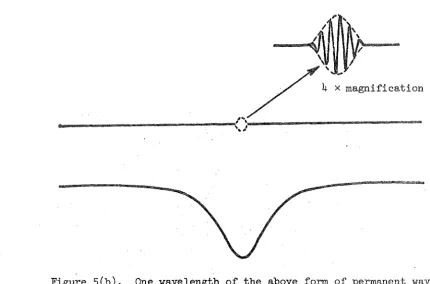
The amplitude of the interface wave (measured by e:) in the examples of
figure 3 may be increased step by step while the amplitude of the free surface
wave group is held constant. Figure 5 shows the first form of permanent wave
structure at p
=
1.05, h = 0.9, p=
2, e:=
0.05, e:'=
0.01. The phase velocityof the structure is
o.
074, which is the same (to this accuracy) as the phasevelocity of the permanent interface wave in the absence of a free surface wave
group. 1.rhe horizontal velocity at the centre of the free surface wave group
due to the interface wave is 0.045, and from equation (5.3) the wavenumber at
the centre of the free surface wave group is therefore about 150. This is
consistent with figures 5(a) and 5(b). The central wavenumber is much larger
than in the examples of figure 3 because the horizontal velocity at the free
surface is much larger, requiring a smaller group velocity in equation (5.3).
When the fundamental wavelength is increased while all other parameters
of solitary permanent wave structures. ·.fue central quarter of one wavelength
of the first form of permanent wave structure at P
=
1.05, h=
0.9, µ=
0.5,£
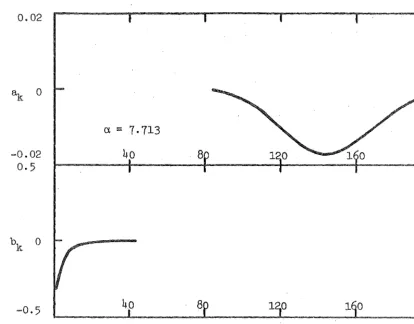
=
£1=
0.01 is drawn in figure 6(b). The remainder of the wavelength consistsof a level free surface and a level interface. The spectra of harmonics of the
interface and free surface waves are drawn in figure 6(a) as continuous curves
for convenience and because they approximate to the Fourier transforms of a
solitary permanent wave structure.
In all the calculations above, the depth of the lower layer is fixed at
0.9 of the total depth (h
=
0.9). As this ratio is decreased with all otherparameters held constant, the horizontal velocity field at the free surface
due to the interface wave also decreases, since the interface moves further
from the free surface. Beginning from the example of figure 3, as h is
decreased at constant p, µ, £, and E1
, the spectra of the interface wave and
free surface wave tend towards those of the example in figure 2. The number
of harmonics in the interface wave decreases as h decreases until about
h
=
0.35, when the second harmonic passes through zero. When his decreasedfurther, the number of harmonics in the interface wave increases again, but
the number of harmonics in the free surface wave remains small because the
horizontal velocity field at the free surface is also small.
7.
DiscussionThe permanent wave structures described here consist of a wave of permanent
shape at the interface and a wave group of permanent envelope at the free
surface. An interface wave has permanent shape when the linear dispersion and
the nonlinear steepening or flattening of inclined surfaces is in balance
([9],
§1). There is a similar explanation for the permanent shape of the freesurface wave envelope. The horizontal velocity field at the free surface due
to the interface wave has a forward maximum above the wave trough, decreasing
on either side of the trough. Hence a free surface wave behind the trough is
stretched and therefore moves faster, since the phase velocity is an increasing
is compressed and therefore moves slower. The net effect for the free
surface waves is one of balance between the linear dispersion and the nonlinear
interaction with the interface wave.
This physical argument mEcy" be applied also to wave groups of permanent
envelope on deep water ([11), §17.8). In this case, there is a balance between
linear dispersion and the mean quadratic velocity field caused at the free
surface by the wave group itself.
On comparing the different forms of permanent wave structure in figures
2 or 3, for example, it can be seen that the higher the form, the more complex
is the shape of the free surface wave group, although the interface wave
remains almost unchanged. Hence, when all other parameters are held constant,
the energy of the permanent wave structure is expected to be greater, the higher
the form of structure. This in turn implies that the higher forms are less
stable, and that the first form of permanent wave structure is most likely
to occur in practice. A stability analysis will be made to test this argument.
The unsteady solutions of equations (2.7) will also be investigated. The
second type of nonlinear interaction identified in
§4,
for example, generatesinterface waves whenever there is a spectrum of free surface waves. When the
free surface waves are forced by the wind, this interaction provides a
near-resonant mechanism for the generation and growth of interface waves. The
permanent wave structures described here may in some sense represent an
asymptotic state for waves on a two layer fluid.
Acknowledgment.
The author is grateful to Professor David J, Benney for suggesting this
References
1. D.J. Benney Significant interactions between small and large scale
surface waves. Stud. AppZ. Math. 66, 93-106 (1976).
2. M.S. Longuet-Higgins
&
R.W. Stewart Changes in the form of shortgravity waves on long waves and tidal currents.
J.
FZuid Meah. 8, 565-583 ( 1960).3, A.E. Gargett
&
B.A. Hughes On the interaction of surface and internalwaves. J. FZuidMeah.
62,
179-191 (1972).4.
John E. Lewis, Bruce M. Lake&
Denny R.S. Ko On the interaction ofinternal waves and surface gravity waves. J. FZuid Me ah. 6 3 , 773-800 ( 1974).
5. P. J. Bryant Periodic waves in shallow water. 'J. FZuid Meah. 6 9 , 625-644 (1973).
6.
P.J. Bryant Stability of periodic waves in shallow water.J.
FZuid Me ah. 6 6 , 81-96 ( 1974) •7. A.S. Peters
&
J,J, Stoker Solitary waves in liquids having non-constantdensity. Comm. PU!'e AppZ. Math.
13,
115-164 (1960).8. D.J. Benney Long non-linear waves· in fluid flows. J, Math & Phys. 4 5 ~ 52-63 ( 1966) •
9. T.B. Benjamin Internal waves of finite amplitude and permanent form.
J. FZuid Me ah.
2
6 , 241-270 ( 1966) •Appendix.
Define Fk
=
~ cosh µk(l-h) -µk sinh µk(l-h),Gk
=
w~ sinh µk(l-h) - µk cosh µk(l-h).Then
Pk
,.t
=
l@k [( P-1 )(w} - w
.t"'k+l + <{+,el
p(
~+l
-w
l) [ wk+l .w
ll
- + _ __.,;;.._
tanh µkh tanh µ(k+l)h tahh µlh
PW.e_ ~+l
2 2
Wo Wk+o [ U2 £(k+.f.)
+ .c.. .c..
w
2 (w
2 -w
w
+w
2-2F p Flr+P. k
l
l
k+l k+lW.e_
Wk+l2 k+l l ]
- (~+£. - w.ehJ k(-w- +
w ) ;
k+l
l
_ µ2 k2 tanh µkh tanh µk(l-h)
~,l
-
2w~(
p + tanh µkh tanh µk( 1-h))p(wk+l - wl) [
~+£.
+tanh µkh . tanh µ(k+l)h
- tanh µlh tanh µ(k+l)h +
+ ( ) ( p - (
P-:p
µk ) (w
Gk+l +w
o GFl )(Both
(R2)k,l
and(Rs)k,l
may be approximated by simpler expressionsP2
=
1pl = 1.
05
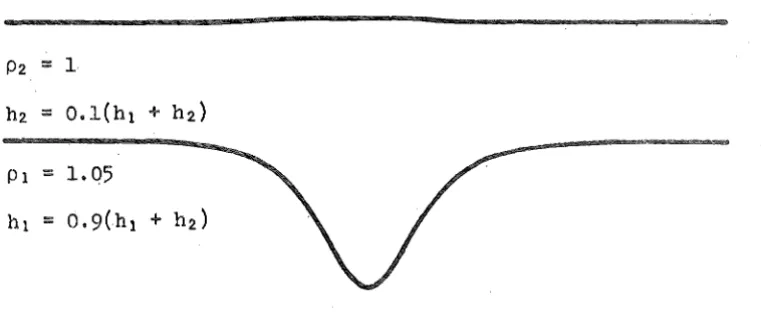
[image:24.598.173.554.369.531.2]h1
=
o.9(h1 + h2)I .)' I .)' I
.
.,,/"'
i !lJ I:J'
0 0 0 00 00 :>;' 00.
.
.
.
!\) !\) I\) I\) I\) !\) I\) I\) I\) \J1 0 \J'l \J1 0 \J1 \J1 0 \J1 \J1 0 \J1 \J1 0 Q + Q Q Q Q Ii•
II I! II II I\) + !\) + I\) ++
•
I I I\)•
I\) 0 I-' I-' I-' I-'.
+.
+.
+.
t
.
t
\() I I-' Is;
)
w w \.nl-\() + V1 I-' \ \J1 \J1 I-' \J1 ·co + \J1I
I-' . -..;i I-'•
~·
+'
\"
+.J
L
+·"+
..
~
+---~
...
,
r+/
+ b~.,,,..-ci++~
b
-,
b
~~
/
----1,
~--~+
.
:>;'j ~' :>;'I :>;' :>;' .. , :>;'..
,
..
--
·--..
~
..
,
'+'
+'
..
,
+.1-'j--t:/
I-''·
I-' I-''+
I-'\
\J1 ' \J1'·
\J1..
,
\J1 \ \J1.,
'
\
'
t
.,
t
+ + \i
•
...
+ +1
\
'
I + + ~~1
I\) I I\)i
!\)•
I\)t
01
0 0 + 0 +I
..
Figure( =l 0
=l
I =l 0
=l
I :::l 0
=l
I :::l
=l
I =l 0 :::l
0.1
0
-0 .. 1
1. 0
-1.0
0.1
0
-0.1
1
-1
a= 6.953
10'
++++++++++++++
1
20
2
a
=
6.880+ +
10 20
+++++++++++++++
+
10 20
30
40
503
4
5
30
4o
5030
40
50Figure 3(a). Wave spectra for the first two: forms of permanent wave
[image:27.600.57.538.83.742.2]..r1'M1l''i.,,
---V,JL/\l(.Y'~---Figure 3(b). One wavelength of the first two forms of permanent wave
structure at long wavelength with E
=
E1=
0.01 (vertical magnificationI. 0
-1. 0
1. 5
...:i.5 +
a.
=
7.ll.L 5•
• +
10
•
• • • 15
k
•
+ • • •
• + • • +
+ • • • •
1 1
k
• • • • • • • • • ~ + ~
20
25
2 2
Figure 4(a). Wave ~pectra for the second form of permanent wave structure
at long wavelength with
e:
=
0.01,e:'
=
0.05.Figure 4(b). One wavelength of the above form of ;r:iermanent wave structure
[image:29.600.45.532.107.424.2] [image:29.600.82.537.395.793.2]0.005
-0.005
1.0
-1.0
a
=
30.90140
Bo
4o
80
120 160Figure 5(a). Wave spectra for the first form of permanent
wave structure at long wavelength with 8
=
0.05, €1=
0.01.The discrete points have been replaced by a continuous curve.
p '
Figure 5(b). One wavelength of the above form of permanent wave
[image:30.602.98.521.83.403.2] [image:30.602.91.521.509.793.2]0.02
0
-0.02
0.5
ct=
7.713
4o
4.o
8
8 1 0 1 0
Figure 6(a). Wave spectra for the first form of permanent
wave structure at very long wavelength.
•/
The discrete points·have been replaced by a continuous curve.
Figure 6(b). The central quarter of one wavelength of the above
[image:31.621.84.515.90.727.2] [image:31.621.97.511.99.423.2]