Diameter Two Graphs of Minimum Order
with Given Degree Set
Gholamreza Abrishami, Freydoon Rahbarnia
⋆and Irandokht Rezaee
Abstract
Thedegree setof a graph is the set of its degrees. Kapoor et al. [Degree sets for graphs, Fund. Math. 95 (1977) 189-194] proved that for every set of positive integers, there exists a graph of diameter at most two and radius one with that degree set. Furthermore, the minimum order of such a graph is determined. A graph is2-self-centeredif its radius and diameter are two. In this paper for a given set of natural numbers greater than one, we determine the minimum order of a 2-self-centered graph with that degree set.
Keywords: Degree set, self-centered graph, radius, diameter.
2010 Mathematics Subject Classification: 05C07, 05C12.
1. Introduction
LetG be a simple graph with vertex setV(G)and edge set E(G). For a vertex
v of G, the degree of v in G, denoted by degG(v). We denote the minimum and maximum degrees of the vertices ofG byδ(G)and∆(G), respectively. The distance between two vertices u and v of a connected graph G is denoted by
dG(u, v) and it is the number of edges in a shortest path connecting u and v. TheeccentricityeG(u)of a vertexu, of a connected graphG, ismax{dG(u, v)|v∈
V(G)}. The radius of a connected graphG, rad(G), is the minimum eccentricity among the vertices of G, while the diameter of G, diam(G), is the maximum eccentricity. If rad(G)=diam(G)=r, then G is an r-self-centered graph. We use r-scas a notation for r-self-centered graph. F. Buckley [2] worked onr-scgraphs, but the concept of r-sc graphs was developed independently by Akiyama, Ando, and Avis [1], who called them r-equi graphs. They proved that if G is an r-sc graph, thenGis a block and∆(G)≤ |V(G)| −2(r−1).
⋆Corresponding author (Email: [email protected])
Academic Editor: Ali Reza Ashrafi
Received 02 May 2016, Accepted 12 June 2016 DOI: 10.22052/mir.2016.34107
c
Hence, for r= 2we have the following corollary.
Corollary 1.1. If Gis a 2-sc graph andv is a vertex ofG, then 2≤degG(v)≤ |V(G)| −2.
In this paper we study 2-sc graphs in terms of the degree sets, where for a given graphGthe degree setofG, denoted by D(G), is the set of degrees of the vertices ofG. It is a simple observation that any set of positive integers forms the degree set of a graph. So it is natural to investigate the minimum order of such graphs. This question is completely answered by a result of Kapoor, Polimeni and Wall [4]. Their result can be stated as follows.
Theorem 1.2(S. F. Kapoor et al. [4]). For every setS={a1, ..., an}of positive
integers, with a1 < · · · < an, there exists a graph G such that D(G) = S and furthermore,
µ(S) =an+ 1,
whereµ(S)represents the minimum order of such a graphG.
The graph Gin Theorem 1.2 has orderan+ 1. Therefore Ghas diameter at most two and radius one. HenceGis not a 2-sc graph. Corollary 1.1 implies that every 2-sc graph has no vertex of degree less than or equal to 1. In this paper, we show that for a finite, nonempty set S of positive integers greater than 1, there exists a 2-sc graphG such thatD(G) =S. Furthermore, the minimum order of such a graphGis determined.
2. Results
We writeKnandCnfor theCompletegraph and theCycleof ordern, respectively. Also for a graphG, the graph G¯ is theComplement of G. Theunion of graphs
Gand H is the graphG∪H which consists of copies of graphs Gand H. Two graphs are disjoint if they have no vertex in common. If a graph G consists of
k(≥2)disjoint copies of a graphH, then we writeG=kH.
Let S be a set of positive integers, where S = {a1, ..., an} and 1 < a1 <
· · ·< an. We defineµr(S)to be the minimum order of an r-sc graphGfor which
D(G) =S. In the case when S ={a1}, the following theorem implies that there
exists ana1-regular 2-sc graph of minimum order.
Theorem 2.2. Let a1 be a positive integer greater than 1 andS ={a1}. There
exists a 2-sc graphGsuch thatD(G) =S and furthermore,
µ2(S) =
{
a1+ 2
a1+ 3
ifa1 is even
ifa1 is odd
.
Proof. Leta1 be a positive integer greater than 1. Ifa1 is even, then the graph
G= (a1
is clearly ana1-regular graph witha1+2vertices. The graphGis also a 2-sc graph
[3]. Additionally, Corollary 1.1 implies that, every 2-sc graph of ordera1+ 1has
no vertex of degreea1. Therefore, we need at leasta1+ 2vertices to construct an
a1-regular 2-sc graph. Hence µ2(S) =a1+ 2.
Ifa1 is odd, then the graph
H =Ca1+3,
is ana1-regular graph of order a1+ 3. The graphH is also a 2-sc graph. Since
the graphH has order at least 6 and for each pair of nonadjacent verticesuand
v of H there exists at least one common neighbour, it follows that dH(u, v) = 2. Since, in any graph, the number of vertices of odd degree is even. Thus there is no
a1-regular graph of order a1+ 2. Therefore, the graphH has the minimum order
among all such 2-sca1-regular graphs. Henceµ2(S) =a1+ 3.
The following lemma which is obtained by Z. Stanic [5] has an interesting applications for constructing 2-sc graphs from other not necessarily 2-sc graphs and also it will be needed in the proof of our results for non-regular graphs. Recall that thejoinG+H of two disjoint graphsGandH is the graph consisting of the unionG∪H, together with edgesxy, wherex∈V(G)andy∈V(H).
Lemma 2.3. (Z. Stanic[5])LetGandH be simple nontrivial graphs with∆(G)≤ |V(G)| −2 and∆(H)≤ |V(H)| −2, thenG+H is a 2-sc graph.
Now, we extend Theorem 2.2 for non-regular graphs in following theorems. Theorem 2.4. Let a1 be even and S be a set of positive integers, where S =
{a1, . . . , an},2≤a1<· · ·< an andn >1. Then there exists a 2-sc graphGsuch thatD(G) =S and furthermore,
µ2(S) =an+ 2.
Proof. Let S1 = {a2−a1, a3−a1, ..., an−a1}. By Theorem 1.2, there exists a
graphH of orderan−a1+ 1 such thatD(H) =S1. Consider the graph
G= (H∪K1) +F,
whereF = a1
2K2. The graphGhas orderan+ 2. We observe that for each vertices
v ofG, one of the following cases occurs: 1) Ifv∈V(K1), thendegG(v) =|V(F)|=a1.
2) Ifv∈V(F), thendegG(v) =degF(v) +|V(K1)|+|V(H)|= (a1−2) + 1 + (an−
a1+ 1) =an.
3) Ifv∈V(H), then degG(v) =degH(v) +|V(F)|=degH(v) +a1.
Theorem 2.5. Let a1 be odd and S be a set of positive integers, where S =
{a1, ..., an}, 3 ≤a1 < · · · < an and n >1. Then there exists a 2-sc graph G of orderan+ 3 such that D(G) =S.
Proof. Let S1 = {a2−a1, a3−a1, ..., an −a1}, where for 1 ≤ i ≤ n, ai ∈ S. By Theorem 1.2, there exists a graphH of orderan−a1+ 1such thatD(H) =
{a2−a1, ..., an−a1}.Consider the graph
G= (H∪2K1) +F1,
whereF1=Ca1. The graphGhas orderan+ 3. We observe that for each vertices
v ofG, one of the following cases occurs. 1) Ifv∈V(2K1), thendegG(v) =|V(F1)|=a1.
2) Ifv∈V(F1), thendegG(v) =degF1(v) +|V(2K1)|+|V(H)|=an. 3) Ifv∈V(H), then degG(v) =degH(v) +|V(F1)|=degH(v) +a1.
ThusD(G) =S. Moreover, by Lemma 2.3,Gis a 2-sc graph.
Note that we consideredS={a1, ..., an}and presented a construction method
in Theorem 2.4 to ascertain the value ofµ2(S), where a1 is even, whereas ifa1 is
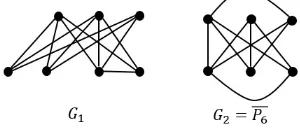
odd, the graphG described in the proof of Theorem 2.5 has not necessarily the minimum order. As an example, forS ={3,4}, the graph G1 of Figure 1 which
is obtained by the method of Theorem 2.5 has order 7, whereas the 2-sc graphG2
whereG2=P6 with 6 vertices has also the same degree set (see Figure 1).
Figure 1: The 2-sc graphsG1 and G2 with different orders and the same degree
sets.
In this section, we prove that if at least one element ofS is even thenµ2(S) =
an+ 2. We begin with a simple case.
Theorem 2.6. Let S be a set of positive integers, where = {a1, ..., an}, n > 1,
1< a1< a2<· · ·< an,a1 is odd andan=an−1+ 1then µ2(S) =an+ 2.
Proof. Let S1 = {a2−a1, a3−a1, ..., an−a1}. By Theorem 1.2, there exists a
graphH of orderan−a1+ 1 such thatD(H) =S1. Consider the graph
F= (H∪K1) +Ca1.
Lemma 2.3 implies that the graph F is a 2-sc graph. The graph F has order
an+ 2, and D(F) = S. Since there is no 2-sc graph of order an+ 1, therefore,
Now we consider the set S ={a1, ..., an} of positive integers. We prove that
if all the elements ofS are odd, then µ2(S) =an+ 3, otherwiseµ2(S) =an+ 2. Before proving the main result, we need to have the following theorem.
Theorem 2.7. (I. Zverovich [6]) Let S be a set of positive integers, where S = {a1, ..., an}and3≤a1<· · ·< an. Then there exists a Hamiltonian graphGsuch thatD(G) =S and|V(G)|=an+ 1.
Lemma 2.8. For a graph G, if ∆(G) =|V(G)| −2 and Gcontains at least two non−adjacent vertices of degree∆(G), thenGis a 2-sc graph.
Proof. Letxandy be two non−adjacent vertices ofGwithdegG(x) =degG(y) = ∆(G) = |V(G)| −2. Obviously, xand y are adjacent to all other vertices of G. Therefore,eG(x) =eG(y) =dG(x, y) = 2. Moreover, since ∆(G) =|V(G)| −2, it follows that for all other verticesv ofGthere is at least one non−adjacent vertex. HenceeG(v) = 2. ThereforeGis a 2-sc graph.
Lemma 2.9. Let S be a set of positive integers whereS ={a1, ..., an} and 2 ≤
a1<· · ·< an. Then there exists a graph Gof order an+ 1 such thatD(G) =S andGhas a Hamilton path.
Proof. Let S′ = {a1 + 1, ..., an + 1}. Since a1 + 1 ≥ 3, Theorem 2.7 implies
that there exists a Hamiltonian graphG′ of orderan+ 2such that D(G′) =S′. Let C′ be a Hamilton cycle in G′ where C′ = (v1, v2, ..., van+2, v1). Without
loss of generality, let v1 be a vertex of degree an+ 1 which is connected to all other vertices of G′. Let G = G′−v1. Thus D(G) = S, |V(G)| = an + 1. Furthermore, by removing the vertex v1 of C′ we obtain the Hamilton path P
whereP = (v2, v3, ..., van+1, van+2).
Lemma 2.10. Let S be a set of positive integers where S ={a1, ..., an}, an be odd and 3 ≤ a1 < · · · < an. Then there exists a graph G of order an+ 1 such that D(G) = S and G has at least two adjacent vertices x and y of degree an. Moreover,Ghas a matching of size an−1
2 which contains the edge xy.
Proof. LetS′={a1−1, ..., an−1}. By Lemma 2.9, there is a graph G′ of order
an withD(G′) =S′ and a Hamilton pathP such thatP = (v1, v2, ..., van)where
vi∈V(G′)for1≤i≤an. Letxbe a vertex of degreean−1ofG′. We construct
Gby adding a new vertex y to G′ adjacent to all vertices of G′. For1 ≤i ≤an we have
degG(vi) =degG′(vi) + 1.
Clearly, we have two adjacent verticesxandyof degree an and alsoGis a graph of orderan+ 1such thatD(G) =S. We claim thatGhas a matching of size an2−1 which contains the edgexy. Obviously, P is a path inG. Let M′ be a maximal matching of P such that the vertex x is unsaturated. The size of matching M′
is at least an−3
2 . Let M =M′∪ {xy}. ClearlyM is a matching of Gsuch that
|M|= an−1
Now we prove our main theorem.
Theorem 2.11. Let S be a set of positive integers where S = {a1, ..., an} and
1< a1<· · ·< an. If all elements of S are odd, then µ2(S) = an+ 3, otherwise
µ2(S) =an+ 2.
Proof. Consider the case when all elements of S are odd. Theorem 2.5 implies that there exists a 2-sc graphGof orderan+ 3such thatD(G) =S. Moreover, as noted earlier, in any graph, there is an even number of odd vertices. Hence there is no graph of orderan+ 2with S as its degree set. ThereforeGis a 2-sc graph of minimum order such thatD(G) =S, Henceµ2(S) =an+ 3.
Now assume that at least one even element ai exists inS where1≤i≤n. If
a1is even, then by Theorem 2.4,µ2(S) =an+ 2. Now leta1be odd. There exists
at least one i where 2 ≤i ≤n such that ai is even. Now we have two cases as follows:
First we consider the case in whichanis even. Hence|V(G)|is odd. Sincea1≥
3, Theorem 2.7 implies that there exists a Hamiltonian graphGof orderan+1such thatD(G) =S. LetCbe a Hamilton cycle inGsuch thatC= (v1, v2, ..., van+1, v1)
wherevi∈V(G)for1≤i≤an+ 1. Without loss of generality, let v1be a vertex
of degreean.
LetM be a matching ofGwhereM ={v2v3, v4v5, ..., vanvan+1} and the edge
vivi+1for2≤i≤an is an edge of the Hamilton cycleC(Notice that exactly one vertexv1 ofGis not saturated byM, hence |M|= |V(G2)|−1). Let G∗=G−M.
Clearly, for2≤i≤an+ 1, we havedegG∗(vi) =degG(vi)−1and alsodegG∗(v1) =
degG(v1). Now, we construct a new graph H by adding a new vertexv adjacent
to each vertex of G∗ except v1. Since degH(v) = degH(v1) = degG(v1) = an and for 2 ≤ i ≤ an, we have degH(vi) = degG(vi), it follows immediately that
D(H) =D(G) =S. Furthermore, since|V(H)|=an+ 2and H has at least two non−adjacent verticesv andv1 of degree an, by Lemma 2.8, H is a 2-sc graph. Therefore,µ2(S) =an+ 2.
Now we consider the case in whichan is odd. Lemma 2.10 implies that there exists a graphGof orderan+ 1such that D(G) =S. Furthermore, the graph G has at least two adjacent verticesxandyof degreean and alsoGhas a matching of size an−1
2 which contains the edge xy . Letvi be a vertex of degree ai where
ai is even and 2 ≤i ≤ n−1. Consider the matching M of size a2i of G which contains the edgexy. Let
G∗=G−M.
We constructH by adding a new vertexv toG∗ such that
E(H) =E(G∗)∪{vui|ui is the vertex ofGwhich is saturated byM, where1≤i≤n}.
References
[1] J. Akiyama, K. Ando and D. Avis, Miscellaneous properties of equi-eccentric graphs,Ann. Discrete Math.20(1984)13−23.
[2] F. Buckley, The central ratio of a graph,Discrete Math.38 (1982)17−21. [3] F. Göbel, H. J. Veldman, Even graphs,J. Graph Theory 10(1986)225−239. [4] S. F. Kapoor, A. D. Polimeni, C. E. Wall, Degree sets for graphs,Fund. Math.
95(1977)189−194.
[5] Z. Stanić, Some notes on minimal self-centered graphs, AKCE J. Graphs. Comb.7(2010)97−102.
[6] I. E. Zverovich, On a problem of Lesniak, Polimeni and Vanderjagt. Rend. Mat. Appl. (7), 26(2006)211−220.
Gholamreza Abrishami
Department of Applied Mathematics, Ferdowsi University of Mashhad, P. O. Box 1159, Mashhad 91775, Iran
E-mail: [email protected]
Freydoon Rahbarnia
Department of Applied Mathematics, Ferdowsi University of Mashhad, P. O. Box 1159, Mashhad 91775, Iran E-mail: [email protected]
Irandokht Rezaee