ISSN : 2581-7175 ©IJSRED: All Rights are Reserved Page 77
THE EFFECTS OF CHEWING GUM ON MEMORY
AND CONCENTRATION
Mala Thakur
1, Vishal Saxena
21.
Medical Student, Xavier University School of Medicine, Oranjestad Aruba.
2.
Professor of Pathology, Xavier University School of Medicine, Oranjestad Aruba.
Corresponding Author
Mala Thakur
Xavier University School of Medicine,
Oranjestad Aruba.
[email protected]
BACKGROUND
Increases to functional attention as a result of pharmaceutical advances have enhanced the lives of individuals with
attention deficit disorders and their ability to function properly during everyday life. [1] Although there have been many
studies done on the relationship of memory, concentration and chewing gum, the question of does it really help students perform better in classwork such as tests has been vague. In order to further test this study, I set up a controlled testing environment, in which I observed and recorded student concentration behaviors and memory test scores, with and without chewing gum.
METHODS
Participants were subjected to experimental conditions (Chewing Gum vs. Not Chewing Gum) during two trails and were expected to perform random tasks as directed in the folders given to them. Students in the study were under video surveillance and the video footage was used to monitor expressive behavior that would indicate a distracted state over
the course of the study.[1]
RESULTS
All sixteen subjects displayed distracted behaviors when gum was not presented to them in the non-chewing gum trial whereas, the same subjects were more focused and attentive when gum was presented to them in the gum chewing trial, regardless of the randomized trials.
CONCLUSIONS
After each trail was taken place, there was a high correlation between chewing gum with memory and concentration. As when the gum was not provided, participants did not engage in the activities assigned and lost focus.
KEY WORDS
Chewing Gum, Memory, Concentration, and Functional Attention.
INTRODUCTION
Life demands our attention whether it is in the home, at school, or in the workplace, and for individuals who have
difficulty focusing, small tasks can seem impossible.[1]Medications have been engineered to enhance functional attention-
the selection of stimuli provided by ones environment and the integration of that information into a functional response- in these settings, and while it is quite an accomplishment to have generated such drugs, there are some major concerns
about their negative side effects. [1,7,8] Chewing gum claims to help with concentration and memory.[9] The purpose of this
study is to observe student behavior and monitor cognitive test results in comparison to two types of scenarios: chewing gum and not chewing gum while completing dull tasks such as retyping an essay and memorizing a set of words.
According to researchers, there is a relationship between chewing gum and memory.[3]This relationship resulted in
mechanisms of an increased blood flow to the brain as well as an increase of insulin, and heart rate.[5,6,10]Although there
have been many studies done on the relationship of memory, concentration and chewing gum, the question of does it really help students perform better in classwork such as tests has been vague. The correlation between chewing gum with concentration and memory is that it is known to increase improve the flow of oxygen to regions of the brain responsible for attention. [11,12]
ISSN : 2581-7175 ©IJSRED: All Rights are Reserved Page 78
Chewing gum increases alertness and leads to changes in cognitive performance.[9]Preliminary research has shown
that participants that chewed gum results in elevated alertness, which consequently lead to improvements in cognitive
performance.[13]If chewing gum helps with concentration and memory, then this method will help improve student study
strategies and test scores which will result in fewer dropouts and increase in school attendance. This would be a cheap and effective way to help increase student performance and can lead to more students graduating that would result in higher school rankings.
Objective of the Study
The objective of the study was to determine the relationship between memory, concentration, and chewing gum. The idea was to determine the effects on participants memory as well as concentration in the presence and absence of chewing gum.
METHODS
Study design: Comparative experimental design
Techniques used to perform the following comparative experimental design were made at random with the intentions of solely focusing on uninteresting topics.Data collected from this experiment were based off the online memory test score on psychologistworld.comas well as video analysis that was generated through MacBook Pro’s photobooth. This website allows users to do a memory test using day to day items, by remembering them for 30 seconds and recalling them by typing it out in the next template. The website then generates a score out of 12. According to the website, the average score is 7 +or- 2, which means that if the scores lies between 5 and 9, the individual’s memory is working at average capacity however;the website also provides different techniques to improve memory such as regular use of mental faculties, mental exercise and yoga to decrease stress.The data collected from the participants were uploaded to the pyschologistworld.com webpage and the scores were generated.
Sample
A sample of sixteen participants between the ages of eighteen to twenty-threeyears old who have difficulty memorizing and concentrating during simple tasks were selected as subjects.The sample size was taken based on the convenience of the study. After obtaining IRB approval, Holy Names University announced the recruitment of participants for the research study. Participants interested in joining the research study were asked to email the research head. The sample size was determined by the number of emails and interested participants, which was a total of sixteen students. All the participants were current students of Holy Names University and all of them signed consent forms prior to the experiment. These participants all varied from different undergraduate majors as well as double majors. The subjects were given a survey to make sure they had efficient amount of sleep before taking part in the study. The subjects had no specific time limits for the concentrative as well as memory activities, which were under video surveillance. Typical activities that were used to distract the subject from the main objective, which was chewing gum and not chewing gum when performing the memory test as well as retyping a uninteresting paper, included: bouncing the paddle ball for fifteen minutes, stabbing a tooth pick into a cupcake wrapper, drawing certain shapes, and placing tooth picks in a bag one by one.
MacBook
Video analysis was gathered at Holy Names University in Oakland CA on November 10th, 12th, and 17th 2015. MacBook
Photo Booth feature was used for video analysis. Video surveillance was used to monitor each of the subjects and was collected after they concluded the experiment.
Procedure
ISSN : 2581-7175 ©IJSRED: All Rights are Reserved Page 79
psychologistworld.com, in which the participants are given a set of words where they are expected to recall and type the words in the same order to test their memory. Analysis of the memory test was provided by the scores obtained at the end of the test and were recorded by both myself as well as the subject to prevent any dishonesty. The concentration test analyzed by video surveillance of the subjects retyping a boring essay.This was solely done by observing the subjects body language as well as facial expressions during the duration of retyping the paper that was recorded on video. The concentration aspect of the study was done by computing the number of amounts the subject would fidget, yawn, or would stop and take their hands off the keyboard to do something else like play with their hair, face, or just stare at the computer screen. The behaviors were then compared to one another in each trial to see which consisted of fewer fidgeting and distracting like behaviors. The video surveillance did not only provide visual content of the subject’s behavior in between both trials, but also allowed for the documentation of time it took for the subject to complete the retyping of the essay.Even though there was no time limit on the study, the time durationallowed for us to compare how fast and efficient each trial was with and without the presence of gum when it came to retyping the uninteresting paper. Both of these tests were done under the chewing and non-chewing gum trials. These chewing and non-chewing gum trials were randomized, and every subject performed both of them. All sixteen participants were allocated into both the chewing and non-chewing trials. All sixteen subjects were expected to complete both the chewing and non-chewing trials.Upon entering the research room, each participant drew a paper slip from the box which had their table number assignment written on them to keep the study as unbiased and randomized as possible. The subjects were blind to the actual implication of the tasks and did not realize that chewing the gum was a critical part in this experiment, which therefore did not create any noise that would tort the data collected.
Analysis
Analysis of the whole experiment was collected by the video recordings in both of the trails conducted for each of the subjects. These video recordings were analyzed to observe distracted behaviors that were expressed by the subjects when they performed the tasks in the two scenarios: chewing gum and not chewing gum as well as the efficiency in time to complete the essay. Survey A was given to the subjects prior to the experiment to pertain the validity of my results such as: if the subject had enough sleep that could possibly influence the outcomes of my results, if he or she were regular gum chewers, and what particular time/event do they chew gum. Results of the answers are outlined in the discussion section of this paper.
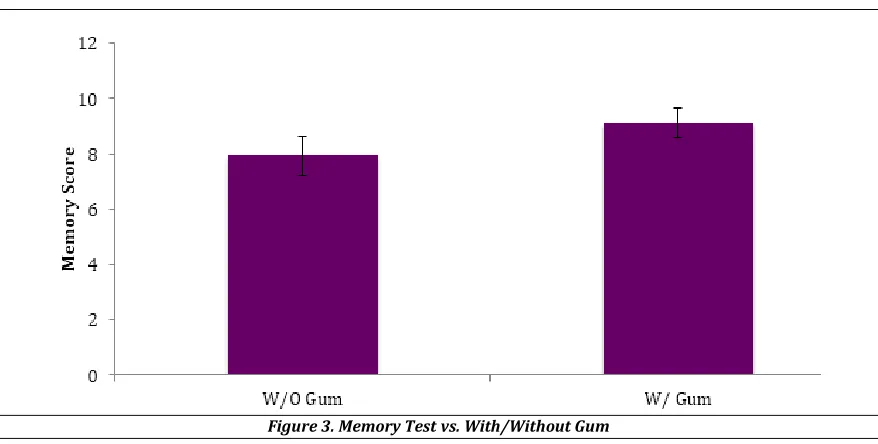
Figures 1 and 2 are examples of concentrated and distracted behaviors of subjects in the two scenarios of gum chewing vs. not chewing gum. Only participants who release his or her video footage for the purpose of this experiment were used outside of data analysis for publication purposes. Memory scores were recorded via Microsoft Excel worksheet programming in comparison to the two types of scenarios: Chewing Gum and Non-chewing are displayed in Figure 3.
RESULTS
All sixteen subjects displayed distracted behaviors when gum was not presented to them in the non-chewing gum trial whereas, the same subjects were more focused and attentive when gum was presented to them in the gum chewing trial, regardless of the randomized trials. During the non-chewing gum trial, subjects are seen fidgeting, yawning, and playing with their hair which displayed symptoms of boredom and unfocused. These findings that displayed lack of attention span were documented in Figure 2. Along with signs of boredom, these subjects were also noted to have taken much longer in completing tasks in the absence of chewing gum. That time was cut much shorter when the same subjects were given the gum during the gum chewing trial. The subject’s performance on the memory test was also significantly higher in the presence of gum compared to when the gum was not present. The memory test results of all subjects showed that when the gum was absent their scores were much lower. This correlation can indicate a positive relationship between chewing gum and memory.
During the chewing gum trial, the same subjects were documented as being more focused compared to the non-chewing gum trial. These subjects did not fidget once nor did their eyes wander around. Not only were these subjects focused, the time it took for them to retype the boring essay was much quicker than compared to the non-chewing gum trial. This behavior was documented in Figure 1 with the subjects focused on the computer screen. Throughout the video recording, the subjects were seen constantly chewing the gum without ever stopping during the chewing gum trial. The muscles of mastication were continuously being used in the duration of the chewing gum trial.
ISSN : 2581-7175 ©IJSRED: All Rights are Reserved Page 80
Figure 1. Concentrated Behaviors with Chewing GumSubjects were monitored via web cam recorder which showed that they were attentive when retyping an essay while chewing gum. They showed no signs of distraction and not once did they fidget.
Figure 2. Distracted Behaviors with Non Chewing
The same subjects shown in Figure 1 are shown here, but in a trial where no gum chewing was allowed. Subjects had to retype the same essay without chewing gum, and results showed a distracted behavior where subjects are seen fidgeting. The subjects had zero fidget movements when they chewed gum, but during the non gum chewing trial, the fidgeting movements were present anywhere from two to three hand movements around the head and face.
ISSN : 2581-7175 ©IJSRED: All Rights are Reserved Page 81
Figure 3. Memory Test vs. With/Without GumResults show that the error bar is low in both situations. Memory score reveals that subjects who did chew gum had a significant higher score on the test compared to subjects who did not chew while taking the memory test.
Gum No Gum
Mean 9.125 7.9375
Std. Dev. 2.777888887 2.048373338
Std. Error 0.717247826 0.528887722
T-Test 0.078471738
Table 1. Table of Obtained Calculations
Results from the table above show the mean, standard deviation, standard error, as well as the T-test.Data was collected from each group results: chewing gum and non-chewing. In Table 1, the bar graph shows little standard error in both trials.
DISCUSSION
Throughout the study, prevention of noise was the main target when conducting the trials. The task to keep the study as smooth as possible without any of the participants interacting with one another was one of the main challenges. In order to prevent noise, the subjects were placed far away from one another and separated by table dividers. This prevented the interactions of the subjects from one another as well as created a noise free environment so the participants can solely focus on getting the tasks done efficiently.
Even though the results showed otherwise, data obtained from the memory test as well as the concentration video monitor showed a relationship. The results suggest further future studies on this topic to obtain more accuracy of data.Although the results were not sufficient based on lack of data, more subjects are needed in order to obtain sufficient amount of data. The results obtained were classified as not significant simply due to the T-Test value.I believe this had a lot to do with the lack of subjects, therefore I believe this data can be accepted and significant with more subjects.
The significance of these results can be utilized to promote effectiveness of a safer alternative for functional attention medications. The goal of this study was to find an effective method to help individuals with their concentration and memory without the use of certain medications. I accomplished that goal and found that gum chewing is an effective and alternative way to help individuals to concentrate and memorize. This cheap and healthy alternative is capable of also helping students in their stressed school lives.
ISSN : 2581-7175 ©IJSRED: All Rights are Reserved Page 82
backed up sufficient data as well as valid evidence, people will not have to depend on certain medications and will be able to make choices for a healthier body without the dependence on certain medications.
CONCLUSIONS
Our findings suggested there is a correlation between chewing gum with memory as well as concentration. Chewing gum enhances an individual’s ability to focus when learning in an uninteresting environment. Not only does it help increase a person’s attention span, but also helps with memory. An individual’s memory enhances when memorizing words or certain phrases in the presence of gum.
ACKNOWLEDGMENTS
I would like to express my gratitude to Dr. Michael Limm in assisting me in the process of my study through the journey of completion. I also would like to thank Holy Names University for providing me the resources I needed to achieve this research.
REFERENCES
[1] Gaitan, Raquel. (2014). An Observational Analysis of Weighted Vests and their Effects on Functional Attention.
[2] McCabe,S. E.,Knight, J.R.,Teter,C.J.and Wechsler, H. (2005), Non-medical use of prescription stimulants among US
college students: prevalence and correlates from national survey. Addiction, 100:96-106. Doi: 10.1111/j.1360-0443.2005.00944.x
[3] Johnson, A., & Miles, C. (n.d.). Chewing gum and context dependent memory: The independent roles of chewing
gum and mint flavour. Appetite, 561-561.
[4] Tänzer, U., Fintel, A., &Eikermann, T. (n.d.). Chewing Gum And Concentration Performance 1. Psychological
Rep5(orts, 372-374.
[5] Hussain A, Latiwesh OB, Ali F, Younis MY, Alammari JA. Effects of Body Mass Index, Glycemic Control, and
Hypoglycemic Drugs on Serum Uric Acid Levels in Type 2 Diabetic Patients.Cureus. 2018 Aug 17; 10(8): e3158
[6] Hall, A., Creanor, S., Strang, R., Gilmour, W., Foye, R., Brown, J., & Geddes, D. (n.d.). The Effect of Sucrose-Containing
Chewing-Gum Use on in situ Enamel Lesion Remineralization. Caries Res Caries Research, 477-482.
[7] Hussain A, Tabrez ES, Mavrych V, Bolgova O, Peela JR. Caffeine: A Potential Protective Agent Against Cognitive
Decline in Alzheimer's Disease.Crit Rev Eukaryot Gene Expr. 2018;28(1):67-72. doi:
10.1615/CritRevEukaryotGeneExpr.2018021391. Review
[8] Expert discusses alternative treatment options for ADHD in children. (2005) Brown University Child & Adolescent
Psychopharmacology Update, 7(9), 1-5.
[9] Smith, A. (n.d.). Effects of chewing gum on mood, learning, memory and performance of an intelligence test.
Nutritional Neuroscience, 81-88.
[10] Allen K, Galvis D & Katz RV (2006) Evaluation of CDs and chewing gum in teaching dental anatomy. New York State
Dental Journal 72: 30–33.
[11] Davidson, J., Linforth, R., Hollowood, T., & Taylor, A. (n.d.). Effect of Sucrose on the Perceived Flavor Intensity of
Chewing Gum. J. Agric. Food Chem. Journal of Agricultural and Food Chemistry, 4336-4340.
[12] Hussain A, Tabrez ES, Muhammad A, Peela JR. The Mechanisms of Dietary Phytoestrogen as a Potential Treatment
and Prevention Agent against Alzheimer's Disease.Crit Rev Eukaryot Gene Expr. 2018;28(4):321-327. doi: 10.1615/CritRevEukaryotGeneExpr.2018025847.
[13] Hirano, Yoshiyuki, Takayuki Obata, Hidehiko Takahashi, Atsumichi Tachibana, DaigoKuroiwa, Toru Takahashi,