389 Information Technology and Control 2019/3/48
A New Genetic Algorithm with
Agent-Based Crossover for the
Generalized Assignment Problem
ITC 3/48
Journal of Information Technology and Control
Vol. 48 / No. 3 / 2019 pp. 389-400
DOI 10.5755/j01.itc.48.3.21893
A New Genetic Algorithm with Agent-Based Crossover for the
Generalized Assignment Problem
Received 2018/10/19 Accepted after revision 2019/08/03
http://dx.doi.org/10.5755/j01.itc.48.3.21893
Corresponding author: [email protected]
Murat Dörterler
Gazi University, Faculty of Technology, Department of Computer Engineering, Teknikokullar, 06560, Ankara, Turkey, Phone Number: +90 312 202 85 95, Fax Number: +90 312 202 89 47; e-mail: [email protected]
Generalized assignment problem (GAP) considers finding minimum cost assignment of n tasks to m agents provided each task should be assigned to one agent only. In this study, a new Genetic Algorithm (GA) with some new methods has been proposed to solve GAPs. The agent-based crossover is based on the concept of dominant gene in genotype science and increases the fertility rate of the feasible solutions. The solutions are classified as infeasible, feasible and mature with reference to their conditions. The new local searches provide not only feasibility in high diversity but high profitability for the solutions. A solution is not given up through matura-tion-based replacement until it reaches its best. The computational results show that the agent-based cross-over has much higher fertility rate than classical crosscross-over. Finally, the proposed GA creates either optimal or near-optimal solutions.
KEYWORDS: Generalized Assignment Problem; Genetic Algorithm; Agent-Based Crossover.
1. Introduction
GAP is a well-known, NP-complete combinatorial op-timization problem [23]. It is a type of one-to-many as-signment problems that recognizes capacity limits [21]. GAP considers finding minimum cost assignment of n
tasks to m agents provided each task should be assigned to one agent only. On the other hand, an agent may be
as-signed more than one task, subject to the agents’ avail-able capacity [22]. The GAP has several applications in real life, solved by exact and heuristic algorithms. Never-theless, heuristic algorithms are more capable of solving large-scale GAPs than exact algorithms [5, 19].
Information Technology and Control 2019/3/48 390
algorithms and there are a few GAP studies involving GA. Additional operators are used in these studies as standard GA is not capable of solving GAPs. These studies roughly proposed various local search meth-ods to overcome the incapability. The aims of the lo-cal search methods are that either an infeasible solu-tion is evolved into feasible one, or a feasible solusolu-tion is evolved into one with its fittest value. In addition, classical crossover method is used in the studies even though the classical crossover method most probably causes to create infeasible solutions from feasible ones especially in difficult GAP instances. Moreover, a candidate solution can lose its place in population at the end of the selection and replacement methods without any improvement.
In this study, a new GA has been proposed by develop-ing some new methods. The methods involve agent-based crossover, local search methods and maturi-ty-based replacement. The local search methods aim to improve feasibility, efficiency and diversity of the solutions. Each candidate solution was evaluated and passed through some new improvement processes. The agent-based crossover is based on the concept of dominant gene in genotype science. When a solu-tion in populasolu-tion reaches its best fitness value, it is judged as a mature solution and agent-based cross-over is triggered. The offspring solutions are created through applying agent-based crossover process to a pair of parent. When the mature solution is thrown out of the population at the end of the agent-based crossover, offspring solution takes its place in popula-tion. The proposed methods provide diversity of can-didate solution; thus, a near-optimal solution can be obtained in lesser execution time.
Section 2 presents GAP and the previous studies on GAP. Section 3 elaborates GA and the new method. Section 4 deals with theresults of the computation-al studies. Section 5 is about the experimentcomputation-al results and analyses.
2. The Generalized Assignment
Problem
The GAP can be formulated as an integer linear pro-gram beside its definition presented in the previous section:
Minimize
2 The Generalized Assignment Problem
The GAP can be formulated as an integer linear program beside its definition presented in the previous section:
Minimize ∑ ∑mi=1 nj=1cijxij (1)
Subject to: ∑mi=1xij=1 j=1,…,n, (2)
∑nj=1aijxij≤ bi i=1,…,m, (3)
xij∈ {0,1} i=1,…,m; j=1,…,n, (4)
where cij is the cost of assigning agent i to task j, and, if agent i is assigned to task j, xij = 1, else 0; aij is
the amount of agent i's capacity consumed by task j in case it is assigned to i. Finally, bi is the available
capacity of agent i. The first constraint indicates that each task is assigned to only one agent; the second constraint is that the resource demand of the tasks, which are assigned to an agent, must not exceed the capacity of the agent.
Ross and Soland [22] have come up with GAP. Such real life problems as vehicle routing [10], grouping and loading for flexible manufacturing systems [17], assigning ships to overhaul [12], assigning jobs to computers in computer networks [2], land use allocation [6] relate to GAP. The chief applications and algorithms about GAP are presented in the survey study of Cattrysse and Van Wassenhove [4].
Exact algorithms have been proposed to solve GAPs. Branch-and-price algorithm [25], cutting plane algorithm [1], branch-and-cut algorithm [18], branch-and-bound [11] have been the significant ones of them in the last two decades. The existing exact algorithms are not effective for more difficult large-scale problems [15].
The large-scale GAPs are currently handled through heuristic and metaheuristic methods to get the most near-optimal solutions. Osman [19] designed both tabu search and hybrid simulated annealing/tabu search methods for GAP. Moreover, tabu search was used by Diaz and Fernandez [7], dynamic tabu search was proposed by Higgins [13] and a hybrid tabu search/branch-and-bound was implemented by Woodcock and Wilson [29]. Differential evolution algorithm [27, 14, 26], bees algorithm [20], the neighbourhood search algorithm [32] and ejection chain approach [31] are other notable heuristic approaches applied to GAP.
The studies which apply GA to GAPs benefit from additional processes [5, 16, 28, 9]. As classical GA violates the capacity constraint (3), it creates infeasible solutions in high probability. Chu and Beasley [5] used GA involving classical crossover, binary tournament selection and single point mutation operators. Authors presented not only fitness function but also unfitness functions to measure infeasibility of a solution. They also proposed two local search methods, which were applied to each created solution at the end of the crossover method. The first one aim to turn into feasible solutions from infeasible ones. The second one aims to reduce the cost of the solution. The local searches are applied to the solutions for once and they do not fulfil their aims sufficiently.
Wilson [28] used classical crossover and tournament selection methods. He proposed a 2-phase local search method, sharing the similar aims with the local searches of Chu and Beasley [5]. The first phase improves the feasibility of the selected solution; the second phase seeks the lower cost value for the solution. GA process is interrupted if any feasible solution is obtained. This feasible solution is selected for the 2-phase local search. Otherwise, the best solution with the best fitness value is selected at the end of the GA process. The local search is only applied to the selected solution if the solution is not feasible. It is unlikely to get a near-optimal solution in case a feasible solution is obtained.
Feltl and Raidl [9] proposed several improvements for the study of Chu and Beasley [5]. They presented two alternative heuristic methods to increase proportion of feasible individuals in initial population. Selection and replacement schemas were suggested to eliminate infeasible individuals while creating an initial population. In addition, heuristic mutation solution was used to decrease the probability of turning feasible individuals into infeasible ones. They also presented a selection and replacement strategy to eliminate infeasible solutions aggressively. In their study, classical crossover method was used to generate an offspring where this operation causes infeasible solutions.
(1)
Subject to:
2 The Generalized Assignment Problem
The GAP can be formulated as an integer linear program beside its definition presented in the previous section:
Minimize ∑ ∑mi=1 nj=1cijxij (1)
Subject to: ∑mi=1xij=1 j=1,…,n, (2)
∑nj=1aijxij≤ bi i=1,…,m, (3)
xij∈ {0,1} i=1,…,m; j=1,…,n, (4)
where cij is the cost of assigning agent i to task j, and, if agent i is assigned to task j, xij = 1, else 0; aij is
the amount of agent i's capacity consumed by task j in case it is assigned to i. Finally, bi is the available
capacity of agent i. The first constraint indicates that each task is assigned to only one agent; the second constraint is that the resource demand of the tasks, which are assigned to an agent, must not exceed the capacity of the agent.
Ross and Soland [22] have come up with GAP. Such real life problems as vehicle routing [10], grouping and loading for flexible manufacturing systems [17], assigning ships to overhaul [12], assigning jobs to computers in computer networks [2], land use allocation [6] relate to GAP. The chief applications and algorithms about GAP are presented in the survey study of Cattrysse and Van Wassenhove [4].
Exact algorithms have been proposed to solve GAPs. Branch-and-price algorithm [25], cutting plane algorithm [1], branch-and-cut algorithm [18], branch-and-bound [11] have been the significant ones of them in the last two decades. The existing exact algorithms are not effective for more difficult large-scale problems [15].
The large-scale GAPs are currently handled through heuristic and metaheuristic methods to get the most near-optimal solutions. Osman [19] designed both tabu search and hybrid simulated annealing/tabu search methods for GAP. Moreover, tabu search was used by Diaz and Fernandez [7], dynamic tabu search was proposed by Higgins [13] and a hybrid tabu search/branch-and-bound was implemented by Woodcock and Wilson [29]. Differential evolution algorithm [27, 14, 26], bees algorithm [20], the neighbourhood search algorithm [32] and ejection chain approach [31] are other notable heuristic approaches applied to GAP.
The studies which apply GA to GAPs benefit from additional processes [5, 16, 28, 9]. As classical GA violates the capacity constraint (3), it creates infeasible solutions in high probability. Chu and Beasley [5] used GA involving classical crossover, binary tournament selection and single point mutation operators. Authors presented not only fitness function but also unfitness functions to measure infeasibility of a solution. They also proposed two local search methods, which were applied to each created solution at the end of the crossover method. The first one aim to turn into feasible solutions from infeasible ones. The second one aims to reduce the cost of the solution. The local searches are applied to the solutions for once and they do not fulfil their aims sufficiently.
Wilson [28] used classical crossover and tournament selection methods. He proposed a 2-phase local search method, sharing the similar aims with the local searches of Chu and Beasley [5]. The first phase improves the feasibility of the selected solution; the second phase seeks the lower cost value for the solution. GA process is interrupted if any feasible solution is obtained. This feasible solution is selected for the 2-phase local search. Otherwise, the best solution with the best fitness value is selected at the end of the GA process. The local search is only applied to the selected solution if the solution is not feasible. It is unlikely to get a near-optimal solution in case a feasible solution is obtained.
Feltl and Raidl [9] proposed several improvements for the study of Chu and Beasley [5]. They presented two alternative heuristic methods to increase proportion of feasible individuals in initial population. Selection and replacement schemas were suggested to eliminate infeasible individuals while creating an initial population. In addition, heuristic mutation solution was used to decrease the probability of turning feasible individuals into infeasible ones. They also presented a selection and replacement strategy to eliminate infeasible solutions aggressively. In their study, classical crossover method was used to generate an offspring where this operation causes infeasible solutions.
(2)
2 The Generalized Assignment Problem
The GAP can be formulated as an integer linear program beside its definition presented in the previous section:
Minimize ∑ ∑mi=1 nj=1cijxij (1)
Subject to: ∑mi=1xij=1 j=1,…,n, (2)
∑nj=1aijxij≤ bi i=1,…,m, (3)
xij∈ {0,1} i=1,…,m; j=1,…,n, (4)
where cij is the cost of assigning agent i to task j, and, if agent i is assigned to task j, xij = 1, else 0; aij is
the amount of agent i's capacity consumed by task j in case it is assigned to i. Finally, bi is the available
capacity of agent i. The first constraint indicates that each task is assigned to only one agent; the second constraint is that the resource demand of the tasks, which are assigned to an agent, must not exceed the capacity of the agent.
Ross and Soland [22] have come up with GAP. Such real life problems as vehicle routing [10], grouping and loading for flexible manufacturing systems [17], assigning ships to overhaul [12], assigning jobs to computers in computer networks [2], land use allocation [6] relate to GAP. The chief applications and algorithms about GAP are presented in the survey study of Cattrysse and Van Wassenhove [4].
Exact algorithms have been proposed to solve GAPs. Branch-and-price algorithm [25], cutting plane algorithm [1], branch-and-cut algorithm [18], branch-and-bound [11] have been the significant ones of them in the last two decades. The existing exact algorithms are not effective for more difficult large-scale problems [15].
The large-scale GAPs are currently handled through heuristic and metaheuristic methods to get the most near-optimal solutions. Osman [19] designed both tabu search and hybrid simulated annealing/tabu search methods for GAP. Moreover, tabu search was used by Diaz and Fernandez [7], dynamic tabu search was proposed by Higgins [13] and a hybrid tabu search/branch-and-bound was implemented by Woodcock and Wilson [29]. Differential evolution algorithm [27, 14, 26], bees algorithm [20], the neighbourhood search algorithm [32] and ejection chain approach [31] are other notable heuristic approaches applied to GAP.
The studies which apply GA to GAPs benefit from additional processes [5, 16, 28, 9]. As classical GA violates the capacity constraint (3), it creates infeasible solutions in high probability. Chu and Beasley [5] used GA involving classical crossover, binary tournament selection and single point mutation operators. Authors presented not only fitness function but also unfitness functions to measure infeasibility of a solution. They also proposed two local search methods, which were applied to each created solution at the end of the crossover method. The first one aim to turn into feasible solutions from infeasible ones. The second one aims to reduce the cost of the solution. The local searches are applied to the solutions for once and they do not fulfil their aims sufficiently.
Wilson [28] used classical crossover and tournament selection methods. He proposed a 2-phase local search method, sharing the similar aims with the local searches of Chu and Beasley [5]. The first phase improves the feasibility of the selected solution; the second phase seeks the lower cost value for the solution. GA process is interrupted if any feasible solution is obtained. This feasible solution is selected for the 2-phase local search. Otherwise, the best solution with the best fitness value is selected at the end of the GA process. The local search is only applied to the selected solution if the solution is not feasible. It is unlikely to get a near-optimal solution in case a feasible solution is obtained.
Feltl and Raidl [9] proposed several improvements for the study of Chu and Beasley [5]. They presented two alternative heuristic methods to increase proportion of feasible individuals in initial population. Selection and replacement schemas were suggested to eliminate infeasible individuals while creating an initial population. In addition, heuristic mutation solution was used to decrease the probability of turning feasible individuals into infeasible ones. They also presented a selection and replacement strategy to eliminate infeasible solutions aggressively. In their study, classical crossover method was used to generate an offspring where this operation causes infeasible solutions.
(3)
2 The Generalized Assignment Problem
The GAP can be formulated as an integer linear program beside its definition presented in the previous section:
Minimize ∑ ∑mi=1 nj=1cijxij (1)
Subject to: ∑mi=1xij=1 j=1,…,n, (2)
∑nj=1aijxij≤ bi i=1,…,m, (3)
xij∈ {0,1} i=1,…,m; j=1,…,n, (4)
where cij is the cost of assigning agent i to task j, and, if agent i is assigned to task j, xij = 1, else 0; aij is
the amount of agent i's capacity consumed by task j in case it is assigned to i. Finally, bi is the available
capacity of agent i. The first constraint indicates that each task is assigned to only one agent; the second constraint is that the resource demand of the tasks, which are assigned to an agent, must not exceed the capacity of the agent.
Ross and Soland [22] have come up with GAP. Such real life problems as vehicle routing [10], grouping and loading for flexible manufacturing systems [17], assigning ships to overhaul [12], assigning jobs to computers in computer networks [2], land use allocation [6] relate to GAP. The chief applications and algorithms about GAP are presented in the survey study of Cattrysse and Van Wassenhove [4].
Exact algorithms have been proposed to solve GAPs. Branch-and-price algorithm [25], cutting plane algorithm [1], branch-and-cut algorithm [18], branch-and-bound [11] have been the significant ones of them in the last two decades. The existing exact algorithms are not effective for more difficult large-scale problems [15].
The large-scale GAPs are currently handled through heuristic and metaheuristic methods to get the most near-optimal solutions. Osman [19] designed both tabu search and hybrid simulated annealing/tabu search methods for GAP. Moreover, tabu search was used by Diaz and Fernandez [7], dynamic tabu search was proposed by Higgins [13] and a hybrid tabu search/branch-and-bound was implemented by Woodcock and Wilson [29]. Differential evolution algorithm [27, 14, 26], bees algorithm [20], the neighbourhood search algorithm [32] and ejection chain approach [31] are other notable heuristic approaches applied to GAP.
The studies which apply GA to GAPs benefit from additional processes [5, 16, 28, 9]. As classical GA violates the capacity constraint (3), it creates infeasible solutions in high probability. Chu and Beasley [5] used GA involving classical crossover, binary tournament selection and single point mutation operators. Authors presented not only fitness function but also unfitness functions to measure infeasibility of a solution. They also proposed two local search methods, which were applied to each created solution at the end of the crossover method. The first one aim to turn into feasible solutions from infeasible ones. The second one aims to reduce the cost of the solution. The local searches are applied to the solutions for once and they do not fulfil their aims sufficiently.
Wilson [28] used classical crossover and tournament selection methods. He proposed a 2-phase local search method, sharing the similar aims with the local searches of Chu and Beasley [5]. The first phase improves the feasibility of the selected solution; the second phase seeks the lower cost value for the solution. GA process is interrupted if any feasible solution is obtained. This feasible solution is selected for the 2-phase local search. Otherwise, the best solution with the best fitness value is selected at the end of the GA process. The local search is only applied to the selected solution if the solution is not feasible. It is unlikely to get a near-optimal solution in case a feasible solution is obtained.
Feltl and Raidl [9] proposed several improvements for the study of Chu and Beasley [5]. They presented two alternative heuristic methods to increase proportion of feasible individuals in initial population. Selection and replacement schemas were suggested to eliminate infeasible individuals while creating an initial population. In addition, heuristic mutation solution was used to decrease the probability of turning feasible individuals into infeasible ones. They also presented a selection and replacement strategy to eliminate infeasible solutions aggressively. In their study, classical crossover method was used to generate an offspring where this operation causes infeasible solutions.
(4)
where cij is the cost of assigning agent i to task j, and,
if agent i is assigned to task j, xij = 1, else 0; aij is the
amount of agent i’s capacity consumed by task j in case it is assigned to i. Finally, bi is the available
ca-pacity of agent i. The first constraint indicates that each task is assigned to only one agent; the second constraint is that the resource demand of the tasks, which are assigned to an agent, must not exceed the capacity of the agent.
Ross and Soland [22] have come up with GAP. Such real life problems as vehicle routing [10], grouping and loading for flexible manufacturing systems [17], assigning ships to overhaul [12], assigning jobs to computers in computer networks [2], land use alloca-tion [6] relate to GAP. The chief applicaalloca-tions and algo-rithms about GAP are presented in the survey study of Cattrysse and Van Wassenhove [4].
Exact algorithms have been proposed to solve GAPs. Branch-and-price algorithm [25], cutting plane algo-rithm [1], cut algoalgo-rithm [18], branch-and-bound [11] have been the significant ones of them in the last two decades. The existing exact algorithms are not effective for more difficult large-scale problems [15]. The large-scale GAPs are currently handled through heuristic and metaheuristic methods to get the most near-optimal solutions. Osman [19] designed both tabu search and hybrid simulated annealing/tabu search methods for GAP. Moreover, tabu search was used by Diaz and Fernandez [7], dynamic tabu search was proposed by Higgins [13] and a hybrid tabu search/branch-and-bound was implemented by Woodcock and Wilson [29]. Differential evolution algorithm [27, 14, 26], bees algorithm [20], the neigh-bourhood search algorithm [32] and ejection chain approach [31] are other notable heuristic approaches applied to GAP.
infeasi-391 Information Technology and Control 2019/3/48
ble solutions in high probability. Chu and Beasley [5] used GA involving classical crossover, binary tourna-ment selection and single point mutation operators. Authors presented not only fitness function but also unfitness functions to measure infeasibility of a solu-tion. They also proposed two local search methods, which were applied to each created solution at the end of the crossover method. The first one aim to turn into feasible solutions from infeasible ones. The sec-ond one aims to reduce the cost of the solution. The local searches are applied to the solutions for once and they do not fulfil their aims sufficiently.
Wilson [28] used classical crossover and tourna-ment selection methods. He proposed a 2-phase lo-cal search method, sharing the similar aims with the local searches of Chu and Beasley [5]. The first phase improves the feasibility of the selected solution; the second phase seeks the lower cost value for the solu-tion. GA process is interrupted if any feasible solution is obtained. This feasible solution is selected for the 2-phase local search. Otherwise, the best solution with the best fitness value is selected at the end of the GA process. The local search is only applied to the se-lected solution if the solution is not feasible. It is un-likely to get a near-optimal solution in case a feasible solution is obtained.
Feltl and Raidl [9] proposed several improvements for the study of Chu and Beasley [5]. They presented two alternative heuristic methods to increase proportion of feasible individuals in initial population. Selection and replacement schemas were suggested to eliminate infeasible individuals while creating an initial popula-tion. In addition, heuristic mutation solution was used to decrease the probability of turning feasible individ-uals into infeasible ones. They also presented a selec-tion and replacement strategy to eliminate infeasible solutions aggressively. In their study, classical cross-over method was used to generate an offspring where this operation causes infeasible solutions.
Dorterler et al. [8] proposed a new GA for a real problem seen as a special case of the GAP. The authors empha-sised that classical crossover method violated the ca-pacity constraint. Thus, Nucleotide Exchange operator was proposed instead of the classical crossover opera-tor in the same study. A gene keeps multiple significant data, each of which is called nucleotide, as designated in the natural sciences. The operator creates offspring from a single parent by swapping the nucleotides
be-tween genes at the crossover stage. Even if experiential results are successful, the heuristic is not suitable for applying to classical GAP without some modifications.
3. The Proposed Heuristic
GA provides more near-optimal solutionswith com-paratively much lower computational complexity than deterministic methods. GA aims to get a number of solutions, which provide better results by iteration. GA is inspired by natural selection; thus, the same ter-minology is used. Solutions are named chromosomes and the set of solutions is named population. Chro-mosome is composed of meaningful data string; each one is called a gene. New solutions called offspring are created by means of crossover method in each it-eration. Crossover creates offspring from the genes of its parent chromosomes selected by any selection method in population. Mutation process changes one or more genes of the offspring randomly in pre-defined probability, lest the GA process is trapped in local minima. The new generation for next iteration is composed by replacing a number of offspring with chromosomes selected in population. Fitness func-tion measures profitability of the chromosomes in population. GA process is executed until the termina-tion conditermina-tion is occurred. The terminatermina-tion conditermina-tion should be the one which gets either a number of itera-tions or a desired fitness value [33].
3.1. Representation
The structure of a solution should be coded accord-ing to the problem in question at the initial stage of a GA design. Chromosomes are depicted as a numer-ical vector. Bit array structures are used to code the solution. Nevertheless, codding the genes as real data provides considerable advantages [24]. The studies [5, 28, 9] depicted the chromosomes as an integer vector;
S={S1,S2,…, Sn}, if n number of jobs need to be done. Sj
in-dicates the agent to which job j is assigned, for j=1,…,n.
3.2. Elaboration of the Proposed GA
The main steps of the proposed GA algorithm for GAP are as follows:
Step 1: Generate an initial population consisting of randomly created solutions,
Information Technology and Control 2019/3/48 392
Step 3: Improve each solution according to its condi-tion
If it is infeasible: Convert the solution into a feasi-ble one
Else if it is feasible: Improve fitness value of the solution
Else if it is mature: Create an offspring by agent based crossover. Replace the mature solution by the created offspring.
Step 4: Repeat Steps 2 and 3 until satisfactory solu-tion has been reached.
3.2.1. Initialisation of the Population
In this step, a certain number of solutions are creat-ed randomly as initial population. While each agent is assigned to a job randomly, the agent’s capacities are not taken into account at initial phase. Hence, initial solutions are more likely to be infeasible due to vio-lating the capacity constraint within (3). Successive
steps are processed to improve feasibility, profitabili-ty of the solutions in guide of Algorithm 1.
3.2.2. Evaluation of the Solutions
Two indicators are needed to evaluate a GAP solution. The first one is cost, which is the aim of the problem. The other one is feasibility. In this study, the cost is defined as fitness value and feasibility is defined as provisional value. Provisional value (Pk) of solution k
is defined as a boolean value and determined by
Dorterler et al. [8] proposed a new GA for a real problem seen as a special case of the GAP. The authors emphasised that classical crossover method violated the capacity constraint. Thus, Nucleotide Exchange operator was proposed instead of the classical crossover operator in the same study. A gene keeps multiple significant data, each of which is called nucleotide, as designated in the natural sciences. The operator creates offspring from a single parent by swapping the nucleotides between genes at the crossover stage. Even if experiential results are successful, the heuristic is not suitable for applying to classical GAP without some modifications.
3 The Proposed Heuristic
GA provides more near-optimal solutions with comparatively much lower computational complexity than deterministic methods. GA aims to get a number of solutions, which provide better results by iteration. GA is inspired by natural selection; thus, the same terminology is used. Solutions are named chromosomes and the set of solutions is named population. Chromosome is composed of meaningful data string; each one is called a gene. New solutions called offspring are created by means of crossover method in each iteration. Crossover creates offspring from the genes of its parent chromosomes selected by any selection method in population. Mutation process changes one or more genes of the offspring randomly in predefined probability, lest the GA process is trapped in local minima. The new generation for next iteration is composed by replacing a number of offspring with chromosomes selected in population. Fitness function measures profitability of the chromosomes in population. GA process is executed until the termination condition is occurred. The termination condition should be the one which gets either a number of iterations or a desired fitness value [33].
3.1 Representation
The structure of a solution should be coded according to the problem in question at the initial stage of a GA design. Chromosomes are depicted as a numerical vector. Bit array structures are used to code the solution. Nevertheless, codding the genes as real data provides considerable advantages [24]. The studies [5, 28, 9] depicted the chromosomes as an integer vector; S={S1,S2,…, Sn}, if n number of jobs need to be done. Sj
indicates the agent to which job j is assigned, for j=1,…,n.
3.2 Elaboration of the Proposed GA
The main steps of the proposed GA algorithm for GAP are as follows:
Step 1: Generate an initial population consisting of randomly created solutions, Step 2: Evaluate the condition of each solution in the population.
Step 3: Improve each solution according to its condition
a) If it is infeasible: Convert the solution into a feasible one b) Else if it is feasible: Improve fitness value of the solution
c) Else if it is mature: Create an offspring by agent based crossover. Replace the mature solution by the created offspring.
Step 5: Repeat Steps 2 and 3 until satisfactory solution has been reached.
3.2.1 Initialisation of the Population
In this step, a certain number of solutions are created randomly as initial population. While each agent is assigned to a job randomly, the agent’s capacities are not taken into account at initial phase. Hence, initial solutions are more likely to be infeasible due to violating the capacity constraint within (3). Successive steps are processed to improve feasibility, profitability of the solutions in guide of Algorithm 1.
3.2.2 Evaluation of the Solutions
Two indicators are needed to evaluate a GAP solution. The first one is cost, which is the aim of the problem. The other one is feasibility. In this study, the cost is defined as fitness value and feasibility is defined as provisional value. Provisional value (Pk) of solution k is defined as a boolean value and determined by
Ai=bi -∑n aijxij
j=1 | Sj=i (5)
Pk=�1, if ∀Ai≥0 | i ∈ I
0, otherwise. (6)
(5)
Pk=�1, if ∀Ai≥0 | i ∈ I
0, otherwise. (6)
Only if the solution is feasible is fitness value of the solution computed. Thus, the execution time de-creases. Nevertheless, the worst-case computational complexity of this phase is O(mn). The evaluation of a solution is implemented by Algorithm 1.
1: forj=1tondo
// evolve into feasible if the solution infeasible 2: if Pk=0 then
3: search for an agent i* | a
i*j Ai*
4: if such i* exists, select one of them randomly
5: else select i* randomly;
6: ifi = i*then continue; rand [0,1];
8: if (ri*j< rijand rand > CSR) or (Ai< 0andrand > CSR) then
9: Sj i*;
10: Ai Ai+ aij; Ai* Ai*- ai*j;
11: end if
// decrease the cost if the solution is feasible 12: else
13: select j* randomly;
14: ifSj= Sj*then continue; | Sj= i; Sj*= i*; fk'= f
k- cij+ cij*;
Ai' Ai+ aij- aij*; Ai'* Ai*+ aij*- aij; 15:
if fk' < f
kandPk' = 1 | Ai' Ai'* then 16:
swap Sj; Sj Sj*; Sj* swap; 17:
Ai Ai'; Ai* Ai'*;
18:
fk fk'; 19:
end if;
20:
end if;
24: end for;
21: 22: 23: 7: Algorithm 1
393 Information Technology and Control 2019/3/48
3.2.3. Improvement of Solutions
Each solution in the population is evaluated accord-ing to its condition. A solution can be in three dif-ferent conditions. These are infeasible, feasible, and mature. After the conditions of the solutions are de-tected in evaluation step, each solution is improved in terms of its condition.
Making a solution feasible: It is highly probable that most of the solutions in initial population are infeasible. Moreover, offspring created by agent-based crossover may be infeasible. The proposed local search in this study ensures that an infeasible solution is evolved into a feasible one. Moreover, it provides the diversity of the feasible solutions to ensure a near-optimal solution. Shift neighborhood type local search, which is per-formed by changing the assigned agent of one job, is adopted for these aims [31]. In this study, the candidate agent for the job should have available capacity at the time (Ai) if possible. Moreover, the local search is
depen-dent on two different alternative conditions, for the per-formance of using single condition is subject to change according to resources of the GAP in question. It is ben-efited from Condition Selection Ratio (CSR) indicating which condition is considered over what percentage. One of the conditions is fulfilled as the capacity of the agent assigned to the job in question is overloaded. The other condition is based on relative cost-resource value (rij) from [9]. The value is calculated by the formula (7):
Only if the solution is feasible is fitness value of the solution computed. Thus, the execution time decreases. Nevertheless, the worst-case computational complexity of this phase is O(mn). The evaluation of a solution is implemented by Algorithm 1.
3.2.3 Improvement of Solutions
Each solution in the population is evaluated according to its condition. A solution can be in three different conditions. These are infeasible, feasible, and mature. After the conditions of the solutions are detected in evaluation step, each solution is improved in terms of its condition.
Making a solution feasible: It is highly probable that most of the solutions in initial population are infeasible. Moreover, offspring created by agent-based crossover may be infeasible. The proposed local search in this study ensures that an infeasible solution is evolved into a feasible one. Moreover, it provides the diversity of the feasible solutions to ensure a near-optimal solution.
Shift neighborhood type local search, which is performed by changing the assigned agent of one job, is adopted for these aims [31]. In this study, the candidate agent for the job should have available capacity at the time (Ai)
if possible. Moreover, the local search is dependent on two different alternative conditions, for the performance of using single condition is subject to change according to resources of the GAP in question. It is benefited from Condition Selection Ratio (CSR) indicating which condition is considered over what percentage. One of the conditions is fulfilled as the capacity of the agent assigned to the job in question is overloaded. The other condition is based on relative cost-resource value (rij) from [9]. The value is calculated by the formula (7):
rij=cij* abij
i . (7)
1: for j=1 to n do
// evolve into feasible if the solution infeasible 2: if Pk=0 then
3: search for an agent i* | a i*j≤ Ai*
4: if such i* exists, select one of them randomly
5: else select i* randomly;
6: if i=i* then continue;
rand ← [0,1];
7: if (ri*j<rij and rand>CSR) or (Ai<0 and rand>CSR) then
8: Sj←i*;
9: Ai←Ai+aij; Ai*←Ai*-ai*j;
10: end if
// decrease the cost if the solution is feasible 11: else
12: select j* randomly;
13: if Sj=Sj* then continue; | Sj=i; Sj*=i*;
fk'= f
k- cij+cij*;
Ai'←Ai+aij-aij*;
Ai'*←Ai*+aij*-aij;
14: if fk' <f
k and Pk' =1 | Ai'≥ 0, Ai'*≥ 0 then
15: swap←Sj; Sj←Sj*; Sj*←swap;
16: Ai←Ai'; Ai*←Ai'*;
17: fk←fk';
18: end if;
19: end if; 20: end for;
Algorithm 1 Evaluation of the solutions
(7)
The second condition is fulfilled if The second condition is fulfilled if ri*j of the candidate agent is lower than rij of the agent assigned to the job.
Making a solution mature: The maturing a solution means minimising the fitness value of a solution as much as possible. In this approach, it is fixed that which agent executes how many jobs for a feasible solution. This situation does not change in this step. Hence, each feasible solution has its own ultimate cost value. It is judged that the solution reaches to the value when the maturation condition occurs for the solution.
Swap neighborhood type local search, which is performed by exchanging the assigned agents of two jobs, is adopted for maturation [30]. In this study, a second job is selected randomly together with the next one in iteration process. The local search depends on two conditions. Not only should fitness value (fk') be lesser, but
also feasibility (Pk') should be maintained for the subjected solution at the end of the exchange.
The maturation condition depends on the number of iterations in which a better fitness value is not obtained for the solution. The value is called Maturation Value (MV) and it affects not only the performance positively but also the execution time adversely. Hence, the MV increases from a predefined base value to predefined the top value gradually. The mechanism is defined in Algorithm 3 in Section 4.
3.2.4 Creating and Replacing Offspring
This step covers selection, creation, and replacement processes of GA. The trials showed that there is a low possibility in operating classical crossover to get a better feasible solution, for the capacity constraint is more likely to make it infeasible. Therefore, agent-based crossover method is designed and performed in this study to increase the possibility. When a solution is judged as a mature one, it should be replaced with an offspring. Two parent chromosomes are selected by tournament selection method and agent-based crossover method is applied to the selected parents. The parents are selected as feasible solutions in population, if they exist.
Multi point (1+⌊n/100⌋) mutation is applied to created offspring in terms of mutation rate. The mutation process is performed by assigning randomly selected agents to randomly selected jobs. Maturation-based replacement is proposed for replacement at the end of this step. The offspring solution replaces the mature one in the population. Hence, it is aimed that no solutions are thrown out of the population until it reaches its best fitness value.
The agent-based crossover method: The agent-based crossover is inspired from the concepts of dominant and recessive genes in genotype science. The dominant feature describes which certain phenotype to pass from parent to offspring. The agents of the parents are classified as dominant or recessive for the jobs due to the restriction based on agent capacity (3). The key point in this operation is the question of what jobs performed by which agents are passed on the offspring from which parent.
Figure 1
Illustration of Agent-based Crossover of the candidate
agent is lower than
The second condition is fulfilled if ri*j of the candidate agent is lower than rij of the agent assigned to the job.
Making a solution mature: The maturing a solution means minimising the fitness value of a solution as much as possible. In this approach, it is fixed that which agent executes how many jobs for a feasible solution. This situation does not change in this step. Hence, each feasible solution has its own ultimate cost value. It is judged that the solution reaches to the value when the maturation condition occurs for the solution.
Swap neighborhood type local search, which is performed by exchanging the assigned agents of two jobs, is adopted for maturation [30]. In this study, a second job is selected randomly together with the next one in iteration process. The local search depends on two conditions. Not only should fitness value (fk') be lesser, but
also feasibility (Pk') should be maintained for the subjected solution at the end of the exchange.
The maturation condition depends on the number of iterations in which a better fitness value is not obtained for the solution. The value is called Maturation Value (MV) and it affects not only the performance positively but also the execution time adversely. Hence, the MV increases from a predefined base value to predefined the top value gradually. The mechanism is defined in Algorithm 3 in Section 4.
3.2.4 Creating and Replacing Offspring
This step covers selection, creation, and replacement processes of GA. The trials showed that there is a low possibility in operating classical crossover to get a better feasible solution, for the capacity constraint is more likely to make it infeasible. Therefore, agent-based crossover method is designed and performed in this study to increase the possibility. When a solution is judged as a mature one, it should be replaced with an offspring. Two parent chromosomes are selected by tournament selection method and agent-based crossover method is applied to the selected parents. The parents are selected as feasible solutions in population, if they exist.
Multi point (1+⌊n/100⌋) mutation is applied to created offspring in terms of mutation rate. The mutation process is performed by assigning randomly selected agents to randomly selected jobs. Maturation-based replacement is proposed for replacement at the end of this step. The offspring solution replaces the mature one in the population. Hence, it is aimed that no solutions are thrown out of the population until it reaches its best fitness value.
The agent-based crossover method: The agent-based crossover is inspired from the concepts of dominant and recessive genes in genotype science. The dominant feature describes which certain phenotype to pass from parent to offspring. The agents of the parents are classified as dominant or recessive for the jobs due to the restriction based on agent capacity (3). The key point in this operation is the question of what jobs performed by which agents are passed on the offspring from which parent.
Figure 1
Illustration of Agent-based Crossover
of the agent assigned to the job.
Making a solution mature: The maturing a
solu-tion means minimising the fitness value of a solusolu-tion as much as possible. In this approach, it is fixed that which agent executes how many jobs for a feasible solution. This situation does not change in this step. Hence, each feasible solution has its own ultimate cost value. It is judged that the solution reaches to the value when the maturation condition occurs for the solution.
Swap neighborhood type local search, which is per-formed by exchanging the assigned agents of two jobs, is adopted for maturation [30]. In this study, a second job is selected randomly together with the next one in iteration process. The local search depends on two conditions. Not only should fitness value (fk' ) be
less-er, but also feasibility (Pk' ) should be maintained for
the subjected solution at the end of the exchange. The maturation condition depends on the number of iterations in which a better fitness value is not ob-tained for the solution. The value is called Maturation Value (MV) and it affects not only the performance positively but also the execution time adversely. Hence, the MV increases from a predefined base val-ue to predefined the top valval-ue gradually. The mecha-nism is defined in Algorithm 3 in Section 4.
3.2.4. Creating and Replacing Offspring
This step covers selection, creation, and replacement processes of GA. The trials showed that there is a low possibility in operating classical crossover to get a better feasible solution, for the capacity constraint is more likely to make it infeasible. Therefore, agent-based crossover method is designed and performed in this study to increase the possibility. When a solution is judged as a mature one, it should be replaced with an offspring. Two parent chromosomes are selected by tournament selection method and agent-based crossover method is applied to the selected parents. The parents are selected as feasible solutions in pop-ulation, if they exist.
Multi point (1+⌊n/100⌋) mutation is applied to creat-ed offspring in terms of mutation rate. The mutation process is performed by assigning randomly selected agents to randomly selected jobs. Maturation-based replacement is proposed for replacement at the end of this step. The offspring solution replaces the mature one in the population. Hence, it is aimed that no solu-tions are thrown out of the population until it reaches its best fitness value.
The agent-based crossover method: The
agent-based crossover is inspired from the concepts of dom-inant and recessive genes in genotype science. The dominant feature describes which certain phenotype to pass from parent to offspring. The agents of the parents are classified as dominant or recessive for the jobs due to the restriction based on agent capacity (3). The key point in this operation is the question of what jobs performed by which agents are passed on the off-spring from which parent.
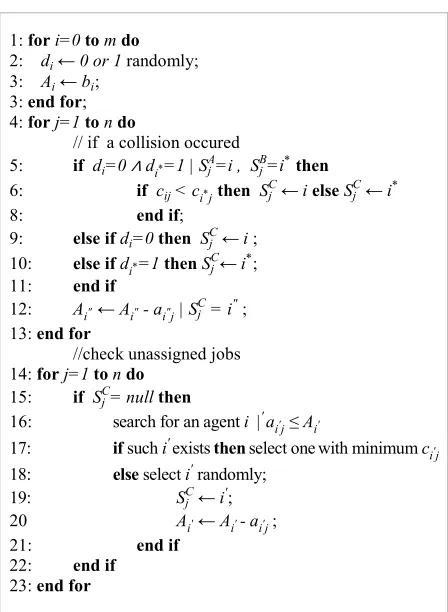
In Figure 1, the agent-based crossover is depicted. SA
and SB are selected parents, SC is the offspring for n=15
and m=5. di = 0indicates the jobs performed by the
Information Technology and Control 2019/3/48 394
Else if di = 1 indicates the jobs performed by the agent i in solution SB, these jobs are passed on to SC
. The
agent-based crossover is described in Algorithm 2. Figure 1
Illustration of Agent-based Crossover
The second condition is fulfilled if ri*j of the candidate agent is lower than rij of the agent assigned to the job.
Making a solution mature: The maturing a solution means minimising the fitness value of a solution as much as possible. In this approach, it is fixed that which agent executes how many jobs for a feasible solution. This situation does not change in this step. Hence, each feasible solution has its own ultimate cost value. It is judged that the solution reaches to the value when the maturation condition occurs for the solution.
Swap neighborhood type local search, which is performed by exchanging the assigned agents of two jobs, is adopted for maturation [30]. In this study, a second job is selected randomly together with the next one in iteration process. The local search depends on two conditions. Not only should fitness value (fk') be lesser, but
also feasibility (Pk') should be maintained for the subjected solution at the end of the exchange.
The maturation condition depends on the number of iterations in which a better fitness value is not obtained for the solution. The value is called Maturation Value (MV) and it affects not only the performance positively but also the execution time adversely. Hence, the MV increases from a predefined base value to predefined the top value gradually. The mechanism is defined in Algorithm 3 in Section 4.
3.2.4 Creating and Replacing Offspring
This step covers selection, creation, and replacement processes of GA. The trials showed that there is a low possibility in operating classical crossover to get a better feasible solution, for the capacity constraint is more likely to make it infeasible. Therefore, agent-based crossover method is designed and performed in this study to increase the possibility. When a solution is judged as a mature one, it should be replaced with an offspring. Two parent chromosomes are selected by tournament selection method and agent-based crossover method is applied to the selected parents. The parents are selected as feasible solutions in population, if they exist.
Multi point (1+⌊n/100⌋) mutation is applied to created offspring in terms of mutation rate. The mutation process is performed by assigning randomly selected agents to randomly selected jobs. Maturation-based replacement is proposed for replacement at the end of this step. The offspring solution replaces the mature one in the population. Hence, it is aimed that no solutions are thrown out of the population until it reaches its best fitness value.
The agent-based crossover method: The agent-based crossover is inspired from the concepts of dominant and recessive genes in genotype science. The dominant feature describes which certain phenotype to pass from parent to offspring. The agents of the parents are classified as dominant or recessive for the jobs due to the restriction based on agent capacity (3). The key point in this operation is the question of what jobs performed by which agents are passed on the offspring from which parent.
Figure 1
Illustration of Agent-based Crossover
The agents of the parents are identified as dominant or not; this domination is based on the jobs per-formed by each agent. It is possible that some of the jobs of the offspring are assigned to either no agent or two agents after passing dominant features. If a collision occurs in assigning two agents to one job, the job is assigned to the agent, who has a lower cost for the job. On the other hand, the other agent is re-leased and its current available capacity increases. If there is an unassigned job, any agent, having current available capacity for the job, is assigned the job. If current available capacities of the agents are still not enough for the job, a random agent is assigned to the job. The computational complexity of the agent-based crossover is O(n).
4 Computational Results
Chu and Baeasley’s test problem instances from OR library [3] were utilized in the present study to test and compare the proposed algorithm. These instanc-es were used for the computational experiments in other previous studies. The problem instances are divided into two groups as small sized and large sized. The large sized instances are generated as both agent/job combination m=5, 10, 20 and n=100, 200 and four different resources types from A to E [5, 30]. The proposed algorithm is applied only to large sized instances; because, the small sized ones are not 1: fori=0tomdo
2: di← 0 or 1 randomly; 3: Ai← bi;
3: endfor; 4: forj=1tondo
// if a collision occured
5: if di=0 ∧ di*=1 | SjA=i , SjB=i*then
6: if cij< ci*jthen SjC←ielseSjC←i*
8: end if;
9: else ifdi=0then SjC←i ;
10: else ifdi*=1thenSjC←i*;
11: end if
12: Ai" ← Ai"- ai"j | SjC = i" ;
13: end for
//check unassigned jobs 14: forj=1tondo
15: if SjC=nullthen
16: search for an agent i | a' i'j ≤Ai'
17: if such i' exists then select one with minimum c i'j 18: else select i' randomly;
19: SjC←i';
20 Ai'← Ai'-ai'j ;
21: end if
22: end if 23: end for Algorithm 2
395 Information Technology and Control 2019/3/48
challenging enough for contemporary computers. In this computational study, the conditions are ar-ranged according to the study by Chu and Beasely [5] as possible. The population size is always 100. The termination condition depends on Sterility Index (SI) indicating the number of offspring were created without getting any better fitness values. When SI is reached to 500000, GA is terminated. Maturation value (MV) varies between 30 and 50 and is updated according to Algorithm 3 for iterations. CSR value is determined as 0.1, 0.9, 0.1, 0.9 and 0.9 for the in-stance from A to E, respectively. The mutation prob-ability is defined as 0.001.
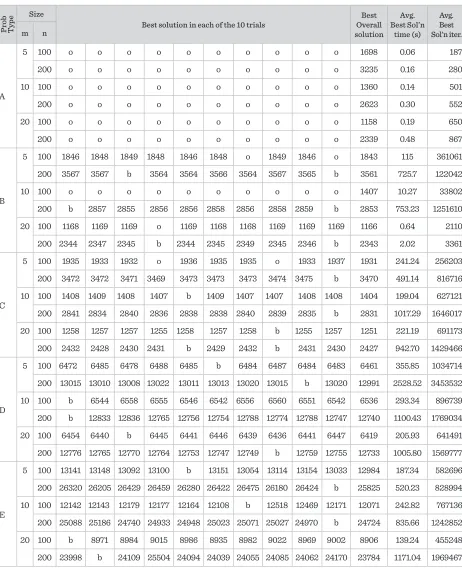
the averages of the execution times and the average number of iterations at the best solution obtained are presented. Both values are reasonable.
Table 3 shows the quality of solutions and a com-parison of the results. The percentage of deviation (σ) between best solution value (Si) and their known
best-cost value (So) (8) is used to measure the quality
of solutions:
E 5 100 12681 n/a n/a n/a 3.28 0.45 2.38 200 24930 n/a n/a n/a 5.50 0.79 3.59 10 100 11577 n/a n/a n/a 4.89 0.30 4.26 200 23307 n/a n/a n/a 7.13 0.62 6.07 20 100 8443 n/a n/a n/a 6.32 0.41 5.48 200 22379 n/a n/a n/a 7.42 0.46 6.27 * The best values are reported in [30].
** The values are figured out from [5].
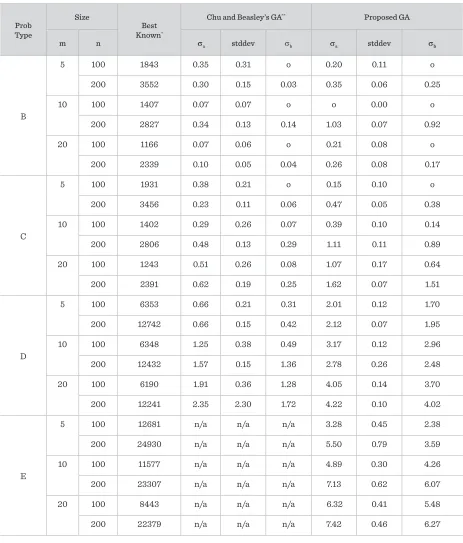
Table 3 shows the quality of solutions and a comparison of the results. The percentage of deviation (σ) between best solution value (Si) and their known best-cost value (So) (8) is used to measure the quality
of solutions:
σ=(Si-So)/So*100% . (8)
The average percentage of gap of the run’s best solution is shown in Table 3 (σa), the standard deviation
of the best solutions of trials (stddev) and the percentage gap of the best run’s solution (σb) are presented
as well.
The results of Type A instances are not included in Table 3, for both GAs find out the optimum cost for all six easy instances. Even if the agent-based method provides superiority over classical crossover method, as in Table 2, the percentage of the deviation values is partly better than those of Chu and Beasley’s GA. One of the reasons for this would be that the trials for Type D were terminated when IS had reached 3×10⁶. Nevertheless, the differences between the compared values are easily tolerable.
Moreover, the standard deviation values of the proposed GA are better for almost all instances.
In terms of computational complexity, the evaluation of solutions and agent-based crossover have complexities of O(mn) and O(n), respectively. Thus, the heuristic has a complexity of O(mn). The complexity of the Chu and Beasley’s GA is O(m2n) [5]. On the other hand, the computational times are
not compared because all the studies have different codes in different programming languages, different CPU times on different hardware, and different stopping criteria. In addition, larger sized GAP instances were used in a few previous heuristic studies. The answers to the objective questions would not change with such a large-sized problem. Additionally, testing with this type instances takes larger execution times. It is anticipated, in the present study, that this type of larger sized instances are more suitable for competition type papers.
5 Conclusions
This study has proposed a GA with new methods for GAP. Classical crossover method is given up and agent-based crossover is presented to increase the possibility of creating feasible solutions. The solutions are classified as infeasible, feasible, and mature. The fitness value is not computed for infeasible ones to shorten the execution time. Moreover, a solution is not thrown up from the population until it is matured. Moreover, it is ensured that all the infeasible solutions are turned into feasible ones by the proposed local search methods in the feasible solution diversity as much as possible.
The computational results show that the agent-based crossover is more effective in terms of creating feasible solutions. Further, the proposed GA is able to create optimal and near-optimal solutions for GAP. The proposed GA obtains the best solution in both the execution time and number of iterations. Additionally, the lower standard deviation values indicate the consistency of the algorithm. Prospective studies could use the agent-based crossover and maturity-based replacement methods with different local searches than the ones in the previous studies, and should develop new methods.
Acknowledgement
The author thanks Dr. Ömer Faruk Cantekin, member of the Academic Writing Centre at Gazi University, for his support to checking the manuscript in terms of vocabulary and grammar.
References
(8)
The average percentage of gap of the run’s best solu-tion is shown in Table 3 (σa), the standard deviation of the best solutions of trials (stddev) and the percent-age gap of the best run’s solution (σb) are presented as well.
The results of Type A instances are not included in Table 3, for both GAs find out the optimum cost for all six easy instances. Even if the agent-based method provides superiority over classical crossover method, as in Table 2, the percentage of the deviation values is partly better than those of Chu and Beasley’s GA. One of the reasons for this would be that the trials for Type D were terminated when IS had reached 3×10⁶.
Nevertheless, the differences between the compared values are easily tolerable. Moreover, the standard deviation values of the proposed GA are better for al-most all instances.
In terms of computational complexity, the evaluation of solutions and agent-based crossover have com-plexities of O(mn) and O(n), respectively. Thus, the heuristic has a complexity of O(mn). The complexity of the Chu and Beasley’s GA is O(m2n) [5]. On the
oth-er hand, the computational times are not compared because all the studies have different codes in differ-ent programming languages, differdiffer-ent CPU times on different hardware, and different stopping criteria. In addition, larger sized GAP instances were used in a few previous heuristic studies. The answers to the objective questions would not change with such a large-sized problem. Additionally, testing with this type instances takes larger execution times. It is an-ticipated, in the present study, that this type of larg-er sized instances are more suitable for competition type papers.
Algorithm 3
Computation of Maturation Value
In this computational study, the conditions are arranged according to the study by Chu and Beasely [5] as possible. The population size is always 100. The termination condition depends on Sterility Index (SI) indicating the number of offspring were created without getting any better fitness values. When SI is reached to 500000, GA is terminated. Maturation value (MV) varies between 30 and 50 and is updated according to Algorithm 3 for iterations. CSR value is determined as 0.1, 0.9, 0.1, 0.9 and 0.9 for the instance from A to E, respectively. The mutation probability is defined as 0.001.
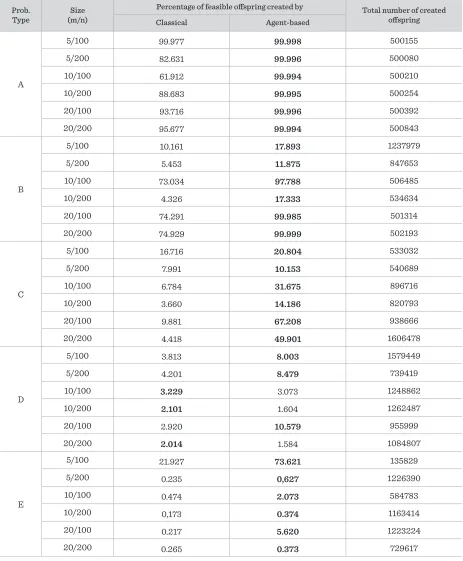
Table 1
Percentages of feasible offspring created by Classical and Agent-based Crossover Methods Prob.
Type (m/n) Size Percentage of feasible offspring created by created offspring Total number of Classical Agent-based
A
5/100 99.977 99.998 500155
5/200 82.631 99.996 500080
10/100 61.912 99.994 500210
10/200 88.683 99.995 500254
20/100 93.716 99.996 500392
20/200 95.677 99.994 500843
B
5/100 10.161 17.893 1237979
5/200 5.453 11.875 847653
10/100 73.034 97.788 506485
10/200 4.326 17.333 534634
20/100 74.291 99.985 501314
20/200 74.929 99.999 502193
C
5/100 16.716 20.804 533032
5/200 7.991 10.153 540689
10/100 6.784 31.675 896716
10/200 3.660 14.186 820793
20/100 9.881 67.208 938666
20/200 4.418 49.901 1606478
D
5/100 3.813 8.003 1579449
5/200 4.201 8.479 739419
10/100 3.229 3.073 1248862
10/200 2.101 1.604 1262487
20/100 2.920 10.579 955999
20/200 2.014 1.584 1084807
E
5/100 21.927 73.621 135829
5/200 0.235 0,627 1226390
10/100 0.474 2.073 584783
10/200 0,173 0.374 1163414
20/100 0.217 5.620 1223224
20/200 0.265 0.373 729617
The proposed algorithm was coded in Java programming language and run on Java JRE v. 1.8.0_25 for Windows x64 installed on a machine which has an Intel(R) Core(TM) i5 3.1 GHz CPU and a 6 GB of
MVbase← 30;
MVinterval← 20;
MV← MVbase ;
//Update in each iteration
if M-Mbase<SI/(500000/MVinterval)then
MV← Mbase+SI/(500000/MVinterval)
end if
Algorithm 3
Computation of Maturation Value The proposed algorithm was coded in Java
program-ming language and run on Java JRE v. 1.8.0_25 for Windows x64 installed on a machine which has an In-tel(R) Core(TM) i5 3.1 GHz CPU and a 6 GB of RAM. Minimum and maximum memory allocations are specified as 256 MB and 4096 MB, respectively, for the execution of the code.
Table 1 indicates the comparison of fertility between the proposed agent-based crossover and classical sin-gle point crossover. This comparison was conducted by applying the proposed algorithm to the 24 large sized GAP instances. After the agent-based crossover was performed, the classical crossover was applied to the same parent solutions. The percentage of the fea-sible offspring generated by the proposed crossover methods was much higher than the classical cross-over method in 27 instances out of 30.
Information Technology and Control 2019/3/48 396
Table 1
Percentages of feasible offspring created by Classical and Agent-based Crossover Methods
Prob.
Type (m/n)Size
Percentage of feasible offspring created by Total number of created offspring Classical Agent-based
A
5/100 99.977 99.998 500155
5/200 82.631 99.996 500080
10/100 61.912 99.994 500210
10/200 88.683 99.995 500254
20/100 93.716 99.996 500392
20/200 95.677 99.994 500843
B
5/100 10.161 17.893 1237979
5/200 5.453 11.875 847653
10/100 73.034 97.788 506485
10/200 4.326 17.333 534634
20/100 74.291 99.985 501314
20/200 74.929 99.999 502193
C
5/100 16.716 20.804 533032
5/200 7.991 10.153 540689
10/100 6.784 31.675 896716
10/200 3.660 14.186 820793
20/100 9.881 67.208 938666
20/200 4.418 49.901 1606478
D
5/100 3.813 8.003 1579449
5/200 4.201 8.479 739419
10/100 3.229 3.073 1248862
10/200 2.101 1.604 1262487
20/100 2.920 10.579 955999
20/200 2.014 1.584 1084807
E
5/100 21.927 73.621 135829
5/200 0.235 0,627 1226390
10/100 0.474 2.073 584783
10/200 0,173 0.374 1163414
20/100 0.217 5.620 1223224
397 Information Technology and Control 2019/3/48
Table 2
Computational Results for Large Sized GAP Instances. o: integer optimum reached. b: best overall solution value
Pr
ob
Type
Size
Best solution in each of the 10 trials Overall Best solution
Avg. Best Sol’n
time (s)
Avg. Best Sol’n iter. m n
A
5 100 o o o o o o o o o o 1698 0.06 187
200 o o o o o o o o o o 3235 0.16 280
10 100 o o o o o o o o o o 1360 0.14 501
200 o o o o o o o o o o 2623 0.30 552
20 100 o o o o o o o o o o 1158 0.19 650
200 o o o o o o o o o o 2339 0.48 867
B
5 100 1846 1848 1849 1848 1846 1848 o 1849 1846 o 1843 115 361061
200 3567 3567 b 3564 3564 3566 3564 3567 3565 b 3561 725.7 122042
10 100 o o o o o o o o o o 1407 10.27 33802
200 b 2857 2855 2856 2856 2858 2856 2858 2859 b 2853 753.23 1251610
20 100 1168 1169 1169 o 1169 1168 1168 1169 1169 1169 1166 0.64 2110
200 2344 2347 2345 b 2344 2345 2349 2345 2346 b 2343 2.02 3361
C
5 100 1935 1933 1932 o 1936 1935 1935 o 1933 1937 1931 241.24 256203
200 3472 3472 3471 3469 3473 3473 3473 3474 3475 b 3470 491.14 816716
10 100 1408 1409 1408 1407 b 1409 1407 1407 1408 1408 1404 199.04 627121
200 2841 2834 2840 2836 2838 2838 2840 2839 2835 b 2831 1017.29 1646017
20 100 1258 1257 1257 1255 1258 1257 1258 b 1255 1257 1251 221.19 691173
200 2432 2428 2430 2431 b 2429 2432 b 2431 2430 2427 942.70 1429466
D
5 100 6472 6485 6478 6488 6485 b 6484 6487 6484 6483 6461 355.85 1034714
200 13015 13010 13008 13022 13011 13013 13020 13015 b 13020 12991 2528.52 3453532
10 100 b 6544 6558 6555 6546 6542 6556 6560 6551 6542 6536 293.34 896739
200 b 12833 12836 12765 12756 12754 12788 12774 12788 12747 12740 1100.43 1769034
20 100 6454 6440 b 6445 6441 6446 6439 6436 6441 6447 6419 205.93 641491
200 12776 12765 12770 12764 12753 12747 12749 b 12759 12755 12733 1005.80 1569777
E
5 100 13141 13148 13092 13100 b 13151 13054 13114 13154 13033 12984 187.34 582696
200 26320 26205 26429 26459 26280 26422 26475 26180 26424 b 25825 520.23 828994
10 100 12142 12143 12179 12177 12164 12108 b 12518 12469 12171 12071 242.82 767136
200 25088 25186 24740 24933 24948 25023 25071 25027 24970 b 24724 835.66 1242852
20 100 b 8971 8984 9015 8986 8935 8982 9022 8969 9002 8906 139.24 455248
Information Technology and Control 2019/3/48 398
Table 3
Comparison of Chu and Beasley’s GA and proposed GA. o: integer optimum reached
Prob Type
Size
Best Known*
Chu and Beasley’s GA** Proposed GA
m n σa stddev σb σa stddev σb
B
5 100 1843 0.35 0.31 o 0.20 0.11 o
200 3552 0.30 0.15 0.03 0.35 0.06 0.25
10 100 1407 0.07 0.07 o o 0.00 o
200 2827 0.34 0.13 0.14 1.03 0.07 0.92
20 100 1166 0.07 0.06 o 0.21 0.08 o
200 2339 0.10 0.05 0.04 0.26 0.08 0.17
C
5 100 1931 0.38 0.21 o 0.15 0.10 o
200 3456 0.23 0.11 0.06 0.47 0.05 0.38
10 100 1402 0.29 0.26 0.07 0.39 0.10 0.14
200 2806 0.48 0.13 0.29 1.11 0.11 0.89
20 100 1243 0.51 0.26 0.08 1.07 0.17 0.64
200 2391 0.62 0.19 0.25 1.62 0.07 1.51
D
5 100 6353 0.66 0.21 0.31 2.01 0.12 1.70
200 12742 0.66 0.15 0.42 2.12 0.07 1.95
10 100 6348 1.25 0.38 0.49 3.17 0.12 2.96
200 12432 1.57 0.15 1.36 2.78 0.26 2.48
20 100 6190 1.91 0.36 1.28 4.05 0.14 3.70
200 12241 2.35 2.30 1.72 4.22 0.10 4.02
E
5 100 12681 n/a n/a n/a 3.28 0.45 2.38
200 24930 n/a n/a n/a 5.50 0.79 3.59
10 100 11577 n/a n/a n/a 4.89 0.30 4.26
200 23307 n/a n/a n/a 7.13 0.62 6.07
20 100 8443 n/a n/a n/a 6.32 0.41 5.48
200 22379 n/a n/a n/a 7.42 0.46 6.27