Copyright © 2015 IJECCE, All right reserved
MRI Image Segmentation Using Gaussian Kernel Based
Fuzzy C-Means Algorithm
Nookala Venu
Research Scholar, Dept. of Electronics and Communication Engineering, Sri Venkateswara University College of
Engineering Sri Venkateswara University, Tirupati-517502,Andra Pradesh, India
email: [email protected]
B. Anuradha
Professor, Dept. of Electronics and Communication Engineering, Sri Venkateswara University College of Engineering
Sri Venkateswara University, Tirupati-517502, Andra Pradesh, India
email: [email protected]
Abstract: In this paper, a new segmentation algorithm with the integration of mean, median and peak-and-valley filter- ing based denoising and Gaussian kernels based fuzzy c-means (MPVKFCM) algorithm With spatial information is proposed for medical image segmentation. First, the image is denoised by using the mean, median and peak-and-valley filtering algorithm. Secondly, image segmentation algorithm with Gaussian kernels based fuzzy c-means is performed on the denoised image. The performance of the proposed algorithm is tested on OASIS-MRI image dataset. The performance is tested in terms of Score, Number of iterations (NI), Execution time (TM) and PSNR values under different Gaussian noises on OASIS-MRI dataset. The results after investigation, the proposed method shows a significant improvement as compared to other existing methods in terms of PSNR, Score, NI and TM under different Gaussian noises on OASIS-MRI dataset.
Keywords: FCM, Mean Filtering, Median Filtering, Image Segmentation, Gaussian Kernal, Fuzzy, Multiple-Kernal.
1.
I
NTRODUCTIONImage segmentation is an active research area in medical image processing [1] and computer vision applications. Image segmentation is the process of dividing the image into non-overlapped, unfailing regions. The divided or segmented regions are uniform with respect to some characteristics like color, texture, intensity etc. Based on the characteristics, image segmentation is divided into four categories: thresholding (intensity), clustering (intensity), edge detection (texture) and region extraction (color or texture).
So many image segmentation algorithms are available in the literature. The brief survey of available techniques can be seen as follows: intensity based or thresholding algorithm [2], clustering based algorithm [3], classification [4], region growing [5], artificial neural networks (ANNs) [6], Markov Random Field (MRF) [7] based algorithms etc. From literature survey, we observed that the clustering based image segmentation algorithms are best as compared to other algorithms. This observation is motiv- ated us to work in the direction of clustering algorithm based image segmentation.
Clustering is a process for classifying or segmenting the regions or objects in an image. The samples of classified objects or regions are contain the more similar content to one another than samples belonging to different clusters. There are two types of clustering strategies are available in the literature which are the hard clustering scheme and the
fuzzy clustering scheme. The hard clustering scheme called k-mean algorithm is proposed by MacQueen [8]. The k-mean clustering method classifies each point of the data set just to one cluster. As The outcome of the results are repeatedly very hard, i.e., in image clustering each pixel of the image belongs just to one cluster. However, in many real conditions, issues such as limited spatial resolution, poor contrast, overlapping intensities, noise and intensity in homogeneities reduce the effectiveness of hard (crisp) clustering methods. To avoid the problem of hard clustring (k-mean) algorithm, the fuzzy set theory is introduced in [9]. The fuzzy set theory is based on the fuzzy membership, described by a membership function. The Fuzzy clustering is considered as a soft segmentation method. The brief literature survey about the fuzzy set theory for image segmentation can be seen in [10]–[19]. From literature, it is observed that the fuzzy c-means (FCM) algorithm [10] is more popular among the fuzzy clustering methods. In image segmentation, FCM is the most popular method because it has robust characteristics for vagueness and can hold much more information than hard segmentation methods [11]. However, the standard FCM algorithm is more suitable for noise-free images and it is very sensitive to noise and other imaging artifacts, since it does not consider any information about spatial context.
Copyright © 2015 IJECCE, All right reserved Chen and Zhang [16] have proposed two variants of the
FCM_S algorithm (FCM_S1 and FCM_S2) in order to reduce the computational time. These two algorithms introduced the concepts of mean and median-filtered image, respectively. These values are calculated in advance, to replace the neighborhood term of FCM_S. With this, the execution times of both FCM_S1 and FCM_S2 are considerably reduced. Further, they have improved the objective function of FCM_S to more likely reveal inherent non-Euclidean structures in data and more robustness to the noise. They have used the kernel-induced distance in place of the Euclidean distance. Further, they have proposed the kernel versions of FCM with spatial constraints, called KFCM_S1 and KFCM_S2 [16]. However, the main drawback of FCM_S and its variants FCM_S1, FCM_S2, KFCM_S1 and KFCM_S2 is that their parameters heavily affect the final clustering results.
To accelerate the image segmentation process, Szilagyi et al. [17] have proposed the enhanced FCM (EnFCM) algorithm. The structure of the proposed EnFCM algorithm is different from the FCM_S and its variants. First, a linearly-weighted sum image is formed by using both original image and each pixel’s with local neighborhood mean gray level. Then clustering is performed on the basis of the gray level histogram instead of pixels of the summed image. The main reason behind this is that the number of gray levels in an image is generally much smaller than the number of its pixels, with this the computational time of EnFCM algorithm is reduced, while the quality of the segmented image is comparable to that of FCM_S [17]. Cai et al. [20] have proposed the fast generalized FCM algorithm (FGFCM) which incorporates the intensity of the local pixel neighborhood, the spatial information and the number of gray levels in an image. As compared to ref. [17], here they have calculated the image by nonlinearly-weighted sum from both original image and its local spatial and gray level neighborhood. The computational time of FGFCM is very small, because clustering is operated on the basis of the gray level histogram. The quality of the segmented image is well enhanced [20] as compared to [17]. The Gaussian kernel based FCM (GKFCM) for medical image segmentation is proposed by Yang and Tsai [21]. The proposed GKFCM algorithm becomes a generalized form of FCM, KFCM_S1 and KFCM_S2 algorithms and proposed with more efficiency and robustness. Chen et al. [22] have proposed the multiple-kernel fuzzy C-means (FCM) (MKFCM) for image-segmentation problems. They have used the linear combination of multiple kernels as composite kernel.
The hyper tangent FCM (HTFCM) based image segmentation for breast images is proposed by Kannan et al. [23]. They have used the hyper tangent function in place of Euclidean distance as objective function on feature space.
The main contributions of this paper are given as follows. (a) Mean filtering and Gaussian kernel based FCM (GKFCM) are integrated for medical image segmentation under different noise conditions. (b) The
performance of the proposed method is tested on OASIS-MRI image data under different noise conditions. (c) The segmentation results show a significant improvement as compared to other existing methods.
The organization of the paper is given as follows. Sections I, presents the literature and related work of proposed clustering algorithms. The various methods which are available for cluster based segmentations are given in section II, Section III, presents the evaluation measures and dataset used in this paper. The experimental results and discussions are given in section IV. Conclusions are derived in section V.
2.
M
ETHODSA. Fuzzy C-means Algorithm:
To avoid the problem of k-means algorithm, the fuzzy c-means clustering (FCM) algorithm is proposed. FCM shows extremely good results in image segmentation and object classification. As in hard k-means algorithm, Fuzzy C-means algorithm is based on the minimization of a criterion function.
Suppose a data of n elements (image pixels), each of sizes s( 1)is represented as X ( ,x x1 2,...,xn). FCM estimates the clusters iteratively by minimizing the objective function as given in Eq. (1).
Objective function: 2
1 1
( , ) ( , )
c n mm ij j i
i j
O U C U D x C (1)
Constraint: 1
1; c
ij i
U j
(2)Where,
U
ijis membership of the thj
data in the thi clusterCi,
m is fuzziness of the system (m=2) andDis the distance between the cluster center and pixel.
FCM algorithm:
Fig. 1 illustrates the flow chart of FCM algorithm and the algorithm for the same is given bellow.
Input: Raw image; Output: Segmented image;
Randomly initialize the cluster centers Ci(c3 clusters).
The distanceDbetween the cluster center and pixel is calculated by using Eq. (3).
2 2
( ,j i) j i
D x C x C (3)
The membership values are calculated by using Eq. (4).
1/ ( 1)
1/ ( 1)
1
( , )
( , ) m
j i
ij c m
j k
k
D x C U
D x C
(4)Copyright © 2015 IJECCE, All right reserved 1 1 n m ij j j i n m ij j U x C U
(5) The iterative process starts:
1. Update the membership valuesUijby using Eq. (4).
2. Update the cluster centersCi by using Eq. (5). 3. Update the distance D using Eq. (3).
4. If CnewCold
; (
0.002)then go to step1 5. Else stopAssign each pixel to a specific cluster for which the membership value is maximal
B. Kernel Based FCM:
Kernel based FCM uses the kernel function in place of Euclidean distance. The objective function with the mapping is as follows:
Objective function:
1 1
( , ) (1 ( , ))
c n
m
m ij j i
i j
O U C U K x C
The iterative updating of the cluster centers and membership functions for minimizing the objective function O U Cm( , ) are as follows:
1
1
( , )
; 1, 2,.... ( , )
n m
ij j i j j
i n m ij j i j
U K x C x
C i C
U K x C
(6)
1/ ( 1)
1/ ( 1)
1
1 ( , ) 1, 2,....
;
1, 2,.., 1 ( , )
m
j i
ij c m
j i
k
K x C i C
U
j n
K x C
(7)Here, the kernel function K is the Gaussian function withK x C( ,j i)exp( || xjCi||2
2). The Gaussian kernel is suitable for clustering in which it can actually induce the necessary conditions. However, the KFCM algorithm is very sensitive to the noise. To address this problem Chen and Zhang [16] have proposed the KFCM_S1 and KFCM_S2 algorithms which have utilized the spatial neigh pixel information by introducing α parameter.C. Gaussian Kernal FCM (GKFCM):
Yang and Tsai [21] have proposed the GKFCM which is the generalized type of FCM, KFCM_S1 and KFCM_S2 algorithms. Here, they replace the parameter α with ƞi which correlates the each cluster i. In this sense, Yang and Tsai [21] have considered the modified objective function
( , ) G m
O U C with the following constraints.
1 1 1 1
( , ) (1 ( , )) (1 ( , ))
c n c n
G m m
j
m ij j i i ij i
i j i j
O U C U K x C U K x C
(8)Where K x C( ,j i)exp( || xjCi||2
2), xj is themean of the neighbor pixels,
2is the variance of the total image.
1 1 ( , ) ( , ); 1, 2,.... ( , ) ( , )
n m
j j ij j i j i i j
i n
m
j
ij j i i i
j
U K x C x K x C x
C i C
U K x C K x C
(9)
1/ ( 1)
1/ ( 1) 1
(1 ( , )) (1 ( , )) 1, 2,.... ;
1, 2,.., (1 ( , )) (1 ( , ))
m j
j i i i
ij c m
j
j i i i
k
K x C K x C i C
U
j n
K x C K x C
(10)D. Integration of Mean and Peak-and-Valley Filter-
ing and GKFCM:
The ideas which are presented in mean filtering based image denoising [26] and GKFCM [21] are motivated us to propose the MPVKFCM Algorithm.
Review of Mean Filtering:
The earliest median filter proposed is the standard mean filter. In this method, there is a square window for filtering, and the window size is variable. The center pixel in the scan window is to be de-noised. The first step is to sort all the pixel values in the scan window, and the second step is to change the value into the standard mean of the sorted sequence. The standard mean filter method is a simple and efficient technique to remove impulse noise, and it has lasted used for a long time.
E. Review of Peak-and-Valley Filtering:
The Peak-and-Valley filter is a new filter algorithm that has been put forward lately; it differs from the Median filter and adopts a series of operations based on min-max operators. Its core algorithm is following: first, it finds out the minimum and the maximum of the eight pixels surrounding the central pixel within a 3×3 window, then, compares the value of the central pixel with the minimum and the maximum, if the central pixel has a gray level which is much higher than the maximum, this means that the central pixel has been noised, and its gray level is replaced by the maximum, on the contrary, if the central pixel has a gray level which is much smaller than the minimum, its gray level is replaced by the minimum. Compared with the Median filter, the filter algorithm has a noise detection function; it is found to be adaptive to noise density variation and prone to protecting the details of the image better.
After calculation of mean and peak-and-valley filtering, the resultant image is used for the segmentation with GKFCM algorithm. The algorithm for the proposed segmentation method is given bellow.
MPVKFCM Algorithm Input: Raw image; Output:
Segmented image;
Apply the mean, median and peak-valley filter based denoising.
Apply the GKFCM using the following steps. Randomly initialize the cluster centers
i
Copyright © 2015 IJECCE, All right reserved Membership values calculation using Eq. (11).
Cluster centers updating using Eq. (12). The iterative process starts:
1. Membership values updatingUij using Eq. (11).
2. Update the cluster centersCi by using Eq. (12).
3. If
C
new
C
old
; (
0.002)
then go to step1 4. Else stop Assign each pixel to a specific cluster for which the membership value is maximal
3.
E
VALUATIONM
EASURES ANDD
ATASETA. Segmentation accuracy/Score:
In order to analyze the performance of the proposed method, we use the score which is defined in [25] and [26]. The score Sik is defined as:
ik refk ik
ik refk
A
A
S
A
A
(13)Where Aik represents the set of pixels belonging to the
kth class calculated by the ith algorithm and Arefk represents the set of pixels belonging to the kth class in the reference segmented image.
In this paper, we also used the number of iterations (NI) and execution time which are required for the convergence of the algorithm.
Table I: MRI data acquisition details [27] Sequence MP-RAGE TR (msec) 9.7 TE (msec) 4.0 Flip angle (o) 10
TI (msec) 20
TD (msec) 200 Orientation Sagittal Thickness, gap (mm) 1.25, 0
Resolution (pixels) 176×208
MRI Dataset:
The Open Access Series of Imaging Studies (OASIS) [26] is a series of magnetic resonance imaging (MRI) dataset that is publicly available for study and analysis. This dataset consists of a cross-sectional collection of 421 subjects aged 18 to 96 years. The MRI acquisition details are given in Table I. The performance of the proposed method is measures in terms of score, number of iterations
and execution time. Fig. 1 illustrates two sample images selected for experimentation.
Fig.1. Sample Images Used for Experiments
4.
E
XPERIMENTALR
ESULTS ANDD
ISCUSSIONSIn order to prove the effectiveness of the proposed algorithm, experiments were conducted on two brain MRIs [26]. The performance of the proposed algorithm is tested in terms of score, number of iterations (NI) and computational time (CT) and PSNR as compared to other existing FCM variant methods on OASIS-MRI dataset.
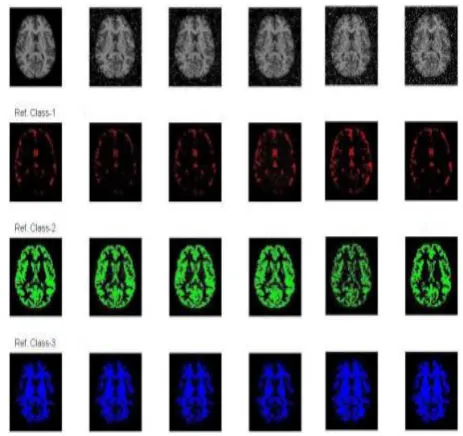
Fig.2. Comparison of proposed method with other existing methods (GKFCM_S1, GKFCM_S2, HTFCM and MHTFCM) in terms of three segmented clusters. The original image (Image (a)) are corrupted with 5% of Gaussian noise.
Table II. Comparison of various techniques in terms of score on Image (a) at different Gaussian noises Cl: Cluster
Method
Gaussian Noise (%)
5% 10% 15% 20%
Copyright © 2015 IJECCE, All right reserved
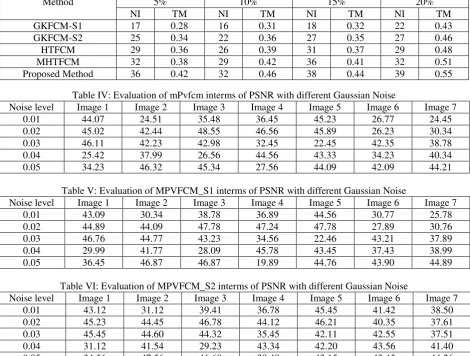
Table III: Comparison of various techniques in terms of number of iterations and execution time at different Gaussian noise on Image (b) NI: Number of iterations; TM: Execution Time (Sec.)
Method
Gaussian Noise
5% 10% 15% 20%
NI TM NI TM NI TM NI TM
GKFCM-S1 17 0.28 16 0.31 18 0.32 22 0.43
GKFCM-S2 25 0.34 22 0.36 27 0.35 27 0.46
HTFCM 29 0.36 26 0.39 31 0.37 29 0.48
MHTFCM 32 0.38 29 0.42 36 0.41 32 0.51
Proposed Method 36 0.42 32 0.46 38 0.44 39 0.55
Table IV: Evaluation of mPvfcm interms of PSNR with different Gaussian Noise
Noise level Image 1 Image 2 Image 3 Image 4 Image 5 Image 6 Image 7
0.01 44.07 24.51 35.48 36.45 45.23 26.77 24.45
0.02 45.02 42.44 48.55 46.56 45.89 26.23 30.34
0.03 46.11 42.23 42.98 32.45 22.45 42.35 38.78
0.04 25.42 37.99 26.56 44.56 43.33 34.23 40.34
0.05 34.23 46.32 45.34 27.56 44.09 42.09 44.21
Table V: Evaluation of MPVFCM_S1 interms of PSNR with different Gaussian Noise
Noise level Image 1 Image 2 Image 3 Image 4 Image 5 Image 6 Image 7
0.01 43.09 30.34 38.78 36.89 44.56 30.77 25.78
0.02 44.89 44.09 47.78 47.24 47.78 27.89 30.76
0.03 46.76 44.77 43.23 34.56 22.46 43.21 37.89
0.04 29.99 41.77 28.09 45.78 43.45 37.43 38.99
0.05 36.45 46.87 46.87 19.89 44.76 43.90 44.89
Table VI: Evaluation of MPVFCM_S2 interms of PSNR with different Gaussian Noise
Noise level Image 1 Image 2 Image 3 Image 4 Image 5 Image 6 Image 7
0.01 43.12 31.12 39.41 36.78 45.45 41.42 38.50
0.02 45.23 44.45 46.78 44.12 46.21 40.35 37.61
0.03 45.45 44.60 44.32 35.45 42.11 42.55 37.51
0.04 31.12 41.54 29.23 43.34 42.20 43.56 41.40
0.05 34.56 47.56 46.60 39.40 43.15 43.45 44.26
Fig. 2 illustrates the cluster segmentation results of the proposed method and other existing methods with the 5% Gaussian noise on Image (a) of OASIS-MRI dataset. The performance of the proposed method is compared with the GKFCM_S1 and GKFCM_S2. Table II to Table III shows the segmentation performance in terms of score, NI,TM and PSNR on image (a) and Image (b) respectively under different Gaussian noise conditions. From, Fig. 2 and Tables II to VI, it is clear that the proposed method outperforms the other existing algorithms in terms of score, NI,TM and PSNR.
5.
C
ONCLUSIONSIn this paper, new image segmentation algorithms (MPVKFCM) which are increasing the performance and decreasing the computational complexity is proposed. The algorithm utilizes the integration of mean and median filtering and GKFCM algorithms for segmentation modifies the membership weighting of each cluster using spatial information.. The proposed algorithm is applied on brain MRI which degraded by Gaussian noise. The segmentation results demonstrate that the proposed
algorithm shows the robustness under different noises as compared to other existing image segmentation algorithms from FCM family.
R
EFERENCES[1] László Szilágyi, Sándor M. Szilágyi, Balázs Benyó and Zoltán
Benyó, “Application of Hybrid c-Means Clustering Models in
Inhomogeneity Compensation and MR Brain Image Segmentation,” 5th International Symposium on Applied Computational Intelligence and Informatics , pp.105-110, May. 2009.
[2] Orlando J. Tobias, and Rui Seara, "Image Segmentation by Histogram Thresholding Using Fuzzy Sets," IEEE Transactions on Image Processing, vol. 11, no. 12, pp. 1457-1465, 2002.
[3] Arnau Oliver, Xavier Munoz, Joan Batlle, Lluıs Pacheco, and Jordi
Freixenet, "Improving Clustering Algorithms for Image Segmentation using Contour and Region Information," International Conference on Automation, Quality and Testing, Robotics, Cluj-Napoca, vol. 1, pp. 315-320, 2006.
[4] H. Choi, and R. G. Baraniuk, "Image Segmentation using Wavelet-domain Classification,"Proc. SPIE Technical Conference on Mathematical Modeling, Bayesian Estimation, and Inverse Problems, Denver, pp. 306-320, 1999.
Copyright © 2015 IJECCE, All right reserved
[6] Indira SU and Ramesh A C, "Image Segmentation Using Artificial Neural Network and Genetic Algorithm: A Comparative Analysis," International Conference on Process Automation, Control and Computing (PACC), Coimbatore, pp. 1-6, 2011.
[7] Dipti Patra and P. K. Nanda, " Image Segmentation Using Markov Random Field Model Learning Feature and Parallel Hybrid Algorithm," International Conference on Computational Intelligence and Multimedia Applications, Sivakasi, Tamil Nadu, pp. 400-407, 2007.
[8] MacQueen,J.B. “Some Methods for classification and Analysis of
Multivariate Observations,"Proceedings of 5th Berkeley Symposium on Mathematical Statistics and Probability. University of California Press, pp. 281–297, 1967.
[9] L. Zadeh, “Fuzzy sets,” Inf. Control, vol. 8, pp. 338–353, 1965.
[10] J. Udupa and S. Samarasekera, “Fuzzy connectedness and object
definition: Theory, algorithm and applications in image
segmentation,” Graphical Models and Image Processing, vol. 58,
no. 3, pp. 246–261, 1996.
[11] J. C. Noordam and W. H. A. M. van den Broek, "Multivariate image segmentation based on geometrically guided fuzzy C-means clustering," Journal of Chemometrics, vol. 16, 1 - 11, 2002.
[12] Y. Tolias and S. Panas, “Image segmentation by a fuzzy clustering
algorithm using adaptive spatially constrained membership
functions,” IEEE Transactions on Systems, Man, and Cybernetics,
vol. 28, no. 3, pp. 359–369, Mar.1998.
[13] J.C. Noordam, W.H.A.M. van den Broek, and L.M.C. Buydens, " Geometrically Guided Fuzzy C-means Clustering for Multivariate Image Segmentation," Proc. Int. Conf. on Pattern Recognition, Barcelona, vol. 1, 462 - 465, 2000.
[14] D. Pham, “Fuzzy clustering with spatial constraints,” in
Proceedings of International Conference on Image Processing, New York, 2002, vol. II, pp. 65–68.
[15] M. Ahmed, S. Yamany, N. Mohamed, A. Farag, and T. Moriarty,
“A modified fuzzy C-means algorithm for bias field estimation and
segmentation of MRI data,” IEEE Transactions on Medical
Imaging, vol. 21, no. 3, pp. 193–199, 2002.
[16] S. Chen and D. Zhang, “Robust image segmentation using FCM with spatial constraints based on new kernel-induced distance
measure,” IEEE Transactions on Systems, Man, and Cybernetics,
vol. 34, pp. 1907–1916, 2004.
[17] L. Szilagyi, Z. Benyo, S. Szilagyii, and H. Adam, “MR brain image
segmentation using an enhanced fuzzy C-means algorithm,” in Proceedings of the 25" Annual International Conference of the IEEE EMBS, pp. 17–21, 2003.
[18] M. Krinidis and I. Pitas, “Color texture segmentation based-on the
modal energy of deformable surfaces,” IEEE Transactions on Image Processing, vol. 18, no. 7, pp. 1613–1622, Jul. 2009.
[19] M. Yang, Y. J. Hu, K. Lin, and C. C. Lin, “Segmentation
techniques for tissue differentiation in MRI of ophthalmology using
fuzzy clustering algorithms,” Magnetic Resonance Imaging, vol. 20, no. 2, pp. 173–179, 2002.
[20] W. Cai, S. Chen, and D. Zhang, “Fast and robust fuzzy c-means clustering algorithms incorporating local information for image
segmentation,” Pattern Recognition, vol. 40, no. 3, pp. 825–838, Mar. 2007.
[21] Miin-Shen Yang, Hsu-Shen Tsai, “A Gaussian kernel-based fuzzy
c-means algorithm with a spatial bias correction,” Pattern
Recognition Letters, vol. 29, pp. 1713–1725, May 2008.
[22] Long Chen, C. L. Philip Chen, and Mingzhu Lu, “A Multiple
-Kernel Fuzzy C-Means Algorithm for Image Segmentation,” IEEE Trans. Systems, Man, And Cybernetics—Part B: Cybernetics, vol. 41, No. 5, pp. 1263 – 1274, February 9, 2011.
[23] S.R. Kannan, S. Ramathilagam, R. Devi, A. Sathya, " Robust kernel FCM in segmentation of breast medical images," Expert Systems with Applications, vol. 38, 4382–4389, 2011.
[24] Masulli, F., Schenone, A., "A fuzzy clustering based segmentation system as support to diagnosis in medical imaging," Artif. Intell. Med. vol. 16, pp. 129–147, 1999.
[25] Zhang, D.Q., Chen, S.C., "A novel kernelized fuzzy c-means algorithm with application in medical image segmentation," Artif. Intell. Med., vol. 32, pp. 37–50, 2004.
[26] Chin-Chen Chang, Ju-Yuan Hsiao and Chih-Ping Hsieh, "An Adaptive Median Filter for Image Denoising," Second International Symposium on Intelligent Information Technology Application, sh-
anghai, pp. 346-350, 2008.
[27]D. S.Marcus, T. H. Wang, J. Parker, J. G. Csernansky, J. C.Morris, and R. L. Buckner, Open access series of imaging studies (OASIS): Crosssectional MRI data in young, middle aged, nondemented, and demented older adults. J. Cogn. Neurosci., 19 (9) 1498–1507, 2007.