Available Online at www.ijpret.com
7
INTERNATIONAL JOURNAL OF PURE AND
APPLIED RESEARCH IN ENGINEERING AND
TECHNOLOGY
A PATH FOR HORIZING YOUR INNOVATIVE WORK
MITIGATING CONGESTION FOR HETEROGENEOUS TRAFFIC IN MULTIPATH
WIRELESS SENSOR NETWORK
PROF. SANKET A. CHANDURE, DR. H. R. DESHMUKH
Department of C.S.E., IBSS COE Amravati.
Accepted Date: 27/02/2014 ; Published Date: 01/05/2014
\
INTRODUCTION
Wireless Sensor Network consists of one or more sinks large number of sensor nodes scattered in an area. The downstream traffic from the sink to the sensor nodes usually is a one-to-many
Abstract: In this work we present algorithm which enables the reliable delivery of data. The
algorithm provides an efficient way to prevent the packet loss at each node. This results in congestion management in the sensor networks. Through monitoring and controlling the scheduling rate the flow control and congestion control are managed. Different types of data generated in heterogeneous wireless sensor networks have different priorities. In multi path wireless sensor networks, the data flow is forwarded in multiple paths to the sink node. Each sensor node route is own data as well as the data generated from other senor nodes. The parent node of each sensor node allocates the bandwidth based on the source traffic priority and transit traffic priority of the data from heterogeneous applications in the child nodes. Congestion is detected based on the packet service ratio.
Keywords: Traffic Control; Congestion Control; heterogeneous traffic; multi path;
Corresponding Author: PROF. SANKET A. CHANDURE
Access Online On:
www.ijpret.com
How to Cite This Article:
Available Online at www.ijpret.com
8 multicast. The upstream traffic from sensor nodes to the sink is a many - to- one communication. Due to the focused nature of upstream traffic, congestion more probably appears in the upstream direction. Congestion control is achieved by distributing the network bandwidth across multiple end -to- end connections.
Network congestion occurs when offered traffic load exceeds available capacity at any point in a network. In wireless sensor networks, congestion causes overall channel quality to degrade and loss rates to rise, leads to buffer drops and increased delays (as in wired networks), and tends to be grossly unfair toward nodes whose information needs to traverse a larger number of radio hops.
Two types of congestion could occur in WSNs they are node-level congestion and link-level congestion. The node-level congestion that is common in conventional networks. It is caused by buffer overflow in the node and can result in packet loss, and enhanced queuing delay[1].
Two general approaches to control congestion they are network resource management and traffic control. Network resource management tries to extend network resource to mitigate congestion when it occurs[8]. In wireless network, power control and multiple radio interfaces can be used to increase bandwidth and weaken congestion. This approach, it is necessary to guarantee precise and exact network resource adjustment in order to avoid over- provided resource or under-provided resource.
As many researchers in wireless sensor network worked on the problem of congestion and propose a technique such as priority based congestion control protocol, congestion detection and avoidance in sensor networks. Whereas these techniques does not solve the problem of heterogeneous traffic in WSN. Heterogeneous traffic is major concern related to congestion[2] .
WSN consist of heterogeneous traffic the problem of congestion lies in this, to tackle this problem heterogeneous traffic will devided into different classes and sends them to appropriate queue. Each queue is assigned with a priority. The multi path multi hop heterogeneous network model considered in the work. In case of multipath routing, each node divides its total traffic into multiple traffic flows and those flows pass through multiple downstream nodes. This will achieved by dividing bandwidth of parent nodes to child nodes[3].
As congestion enter into a network with the parameters such as packet loss, interference and delay, this propose work find out solution for improving the effect of these parameters[5].
Available Online at www.ijpret.com
9 Fig.1 represents the system architecture of the proposed work. The Congestion Detection Unit (CDU) calculates the packet service ratio. When the value of packet service ratio is less than 1, it indicates congestion. With the help of Traffic Adjustment Unit (TAU), each parent node diverted the traffic to child nodes according to the source traffic priority and transit traffic priority. According to the queue length congestion is find out and traffic diversion is takes place to child node[9].
Fig 1. System Architecture
III.SYSTEM DESIGN
IV. SIMULATION RESULTS AND DISCUSSIONS
Available Online at www.ijpret.com
10 The maximum queue length is considered to be 800 packets, with a packet size of 30 bytes[7].
a) Data packet delivery ratio,
The data packet delivery ratio is the ratio of => (the total number of delivered data packets at the destination I the total number of data packets sent).
b) Average end-to-end delay of data packets,
The average end-to-end delay is the transmission delay of data packets that are delivered successfully. This delay includes of propagation delays, queuing delays, retransmission delays, detection delay and buffering delays[10].
c) Packet loss
Packet loss, no of packets lost during the transmission of packets from source to destination which includes the due congestion; queue overflow. We fixed the deadline as 200ms. The deadline fixed as 2000ms for the exploratory packets[4].
d) Packet Service Ratio
Reliability of data in wireless sensor networks depends on the packet reliability which requires the successful reception of the packets at the sink node within the specified success ratio. The packet service rate is the inverse of the delay at the sensor node. This delay time will include the time from which the packet has been received at the receive buffer at the node, till the
time at which the packet is retransmitted from the node. Packet service ratio, ri can be used as
a measurement to control the scheduling rate at each node i. It is the ratio of average packet
service rate denoted by Ris and packet scheduling rate Risch in each sensor node i as follows:
ri=Ris/Risch
Available Online at www.ijpret.com
11
Fig 2. Network Scenario
B. Packet Service Ratio
Reliability of data in wireless sensor networks depends on the packet reliability which requires the successful reception of the packets at the base station within the specified success ratio. The packet service rate is the inverse of the delay at the sensor node. This delay time will include the time from which the packet has been received at the receive buffer at the node, till
the time at which the packet is retransmitted from the node. Packet service ratio, ri can be used
as a measurement to control the scheduling rate at each node i. It is the ratio of average packet
service rate denoted by Sir and packet scheduling rate Schir in each sensor node i as follows[6]:
ri=Sir/Schir
Fig 3. Packet service Ratio vs Success rate
C. Packet Drop Ratio
Available Online at www.ijpret.com
12
Fig 4. Packet Drop Ratio
D. Queue Length Over Time
Fig. illustrates the status of average queue length over
time. It shows that the moderate queue length is maintained. for about 20 second simulation time while all of the parents are congested in the interval [5 10]. It shows that the average queue length never exceeds the maximum queue length (8000). This illustrates that the proposed scheme avoids packet loss due to buffer overflow[11].
Fig 5. Queue Length
E. Traffic Switching
Available Online at www.ijpret.com
13
Fig 6 : Traffic Analysis
F. Performance Analysis
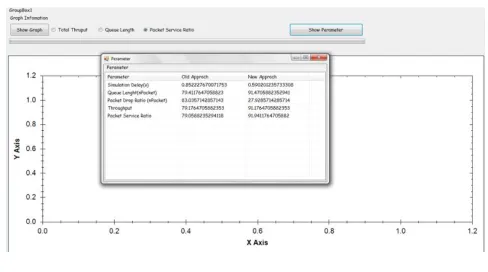
Fig.7 shows comparison between new approach and old approach .In new approach simulation delay and packet drop ratio is decrease and parameters such queue length, total throughput, packet service ratio increases.
Fig.7 Performance Analysis
V. CONCLUSION
In this paper, we have presented an efficient multipath congestion control mechanism for heterogeneous data originated from a single sensor node We have demonstrated through the simulation that our scheme achieves: i) Desired throughput for diverse data according to the priority specified by the sink, ii) Higher Packet service ratio iii) Lower packet drop rate.
VI. REFERENCES
Available Online at www.ijpret.com
14
2. C. G. Wang, K. Sohraby, V. Lawrence, B. Li, and Y. M. Hu, “Priority-based congestion control
in wireless sensor networks,” in proceedings of IEEE International Conference on Sensor Networks, Ubiquitous and Trustworthy Computing, 2006..
3. M. H. Yaghmaee and D. A. Adjeroh, “A new priority based congestion control protocol for
wireless multimedia sensor networks,” in Proceedings of WOWMOM’08, June 2008, pp.1-8.
4. Kai Shi, Yantai Shu, Oliver Yang, and Jiarong Luo, “Receiver assisted congestion control to
achieve high throughput in lossy wireless networks”, IEEE Trans. Nuclear Science, vol. 57, No. 2, pp. 491-496, Apr. 2010.
5. Sanket A. Chandure,Ms. Veena Gulhane, “Congestion Control Methods and Design
Guidelines in Wireless Sensor Network”,IJASCSE ,Vol 1 ,Issue 4.Dec2012
6. C.-Y. Wan, S. B. Eisenman, A. T. Campbell, and J. Crowcroft, “Siphon: Overload traffic
management using multi-radio virtual sinks in sensor networks,” in Proc. ACM SenSys, Nov. 2005.
7. C. Wang et al., “ Upstream Congestion Control in Wireless Sensor Networks Through
Cross-Layer Optimization,” IEEE Journal on Selected Areas in Communications, Vol.25, No.4, May 2007.
8. Y. G. Iyer, S. Gandham, and S. Venkatesan, “STCP: A Generic Transport Layer Protocol for
Wireless Sensor Networks,” Proc. IEEE Intl. Conf. on Computer Communications and Networks (
ICCCN 2005), San Diego, CA, USA, pp. 449-454, Oct. 2005.
9. C. –Y. Wan, S.B. Eisenman and A.T.Campbell, “CODA: Congestion Detection and Avoidance in
Sensor Networks”, proc. ACM SenSys ‟03, Los Angeles, CA, pp. 266-279, Nov 2003.
10. C.-T. Ee and R. Bajcsy, “Congestion Control and Fairness for Many-to- One Routing in Sensor Networks,” Proc. ACM Sensys ’04, Baltimore, MD, pp. 148-161, Nov. 3–5, 2004.
11.C.G. Wang, K. Sohraby, V. Lawrence, B. Li, and Y.M. Hu, “Priority-Based Congestion Control
in Wireless Sensor Networks”, IEEE Int’l Conf. Sensor Networks, Ubiquitous, and Trustworthy
![Fig.6 shows switching of traffic for node number 10 over the simulation time [15 seconds]](https://thumb-us.123doks.com/thumbv2/123dok_us/8751558.1748713/6.595.69.311.402.538/fig-shows-switching-traffic-node-number-simulation-seconds.webp)