ISSN: 1942-9703 / © 2017 IIJ Abstract— Flight simulators are currently used to train
prospective pilots who will fly aircrafts. However, the flight simulator usually need more space, more budgets, and another things so that the simulator can be operated as similar as possible to a real aircraft. Responding to the challenges that faced today and going into the era of portable that permeated whenever and wherever, in this paper, it is developed a virtual reality flight simulator. The virtual reality flight simulator is intended to act as the conventional flight simulator that simulates the environment of real flight. In addition, it can be used anywhere and anytime. The paper presents virtual reality, flight simulator, and programming process of virtual reality flight simulator. Flight simulator using virtual reality is able to provide strong sensations like being in a plane cockpit.
Index Terms— flight simulator, aircraft model, virtual reality, mobile learning
I. INTRODUCTION
HIS day, simulators are widely used in a variety of things in human life, especially in areas that require special skills which can only be obtained through practices or hours of flying time. The use of simulators is a very effective method of learning to know the functions and workings of a tool or a unit, especially for novice. By using the simulator, the learner will be able to use the tools or the original unit much better than before. In field of aviation, especially in pilot training, a pilot needs to carefully know the right procedures to operate an aircraft, the uses of each panel or tools. The advantage of using a simulator compared to actual flight is the flight simulator gives a better safety, in which in the simulator, pilots can even try many scenarios of unusual or even life-threatening events, and in some cases an event which required a specific flight condition that rarely happens, can be simulate so pilot will have a better knowledge when taking a real flight so the pilot has better approaches and do the best procedure
Manuscript received September 9, 2016. This work was supported in by the Ministry of Research, Technology and Higher Education of the Republic of Indonesia under the Decentralized Research Program on Excellent Research University, Bandung Institute of Technology, Bandung, Indonesia 2016.
K. Valentino is with the Engineering Physics Study Program, Faculty of Industrial Technology, Bandung Institute of Technology, Indonesia (e-mail: [email protected]).
K. Christian is with the Engineering Physics Study Program, Faculty of Industrial Technology, Bandung Institute of Technology, Indonesia (e-mail: [email protected]).
E. Joelianto is with the Instrumentation and Control Research Group, Faculty of Industrial Technology, Bandung Institute of Technology, Indonesia (corresponding author, e-mail: [email protected]).
that can be used in these circumstances [1]. If the simulator is effective, then an hour of training in a simulator could replace an hour, or even several hours trainingin an aircraft. A flight simulator should be made as closely as possible to the real situation they would have when riding a plane. Even a flight simulator can be used too for research and simulation for new model of an aircraft. Another advantage is unpolluted environment, where in one flight, the burning of kerosene will be reduced so that the air is not polluted. And a simulator will give financial benefit which cost is much lower that an actual flight [2].
Along with the development of technologies, where all devices (gadgets) can be taken anywhere and at any time, it will be more convenient if a simulator is able to be used portable. This could be used from young children to adults, even for pilots. Where flight simulator is commonly used, even become a part of curricula, in flight school [3]. All in all, the cost of building a full-scale flight simulator facility is so much higher than building it in a virtual reality device. The presence of virtual reality features into this world of technology makes the future of the simulator could develop to this stage. Virtual reality world is still developing and it starts bustling used by many people. However, to enter into the world of the simulator, at the moment there are not many people wearing it and still not developed much. Therefore, in this paper, it is attempted to take this momentum by designing a flight simulator in virtual reality technologies.
A. Flight Simulator
A flight simulator is a device that recreates an aircraft and its environment or any events where it flies. It is a world where someone who wants to become a pilot, or someone who just wants to learn how to drive a plane, or just to play without having to use the original plane. In this case, the flight simulator is very important for the learning of prospective pilots or airline pilots. To support this pilot prospective study, the flight simulator should be made as closely as possible to the real situation they would have when riding a plane. In this manner, this device needs to include equations of how an aircraft is flying, how flight controls react when it is triggered, effects of other aircraft systems, and reaction of aircraft to external factors such as damping, gravity, air density, turbulence, etc.
In a flight simulator, it is presented some of the best models that each plane has its own character and its specifications. Generally, if a prospective new pilot learns to ride a plane, then the plane chosen is usually the best Cessna 182 because the plane is the most frequently used by someone who first
Virtual Reality Flight Simulator
Kelvin Valentino, Kevin Christian, and Endra Joelianto,
Member, IEEE
learned and also has a relatively affordable price for most laymen that laypeople also sometimes have the aircraft. Some other models are often used in the world of flight simulator is the Air Force, Army, and Navy. A military air force would often practice for driving a fighter by first using a flight simulator beforehand so it can be more proficient and is used in an exercise using an actual plane. Even this has become a regulation, such as in Federal Aviation Administration, for pilot to adapt in flight [4]. simulator.
B. Virtual Reality
Virtual reality (VR) is a new technology that is being developed, which included softwares that give illustrations and also sound similar as possible as if it was in the world given. The virtual reality gives priority to the visual perception of each user, so as to create strong imagination of moving pictures and sound presented by the software. Or you can just say it like a window or a gate to look into a new world, a virtual world. Virtual reality is used by using a special tool fastened to the head, and then we watch a show that is presented inside a special device. Such tools are usually have specially adapted screen field of vision with our eyes so we can see it clearly. In this virtual reality, a person is able to look around in the virtual world, can also interact with the surrounding, supported the use of headphones create an atmosphere like being entered into the virtual world. The support is obtained due to sensors that are needed in the world of virtual reality like a gyroscope sensor, proximity, and also an accelerometer, so the ability to interact with the virtual world could be more exciting again.
The VR technology has leaded to many research and development, such on education: as to assist teachers in teaching students about optical waves [5][6], to teach in medical class that provides great advantage for medical interns to enter medical field [7], to teach anatomy for students so they can be familiar with it, which saves a great expense in experimental materials [8], to teach more effectively about sign language because the students are in 3D domain [9], to educate and training to hydrogen fuel station staff by constructing various scenarios that could happen on 3D VR platform so the staff could understand better the standard of handling process and troubleshooting in an accident [10]. It has also been used in learning vehicle simulation platform, which used to developed driver skills for security verification test platforms [10][11][12][13].
C. Unity
Unity is a software to create a game that will be distributed to the public. Unity has also been widely used by developers to create games based on Android, Windows, Apple, etc. Unity can be used by anyone for a variety of purposes, ranging from personal purposes, learning purposes, until the purposes in commercial terms. This software is very supportive of making games in three dimensions so that the game is made more real taste. And for realistic purpose, Unity has physics element
such as center of gravity in object. Unity also supports the creation of a virtual reality game so that the game becomes more real and more real as well as what to expect in a virtual reality. Inside the unity, there is a programming language used, namely C#. The language is familiar to someone already knows the programming language C or C ++ programming languages.
II. STAGES OF PREPARATION
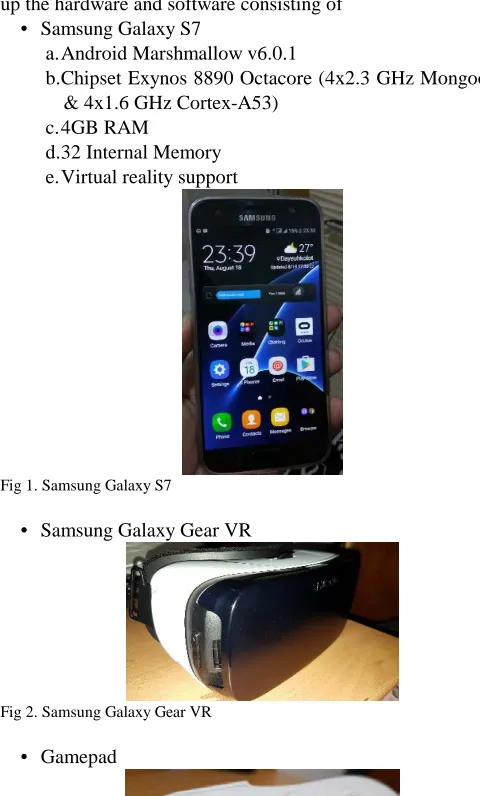
In the development of virtual reality flight simulator, we set up the hardware and software consisting of
• Samsung Galaxy S7
a.Android Marshmallow v6.0.1
b.Chipset Exynos 8890 Octacore (4x2.3 GHz Mongoose & 4x1.6 GHz Cortex-A53)
c.4GB RAM
d.32 Internal Memory e.Virtual reality support
Fig 1. Samsung Galaxy S7
• Samsung Galaxy Gear VR
Fig 2. Samsung Galaxy Gear VR
• Gamepad
Fig 3. Gamepad
ISSN: 1942-9703 / © 2017 IIJ • Software Unity Personal Edition
In this case, the ability of the software on the laptop is still very limited in comparison with the developers who have already made and also developed their game or simulator.
III. STAGE OF CONSTRUCTION
First, for the software, it requires us to have Unity program. Unity Personal Edition is sufficient to make a prototype of this virtual reality flight simulator. And then we need some specific assets files that will be used in the construction of this virtual reality flight simulator. For example of this assets files is a 3D models of an aircraft, codes, objects, and many else.
The process of making this flight simulator has two parallel steps. The first step is making the flight model, such as 3D aircraft model and the environment. In this software, we create a simple landscape with a single road, trees, valleys and hills for the flight test. For the 3D model, Unity has a basic model of Cessna aircraft to be used.
After building the flight environment, we develop scripts for the input controller of the 3D model aircraft. For this controller, we use one-handed gamepad which have two index buttons and a control stick. The upper button functioned as reset button and the lower button functioned as throttle. The control stick functioned to control the movement direction of the aircraft. Also can be controlled by moving of our head. If our head looks to the right, our plane will turn right too and if our head looks to the left, our plane will turn left too.
The movement of the 3D model aircraft needs to be as actual as it can. We need to implement the equations of motions of the Cessna 182. First, we compute the aerodynamic coefficients of the aircraft, such as the angle of attack and sideslip. Then, with the result of computation of aerodynamic coefficients, we compute aerodynamic forces and moments. These forces and moments are combined with the computation from moments and forces generated from engine to compute the body frame of linear and angular accelerations. These accelerations are integrated to form the body frame linear velocities and the body frame rates. The steps to prepare the script shown in following diagram (Fig 4).
Fig 4. Workflow of computing equation of motions
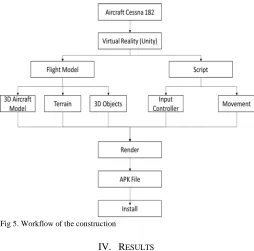
After the process of building a terrain and movement, the next is rendering the game. The rendering process of the simulator takes a long time, it takes until 25 hours to complete rendering the simulator. This rendering time is depending to compatibility of computer that is used and how large space the flight model used. After rendering, it will form of an .apk file which is the base application of the Android. After that, the apk file is ready to be installed in the intended gadget and ready to be used to play as the flight simulator. Overall, the stages of construction are shown in Fig 5 that describes the work flow of making the virtual reality flight simulator.
Fig 5. Workflow of the construction
IV. RESULTS
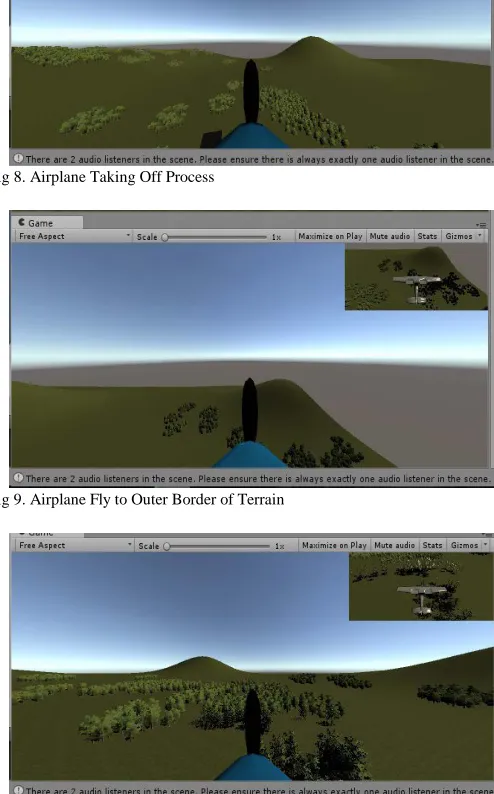
simulated in a computer, because in the gadget, the screenshot cannot be taken. However, the simulation is similar to the gadget. The results of game are given in Fig. 8, Fig. 9, Fig. 10, Fig. 11. In Fig. 8, the airplane is in stand by position and ready to take off. In Fig. 9, the airplane is taking off and flying to another place until in Fig. 10, the airplane flies into outer border of terrain. In Fig. 11, the airplane tries to fly to another terrain. This flight simulator in virtual reality can make a sensation during take-off and landing, because of the difference in the current conditions on the runway and while on the sky. The performances of the development process of the virtual reality flight simulator is summarized in Table 1.
TABLEI
PERFORMANCEOFVIRTUALREALITYFLIGHTSIMULATORGAME
Rendering 25 hours
Duration of Simulation 4 hours
Frame per Seconds 75 frame per seconds
Fig 6. Architecture of Virtual Reality Flight Simulator
Fig 7. Airplane Standby
Fig 8. Airplane Taking Off Process
Fig 9. Airplane Fly to Outer Border of Terrain
Fig 10. Airplane Flying to Another Terrain
V. CONCLUSION
ISSN: 1942-9703 / © 2017 IIJ going to be included with better terrains and more realistic
plane object.
REFERENCES
[1] S.M. Casner, R.W Geven, K.T. Williams. “The Effectiveness of Airline Pilot Training for Abnormal Events”. Human factors, vol. 55, no. 3, pp. 477-485. 2013.
[2] D. Allerton. Principles of Flight Simulator. United Kingdom: Wiley, 2009.
[3] Pilot’s Handbook of Aeronautical Knowledge. United States
Department of Transportation, Federal Aviation Administration, Airman Testing Standards Branch, 2016.
[4] A. Haslbeck, P. Kirchner, E. Schubert, K. Bengler, “A Flight Simulator Study to Evaluate Manual Flying Skills of Airline Pilot,” In Proceedings of the human factors and ergonomics society annual meeting. Sage CA: Los Angeles, CA : Sage Publications, vol. 58, no. 1, pp. 11-15, September 2014.
[5] T. Monahan, G. McArdle, and M. Bertolotto, “Virtual reality for Collaborative E-learning,” Computers & Education, vol. 50, no. 4, pp. 1339–1353, 2008.
[6] C.S. Chang, T.S. Chen, and W.H. Hsu, “The Study on Integrating WebQuest with Mobile Learning for Environmental Education,” Computers & Education, vol. 57, no. 1, pp. 1228-1239, 2011.
[7] L. Chittaro, and R. Ranon, “Web3D Technologies in Learning, Education and Training: Motivations, Issues, Opportunities,” Computers & Education, vol. 49, no. 1, pp. 3–18, 2007.
[8] H. Brenton, J. Hernandez, F. Bello, P. Strutton, T. Firth, and A. Darzi, “Using multimedia and Web3D to enhance anatomy teaching,” Computers & Education, vol. 49, no. 1, pp. 32–53, 2007.
[9] K. Crohn, and M. Birnbaum, “Environmental Education Evaluation: Time to Reflect, Time for Change,” Evaluation and Program Planning, vol. 33, no. 2, pp. 155-158, 2010.
[10] Y. Lee, J. Kim, J. Kim, E.J Kim, Y.G. Kim, I. Moon, “Development of a Web-based 3D Virtual Reality Program for Hydrogen Station,” International Journal of Hydrogen Energy, vol. 35, no. 5, pp. 2112-2118, 2010.
[11] K.S Hsu, J.F Jaing, H.Y. Wei, T.H. Lee, “Application of the Environmental Sensation Learning Vehicle Simulation Platform in Virtual Reality,” Eurasia Journal of Mathematics, Science & Technology Education , vol. 12, no. 5, pp. 1477-1485, 2016.
[12] N. Goode, P.M. Salmon, and M.G. Lenné, “Simulation-based Driver and Vehicle Crew Training : Applications, Efficacy and Future Direction,”Applied ergonomics, vol. 44, no. 3, pp. 435-444, 2013. [13] K.S. Hale, K.M. Stanney. Handbook of Virtual Environments : Design,
Implementation, and Applications. Mahwah, New Jersey: Lawrence Erlbaum Associates, 2002, ch. 19.
Kelvin Valentino is a student at the Engineering Physics Study Program,
Faculty of Industrial Technology, Bandung Institute of Technology, Bandung, Indonesia. He is working on a virtual reality project at the Intelligent Control and Automation Laboratory, Engineering Physics Study Program, Faculty of Industrial Technology, Bandung Institute of Technology, Bandung, Indonesia.
Kevin Christian is a student at the Engineering Physics Study Program,
Faculty of Industrial Technology, Bandung Institute of Technology, Bandung, Indonesia. He is working on a virtual reality project at the Intelligent Control and Automation Laboratory, Engineering Physics Study Program, Faculty of Industrial Technology, Bandung Institute of Technology, Bandung, Indonesia.
Endra Joelianto (M’01) received his B.Eng. degree in Engineering Physics
from Institute of Technology Bandung (ITB), Indonesia in 1990, and his Ph.D. degree in Engineering from The Australian National University (ANU), Australia in 2002.
He was a Research Assistant in the Instrumentation and Control Laboratory, Department of Engineering Physics, Bandung Institute Technology, Indonesia from 1990-1995. Since 1999, he has been with the Department of Engineering Physics, Bandung Institute of Technology, Bandung, Indonesia, where he is currently a Senior Lecturer. He has been a Senior Research Fellow in the Centre for Unmanned System Studies (CENTRUMS), Bandung Institute of Technology, Bandung, Indonesia since