The Journal of Social Sciences Research
ISSN(e): 2411-9458, ISSN(p): 2413-6670
Vol. 5, Issue. 3, pp: 683-689, 2019
URL: https://arpgweb.com/journal/journal/7 DOI: https://doi.org/10.32861/jssr.53.683.689
Academic Research Publishing Group
Original Research Open Access
The Impact of Organizational and Professional Development on Human
Resource Development Practitioners in Malaysian Organizations
Kahirol Mohd Salleh
*UniversitiTun Hussein Onn Malaysia, 86400 Parit Raja, Malaysia
Nor Lisa Sulaiman
UniversitiTun Hussein Onn Malaysia, 86400 Parit Raja, Malaysia
Abstract
Competencies are skills set required for effective working performance in a real-world’s task or activity at the workplace. To develop competent workers in organizations, Human Resource practitioners need to establish training and development for their workers. In the context of an organization, organizational and professional development refers to any types of educational experiences, learning opportunities and competencies related to workers’ task. This paper provides an overview and framework for designing effective organizational and professional development systems towards better workers’ competencies. A non-experimental, descriptive, cross-sectional, web-based survey design was used to examine structure, process, and outcome variables associated with organizational and professional development. The findings suggested that HRD practitioners perceived the importance of organizational and professional development with regard to workers’ developmental process and organizational performance.
Keywords: Organizational development; Professional development; Human resource development; Competencies. CC BY: Creative Commons Attribution License 4.0
1. Introduction
An increased awareness of how organizational and professional development impacts workers’ performance has resulted in an impact on the tasks of Human Resource Development (HRD) practitioners. Nowadays, HRD practitioners cannot rely on a single method of training since workers are exposed to multitasking jobs. Moreover, demands on workers are growing, workers are facing increasingly complex skills they need to learn in preparation for work environment in the 21st century. Workers with multi sets of skills and knowledge will benefit from integration with the global economy, while workers who lack competencies are destined to fall further behind (Salleh et al., 2010). To identify organizational and professional development, HRD needs some tools or assessments. By providing the tools or assessments, HRD will be able to develop a foundation for comparisons in 360-degree assessments or performance management systems. Without proper assessment strategies and the ability to predict the competencies needed by the workers, organizations are left clueless as to what competencies exist and needed. By putting assessment strategies and processes in the right place, organizations will be able to measure critical competencies and take steps to address areas that need development. In the context of organization, organizational and professional development refers to any types of educational experiences, learning opportunities, and competencies that are related to workers’ task. Effective organizational and professional development will increase workers’ competencies and enable workers to develop the specific knowledge and skills they need to perform a task. Competencies consist of a set of skills including skills, knowledge, attitudes, and behaviors required for effective performance of a real-world’s task or activity at the workplace (Salleh, 2012; Salleh and Sulaiman,
2016;2017). Thus, the competency of workers is an important factor in determining how much a worker is prepared
to learn before entering a workplace.
2. Organizational and Professional Development
The history of HRD started when employers developed the belief that workers need training and development process to improve their performance. For the most part, the terms training and development are used interchangeably in HRD to describe the overall improvement and education of an organization's employees. However, while closely related, there are important differences between the terms training and development. In general, training programs have very specific and measureable objectives, while developmental programs, on the other hand, concentrate on broader skills that are applicable to a wider variety of situations. To date, many organization offer in-house training course that are tailored to specific jobs and tasks. After going through training, employers expect the workers to become competent in their work. However, to be considered as competent workers, professional development must be delivered in a way that yields direct impact on the workers’ practice. Organizations must seriously evaluate the strategic value of particular competencies before deciding to make any development steps to the workers or organizations. Over the time, professional development has become a tool to prepare for workers advancements and additional responsibilities. However, development is a difficult process to be implemented in organization and can be costly and time consuming.
Organizational and professional development is the continuous process of thinking and learning for workers’ improvement of practices. Learning takes place among workers, teams, departments, or organizations, in which all the variables interacts. Significant changes in work practices happen because of the workforce and industrial demands. These changes happen in every organization because it is a growing and a dynamic process. Nevertheless, this process is more than mere training. Organizational and professional development is a practice to help organizations build the capacity to change and achieve greater effectiveness, typically involving workers through bottom-up involvement in change efforts. Hameed and Waheed (2011), argued there is a direct relationship between organizational and professional development and worker performance, as when workers are more developed, they would be more satisfied with the job, more committed with the job and the performance would be increased. Thus, offering organizational and professional development training programs allows workers to perform better and prepare them for better positions and greater responsibilities. Organizational development is a process through which an organization develops the internal capacity to be the most effective that it can be in its mission work and to sustain itself over the long term (Philbin and Mikush, 2000).
According to Vinesh (2014), the objectivity of professional development and its continuous learning process have always been leveraged with an organization. Now, it has become a rather overarching trend of social needs, which emphasize that organizations must inculcate learning culture as a social responsibility. A learning process is not about giving more training to the workers in organizations but rather on how to develop competent workers. Implementing feedback on training and professional development opportunities help organizations retain and grow high-performing workers, as well as attract new talent. It is critically important that a new set of skills be followed by practice to become competent. A very good training program of building competencies is vital to the success of any organizations but surprisingly it is most often overlooked. While training does help develop workers in certain types of set skills, a learning process involves more development of higher levels of competencies. Professional development in organizations is also commonly viewed as in-house training that includes leaders sharing their exploration, mentoring, reflective practice, and learning both on-the-job and in real organization settings. Offering professional development programs allows workers to perform better and prepares them for better positions and greater responsibility. However, it can also help workers lead to a promotion or change in job, attract top job candidates, retain the best workers, identify future leaders, or doing better in a current position. To be able to maximize workers’ potential and amplify their contributions in furtherance of the organization’s success, most HRD focus on organizational development. Many training and development professionals are focusing toward organizational development to enhance workers skills in identifying the structural elements of organizations that need to be changed or enhanced for training and new skills to be effective. Additionally, the challenge for a HRD is to how balance the workers’ desires with their actual talents and the company needs.
3. Methodology
This study was conducted using a fully quantitative research design survey method since the study provided a numeric description of opinion of a population. It was a non-experimental in design, as this did not require any changing or manipulation of the variables. Data collections for the sampling framework consisted of target responses from the sample of HRD practitioners in Malaysia. The number of samples was based on a sample size table and the response rate. The list of participants was selected from the Federation of Malaysian Manufacturers (FMM) list. Preliminary e-mails to the participants explaining the purpose of this study and three reminders were also sent in advance. The survey used a five-point Likert scale to evaluate self-reported expertise and answers to the questions. Although the survey was an inventory survey, it was pre-tested using a pilot study to determine if there were any detectable deficiencies, information that was potentially misinterpreted, items that required clarity, or any other potentially serious problem. To achieve this purpose, a pilot sample consisted of 30 pilot participants was administered using Qualtrics, an on-line survey platform. The participants comprised the FMM members and a small number of individuals in the FMM organization in Malaysia. The pilot study led to minimal changes to the structural presentation of the survey items. The survey instruments were then mailed using on-line survey platform to all participants in two phases because it was easy for researchers to monitor the progress. It included a cover letter, permission to conduct the study, and the questionnaire. The participants were volunteers in this study and as such they were not forced to take the survey. If they wished not complete to the survey, they could opt out of the process. A total of 144 respondents completed the survey, which were used for data analysis. This represented a six percent response rate. Raw data from the web survey were transferred, coded, and analyzed using SPSS.
4. Findings and Discussion
To analyze and interpret this dataset, descriptive statistical analysis including frequencies and percentages were used followed by Exploratory Factor Analysis. The demographic profile of the respondents for this study indicated the primary discipline of the respondents was Human Resource Management. The data showed 40.3 percent of the respondents were in the Human Resource Management discipline, and 59.7 percent of respondents were in other areas. Most of the respondents or 43.1 percent of the total sample were at the Manager level in their organizations. The demographics indicated that 29.2 percent had one to five years of experience and 28.5 percent had six to ten years. Most of the respondents had some types of formal education and about 54.9 percent of the respondents had a bachelor’ degree as the highest level of education received. The ages of respondents ranged from 25 and under to over 65. Respondents between the ages of 46 to 55 years (43.1%) formed the biggest age group in this study. There were 87 male respondents (60.4%) from the total sample. In terms of business types, manufacturing represented 56.3 percent of the respondents while non-manufacturing was about 43.8 percent. 46.3 percent of the respondents mostly worked for organizations that had less than 100 full-time employees. The majority of the respondents in this study worked in local companies representing about 63.2 percent of the total respondents.
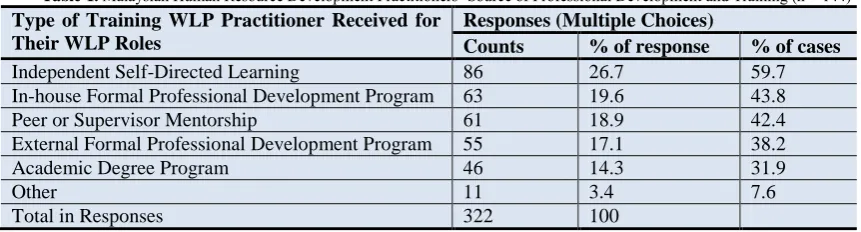
The data in Table 1 show the responses of professional development and training sources. When inspecting the type of training received, Malaysian HRD practitioners responded that independent self-directed learning (26.7%) and in-house formal professional development program (19.6%) were the two most frequent primary sources of professional development.
Table-1. Malaysian Human Resource Development Practitioners’ Source of Professional Development and Training (n = 144)
Type of Training WLP Practitioner Received for Their WLP Roles
Responses (Multiple Choices)
Counts % of response % of cases
Independent Self-Directed Learning 86 26.7 59.7
In-house Formal Professional Development Program 63 19.6 43.8
Peer or Supervisor Mentorship 61 18.9 42.4
External Formal Professional Development Program 55 17.1 38.2
Academic Degree Program 46 14.3 31.9
Other 11 3.4 7.6
Total in Responses 322 100
Note: Respondents were allowed to check more than one response
Table-2. Malaysian Human Resource Development Practitioners’ Perceptions of the Effectiveness of Training Source (n = 144)
Rank* Effectiveness of Training M SD
1 Other 3.43 1.16
2 Independent self-directed learning 3.19 1.41
3 In-house formal professional development program 3.14 1.17
4 Peer or supervisor mentorship 3.13 1.16
5 External formal professional development program 3.10 1.20
6 Academic degree programs 3.10 1.25
*Rank based on mean value. Rating of 1 indicates perceived most effective while rank 6 indicates least effective.
Rank* Effectiveness of Training Frequency
1 Independent self-directed learning 121
2 In-house formal professional development program 113
3 External formal professional development program 106
4 Peer or supervisor mentorship 104
5 Academic degree programs 101
6 Other 23
*Rank based on respondent frequency. Rank of 1 indicates perceived most effective by frequency counts while rank 6 indicates least effective frequency counts.
Exploratory Factor Analysis (EFA) was conducted using principal axis factor analysis with oblique rotation was conducted to assess the underlying structure for the 52 competencies. The result of a Kaiser-Meyer-Olkin (KMO) measure of sampling adequacy value was .78, which suggested it is Meritorious and that there was a correlation among items. The KMO also suggests that the matric is appropriate for conduction further analysis using Confirmatory Factor Analysis (CFA) for each analysis. Table 3 displays the KMO’s interpretation. Eigenvalues represent show how much variability is accounted for by each factor not in sum but out of the total amount of variance, which means there will be times the percentages can be greater than 100%. Moreover, Bartlett's test of sphericity with significance level below threshold level of 0.05 supported the findings of KMO test. EFA then revealed the presence of eleven components with eigenvalues exceeding 1.00. The obtained an eigenvalues of 9.04 for first factor and the first three factors explain 36.17% of variance. Initial analysis was done using a scree plot.
Table-3. Kaiser-Meyer-Olkin (KMO) Interpretation
KMO’s Score Index Levels
In the .90s Marvelous
In the .80s Meritorious
In the .70s Middling
In the .60s Mediocre
In the .50s Miserable
Below .50 Unacceptable
Table-4. Factorial Loadings for the Rotated Factors for Main Competencies, Sub Competencies 1, and Sub Competencies 2
Scale Items Factor Loadings Communality
Main Comp Sub Comp1
Sub Comp 2
Identification of Critical Business Issues 0.692 0.585
Communication 0.645 0.608
Group Dynamics 0.629 0.564
Work Environment Analysis 0.589 0.517
Goal Implementation 0.583 0.627
Buy-in/Advocacy 0.569 0.575
Consulting 0.567 0.575
Negotiating/Contracting 0.561 0.466
Systems Thinking 0.555 0.669
Visioning 0.448 0.589
Workplace Performance, Learning
Strategies, and Intervention Evaluation
0.732 0.655
Competency Identification 0.707 0.662
Facilitation 0.679 0.646
Standard Identification 0.667 0.543
Questioning 0.628 0.635
Model Building 0.572 0.597
Analytical Thinking 0.562 0.523
Leadership 0.462 0.658
Staff Selection Theory and Application -0.774 0.689
Training Theory and Application -0.761 0.705
Feedback -0.617 0.690
Reward system theory and Application -0.539 0.724
Organization Development Theory and Application
-0.483 0.619
Career Development Theory and
Application
-0.474 0.716
Process Consultation -0.447 0.701
Eigenvalues 9.04 1.90 1.50
% of variance 36.17 7.59 6.01
Note: Loadings <.40 are omitted
To assess whether the new constructs that were summed to create the competency group formed a reliable scale, Cronbach’s alphas were computed one more time. Table 5 shows the alpha for the Organizational Competencies (Main Competencies) was .88, Thinking Competencies (Sub Competencies 2) was .87, and Application Competencies (Sub Competencies 2) was .88, indicating that the items had a reasonable internal consistency. Furthermore, the overall Cronbach’s alpha was .93, meaning an overall high internal consistency.
Table-5. Reliability Coefficients (Cronbach’s Alpha) for New Construct
Competency Group Number of Items Cronbach’s Alpha ()
Organizational competencies (Main Competencies)
10 .88
Thinking competencies (Sub Competencies 1)
8 .87
Application competencies (Sub Competencies 2))
7 .88
Overall 25 .93
partial suggested that three factors occurred. According to Watkins (2006), parallel analysis is one of the most accurate guides for determining the number of factors to extract in EFA.
Table-6. New Items for Main Competencies, Sub Competencies 1, and Sub Competencies 2
Main
Competencies
Factor Loadings
Sub Competencies 1 Factor Loadings
Sub Competencies 2 Factor Loadings
Identification of Critical Business Issues
0.692 Workplace
Performance,
Learning Strategies,
and Intervention
Evaluation
0.732 Staff Selection Theory
and Application
-0.774
Communication 0.645 Competency
Identification
0.707 Training Theory and
Application
-0.761
Group Dynamics 0.629 Facilitation 0.679 Feedback -0.617
Work Environment Analysis
0.589 Standard
Identification
0.667 Reward system theory
and Application
-0.539
Goal
Implementation
0.583 Questioning 0.628 Organization
Development Theory and Application
-0.483
Buy-in/Advocacy 0.569 Model Building 0.572 Career Development
Theory and Application
-0.474
Consulting 0.567 Analytical Thinking 0.562 Process Consultation -0.447
Negotiating/Cont racting
0.561 Leadership 0.462
Systems Thinking
0.555
Visioning 0.448
% of variance 36.17 7.59 6.01
5. Conclusion
Today’s organizations are faced with many options for investing back into their workers, and it is becoming a more common expectation. Organizational and professional development give an opportunities to workers a chance to grow with the organization and added value in terms of developing their competencies. Similarly, the findings of this study also suggested that HRD practitioners perceive the importance of organizational and professional development in regard to worker’s development process and organizational performance. The aim of organizational and professional development is to produce competent and qualified workers those who perform assigned job and contribute to the organizations’ development and goals accomplishment efficiently and effectively. Thus, organizational and professional development is important in order to improve working efficiency, expand productivity, and advance worker competencies. These developments are important for any organization because, without training and development, organizations would likely lose their competitive edge and fail to meet the needs of what most hope to be a growing for the workers. toTherefore, organizations nowadays are investing huge amount of resources including money, time, commitment, and effort on organizational and professional development.
The findings also revealed that the role played by the HRD professional has equally changed with the change in the organizational environment. In today’s organizations, human resource function has expand and different in many aspects from other resources of organizations. The research, however, may be limited to understanding or measuring the values of HRD practitioners in context of organizational and professional development. While new techniques professional development and training are under continuous development, several common professional development and training methods have proven to be highly effective independent self-directed learning and In-house formal professional development program. Good continuous learning and development initiatives often feature a combination of several different methods that, blended together, produce one effective training program. Additionally, organizations should also consider integrating professional development and training with competencies to ensure the success of the program and improve the performance.
Acknowledgements
Thank you and gratitude to Office for Research, Innovation, Commercialization and Consultancy Management, UniversitiTun Hussein Onn Malaysia (UTHM) for the support in contributing to the successful completion of this study.
References
Cummings, T. G. and Worley, C. G. (2015). Organization development and change. 9th edn: South-Western Cengage Learning: Mason, OH.
Hameed, A. and Waheed, A. (2011). Employee development and tis affect on employee performance a conceptual framework. International Journal of Business and Social Science, 2(13): 224-29.
Marshak, R. J. and Grant, D. (2008). Organizational discourse and new organization development practices. British Journal of Management, 19(S1): 7-19.
Philbin, A. and Mikush, S. A. (2000). A Framework for organizational development, The why, What, And how of OD work. Mary Reynolds Babcock Foundation: Winston-Salem, NC.
Salleh, K. M. (2012). Human resource development practitioners’ perspectives on competencies, An application of American Society for Training and Development (ASTD) Workplace Learning and Performance (WLP) competency model in Malaysia. Available from ProQuest Dissertation and Theses database. (UMI No. 3551639).
Salleh, K. M. and Sulaiman, N. L. (2016). Competencies among human resource development practitioners according to disciplines and levels in Malaysian organizations. International Journal of Applied Business and Economic Research, 14(9): 521-33.
Salleh, K. M. and Sulaiman, N. L. (2017). Human resource competencies and human resource role in organization practice. International Journal of Applied Business and Economic Research, 15(4): 377- 85.
Salleh, K. M., Sulaiman, N. L. and Talib, K. N., 2010. "Globalization’s impact on soft skills demand in the Malaysian workforce and organizations, What makes graduates employable?" In Proceedings of the 1st UPI International Conference on Technical and Vocational Education and Training. Bandung, Indonesia: UniversitasPendidikan Indonesia. pp. 210-15.
Vinesh (2014). Role of training and development in an organizational development. International Journal of Management and International Business Studies, 4(2): 213-20.
Watkins, M. W. (2006). Determining parallel analysis criteria. Journal of Modern Applied Statistical Methods, 5(2): 344-46.