3 Iranian Journal of Chemical Engineering
Vol. 7, No. 4 (Autumn), 2010, IAChE
Investigation of Packing Effect on Mass Transfer Coefficient
in a Single Drop Liquid Extraction Column
Z. Azizi, A. Rahbar, H. Bahmanyar∗
Engineering College, Chemical Engineering Faculty, University of Tehran, Iran.
Abstract
Mass transfer coefficients of rising drops in spray and packed columns with random and structured packing in a liquid-liquid extraction operation were experimentally measured and the results compared. In this work, a high interfacial tension chemical system of toluene-acetic acid-water in a structured packed column is investigated. Results of random and structured packing show that random types are effective only for a drop size less than 9 mm, while the structured ones are shown to have a positive effect on mass transfer coefficient in a wide drop size range. Furthermore, structured packing proved to be slightly more effective than random packing in improving the mass transfer coefficient. The effect of drop size on mass transfer coefficient has also been studied in this work and the results showed that when the drop diameter increases, the mass transfer coefficient increases too. Finally, new correlations for the prediction of the mass transfer coefficient in both a random and structured packed column have been introduced which are in better agreement with the experimental data in comparison with those resulted from Newman, Kronig-Brink and Handlos-Baron models.
Keywords: Liquid-Liquid Extraction, Mass Transfer Coefficient, Packed Column, Random Packing, Structured Packing
∗ Corresponding author: [email protected] 1- Introduction
The prediction of dispersed phase mass transfer coefficient in liquid systems is faced with considerable uncertainty. There are many parameters that can affect the mass transfer coefficient, such as drop diameter, rising time, drop velocity, continuous phase mixing, presence of surfactants, breakage and coalescence of drops. Even if some of them can be neglected, theoretical statements
4 Iranian Journal of Chemical Engineering, Vol. 7, No. 4 transfer coefficients by single drop
experiments is a promising method to solve the above problem [1].
In this work, mass transfer coefficients are calculated in a vast drop size range for the system of toluene-acetic acid- water as a high interfacial tension chemical system [2]. It should be noted that for the purpose of studying the effect of packing on mass transfer, first some tests have been done in a column empty of packing(spray column), then in the same column containing Raschig ring packing, which was used in two different shapes of random and structured. Finally, two correlations based on previous models for the prediction of dispersed phase mass transfer coefficient in random and also structured packed column are introduced.
2- Previous work
According to literature, three states for mass transfer of a drop moving through a column of continuous phase have always been discussed:
2.1- Stagnant spherical drop
By assuming molecular diffusion and neglecting the continuous phase resistance, Newman [3] presented an equation for unsteady state mass transfer inside a spherical drop. This equation is used for very small drops that are assumed to be stagnant. The Reynolds number for such drops is usually less than 10.
2 2
2 2 2
1 4 6 1 6 d d n
D n t d
K Ln exp
t n d
π π ∞ = ⎡ ⎛ ⎞⎤ ⎛ ⎞ ⎛ ⎞ ⎛ ⎞ = −⎜ ⎟ ⎢⎜ ⎟ ⎜ ⎟ ⎜− ⎟⎥ ⎝ ⎠ ⎣⎝ ⎠ ⎝
∑
⎠ ⎝ ⎠⎦ (1)2.2- Circulating drops
Kronig and Brink [4] presented a model based on circulating drops, which are due to the relative motion of the drop and continuous phase. They assumed that these circulations are laminar and the continuous phase resistance is negligible. The constant values of λn and Bn were reported by Elzinga and Banchero in 1959[5].
2 2 1 64 3 6 8 n d Od n n D t d
K ln B exp
t d λ ∞ = ⎡ ⎛ ⎞⎤ = − ⎢ ⎜− ⎟⎥ ⎝ ⎠
⎣
∑
⎦ (2)This equation is used for a Reynolds number range of 10 to 200.
2.3- Oscillating drops
Handlos and Baron [6] proposed a model for drops with high internal circulation. They considered that in a high Reynolds number (Re>200), drops were completely agitated or oscillated. By assuming eddy diffusion between internal toroidal stream lines and neglecting the continuous phase resistance, they presented the equation below, in which Vt is the terminal velocity (in the present
work, it is calculated by dividing the packing height by rising time):
2 1
6
6 128 1
n t
Od n
n
V t d
K Ln B exp
t d ( )
λ κ ∞ = ⎡ ⎛ ⎞⎤ = − ⎢ ⎜− ⎟⎥ + ⎝ ⎠ ⎣
∑
⎦ (3)Iranian Journal of Chemical Engineering, Vol. 7, No. 4 5 equation of Kronig and Brink with the
dimensionless enhancement factor, ℜ= 2.25:
1 2 2
2
4
1 1
6
d d
D t d
K Ln exp
t d
π
⎡ ⎧⎪ ⎛ ℜ ⎞⎫⎪ ⎤
⎛ ⎞ ⎢ ⎥
= −⎜ ⎟ − −⎨ ⎜− ⎟⎬
⎢ ⎥
⎝ ⎠ ⎣ ⎪⎩ ⎝ ⎠⎪⎭ ⎦
(4)
Photographic study of oscillating drops by Rose and Kintner shows that the toroidal circulation patterns postulated by Handlos and Baron deviate from reality. When the drop oscillates, the surface area changes with time[8].
Furthermore, the surface active agents affect the internal circulation of drops and consequently the amount of mass transfer [9].
3- Experimental setup
A Pyrex column with an inside diameter of 7.2 cm and height of 65 cm is used as the liquid-liquid extraction contactor. In its bottom there is a discharge valve and also a glass entrance nozzle which can be used to connect to different nozzles for dispersed phase inlet. Fig. 1 shows a schematic diagram of the apparatus.
4- Chemical system
The liquid system studied was toluene-acetic acid -water (high interfacial tension.) Mass transfer direction was from dispersed to continuous phase, distilled water saturated
with toluene as the continuous phase, and toluene saturated with distilled water with a particular percentage of acetic acid as the dispersed phase formed the applied system. The physical properties of this system are tabulated in Table 1.
Figure 1. Schematic diagram of the apparatus
The viscosities of both phases are measured by a laboratory LAUDA viscometer. The densities are determined by use of a scale in order of 0.0001g. The interfacial tension
values are based on literature. Dd (Molecular
diffusivity of mixture) is calculated from the Wilke-Chang correlation [10].
Table1. Physical property of system (water-acetic acid-toluene)
Dd (cm2/s) (dyn/cm)σ
d (g/cm3) ρ
ρc (g/cm3) d (cp)μ
c (cp)μ
0.0000227 22
0.996 0.858
0.931 0.643
1. Overhead Tank (Dispersed Phase) 2 & 3. Dispersed Phase
6 Iranian Journal of Chemical Engineering, Vol. 7, No. 4 5- Calculation of mass transfer coefficients
5.1- Local efficiency
Assuming c0, c and c* as the solute
concentration in the primary drop (before contact), concentration in a specific position and the concentration in equilibrium with continuous phase respectively, local efficiency is calculated from the following equation:
0
0
c c
E
c c∗
− =
− (5)
The acetic acid content of the dispersed phase (c) was determined by a titration technique using normal NaOH. Because the continuous phase resistance is negligible, c* can be assumed zero.
5.2- Determination of mean drop diameter
By taking several photographs of rising drops while considering a background reference size inside the column, the mean drop diameter was calculated using the following equation
3 i i
32 2
i i
n d d
n d
=
∑
∑
(6)A high-resolution Powershot G9 type of camera was used followed by analysis using Photoshop software.
5.3- Mass transfer coefficient
From the mass balance for the dispersed phase we get the experimental mass transfer coefficient [11]:
(
1)
6
d
d
K ln E
t
⎛ ⎞
= −⎜ ⎟ −
⎝ ⎠ (7)
In the above equation, “t” is the rising time of a drop which is determined by use of a stop watch and measuring the time of a single drop from the moment it leaves the nozzle until being collected from the valve. By replacing the local efficiency (E) and mean drop diameter (d) which are described in previous sections and also rising time (t) in this formula, the experimental mass transfer coefficient is obtained.
6- Results and discussion
6.1- Results of spray column
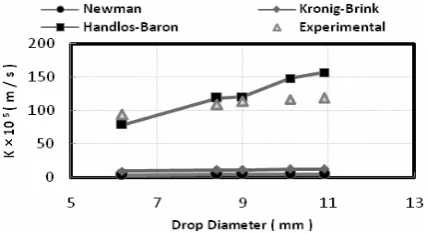
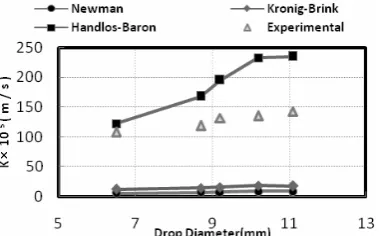
Iranian Journal of Chemical Engineering, Vol. 7, No. 4 7 model. Handlos-Baron overpredicts the data
because it is based on fully turbulent internal circulations, which in practice the drops did not reach this condition, and they experience a transition state between laminar and fully turbulent.
Figure 2. Mass transfer coefficients of dispersed phase versus drop diameter for height of 10 cm (Spray column)
Figure 3. Mass transfer coefficients of dispersed phase versus drop diameter for height of 15 cm (Spray column)
6.2- Investigation of packing effect
Results of packing usage for both types are presented in the following sections. In this research, a Raschig ring with an inside diameter of 1.6 cm and height of 2 cm was used. For random packed column the packing formed a bed with a height of 4 cm, and for structured packed column this packing was put on top of each other in two rows in a
circular structure with a diameter equal to an internal diameter of the extraction column.
6.2.1- Results of random packed column
In this experiment, the drops were moving through the packing without any breakage or coalescence. Results of mass transfer coefficient in this packed column for heights of 10 and 15 cm (from the top of nozzle) versus drop diameter are shown in Figs. 4 and 5. Although the experimental results are again almost close to those calculated by Handlos-Baron’s model, generally they do not have good agreement with the theoretical models.
Figure 4. Mass transfer coefficients of dispersed phase versus drop diameter for height of 10 cm (Random packed column)
8 Iranian Journal of Chemical Engineering, Vol. 7, No. 4 Fig. 6 shows the results of spray and random
packed column in comparison. In this figure, dispersed phase mass transfer coefficients versus drop size for heights of 10 and 15 cm are presented. We can conclude from these figures that, although for small drops (less than about 9 mm in size) mass transfer coefficient has increased 10%, for larger ones packing proved to be ineffective. It means that if we consider the mass transfer coefficient as a function of drop size or dispersed phase Reynolds number, use of random packing has no positive effect on mass transfer coefficient out of a particular range of drop size or Reynolds number. Their relative invisible breakage makes the larger drops become smaller and this fact may have
caused the decrease of mass transfer coefficients at this drop size range. It should be noted that while the drop size decreases, internal circulation and consequently mass transfer coefficient decreases, too.
6.2.2- Results of structured packed column
As illustrated in Figs. 7 and 8, by the increase of drop diameter, mass transfer coefficient increases as well. Fig. 9 shows that the use of structured packing can improve the mass transfer coefficient up to 11%. Considering Fig. 10 we can state that structured packing is slightly more effective than random packing in a vast drop size range.
(a) h=10 cm (b) h=15 cm
Figure 6. Comparison of mass transfer coefficients in spray and random packed column for the same heights, (a) h=10 cm, (b)h=15 cm
Figure 7. Mass transfer coefficients of dispersed phase
versus drop diameter for height of 10 cm (Structured packed column)
Iranian Journal of Chemical Engineering, Vol. 7, No. 4 9 Figure 9. Comparison of mass transfer coefficients in
spray and structured packed column for the same heights(h=15 cm)
Figure 10. Comparison of mass transfer coefficients in random and structured packed column for heights of 15 and 20cm
7- Introducing correlations for dispersed phase mass transfer coefficient of the applied system
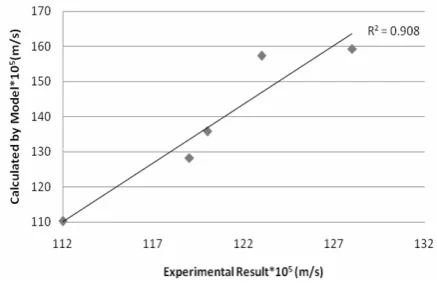
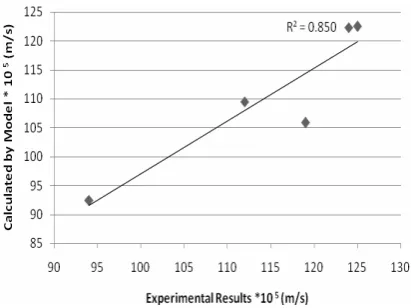
As discussed, theoretical models have failed to predict the experimental mass transfer coefficients. The reason is that, in extraction columns, drops swarm and the mass transfer of one drop is influenced by another. Therefore, theoretical solutions involving simplifying assumptions are not able to predict the exact conditions. According to the experimental results of packed column, the values of mass transfer coefficients are between those predicted by two models of Kronig-Brink and Handlos-Baron. This
indicates that drops are located in a transition state between laminar and fully turbulent conditions. By taking this point into consideration, we can use the combination of these models in order to better predict the experimental results. Thus, The following equations are introduced for prediction of mass transfer coefficients of rising drops in random (Eq. 8) and structured (Eq. 9) packed columns where K
d H
d K
K , are the mass transfer coefficients of Handlos-Baron and Kronig-Brink, respectively.
. H K
df d d
K =0 02 K +9 K (8)
. H K
df d d
K =0 02 K +9 K (9)
For instance, the results of these models have been shown in comparison with experimental ones in Figs. 11 and 12 for one experimental height. The dimension of the mass transfer coefficient in the tables is 10-5 m/s. It is obvious that experimental results can be predicted by the proposed correlations precisely, while the error range reproduced by Kronig-Brink is almost 90 percent, and 80 percent for Handlos-Baron’s model.
10 Iranian Journal of Chemical Engineering, Vol. 7, No. 4 Figure 12. Comparison of structured packed
experimental results with calculated values (h=15cm)
8- Conclusions
This work has been done for the purpose of investigation of drop size and packing usage effects on mass transfer coefficients. It is obvious that theoretical models do not provide a reliable prediction for dispersed phase mass transfer coefficient. Thus, to reach better models, more experimental work is necessary. For the case of random packed column, mass transfer coefficient has increased 10% for small drops (less than about 9 mm in size), but for larger ones packing usage has no positive effects. This means that random Rachig ring is effective in a particular range of drop size or dispersed phase Reynolds number, and out of this range the mass transfer coefficients are not affected, while using structured packing improves the dispersed phase mass transfer coefficients in a whole range of measured drop sizes. Also, for the purpose of having a higher mass transfer coefficient the use of structured packing is recommended and it has been shown to be more effectual than random packing. Experimental data resulted from structured packed column is much
closer to the Handlos-Baron model than random packed column ones, due to the more internal circulation a drop gains from moving through structured packing. The introduced correlations proved to be effective for this system. Accordingly, the prediction of mass transfer coefficients in the form of such correlations (combination of Handlos-Baron and Kronig-Brink mass transfer coefficients) seems to be useful with high accuracy.
9- Nomenclature
n
B Constants of Eqs. (2), (3)
c Solute concentration in dispersed phase
(
3)
m Kg
0
c Initial concentration of solute in
dispersed phase
(
3)
mKg
*
c Equilibrium concentration of solute in dispersed phase
(
3)
m
Kg
32
d Mean drop diameter
( )
md
D Molecular diffusivity
( )
m2 sE Local efficiency
(
=(
c0−c)
(
c0−c*)
)
h Height above nozzle( )
md
K Dispersed phase mass transfer coefficient
( )
m sod
K Overall dispersed phase mass
transfer coefficient
( )
m sℜ Enhancement factor for mass
transfer
Re Reynolds number
(
=ρcVd μc)
t Contact time( )
st
V Terminal velocity of a single drop
( )
m sGreek symbols
Iranian Journal of Chemical Engineering, Vol. 7, No. 4 11
κ Ratio of dispersed phase viscosity to continuous phase viscosity
(
=μd μc)
n
λ Constants of Eqs. (2), (3)
μ Viscosity
(
Pa.s)
ρ Density
(
Kg m3)
Subscripts
c Continuous phase d Dispersed phase
References
[1] Jie, Y., Weiyang, F. and Huai, Z., "Effect of packing on drop swarms extraction of high viscosity solvents" Hydrometallurgy, Vol. 78, No. 1-2, pp. 30-40, (2005).
[2] Misek, T., "Recommended systems for liquid extraction studies, European Federation of Chemical Engineers" I. Chem. E. London, Vol. 1, P. 1, (1978).
[3] Newman, A. B., "The drying of porous solids: Diffusions and surface emission equations" Trans. Am. Inst. Chem. Eng., Vol.27, pp.203-220, (1931).
[4] Kronig, R. and Brink, J. C., "On the theory of extraction from falling drops" Appl. Sci. Res., A2, pp.142-154, (1950).
[5] Elzinga, E.R. and Banchero, J.T., "Film coefficients for heat transfer to liquid drops" Chem. Eng. Prog. Symp. Ser., Vol.55, No. 29, pp.149-161, (1959).
[6] Handlos, A. E. and Baron T., "Mass and heat transfer from drops in liquid–liquid extraction". AIChE J., Vol.3, pp. 127– 136, (1957).
[7] Calderbank, P. H. and Korchinsky, I. J. O., "Circulation in liquid drops: A heat transfer study", Chem. Eng. Sci. 6, 65, (1956). [8] Rose, P. M. and Kintner, R. C. "Mass transfer
from large oscillating drops" AIChE J., Vol.12, pp. 530– 534, (1966).
[9] Kumar, A. and Hartland, S., "Correlations of mass transfer coefficients in single drop systems and liquid-liquid extraction columns" Trans. Inst. Chem. Eng., Vol.77, pp. 372-384, (1999).
[10] Bird, R.B., Stewart, W.E. and Lightfoot, E.N., Transport phenomena, Wiley, New York, pp. 530, (2001).