46 |
P a g e
Asian Journal of Pharmaceutical Science & Technology
e-ISSN: 2248 – 9185
www.ajpst.com
Print ISSN: 2248 – 9177
FORMULATION AND EVALUATION OF MEFENAMIC ACID
TABLETS BY USING MODIFIED STARCH
Amaravathi Vikram*, S Firoz, D Kishore, Y Chandra Mouli, T Venkataramudu
Department of Pharmaceutics, Sree Vidyanikethan College of Pharmacy, A.Rangampet, Tirupati- 517 102, India.
ABSTRACT
The objective of the present research work is to enhance the dissolution profile of the mefenamic acid by Modified Starch. Potato starch citrate is prepared as a disintegrating agent and as a noval carrier for the solid dispersions. Starch citrate was prepared by reacting the citric acid with starch at elevated temperature. Starch citrate was exhibited good flow properties and it had good swelling property without pasting when heated in water was considered to be promising excipient. Starch citrate was characterized by Fourier transform infrared spectroscopy (FTIR), Differential scanning calorimetry (DSC) and X-ray diffraction (XRD) and these results were suggesting that structure of starch had been modified. Mefenamic acid is a non-steroidal anti-inflammatory drug belongs to the Biopharmaceutics classification system (BCS) class II drug. Dissolution rate is the rate determining step in the bioavailability of the mefenamic acid. Tablets of four different batches each containing 100 mg of mefenamic acid were prepared by wet granulation and direct compression method using starch citrate, starch citrate-mafanamic acid sloid dispersions, microcrystalline cellulose and lactose. Prepared tablets were characterized by Fourier transform infrared spectroscopy (FTIR), Flow properties, Drug content, Hardness, friability, In-vitro dissolution studies. Results of the Fourier transform infrared spectroscopy were revealed that there were no interactions between the drug and polymer. Dissolution parameters of mefenamic acid were found to be improved in tablets prepared by using starch citrate as direct compressible and disintegant, starch citrate-mefenamic acid solid dispersions when compared to tablets prepared by using microcrystalline cellulose and lactose. It was concluded that starch citrate is a promising excipient for tablet formulation and also as a carrier for solid dispersions for enhancing the dissolution rate of poorly water soluble drugs.
Key words: Mefenamic acid, Starch citrate, Biopharmaceutics classification system, Dissolution rate.
INTRODUCTION
Nearly about 40% of the newly discovered drugs are lipohilic and failed to reach market due to the poor water solubility [1]. Solubility and dissolution rate is the rate determining step for bioavailability of the BCS class II drugs. The bioavailability problem with BCS class II drugs can be overcome by increasing the solubility and dissolution rate of the drug in the gastrointestinal fluids [2]. Various pharmaceutical formulation technologies are being developed for the solubility and dissolution rate of poorly water soluble drugs such as Micronization, Super critical fluid process, Solid dispersions, Solid solutions, Sonocrystalisation, Nano suspension, Co solvency, Hydrotropy etc [3].
There are numerous carriers available for enhancement of the solubility and dissolution rate such as super disintegrants, polymers, cyclodextrins, carbohydrates, surfactants, hydrotropes, polyglycolized glycerides, acids,
dendrimers [4]. Although a variety of carriers are available for the improvement of dissolution profile of the drugs continues development of new carriers is needed. Chowdary et al [5, 6] has reported starch citrate is as a disntegrant in tablet formulation and also a noval carrier for solid dispersions.
Mefenamic acid is a NSAID belongs to the BCS class II drug. Dissolution rate is the rate determining step in the bioavailability of the Mefenamic acid. The main aim of the present research work is preparation of the potato starch citrate as a disintegrating agent and as a noval carrier for the solid dispersions. The dissolution profile of the Mefenamic acid has been improved by using starch citrate. Tablets of four different batches each containing 100mg of mefenamic acid were prepared by wet granulation and direct compression method using starch citrate, starch citrate-mafanamic acid sloid dispersions, microcrystalline cellulose and lactose. Solid dispersions were prepared by solvent
47 |
P a g e
evaporation method [7]. The prepared tablets were characterized by Fourier transform infrared (FTIR) spectroscopy, Flow properties, Drug content, Hardness, friability, In-vitro drug release.
MATERIAL AND METHODS
Mefenamic acid was a gift sample from AtoZ pharmaceuticals, Chennai, Potato starch and Methanol were purchased from S.D. Fine Chem. Ltd, Mumbai, and Citric acid was purchased from Microfine chemicals. All other chemicals and solvents used were of analytical grade.
Preparation of Starch Citrate
Potato Starch citrate was prepared based on the method of K.P.R. Chowdary et al [5, 7]. 20gm of the citric acid was dissolved in 20ml of the distilled water. The pH of the citric acid solution was adjusted to 3.5 with 10M sodium hydroxide solution and finally the volume of the solution was made up to 50ml by adding distilled water. The citric acid solution was mixed with 50gm of potato starch in a stain less steel tray and conditioned for 16hr at room temperature (280C). The tray was then placed in a hot air oven and dried at 600C for 6hr. the resulting mixture was ground and further dried in hot air oven and dried at 1300C foe 2hr. From the dried mixture the unreacted citric acid was removed by washing the product with distilled water. The washed product was dried at 500C to remove water/moisture completely. The dried starch citrate was ground and sized.
Characterization of Starch Citrate Fourier transform infrared (FTIR)
The FTIR spectra of starch, citric acid and starch citrate were obtained on a Thermo-IR 200 FTIR Spectrophotometer. The KBr pellet technique was used to prepare the samples. The spectrum was recorded in the spectral region from 4000 to 400cm-1.
Differential scanning calorimetry (DSC)
DSC analysis of the starch, citric acid and starch citrate were performed using Mettler Toledo DSC 822e. The samples were weighed and encapsulated in a flat bottomed aluminum pans. Liquid nitrogen was used as coolant. The samples were scanned at 100C/min over temperature range of 0-3000C.
X-ray diffraction (XRD)
The solid state properties of the starch and starch citrate were carried by X-RD by using XPERT-PRO X ray diffractometer. The diffraction pattern was recorded at room temperature over a range 3 to 80 (2θ).
Physicochemical properties
The physicochemical properties like solubility, pH, melting point, viscosity, swelling index, test for gelling property, density, bulk density, angle of repose,
compressibility index of starch citrate were determined based on method of chowdary et al [8].
Preparation of Solid Dispersions
Solid dispersions of Mefenamic acid were prepared by solvent evaporation method. The solid dispersions were prepared in 1:2 ratio of drug: carrier. Required amount of Mefenamic acid was taken into a dry mortar and add sufficient amount of methanol to get clear drug solution. Starch citrate was then added and mixed. The thick slurry was kneaded for complete evaporation of methanol and then dried at 55oC until dry. The dried mass was pulverized and sieved through mesh no. 80 and stored in desicator.
Drug content
50mg equivalent of Mefenamic acid was weighed and transfer in to 50ml of volumetric flask. Methanol was added and mixed the contents thoroughly to dissolve the drug from the solid dispersions and kept aside for 1hr. The solution was filtered. From the filter solution 1ml was withdrawn into 100ml volumetric flask. The volume was made up to 100ml with methanol and assayed at 279nm for Mefenamic acid.
Preparation of mefenamic acid tablets
Mefenamic acid tablets were prepared by using pure drug and solid dispersions (1:2) by wet granulation and dry compression method using starch citrate, microcrystalline cellulose as direct compressible vehicle. MF1, MF2 batches were formulated by direct compression method and MF3, MF4 batches were formulated by wet granulation method. Tablets of four different batches each containing 100mg of mefenamic acid were as per formula given table.1.
Direct compression method
All ingredients were weighed as per formula given in table and passed through sieve no 40. The ingredients were blended for sufficient time to get uniform mixing of ingredients in a closed polyethylene bag. The powdered blend was compressed in to tablets using rotary punch tablet machine.
Wet granulation method
48 |
P a g e
EvaluationFlow properties
Flow properties of prepared tablet blend were evaluated by angle of repose, carr’s index, hausner’s ratio. Angle of repose was calculated by fixed funnel method. Tapped and bulk densities were used for calculation of carr’s index, hausner’s ratio.
Fourier transform infrared (FTIR)
The FTIR spectra of starch citrate, Mefenamic acid and solid dispersions were obtained on a Thermo-IR 200 FTIR Spectrophotometer which was employed to characterize the possible interactions between the drug and carrier in the solid state. The KBr pellet technique was used to prepare the samples. The spectrum was recorded in the spectral region from 4000 to 400cm-1.
Evaluation of tablets
The prepared tablets were evaluated for weight variation, disintegration time, hardness, friability. Hardness and friability was determined by using “monsanto hardness tester”, roche fribilator respectively. Disintegration time was determined by using disintegration apparatus (model TDL-082 electrolab), water as a testing liquid.
Drug content
20 tablets from each batch of prepared tablets were used for determination of drug content. The 20 tablets were weighed and powdered. From the tablet powder, 100 mg equivalent was weighed and transfer in to 100ml of volumetric flask. Methanol was added and mixed the contents thoroughly to dissolve the drug and kept aside for 1hr. The solution was filtered; the filter solution was diluted suitably and assayed at 279nm for mefenamic acid using UV.
In-vitro dissolution study
In-vitro dissolution studies were carried for an
prepared batches of tablets by using USP XXIV type II apparatus. Dissolution studies were carried at temperature 370C±0.50C and the paddle rotation speed of 50rpm using 7.4 phosphate buffer as dissolution medium. A sample of 5ml was withdrawn at different intervals of time up to 60 minutes and 5ml of fresh drug free dissolution medium was added to replace the sample that was withdrawn. Samples were filtered (0.45µ membrane filter) and diluted suitably and analysed for mfenamic acid at 279nm using UV. The dissolution experiments were performed in triplicate.
RESULTS AND DISCUSSION Starch citrate
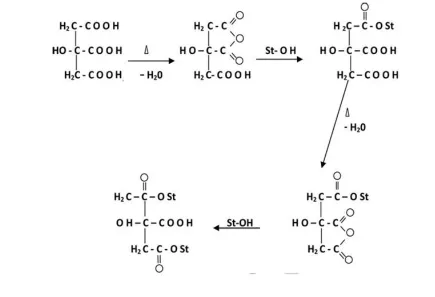
Citric acid can form reactive anhydride upon heating by loosing water molecule. The reactive anhydride can react with starch which is present in the reaction mixture to form starch citrate. The reaction involved in the preparation was shown in the Fig.1.
Physicochemical properties
Physicochemical properties of the starch citrate were shown in the Table.2. Native potato starch was found to be simple granules (round and polygonal) in shape. The starch granules consist of semicrystalline structure [9]. The prepared starch citrate was found to be off white color and semicrystalline nature. The semicrystalline nature further conformed by DSC. The melting point of the starch citrate was determined by using meting point apparatus. Native starch and starch citrate was not having any meting point but charred at 2380C, 2220C. The results of DSC further conformed that the native starch and starch citrate does not having melting point. Native starch was hydrolyzing upon heating and converted to gel/ paste and it was not found in case of the starch citrate. The swelling property of the starch citrate in water was compared with starch and it was found that starch citrate had 1100% swelling in water. Starch citrate was found to be insoluble in water, aqueous buffers of pH 1.2, 4.5, 7.4 and organic solvents. Starch citrate was exhibited good flow properties.
Chemically modified starch had good swelling property without pasting when heated in water was consider to be promising carrier for solid dispersions for enhancing the dissolution rate of poorly water soluble drugs.
Fourier transform infrared spectroscopy
FTIR spectra of the starch, citric acid and starch citrate were shown in Fig.3. The starch shows significant peaks at 3214.29 cm-1 indicates OH Stretching, 2920.80 cm
-1. The starch citrate shows significant peaks at 3379.37 cm-1
indicates OH Stretching, 1705.09 cm-1 indicates C=O stretching, 1146.86 cm-1 indicates C-O-C stretching. The C=O stretching, C-O-C stretching characteristic bonds were absent in the starch.
Differential Scanning Calorimetry
The DSC thermograms of the starch, citric acid and starch citrate were shown in the Fig.4. There was no endothermic peaks were observed in starch and starch citrate. The citric acid was showing the melting point at 156.560C. The results of the DSC conformed that the structure of the starch and starch citrate were not totally crystalline in nature.
X-ray diffraction
49 |
P a g e
peaks were decreased but it was spread over region of the 2θ values. The XRD of the potato starch and potato starch citrate were found to be different and indicates that the crystalinty of the starch and starch citrate were found to be different. The crystalinty structure was increased in case of the potato starch citrate. The change in the crystalinity may be due to the addition of the citric acid to the starch.
Drug content in solid dispersions
Drug content in solid dispersions were determined by using UV. Drug content in solid dispersions was found to be 99.473%.
Flow properties
The values of Angle of repose, Carr’s index and Hausners ratio were shown in table.3. The prepared tablet blends were having good flow properties. The values of the angle of repose, carr’s index, hausner ratio were within the limits.
Fourier transform infrared
The FTIR spectra of the mefenamic acid, starch citrate and solid dispersions were shown in the Fig.6.
Table 1. Formulae Mefenamic acid tablets formulated employing Starch citrate by Wet Granulation and Direct Compression Methods
Ingredient (mg/Tablet) Formulation
MF1 MF2 MF3 MF4
Mefenamic acid 100 100 100 -
Starch citrate - - 250 -
Mefenamic acid – starch citrate solid dispersion (1:2) - - - 300
MCC 256 - - -
Lactose - 256 6 56
Crospovidone 20 20 20 20
Acacia 8 8 8 8
Talc 8 8 8 8
Magnesium stearate 8 8 8 8
Total weight of tablet (mg) 400 400 400 400
50 |
P a g e
Fig.2. Microscopic images of (A) Starch and (B) Starch citrateTable.2.Physical properties of the Potato Starch citrate prepared
S.NO Property Result
1 Solubility Insoluble in all aqueous and organic solvents
2 pH(1% w/v aqueous dispersion) 4.78
3 Melting point Charred at 2220C
4 Viscosity (1% w/v aqueous dispersion) 0.9906 cps
5 Swelling index 1100
6 Gelling property No gelling and the swollen particles of starch citrate separated from water. Where as in the case of starch, it was gelatinized and formed gel
7 Density 0.605 g/cc
8 Angle of Repose 20.04o
9 Compressibility Index 8.33%
51 |
P a g e
Fig.4.DSC thermograms of (A) Citric acid, (B) Starch and (C) Starch citrateFig.5. X-Ray Diffractograms of (A) Starch and (B) Starch citrate
Table.3. Flow properties of Solid dispersions
Formulation Angle of repose Carr’s index Hausner ratio
P1 23.14 ± 0.86 15.86 ± 0.25 1.11 ± 0.07
P2 22.49 ± 1.18 13.25 ± 0.41 1.13 ± 0.01
P3 21.59 ± 0.72 14.5 ± 0.10 1.13 ± 0.01
P4 21.02 ± 0.68 15.06 ± 0.73 1.15 ± 0.03
52 |
P a g e
Fig.7. Dissolution profile of Mefenamic acid tabletsTable.4. Characteristics of prepared Mefenamic acid tablets
Code
Drug content (%w/w)
Weight
variation(mg) Thickness (mm) Friability (%)
Hardness (kg/cm2)
Disintegration Time (Min)
MPF1 98.05263 400.55 ±0.792 5.12 ± 0.025 0.465 ± 0.03 7 1.46± 0.41
MPF2 99.23684 400.4 ± 0.744 5.16 ± 0.046 0.494 ± 0.02 7 1.34 ± 0.60
MPF3 99.00000 401.21 ± 0.10 5.12 ± 0.054 0.475 ± 0.10 8 0.26± 0.15
MPF4 99.71053 402.21 ±0.948 5.14 ± 0.049 0.504 ± 0.05 8 0.29± 0.80
Table.5. Dissolution parameters of Mefenamic acid tablets
Parameters Q30a Q45a DE30b DE45b MDRc IDRc t50% (min)c
Commercial tablets 41.210 51.157 27.414 27.670 2.591 4.310 43.26
MF1 28.657 37.184 17.490 19.089 1.543 2.373 >45
MF2 21.221 29.131 13.256 14.466 1.222 1.927 >45
MF3 72.947 92.605 44.210 48.039 3.994 6.3 15.17
MF4 81.236 98.526 54.195 54.197 5.123 8.572 8.35
a Q: percent drug released at 30, and 45 min.,b DE: Dissolution efficiency at 30 and 45 min. c MDR, IDR and t50% (min): mean
dissolution time, mean dissolution rate, initial dissolution rate, relative dissolution rate and time taken to release 50% of the drug and respectively.
The mefenamic acid was shown significant peaks at 3307.40 cm-1 indicates N-H stretching, intense bands at 1570.04 cm-1 indicates N-H bending, 1645.18 cm-1 indicates C=O stretching, 746 cm-1 indicates aromatic stretching. These characteristic peaks were also observed in FTIR spectrum of solid dispersions formulation suggesting that there were no interactions between the drug and polymer.
Evaluation of tablets
Tablets of four different batches each containing 100 mg of mefenamic acid were prepared by wet granulation and direct compression method. Results of the FTIR study were suggesting that there was no drug interactions were observed. The prepared tablet blend was evaluated for flow properties and these results were suggesting that prepared tablet blend was having good flow properties and the values of angle of repose, carr’s index, hausner’s ratio were shown in table.3. The Average weight
ranged from 400.21 to 402.21 mg. The weight variations for all the formulated tablets were within the Pharmacopoeial limits. The thickness of tablets ranged between 5.12mm to 5.16 mm for Mefenamic acid tablets. All the formulated tablets showed uniform thickness. The percentage friability of all the formulations are within the limit (Limit: NMT 1.0%) and has required mechanical strength. The hardness of the various tablet formulation are uniform with 7-8 kg/cm2 (n=3), which is required to maintain the mechanical strength. Drug content was found to be in the range of 98.05-99.71% and the values of drug content were reported in the table.4.
53 |
P a g e
cellulose. The swelling property of starch citrate aided in disintegration of the tablet.
The in vitro dissolution study performed in pH 7.4 phosphate buffer and shows maximum release of drug at the end of 45 min. MF4 formulation was shown maximum amount drug release at 45min. The dissolution efficiency of tablets suggests that increased solubility and dissolution rate of Mefenamic acid. The initial dissolution rate was enhanced up to 8.572. At the end of 45 min commercial tablets showed a maximum release of 51.15% of the drug where as tablets of MP1, MP2, MP4 and MP5 showed 37.18%, 29.13%, 92.6 and 98.52% respectively. P4 formulation was shown 97.342% drug release at 45min. DE45 of commercial tablets, MP1, MP2, MP3 and MP4 was
found in the order of the 27.67, 19.08, 14.46, 48.03 and 54.19. Mean dissolution rate was improved up to 5.123. Time taken by the MP4 formulation to release 50% of drug was found to be 8.35 minutes. The dissolution parameters (DE, MDR, IDR, t50%) of tablets suggest that increased
dissolution rate of Mefenamic acid from the tablets prepared by starch citrate as a direct compressible vehicle and as a disintegrant, solid dispersions when compared to tablets prepared by using microcrystalline cellulose and lactose.
CONCLUSION
In the present study the starch citrate was prepared by reacting the citric acid with starch at elevated temperature. Prepared starch citrate was found to be insoluble in water, organic solvents, acidic and alkaline pH. Starch citrate was exhibited good flow properties. Starch citrate was characterized by FTIR, DSC and XRD and these results were suggesting that structure of starch had been modified. Chemically modified starch had good swelling property without pasting when heated in water was consider to be promising excipient for tablet formulation and also as a carrier for solid dispersions for enhancing the dissolution rate of poorly water soluble drugs. Results of the FTIR were revealed that there were no interactions between the drug and polymer. Dissolution parameters of mefenamic acid were improved in tablets prepared by using starch citrate as direct compressible disintegant, starch citrate-mefenamic acid solid dispersions when compared to tablets prepared by using microcrystalline cellulose and lactose. It was concluded that starch citrate is a promising excipient for tablet formulation and also as a carrier for solid dispersions for enhancing the dissolution rate of poorly water soluble drugs.
REFERENCES
1. Daisy Sharma, Mohit Soni, Sandeep Kumar, GD Gupta, Solubility Enhancement – Eminent Role in Poorly Soluble Drugs: An Overview. Research J. Pharm. and Tech, 2(2), 2009, 220-224.
2. Urbanetz NA. Stabilization of solid dispersions of nimodipine and polyethylene glycol 2000. E J Pharm Sci, 28, 2006, 67-76. 3. Mohanachandran PS, Sindhumol PG, Kiran TS. Enhancement of Solubility and Dissolution rate: An Overview. International
Journal of Comprehensive Pharmacy, 4(11), 2010.
4. Vikas A Saharan, Vipin Kukkar, Mahesh Kataria, Manoj Gera, Pratim K Choudhury, Dissolution Enhancement of Drugs Part I: Effect of Carriers. Int J Health Res., 2(3), 2009, 2-7.
5. Chowdary KPR, Veeraiah Enturi. Preparation, Chracterization and Evaluation of Starch citrate- a New Modified starch as a Disintegrant in Tablet Formulations. International Journal of Pharma Research and Development, 2(12), 2011, 9-17. 6. CH Divakara Rao, M Sandeep, R Santosh Kumar. Preparation, Characterization and Evaluation of Carbamazepine Solid
Dispersions Employing Starch Citrate - A Novel Carrier For Solid Dispersions.
7. Chowdary KPR, Veeraiah Enturi. Enhancement of Dissolution Rate and Formulation Development of Efavirenz Tablets Employing Starch Citrate-A New Modified Starch. Journal of Applied Pharmaceutical Science, 01(05), 2011, 119-123. 8. Chowdary KPR, Veeraiah Enturi, Sravani Pulya. Formulation Development of Etoricoxib Tablets by Wet Granulation and
Direct Compression Methods Employing Starch Citrate. Research Journal of Pharmaceutical, Biological and Chemical
Sciences, 2(3), 2011, 983-993.