doi: 10.15171/rdme.2018.017 https://rdme.tbzmed.ac.ir
Developing communities of practice model to enhance knowledge
and improve learning among faculty members (Case study: Tabriz
University of Medical Sciences)
Nayer Seyednazari1, Sadegh Maleki Avarsin1*ID, Jahangir Yari Haj Atalou1ID
1Department of Educational Sciences, Tabriz Branch, Islamic Azad University, Tabriz, Iran
Introduction
Knowledge in medical universities is more important than in other organizations due to the application to health and medical education. On the other hand, considering the complexity of medical education, providing a context for sharing knowledge to overcome these complexities is complicated but equally important.
Communities of practice (CoPs) are social structures that focus on knowledge.1 Such communities have
been identified as an effective method to extract and disseminate tacit knowledge2 and as a vehicle for learning.3
They are effective tools for the creation and sharing of
organizational knowledge, and an increasing number of organizations are adopting them as part of a knowledge management strategy.4 These communities are used as
a tool in many higher educational contexts in faculty development 5 and in teacher training.6 CoPs have become
commonplace in educational institutions as a means of bringing staff members together to discuss matters of common interest, as well as being used in educational practice itself.7 They can guide the development of
interventions to make medical education more effective and can help both learners and educators better cope with medical education complexity.8 Learning is one of the
*Corresponding author: Sadegh Maleki Avarsin, Email: [email protected]
Publishing Group TUOMS
Article Type: Original Research
Article History: Received: 1 Sep. 2018 Accepted: 31 Oct. 2018 epublished: 30 Dec. 2018
Keywords:
Community participation Social learning
Information dissemination Knowledge management
Abstract
Background:Due to the importance of the teaching and learning process in medical sciences, it is necessary to provide an appropriate context to facilitate knowledge sharing. Communities of practice (CoPs) is one strategy for sharing explicit knowledge and learning among individuals. This research aimed to develop CoPs model at Tabriz University of Medical Sciences.
Methods: This descriptive-survey research was conducted on 245 faculty members selected through a simple random sampling method at Tabriz University of Medical Sciences who had the rank of professor, associate professor and assistant professor in the 2017-2018 academic year. An exploratory factor analysis (EFA) was performed by analyzing main components that were verified by a confirmatory factor analysis (CFA). The reliability of components was calculated using Cronbach’s alpha.
Results: The CoPs model consists of six components including participatory leadership, goals/ aims, boundary and size, interactions, formal structures, and informal structures. There was a significant relationship observed between all components. The strongest correlations were observed between the boundary-size and interactions (0.85), goals/aims and leadership (0.78), and informal structure and leadership (0.76). In examining the relationships between each component, the strongest correlation was found between CoPs and informal structure (0.88), participatory leadership (0.87), and interactions (0.85) and the weakest relationship was observed between formal structure and CoPs (0.61). Results of determining fit indices indicated validity of the CoPs model (χ2/df =2.69, CFI= 0.92, IFI= 0.92, NFI= 0.88, RMSEA= 0.09).
Conclusion: university managers using this model and strengthening the informal aspects of existing communities increase the possibility of faculty members’ interactions from different units and having them participate in decision making related to teaching and learning processes to take effective steps towards academic development of this university.
Article info
most important benefits of CoPs.9 CoPs help to improve
practice of and learning about teaching.10 CoPs’ approach
to teaching and learning in higher education provides a space for staff to collaboratively reflect on, review, and update current teaching and learning practices.11 These
informal teacher communities allow teachers to engage in a dialogue with colleagues and to share questions, solutions, and interpretations. These teacher communities also provide opportunities to explicate tacit expertise, which helps participants develop an idea of their own role and form a frame of reference for their own experiences.12 The
application of CoPs can potentially serve as an effective learning strategy for higher education classrooms by contributing to student professional development while fostering a desire for life-long learning.13 The learning that
occurs within CoPs is interactive.14 Interaction between
community members increases knowledge, helps access to different experiences, and improves participant’s expertise. Improvements in work performance are largely due to the sharing of experiences and best practices.9 Individuals
participate in CoPs to learn practical knowledge from one another, and to accomplish shared objectives.15
Regarding the responsibility of medical universities in the field of education and health, as well as the diversity of educational trends and complexity of the nature of education in the field of medical sciences, having a systematic approach to health-related topics is necessary. Because it is not possible to achieve all these facets through formal education alone, creating and fostering CoPs at medical universities is an effective way to address these complex needs due to the semi-formal nature of these communities. No studies were done on CoPs at Tabriz University of Medical Sciences (TUOMS); thus researchers conducted this study and presented a native model of CoPs to provide a suitable framework to facilitate knowledge sharing and experience of faculty members at this university under different goals and conditions.
Materials and Methods
This descriptive-survey study was conducted with 245 faculty members at TUOMS in 2017-2018. This sample size was calculated based on sample selection criteria for factor analysis recommended by different authors of 5 to 10 samples for each item.16-18 and considering a 15%
dropout rate. First, the number of faculty members who had the ranks of professor, associate professor or assistant professor was assessed. Then faculty members with administrative positions, members of educational and research councils, and participants in workshops during 2016-2017 were identified, and among them 7 people per item were selected as a statistical sample. Faculty members were selected using simple random sampling.
Inclusion criteria were being a faculty member at TUOMS with the ranks of professor, associate professor, or assistant professor with more than one year of activity or instructors who were promoted to assistant professor), or
who had participation in two or more workshops during the last two years, and the chancellors and managers of departments, programs, and research centers, supervisors, research directors, educational and research deputies, and research group members. There were no exclusion criteria. The data collection tool was a questionnaire that was valid and reliable in a previous published study. It was designed on a 5-point Likert scale (1= absolutely proper, 2= proper, 3= partly proper, 4= improper, 5= absolutely improper). The impact scores of items were above 1.5, with a content validity ratio (CVR) of 0.78, a content validity index (CVI) of 0.92, an α of 0.89, and an intra-class correlation coefficient (ICC) of 0.92.19
The justification for performing factor analysis was tested using Kaiser-Meyer-Olkin (KMO) and Bartlett’s test of sphericity. Mardia’s coefficient measurement was used to verify multivariate normality of data. The number of components was determined using exploratory factor analysis (EFA), principal component analysis (PCA) and a scree test that was described with details in a previously published study.19 Confirmatory factor analysis (CFA)
was performed in 2 steps to confirm the extracted factors, evaluate the goodness of fit indices and to develop the CoPs model. In the first-order CFA, the relation between each latent variable with observable variables was measured and the partial and general fit indices were calculated. Standard coefficients, t-values, chi-square, root mean square error of approximation (RMSEA), comparative fit index (CFI), normed fit index (NFI), goodness of fit index (GFI), adjusted goodness of fit index (AGFI), and incremental fit index (IFI) were used for determining fit indices. The most important fit index is chi-square, which shows the difference between the observable and estimated matrices. The smaller values of this statistic show the goodness of fit of model, but since this statistic is sensitive to the sample size, it is divided into degrees of freedom in high samples; a value of 2 is often considered appropriate in use of this index,20 although some sources
have suggested that the χ2/df should be less than 3 to accept
the model.21 The IFI, CFI, NFI, GFI, and AGFI indices are
placed between 0 and 1; as these values approach 1, the model is regarded as more appropriate and has goodness of fit.17,22 In contrast, lower values for RMSEA show better
fitness, so that values of less than 0.05 show good fitness, values between 0.05 and 0.08 show proper fitness, and values between 0.081 and 0.10 show average fitness.20,23-25
To investigate the relation between observable and latent variables and the relation between endogenous latent variables and their main constructs (exogenous variables), a second order CFA was done. The reliability of each factor was then calculated using Cronbach alpha. Data were analyzed using SPSS version 21 and LISREL 8.80.
Results
to lack of complete answers to all questions for a response rate of 86%. Despite multiple requests, 15 faculty members did not return a questionnaire.
Over half of the participants were male (58.1%). The department with the highest representation was Medicine (37%), followed by Pharmacy (13%), and then Research Centers (9%). In terms of rank, the majority (62.9%) were assistant professors (Table 1).
The KMO was 0.881 and Bartlett’s test of sphericity was performed with a result of 3906.519 and P < 0.001, which justified performing the factor analysis. Mardia’s coefficient
(2.93) expressed multivariate kurtosis normality.26 Six
components were identified based on EFA, PCA and the scree plot (Figure 1 and Table 2 in a previous published study).19 The initial structure of the extracted components
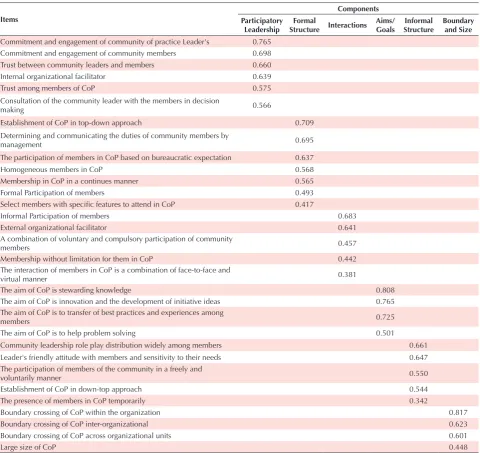
was examined in terms of the content relation of items with their underlying factor based on the theoretical principles of the subject. At this stage, four items (14, 22, 25, and 26) were removed due to an insignificant relationship with a factor. The final structure of the extracted components was named according to the latent concepts in items and referring to the related research literature. The results are presented in Table 2.
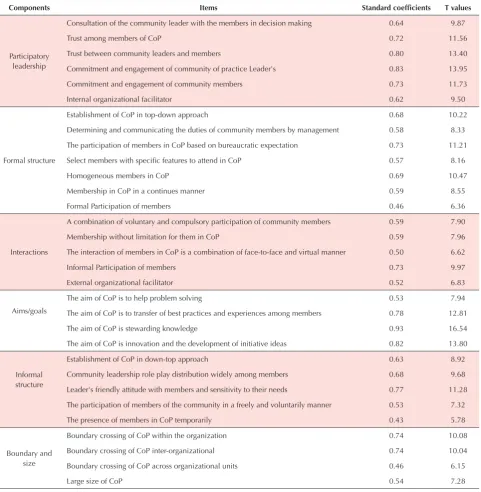
Table 3 shows the partial fit indices (standard coefficients and t-values) for each component.
According to Table 2, the results indicate a correlation between observable and latent variables. The relation between each item and its related factor in all items had t-values above 1.96, indicating the significance of the relationships. In Table 4, results of calculating general fit indices of the measurement models by estimating maximum likelihood are presented.
Given the comparison of the calculated indices with the acceptable values, the validity of the evaluation scale with the measurement models is able to be confirmed.
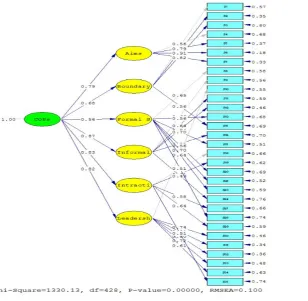
As already stated, the CoPs model consists of six variables. The standard factor loadings and t-values were calculated to evaluate partial fit indices as presented in Figures 1 and 2.
As shown in Figure 1, there is a correlation between
Table 1. Demographic characteristics of participants
No. %
Gender MaleFemale 12288 58.141.9
Rank
Professor 28 13.3
Associate professor 50 23.8
Assistant professor 132 62.9
Department
Advanced Medical Science 13 6.2
Dentistry 15 7.1
Health 11 5.2
Management & Medical Informatics 11 5.2
Medicine 78 37.1
Nursing & Midwifery 13 6.2
Nutrition 5 2.4
Paramedical 6 2.9
Pharmacy 27 12.9
Rehabilitation 12 5.7
Research Centers 19 9.0
observable and latent variables as well as endogenous latent variables and their main constructs (exogenous variables). The strongest correlations were seen between CoPs and informal structures (0.87), interactions (0.83), and participatory leadership (0.82), but formal structure had a weaker relation with CoPs (0.56). The results of examining the significance of the above relations are presented in Figure 2.
In Figure 2, the t-values are above 1.96 in all cases, showing significant relations between the items and their related factors, as well as between the endogenous and exogenous latent variables, which implies the appropriateness of partial fit indices.
Results of determining general fit indices of the second order CFA are presented in Table 5.
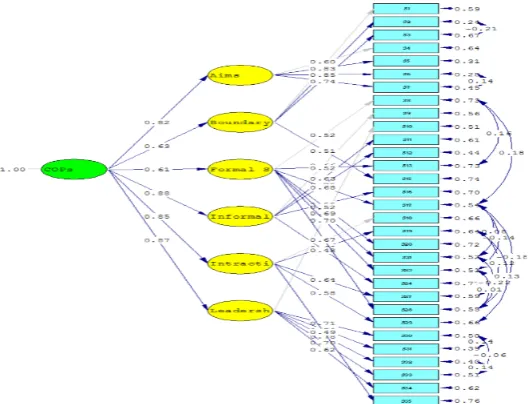
Based on results of Table 5, the validity of the CoPs model was confirmed (to achieve the optimal model, several
error covariance for the items were released during modification of the model.) The CoPs model following modification is presented in Figure 3.
The results show that after modification of the model, a powerful correlation was found between CoPs and informal structure (0.88), participatory leadership (0.87) and interactions (0.85).
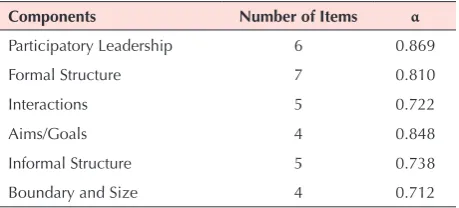
The results of examining the reliability of factors are presented in Table 6.
As shown in Table 6, the results for all variables were higher than the generally accepted value of 0.7, from which it can be concluded that the structures have an optimal level of internal consistency (Figure 4).27
Discussion
Today’s successful organizations must be regarded as institutions where knowledge and skills are continually
Table 2. Final structure of the extracted components
Items
Components Participatory
Leadership StructureFormal Interactions Aims/ Goals StructureInformal Boundary and Size Commitment and engagement of community of practice Leader's 0.765
Commitment and engagement of community members 0.698
Trust between community leaders and members 0.660
Internal organizational facilitator 0.639
Trust among members of CoP 0.575
Consultation of the community leader with the members in decision
making 0.566
Establishment of CoP in top-down approach 0.709
Determining and communicating the duties of community members by
management 0.695
The participation of members in CoP based on bureaucratic expectation 0.637
Homogeneous members in CoP 0.568
Membership in CoP in a continues manner 0.565
Formal Participation of members 0.493
Select members with specific features to attend in CoP 0.417
Informal Participation of members 0.683
External organizational facilitator 0.641
A combination of voluntary and compulsory participation of community
members 0.457
Membership without limitation for them in CoP 0.442
The interaction of members in CoP is a combination of face-to-face and
virtual manner 0.381
The aim of CoP is stewarding knowledge 0.808
The aim of CoP is innovation and the development of initiative ideas 0.765
The aim of CoP is to transfer of best practices and experiences among
members 0.725
The aim of CoP is to help problem solving 0.501
Community leadership role play distribution widely among members 0.661
Leader's friendly attitude with members and sensitivity to their needs 0.647
The participation of members of the community in a freely and
voluntarily manner 0.550
Establishment of CoP in down-top approach 0.544
The presence of members in CoP temporarily 0.342
Boundary crossing of CoP within the organization 0.817
Boundary crossing of CoP inter-organizational 0.623
Boundary crossing of CoP across organizational units 0.601
Table 3. Standard coefficients and t-values of measuring models
Components Items Standard coefficients T values
Participatory leadership
Consultation of the community leader with the members in decision making 0.64 9.87
Trust among members of CoP 0.72 11.56
Trust between community leaders and members 0.80 13.40
Commitment and engagement of community of practice Leader's 0.83 13.95
Commitment and engagement of community members 0.73 11.73
Internal organizational facilitator 0.62 9.50
Formal structure
Establishment of CoP in top-down approach 0.68 10.22
Determining and communicating the duties of community members by management 0.58 8.33
The participation of members in CoP based on bureaucratic expectation 0.73 11.21
Select members with specific features to attend in CoP 0.57 8.16
Homogeneous members in CoP 0.69 10.47
Membership in CoP in a continues manner 0.59 8.55
Formal Participation of members 0.46 6.36
Interactions
A combination of voluntary and compulsory participation of community members 0.59 7.90
Membership without limitation for them in CoP 0.59 7.96
The interaction of members in CoP is a combination of face-to-face and virtual manner 0.50 6.62
Informal Participation of members 0.73 9.97
External organizational facilitator 0.52 6.83
Aims/goals
The aim of CoP is to help problem solving 0.53 7.94
The aim of CoP is to transfer of best practices and experiences among members 0.78 12.81
The aim of CoP is stewarding knowledge 0.93 16.54
The aim of CoP is innovation and the development of initiative ideas 0.82 13.80
Informal structure
Establishment of CoP in down-top approach 0.63 8.92
Community leadership role play distribution widely among members 0.68 9.68
Leader's friendly attitude with members and sensitivity to their needs 0.77 11.28
The participation of members of the community in a freely and voluntarily manner 0.53 7.32
The presence of members in CoP temporarily 0.43 5.78
Boundary and size
Boundary crossing of CoP within the organization 0.74 10.08
Boundary crossing of CoP inter-organizational 0.74 10.04
Boundary crossing of CoP across organizational units 0.46 6.15
Large size of CoP 0.54 7.28
Table 4. Fit indices of measuring models (CFA1)
Components Fit indices
χ2/df NFI CFI GFI AGFI IFI RMSEA
Participatory leadership 2.10 0.99 0.99 0.98 0.93 0.99 0.07
Formal structure 1.34 0.98 0.99 0.98 0.95 0.99 0.04
Interactions 0.69 0.99 1.00 0.99 0.98 1.00 0.00
Aims/goals 2.89 0.99 0.99 0.99 0.93 0.99 0.09
Informal structure 0.83 0.99 1.00 0.99 0.98 1.00 0.00
developed, refined, updated, and protected through complex learning processes that lead to innovation.14 This
is possible by providing a suitable context that facilitates the sharing of knowledge and skills among individuals. CoPs are one such structure that enables sharing knowledge and
experiences among members of an organization. Regarding attention to the importance of these communities in educational organizations, especially higher education, and taking into consideration that no previous studies were conducted in this field at TUOMS, this study aimed
Figure 2. T-values of CoPs model (CFA2).
Figure 3. CoPs model.
Table 5. Fit indices of CFA2
Fit Indices χ2/df NFI CFI GFI AGFI IFI RMSEA
Seyednazari et al
to identify components of CoPs at TUOMS and to provide a native model. The important point of this study is the presentation of a novel framework. This study identified 6 components of CoPs as well as outlining the structure of CoPs. In theoretical principles and previous studies, selecting the type of structure was based on the approach of community formation by management (a top-down approach) or at the request of the members (a bottom-up approach); the results of this study showed the approach of establishing CoPs relied on many factors,28 the style of
management and leadership,29-31 the type of participation
of members (formal or informal), the way members participated (compulsory, voluntary or a combination of both), the member selection process (open or closed), as well as the presence of members (permanent or temporary) in these communities32,33; thus, the formal or
informal nature of the structure of these communities can be determined. The results of this study demonstrated the importance of informal structures in CoPs.
Another result of this study was the boundary and size of CoPs, which in theoretical principles and, according to previous studies, were examined separately. The boundaries of CoPs are considered as places for negotiation, regeneration of knowledge,34 promoting learning35 and
are important factors in the innovation process,35,36
which can be unit, intra-organizational, and inter-organizational. Some of these communities may be small and may include only a few experts, while others may consist of hundreds of people.37 In all types of boundaries,
people with different levels of expertise and skill through communication and interactions share knowledge and experience inter- or intra-organizationally, which leads to improved education and learning, professional skills development, performance improvement and increased trust. The size of CoPs (number of members) can be determined by the type of objective and the complexity of the issues that need to be discussed, but small
Table 6. Reliability of Components
Components Number of Items α
Participatory Leadership 6 0.869
Formal Structure 7 0.810
Interactions 5 0.722
Aims/Goals 4 0.848
Informal Structure 5 0.738
Boundary and Size 4 0.712
Figure 4. Study Flowchart.
Participatory Leadership 6 0.869
Formal Structure 7 0.810
Interactions 5 0.722
Aims/Goals 4 0.848
Informal Structure 5 0.738
Boundary and Size 4 0.712
As shown in Table 7, the results for all variables were higher than the generally accepted
value of 0.7, from which it can be concluded that the structures have an optimal level of
internal consistency (Figure 4).27
Figure 4.Study Flowchart
Discussion
Today's successful organizations must be regarded as institutions where knowledge and skills are continually developed, refined, updated, and protected through complex learning
processes that lead to innovation.14 This is possible by providing a suitable context that
facilitates the sharing of knowledge and skills among individuals. CoPs are one such structure that enables sharing knowledge and experiences among members of an organization.
Regarding attention to the importance of these communities in educational organizations, especially higher education, and taking into consideration that no previous studies were conducted in this field at TUMS, this study aimed to identify components of CoPs at TUMS and to provide a native model. The important point of this study is the presentation of a novel framework. This study identified 6 components of CoPs as well as outlining the structure of CoPs. In theoretical principles and previous studies, selecting the type of structure was based on the approach of community formation by management (a top-down approach) or at the request of the members (a bottom-up approach); the results of this study showed the approach
of establishing CoPs relied on many factors,28 the style of management and leadership,29-31
the type of participation of members (formal or informal), the way members participated (compulsory, voluntary or a combination of both), the member selection process (open or closed), as well as the presence of members (permanent or temporary) in these
communities32-33; thus, the formal or informal nature of the structure of these communities
can be determined. The results of this study demonstrated the importance of informal structures in CoPs.
Literature review about CoPs Design and psychometrics CoPs questionnare Structural equations modeling
communities limit ideas and experiences that are shared to solve problems and achieve other goals. Therefore, according to opinion of faculty members at TUOMS, the presence of more members from within the organization as well as from different units or other organizations is a good approach to achieve goals.
The results of this study regarding interactive processes and participation of CoPs members were congruent with the results of previous research.32,33 All necessary aspects
for the interaction of an organization members, a unit of the organization or other organizations were considered, and the unlimited presence of members in CoPs, the participation of members in the activities of CoPs both formally and informally, and their interactions into a combination of face-to-face and virtual communication, increased the desire of members to engage in the activities of the CoPs, consequently, facilitated the creation and sharing of more knowledge and experiences. The presence of an external facilitator helps facilitate the relations among the members of CoPs7 and may be regarded as a
necessary arrangement to achieve the goals.
CoPs are formed for a variety of purposes, including: to enhance problem solving, to transfer best practices and experiences, to provide stewards of knowledge, and to aid in innovation.37,38 The results of this study provided an
empirical confirmation of theoretical principles and were congruent with the results of the study of Piri.39
In addition to confirming the role of leadership as one of the most influential factors in the success of CoPs30,31,37,40
this contention has been supported and confirmed by various researches. In this study, the participatory leadership style, with all its relevant features including trust between members and leader, the commitment of members and the leader, the role of leader or member of the communities as facilitator, was identified and verified as one of the most important components of CoPs. The results were congruent with previous studies about the trust between the leader and the members,41,42
the commitment of the leader and the members,43,44 and
facilitating role of the leader in CoPs.40,45
Limitations
provide a framework for research at other institutions. It is recommended that CoPs be examined in other studies from the perspective of the faculty members who are instructors and the results be compared with the findings of the present study. It is also suggested that the role of the CoPs model on the performance of faculty members be examined.
Conclusion
Considering the complexity and sensitivity of the duties and functions of medical universities, the wide range of trends and fields of study, as well as the importance of interdisciplinary and multidisciplinary education, research, and learning in these universities, we can use the model presented in this study as a tool for facilitating the creation and sharing of knowledge, promoting learning and innovation, and improving professional skills and performance at the individual, organizational and community levels. Using this model and based on the type of objective, structure, leadership style and management, interactive practices, the level of homogeneity of individuals’ specialties, and the number of members, CoPs at the university level can be created and developed.
Ethical approval
This study was approved by Ethics Committee of Tabriz University of Medical Sciences and Islamic Azad University of Tabriz (IR.IAU.TABRIZ.REC.1396.86).
Competing interests
None to be declared.
Authors’ Contributions
Data collection was done by NS and the data were analysed by NS and SMA. The article was written by NS and SMA and manuscript edition was done by SMA and JYHA. Final confirmation of this article was done by SMA.
Acknowledgements
We would like to express our gratitude and appreciation to the faculty members at TUOMS who have provided assistance in completing the questionnaires.
References
1. Wenger E. Knowledge management as a doughnut: Shaping your knowledge strategy through communities of practice. London, ON: University of Western Ontario; 2004. p. 1-8. 2. Lee S, Hong JY, Suh E. Measuring the change in knowledge
sharing efficiency of virtual communities of practice: a case study. Int J Technol Manag. 2016;70(1):58-75. doi: 10.1504/ IJTM.2016.074675.
3. Saint-Onge H, Wallace D. Leveraging Communities of Practice for Strategic Advantage. New York: Routledge; 2012.
4. Wang CY, Yang HY, Chou ST. Using peer-to-peer technology for knowledge sharing in communities of practices. Decis Support Syst. 2008;45(3):528-40. doi: 10.1016/j.dss.2007.06.012.
5. Coffman K, Putman P, Adkisson A, Kriner B, Monaghan
C. Waiting for the Expert to Arrive: Using a Community of Practice to Develop the Scholarly Identity of Doctoral Students. International Journal of Teaching and Learning in Higher Education. 2016;28(1):30-7.
6. Wenger-Trayner E, Wenger-Trayner B. Introduction to Communities of Practice: A Brief Overview of the Concept and its Uses. Grass Valley, CA: Wenger-Trayner; 2015. 7. Baker AT, Beames S. Good CoP: what makes a community
of practice successful? Journal of Learning Design. 2016;9(1):72-9. doi: 10.5204/jld.v9i1.234.
8. Cruess RL, Cruess SR, Steinert Y. Medicine as a community of practice: implications for medical education. Acad Med. 2018;93(2):185-91. doi: 10.1097/acm.0000000000001826. 9. Sanchez-Cardona I, Sanchez-Lugo J, VZlez-Gonzalez J.
Exploring the potential of communities of practice for learning and collaboration in a higher education context. Procedia Soc Behav Sci. 2012;46:1820-5. doi: 10.1016/j. sbspro.2012.05.385.
10. Santos VC, Arroio A. Characterization of the development of a community of practice to support pre-service chemistry teachers. Probl Educ 21st Century. 2013;57(57):124-32. 11. McDonald J, Star C. The challenges of building an
academic community of practice: An Australian case study. In: Proceedings of the 31st HERDSA Annual Conference: Engaging Communities (HERDSA 2008), Higher Education Research and Development Society of Australasia (HERDSA); 1-4 July 2008; Rotorua, New Zealand.
12. van Lankveld T, Schoonenboom J, Kusurkar R, Beishuizen J, Croiset G, Volman M. Informal teacher communities enhancing the professional development of medical teachers: a qualitative study. BMC Med Educ. 2016;16(1):109. doi: 10.1186/s12909-016-0632-2.
13. Monaghan CH, Columbaro NL. Communities of practice and students’ professional development. International Journal of Teaching and Learning in Higher Education. 2008;20(3):413-24.
14. Harvey JF, Cohendet P, Simon L, Dubois LE. Another cog in the machine: Designing communities of practice in professional bureaucracies. European Management Journal. 2013;31(1):27-40. doi: 10.1016/j.emj.2012.07.008.
15. Neufeld D, Fang Y, Wan Z. Community of practice behaviors and individual learning outcomes. Group Decision and Negotiation. 2013;22(4):617-39. doi: 10.1007/s10726-012-9284-8.
16. Heravi-Karimooi M, Anoosheh M, Foroughan M, Sheykhi MT, Hajizadeh E. Designing and determining psychometric properties of the Domestic Elder Abuse Questionnaire. Salmand. 2010;5(1):7-21. [Persian].
17. Kline RB. Principles and Practice of Structural Equation Modeling. New York, NY, US: The Guilford Press; 2015. 18. Pallant J. SPSS Survival Manual: A Step by Step Guide to
Data Analysis Using the SPSS program. Tabriz: Forouzash; 2015. [Persian].
19. Seyednazari, Maleki Avarsin S, Yari Hajatalou J. Design and psychometrics of communities of practice questionnaire in Tabriz University of Medical Sciences. Res Dev Med Educ. 2017;6(2):94-100. doi: 10.15171/rdme.2017.019.
10.1037/0021-9010.91.6.1321.
21. Munro BH. Statistical methods for health care research. Philadelphia: Lippincott Williams & Wilkins; 2005. 22. Schumacker RE, Lomax RG. A Beginner’s Guide to
Structural Equation Modeling. New York: Psychology Press; 2004.
23. Hu Lt, Bentler PM. Cutoff criteria for fit indexes in covariance structure analysis: Conventional criteria versus new alternatives. Struct Equ Modeling. 1999;6(1):1-55. doi: 10.1080/10705519909540118.
24. MacCallum RC, Browne MW, Sugawara HM. Power analysis and determination of sample size for covariance structure modeling. Psychol Methods. 1996;1(2):130-49. doi: 10.1037/1082-989X.1.2.130.
25. Rigdon EE. CFI versus RMSEA: A comparison of two fit indexes for structural equation modeling. Struct Equ Modeling. 1996;3(4):369-79. doi: 10.1080/10705519609540052.
26. Bentler PM. EQS 6 Structural Equations Program Manual. Encino, CA: Multivariate Software, Inc; 2006.
27. Gliem JA, Gliem RR. Calculating, interpreting, and reporting Cronbach’s alpha reliability coefficient for Likert-type scales. In: Midwest Research-to-Practice Conference in Adult, Continuing, and Community Education; 2003; Columbus, OH.
28. Mladkova L. Dysfunctional communities of practice–thread for organization. Procedia Soc Behav Sci. 2015;210:440-8. doi: 10.1016/j.sbspro.2015.11.392.
29. Filstad C. Learning and knowledge as interrelations between CoPs and NoPs. The Learning Organization. 2014;21(2):70-82. doi: 10.1108/TLO-11-2012-0077. 30. Scarso E, Bolisani E, Salvador L. A systematic framework
for analysing the critical success factors of communities of practice. J Knowl Manag. 2009;13(6):431-47. doi: 10.1108/13673270910997105.
31. Zboralski K. Antecedents of knowledge sharing in communities of practice. J Knowl Manag. 2009;13(3):90-101. doi: 10.1108/13673270910962897.
32. Dube L, Bourhis A, Jacob R. The impact of structuring characteristics on the launching of virtual communities of practice. Journal of Organizational Change Management. 2005;18(2):145-66. doi: 10.1108/09534810510589570. 33. Dube L, Bourhis A, Jacob R. Towards a typology of virtual
communities of practice. Interdisciplinary Journal of Information, Knowledge & Management. 2006;1:69-93. doi: 10.28945/115.
34. Oborn E, Dawson S. Learning across communities of practice: an examination of multidisciplinary work. Br J Manag. 2010;21(4):843-58. doi: 10.1111/j.1467-8551.2009.00684.x.
35. Fallah N. Routines and their Influence in the Communities of Practice (CoPs): the Case of International Institutions. Procedia Soc Behav Sci. 2012;46:1532-6. doi: 10.1016/j. sbspro.2012.05.335.
36. Mork BE, Hoholm T, Maaninen-Olsson E, Aanestad M. Changing practice through boundary organizing: A case from medical R&D. Hum Relat. 2012;65(2):263-88. doi: 10.1177/0018726711429192.
37. Wenger E, McDermott RA, Snyder W. Cultivating communities of practice: a guide to managing knowledge. Watertown, MA: Harvard Business Press; 2002.
38. Pavlin S. Community of practice in a small research institute. J Knowl Manag. 2006;10(4):136-44. doi: 10.1108/13673270610679426.
39. Piri M. A Model of Evaluation and Selection of types of Communities of Practice using Innovation Approach: A Study on Technology based Organizations [dissertation]. Iran: Iran University of Science and Technology; 2016. [Persian].
40. Borzillo S. Communities of Practice to Actively Manage Best Practices. Wiesbaden: Springer; 2007.
41. Koch M, Fusco J. Designing for growth. In: Kimble C, Hildreth P, Bourdon I, eds. Communities of Practice: Creating Learning Environments for Educators. North Carolina: Information Age Publishing; 2008. p. 1-23. 42. Schenkel A, Teigland R. Improved organizational performance
through communities of practice. J Knowl Manag. 2008;12(1):106-18. doi: 10.1108/13673270810852421. 43. Schiavone F. Communities of practice and vintage
innovation: A strategic reaction to technological change. New York: Springer Science & Business Media; 2013. 44. Zou Y. A Relational View of Individual Participation in
Online Communities of Practice: An Integrative Literature Review. In: Thirty Sixth International Conference on Informati n Systems; 13-16 December 2015; Fort Worth, Texas, USA .