ISSN 1822–8402 EUROPEAN INTEGRATION STUDIES. 2013. No. 7
ECOLOGICAL RISKS IN THE CONTEXT OF SUSTAINABLE DEVELOPMENT:
STATISTICAL FIGURES IN LATVIA
Iveta Briska
Research Centre SKDS e-mail: [email protected]
http://dx.doi.org/10.5755/j01.eis.0.7.4328
A traditional tendency of modern society is a course towards sustainable development, raising of living standards, and technological progress; however, the quality of life should be improved while preserving the environment. To achieve this goal it is necessary to strike a balance between the activities of the industrial society and real environmental resources. As early as in the previous century it was considered that environmental issues meant only the lack of natural resources, i.e., it was merely a problem of economical nature requiring economical solution. Nowadays the lack of environmental resources has not lost its urgency. So far as environmental problems and their comprehension grew deeper, environmental protection became an instant part of political and social agenda.
The objective, materials, and methods of the paperIn the long view it can be said that the expansion of industrialization generates more and more serious risks or side effects to deal with. The Central Statistical Bureau of the Republic of Latvia (the CSB) investigates, registers, and summarizes various variables related to the environment. Evaluation of environmental figures over a period of several years provides an opportunity to apprehend the dynamics of ecological risks in the country. Positive dynamics shows the development of environmental consciousness of the Latvian people, which is an important condition for a sustainable development of the country.
Within the framework of this article the analysis of the dynamics of environmental risks is performed on the basis of the data collected by the CSB regarding various environmental aspects during the period from 1996 to 2011.
Results Characterizing the dynamics of environmental risks in Latvia over the last five years it should be concluded that the country has invested more and more funds in the field of environmental protection, thus achieving that in respect of several indices, e.g., the level of air pollution, Latvia today has less expressed risks that could endanger ecological situation in the country than other European countries. However, there are some figures, e.g., in the field of waste storage and treatment in Latvia, that are still at an unsatisfactory level, thus creating the possibility that the country risks in this field could be greater than in other countries of the European Union.
ConclusionsConsidering the development of Latvia from the point of view of sustainable development on the basis of the dynamics of environmental figures it should be concluded that Latvia has all possibilities to become a developed European country, where people would be committed to environmental culture and be characterized by environmental consciousness and way of thinking. Such a developed society, in its turn, has always been a guarantor of future sustainable development for each country.
Keywords: sustainable development, ecological risks, environmental statistics.
Introduction
Modern society is characterized by the tendency towards sustainable development, raising of living standards, and technological progress. However, environmental considerations should also be kept in mind in the process of improvement of the quality of life. This is only possible if there is a balance between the performance of industrial society and actual environmental resources. Recently it was considered that environmental issues are limited to the lack of natural resources, i.e., it was merely an economical problem requiring economical solutions. Although the issue of the
deficiency of environmental assets has not lost its urgency, as
long as environmental problems and their comprehension grew deeper, protection of the environment became an essential part of political and social agenda of each country. Therefore, the topicality of the paper is demonstrated by the fact that close monitoring and analysis of dynamics of environmental indices is very important to assess country’s development from the point of view of sustainable development.
The scientific problem the article deals with is associated
with the necessity to look upon environmental risks which modern risk society has to face not only from the perspective of current situation, but also in the context of sustainable
development. Which in turn requires in-depth analysis of the longitudinal trends of individual environmental figures.
The objective of the paper is to investigate the problem ecological risks in the view of sustainable development and to provide the analysis of the dynamics of environmental risks in Latvia.
The subject of the paper is the longitudinal profile of
ecological indices of Latvia.
The following tasks have been set in order to achieve the above aims of the article:
• to provide theoretical characteristics of the concept of sustainable development and its aspects on the
basis of the analysis of scientific literature, available
• to analyse the dynamics of environmental risks in Latvia basing upon on the basis the data collected by the Central Statistical Bureau of the Republic of Latvia regarding various environmental aspects during the
period from 1996 to 2011;
• to draw conclusions on the basis of the collected information and performed analysis.
The methods used to accomplish the set tasks include the
analysis of theoretical scientific literature, research materials,
and documents related to the subject of the paper; the analysis of statistical data; as well as the elements of the descriptive analysis.
As a result of the study of the recent dynamics of environmental risks in Latvia performed within the framework of this article it can be said that during the period under analysis the country has invested more and more funds in the
field of environmental protection, thus achieving that today
Latvia is less expressed to several environmental risks, e.g. air pollution, than other European countries. However, some
figures, e.g., in the field of waste storage and treatment, are
still at an unsatisfactory level. Considering the development of Latvia from the point of view of sustainable development basing upon the analysis of dynamics of environmental
figures it should be concluded that Latvia has all possibilities
to become a developed European country characterized by environmental consciousness and way of thinking.
Environmental risks in the context of sustainable development: theoretical characteristics
Environmental quality and ecological risks have taken on
substantial significance in the processes associated with efforts
towards securing sustainable development both on a global and national scale. Michael Redclift1 emphasizes that it was the discourse on „sustainability” and „sustainable development” in the 80’s that gave rise to the interest of sociology in the environment; however, the discussions have been quite discordant – from arguments on the ability of economic progress to adopt „sustainable” thinking to a pronounced contradiction between sustainability and development and even to a belief that sustainable development is an oxymoron (a notionally logical contradiction), as well as reproaches that discussions about sustainable development have contributed to marginalization of poverty, justice and other issues. In more recent discussions, however, it was emphasized that
both scientific evidence of global environmental changes and growing globalization showed that it is possible to „re-tune”
development so that it is less intensive in terms of expenditure
of energy and materials (Redklift, 2009:370).
In this article ecological risks are explored in the context of sustainable development providing the examples of environmental risks in Latvia. Environmental risks in this article shall mean risks caused by environmental pollution. Our society daily faces various conscious and unconscious risks, e.g., water and air pollution, global warming, genetically
modified food, epidemic diseases, harmful effects of new
technologies, etc., which require solutions to successfully form 1 Professor of International Environmental Policy in the
Depart-ment of Geography at King’s College, London, who has turned to research on sustainable development and environment and in 2006 was awarded by the International Sociological Association, for an outstanding contribution to environmental sociology.
everyday life while developing new technologies and reducing
the influence of various adverse aspects of development on
the development of the society, life of each individual, and the environment. However, in the perspective of risk society, according to U. Beck, the problems of the society are not limited to dangers associated with environmental pollution detrimental to life and health, as one of the characteristics of risk society is an absolute vanishing of time, territorial, and social boundaries.2 Risk society endangers utilization of natural resources depleting them too fast and not allowing them to restore, and waste and pollution produced as a result of industrial production damage the environment and prevent its restoration (Sutton, 2007:127). Therefore it is important to look upon environmental risks which modern risk society has to face no only in the view of the current situation, but also in the context of sustainable development.
In 2000 Latvia ranked 10th out of 142 countries in environmental sustainability index; however, this does not mean that basic knowledge of people about the state of the
environment and environment-related problems should not be
expanded.
The concept of sustainable development is widely used today, but its roots can be traced back to various ideas of global environmental movements of the previous century. Initially coordinated activities in environmental matters were restrained by the fact that there was no single international organization which would be engaged in the problems of environment, demography, and natural resources at a global level, until United Nations Organization turned to these
issues. In 1972 the first United Nations Conference on the
Human Environment was held in Stockholm where the declaration containing basic principles and guidelines for the development of global environmental policy was introduced.
The concept of sustainable development was first officially defined in 1987. The World Commission on Environment
and Development (also known as Brundtland Commission named after its Chairman, former Prime Minister of Norway, Gro Harlem Brundtland) created by U.N. General Assembly
in its report „Our Common Future” defined sustainable
development as „development that meets the needs of the present without compromising the ability of future generations to meet their own needs”. It included two key concepts: the concept of needs, especially the basic needs of the world’s poor, to which a priority should be given, and the concept of limitations imposed by technological and social development on the ability of the environment to meet current and future
needs (WCED, 1987).
Human being is the centre of sustainable development, as its aim is to ensure general welfare and to provide people with an opportunity to live in a healthy environment, while realizing
their potential and abilities (Briška, 2010).Environmental problems from the viewpoint of human-environment
interaction are brought into focus by a matter of time, as coordinated activities of several generations are necessary to
find solutions to these problems (Sutton, 2007:129). However,
sustainability at the same time is not static; it is determined by the ability of corresponding biological and social system
2 As an example U. Beck mentions Chernobyl accident in 1986, pointing
out that the consequences of this accident have affected not only the Ukrai
-nian residents, but the whole Europe, and the impact of radiation on human
to meet continuously its essential needs. The essential needs, on their turn, are not limited to physical needs only. Human needs mean something more than just material matters – food, shelter, security; these necessities also include emotional, intellectual, and spiritual needs to realize one’s bond both with the community and nature (Taylor & Taylor, 2011).
Various elements of sustainable development are usually divided into three aspects: environmental, economic, and social.
The researchers of sustainable development give more
and more consideration to the significance of all three aspects:
1) Economic aspect – an economically sustainable system should be able to continuously produce goods and services, maintain government and external debt at
a manageable level, and to prevent an excessive
cross-sector misbalance;
2) environmental aspect – an environmentally sustainable system should be able to maintain a stable resource
base and to prevent overutilization of non-renewable
resources, including maintenance of biological diversity and ecosystems, which are not always regarded as economic resources;
3) social aspect – a socially sustainable system should achieve fairness in distribution and opportunity for all individuals in adequate provision of such social services as health and education, as well as to ensure
gender equity (Hulse, 2007:29).
All three elements of sustainable development are equally important; however, the article is focused on the environmental aspect.
The United Nations Organization in the end of the 20th century devoted great care to further promotion of the concept of sustainable development complementing it with a more
specific content and facilitating elaboration of strategies
for sustainable development and their adoption at different
levels. The first most significant discussion on this subject
was the United Nations Conference on Environment and
Development (UNCED) held in 1992 in Rio de Janeiro. A
comprehensive plan of action for the 21st century (Agenda 21), the Declaration on Environment and Development, the
Statement of Forest Principles, and other documents were
adopted at this conference. Emphasizing environmental protection as an integral part of the development, these documents gave consideration also to a social sphere, especially to the reduction of the world’s poverty, sustainable patterns of production and consumption, participation of the most diverse groups and cooperation of countries in the provision of sustainable development.
Another most significant meeting of a global scale devoted
to sustainable development was held in 2002 in Johannesburg at the World Summit on Sustainable Development. At this summit the Plan of Implementation of the World Summit on Sustainable Development has been agreed upon for realization of the commitments in social, economic, and environmental
field in different world regions, emphasizing, among other
things, that natural resources are the basis of economic and social development (Johannesburg Plan of Implementation). In June 2012 the United Nations Conference on Sustainable
Development “Rio +20” took place in Rio de Janeiro to affirm the commitments in the field of sustainable development,
evaluate the progress since Rio de Janeiro conference in
1992 and Johannesburg summit in 2002, as well as to draw
attention to new issues to be solved.
Though the issues of sustainable development still appear on the agenda of the world politics, the researchers believe
that the outcomes of the 1992 conference in Rio de Janeiro
have not been beaten in terms of political weight. At this conference it was acknowledged that the global environmental and development crisis should be resolved fairly – on the basis of partnership and strategic agreement, and that the Nordic countries were to a greater extent liable for global environmental depletion, they had more resources, and should bear greater responsibility for solving environmental and development problems. The following „Rio +5” summit in
New York in 1997 concluded with no political statement – the
rift between the North and the South has grown formidable.
After another five years, in 2002, during „Rio +10” summit in
Johannesburg it was acknowledged that the conceptions of the Plan of Action for the 21st century had not been implemented (Römpczyk, 2007:88).
Sustainable development has been given attention at
regional level as well. For example, the European Union has
its own Strategy for Sustainable Development adopted by the European Council3 in 2001 in Goteborg when preparing the contribution of the European Union to „Rio +10” summit in
Johannesburg and signed in 2006 in Brussels. When adopting
its Strategy for Sustainable Development the European Council emphasized that thus the coherence in economic, social, and environmental policy would be facilitated, and as the key directions of action mentioned combating climate change, securing sustainable transport, solving public health hazards, and responsible resource management (Presidency Conclusions, 2001).
In compliance with the conclusions of the European
Council of 2006 the European Union Strategy for Sustainable Development has been updated with the objectives in the field
of environmental protection, social cohesion, and economic
welfare, as well as in the field of international commitments.
The reviewed Strategy for Sustainable Development as the
key directions of activity specified restriction of climate
change and clean energy, sustainable transport, sustainable consumption and production, preservation and management of resources, facilitation of public health, social inclusion, demography and migration, as well as solving poverty and sustainable development challenges at a global level (Review
of the EU Sustainable Development Strategy, 2006). As seen
from the above, the previous strategy has been complemented by actions related to sustainable consumption and production, formation of an inclusive society, and facilitation of sustainable development at an international level.
Implementation of the Strategy for Sustainable Development in the European Europe appeared to be complicated, just like it happened on a global scale. One
of the possible causes could be too wide range of cross-cutting policies or strategies with different roles they fulfil
(Mainstreaming sustainable development into EU policies,
2009:13-14).
3 The European Council is an official institution of the European Union
consisting of the Heads of State or Government of the Member States, toget
-her with its President and the President of the Commission. Its major task is
The Strategy for Sustainable Development remains in force; however, the European Union strategy „Europe 2020” adopted in 2010 for the following ten years for smart, sustainable and inclusive growth also included environmental
protection issues with specific goals in solving climate
change, i.e., reduction of greenhouse gas emissions by 20% (or even by 30%, if other developed countries would undertake similar obligations and developing countries would make their contribution according to their abilities) compared
to 1990, 20% net energy consumption from renewable energy
resources, and raising energy performance by 20% (Europe 2020, 2010:5). „Europe 2020” additionally considers the issues of employment, education, as well as social inclusion; furthermore, it also emphasizes a coordinated strategy management both at national (each member state, including Latvia, shall develop a national programmes of reforms for the implementation of „Europe 2020” strategy stipulating
specific (quantitative) national goals, directions of activity,
and measures to be put into effect), both at the level of the European Union; however, at the moment it is early days yet to evaluate the results.
„Eurostat”, the Central Statistical Bureau of the European Union, continues to evaluate the situation in Europe using the
indices of sustainable development with regard to
socially-economic development, sustainable consumption and production, social inclusion, demographic change, public health, climate change and energy, sustainable transport, natural resources, global partnership, and good management. Pursuant to „Eurostat” evaluation performed in 2011 on the progress since 2000:
• favourable changes are observed in respect of social
inclusion figures, greenhouse gases emissions, and
utilization of renewable energy resources;
• moderately favourable changes are observed with
regard to socially-economic development and life
expectancy, as well as abundance of common birds (abundance of birds is one of the basic indices of the subject of „natural resources” and abundance of
common birds is specifically affected by agricultural
activities);
• moderately unfavourable changes are observed in relation to indices of productivity of natural resources,
employment of elderly people, energy consumption in
transport sector, preservation of fish stock, and official
development assistance (Sustainable development in the European Union, 2011:14-15).
Having admitted that sustainable development is a global
society-level social, economic, political, and natural resources
renovation project with a substantial potential, critics, however, believe that its objective comes down to desperate attempts to achieve consensus, being unable, at the same time, to stand against the interests of companies and governments which continue to pollute the environment or do not ensure
sufficiently fast changes (Sutton, 2007:143). Environmental
situation does not get better, people keep promoting climate
change, and at the same time the most influential countries
still do not contribute to the efforts aimed at the environmental protection. It is impossible even to predict how these processes
will influence the life of future generations and their ability to
satisfy their needs.
Researchers offer different solutions, which would
enable achievement of progress in the field of sustainable
development – more strict international regulation, greater attention to the contribution of countries to the provision of sustainable development, more responsible business activities, new vision, and more active public participation.
For example, Joseph Hulse4 believes that an international organization is necessary, whose authority to set standards and regulations related to preservation of biological diversity and natural resources, atmosphere protection, and restriction of global warming would be acknowledged by all countries; however, it is unlikely that such organization will be established in the nearest future. Therefore, today the highest hopes are put on the expansion of good political practice, which could set the pattern for other countries or communities by adopting it to their needs, opportunities, and resources (Hulse 2007:247). The fact that many of the most essential environmental problems are deeply rooted in the
socio-economic structure of the modern society is mentioned
among other causes of the lack of progress in solving the challenges of environmentally sustainable development. As long as there is no basis for the changes in social structures, the gap between what has been done and what has to be done will grow further; therefore, all the parties involved, including science representatives, should take part in the formation of sustainable development (Lidskog 2001:113).
Good practice is observed also in the business environment,
taking into account that business is able to positively influence
the environment – preserve ecosystems, solve climate change, reduce degradation of the environment and deforestation, improve farming industry and drinking water supply, as well as preserve biological diversity. However, business
operator first has to see business opportunities not only in the usual approach to personal economic benefit (profit).
Businessmen feeling opportunities offered by sustainability and development are more concerned about different environmental aspects than those looking for opportunities of
securing economic benefit only. Individuals, who care about
the environment, will consider environmental changes and will form corresponding opportunities for preservation of the environment in their business as well (Patzelt & Shepherd, 2011).
Other researchers invoke looking for solutions in new approaches, as in the 21st century it is more and more obvious that a sustainable society cannot do with just status quo. Today, more than ever before, we face various challenges that question traditional policy and institutional compliance and require formation of a new vision and world perception, which would bring hope and would become a viable alternative to currently dominating model; and the Earth Charter5 could
4 Canadian biochemists and one of the world’s leading experts in the field of
biotechnologies, who has been studying food, nutrition, and food safety issu -es. He is also a former vice-president of Canada’s International Development Research Centre and former scientific advisor to the UN Secretary General.
5 The Earth Charter is a declaration of basic ethical principles for building
a just, sustainable, and peaceful global society in the 21st century by inspi -ring in all individuals a sense of joint responsibility for the well-being of the
whole mankind and future generations Its development has been commenced
shortly after Rio de Janeiro conference in 1992 as an initiative of a civil
form the basis for such new vision (Taylor & Taylor, 2011). Philip Sutton6 also emphasizes that strategies for sustainable
development – nether the Plan of Action for the 21st century, nor the following plans and declarations – by no means set society groups against each other. Society groups, on the contrary, should cooperate to prevent world’s poverty and preserve natural environment. Sustainable development is a project, where everyone is called to render assistance for the achievement of its results (Sutton, 2007:132).
Turning to a national level and to Latvia in particular, it should be acknowledged that Latvia has complied with all formal obligations arising from UN and European Union strategies and declarations. Latvia has joined the Plan of Action
for the 21st century adopted in 1992. Again, while preparing for
„Rio+10” in 2002, the Latvian National Report for „Rio+10” has been developed and the Cabinet of Ministers has adopted Guidelines of Sustainable Development of Latvia that covered a wide range of policies (the Guidelines ceased to be in force in 2010). Informative reports on implementing guidelines for sustainable development in Latvia were prepared in 2004
and 2006. Reports on indicators of sustainable development
in Latvia were published in 2003 and 2007. In compliance with the reviewed European Union Strategy for Sustainable Development the „National Report on Implementing Sustainable Development of the republic of Latvia” was prepared in 2007, in which it was acknowledged that since
the adoption of the Guidelines „significant success had been
achieved in implementation of sustainable development”, basing on the following indicators – actual increase in GDP, growth of GDP per capita, total government budget balance and tax burden in relation to work, consumption, and capital
(Latvijas Republikas nacionālais pārskats par ilgtspējīgas attīstības īstenošanu, 2007:4-5). Though the Report contains information also on the accomplishments in the field of environmental protection and social field, it is obvious that
measurement of achievements were based mostly upon economic aspect of sustainability without considering social and environmental aspects.
The development of all the above national documents to a great extent can be associated with international obligations of Latvia and integration into European Union and not
with the will of decision-makers to implement a policy
aimed at sustainable development in Latvia, as it was also
acknowledged in the „Non-Governmental Organizations
Report on Sustainable Development in Latvia” prepared in
2007 (Nevalstisko organizāciju ziņojums par ilgtspējīgu attīstību Latvijā, 2007:8).
In 2007 the development of a new Latvian Strategy for Sustainable Development was commenced under the
guidance of Ass. Prof. R. Ķīlis and with a broad participation
of the public and a wide range of experts. The strategy was completed and approved by the Saeima in 2010 and covered the period till the year 2030. The Strategy stipulated a wide range of goals, basing upon by that time already traditional conception of sustainable development regarding meeting the needs of current generation without compromising the ability of future generations to meet their own needs and regarding interaction between economic, social, and environmental
6 British sociologist who conducted research in the field of history,
social movements, and environmental sociology.
aspects, as well as considering that human necessities are not only physical and related to material things:
• By 2030 Latvia shall be a prosperous country of active and responsible citizens. Everyone will feel safe and involved with Latvia; everyone here will have an opportunity to reach his/her goals. The strength of the nation will be based upon hereditary, acquired, and newly formed cultural and spiritual values, wealth of the Latvian language, and knowledge of other languages. It will unite the society for the creation of new, manifold, and unique values in economy, science, and culture, which will be appreciated, known, and respected outside of Latvia as well.
• Riga will become a valuable cultural, tourist, and business centre in Europe. Partnership between cities and rural regions will ensure high living standards on the whole territory of Latvia.
• Latvia is our home, green and well-kept, creative and
easy to reach place in the global space, for sustainable development of which we are responsible to the
generations to come” (Latvijas Ilgtspējīgas attīstības stratēģija līdz 2030. gadam, 2010:10).
The Strategy for Sustainable Development of Latvia till 2030 includes seven priorities: development of cultural space, investments in human resources, changing educational
paradigm, innovative and environmentally efficient economy,
nature as a future capital, spatial development perspective, innovative management, and public participation, for which more detailed directions and indicators for evaluation of achievements are provided. Issues of environmental protection in the Latvia’s strategy for sustainable development are generally touched upon in connection with the priorities of
innovative and environmentally efficient economy (renewable energy resources, energy performance, and
environmentally-friendly transport), nature as a future capital (management of natural capital, market instruments, capitalization of natural assets, and sustainable lifestyle), as well as spatial development perspective (natural diversity).
As far as implementation is concerned, it should be noted that the Latvia’s strategy for sustainable development hierarchically is the highest planning document for the development of the country, and the main tool for implementing this strategy is The National Development
Plan, which specifies development priorities for a medium
term of seven years by scheduling investment programmes of the state and municipalities, as well as EU funds and other
financial sources. In this context it should be mentioned that
in 2012 the formation of the National Development Plan for
2014-2020 was commenced and the Cabinet of Ministers
decided that it’s governing motive would be an „economic
breakthrough” (Kursiša, 2012).
Such governing motive to a certain extent reminds of the shady side of the rapid pre-crisis growth; therefore, it
is essentially important that the contents of the National
Development Plan is well-thought-out and balanced
2000 (Sustainable development in the European Union, 2011). As already mentioned above, this evaluation examined the development of the Member States of the European Union in
various fields, covering economic, social, and environmental
aspects of sustainability:
• socio-economic development – Latvia is among the
countries with the lowest indicators (low GDP per capita, the greatest regional differences in terms of economic welfare, the second lowest household
savings, the third lowest labour efficiency, and the
second highest unemployment rate);
• sustainable consumption and production (Latvia is among the countries with the quickest increase in domestic consumption and the lowest index of generation of waste (in tons); the rate of growth of generation of hazardous waste are the highest and the rate of growth of power use and car purchase is relatively high);
• social inclusion (Latvia has the highest index of poverty risk);
• demographic changes (Latvia has the lowest birth rate and one of the lowest retirement income replacement level);
• public health (Latvia is among the countries with the lowest life expectancy at birth and the highest death rate due to chronic diseases);
• climate change and energy (Latvia has one of the greatest reductions in relation to greenhouse gases
emissions since 1990);
• sustainable transport (in the modal division of freight transport Latvia has the lowest rate of motor transportation, which needs the largest infrastructure, as well as the greatest reduction in the number of killed in motor accidents);
• natural resources (Latvia has one of the highest indices related to abundance of common birds);
• global cooperation (Latvia has the lowest expenses on development cooperation);
• good management (Latvia has average overall indices).
Environmental risks: analysis of statistical data and dynamics
Comparing with the situation in the European Union on the whole, the situation in Latvia shows the necessity to solve all three aspects of sustainable development, not only economic aspect. The Central Statistical Bureau of the Republic of Latvia (the CSB) investigates, registers, and summarizes various variables related to the environment, including the abovementioned parameters included in the „Eurostat” evaluation of sustainable development in the European
Union. Evaluation of individual environmental figures over a
period of several years provides an opportunity to apprehend the dynamics of various ecological risks in the country. In this article the analysis of the dynamics of environmental risks is performed on the basis of data collected by the CBS and other institutions regarding greenhouse gases emissions and air pollution, deforestation, waste management, and investments
in environmental protection during the period from 1996 till
2010.7
Greenhouse gases emissions (GHG) are one of the key
indices of air pollution influenced, for example, by pollutions
from industrial facilities and vehicle exhaust gases. Energy sector, which includes transport, is one of the largest sources of GHG emissions. A rapid reduction in GHG emissions has
been observed in energy sector since the beginning of 1990’s;
however, GHG emissions increased after 2004, which was mostly connected with the increase in number of vehicles (see
Figure 1). Certain reduction was observed in 2008 and 2009
with a slight rise in 2010 and further decrease in 2011. These variations could be explained by the effects of economic and
financial crisis.
Figure 1. Total greenhouse gases emissions in Latvia Source: Latvian Environment, Geology and Meteorology Centre, http://www.meteo.lv/public/29658.html
Rapid reduction in emissions generated by industrial
processes in the beginning of 1990’s could result from the
decline of production after the restoration of independence of Latvia; however, the amount of emissions has been growing after 2000. Decrease in the amount of emissions could be
observed after the outbreak of economic recession. In 2009
emissions dropped by 13% if compared with 2008. Though in 2010 total amount of emissions exceeded the value reported
in 2009, in 2011 it dropped almost to the same value and, comparing with 1990, which was specified as the reference
year for Latvia, emissions in all sectors were lower than stated in Kyoto protocol.
Owing to the removal of emissions in forests and on agricultural lands emissions of greenhouse gases have been negative for more than 10 years, i.e., forests and agricultural lands attract more carbon dioxide than it is emitted in the air
(see Figure 2). This index is also associated with Latvia’s vast
forest areas; however, at the same time it can positively point out the readiness of Latvia to comply with international rules
in the field of environmental protection. Still in 2009 this figure
took a turn for the worse, with only a slight improvement in 2011, which can be explained by an increase in deforestation
during economic and financial crisis (see Figure 3).
7 During data analysis it should be considered that in 2008 – 2009 Latvia
was strongly affected by global economic and financial crisis, during which
Latvia experienced the crisis of state budget and external debt, as well as a substantial fall of GDP, as a result of which implementation of sustainable
development suffered significant losses. However, as it will be said below,
the consequences of the crisis were even favourable for some areas of envi
Figure 2. GHG emissions by sectors, in CO2 equivalents, KT Source: Latvian Environment, Geology and Meteorology Centre, http://www.meteo.lv/public/29658.html
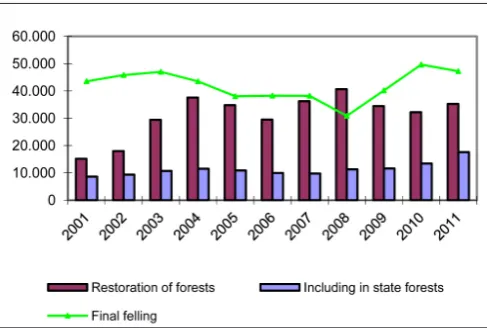
Figure 3. Main areas of deforestation and forest restoration (ha) Source: State Forest Service, http://www. vmd.gov.lv/?sadala=762
Non-reduction of forest areas and volume stand is one of
the key indices characterizing sustainable forest management.
According to the data of the State Forest Service forest areas, if compared to 1920’s, have doubled – in 2010 percent of forest area amounted to 50,5%, while in 1923 it was
only 23%. Latvia is a country rich in woods in comparison with other European countries, as forest in Europe occupy
33% of land territory on an averages (Valsts meža dienesta 2010. gada publiskais pārskats, 2011:42). However, certain
environmental risk and urgency of deforestation problem in Latvia is indicated by the fact that areas of deforestation over the last years have more and more exceeded the areas of forest restoration and the restored forest plantations will be useable only after several decades. Beginning with 2008 more timber has been logged in state forests than in the forests owned by
other possessors; it was especially obvious in 2009, when
72% of the whole deforested volume were obtained from state
forests (see Figure 4).
Since the beginning of 1990’s volumes of deforestation
have increased every year till 2003, when the downtrend has been observed till 2008; however, during the period of crisis
in 2009–2011 an increase in deforestation could be observed
again, especially in state forests, considering the importance of timber export at that time.8
Figure 4. Areas deforested by clear cutting in 2004–2011 (ha) Source: State Forest Service, http://www.vmd.gov. lv/?sadala=762
Turning to environmental risks associated with waste generation and management, statistical data show that the amount of household waste generated in Latvia has increased
since 1996; however, a descending tendency can be observed
after 2007. As it was already mentioned above, the amount of generated waste per capita in Latvia is still relatively low if compared to other countries, including such neighbouring
country as Estonia and Lithuania (see Figure 5).
Figure 5. Household waste generation per capita (kg) Source: Eurostat, http://epp.eurostat.ec.europa.eu/portal/page/ portal/structural_indicators/indicators/environment
A new „Law on Waste Management” was adopted in 2010 with the aim to „specify the procedure of waste management in order to protect the environment, human life and health by preventing generation of waste, ensuring separated collection and regeneration of waste generated on the territory of Latvia,
as well as facilitating efficient utilization of natural resources
and reduction of the amount of dumped wastes” (Atkritumu
apsaimniekošanas likums, Article 2). In the context of
sustainable development it is essential to examine not only
the volumes of waste generation, but also the efficiency of
management of waste already generated. The objectives of waste management in Latvia in relation to the generated waste are to ensure that:
• waste is not hazardous or poses minor risk to the 8 Deforestation in Latvia attracted attention of public also at international
level – a petition was published at www.thepetitionsite.com, in which people from different countries required that Latvia stopped deforestation activities,
environment and health;
• the greatest part of waste is returned into economic turnover, particularly using recycling, or is returned to
the environment in a useful or non-hazardous form; • the amount of dumped waste is reduced to a minimum
and waste is disposed or dumped in a way harmless to the environment and human health;
• waste is processed as close as possible to the places of
generation (Atkritumu apsaimniekošanas valsts plāns 2006–2012. gadam, 2005:5-6).
Latvian society still continues to adopt
environment-friendly lifestyle and this applies also to the situation with waste separation in Latvia, which has not become a routine practice yet. Considering statistical data on the volumes of household waste dumping, it should be acknowledged that in
Latvia these indices far exceed average figures in European union (see Figure 6); therefore a lot has to be done to achieve
that the greatest part of waste is returned into economic turnover. The comparison of data on the Baltic States shows that Estonia has improved its waste management and today it is close to average indices of the European Union, while in
Latvia and Lithuania there are no significant improvements
yet, though certain descending tendency can be observed in 2008–2010.
Figure 6. Household waste dumping per capita (kg) Source: Eurostat, http://epp.eurostat.ec.europa.eu/portal/page/portal/ structural_indicators/indicators/environment
Speaking specifically about hazardous wastes constituting
a danger to human life and health, as well as the environment,
endangering waters, air, land, and flora and fauna, the key
waste generators in Latvia are manufacturing facilities. In
2004–2009 the amount of both generated and collected
waste has increased. In 2010 the amount of generated waste dropped by approximately 43%; however, in 2011 the level of
generated waste even exceeded the amount observed in 2009.
Also the amount of collected waste in 2011 decreased by
34% if compared with 2009. On the other hand, while during the period from 2006 till 2009 exported amounts have been
decreasing, this value slightly grew in the recent years. As for the amounts of recycled hazardous waste, there were no
significant variations till 2010; however, in 2011 their level dropped substantially (by 59% comparing with 2010) (see Figure 7).
Figure 7. Hazardous waste in Latvia in 2002–2011, tons Source: CBS, http://www.csb.gov.lv/statistikas-temas/vides-aizsardziba-datubaze-30120.html
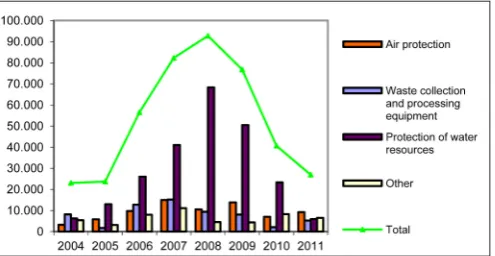
Latvia’s investments in the environmental protection after Latvia joined European Union have increased considering also the support provided by European funds for implementation
of environmental project (see Figure 8). In 2004 these
investments amounted to 23 million lats, while in 2008 they
grew fourfold (92.7 million lats). The greatest amounts were invested by companies and municipalities mostly in the protection of water resources. However, during the period from 2008 till 2011 these investments have shrunk gradually.
Figure 8. Investments in environmental protection (actual prices, thous. lats) Source: CBS,
http://www.csb.gov.lv/statistikas-temas/vides-aizsardziba-datubaze-30120.html
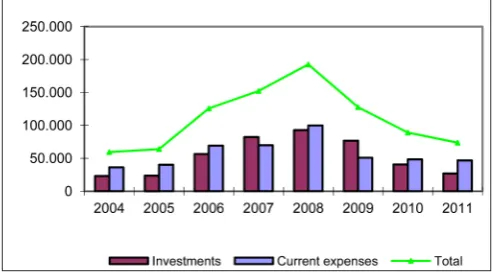
During the past three years both investments and current expenses on environmental protection have experienced certain decrease. As it can be seen, this sphere was also affected by the crisis, which resulted in the amount of public investments. It should be still noted that it is not correct to
compare data of 2009-2011 with the previous periods, as
according to the information provided by CBS the sample size
has decreased since 2009 and not all of the sectors have been
analyzed.9 However, it is worth mentioning that the volume
of investments in environmental protection is proportional
to the expenses, which were necessary to maintain this field.
Notwithstanding substantial investments expenses were in excess of investments almost every year except for the years
9 Data after 2009 have been obtained from all economically active busi-nesses belonging to the group of big busibusi-nesses (100 and more employees)
with the following codes according to NACE. Rev.2.: 08-34, 39, and 49, and NACE Rev.2.: 35, 36, 37, 38, where the number of employees is 20 and
more; others were analyzed randomly and data were generalized. The sample
size in 2006 was 5000, in 2007 it amounted to 4000, in 2008 it was 3000, in 2009 – 900, and in 2010 it amounted to 1057. In 2007 municipalities did not
2007 and 2009 (see Figure 9). This could be indicative of the
fact that the amount of funds invested in the environmental
protection in Latvia is still insufficient for solving ecological
risks. The tendency of the reduction of state and municipal
investments in the fields related to environmental protection
also shows a certain decline in environmental investments, which will need recovery when the crisis is over.
Figure 9. Expenditures on environmental protection (actual prices, thous. lats) Source: CBS: http://www.csb.gov. lv/statistikas-temas/vides-aizsardziba-datubaze-30120.html
Conclusions
Having considered the above indices related to sustainable development, which are analyzed and summarized by CBS on a regular basis, the following conclusions can be drawn:
Greenhouse gases emissions in Latvia, if compared to
1990, which was set as a reference year, in all sectors are still lower than those specified according to the standards of
Kyoto protocol. Latvia leaves behind other EU countries in this sphere; however, this should be viewed in the context of the situation in the production sector. Therefore, in order to
maintain positive figures in terms of emissions, Latvia has to move towards innovative and environmentally efficient
economy, as it is stated in Latvia’s Strategy for Sustainable Development.
According to statistical data restoration of forests in Latvia generally proceeds more intensively than deforestation; however, in the past deforested areas more and more exceeded the areas of forest restoration, and utilization of new plantations will be possible only after several decades; therefore, the problem of deforestation is still urgent in Latvia and requires close monitoring until further development.
The amount of waste generated in Latvia per capita still remains relatively low. It is lower than average level in other countries of the European Union. However, the amounts of dumped waste are much higher than average European
figures, which indicates that a lot is still to be done in Latvia in the field of waste processing, including the formation of the
habit of waste separation.
The amount of investments in environmental protection in Latvia just after joining the European Union has increased manifold; however, in the previous years quite a large part of the funds was provided by European Union. The amount of
this financing has slightly decreased by now. As a result of the effects of the crisis provision of financing for environmental
protection has decreased. If this tendency persists, deceleration
of the rate of development of the quality of life is possible in future.
Considering the development of Latvia from the point of view of sustainable development basing upon both international obligations of the country and national objectives, as well as the dynamics of statistical data it can
be concluded that Latvia needs a more efficient management, including well-thought-out and coordinated action at national
level, and not just episodic activities, which in fact are limited to the reaction to international obligations.
Characterizing the dynamics of ecological risks in Latvia in the past 5–7 years it can be said that in Latvia on the whole risks, which could endanger ecological situation in the country, are less expressed than in other European
countries. However, there are certain figures, e.g., in the field
of waste storage and processing in Latvia, that are still at an unsatisfactory level, which results in greater environmental
risk in this field than in other countries of the European Union.
There are, of course, also environmental factors data on which has not been summarized, but which could have an impact on environmental protection in the country, e.g., environmental hazards caused by neighbouring countries, growing of
genetically modified plants in Latvia, public awareness of
environmental issues and readiness to get involved in solving these issues, etc. However, these factors call for an analysis in a separate article, where the results of various sociological surveys related to environmental problems in Latvia would be reviewed.
References
APSL (2007). Analītisko pētījumu un stratēģiju laboratorija. Latvijas ilgtspējīgas attīstības stratēģija līdz 2030. gadam. Pamatziņojums. Available at: http://www. latvija2030.lv/upload/lias_pamatzinojums_lat.pdf Briska, I. (2010). Sustainable development: dynamics of
environmental awareness and environmental behaviour
in Latvia, 2006-2010. In: Economics. Communication Sciences. Political Science. Sociology. Social Policy and Social Work. Law: Collection of Scientific Papers, 2011: Rīga Stradiņš University Research Articles. Rīga, pp.
43–51.
Care2 (2012). Care 2 Petitionsite. Latvia, Stop Destroying
Your Forests. Available at: http://www.thepetitionsite.
com/1/latvia-stop-destroying-your-forests/
CEC (2009). Commission of the European Communities.
Mainstreaming sustainable development into EU
policies: 2009 Review of the European Union Strategy
for Sustainable Development: Communication from the Commission to the European Parliament, the Council, the European Economic and Social Committee and the Committee of the Regions. Commission of the European
Communities, Brussels, 24.7.2009, COM(2009) 400 final. Available at: http://eur-lex.europa.eu/LexUriServ/ LexUriServ.do?uri=COM:2009:0400:FIN:EN:PDF Council of the European Union (2006). Review of the EU
Sustainable Development Strategy (EU SDS): Renewed
Strategy. Brussels, 9 June, 2006. Available at: http://
CSP. Centrālās statistikas pārvaldes vides aizsardzības datubāze. Available at: http://www.csb.gov.lv/statistikas-temas/vides-aizsardziba-datubaze-30120.html
European Commission (2010). Europe 2020: A Strategy for Smart, Sustainable and Inclusive Growth, Brussels,
2010.3.3, COM(2010) 2020 final. Available at: http://eur-lex.europa.eu/LexUriServ/LexUriServ.do?uri=COM:201 0:2020:FIN:EN:PDF
European Council (2001). Presidency Conclusions, Göteborg
European Council, 15–16 June 2001. Available at: http:// www.consilium.europa.eu/ueDocs/cms_Data/docs/
pressData/en/ec/00200-r1.en1.pdf
Eurostat (2010). European Commission, Eurostat. Structural indicators: Environment, last update 03.03.2010. Available at: http://epp.eurostat.ec.europa.eu/portal/page/ portal/structural_indicators/indicators/environment Eurostat (2011). Sustainable Development in the European
Union: 2011 Monitoring Report of the EU Sustainable Development Strategy. Eurostat Statistical Books,
European Union, 2011. Luxembourg: Publications Office
of the European Union. Also available at: http://epp.
eurostat.ec.europa.eu/cache/ITY_OFFPUB/KS-31-11-224/EN/KS-31-11-224-EN.PDF
Hulse, J. H. (2007). Sustainable Development at Risk: Ignoring the Past. Ottawa: International Development
Research Centre [open e-book]. Available at: http://idrc/
ca/openebooks/368-3/
Kursiša, G. Nacionālā attīstības plāna vadmotīvs – “ekonomikas izrāviens”. Available at: http://www.
db.lv/citas-zinas/nacionala-attistibas-plana-vadmotivs-ekonomikas-izraviens-253622
Latvijas Vides, ģeoloģijas un meteoroloģijas centrs. Sagatavotie un iesniegtie ziņojumi. Available at: http://
www.meteo.lv/public/29658.html Lidskog, R. (2001). The re-naturalization of
society? Environmental challenges for sociology.
Current Sociology, 49 (1): 113–136. DOI:
10.1177/0011392101049001007. Also available at: http://
csi.sagepub.com/content/49/1/113
LR MK (2005). Atkritumu apsaimniekošanas valsts plāns 2006.–2012. gadam. LR Ministru kabineta 2005.29.XII rīkojums Nr. 860. Available at: http://polsis.mk.gov.lv/
view.do?id=2271
LR Saeima (2010a). Latvijas ilgtspējīgas attīstības stratēģija līdz 2030. gadam, Latvijas Republikas Saeima, 2010. gada jūnijs. Available at: http://www.latvija2030.lv/ upload/latvija2030_lv.pdf
LR Vides aizsardzības un reģionālās attīstības ministrija (2007). Latvijas Republikas nacionālais pārskats par
ilgtspējīgas attīstības īstenošanu. Available at: http:// www.varam.gov.lv/lat/darbibas_veidi/ilgtspejiga_
attistiba/?doc=5109
LR Saeima (2010b). Atkritumu apsaimniekošanas likums, pieņemts 2010.28.X. Latvijas Vēstnesis, Nr. 183, 17. nov. Also available at: http://www.likumi.lv/doc.
php?id=221378&from=off
Patzelt, H., Shepherd, D. A. (2011). Recognizing opportunities for sustainable development.
Entrepreneurship: Theory and Practice, 35 (4): 631–652
(Questia, Web, 2012.17.III).
Redclift, M. (2009). The environment and carbon dependence: landscapes of sustainability and materiality. Current Sociology, 57 (3): 369. DOI: 10.1177/0011392108101588. Also available at http://csi.
sagepub.com/content/57/3/369
Römpczyk, E. (2007). Gribam ilgtspējīgu attīstību. Rīga: Friedrich-Ebert-Stiftung: DUE. Also available at: http://
www.varam.gov.lv/files/text/Darb_jomas//Book_
gribamia.pdf
Sutton, P. (2007). The Environment: A Sociological Introduction. Chichester: Polity Press, pp. 126–143.
Taylor, D. M., Taylor, G. M. (2007). The requirements of a sustainable planetary system. Social Alternatives, 26 (3): 10–16 (Questia, Web, 2012.17.III).
United Nations (1992). Agenda 21, The United Nations Programme of Action from Rio, UN Earth Summit, 1992.
Available at: http://www.un.org/esa/dsd/agenda21/index. shtml
United Nations (2002). Johannesburg Plan of
Implementation, UN World Summit on Sustainable Development, 2002. Available at: http://www.un.org/esa/ sustdev/documents/WSSD_POI_PD/English/POIToc.htm
VMD. Valsts meža dienests, Meža statistikas CD. Available
at: http://www.vmd.gov.lv/?sadala=762
VMD (2011). Valsts meža dienesta 2010. gada publiskais pārskats, 2011. Available at: http://www.vmd.gov.lv/ doc_upl/VMD_PUBLISKAIS_PARSKATS_2010.pdf
WCED (1987). Our Common Future. Report of the
World Commission on Environment and Development (WCED), transmitted to the General Assembly as an Annex to document A/42/427 “Development and
International Co-operation: Environment”, 1987.
Available at: http://www.un-documents.net/wced-ocf.htm Zaļā brīvība (2007). Biedrība “Zaļā brīvība”. Nevalstisko
organizāciju ziņojums par ilgtspējīgu attīstību Latvijā.
Available at: http://www.nap.lv/upload/nvo_zinojums.pdf