Vibration Analysis of Composite Leaf Spring by
Finite Element Method
Hemant Rajendra Nehete Assistant Professor
Department of Mechanical Engineering
J. T. Mahajan college of Engineering, Faizpur Faizpur 425503, India
Abstract
Vibration is an oscillation wherein the quantity is a parameter that defines the motion of a mechanical system. The main causes of vibration are unbalanced forces in the machine, dry friction between the mating surfaces, external excitation, earthquakes, wind self-excited vibrations, misalignment of rotating shaft, looseness in rotating machinery, loose foundations and excessive bearing clearances, oil whirl in bearing. The harmful effects of vibrations are excessive stresses in machine parts and undesirable noise. Also due to high vibration there are looseness of parts and partial or complete failure of parts. This vibration phenomenon is used in some musical instruments, vibrating conveyors, shakers, vibrating screens, stress relieving. This vibration can be reduced by removing the causes of vibration, by vibration isolation. Also vibration can be controlled by using shock absorbers and by installing dynamic vibration absorbers. Using composite material also vibration reduce. Automobile suspension Leaf spring consist high vibration during motion. By binding the composite material to steel spring the vibration can be reduced. ANSYS software used for Finite Element Analysis for vibration analysis.
Keywords: Vibration, Composite Material, Natural Frequency, Mode Shape
_______________________________________________________________________________________________________
I. INTRODUCTION
A leaf spring is a simple form of spring, commonly used for the suspension in vehicles. A leaf spring which is an automotive component is used to absorb vibrations induced during the motion of vehicle. Leaf Springs are long and narrow plates attached to the frame of a trailer that rest above or below the trailer's axle. There are single leaf springs and multi leaf spring used based on the application required. It also acts as a structure to support vertical loading due to the weight of the vehicle and payload. Under operating conditions, the behavior of the leaf spring is complicated due to its clamping effects and interleafs contact, hence its analysis is essential to predict the displacement and mode frequency the objective of this paper is to analyze the leaf spring for the constraints such as material composition, vibrations developed in the springs. And finally for both, the analytical results are compared with experimental results and verified. Vibration analysis is done and also how much damping will be required for the spring is determined. Mode frequency for the spring is also determined using ANSYS software. This Project Vibration analysis plays a very important role in the design of composite leaf spring, since the failure due to vibration is more prominent rather than material failure. The heavy & light vehicles need a good suspension system that can deliver a good ride and handling. At the same time, it needs to be lightweight and have an excellent fatigue life. Springs are crucial suspension elements in cars necessary to minimize the vertical vibrations, impacts and bumps due to road irregularities and create a comfortable ride. Vertical vibrations and impacts are buffered by variations in the spring deflection so that potential energy is stored in spring as strain energy and then releases slowly. So increasing the strain energy capacity of the leaf spring ensures a more compliant suspension system. Therefore, material with maximum strength and minimum modulus of elasticity in the longitudinal direction is the most suitable material for a leaf spring. Composite materials are now used extensively in the automotive industry to take the place of metal parts. So it is essential to provide hybrid composite leaf spring with reduced spring rate, which evenly distributes glass fibers and carbon fibers, graphite fiber throughout resin matrix. The hybrid composite materials offer the various advantages like maximum strength, minimum modulus of elasticity in the longitudinal direction, weight & vibration reduction, improved packaging, strain energy capacity, improved durability & fatigue life and cost reduction due to the use of glass fibers & carbon fibers over the conventional composites materials
II. PROBLEM DEFINITION
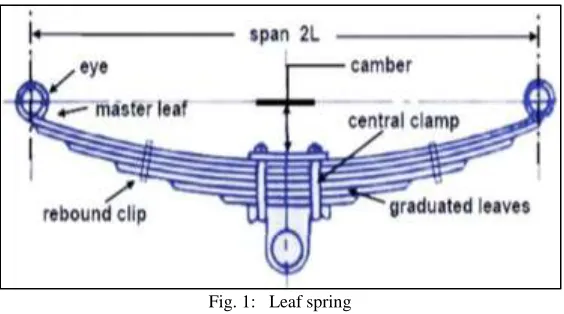
Fig. 1: Leaf spring
III. NEED OF COMPOSITE LEAF SPRING
Vibration analysis plays a very important role in the design of composite leaf spring. A leaf spring is a simple form of spring used for suspension in vehicles. Every heavy and light vehicle needs a good suspension system. A leaf spring is an automotive component used to absorb vibration induced during the motion of vehicle, so for that there should be light weight construction of leaf spring also it have good fatigue life. So for this composite leaf spring is better option over steel leaf spring. Nowadays composite materials are extensively used allover in industries. So it is essential to provide composite leaf spring with reduced spring rate. The composite materials have various advantages like maximum strength, minimum modulus of elasticity in the longitudinal direction, weight and vibration reduction, improved packaging, strain energy capacity, improved durability and fatigue life and cost reduction due to use of composite material. So composite leaf spring is more economical over steel leaf spring.
IV. OVERALL DISCUSSION ON RESEARCH
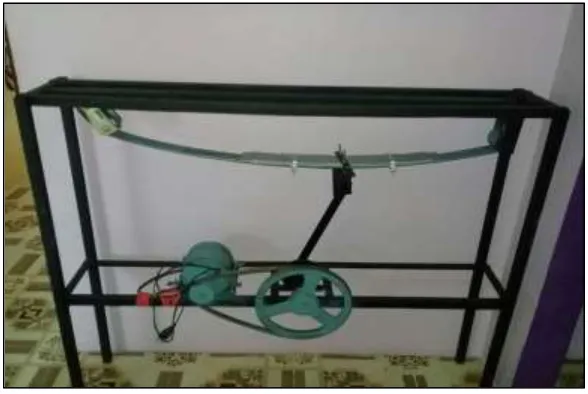
Fig. 2: Composite Leaf spring
Material Properties required for static and vibration analysis Mode shape analysis (vibration analysis)
Case- simply supported
Load required for static analysis=3250N
Material properties of both composite and M.S Spring:
Table – 1 Material properties
Material Density Kg/m3 Youngs Modulus N/mm2 Yield tensile strength N/mm2
Mild Steel 7.7x10³ 2.1x10⁵ 1962
E glass Epoxy 7.7x10³ 207x103 1575
Dimensions of spring
Length (Eye to eye) =1200mm Thickness of Leaf spring=8mm Width of Leaf spring=60mm Dimension of clamping=80x40mm Free casher load condition=120mm
V. FINITE ELEMENT MODELING
The main rule that involved in finite element method is “DEVIDE and ANALYZE”. The greatest unique feature which separates finite element method from other methods is “It divides the entire complex geometry into simple and small parts, called “finite elements”. These finite elements are the building blocks of the finite element analysis. Based on the type of analysis going to be performed, these elements divided into several types. Division of the domain into elements is called “mesh”. The forces and moments are transferred from one element to next element are represented by degrees of freedom (DOFs) at coordinate locations which are called as “nodes”. Approximate solutions of these finite elements give rise to the solution of the given geometry which is also an approximate solution.
The approximate solution becomes exact when
1) The geometry is divided into numerous or infinite elements.
2) Each element of geometry must define with a complete set of polynomials (infinite terms).
The finite element method has become a powerful tool for the numerical solution of a wide range of engineering problems. It has developed simultaneously with the increasing use of high-speed electronic digital computers and with the growing emphasis on numerical methods for engineering analysis. This method started as a generalization of the structural idea to some problems of elastic continuum, is well-established numerical method applicable to any continuum problem, stated in terms of differential equations or as an extranet problem.
The fundamental areas that have to be learned for working capability of finite element method include 1) Matrix algebra.
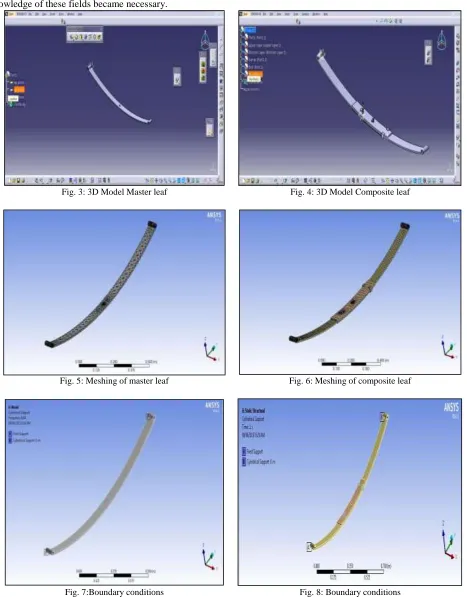
Fig. 3: 3D Model Master leaf Fig. 4: 3D Model Composite leaf
Fig. 5: Meshing of master leaf Fig. 6: Meshing of composite leaf
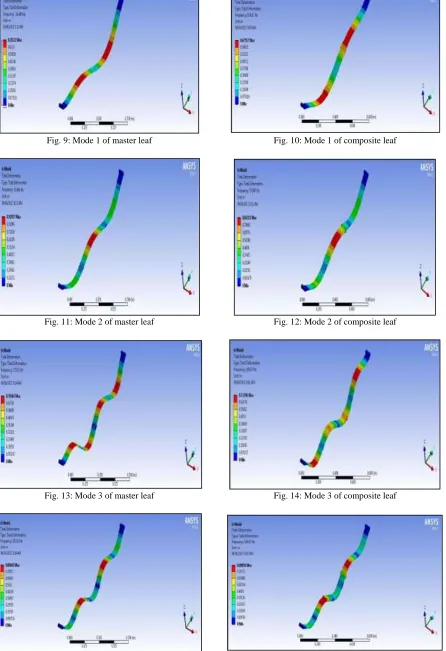
Fig. 9: Mode 1 of master leaf Fig. 10: Mode 1 of composite leaf
Fig. 11: Mode 2 of master leaf Fig. 12: Mode 2 of composite leaf
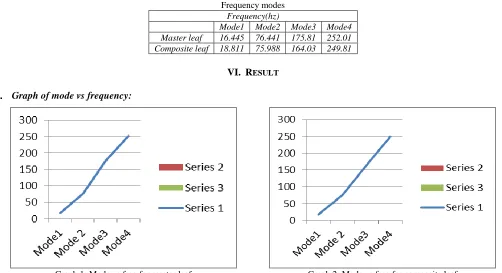
Graph 1: Mode vs freq for master leaf Graph 2: Mode vs freq for composite leaf
VII.CONCLUSION
The composite leaf spring is designed according to constant cross-section area method. The 3-D model of the composite leaf spring is analyzed using finite element analysis. The results of the FEM analysis are verified with the test results. A comparative study has been made between composite and steel leaf springs with respect to weight, riding quality, cost and strength. From the study it is seen that the composite leaf spring are lighter and more economical than that of conventional steel leaf springs for similar performance. Hence, the composite leaf springs are the suitable replacements to the convectional leaf springs.
ACKNOWLEDGEMENT
Author is thankful for Prof. T. D. Garse for his guidance and constant inspiration for the project work. Also author is very much thankful to Prof. D. A. Warke (Head, Department of Mechanical Engineering) for his invaluable guidance and support.
REFERENCES
[1] W. J. Yu and H. C. Kim, “Double Tapered FRP Beam for Automotive Suspension Leaf Spring,” published in “Composite Structures”, 1988, pp. 279-300.
[2] Erol Sancaktar and Mathieu Gratton, “Design, analysis, and optimization of composite leaf springs for light vehicle applications”,published in “Composite
Structures” 1999, pp. 195-204.
[3] Rajendra and S. Vijayarangam, “Optimal design of a composite leaf spring using genetic algorithms”, “Computers and structures”, 2000, pp. 1121-1129.
[4] J.P. Hou, J.Y. Cherruault, I. Nairne, G. Jeronimidis, R.M. Mayer, “Evolution of the eye-end design of a composite leaf spring for heavy axle loads”,
“Composite Structures, “2005, pp. 351-358.
[5] Smita C. Saddu, Vikas V. Shinde, “Modelling and Analysis of Composite as an Alternative Material for Leaf Spring”, IOSR Journal of Mechanical and Civil
Engineering (IOSR-JMCE) e- ISSN: 2278-1684,p-ISSN: 2320-334X, Volume 11, Issue 3 Ver. IV (May- Jun.2014), PP 39-44.
[6] Rangaswamy T and Vijayarangan S, “Optimal Sizing and Stacking Sequence of Composite Drive Shafts”, Journal of Materials science, Vol.11, No.2, 2005,
pp. 133-139.
[7] Pankaj Saini, Ashish Goel & Dushyant Kumar, “Design and Analysis of composite leaf spring for light vehicles”, international journal of innovative research
in science, engineering and technology, vol. 2, issue-5, 2013.
[8] Shishay Amare Gebremeskel, “Design, Simulation, and Prototyping of Single Composite Leaf Spring for Light Weight Vehicle”, Global Journals Inc. (US)
, Vol 12, No 7-A (2012) .
[9] B.Vijaya Lakshmi I. Satyanarayana “Static and Dynamic analysis on Composite Leaf Spring in Heavy Vehicle” International Journal of Advanced
Engineering Research and Studies (IJAERS) ISSN 2249–8974, Vol.II, Issue I, Oct-Dec.2012, pp.80-84.
[10] Mohammed MathenullaShariff ,N. SreenivasaBabu, Dr. JaithirthaRao “Analysis of Glass Epoxy Reinforced Monolithic Leaf Spring” International OPEN
ACCESS Journal Of Modern Engineering Research (IJMER), ISSN: 2249–6645 , Vol. 4, Iss. 8, pp-Aug. 2014.
[11] T. Bhanuprasad, A Purushotham “Performance Comparative Analysis of S-Glass Epoxy Composite leaf spring with M. S. LEAF SPRING” IOSR Journal of
Mechanical and Civil Engineering (IOSR-JMCE) ,Volume 10, Issue 4, pp-38-41, Nov. - Dec. 2013.
[12] Edward Nikhil Karlus, Rakesh L. Himte, Ram Krishna Rathore “Optimization Of Mon Parabolic Leaf Spring” International Journal of Advances in
[13] M. Raghavedra , Syed Altaf Hussain , V. Pandurangadu and K. PalaniKumar, “Modeling and Analysis of Laminated Composite Leaf Spring under the Static Load Condition by using FEA”, International Journal of Modern Engineering Research (IJMER) Vol.2, Issue.4, July-Aug. 2012 pp-1875-1879 ISSN: 2249-6645.
[14] Malaga. Anil Kumar, T.N.Charyulu and Ch.Ramesh, “Design Optimization of Leaf Spring”, International Journal of Engineering Research and Applications
(IJERA) ISSN: 2248-9622, Vol. 2, Issue 6, November-December 2012, pp.759-765.
[15] M. Raghavedra , Syed Altaf Hussain , V. Pandurangadu and K. PalaniKumar, “Modeling and Analysis of Laminated Composite Leaf Spring under the Static