World Maritime University
The Maritime Commons: Digital Repository of the World
Maritime University
World Maritime University Dissertations Dissertations
2001
Web based distance learning management systems
Kevin Okon OkonnaWorld Maritime University
Follow this and additional works at:http://commons.wmu.se/all_dissertations Part of theOnline and Distance Education Commons
This Dissertation is brought to you courtesy of Maritime Commons. Open Access items may be downloaded for non-commercial, fair use academic purposes. No items may be hosted on another server or web site without express written permission from the World Maritime University. For more information, please [email protected].
Recommended Citation
Okonna, Kevin Okon, "Web based distance learning management systems" (2001).World Maritime University Dissertations. 65.
WORLD MARITIME UNIVERSITY
Malmö, Sweden
WEB BASED DISTANCE LEARNING
MANAGEMENT SYSTEMS: AN INVESTIGATION
INTO WMU’S FUTURE NEEDS
By
KEVIN OKON OKONNA
Nigeria
A dissertation submitted to the World Maritime University in partial
fulfilment of the requirements for the award of the degree of
MASTER OF SCIENCE
in
MARITIME AFFAIRS (Maritime Education and Training)
2001
DECLARATION
I certify that all the material in this dissertation that is not my own work has been identified, and that no material is included for which a degree has previously been conferred on me.
The content of this dissertation reflect my own personal views, and are not necessarily endorsed by the University
(Signature) ………..
(Date) ………...
Supervised by: Professor Peter Muirhead World Maritime University
Assessor: Professor Shuo Ma
World Maritime University
Co-assessor: Professor Malek Pourzanjani
ACKNOWLEDGEMENT
I express my profound gratitude to everyone that has contributed to the success of this
research.
In particular I thank my Course Professor, Peter Muirhead for his encouragement and
support to me throughout my studies and for arranging access to the Lecando system for
this research. I will also continue to remember the special interest and assistance I
received from Professor Moira McConnell, Mr David Moulder, the Librarian, Ms Susan
Wangeci-Eklow, the Assistant Librarian, Ms Solveig Anelli, the Faculty Assistant to the
MET, and Ms Cecilia Denne, the Library Assistant. This research also benefited
immensely from the technical contributions of Mr Mikael Gudmundsson of Lecando AB,
Mr Bertil Wagner, the Computer Lecturer and Mr Bengt Emanuelsson, the WMU’s
Network Specialist.
I specially acknowledge the support I received from the entire WMU staff, non-resident
lecturing staff and students who made valuable contributions to this research.
My gratitude also goes to the authorities of the World Maritime University that provided
the funds for my studies.
Finally, I would like to acknowledge the support I have received from my institution, the
Maritime Academy of Nigeria and my relatives at home during the course of my studies
ABSTRACT
Title of Dissertation: Web Based Distance Learning Management Systems: An Investigation into WMU’s Future Needs
Degree: M. Sc.
This dissertation focuses on Web based distance learning management systems and the
investigation into the potential use of such a system by the World Maritime University.
It starts with an overview of the current state of distance learning, its methodologies, the
impact of evolution in technology up to the Internet/World Wide Web.
The reasons for and the barriers to the development of Web based distance learning are
identified before discussing the areas of the challenges to the WMU’s academic standing
requiring increasing goals and activities. The technological requirements for hosting or
using a Web based learning environment are identified and explained. Also, the
pedagogical principles such as learner-centred approach, constructivism theory of
education, and interactive learning tasks, on which online course design depends are
discussed.
Through the examination and comparison of three of the widely used Web based course
management systems, the research presents a detail analysis of the technological features
required for creating interactive learning opportunities through a Web based distance
learning management system. A working model of a Web based course was developed
on one of the examined Web based learning platforms and the trial operations using a
test group of WMU staff and students was monitored and evaluated.
The analyses of the examination of the three Web education systems, the trial operations
results, and the questionnaire responses received from both staff and students are used to
identify the strengths and limitations of Web based distance learning management
recommendations are made concerning the potential use of a Web based distance
learning management system by the World Maritime University.
TABLE OF CONTENTS
Declaration ii
Acknowledgement iii
Abstract iv
Table of Contents vi
List of Tables x
List of Figures xi
List of Abbreviations xii
1. Introduction 1
1.1 Background to the study 1
1.2 Importance of the study 2
1.3 Purpose of the study 2
1.4 Research Methodology 2
1.4.1 Research design 2
1.4.2 Sampling method 3
1.4.3 Interval level of measurement 3
1.4.4 Validity and reliability 4
1.4.5 Data collection methods 4
1.4.6 Scope and limitations 5
2. Web based distance learning:
The implications for the WMU 6
2.1 The concept of distance learning 6
2.1.1 Open learning 7
2.1.2 Distance learning 7
2.1.3.1 Distributed learning 8
2.1.3.2 Dedicated distance learning 10
2.1.4 Global players in distance education 10
2.2 Technology and the development of distance learning systems 11
2.3 Internet and the World Wide Web (WWW): The relationship 11
2.4 Web based distance education 13
2.4.1 Stakeholders in Web based distance education 13
2.4.2 Web based distance learning management systems 13
2.5 Reasons for the development of Web-based distance learning
systems 14
2.6 Barriers to the development of Web-based distance learning
systems 16
2.7 Implications of the development of Web-based distance learning
for the WMU 17
2.7.1 Global Role of the WMU 17
2.7.2 Challenges to WMU’s academic standing 18
2.7.3 The potential of Web based distance learning for WMU
capacity development 19
3. The web based distance learning environment 21
3.1 Pedagogical issues 21
3.1.1 Knowledge construction and online learning 22
3.1.2 Pedagogical implications of online distance learning 23
3.2 Characteristics of Web based distance learning environments 24
3.2.1 Web based course management system 25
3.3 Required technology for Web based course management system 26
3.3.1 Foundation architecture 26
4. Examination of some Web based distance education
management systems 32
4.1 Comparison of Web based education systems 32
4.1.1 Observations 37
4.2 Examination of features of Blackboard 5.0, WebCT 3.5 and
Lecando learning platforms 38
4.2.1 Examination of features 39
4.2.2 Summary of ratings 59
4.3 Development trends in Web based distance education management 60
5. Working model of a Web based course 61
5.1 Administrative issues 61
5.1.1 Strategic decisions 62
5.1.2 Tactical decisions 63
5.1.3 Team approach 63
5.2 Critical design elements for a web based course 65
5.2.1 Instructional and audience analyses 65
5.2.2 Course goals and objectives 65
5.2.3 Course content 66
5.2.4 Learning (instructional) activities 66
5.2.5 Learning Support 67
5.2.6 Evaluation 67
5.3 Model Web based course design and trial operations 67
5.3.1 Principles 67
5.3.2 The Platform 68
6. Data collection and analysis 72
6.1 Questionnaire data analysis 72
6.1.1 Sampling method 72
6.1.2 Questionnaires construction 73
6.1.3 Data collection method 74
6.1.4 Questionnaire data analysis 74
6.2 Analysis of data from examination of Web based distance
education management systems 91
6.3 Analysis of data from trial operations results 91
6.3.1 Evaluation results 92
6.3.2 Limitations 93
7. Conclusions and recommendations 94
7.1 Conclusions 94
7.2 Recommendations 97
References 99
Appendices
Appendix 1 Evolution in distance learning technology 104
Appendix 2 Blackboard 5 minimum hardware/software requirements 105
Appendix 3 Questionnaire data from Lecando 106
Appendix 4 E-mail request for volunteers in the trial operations of
working model course 110
Appendix 5 Text of test questions 111
Appendix 6 Generated discussion pattern in working model course 113
Appendix 7 Research questionnaire (for staff) 114
LIST OF TABLES
Table 4.1 List of some Web based course management systems 33
Table 4.2 Comparison of Web based education systems 34
Table 4.3 Summary of WebCT, Blackboard, and Lecando features 56
Table 4.4 Summary of ratings 59
Table 6.1 Lecturing staff responses to questionnaire 76
Table 6.2 Administrative staff responses to questionnaire 79
Table 6.3 Non-resident lecturing staff responses to questionnaire 82
Table 6.4 Students responses to questionnaire 85
Table 6.5 Summary of preferences for Web based learning tools 88
LIST OF FIGURES
Figure 3.1 Foundation architecture for a Web based course
management system 27
Figure 4.1 Blackboard’s opening screen 41
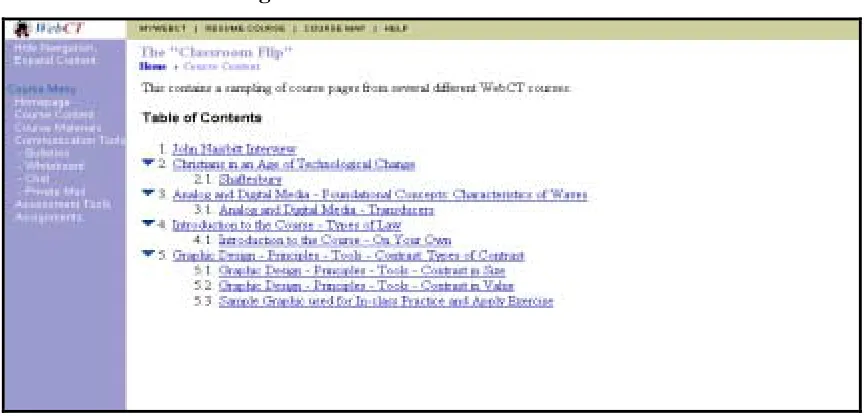
Figure 4.2 WebCT’s homepage 42
Figure 4.3 Lecando startpage 43
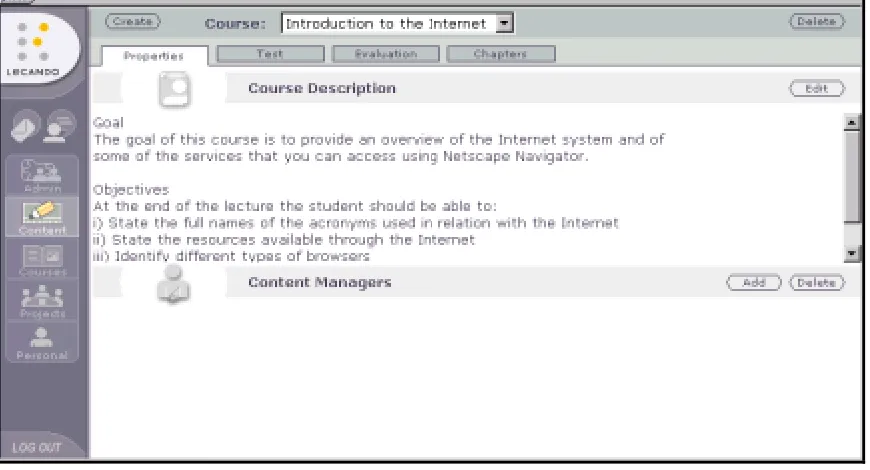
Figure 4.4: Course content display in Lecando system 44
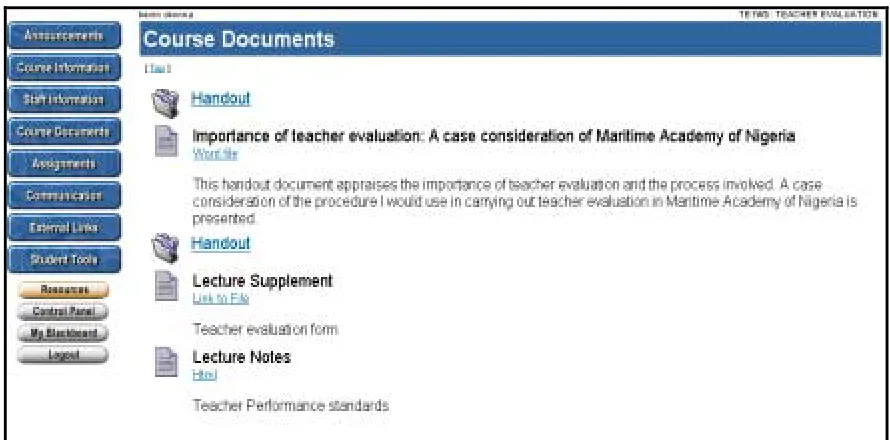
Figure 4.5: Course document page in Blackboard 45
LIST OF ABBREVIATIONS
AICC Aviation Industry CBT Committee
BBS Bulletin Board System
CBS Copenhagen Business School
CBT Computer Based Training
CD-ROM Compact Disc Read Only Memory
CLADEA Consejo Latinoamericano de Escualas de Administrcion
CMC Computer Mediated Conference
CRE The Association of European Universities
ESC Ecole Superieure de Commerce
GB Gigabytes
GTTI Global Telecommunication Training Institute
GTU Global Telecommunication University
HTML Hypertext Markup Language
IMO International Maritime Organisation
IMS Instructional Management System
J2EE Java 2 Enterprise Edition
MB Megabytes
MBA Master of Business Administration
MET Maritime Education and Training
MIT Massachusetts Institute of Technology
OECD Organisation for Economic Co-Operation and Development
OS Operating System
RAM Random Access Memory
TCP/IP Transmission Control Protocol/Internet Protocol
TV Television
URL Universal Resource Locator
US United States of America
Chapter 1
Introduction
1.1 Background to the study
The World Maritime University (WMU) was established in 1983 to serve the global
maritime community as the International Maritime Organisation’s apex institution for
high-level maritime education and training, in furtherance of IMO’s aims and objectives
(WMU, 2001, p. 3). Since its establishment the university has operated in a limited
capacity perceived to be market driven and graduating about 100 students annually.
However the statistics of applications for admission indicates about three times the size
of on-campus opportunities due to limited resource base and infrastructure (Data
obtained from WMU’s Registry). Also, the globalisation movement in higher education
is likely to pose challenges to the WMU in terms of other providers of maritime
education using the Internet and other modern distance learning methods to provide
education for WMU’s potential clients (WMU, 1999, p. 27).
It became pertinent therefore that the WMU should investigate other methods of
programme outreach, which can lead to increase in student enrolment, enhancement in
its research capabilities and sustenance of its credibility and recognition in academic
standing without corresponding requirements for on-campus activities and the implied
cost factor. This led to the need to investigating the suitability of Web based distance
1.2 Importance of the study
Through the findings of this research the WMU will be provided with information on the
current state of Web based distance learning, the methods used, the technological
features for creating learning opportunities, the pedagogical principles upheld in this
learning environment and the inadequacies of such systems for learning purposes. The
importance of this study therefore lies in the benefit of informed and effective future
decisions that can be taken by the university on programme outreach.
1.3 Purpose of the study
The purpose of this research is:
1. To determine a possible future scope of program outreach to students, graduates
and others through the medium of online connectivity
2. To examine selected examples of distance learning Web based management
systems and evaluate their potential for use through the WMU network
3. To develop a working model of a Web based course on a selected system
utilizing a test group of WMU staff and students.
4. To monitor and evaluate trial operations, identifying any limitations or
modifications that are required
5. To draw conclusions and make recommendations as to the potential use of such
systems for WMU purposes
1.4 Research Methodology
1.4.1 Research design
The non-experimental research design was used because experimental and control
researcher usually has control over whom or what to measure, when the measurement
takes place and what to ask or observe. Sometimes the researcher is interested in a
specific event, such as the introduction of a new concept in education, business merger,
etc. which occurred prior to the study. This is why it is also sometimes called Ex Post
Facto research (Sproull, 1988, p. 149).
1.4.2 Sampling method
The population for this study was divided into the following clusters;
i) WMU Class of 2001 students
ii) WMU Class of 2002 students
iii) WMU staff
iv) Non-resident lecturing staff
v) WMU alumni
vi) WMU prospective students
The purposive sampling method was used for this research. In line with this method, the
studied samples were chosen based on the researcher’s consideration of the degree of
possession of WMU characteristics at the time of conducting the research. Consequently
the WMU class of 2002 students were not studied because they arrived the WMU to
commence their courses in the week of administration of the questionnaires. The Class
of 2001, WMU staff, and non-resident lecturing staff were chosen for the study.
1.4.3 Interval level of measurement
The questionnaire used for this research used the summated rating (Likert-type) scale
appropriate for interval level of measurement. For the interval level of measurement,
numbers are assigned to objects or events, which can be categorised, ordered and
assumed to have equal distance between scale values. The purpose of the summated
summing, and sometimes averaging, over all items. It has the advantage of yielding a
single score for several items (Sproull, 1988, pp. 216, 225).
1.4.4 Validity and reliability
In order to ensure the validity and reliability of questionnaire measurements, specific
items relating to the construct (opinion about WMU’s implementation of Web-based
distance learning) were listed and used to build the questionnaire. A pilot study was
carried out to measure the strength of the items in measuring the construct before final
deployment. Since the same construct had to be measured using three samples of the
population, identical questionnaires were used for their responses. Guidford and
Frutcher (1978, p. 87) have argued that the correlation of measured variables for such
sample groups would indicate the reliability of the instruments.
1.4.5 Data collection methods
Data used for this research were collected using the following methods.
i) Questionnaires were administered to WMU Class of 2001 students, entire
WMU staff, and non-resident lecturing staff.
ii) Journals, research publications, books, product manuals and overviews
relating to the WMU and Web based distance learning management systems
were studied and data obtained for the research.
iii) Web based course management systems including Blackboard, WebCT, and
Lecando were examined and compared with respect to their potentials for use
through the WMU’s network.
iv) A model Web based course was designed and trial operations monitored and
evaluated using a test group of WMU staff and students.
v) Communication contact was maintained with the three Web based course
management systems mentioned above for enquiries concerning their
1.4.6 Scope and limitations Scope
In view of Web based learning methodologies being a fairly new concept, a broad view
was adopted to present a clearer picture of the topic. The research started by presenting
the larger framework of distance learning within which Web based methodologies are
considered. The critical components of an effective Web based learning environment
were identified and used as basis for the evaluation of some key commercial Web based
course management systems on the market and their potential for use through the WMU
network. One of these systems was used to develop a model Web based course and also
conduct trial operations using a test group of WMU staff and students. Questionnaires
were used to measure the opinions of WMU students, staff and non-resident lecturing
staff about the introduction of Web based distance learning management system for the
WMU. The research findings were used in recommendations only to the WMU.
Limitations
The survey of the opinions of the WMU population was limited to all resident staff,
non-resident lecturing staff, and the WMU Class of 2001 students as it was not possible to
include all the sample groups in the survey. Their opinions were considered to be
adequately representative of the WMU’s aggregate opinion characteristics.
The general examination of Web based course management systems was limited to 12
and the detail examination/comparison of such systems was limited to three, Blackboard,
WebCT, and Lecando.
The number of WMU staff and students accepted for participation in the model Web
based course was limited to 15 in accordance with the access limitation afforded for the
research by the WMU.
This research was constrained to using a wide range of data including tables and figures
within the major body of text of the dissertation in order to present a holistic and clearer
Chapter 2
Web based distance learning: The implications for the WMU
2.1 The concept of distance learning
The world economy evolved through the last two centuries from consisting of
organisations with manual and clerical workers to knowledge workers with specific
skills. This has led to the concept of knowledge-based economy, referred to by Drucker
(1988, p. 45) as consisting of organisations composed largely of specialists who direct
and discipline their own performance through appropriately designed feedback systems.
This diversified specialisation of skills on which the economy depends to function, puts
a greater value on the creation and maintenance of such skills through appropriate
educational systems. The Organisation for Economic Co-Operation and Development
(OECD) (2000) has also pointed out that, the need for workers to acquire a range of
skills and to continuously adapt these skills underlies the concept of the ‘learning
economy’, in which knowledge is now recognised as the driver of productivity and
economic growth.
The fundamental philosophy of the ‘learning economy’ has been to make quality
education, specific to purpose, available to as many as possible. This involves removing
barriers such as posed by the physical distance between potential learners and
conventional learning institutions and the difficulties of unfavourable physical classroom
Initially, the attempts at solving these problems led to the initiative for correspondence
study in higher education, in which students could study at home, receiving study
materials and sending their work back by post. This system of education can be traced
back to the mid-nineteenth century, and was initially most popular in Europe, North
America and Australia before spreading to other parts of the world. However, Williams,
Parprock and Covington (1999, p. 2) indicate that it was not until 1972 before the term
distance education was used to describe this type of education.
In recent times however, it has become very common to find the terms ‘open learning’
and ‘distance learning’ used interchangeably to mean the educational approach in which
the learners take responsibility for their own learning and learn at their own pace and
their own time. In the following sections both open learning and distance learning are
described and the distinction between them is clarified.
2.1.1 Open learning
Open learning refers to a system of education with reduced barriers to access and giving
the learners more control over their own learning with respect to instruction, place of
study, time and pace for completing specially structured or adapted courses.
The courses are designed to help the learner learn with less help than usual using
conventional teaching methods, and may involve any varieties of media such as print,
audio-cassettes, television, computer and even practical kits (Rowntree, 1992, p. 16).
This might also involve face-to-face tutorials and examination.
2.1.2 Distance learning
Distance learning refers to the learning process, in which the learner is separated from
the teacher by geographical space and time for the whole or part of the program using
technology to bridge the instructional gap (Willis, 2001, p. 1). This is usually achieved
with the help of pre-recorded and suitably packaged learning materials in an
today, synchronous distance learning has also been made possible where traditional
classroom delivery can be covered by high-powered video cameras and transmitted to
students at a distance in real time. This is the concept of the virtual classroom, a distance
learning system that combines broadcast and interactive teleconferencing techniques
operating in real time to deliver distance education (Schmidt, 2000, p. 82). In another
alternative, the materials can be delivered to the distant student using the Internet/World
Wide Web, either in real time or asynchronously.
It is important to note that some of the distance education systems being referred to as
‘open’ such as, the British Open University and the U.S. Community College System,
vary greatly in their extent of open entry policy. In support of this fact, Williams et al
(1999) also state that:
“…of the 850 distance education systems on the U.N. University/International
Centre for Distance Education database in 1996, only 22% had no entry
qualifications” (p. 3).
This indicates that most distance learning schemes use admission criteria that are very
similar to those of conventional institutions.
2.1.3 Distance learning methodologies
Today, distance education utilises appropriate technology to achieve desired learning
outcomes offered through different schemes, sometimes in combination with
conventional educational methodologies. It may be offered as a stand-alone course,
workshop, lecture, seminar, company in-house training, entire curricula, or different
levels of degree/diploma programmes. Typical examples of these methodologies are
described below.
2.1.3.1 Distributed learning
Distributed learning refers to the combination of distance learning and the conventional,
On campus students, who can access lecture materials in their dormitories, apartments,
the libraries, a computer laboratory, or by using their personal computer anywhere in the
world if they have to leave campus, can be considered as being engaged in distance
learning activities. Varying applications of this system exist, such as in Professor Steffen
Schmidt’s class of Iowa State University (Schmidt, 2000, p. 84) and Deacon University
in Australia where portions of the instructions are ‘presential’ (face-to-face) and portions
are available online (Chellman & Duchastel, 2000, p. 231). This convergence of distance
learning and campus-based teaching has led to the concept of distributed learning, a
learner-centred approach, in which a number of technologies are employed to provide
opportunities for activities and interaction in both asynchronous and real-time modes
while still registered as an on-campus students (Bates, 1997, p. 99). This method of
distance learning is sometimes also referred to as the dual-mode of learning or flexible
learning (Stacey, 1995) as found in Chellman and Duchastel (2000, p. 231).
Another variation of distributed learning has the learner undertaking the larger part of
the programme at a distance and the remaining part by physical attendance of
conventional delivery. This is particularly popular for programs involving competencies,
which can better be developed through practical training under supervision. One
example of this method is the Virtual Pilot School, the Lilienthal Project, a cooperation
of European flight training schools funded by the European Commission and the Swiss
Department of Science and Education. The virtual pilot school offers an integrated
system for distance learning in pilot instruction, making use of on- and off-line learning
material, CBT sequences, news and discussion groups, online tele-tutor support, and on
campus learning seminars. The lectures in foundation courses such as mathematics and
the sciences are delivered mainly online with appropriate back-up provided with
CD-ROMs. The students are required to take practical flight training on campus after about
14 modules, spanning a minimum of six months online studies. In effect, the students
meet with the tutors twice a year. The Virtual Pilot School Web site gives further
Another example of this scheme is found in the Australian Maritime College (AMC),
Tasmania. The Faculty of Maritime Transport and Engineering and the Faculty of
Fisheries and Marine Environment offer studies by distance learning, in which delivery
methods such as teleconferences and personal contact with lecturers on interstate and
overseas visits are utilised. (Australian Maritime College, 2000, p. 133).
2.1.3.2 Dedicated distance learning
The dedicated distance learning system is one in which the entire programme is offered
with the student separated from the teacher in physical space (Bates, 1997, p. 1).
An example of the dedicated distance learning system is the Ecole Superieure de
Commerce (ESC)-Pau’s On-line Master of Business Administration (MBA) of the
Athena University. The Athena University located in Pau, France is a private electronic
campus built on a virtual education environment. The program has accreditation from
the French Ministry of Education and the Consejo Latinoamericano de Escualas de
Administrcion (CLADEA) The ESC Pau’s Online MBA Web site has more information
on courses: http://www.vousi.com/mba/
2.1.4 Global players in distance education
Some of the global players in distance education include the University of Phoenix, the
largest private university in the United States, with 40,000 students and no campus
(Schmidt, 2000, p. 76), Britain’s Open University with about 200,000 students (The
Open University, 2000), China TV University System with about 530,000 students,
Turkey Anadolu University with about 577,804 students amongst many other so-called
mega universities with annual student enrolment of more than 100,000 (Potashnik &
Capper, 1998, p. 44). Williams, et al (1999, p. 18) also add that over 10 countries have
open university systems with student population of 100,000 students at any one time.
In the following section the role of technology in the evolution of distance learning is
2.2 Technology and the development of distance learning systems
Right through its development from the days of correspondence study, distance learning
has always incorporated available technology into the teaching-learning environment for
improved learning outcomes. It is therefore considered that suitably developed
technologies have been the driving forces behind today’s successes in distance learning.
The following are the media, techniques, and technologies that are used in varying
combinations for the delivery of learning materials in different distance learning
environments. These include, print, correspondence (through regular mail), audio
cassettes, video cassettes, broadcast TV, compressed video, interactive TV, telephone,
based training (CBT) disks, CD-ROMs, laser disks, personal
computer-mediated conference (CMC), audio-graphics, bulletin board system (BBS), electronic
mail, satellite TV, short-wave radio, two-way audio teletraining, one-way
video/two-way audio teletraining, digital TV, multitasking systems, and increasingly the Internet,
World Wide Web, and on-line video.
The Internet is increasingly becoming a primary medium for the delivery of distance
education in view of its ability to incorporate images, text, sound, and video, as stored,
searchable information with possibilities for both synchronous (real time) and
asynchronous communication. The evolution of technological applications in distance
learning environments may be summarised as in Appendix 1 attached to this dissertation.
2.3 Internet and the World Wide Web (WWW): The relationship.
Although the two terms Internet and World Wide Web (WWW) are frequently used to
mean the same thing, technically they represent different concepts, which are described
The Internet
The Internet is a world-wide network of voluntarily connected networks of computers
that can share information among themselves based on the standard communication
language known as Transmission Control Protocol/Internet Protocol (TCP/IP).
These computers may be connected by wires, phone lines, fibre optics cables, satellite
links or, combinations of these methods for broadband capabilities. Initially, it started as
networks of computers belonging to large organisations that share common goals, such
as research institutions, universities, companies and government agencies. There are
today, commercial access providers (points) for individuals via modems and personal
computers without institutional affiliations to connect to the Internet.
World Wide Web (WWW)
The Internet holds numerous documents with ‘homepages’ available at numerous sites
around the world. These home pages provide links to other documents, images, sound
files, databases, and more. The World Wide Web (WWW) is a system of linking
documents by way of hypertext and hypermedia.
Hypertext provides the means to move from link to link, or item to item. A link might be
a document, an image, or site through specially marked documents. The user normally
would click on the link or use the arrow key to move around the web. Moving round the
World Wide Web, or browsing, requires a suitable Web program or an Internet browser
e.g. Netscape Explorer or Microsoft Internet Explorer (Ellsworth, 1994, p. 539).
The Internet, therefore, emphasises the network of computers while the ‘Web’ refers to
the linkage between the vast resources being held by the Internet.
This vast amount of materials on the World Wide Web, and the Internet’s capabilities in
incorporating sound, pictures, animations, and films for the design of interactive course
materials, open up a new but most powerful tool for creating an environment that
provides both teacher and student with an interactive educational platform where group
2.4 Web based distance education
Based on the foregoing discussions this researcher therefore defines Web based distance
education as any formal education process in which the instruction occurs when the
learner and the instructor are not in the same place and Internet/Web based technology is
used to provide a communication link among the instructor and students.
2.4.1 Stakeholders in Web based distance education
Today, there are numerous Web based distance education programs. Some are part of
campus-based courses, others are part of centralised Open Universities and, others are
entirely Web-based and are offered in a virtual educational environment, without a
physical campus. The students, the tutors, the course developers, the institutions and the
educational resources providers are all stake holders in the development of Web based
distance education.
2.4.2 Web based distance learning management systems
Web based distance learning management systems refer to Web based software systems
that are developed for managing Web based courses for distance learning purposes.
They are mostly managed by organisations that do not directly provide educational
programs, but are involved in the provision of the course management software for
development and distribution of Web based learning materials, management of tuition,
assessment, registration, learner support and general administration. Three examples of
Web based management systems are given below.
Lecando is one example of Web-based distance learning management systems. It creates
the e-learning infrastructure software, which is a platform for Web based flexible and
interactive learning using the Internet as a foundation. It allows the learning program to
Blackboard is another example of Web based distance education management system
that offers enterprise software products and services that powers e-education
infrastructure for schools, colleges, universities and other education providers around the
world. Blackboard claims to have 5.4 million users at more than 1,400 institutions
powered by the Blackboard e-education platform (Backboard, 2001a).
Another system for managing Web-based distance education, initially developed by the
Computer Science Faculty under a grant from the University of British Columbia in
Canada, is the WebCT. It offers a course management system for courses, departments,
the virtual campus and the entire learning community. WebCT claims to host 2,200
colleges and universities in 79 countries on its systems (WebCT, 2000a).
2.5 Reasons for the development of Web-based distance learning systems
The appropriate use of technology generally, and the Web based system in particular,
leads to the widening of access, improvement of quality of teaching and the assurance of
cost-effectiveness of distance education. The phenomenal increase in Web based
distance learning networks on the Internet may be attributed to the following itemised
reasons:
i) Through Web based distance education, courses otherwise unavailable
on-site because of low enrolments or instructor unavailability can be made
available to interested students.
ii) Web based distance learning systems provide the time, pace, and place
flexibility which is a premium decision in today’s class and college decisions,
and allows educational experience while working or attending to family
commitments through powerful synchronous and asynchronous delivery
capabilities.
iii) The Internet has increasing capability and flexibility to incorporate high
searchable information and as real time communications with interactivity to
create an exciting and stimulating environment for studying on the Web.
iv) The scalability of one-to-many or many-to-many learning models, the
efficiency of delivering just-in-time, and on demand, and the possibilities for
life-long learning opportunities have drawn many more knowledge seekers to
Web based learning environments.
v) The Internet provides the platform for the creation of a global education and
information infrastructure that is fully intercultural, with students and
teachers drawn from all over the world.
vi) Increasing partnering between network providers and equipment vendors,
schools, and corporations, together with decreasing cost of hardware, have
helped in the ease of access to and sharing of information, which is very
beneficial to the Web as a learning platform.
vii) Increasing governmental initiative in the creation of broadband information
technologies has also led to wider access to and use of the Internet by the
greater world population.
viii) The quality of learning experiences is believed to be enhanced by Web based
distance learning through its highly student-centred approaches and well
prepared learning materials characterized by zealously created motivation in
the form of interactive activities.
ix) Web based education encourages collaborative learning and teaching
processes where the students are encouraged to contact each other and the
teacher while sharing ideas.
x) Web based distance learning is expected by policy makers and administrators
to reduce cost of education, improve productivity, and enable expansion
without corresponding cost increase.
xi) There is the current perception that the application of information and
up-to-date in technology, and increase their market share in an environment
that is increasingly competitive.
xii) The Web provides a link between vast reservoirs of learning resources that
become very useful as learner support resources in this learning environment.
Such resources would include online journals, articles, research publications,
databases, etc.
For further reading, please see Schimdt, 2000, p. 80; Garison & Borgia, 2000, p. 208;
Farell, 1999, p. 5; Bates, 1997, p. 94.
2.6 Barriers to the development of Web-based distance learning systems
The following are the factors that have hindered the development of Web based distance
education:
i) The lack of properly trained staff in the development of Web based
instructional materials ensuring quality of learning.
ii) Unfamiliarity of both students and teacher with the nitty-gritty of Web
technology also poses a barrier to the development of web based distance
education.
iii) Perceptions and fears by learners about the recognition of educational awards.
iv) Isolation from other learners is one factor that has discouraged potential
learners from Web based distance learning programmes.
v) Resistance to change by teaching and training professionals arising from
internal perceptions and fears related to themselves, their students and the
technologies.
vi) The worry by some teachers about intellectual property rights, and copyright
restrictions on the use of material do not promote sharing through
vii) In many parts of the world there is simply no access to networks and in many
others the cost of access through sufficient bandwidth is prohibitive.
viii) The fear by policy makers that, in view of the wide disparity in quality access,
adopting this learning technology will result in the widening of the gap of
education between the rich and the poor.
ix) Many are concerned about the issue of examination malpractice and the
inability of the widely used multiple choice questions assessment method to
measure higher order knowledge and creative thinking.
For further reading, please see Schimdt, 2000, p. 80; Garison & Borgia, 2000, p. 208;
Farell, 1999, p. 5; Bates, 1997, p. 94.
2.7 Implications of the development of Web based distance learning for the WMU
The concept of distance learning has been analysed in consideration of the various
influencing factors including the dedicated and distributed Web based learning schemes.
Also, the impact of technological advances on the evolution of distance learning, leading
up to the very powerful Web based platforms has been considered. The reasons for the
very fast growth of this learning method as well as the impediments to its acceptance by
some have also been investigated.
2.7.1 Global Role of the WMU
Since establishment, the WMU has built on an excellent reputation of supplying highly
competent manpower to the international maritime community. This manifests in
various ways including, the strength of participation of its graduates in the IMO’s
projects and the high level management positions being held by its alumni around the
world. In July 2001, the Convention of all the ‘Fellows’ of the Sasakawa World
Maritime University Fellowships since inception, administered by the Tokyo Foundation,
creating intercultural and international harmonization of practices especially in the
maritime world.
2.7.2 Challenges to WMU’s academic standing
Despite the above mentioned landmark achievements, the University still faces
challenges relating to limited capacity, both in terms of goals and activities as well as
size, and competition from other Higher Education Institutions. Other challenges include,
keeping the growing alumni updated on the latest technology in the maritime industry
and of the future of global developments and enhancement of its research capability in
view of growing needs for proactive decisions in the maritime industry.
Statistics obtained from the WMU’s Registry indicates that the number of applications
for admission in recent years has always been about three times the available capacity of
the university. Three hundred and sixteen (316) and Two hundred and eighty-four (284)
candidates applied for admissions in 2000 and 2001 respectively for the same available
one hundred and eight (108) positions.
Despite the uniqueness of the target source of WMU students, potential competition by
other institutions in the training of graduates who are competitive in the international job
market have to be acknowledged with the view to possibly converting the threats into
opportunities and strengths. A close example of this case in point is the development of
some similar maritime business courses as the WMU at the Copenhagen Business
School (CBS), one of the foremost business schools in Europe with a student population
of 14,000, just 20 minutes travel distance from the WMU.
The conception of the WMU is that of the focal point of the world-wide system of
providers of maritime training and development. It is therefore important for the WMU
to consider establishing an instrument, which will enable it to continue to perform an
effective role as a focal point for other suppliers of maritime training and fashion out
The institutional audit of the World Maritime University by the Association of European
Universities (CRE) strongly acknowledges the above noted challenges to the University.
The Audit Report in WMU (1999) notes that:
“…many of the trends of the next 5-10 years in higher education are likely to
result in rather more diversified institutional goals and efforts, e.g. lifelong
learning, distance learning, contract research and development, Internet
challenges etc. More goals and activities usually mean increased size and
institutional scope” (p. 14).
The problem of increasing goals and activities is rightly linked to the challenge for
increase in size. But limitations of physical and funding structures place the University
in a very difficult position to host the necessary increases in its activities on the Malmö
campus.
However, the inevitability of the need for engagement in new activities was emphasised
by the Audit Report. The Report in WMU (1999) held that:
“…if the WMU is to sustain credibility and recognition in terms of its academic
standing, it will need to enhance its research capability, which also would
enhance its standing amongst clients in terms of underpinning teaching,
transferring of knowledge etc” (p. 14)
This observation by the Audit further confirms the challenges facing the WMU that were
earlier identified by this research to include enhancement of its research capability in
view of increasing needs for proactive decisions in the maritime industry.
2.7.3 The potential of Web based distance learning for WMU capacity development
Web based distance learning provides the means for global delivery methods, globally
distributed delivery points, and global strategic alliances and networking which, are
critical factors for the WMU’s scope of activities. Web based distance learning is
therefore identified by this research as a very suitable instrument for satisfying WMU’s
institutions of higher learning. The Audit Report in WMU (1999) acknowledged this
potential and recommended that the University should:
“…reasonably evaluate, the possibilities of putting out modules (of its courses)
on the Internet or CD-(ROMs) for those who would find a two year full-time
programme difficult, (and) delivering parts of the programme (e.g. Certificate
Level) in other institutions” (p. 35).
The WMU programme now incorporates the elective system in modular format. Under
this system, fourth semester students are allowed to choose the focus of their
specialisations by selecting from offered elective courses. Some of these elective courses
have to be taken by specialist non-resident professors who, are for the most part of the
semester separated from the students. This further emphasises the need for the
establishment of a learning platform where a part or a whole course programme can be
delivered to on- or off-campus students by either resident or visiting professors with less
dependence on time and physical distance between the teacher and the student.
In the following chapter, the research concentrates on defining the critical components
that make a successful Web based distance learning management system that can
provide an exciting and motivating distance learning environment, and also assure
quality. Based on this knowledge, a suitable distance learning management system will
Chapter 3
The web based distance learning environment
3.1 Pedagogical issues
Web based distance learning environment has been described in Chapter 2 as a learning
platform that is hosted on the Internet, through which the Internet and the World Wide
Web (WWW) technologies are utilized in the design of suitable learning opportunities
for learners separated from their teachers by space and time. Learning in this
environment is sometimes referred to as online learning. These technologies afford
distance learning management systems the capability of incorporating sound, pictures,
animations and films for the design of interactive course materials, which can be
delivered either in real time or asynchronously to distance learners. The reasons for the
fast growth in this network of learning platforms have often been linked to accessibility,
flexibility, cost effectiveness and improvement of student learning. The improvement of
student learning in particular may be explained in terms of the advantages of online
communication, collaboration, information storage and access.
Technological opportunities: A consequence or an event?
Elsworth (1994, p. 433) has pointed out that distance education methods in general and
Web based methods in particular require careful, thorough, up-front planning concerning
forming intellectual opportunities, fashioning contextual systems and community
assumed benefits of online learning are sometimes not met due to the failure of online
learning environments to deliberately create enhanced learning processes and learning
outcomes. This researcher agrees with these arguments and considers that, in the
circumstance where Web based technologies are not deliberately taken advantage of in
the design of online courses, such an environment can become an impediment to
learning due to the lack of planning and inappropriate application of technologies.
Therefore, the capability of online learning technologies in improving student learning
must not be seen as a consequence but as an event, which is deliberately planned.
Taking these issues of concern for the deliberate and timely planning of Web based
distance learning together indicates the need for a pedagogical re-engineering of this
system of education. This implies that, the learning opportunities that are provided by
the new technologies have to become the defining principles of online teaching
pedagogy. The following section takes a look at the suitable educational theories to
explain the context in which Web based distance education should be presented.
3.1.1 Knowledge construction and online learning
The constructivism theory of education emphasizes that learning is a process of personal
understanding and meaning construction, which is active and interpretative. This theory
views learning as the construction of knowledge and not the memorization of facts
(Oliver, 1999, p. 242). Bonk and Cunningham (1998, p. 32) also posit that
constructivism has extensive implications for the use of collaborative learning tools and
argue, with reference to Brooks (1990), that in this domain some teachers believe that
better learning occurs when knowledge is the result of situated construction of reality.
Situated learning, Oliver (1999, p. 242) explains, is a concept that recognises the value
of learning within settings which learners reflect the purpose of learning and the varying
This researcher also recognises the relevance of constructivist learning principles in an
online learning environment. These principles include the provision of the awareness
and experience of knowledge construction process, the creation of relevant, multi-modal,
and interactive learning tasks, and the involvement of social experience in the learning
process.
The potential of electronic collaboration tools in knowledge construction is however not
a new realization. For example, Piaget (1963) as found in Bonk and King (1998, p. 4)
asserted that electronic collaboration tools could foster debates and eventual differences
in opinion; the resolution of which the referencing authors argue should encourage
students to decentre their own views. This is the process of higher knowledge
construction. McAlpine (2000, p. 69) reasons that through collaborative learning
processes learners become aware of the existence of multiple points of views, and that
advance knowledge construction needs to take this into consideration.
3.1.2 Pedagogical implications of online distance learning
The basic pedagogical design of an online course is different from that of a conventional
face-to-face classroom course. While there is no distance hampering communication
between the student and teacher in the conventional classroom, technology mediates the
communication between the online student and his instructor. This implies that efficient
technologies must first be available and then applied effectively in the design of
interactive Web based courses so as to retain motivation in the students throughout the
duration of the course. The interaction of learners with colleagues and their teachers,
also referred to as collaboration, leads to knowledge construction, an educational
theoretical concept on which online course pedagogical design relies on.
Naidu (1997, p. 270) indicates one major pedagogical difference in an online course
design. That the study materials comprise of an outline of the topics of the course and
students are expected to use this outline and brief commentaries on the topics to search
communication and collaborating tools. Also, Kirkwood (2000, p. 255) argues that
online pedagogical design requires the provision for the learners of the flexibility to plan
and execute a personal study pattern that meets their particular needs. Often, in an online
learning setting, the students will undertake cost-benefit analysis, choosing to devote
their time and attention only to those learning materials and components that enable
them to satisfy the course outcome requirements and their personal goals. The opinions
of these authors point to the need for an entirely new approach to the pedagogical design
of an online distance learning program, taking cognisance of the learner-centred
approach that is involved.
3.2 Characteristics of Web based distance learning environments
Distance learning on the Internet is different from that through other forms of instruction.
Elsworth (1994, p. 430) indicates high-speed access and retrieval, time and place
flexibility, possibilities of synchronous and asynchronous communication and non-linear
and linear learning approaches, but without audio and visual feedback, as characteristics
of Web based learning. Interestingly, the speed of evolution of this learning system
becomes apparent in today’s obsolesce of Ellsworth’s opinion in 1994 (just 7 years ago)
that distance education on the Internet did not contain audio and visual feedback. The
use of these facilities is now possible with the Internet. With the 56 kilobits per second
(kbps) Internet modem, 475 kilobytes of audio can be transmitted in 1.14 minutes while
2.4 megabytes video can be transmitted in 5.7 minutes. The High Speed Cable Modem
can transmit the same quantity of data in 0.38-0.13 seconds and 1.9-0.64 seconds
respectively, and 850 pages of A4 paper document in just 2 seconds (Muirhead, 2001, p.
3, Slide 4). The above data serve to present the picture of what is possible through the
Internet as at today.
With respect to place and time flexibility, education no longer has the exact place and
Web for the students to learn anywhere and at their convenient time. Synchronous
communication, where users are communicating in real time, and asynchronous
communication, which do not require the participants to be involved in communication
simultaneously, are tools which make Web based distance learning very resourceful.
The combination of non-linear and linear learning, Ellsworth (1994, p. 431) explains,
means that the learning can be structured by the teacher or learner allowing for a
self-planned pace in the process. The student can, for example, undertake the study in the
traditional start-to-finish style, or by using the interactive hypertext based systems that
enable newly discovered concepts to be explored using the vast resources of the World
Wide Web.
3.2.1 Web based course management system
As mentioned above, the Internet and Web based technologies are used for creating the
environment for managing Web based courses. However, creating a suitable
environment or the platform on which a Web based course is offered requires far more
than the basic skills of creating Web pages with content and possibly with e-mail and
chat services (Siekmann, 2000). The right framework requires appropriate security for
the instructional materials and activities to be undertaken on this environment, suitable
database management system, and compatibility between participants’ systems amongst
many other features. An organized system, where the exact capabilities with respect to
communications, formats for course content organization, files management, exercise
and assessments methods, and course and student management features are installed and
the procedures clearly defined is required. This normally involves features such as
automated scores transfer, facility for tracking student participation in learning activities,
tracking student progress report and managing course and results statistics. Any Web
based system that performs these functions defines a Web based course management
A Web based course management system provides both teacher and student with an
integrated and interactive educational tool where group work and social context provide
opportunities for individual development (Telia, 1999).
However, the objectives for using Web based course management systems are many and
varied, ranging from conventional educational institutions offering part of their
programmes online to increase their accessibility to prospective learners, to traditional
teachers and researchers wishing to use the connections of the World Wide Web to
disseminate their ideas, and to virtual campuses, running their programmes entirely
online. Three of the leaders in the field of Web based course management, to be
analysed in detail in this research, amongst others include, Blackboard Incorporated,
WebCT Incorporated, Lecando AB.
3.3 Required technology for Web based course management system
In order to design a flexible Web based course management system for delivering
different types of courses, appropriate technologies must be incorporated into the system.
For the purposes of this research, two categories of technologies may be identified
within a Web based course management system. One category is the technologies on
which the platform is founded, and the other the technological features that enable the
design of the learning opportunities. In the following section the foundation technology
is described before concluding with the description of communication tools used in Web
based distance learning.
3.3.1 Foundation architecture
Web based course management systems are hosted on the Internet server with standard
products like Java 2 Enterprise Edition (J2EE) or Microsoft Access with database
manager. The educational course or programme may be hosted on the platform’s server
participant who enters the institution’s Internet Web page and clicks on the appropriate
link is connected to the site of the course (Lecando, 2001b, Sida 2 av 41; Telia; 2000, p.
2).
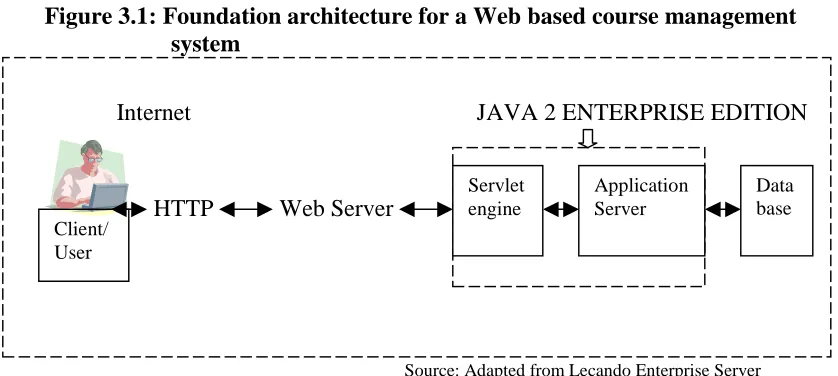
The general foundation architecture may be represented as below.
Figure 3.1: Foundation architecture for a Web based course management system
Internet JAVA 2 ENTERPRISE EDITION
HTTP Web Server
Source: Adapted from Lecando Enterprise Server
Similarly, the foundation architecture of Blackboard 5, for example, is three tiered. It
encompasses a database on the back end and a Web server interacting with the
Blackboard application (written in object-oriented Java and Perl) in the middle,
accessible by a browser on the front end (Yaskin & Gilfus, 2001, p. 5).
Hardware and software requirement
For clients of Web based course management systems, such as institutions, the hardware
requirements are derived from individual data and the number of active users, defined as
individuals enrolled in the course. This ensures that one student who is enrolled in
multiple courses is registered as a multiple accounts holder. An example of hardware
requirement is Blackboard’s hardware requirements for more than 3000 active users but
fewer than 6000 active users, which include:
Data base Servlet
engine
Application Server Client/
One server configuration
Quad processors. Pentium III 700 MHz Xeon processors or Sun, UltraSparc-II
450 MHz processors
4 GB of RAM
Appropriate amount of hard drive space in a RAID array
10/100 network interface card
The table of Blackboard’s Hardware Requirements for different numbers of active users
is attached as Appendix 2 to this research.
The end users of Web based course management systems require a computer connected
to the Internet in order to access the system. In addition, the user requires a browser that
enables the specific Internet server. For example, Java enabling browser such as
Netscape Navigator 4.7 or later or Microsoft Internet Explorer 4.01 or later for Java 2
Enterprise Edition (Lecando, 2001b, Sida 2 av 41).
Additional software requirements
Some courses contain audiofiles, animation tools etc that require additional software or
plug-ins such as Real Player or Windows Media Player to be installed on the users’
computers.
Access requirements
Web based course management systems operate a password protected online
environments. The user requires a username and a password to login to the environment.
Although some systems like Blackboard Inc. and WebCT Inc. provide a course
management programme that can be downloaded free for evaluation purposes, a license
3.3.2 Communication features
The varieties of Web based technologies used for creating learning opportunities
mentioned in Section 3.2.1 have been critically analysed in examining the Blackboard,
WebCT and Lecando Web based course management systems in the following Chapter
4. However, this chapter is concluded with the detail description of the range of
communication tools used in the Web based learning environment.
Communication facilities afford students the opportunity to pose questions, discuss ideas,
analyse information, and synthesise concepts. The following communication features are
common in a typical Web based course management environment.
i) Discussion board or global bulletin board
This is a facility for asynchronous communication between course participants and
the tutor and for carrying out tasks related projects by different project members.
Any material posted on the bulletin board is for public use.
ii) Electronic mail (E-mail)
The electronic mail is both the simplest and most widely used Internet tool (Moody,
1996, p. 49). It is used for asynchronous communication, and utilizes the Universal
Resource Locator (URL), which is the Internet address system employed by Web
browsers. A Web based management system may use internal or externally
connected e-mail service. In the case of externally connected mail service, the user
can receive and send mails outside the domain of the management system.
Sometimes the quota of external mails allowed per participant is determined.
iii) Chat.
This is real time, text only, written communication. The chat may consist of a global
chat area accessible by anybody within the system or a private chat for inviting
iv) Whiteboard.
The whiteboard is another synchronous communication tool used for drawing figures
and colouring where required. It is primarily visual but text may be added,
sometimes through the use of multiple windows.
v) Virtual classroom
In this environment, text, images, and sound are utilized for both synchronous and
asynchronous lecture delivery on the Internet. In the asynchronous delivery mode,
the delivered lecture is recorded and conveyed to students, and the learner can access
the delivery as it was in real time. The virtual classroom can incorporate an area for
slides or drawing, a chat window, and a question box into one tool.
vi) Video conferencing
Video conferencing provides the capability to interconnect two or more parties with
both audio and video. A minimum requirement is of microphone, speakers and video
camera attached to the computer with the right software.
vii) Netmeeting
This is a generic name for meeting between parties within a network of computers,
including the Internet. Netmeeting is a powerful tool that enables real-time
communications and collaboration over the Internet. The facilities within a
netmeeting programme normally involve a combination of any of the following; chat,
whiteboard, video conferencing and file transfer and sharing.
viii) Digital dropbox
The digital ‘dropbox’ is a tool that allows file exchange between participants such as
the instructor and students in an online learning environment. The ‘dropbox’ works
then download the file to work on locally. The student can download the file, work
on it and send it back to the instructor for record keeping, grading, or comments. The
drop box tool is useful in administering assignments and other task related activities.
ix) Project area
The project area is a private area that can be created by anybody in the environment
for sharing files and having a common forum for discussion with members of a
particular project. This is a feature that is useful for task-oriented activities.
x) Calendar
Another tool useful for communication purposes in an online learning environment
is the interactive calendar used for publishing and editing the programme of events.
Any participant in this environment can post events visible and printable by others.
Also, a participant can copy the calendar data to own computer and edit as deemed
necessary. A calendar may be prompted to deliver a message on the events/schedules
of the day to the participants on login.
For further information, please see WebCT, 2001b; Lecando, 2001b; Yaskin &
Chapter 4
Examination of some Web based distance education management
systems
Introduction
In the previous chapter the characteristics of Web based course management systems as
well as the technological opportunities the systems offer for learning were discussed in
detail. In this chapter the list of the major Web based management systems in the market
is compiled (Table 4.1) and the detail examination of their features is organized in the
table of comparison of these features (See Table 4.2). Furthermore, the critical analysis
of three of some of the most widely used of these systems, Blackboard, WebCT, and
Lecando is carried out with the view to identifying the strengths and weaknesses of these
systems generally, and in particular those of the Lecando system to be used in
developing a working model of a Web based distance learning course using a test group
of WMU staff and students.
4.1 Comparison of Web based education systems
The following table of comparison of Web based education systems has been adapted
from Hall (1999), modified and expanded upon by one system, the Lecando system,