
DESIGN GUIDE FOR CMOS PROCESS ON-CHIP 3D INDUCTOR USING THRU-WAFER VIAS
By
Gary VanAckern
A thesis
submitted in partial fulfillment of the requirements for the degree of Master of Science in Electrical Engineering
Boise State University
BOISE STATE UNIVERSITY GRADUATE COLLEGE
DEFENSE COMMITTEE AND FINAL READING APPROVALS
of the thesis submitted by
Gary VanAckern
Thesis Title: Design Guide For CMOS Process On-Chip 3D Inductor Using Thru-wafer Vias
Date of Final Oral Examination: 09 March 2011
The following individuals read and discussed the thesis submitted by student Gary VanAckern, and they evaluated his presentation and response to questions during the final oral examination. They found that the student passed the final oral examination. R. Jacob Baker, Ph.D. Chair, Supervisory Committee
Amy Moll, Ph.D. Member, Supervisory Committee
Vishal Saxena, Ph.D. Member, Supervisory Committee
The final reading approval of the thesis was granted by R. Jacob Baker, Ph.D., Chair of the Supervisory Committee. The thesis was approved for the Graduate College by John R. Pelton, Ph.D., Dean of the Graduate College.
iv
ACKNOWLEDGEMENTS
It has been a great honor and privilege to complete my Masters of Science Degree in Electrical Engineering (MSEE) at Boise State University (BSU).
First of all, I would like to thank my advisor, Dr. Jake Baker, who has provided me with countless hours of quality instruction, guidance, and motivation to complete this thesis. I thank Dr. Saxena for his encouragement and continued support while attending BSU.
I would like to extend a special thanks to Dr. Amy Moll for accepting me to work on the Darpa research project at BSU. This support provided the core funding for the 3D Thru-Wafer Interconnect (TWI) research and provided the opportunity for my research. Additional thanks goes to Research Triangle Inc (RTI) for fabricating the devices in their silicon process.
v ABSTRACT
vi
TABLE OF CONTENTS
ACKNOWLEDGEMENTS ... iv
ABSTRACT ... v
LIST OF TABLES ... ix
LIST OF FIGURES ... x
LIST OF ABBREVIATIONS ... xiii
LIST OF SYMBOLS ... xv
CHAPTER 1 – INTRODUCTION ... 1
1.1 Background ... 1
1.2 Motivation ... 2
1.3 Thesis Organization ... 3
CHAPTER 2 – INDUCTOR PHYSICS ... 4
2.1 The Inductive Phenomena ... 4
2.2 Mutual- and Self-Inductance ... 7
2.3 Skin Effect ... 10
CHAPTER 3 – MONOLITHIC CMOS PLANER INDUCTOR ... 16
3.1 Inductor Architectures ... 16
3.2 Modeling the Planar Inductor ... 20
The Physical Model ... 21
vii
4.1 Inductance (L) Calculation ... 27
4.2 Series Resistance (RS) Calculation ... 31
4.3 Feed-Thru Capacitance (CP) Calculation ... 33
4.4 Oxide Capacitance (COX) Calculation ... 34
4.5 Silicon Resistance (RSi) and Capacitance (CSi) ... 34
4.6 Quality Factor (Q) Calculation ... 37
4.7 Self-Resonant Frequency (fSR) Extraction ... 39
CHAPTER 5 – 3D INDUCTOR ... 41
5.1 Architecture ... 41
5.2 3D Inductor Fabrication ... 44
The Process Flow ... 45
CHAPTER 6 – MEASUREMENT TECHNIQUE ... 58
6.1 Equipment Setup ... 58
6.2 Equipment Calibration ... 59
6.3 Parasitic De-Embedding ... 62
6.4 A 3D Measurement Pitfall ... 72
CHAPTER 7 – 3D TWV INDUCTOR MEASURED PERFORMANCE ... 73
7.1 Smith Chart Measured S11 ... 73
7.2 Measured Quality Factor (Q) ... 76
7.3 Measured Self-Resonant Frequency (fSR) ... 78
7.4 Measured Inductance (L) vs. Frequency ... 79
7.5 Measured |Z| vs. Frequency ... 82
viii
7.7 Line Trace Width to Line Space Ratio ... 86
7.8 Via Height ... 87
7.9 Via Size and Via-to-Via Pitch ... 87
7.10 Surface Trace Lengths ... 88
7.11 Inductor Radius ... 88
CHAPTER 8 – SUMMARY AND CONCLUSIONS ... 89
BIBLIOGRAPHY ... 91
APPENDIX A ... 97
Smith Chart Tutorial APPENDIX B ... 103
Measured and Calculated Data – All Devices APPENDIX C ... 114
ix
LIST OF TABLES
Table B.1 Wide Trace Wire Groups Inductor Length vs. NTurns ... 113
Table B.2 Narrow Trace Wire Groups Inductor Length vs. NTurns ... 113
Table B.3 Wide Trace Wire Groups ηdut vs. NTurns ... 114
x
LIST OF FIGURES
Figure 2.1 Magnetic Flux of a Current Carrying Wire Segment ... 4
Figure 2.2 Total Magnetic Flux Through a Surface ... 6
Figure 2.3 Mutual-Inductance of Two Coils ... 7
Figure 2.4 Mutual-Inductance of Two Coils ... 8
Figure 2.5 Mutual and Self-Inductance of a Planar Spiral Inductor ... 10
Figure 2.6 Electric Field vs. Skin Depth ... 11
Figure 2.7 Skin Depth (δ) vs. Frequency ... 13
Figure 2.8 Effective Conductor Thickness (teff) vs. Frequency ... 14
Figure 2.9 Resistance (Rskin) vs. Frequency ... 14
Figure 3.1 a) Planar Spiral Inductor Shapes [23], b) Circular Inductor [17] ... 17
Figure 3.2 Layout and Cross-Section of 2 Metal Square Spiral Inductor [21] .... 18
Figure 3.3 Cross-Section of Stacked and Shorted Spiral Inductor [21] ... 19
Figure 3.4 Layout and Cross-Section of Spiral Inductor with PGS [1, 21] ... 20
Figure 3.5 Electric and Magnetic Fields in a CMOS Planner Inductor [21] ... 22
Figure 3.6 Basic Planar Inductor Equivalent Circuit Physical Model [4, 20, 21, 24] ... 23
Figure 3.7 Inductor Sub-Models [4, 20, 21, 24] ... 24
Figure 3.8 Substrate Coupling with and without PGS [21] ... 24
xi
Figure 4.1 Greenhouse Method [7, 11] ... 29
Figure 4.2 Reflected Image [24, 5] ... 31
Figure 4.3 Modes of Operation Circuit Diagrams [26] ... 36
Figure 4.4 Modes of Operation [26] ... 37
Figure 4.5 Q and |Z| ... 40
Figure 5.1 HFSS 3D Inductor Architecture ... 42
Figure 5.2 Planar vs. 3D Inductor Area ... 43
Figure 5.3 3D Inductor Masks [28] ... 46
Figure 5.4 3D Inductor Masks [28] ... 47
Figure 5.5 Via Formation [30] ... 49
Figure 5.6 Via Profile with Oxide Charge Buildup [30] ... 50
Figure 5.7 Parylene CVD Process Flow [30] ... 52
Figure 5.8 Barrel Coating Method [34] ... 54
Figure 5.9 Copper Filled TWV [30] ... 55
Figure 5.10 SEM of Barrel Coated TWV [30] ... 55
Figure 5.11 Barrel Coating Process Flow [30] ... 57
Figure 6.1 a) Cascade™ Microtech Probe Station, b) Top-hat View, c) GSG Probe [37] ... 59
Figure 6.2 Impedance Standard Substrate (ISS) [40] ... 61
Figure 6.3 Infinity Probe™ Skating [38] ... 61
Figure 6.4 Calibration Error by Method [38] ... 62
Figure 6.5 On-Wafer De-Embedding Structures ... 63
xii
Figure 6.7 1-Port S-Parameter Measurement Block Diagram ... 65
Figure 6.8 OPD De-Embedding vs. Q and Fsr ... 66
Figure 6.9 |Z| vs. OPD and OSD De-Embedding ... 68
Figure 6.10 OSTD De-Embedding for Qmax vs. Frequency ... 69
Figure 6.11 OSTD De-Embedding for |Z| vs. Frequency ... 70
Figure 6.12 OSTD De-Embedding for L vs. Frequency ... 70
Figure 6.13 OSTD De-Embedding for Qmax vs. Frequency ... 71
Figure 6.14 De-Embedding Block Diagrams: a) Open, b) Open-Short, c) Open-Short-Thru [39] ... 71
Figure 6.15 Auxiliary Chuck ... 72
Figure 6.16 Auxiliary Chuck Micrograph ... 72
Figure 7.1 a) Measured S11 for WT, b) Measured S11 NT Devices for N=1, 3, 5, 10 ... 75
Figure 7.2 Measured S11 for WT and NT Devices for N=1 ... 75
Figure 7.3 a) Q vs. Frequency for WT, b) Q vs. Frequency NT Devices (1, 3, 5, 10, {15, 20}) ... 77
Figure 7.4 a) Qmax vs. NTurns,b) Qmax vs. fo ... 78
Figure 7.5 fsr vs. NTurns ... 79
Figure 7.6 a) L vs. Frequency WT, b) L vs. Frequency NT ... 80
Figure 7.7 a) L at fo vs. N-Turns, b) L vs. fo ... 81
Figure 7.8 a) |Z| vs. Frequency WT, b) |Z| vs. Frequency NT ... 82
Figure 7.9 a) |Z| vs. N, b) |Z| vs. fo ... 84
Figure 7.10 a) Z Angle vs. Frequency WT, b) Z Angle vs. and Frequency NT .... 85
xiii
Figure A.1 Incident and Reflected Wave from a Load ... 98
Figure A.2 Rectilinear Impedance Plane (Complex) ... 99
Figure A.3 Smith Chart from Rectilinear Plane and Polar Plane ... 99
Figure A.4 2-Port Scattering Parameter Coefficients [43] ... 101
Figure A.5 2-Port Measurement ... 101
Figure A.6 1-Port Measurement ... 102
Figure B.1 Q vs. Frequency Wide Trace Site Group 1 ... 104
Figure B.2 L vs. Frequency Wide Trace Site Group 1 ... 104
Figure B.3 |Z| vs. Frequency Wide Trace Site Group 1 ... 105
Figure B.4 Z Phase Angle vs. Frequency Wide Trace Site Group 1 ... 105
Figure B.5 Q vs. Frequency Wide Trace Site Group 2 ... 106
Figure B.6 L vs. Frequency Wide Trace Site Group 2 ... 106
Figure B.7 |Z| vs. Frequency Wide Trace Site Group 2 ... 107
Figure B.8 Z Phase Angle vs. Frequency Wide Trace Site Group 2 ... 107
Figure B.9 Q vs. Frequency NarrowTrace Site Group 3 ... 108
Figure B.10 L vs. Frequency NarrowTrace Site Group 3 ... 108
Figure B.11 |Z| vs. Frequency NarrowTrace Site Group 3 ... 109
Figure B.12 Z Phase Angle vs. Frequency NarrowTrace Site Group 3 ... 109
Figure B.13 Q vs. Frequency NarrowTrace Site Group 4 ... 110
Figure B.14 L vs. Frequency NarrowTrace Site Group 4 ... 110
Figure B.15 |Z| vs. Frequency NarrowTrace Site Group 4 ... 111
xiv
LIST OF ABBREVATIONS
xv
xvi
LIST OF SYMBOLS
AMD………...……... Arithmetic Mean Distance. A ………...……... Area.
Asw ………...……... Side-Wall Area.
xvii
lfix ………..………...……... Fixture Length.
ldut ………..………..………...……... DUT Length.
Mi………..………...……... Metal Level i. Mi,j………..………...……... Mutual Inductance Between i and j. N ………...……... Number of Turns. n ……….………...……... Number of Turns over the Underpass. nH………..…..………...……... Nano-Henries. pH………..………...……... Pico-Henries. Q ………...……... Quality Factor. Qmax………...……... Maximum Quality Factor. R ………..Resistance. Real()………..…...……... Real Part. Rs ………..………...……... Series Resistance. Rsi………...……... Silicon Resistance. SF4……….………...……... Sulfur Tetraflouride. S-Parameters………..………...……... Scattering Parameters. Sij ……….………...……... Scattering Parameters Between Port i and j. T ……….………...……... Frequency Correction Factor. t……….………..………...……... Metal Thickness. teff……….………...……... Effective Metal Thickness. tox,m1-m2………..………. Oxide Thickness Between Metal Layers 1 and 2. w ……….………...……... Metal Trace Width. Yij ……….………...……... Admittance in Terms of Port i and j. Yp ……….………....……... Parallel Admittance. Zij ………….………...……... Impedance Between Ports i and j. Zl ….……….………...……... Impedance of the Load.
Zo….………..………...……... Characteristic Impedance(50Ω).
Γ……….….………..……... Reflection Coefficient.
δ……….………..……... Skin Depth.
xviii
Ω ……….………...……... Ohms.
ε ….………..……... Permittivity.
εo ………...……... Permittivity in Free Space.
εox ………...……... Oxide Permittivity.
εr ……….………...……... Relative Permittivity.
Φm…..………...……... Total Magnetic Flux.
σ………...……... Conductivity.
π………..…...……... PI Constant.
µ ………...………... Permeability. µo ………...……... Permeability in Free Space. µr ………...……... Relative Permeability.
ω ………... Frequency in Terms of PI.
1
CHAPTER 1 - INTRODUCTION
1.1 Background
The interest and proliferation of radio-frequency (RF) circuits in recent years has provided broad opportunity for development of front-end RF modules such as the voltage-controlled oscillator (VCO), low-noise assembly (LNA), transformer, filter, and regulator to support a multitude of new wireless applications [1, 2]. These RF modules have had their foundation built upon discrete passive circuit components like the high frequency (HF) inductor. In the last decade, integration of monolithic inductors built in silicon-based complementary metal oxide semiconductors (CMOS) has been realized rather than relying on their predecessor off-chip components [3]. CMOS has shown itself to be the most preferred technology due to the aggressive scaling in MOS devices and its improved performance above 1GHz [4, 5]. Multi-mode wireless technology also looks to utilize high quality CMOS inductors [50].
As devices scale, designers are challenged with producing smaller and more efficient modules while maintaining or improving circuit performance, predictability, and robustness [2]. These three design requirements directly transcend to the passive
2
1.2 Motivation
While the inductive coil has been around for nearly 200 years, its wide-spread use in modern silicon-based CMOS circuits has been limited by its relatively large size (when compared to other circuit elements) and its inherent performance and integration
limitations.
In order to achieve a reasonable inductance value (~10nH), the device needs to be designed and manufactured with an extremely large footprint, on the order of 250um2. This factor alone is why most inductors are forced to be implemented off-chip. This becomes apparent in CMOS technology since increasing the inductor size both increases the manufacturing cost and produces undesired parasitic effects. Device integration is limited mostly by manufacturing process maturity while parasitic effects reduce the fundamental performance factors of an inductor. This includes a poor quality factor (Q), a reduction in self-resonant frequency (fsr), and a low inductance value (L). Due to these issues, several works in recent years have focused on identifying new processing
3
1.3 Thesis Organization
This thesis aims to provide insight into the design of a 3D integrated inductor using TWV technology versus the conventional CMOS monolithic inductor. Chapter 2 covers a review of inductor physics based upon the monolithic planer spiral topology in a CMOS process. This discussion will cover the inductive phenomena, mutual- and self- inductance, and discuss previous work regarding the electromagnetic fields present within the monolithic inductor. Chapter 3 will provide a more in-depth discussion on the specific monolithic architectures. Parasitics will be identified and their respective
4
CHAPTER 2 - INDUCTOR PHYSICS
This chapter will briefly review the inductive phenomena as it relates to conducting wires and coil inductors. A brief discussion of the following concepts will also be covered: mutual- vs. self-inductance, and the skin effect.
2.1 The Inductive Phenomena
Whether considering a straight wire, a simple coil of wound wire (solenoid), or a CMOS monolithic planar spiral inductor, when an alternating current (AC) source is applied at one terminal of a two terminal device, with the other terminal grounded, an electric current propagates back and forth through the conducting material. The current flow gives rise to a magnetic field intensity (H) and is measured in units of A/m. The alternating nature of the H with change in current direction is shown in Figure 2.1a-b.
a) b)
Figure 2.1 Magnetic Flux of a Current Carrying Wire Segment
5
density carries the units of tesla = Wb/m = H-A/m2. In the case of free space, absolute permeability is simply µo = 4π∙10-7 = 1.257∙10-6 (H/m).
B = µH (2.0)
In the absence of freespace, Equation 2.1 illustrates the change in absolute
magnetic permeability. In this case of non-free space, the relative permeability (µr) of the introduced material scales the permeability of free space (µo). This equation indicates that for a relative permeability µr = N > 1, the magnetic flux density is N-times greater in the material than it would have been in free space [51].
µ = µ µ (H/m) (2.1)
The magnetic field flux is analogous to electric current flow whereas magnetic flux density is to voltage [52]. Unlike electric fields, magnetic fields can occur outside of material where there is an absence of free flowing electrons.
The magnetic flux (Φm), as shown in Equation 2.3, represents the total magnetic flux being equal to the integral of the magnetic flux density over an area of a surface S that intersects the field lines. In the special case of a planar surface, this can be
simplified to (2.4) [45], where A is the cross-sectional area of intersecting surface and θ
is the angle between the surface and the magnetic field lines that extend normal to the flow of current.
6
= (2.4)
Flux linkage (λ) represents the total magnetic flux passing through a surface S of
a single loop of current carrying wire as seen below in Equations (2.4) and Figure 2.2, where N is the number of loops.
= ∙N (2.4)
Figure 2.2 Total Magnetic Flux Through A Surface
For the case of two 3 loop tightly wound current carrying wires with the same intersecting surface S, the magnetic flux generated from each loop is passed through both loops. As such, the total magnetic flux linkage is increased by the square of the number of loops N times the magnetic flux of one loop of wire. This is shown below in Equation (2.5) and Figure 2.3 [53].
7
Figure 2.3 Mutual-Inductance of Two Coils
Inductance is primarily a function of geometric shape. Analagous to capacitors storing electric charge, an inductor stores magnetic energy within the core of its windings where the flux density is greatest. The quantity of inductance can be determined by the ratio of flux linkages to the current that creates the magnetic flux as shown below in Equation (2.6) for the cylindrical NLoop solenoid shown in Figure 2.2 [53].
= = ∙ =µ∙ ∙ ∙ (2.6)
2.2 Mutual- and Self-Inductance
8
driven by current IA and as such is creating the flux density from coil A while coil B is not being driven, but rather receiving. The consequence of coil A on coil B is shown in Equation (2.7). The total flux Φ from coil A to a single loop of coil B is found by integrating the flux density over the shared surface S. The flux linkages are multiplied by the number of turns NB in coil B. The mutual-inductance in Coil B can then be found as shown in Equation (2.8).
Figure 2.4 Mutual-Inductance of Two Coils
λ = N ∙ Φ (2.7)
, = (2.8)
9
= ∙ = ∙ = + + + = ∙ (2.9)
Self-inductance is a special case of mutual-inductance and is referred to in literature as simply inductance [7]. In this case, rather than two circuit elements, two or more individual wire segments have influence on one another within the same element. Thus, the inductance present is understood to be self-inductance and occurs within its own turns rather than from an outside source. This is shown below in Equation (2.10).
= = , = + (2.10)
The total inductance of a circuit or circuit element is the summation of all mutual- and self-inductances with a net result that can be either positive or negative as shown below in Equation (2.11) [7].
= , + , = + ∓2∙ (2.11)
Extending the principles of mutual- and self-inductance to the case of a 1.25 turn monolithic planar spiral inductor as seen below in Figure 2.5, each line segment
10
Figure 2.5 Mutual- and Self-Inductance of a Planar Spiral Inductor
= , + , = + + + + −2
, + , + , + 2 , (2.12)
In general, the summation process is extended to as many segments as are contained in each of the individual elements. The larger the circuit, the more complex this becomes computationally.
2.3 Skin Effect
The phenomenon of the skin effect is well documented and is the tendency of current to flow on the surface or skin of a conductive material [21, 53]. In the case of a single cylindrical conductor, current flow is on the conductor’s outer surface. For any given material, the depth of current flow, skin depth (δ), is determined by the relationship
11
decay. The intersection of the point at which the magnitude of current density has been reduced to = .37 is defined as the skin depth. Thus, materials with lower ρ will cause the exponential to decay faster and, as a result, force the current to flow closer to the conductor’s surface as seen below in Equation (2.13).
Figure 2.6 Electric Field vs. Skin Depth
δ=
µ µ (µm) (2.13)
In semiconductor processing, trace resistance can be cast into terms of sheet resistance (Rsheet) or ohms per square where length (L) and width (w) determine one square as seen in Equation (2.14) below.
R = = Ω (square) (2.14)
12
must be determined as seen in Equation (2.15) by calculating δ (Equation 2.13) and inserting the specific process parameter t for conductor thickness. In practice, the conductor current will not be limited or attenuated by the skin resistance if the metal thickness implemented is several skin depths thick. Inserting the effective thickness (teff) into Equation (2.16) will produce a result of the true resistance of the conductor due to skin effect in ohms/square. One additional factor that affects Rskin is the presense of current crowding at corners, which has the affect of decreasing the effective cross-sectional area (teff) of the conductor.
t = δ 1−e (µm) (2.15)
R = Ω
∎ (2.16)
Skin effect is an important aspect of inductor design because one of the techniques for improving inductor performance is to reduce conductor resistances by increasing trace widths and/or thicknesses [8]. In doing so, the traces are made less susceptible to undesired resistive parasitics from not being able to utilize the full conductor cross-sectional area [4].
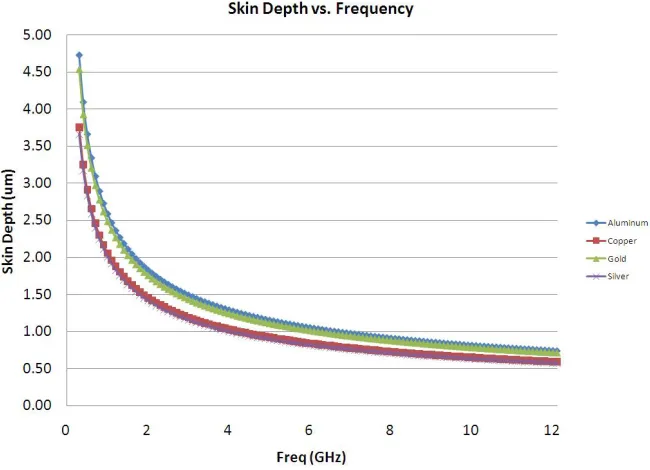
For common conductive materials like aluminum and copper, the skin depth at
1GHz is 2.59µm and 2.09µm, respectively. For quick estimates of skin depth, [9]
13
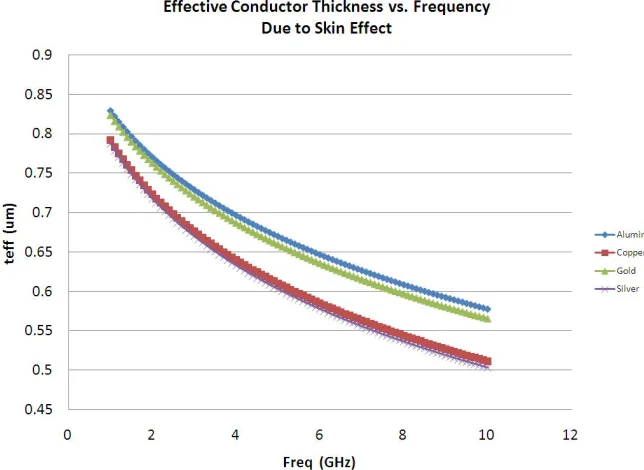
frequency on skin depth, effective thickness, and resistance for various metals as previously discussed [4].
14
Figure 2.8 Effective Conductor Thickness (teff) vs. Frequency
15
Figure 2.7 shows the relationship to the decrease in skin depth and effective conductor thickness with increasing frequency using Equations 2.13 and 2.15,
16
CHAPTER 3 - MONOLITHIC CMOS PLANER INDUCTOR
This chapter will begin by discussing various monolithic CMOS planar inductor architectures. The electromagnetic fields present within a planar inductor will be presented as they apply to their respective inductor equivalent physical circuit model elements.
3.1 Inductor Architectures
The monolithic CMOS planar inductor architecture has become widely used due to its relatively simple integration with existing CMOS capabilities and processing steps. The use of damascene processing and inter-layer vias has enabled integration of the inductor in the upper-most layers of standard multi-metal processes. This section will discuss the various planar inductor architectures being integrated in CMOS circuits. In a later chapter, the 3D inductor architecture of focus will be presented.
17
designs. Research shows that circular shapes result in greater efficiency due to the reduction in current crowding within the device corners [21]. Figure 3.1b shows a circular planar inductor micrograph [11].
a) b) Figure 3.1 a) Planar Spiral Inductor Shapes [23] b) Circular Inductor [17]
Figure 3.2 shows, from left to right, the layout and cross-section in 2 directions for a typical 2-turn square inductor fabricated in a 2-metal process. Cross-section A-A’ illustrates an inductor fabricated in the upper-most layer of metal (M2). Upper layers of metal are typically used to implement the inductor traces because they offer lower resistance since increased metal thicknesses are allowed [13]. Another advantage to device performance is a reduction in substrate coupling with the increased distance between the metal traces and the substrate. Cross-section B-B’ illustrates the M1
18
decrease the inter-layer capacitance between the traces and underpass. Using a lower level of metal contributes to performance degradation and is reflected by a slight lowering of the self-resonant frequency (fsr).
Figure 3.2 Layout and Cross-Section of 2 Metal Square Spiral Inductor [21]
Note the use of the nomenclature Din and Dout in Figure 3.2. Dout represents the outer-most dimension of the square inductor while Din is the inner most. Another parameter, Davg, will be referred to as the arithmetic mean of the previous two parameters. This convention is widely used when comparing the inductance values against an equivalent uniform current sheet. As shown in Equation 3.1, the ratio of the outer to inner diameters is referred to in literature as the fill factor(ρ). This is intuitive by inspection since ρ approaches 1 when Dout ≈ Din and goes to 0 when it is becomes hollow [23].
19
technique is preferable as it reduces the series resistance by tying stacked layers of metal together. In this case, M2 and M3 are shorted mirror images as shown in cross-section A-A’. In this architecture, M1 is used for the underpass as seen in cross-section B-B’. The tradeoff is seen as an increase in interlayer capacitance [2, 3, 4, 44]
Figure 3.3 Cross-Section of Stacked and Shorted Spiral Inductor [21]
20
combination of the first two pictures using the PGS. The cross sections A-A’ and B-B’ show a three metal (M2, M3) shorted inductor with M1 being utilized to strap the poly-silicon to ground in facilitating the underpass [1, 44].
Figure 3.4 Layout and Cross-Section of Spiral Inductor with PGS [1, 21]
In addition to the three common architectures presented, there have been many other methods researched and reported to address one or more parasitic issue. The interested reader can review [14] for a proton beam isolation method while [15] can be reviewed for deep trench isolation techniques.
3.2 Modeling the Planar Inductor
21
method takes expensive software and a large amount of computing resources to complete even for small devices [17].
The planar equivalent circuit model derives its origin from the ability to
completely understand all parasitic phenomena and related parameters present such that assignment of physical or simulated circuit components (resistors, capacitors, etc) are possible. This method allows for a reasonably accurate and faster model development at a reduced cost. Limitations of physical modeling can arise from undetermined high-frequency phenomena like eddy-currents [4, 16, 21]. However, developing an
understanding of all parasitic factors allows for a more intuitive approach to modifying the inductor to achieve the desired design results. The physical model will be covered next.
The Physical Model
While topology choices for CMOS spiral inductors abound, the planar square spiral provides the best illustration of the electromagnetic fields exhibited and the utility of the physical model. As illustrated in Figure 3.5, one magnetic and three electric fields are produced when an AC voltage is applied [20]. The reader is referred to Figure 3.6 for the equivalent planar inductor circuit model.
22
This is directly dependent upon material resistivity (ρ) and is modeled as the series resistance RS.
Figure 3.5 Electric and Magnetic Fields in a CMOS Planner Inductor [21]
The second electric field (E2) is a consequence of the voltage difference between any two turns in the spiral and any individual turn and the underpass [20]. This is a consequence of the second port being connected using a lower level of metal, which induces an inter-winding parasitic capacitance due to the presence of the interlayer dielectric. The modeling parameter for E2 is CP [20].
The third electric field (E3) is present due to the voltage difference between the silicon substrate and the metal of the spirals. Field E3 induces capacitive coupling to the substrate and is oftentimes the most predominant parasitic since it extends into the substrate [20]. This is modeled as the parameter COX. The effect of this field is made worse because most CMOS circuits use low-resistivity substrates in the range of
23
flow, it is necessary to include modeling parameters for the intrinsic substrate capacitance and resistance. These parameters are identified as CSUB and RSUB, respectively.
The final field is the magnetic field (B) produced by the AC current that flows through the traces of the spiral. While the magnetic field is what induces the desired inductive behavior, this also creates a complementary parasitic behavior in the metal traces due to eddy-currents as discussed in Chapter 2 [4, 20, 21, 24, 44].
Figure 3.6 Basic Planar Inductor Equivalent Circuit Physical Model [4, 20, 21, 24]
24
Figure 3.7 Inductor Sub-Models [4, 20, 21, 24]
As previously shown in Figure 3.4, the planar inductor architecture was modified to include a patterned ground shield that acts to shield the field E3 prior to it penetrating into the substrate [1, 2, 20, 21]. Figure 3.8 shows graphically side-by-side the
comparison between the two methods while Figure 3.9 illustrates the addition of the ground shield in the equivalent physical circuit model. The corresponding model element changes involve removing COX/2 and replacing CSi || RSi with series elements Cshld and Rshld. This modification is commonly implemented to achieve higher device performance.
25
Figure 3.9 Basic Planar Inductor Equivalent Circuit Physical Model with PGS [21]
Reflecting on Figures 3.5 and 3.6, it becomes more intuitive of how to optimize device performance. The first parameter, RS, can be reduced by utilizing low resistivity materials like copper or aluminum for metallization. Another method would be to tie two or more exact image metal layers together as illustrated in Figures 3.3 and 3.4; however, an increase in Cox will be traded for the reduction in resistance as a result of the M1-M2 capacitance adding to the M1 to substrate MOS capacitance. The oxide capacitance can be reduced by increasing the inter-layer dielectric between the M1-M2 layers, by increasing the height that the inductor is placed above the substrate, or by adding a PGS [1, 15, 16, 18, 19, 21].
self-26
resonant frequency. A few suggestions to reduce the feed-thru capacitance would be to increase the space between the turns and the underpass, eliminate the underpass
completely, or keep the device footprint as small as possible. Elimination of the
underpass in the planar architecture is not feasible without using the center tap as a bond pad, which would introduce additional parasitics. Feed-thru capacitance degrades the self-resonant frequency, thus any improvements to this parameter will help to minimize existing degradation.
27
CHAPTER 4 – PARAMETER CALCULATION METHODS
This chapter will briefly review the calculation methods for the modeling parameters identified in Chapter 3. Coverage of inductance will cover the most widely accepted method, which is the Greenhouse Method [11]. This chapter will include coverage for both the calculation and plot extraction methods needed to determine the key performance metrics related to inductor evaluation. Additionally, coverage of the quality factor (Q), and self-resonant frequency (fSR) will be discussed.
4.1 Inductance (L) Calculation
28
Greenhouse Method
In the case of non-standard geometric shapes, most designers utilize numerical techniques, curve fitting, and empirical formulas as reported in [7]. A couple of the numerical techniques utilized here are cross-sectional area integration, Taylor series expansion, and geometric mean distance. With the proliferation of silicon-based CMOS devices, Greenhouse furthered the art by developing an algorithm-based approach motivated from Grover’s methods by calculating inductance as the summation of all mutual- and self-inductances of individual line segments [7]. In the case of orthogonal line segments, only a weak mutual coupling exists and thus is not considered. Basic calculations for mutual- and self-inductance were shown in Chapter 2.
Extending the Greenhouse algorithm to the case of Figure 4.1, the mutual- and self-inductance can be calculated by breaking the inductor into individual line segments. The total inductance (LTotal) of the inductor with five line segments is then calculated by extending Equation (2.5), where Li represents the self-inductance of each line segment “i”, and Mi,j is the mutual-inductance between the two line segments “i” and “j”.
29
Figure 4.1 Greenhouse Method [7, 11]
L = L + L + L + L + L −2 M , + M , + M , + 2M , (4.1)
The above approach relies on Equations (4.2)-(4.6) reported by Greenhouse in [11] for calculating either the self- or mutual-inductance of each line segment. This relies on geometric factors:
Conductor Width (w) in microns
Conductor Thickness (t) in microns
Distance Between Conductor Filaments (d)
Relative Permeability (µ)
Geometric Mean Distance (GMD)
30
Mutual Inductance Parameter (Q)
Frequency Correction Factor (T)
L = 0.0002∙l ln 2∙ −1.25 + + µ∙ (4.2)
M, = 0.0002∙l ∙Q (4.3)
ln(GMD ) = ln(d)−
∙
−
∙
−
∙
−
∙
…. (4.4)
Q = + 1 +
.
− 1 +
.
+ (4.5)
AMD = w + t (4.6)
Revised Greenhouse Method
31
Figure 4.2 Reflected Image [24, 5]
L , = L + L + L + L + L −2 M , + M , + M , + 2M , − M1,1′+M2,2′+M3,3′+M4,4′+M5,5′+M1′,5′ (4.7)
When more accurate results are required, the use of full magnetic wave field solvers can be used. This can be the case when implementing non-standard geometric shapes or when highly complex line segment structures are being used. However, the major drawback of this method is the length of simulation time, often taking days, and the cost of related systems and software.
4.2 Series Resistance (RS) Calculation
32
expectations as it didn’t remain constant. Several authors have investigated this and have identified the presence of a frequency dependent component. This dependence is
understood to be a result of contributions from both the presence of skin depth and eddy- currents. As such, Yue and Wong. and Yue, et al. reported in [16, 25] that a good closed form approximation is shown in (4.9), where the following parameters are defined:
is the spiral length
is the resistivity at DC
is the skin depth of the metal
t is the metal trace thickness
w is the metal trace width
= =
( )
(4.8)
33
4.3 Feed-Thru Capacitance (CP) Calculation
The feed-thru capacitance value Cp takes into account the contribution from two parallel plate capacitances. The first is the capacitance created between the sidewall area and inter-winding distance (Csw) (4.9), while the second is the capacitance due to the underpass (m1) and the inductors M2 traces (Cup) (4.10) [16]. The combined equation is shown in (4.11). Due to the small contribution from the sidewall capacitance, a good approximation for Cp is Cup as shown in (4.12).
d is the horizontal distance between traces (i.e., Space length)
1 is the length of the inductor
t is the metal thickness
n is the number of turns over the underpass
w is the line width
ε is the permittivity in a vacuum
ε is the relative permittivity
C = ( ∗ )∙ ∙ = ∙ (4.9)
= n∙w ∙
34
= C + C (4.11)
≈C (4.12)
4.4 Oxide Capacitance (COX) Calculation
The oxide capacitance parameter represents the parallel plate capacitance created by the inductors metal traces above the silicon substrate with the SiO2 dielectric layer sandwiched in between. The oxide capacitance is a straight forward calculation from parameters as shown in (4.13).
C =( ∗ )∙ = ∙ (4.13)
4.5 Silicon Resistance (Rsi) and Capacitance (Csi)
35
= ∙ ∙ ∙ (4.14)
=
∙ ∙ (4.15)
In [26], Hasegawa et al. illustrates the presence of three distinct modes of operation that affect the silicon layer resistivity with a microstrip line situated above on an SiO2 layer. The three modes of operation are Dielectric Quasi-TEM Mode (DQTM), Skin-Effect Mode (SEM), and Slow-Wave Mode (SWM). These modes are a result of the electric and magnetic fields generated from the AC signal. The properties are thus a function of electric permittivity and magnetic permeability.
36
a)
b)
c)
37
Figure 4.4 Modes of Operation [26]
4.6 Quality Factor (Q) Calculation
The quality factor (Q) is another critical parametric that abounds in formulas that have been adjusted depending on geometry, etc. However, the true meaning of Q is simply the efficiency of an inductor to store energy in spite of parasitic effects. The fundamental definition is thus based upon the energy Equation (4.15) and is a dimensionless parameter [1, 13, 25, 43].
Q = 2π| | (4.15)
38
impedance Z11 from a 1-port S-parameter measurement where ω ∙L represents the reactive part and Rs the real part [1, 13, 25, 43].
Q = ∙ ≈ | |= ( )
( ) (4.16)
Equation (4.16) above is an approximation and does not fully account for all of the parasitic affects present when designing inductors over Si-SiO2. As such, two additional terms need to be added to Equation (4.17) [13, 25, 43]. The first is the
substrate loss factor, which accounts for the energy that is dissipated in the substrate. The second is the self-resonance factor, which accounts for both Q peaking and other
reductions as discussed in the next section. As such, Equation (4.17) presents the silicon based quality factor in terms of variables discussed previously in this chapter.
Q = ∙ ∙
∙
∙ 1− ∙ ∙
∙
− ω ∙
∙ + (4.17)
One additional method commonly used in HF designs is shown below in Equation (4.18). This results from plotting of power transfer function |Hjω| in decibels (db). Here
the center frequency ωo is found at the power transfer function peak and Δω (also called
39
the band width BW) is found at the -3db power point where the differences between the
upper and lower values of ω are extrapolated.
Q = 2π (4.18)
4.7 Self-Resonant Frequency (fSR) Extraction
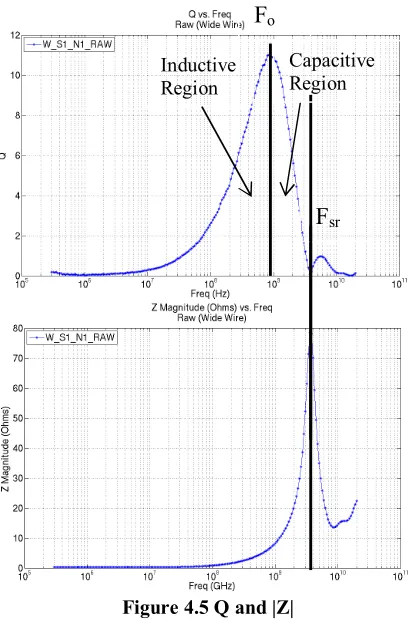
The first self-resonant frequency (fsr) is a critical inductor parametric. This parameter represents the first frequency at which the impedance of the inductor and the capacitor are equal in value and are thus caused to resonate. This is referred to in
literature as self-resonance. Figure 4.5 shows typical Q and |Z| versus frequency inductor plots that has been stacked. Careful observation shows that from DC up to the
characteristic frequency (fo), the plot of the quality factor is inductance whereas from fo to fsr it is capacitive. In the bottom plot, it also becomes evident that fsr can be
40
Figure 4.5 Q and |Z|
Knowing the self-resonance frequency, the capacitance at the self-resonant frequency can also be determined by Equation (4.17 and 4.18) [1].
f =
∙ (4.17)
C =
( ) ∙ (4.18)
Fsr
Inductive Region
Fo
41
CHAPTER 5 - 3D INDUCTOR
This chapter will introduce the underlying 3D inductor architecture and briefly cover the unique manufacturing process. For a detailed understanding of the necessary design cycles needed to obtain and optimize a device for manufacturing, [28-34, 36] can be reviewed for further understanding. Additionally, new design parameters will be introduced.
5.1 Architecture
Device designers have sought to improve inductor performance by pursuing 3D architectures that utilize the area above the wafer surface. In most cases, the devices have one side abutted to the silicon surface while others have attempted to use micro-machining techniques to suspend the inductor in some fashion. Unfortunately, most of these variations have tradeoffs in either manufacturability or mechanical instability that make them less preferable for implementation within a CMOS process.
42
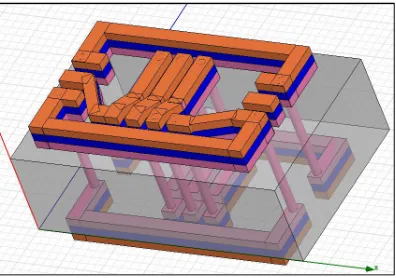
similar to planar technology that ties multiple stacked metal layers together with inter-layer vias. In this case, however, rather than a 1um long via through inter-inter-layer dielectric (ILD), the via spans the thickness of the wafer (~500um). The overall inductor length is only limited by the via processing technology and final desired wafer thickness.
Figure 5.1 shows a 3D physical model of a 3-turn inductor using Ansoft’s HFSS 3D full-wave electromagnetic field simulation layout tool. The material layers have been thickened here to better emphasize the individual layers present. The grey translucent box represents the silicon wafer. Orange is metal1 (M1) copper while blue is the TiN seed layer and pink is a diffusion barrier layer of parylene. As illustrated here, the inductor was laid out for 1-port ground-signal-ground (GSG) RF testing. Port 1 is shown at the left-center contact while port 2 is attached to the guard ring on the lower right contact. Notice that the guard ring is present on both the top and bottom surfaces of the wafer and is connected by TWVs. The guard ring provides isolation from extrinsic noise while taking measurements.
43
The 3D TWV design topology offers some advantages when compared to
traditional planar spiral inductors. The largest of which is found in exploiting the silicon substrate. Figure 5.2 illustrates the area savings that can be realized for a 3-turn equal line-space 3D inductor. As shown, it’s possible to obtain a 40% similar area device with a tradeoff in a full thickness wafer being used and thus creating a 36 times longer
inductor. When a larger 3D inductor is desired, the area impact results in a 40% area increase and a 30% length increase per turn. The same 1-turn increase on a conventional planar device results in both an area and length increase of 40%.
44
A unique advantage of the 3D inductor occurs as a result of using the TWV technology. The inductor length can be tuned in production without adjusting the layout that would otherwise have resulted in additional costs associated with spinning new reticles. This becomes apparent with realization that the backside grind process step allows for customized control of the inductor length. Additionally, the underpass is no longer needed and will eliminate the underpass coupling.
5.2 3D Inductor Fabrication
As with fabricating any new device, integration is limited by the ability of additional processing steps and techniques to be compatible with the existing CMOS process flow. The dominant CMOS processing steps rely heavily upon wet and dry etching techniques. Recent advances in both wet and dry etching techniques have made the realization of the 3D inductor using TWVs possible. While both wet and dry etching technologies have been able to create vias for decades, the advancements in plasma-based dry etching techniques have only recently allowed formation of the high aspect ratio TWV in a production environment possible. New chemistries now offer the ability for a highly selective process over a wide range of materials [27]. The 3D TWV inductor is now well suited for CMOS integration.
45
need to account for this with additional masks and must take measures that will afford appropriate reverse side surface protection. This will become more apparent in the device measurement chapter as it will be necessary to account for the traces on the reverse side of the wafer.
The Process Flow
The following process flow was developed in collaboration between Boise State University (BSU) and MCNC Research Development Institute under U.S. Government research contract N66001-01-C-8034 to develop TWV technology. The manufacturing process flow that follows is based upon this work. As such, the flow will only outline the basic concept of via formation and subsequent transformation into the 3D inductor. Not all details related to fabricating the via will be covered. The inductors were fabricated in the MCNC .3um process.
The Original 3D Inductor Mask Set
46
a) b)
c) d)
e) f)
Figure 5.3 3D Inductor Masks [28]
The New 3D Inductor Mask Set
47
measurement. The first type will be referred to as the wide trace (WT) width vs. narrow space and the other will be a narrow trace (NT) width vs. a wide space as shown in Figure 5.4d-e. The drawn line widths are WT = 70um and NT = 25um while the spaces are 30um and 100um, respectively
Figure 5.4a-c identify the masking levels where a) shows the via mask, b) shows the top metal mask with ground-signal-ground (GSG) probe pads and guard ring, and c) shows the bottom metal mask with guard ring. Figure 5.4d-e shows all masks overlaid to make up the wide and narrow trace inductors.
a) b)
c) d)
e) f)
48
TWV Etching
The via formation is the enabling technology for realization of the 3D TWV inductor. In most CMOS processes, the TWV would be started in the front end of the line; however, this could be tailored as dictated by the process.
Figure 5.5a-g shows the processing steps required to form the TWV. The process begins with a bare 500um wafer as shown in a). In b), a thermal oxide is grown to
49
a) b)
c) d)
e) f)
g)
Figure 5.5 Via Formation [30]
50
was also noted that not all vias etched at the same rate. As such, vias that etched faster thus continued the etching through the oxide and continued to etch into the thermal chuck. Figure 5.4a shows a scanning electron microscope (SEM) micrograph depicting the results of the oxide charge buildup on the via profile [30].
Two methods were used to mitigate this issue and provide a more robust process. The first was to reduce the RF power source. Figure 5.6b shows the corresponding improvement in the via profile. The second method was to use a sacrificial carrier wafer affixed to the bottom side of the target wafer. Affixing the carrier wafer to the target wafer occurred by using photo resist as an adhesive bonding layer.
a) b)
Figure 5.6 Via Profile with Oxide Charge Buildup [30]
Conformal Insulator Barrier Deposition
51
migrating into the silicon. If not inhibited, deterioration of interconnects or deep-level traps in the silicon that could lead to increased standby leakage [31].
Parylene-C was chosen as the diffusion barrier material for several reasons. The first of which is its ability to create a pinhole free conformal diffusion layer. Second, it has the ability to penetrate narrow cavities and bores of small diameter tubes. Third, it has the ability to withstand high temperature processing steps that usually occur later in a standard CMOS process flow. Finally, it has a low-k dielectric constant of ~3.15 [32]. Application of parylene as a thin film is achieved in a specialty tool under vacuum by a dedicated chemical vapor deposition (CVD) process that involves no liquid phase [33].
Parylene Deposition
52
Dry film photoresist is again applied to the backside of the wafer in g) to allow for patterning the via mask. A punch through etch clears the bottom of the via hole as shown in h) and i). Finally, all photoresist is removed from the top and bottom of the wafer. The silicon is now protected from copper migration in subsequent steps.
a) b)
c) d)
e) f)
g) h)
i) j)
53
Conformal Seed Deposition
Copper is a low resistivity metal that has recently been carefully introduced into modern CMOS processes. As with most metals, it requires a precursory adhesion layer to avoid lift off and provide a reliable bond. In this case, titanium nitride (TiN) was chosen to serve this purpose. TiN is applied with a metal organic chemical vapor deposition (MOCVD) process. The MOCVD process allows for the deposition of a continuous uniform thin film on both planar and complex geometries [35]. In this application, it works equally well with both horizontal and vertical surface adhesion. TiN is deposited 1000Å thick using the identical process steps as the Parylene flow with the exception that the deposition occurs in an MOCVD tool. Figure 5.8a-j shows the steps.
a) b)
54
e) f)
g) h)
i) j)
Figure 5.8 Barrel Coating Method [34]
Copper Electroplating
55
SEM micrograph of a 50um via with an aspect ratio of 10:1. Observation shows nearly void free filling of the vias. In practice, the higher the aspect ratio, the likelihood of the vias remaining void free is decreased as shown in Figure 5.9b [30].
a) b)
Figure 5.9 Copper Filled TWV [30]
Due to the voiding issues and necessity of extremely high aspect vias, a secondary method, barrel coating, was developed by MCNC to provide electrical connection
between the top and bottom traces within the via. This method leaves the via core open as shown in SEM micrograph Figure 5.10 [30].
56
The final process steps are shown below in Figure 5.11a-g. The electroplating of the current carrying copper occurs in b) which results in 2-4um thick traces. This is followed by applying photoresist and patterning the inductor traces is shown in c-e. The TiN and Parylene-C layers can either be etched back to expose the bare silicon f) and g) or left for continued protection. The full 3D cross-section through the via hole is shown in h). The inductors are now ready for electrical testing.
a) b)
c) d)
57
g) h)
58
CHAPTER 6 – MEASUREMENT TECHNIQUE
This chapter will briefly review the necessary measurement equipment setup, the calibration technique employed, the de-embedding procedure implemented, and their impact on the accuracy of scattering parameters (S-parameters) measurements. In addition, some of the pitfalls with 3D device characterization will be discussed. Appendix A contains a review of the Smith Chart, (S-parameters), and parameter extraction from the same. Appendix B can be referred to for a quick review of Smith Charts and related parameters.
6.1 Equipment Setup
59
a) b) c)
Figure 6.1 a) Cascade™ Microtech Probe Station. b) Top-hat View. c) GSG Probe [37].
6.2 Equipment Calibration
In order to accurately perform device characterization using the Cascade™ Microtech probe station, it is necessary to remove all RLC parasitics present between the VNA output and the Infinity Probe™ tips. In order to achieve this, all RF cables must be completely removed from the VNA output and the probe tip input. The connector ends, the outside cable jackets, and the adapters must be cleaned with isopropyl alcohol to remove any debris or hand oils that might skew the measurements. The user needs to wear disposable nitrile gloves from this point forward while performing the cleaning, during cable reinstallation, and while working with any part of the probe station. Each serial numbered RF probe comes with a calibration offset table that is unique to it. These coefficient values need to be entered into the Wincal XE software.
Cascade’s Windows-based calibration software WinCal XE™ allows for
60
the following four methods: Short-Open-Load-Thru (SOLT); Line-Reflect-Match (LRM); Line-Reflect-Reflect-Match (LRRM); or Transmission-Reflect-Line (TRL) methods. The interested reader can review [38, 39] for advantages and drawbacks of each method.
The SOLT calibration method provides a reasonably accurate (within 10%) measurement below 20GHz that removes parasitics from the VNA output up to the probe tips. Each calibration method above requires a corresponding impedance standard substrate (ISS). The SOLT ISS is made up of a thin piece of ceramic substrate that contains 40 gold calibration site groups as shown in Figure 6.2 [40]. Each site contains a patterned short, thru, and load structure as shown in the zoomed in window. The loads are trimmed to exactly 50 ohms by the manufacturer; however, not all sites on the ISS will provide a good calibration. As such, the manufacturer provides a paper copy of the ISS that identifies load sites that will provide exact measurements. The sites not circled will be less than 50Ω and can be used for training. The ISS is vacuum mounted on one of the auxiliary chucks. Special care must be taken to keep from destroying the probes since the auxiliary chuck sits higher than the primary wafer chuck.
The only drawback of using the SOLT method is found in measurement
61
it is exactly centered on the probe pads as shown in Figure 6.3a. If deviation in probe skate occurs either by over-skating as shown in 6.3b, or orthogonal mis-alignment, then the calibration can be skewed up to another 5% [38]. Thus, skate is important to
measurement repeatability. Figure 6.3c shows a close up micrograph of the bottom side of the probes.
Figure 6.2 Impedance Standard Substrate (ISS) [40]
Figure 6.3 Infinity Probe™ Skating [38]
62
touching the probe down on the transmission lines at the bottom of the ISS and adjusting the probe holder roll so that three divots with equal size and indentation are shown.
The actual software directed ISS calibration only takes approximately 60 seconds to complete. The open measurement is taken with the probes in a raised position >700um from DUT so no coupling occurs between the probes, chuck, or DUT. The user is then directed to place both port-1 and port-2 probes on the ISS. At the end of the calibration, the measured offsets are stored into the VNA in one of the calibration memory locations. A measurement is taken at the end of the calibration sequence that indicates the accuracy of the calibration. Figure 6.4 shows the typical S11 measurement error vs. calibration frequency between the LRRM and SOLT calibration methods [38].
Figure 6.4 Calibration Error by Method [38]
6.3 Parasitic De-Embedding
63
CMOS substrate is silicon. MOS capacitances are created between the probe pads and the lossy semiconducting substrate due to the presence of the dielectric. As such, it is more accurate to design on-wafer calibration structures that will facilitate on-wafer de-embedding, and then use the open-short-thru de-embedding (OSTD) method in [39] to account for the substrate parasitics.
By implementing the OSTD method, the reference plane is established at the DUT edge and accounts for all parasitics up to the DUT rather than simply up to the probe tips. Figure 6.5 illustrates the de-embedding structures designed for this experiment in both layout and on-wafer micrograph. The open and short structures are the same for all devices; however, each N-turn inductor has a unique thru structure that requires measurement.
64
As reported in [39], the open, short, and thru on-wafer measured values will be used to calculate the correct de-embedding factors at each measurement frequency. The HP 8510C VNA has the capability to measure the reflection coefficient (Γ) in 1-port, 2-port, multi-port mode. Gamma can be plotted directly on a Smith Chart in terms of scattering or S-parameters. When taking S-parameter measurements, it is important to understand the subscripting. Here Sij is defined as the incident wave at port “j” and reflected at port “i”. There are N^2 port terms present, thus in a 2-port measurement four S-parameters are available; S11, S12, S22, S21.
Figure 6.6 2-Port S-Parameter Measurement Block Diagram
65
Figure 6.7 1-Port S-Parameter Measurement Block Diagram
Gamma has a one-to-one relationship with both Z and Y as shown in equation (6.1). Here the characteristic impedance of the VNA is Z0 = 1/Y0 ≈ 50ohms. Solving (6.1) for impedance Z11, we obtain Equation (6.2). Z11 represents complex impedance and can be transformed into admittance with (6.3) [39].
= = = (6.1)
= (6.2)
= 1/ (6.3)
Open De-Embedding
66
subtracted from the measured device admittance values Y11 at each measured frequency as shown in (6.4) and (6.5) [39]. This requires conversion of the DUT S11 to Z11 and then to Y11 as shown in Equations (6.1) to (6.3) for 1-port measurements. Figure 6.8 shows the raw Q measurement of a 1-turn 3D inductor vs. OPD de-embedding. This method provided a 1.5% improvement in Qmax (fo = 843.6MHz) and 460MHz improvement in Fsr.
= 1/( , ) (6.4)
, = − (6.5)
67
Open, Short De-Embedding
The short de-embedding structure is used to remove the input contact impedance (Zi) that occurs when switching from calibrating on the gold ISS pads and then measuring a device with copper metallization. Figure 6.14b shows the block diagram for open-short de-embedding (OSD) [39]. As the name implies, the open measurement (6.6) is
combined with the short measurement (6.5) to obtain Equation (6.7), which is an equivalent Yp. As with the open, the parallel admittance can be directly subtracted from the measured device Y11 values at each frequency to obtain Y11,OSD in (6.8). If the user only desired de-embedding for the silicon substrate and the contact resistance, then the OSD method would be adequate. Figure 6.9 shows that the contact resistance is very small when compared to the overall DUT resistance and no improvement in |Z| at Qmax is observed between the two methods.
, = (6.6)
= 1/( , − , ) (6.7)
68
Figure 6.9 |Z| vs. OPD and OSD De-Embedding
Open, Short, Thru De-Embedding
The thru de-embedding structure is used to remove the parasitic element of the transmission line that extends from the pads to the DUT. This again requires the combined value obtained in (6.8) and lead impedance correction factor Zl. The lead impedance uses a scaling factor ( ) as determined by the ratio of the DUT to the gap as estimated by Equation (6.9). Here lfix is the effective length between the signal pads and ldut is the effective length of the DUT. Referring to Figure 6.5, the DUT length in the thru structure is only the distance from via-to-via and not the full 3D inductor length. The Y’11,thru value in (6.10) is obtained by first de-embedding the Y11,thru values with the OSD values obtained in (6.8). Zl can then be calculated as shown in (6.10) [39]. The Z’11,OSTD impedance is obtained by subtracting the Zl value in (6.10). The block diagram is shown in 6.14c.
69
= /(2∗ , ) (6.10)
, = − (6.11)
Figure 6.8-6.10 shows a very small improvement in Qmax (~.03%) with a corresponding reduction in fo of 45MHz. A 26% reduction in |Z| occurs (Figure 6.11) while a 300pH reduction in L was observed (Figure 6.12).
Figure 6.10 OSTD De-Embedding for Qmax vs. Frequency
X= 4.22GHz Y= 0.06
70
Figure 6.11 OSTD De-Embedding for |Z| vs. Frequency
Figure 6.12 OSTD De-Embedding for L vs. Frequency
With implementing OSTD de-embedding, the presence of an odd harmonic with a much higher Qmax,2 = 281at fo = 7.78GHz is seen. Operating a device above the first self-resonant frequency is frowned upon as it unstable.
X= 843.8MHz Y= 6.876Ω
X= 798.2MHz Y= 4.833Ω
X= 843.8MHz Y= 1.292nH
71
Figure 6.13 OSTD De-Embedding for Qmax vs. Frequency
a)
b)
c)
Figure 6.14 De-Embedding Block Diagrams a) Open b) Open-Short, c) Open-Short-Thru [39]
72
6.4 A 3D Measurement Pitfall
Prior to measuring the 3D TWV inductor presented in this thesis, it became apparent that accurate measurements would not occur if the unpassivated bottom inductor traces came into contact with the grounded chuck. It was thought to use a thin-film barrier on the chuck, but this would have just created a parasitic capacitor between the bottom traces and the chuck. Figure 6.15a shows the situation where the bottom traces would touch the chuck and short to ground.
In order to work around this, an auxiliary chuck was designed and manufactured locally that would adequately raise the 3D wafer ¼” above the chuck. The auxiliary chuck extends the vacuum from the primary chuck as shown in Figure 6.15b. Figure 6.16 shows a micrograph of the manufactured auxiliary chuck backlit with a black light.
Figure 6.15 Auxiliary Chuck
73
CHAPTER 7 – 3D TWV INDUCTOR MEASURED PERFORMANCE
This chapter will discuss the measured performance of the 1-turn 3D TWV inductor in terms of S11 values. The primary parameters Q, fsr, L, and Z will be
discussed with comparisons between the wide trace (WT) and narrow trace (NT) width-to-space ratio using the OSTD de-embedding method. Plots in this chapter will only show the 1, 3, 5, and 10 turn inductors for both the WT and NT widths from device site group 1 since they measured the overall highest Q. The 15 and 20 turn WT inductors have also been plotted, but were not available for the NT width devices. Site group 1 provided the best measurements. Appendix B contains plots with all measured devices for reference. In addition to measured performance parameters, specific design
parameters that were not available in the first iteration of the device will be covered in general terms to provide the interested reader with some insight into additional
parameters that can be adjusted for enhanced device performance.
7.1 Smith Chart Measured S11
74
devices show an increased series resistance due to the narrow trace width. The self-resonant frequency is found at the transition between the upper and lower-half planes.
Figure 7.2 shows the measured S11 values for the 1-turn WT and NT devices. Comparing these two, it is clear that they are well behaved and vary slightly in resistance and inductance. However, careful observation of Figure 7.1a-b shows that the inductors are not so well behaved with increasing turns. This is evident by the dips or lack of smooth curvature. The higher turn inductors show there to be a parasitic series resistance, inductance, and capacitance term(s) that are forcing multiple resonant frequencies affecting the quality factor as will be shown in the next section.
a)
O
Increasing
75
b)
Figure 7.1 a) Measured S11 for WT b) Measured S11 NT Devices for N=1, 3, 5, 10
Figure 7.2 Measured S11 for WT and NT Devices for N=1
O
∞
76
7.2 Measured Quality Factor (Q)
Figure 7.3a-b shows comparison plots of the WT and NT width 3D inductors measured Q performance verse frequency for each N-turn device. General observation indicates the WT inductors provide a higher quality factor (Qmax), yet the NT inductors are well behaved and provide a higher characteristic frequency at maximum Q (fo). The plots also show the presence of a single (WT N=5) and double dip (WT N=15, 20) in Q, which shows dependency on number of turns present. This will be discussed later in this chapter.
77
b)
Figure 7.3 a) Q vs. Frequency for WT b) Q vs. Frequency NT Devices (1, 3, 5, 10, {15, 20})
78
a)
b)
Figure 7.4 a) Qmax vs. NTurns b) Qmax vs. fo
7.3 Measured Self-Resonant Frequency (fSR)
79
on the 1-turn NT width inductor and measured an fsr = 4.58GHz. The WT devices degrade slightly faster in fsr with increasing number of turns than the NT devices.
Figure 7.5 fsr vs. NTurns
7.4 Measured Inductance (L) vs. Frequency
80
a)
b)
Figure 7.6 a) L vs. Frequency WT b) L vs. Frequency NT
81
slightly higher than linear. Figure 7.7b shows that while inductance is increasing with N, fo is also dropping exponentially.
a)
b)
![Figure 4.2 Reflected Image [24, 5]](https://thumb-us.123doks.com/thumbv2/123dok_us/8924427.1844861/48.612.236.419.141.312/figure-reflected-image.webp)
![Figure 4.3 Modes of Operation Circuit Diagrams [26]](https://thumb-us.123doks.com/thumbv2/123dok_us/8924427.1844861/53.612.198.455.153.651/figure-modes-operation-circuit-diagrams.webp)

![Figure 5.4 3D Inductor Masks [28]](https://thumb-us.123doks.com/thumbv2/123dok_us/8924427.1844861/64.612.213.439.374.648/figure-d-inductor-masks.webp)
![Figure 5.5 Via Formation [30]](https://thumb-us.123doks.com/thumbv2/123dok_us/8924427.1844861/66.612.137.511.145.528/figure-via-formation.webp)
![Figure 5.7 Parylene CVD Process Flow [30]](https://thumb-us.123doks.com/thumbv2/123dok_us/8924427.1844861/69.612.154.502.259.685/figure-parylene-cvd-process-flow.webp)
